Abstract
Background:
Slow reaction time is associated with sustaining sport-related musculoskeletal injuries.1,2 However, it is unknown whether slow reaction time may also identify individuals at risk of a sport-related concussion. Our purpose was to investigate the association between baseline reaction time and subsequent sport-related concussion (SRC) among junior high female soccer players.
Hypothesis:
We hypothesized that slower reaction time would be associated with higher odds of sustaining a subsequent SRC compared to faster reaction time.
Methods:
We analyzed baseline computerized neurocognitive data from the Immediate Postconcussion and Cognitive Testing (ImPACT) for junior high female soccer players ages 10-14 years old in this retrospective cohort study. Participants completed demographic and medical history questions as part of baseline ImPACT assessments. ImPACT reaction time testing involved three neurocognitive subtests (X’s and O’s, color match, symbol match), from which the standard composite reaction time score was derived. We compared the composite reaction time score between those who did and did not sustain a healthcare provider diagnosed SRC Welch’s t-test. We then used multivariable logistic regression to examine subsequent SRC odds from the reaction time composite score while adjusting for age, prior concussion, learning disability/ADHD, and baseline symptom score. Odds ratios (OR) with 95% confidence intervals (95% CI) not containing 1.0 considered significant.
Results:
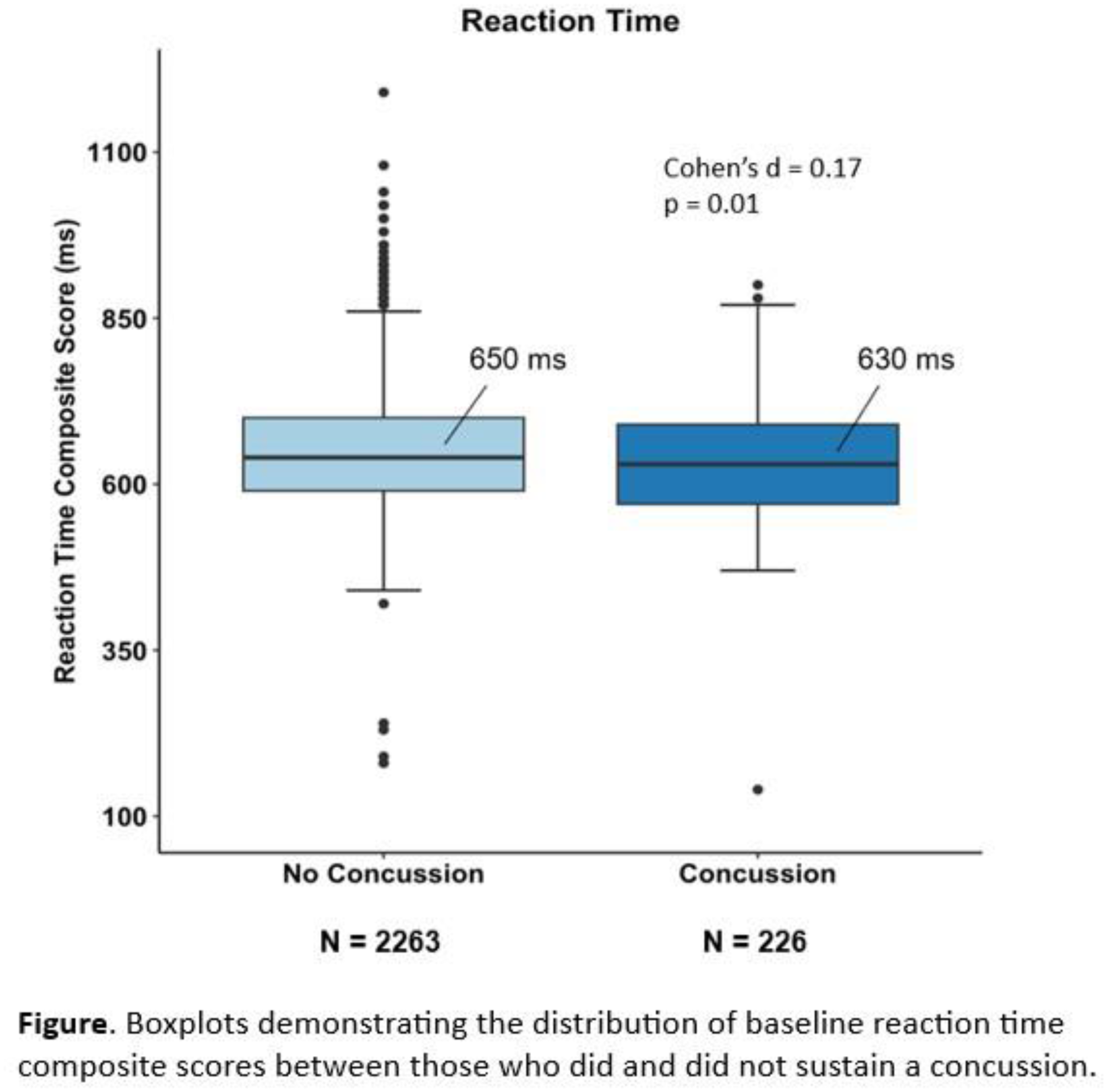
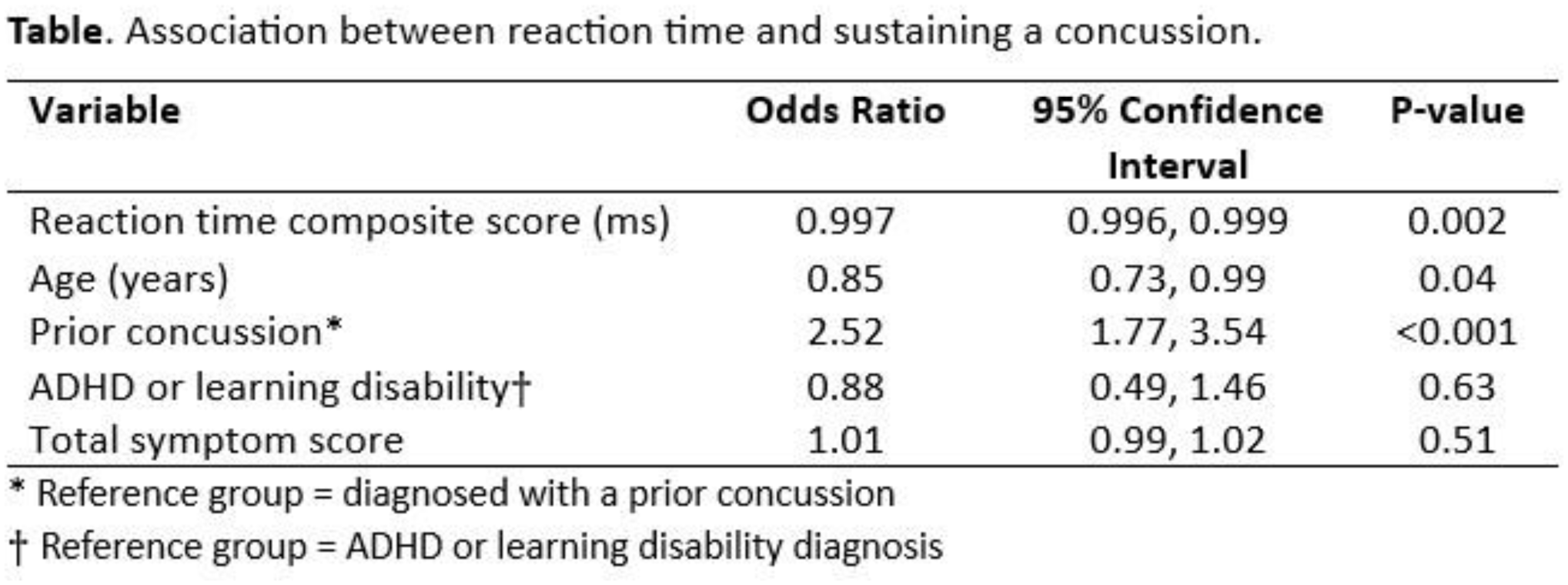
N=2489 female soccer players were included in our analysis (age=13.2±1.02; 2.9±3.1 years playing soccer; 12% reported a prior concussion). Following baseline testing, N=226 (9.1%) athletes sustained a subsequent SRC. Those who sustained a SRC had a faster reaction time composite score compared to those who did not sustain a SRC (p=0.01, Cohen’s d=0.17; Figure). Slower reaction time was associated with lower subsequent SRC odds after covariate adjustment (OR=0.997, 95% CI: 0.996-0.999; Table). Prior concussion was significantly associated with higher subsequent SRC odds (OR=2.52, 95% CI: 1.77-3.54).
Conclusion:
Contrary to our hypothesis, slower baseline reaction time was associated with lower odds of sustaining a subsequent SRC, with every 10-millisecond reaction time increase associated with a 3% decreased subsequent SRC odds. Our results indicate that sustaining a prior concussion was the strongest predictor of sustaining a subsequent SRC, consistent with prior work that has reported sustaining an injury is a risk factor for future injuries. Sport participation exposure time was not captured in the present study and may be a driving unmeasured factor, and thus future research is necessary to validate our findings.