Abstract
Background:
Pediatric orthopaedic sports medicine surgeons and physical therapists (PTs) are critical stakeholders in counseling athletes after undergoing anterior cruciate ligament reconstruction (ACLR).[1] These stakeholders provide support in shaping their patients’ perceptions and subsequent experiences, which link to their successful return-to-play and mitigation of re-injury risk.[2-3] Identifying key factors, challenges, and strategies in effectively capitalizing on this counseling role remains an important area for in-depth exploration.
Hypothesis:
Key themes and trends would emerge to characterize the practical experiences of orthopaedic surgeons and PTs regarding the process of counseling pediatric patients after ACLR.
Methods:
Orthopaedic surgeons and PTs who treat pediatric athletes with ACL injury participated in focus group sessions, either in-person or virtually via Microsoft Teams. Major topics of the semi-structured interview guide were: 1) Current counseling process regarding returning to sports; 2) Factors that differentiate positive and negative counseling outcomes and experiences; 3) Unique considerations of the clinician and their context related to the counseling process. Each session was recorded, transcribed verbatim, and analyzed through a phenomenological, inductive content analysis approach to identify emerging themes.[4,5]
Results:
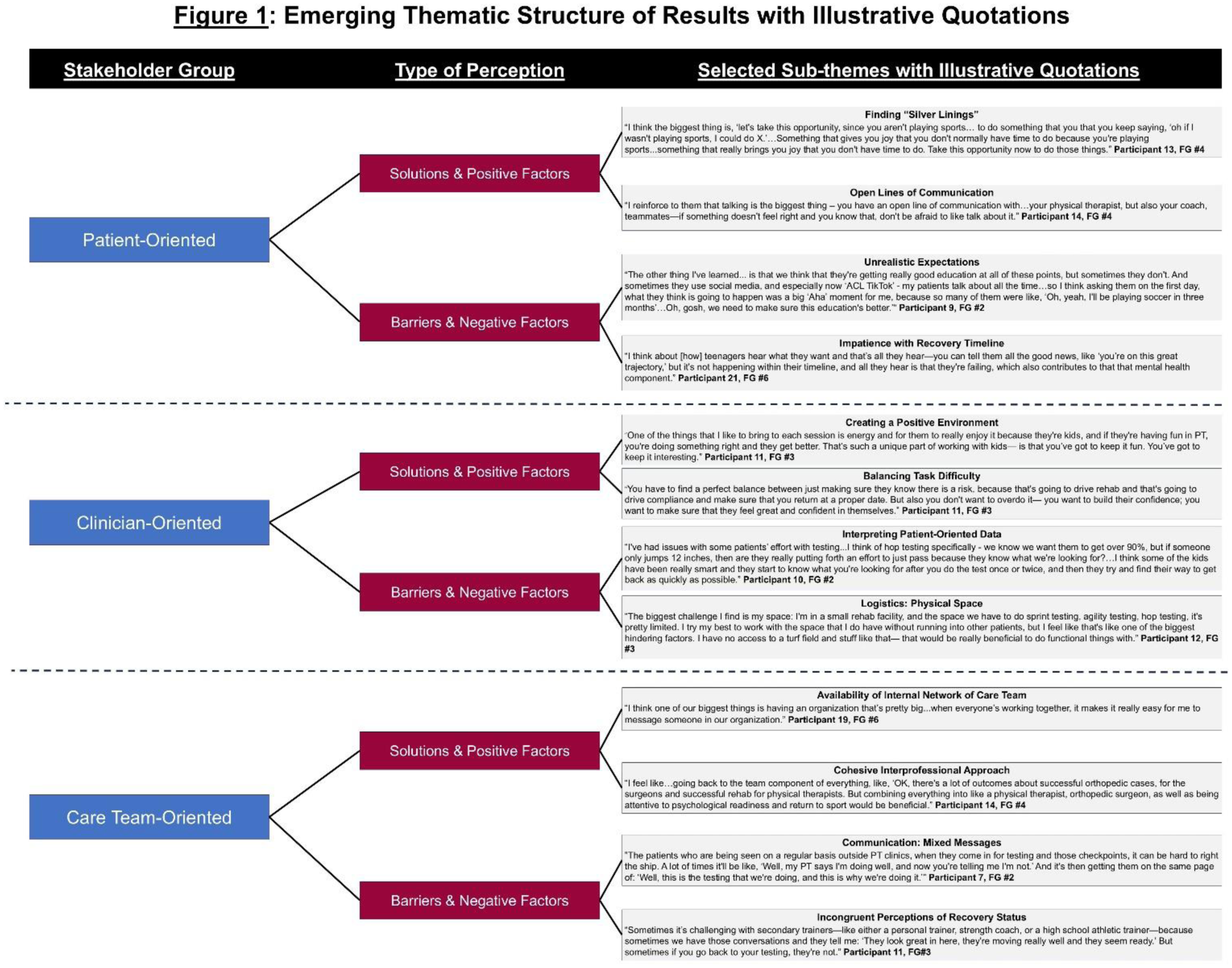
22 participants (9 females; average years of experience = 12.8 ± 9.7 years) took part in the study, comprising 6 focus group sessions (Interview duration: M = 49 minutes, 17.5 seconds ± 3 minutes, 31.5 seconds). The emerging thematic structure of our results, with selected sub-themes and illustrative quotations, is provided in Figure 1. These results were first classified by the stakeholder group that was emphasized in the participant’s response: (1) Their patient; 2) Themselves as a clinician; 3) Their collaboration with the patient’s combined care- team. Within each of these stakeholder groups, participants’ responses were further categorized into type of perception: A) Barriers/Negative Factors (e.g., Lack of psychosocial support for the patient; impatience with recovery timeline; receiving mixed messaging; physical space limitations), & B) Solutions/Positive Factors (e.g., Investment in 1-on-1 counseling; establishing consistent expectations; finding “silver linings” in the patient’s recovery experience; adopting a cohesive interprofessional approach). The breadth of key factors identified in the nested thematic structure of results, complemented by the in-depth illustrative quotations, summarize our participants perceived strengths, challenges, and points of tension in counseling athletes after ACLR.
Conclusion:
Clinicians identified several key patient, clinician, and care-team oriented factors that impact their counseling process after ACLR. By identifying both practical barriers and associated solutions, our results illustrate fruitful avenues for applying and refining best practices in promoting positive experiences for patients and clinicians.