Abstract
Background:
Youth sport specialization is thought to have numerous physical and psychosocial consequences; however, the supporting evidence is mixed. This may be due, in part, to a lack of validated tools available to accurately measure an athlete’s level of specialization. The Wisconsin Sport Specialization Questionnaire (WISSQ)1 is a new, validated tool to measure level of sport specialization in high-school aged athletes; however, a validated tool for younger athletes is not available. We aimed to expand the WISSQ by developing and validating a version (WISSQ-JR) suitable for youth athletes aged 10-13 years.
Hypothesis:
We hypothesized that many of the same items validated and included in the WISSQ would sufficiently inform a valid and reliable tool for younger athletes; however, the structure of the WISSQ-JR would differ from the available tool for older adolescents.
Methods:
A questionnaire containing sport specialization items that previously demonstrated acceptable content validity was administered to 10-13-year-old athletes participating in organized sport in the United States. An exploratory factor analysis (EFA) was used to identify an appropriate structure of the WISSQ-JR and a confirmatory factor analysis (CFA) using an oblique congeneric structure and diagonal weight least squares estimation assessed structural validity and internal consistency reliability. A two-faceted Rasch partial credit model assessed how well each item contributed to the construct of sport specialization. Goodness of fit statistics including the comparative fit index (CFI), Tucker-Lewis Index (TLI) and Root Mean Square Error of Approximation (RMSEA) are reported for structural validity, coefficient alpha for internal consistency reliability, and mean infit/outfit statistics for Rasch modelling.
Results:
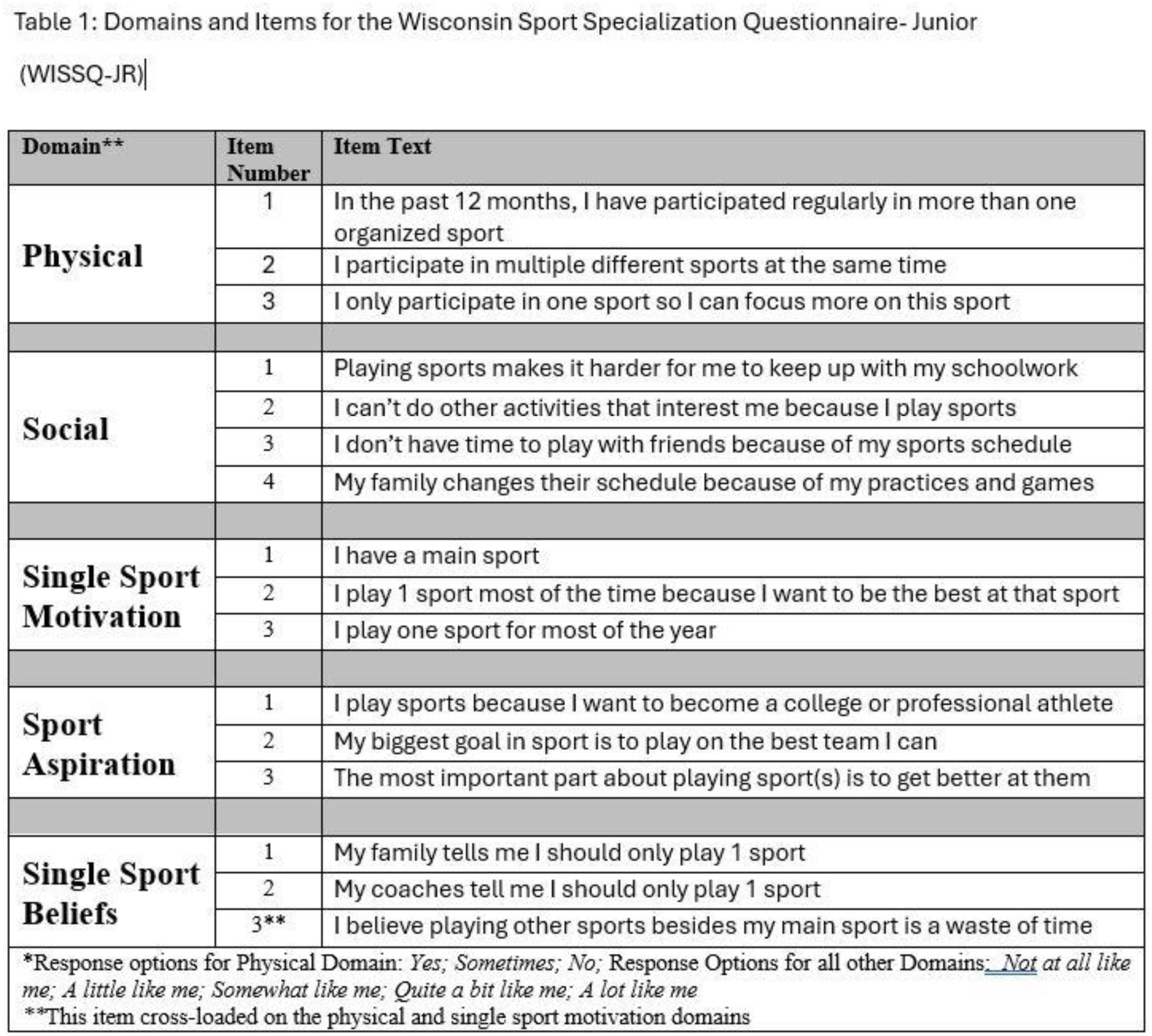
Four-hundred fifty-one athletes completed the questionnaire (38% female, 63% non-Hispanic White). In EFA, 17 of 23 potential items loaded strongly onto five factors. In CFA, 16 items were retained across five domains (Total Sport Load, Social, Single Sport Participation, Sport Aspiration, and Single Sport Motivation), with one item cross-loading on multiple domains (Table 1). CFA fit statistics (CFI= 0.97; TLI= 0.96; RMSEA= 0.06) suggest good model fit. Internal consistency reliability among the subdomains ranged from α=0.72-0.78. Rasch modelling suggested all items contributed appropriately to measuring the construct of sport specialization in the younger ages (infit/outfit: 0.69-1.25).
Conclusion:
The WISSQ-JR is a valid, reliable assessment of sport specialization in youth athletes aged 10-13. The WISSQ-JR has 5 domains compared to 3 in the WISSQ as internal and external beliefs about single sport participation appear to play a more prominent role in younger athletes’ decisions to specialize.