Abstract
Background:
Gymnasts, due to repetitive upper extremity weightbearing, are prone to developing capitellar osteochondritis dissecans (OCD) lesions. Surgical intervention is often necessary for these lesions, resulting in time away from sport, training delays, with a significant number of gymnasts unable to continue competitive sport. (1) Ultrasound has shown promise in detecting early, often asymptomatic, capitellar osteochondral lesions in baseball players. (2) However, this has not been employed in the young, healthy gymnast population.
Hypothesis:
Our hypothesis is that there would be a high prevalence of capitellar osteochondral changes in young, high-level gymnasts.
Methods:
This IRB-approved descriptive diagnostic epidemiology study recruited healthy gymnasts from local gymnastic clubs. Inclusion criteria involved gymnasts aged 10-19 years who primarily engaged in gymnastics, while those under treatment for upper extremity injuries in the prior six months were excluded. Athletes with previous elbow surgery were also excluded. Questionnaires captured sports history, surgery history, activity level according to The Hospital for Special Surgery Pediatric Functional Activity Brief Scale (Pedi-FABS), and dominant elbow function according to the Single Assessment Numeric Evaluation (SANE). Physical examination included assessment of bilateral elbow range of motion, valgus measurements, and pain with palpation over the medial elbow and radiocapitellar joint. Ultrasound evaluation of the elbows, including the medial epicondyle, ulnar collateral ligament, and radiocapitellar joint was conducted using a GE VenueGo portable ultrasound machine with a 4-20MHz Linear transducer. Comparisons were made between those with and without capitellar osteochondral changes.
Results:
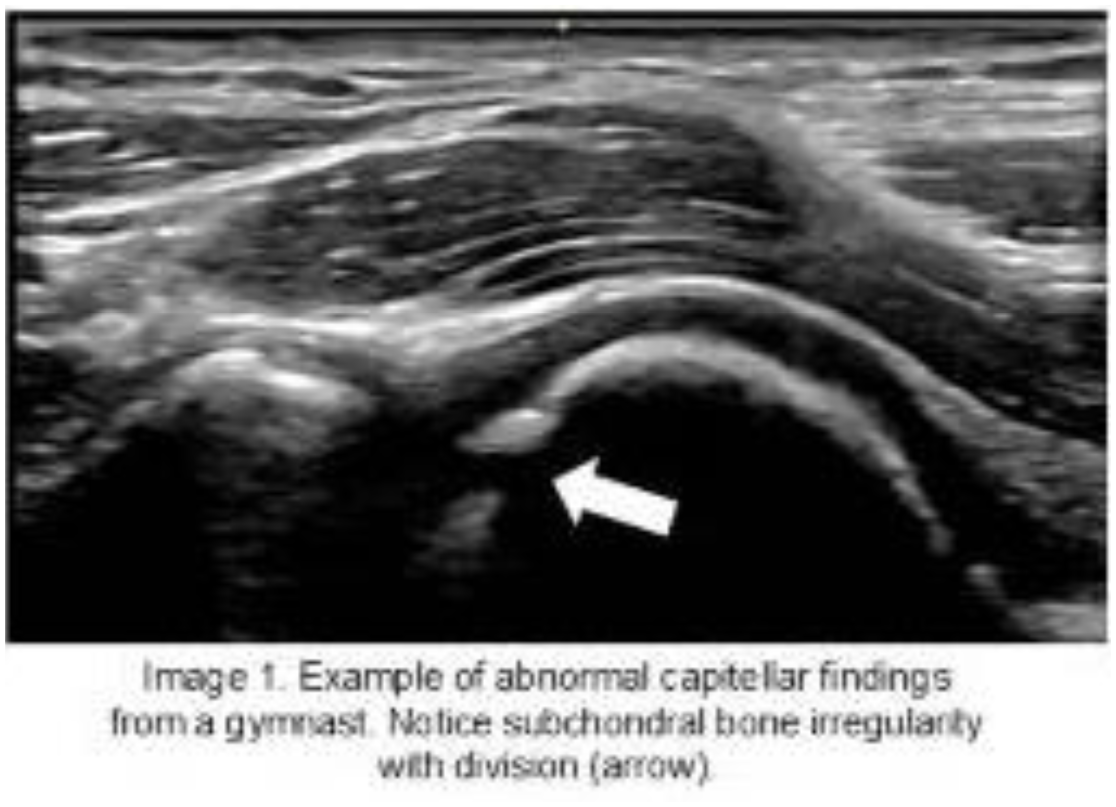
Sixty-two elbows were evaluated in 31 gymnasts (13.7±2.9 years; 80.6% female). They trained at levels 6-10+ (mean= 8.57) with 8.9±3.7 years of gymnastics participation. 15 (24.2%) elbows (9 gymnasts) had radiocapitellar joint changes. 66.7% of gymnast with radiocapitellar joint changes had bilateral changes. Visualized capitellar changes included 7 concave abnormality of the subchondral plate (11.3%), 6 with subchondral flattening (9.7%), and 2 with division of the subchondral plate (3.2%). Two elbows (3.2%) demonstrated healed medial epicondyle avulsions and 1 demonstrate a sublime tubercle avulsion (1.6%). Capitellar changes were not associated with Pedi-FABS scores, SANE elbow function scores, training volume, elbow ROM, or valgus differences.
Conclusion:
One-fourth of high-level youth gymnasts' elbows demonstrated capitellar osteochondral changes, irrespective of reported pain or activity levels. Two-thirds of gymnasts with capitellar changes had bilateral findings. Further studies are needed, but screening gymnasts' elbows with ultrasound may facilitate earlier and more successful treatment for the challenging diagnosis of capitellar OCDs.