Abstract
Background:
Following concussion, a series of neurometabolic changes occur that may disrupt sleep and delay recovery. Sleep health is a multidimensional concept characterized by duration, quality, and timing. Current concussion literature disproportionately focusses on sleep duration and quality rather than timing. While sleep duration and quality are associated with recovery, emerging research suggests that consistent sleep timing (i.e., bed/wake times) may be an important recovery modifier. Irregular sleep timing can lead to circadian misalignment, reduced sleep quality, and impaired physiological healing of the injury, despite sufficient sleep duration. A gap remains in understanding the association between sleep duration variability and timing variability on concussion recovery.
Hypothesis:
To examine if intraindividual variability (IIV) in sleep duration and bed/wake times during while symptomatic after concussion were associated with odds of developing persisting symptoms (PSaC: >28 days) following adolescent concussion.
Methods:
We assessed adolescents within 16 days of a diagnosed concussion. Sleep duration and bed/wake times were measured nightly using Fitbit devices while symptomatic. IIV was operationalized as the standard deviation/mean*100 of each participant’s nightly sleep duration and bed/wake times. Higher values indicated greater night-to-night sleep duration or timing variability. Separate logistic regression models determined whether IIV in sleep duration or bed/wake time were associated with the odds of developing PSaC, while controlling for initial symptom severity, concussion history, and biological sex. To facilitate interpretation of model coefficients, IIV variables were scaled such that odds ratios reflect the change in odds of PSaC per 10% increase in variability.
Results:
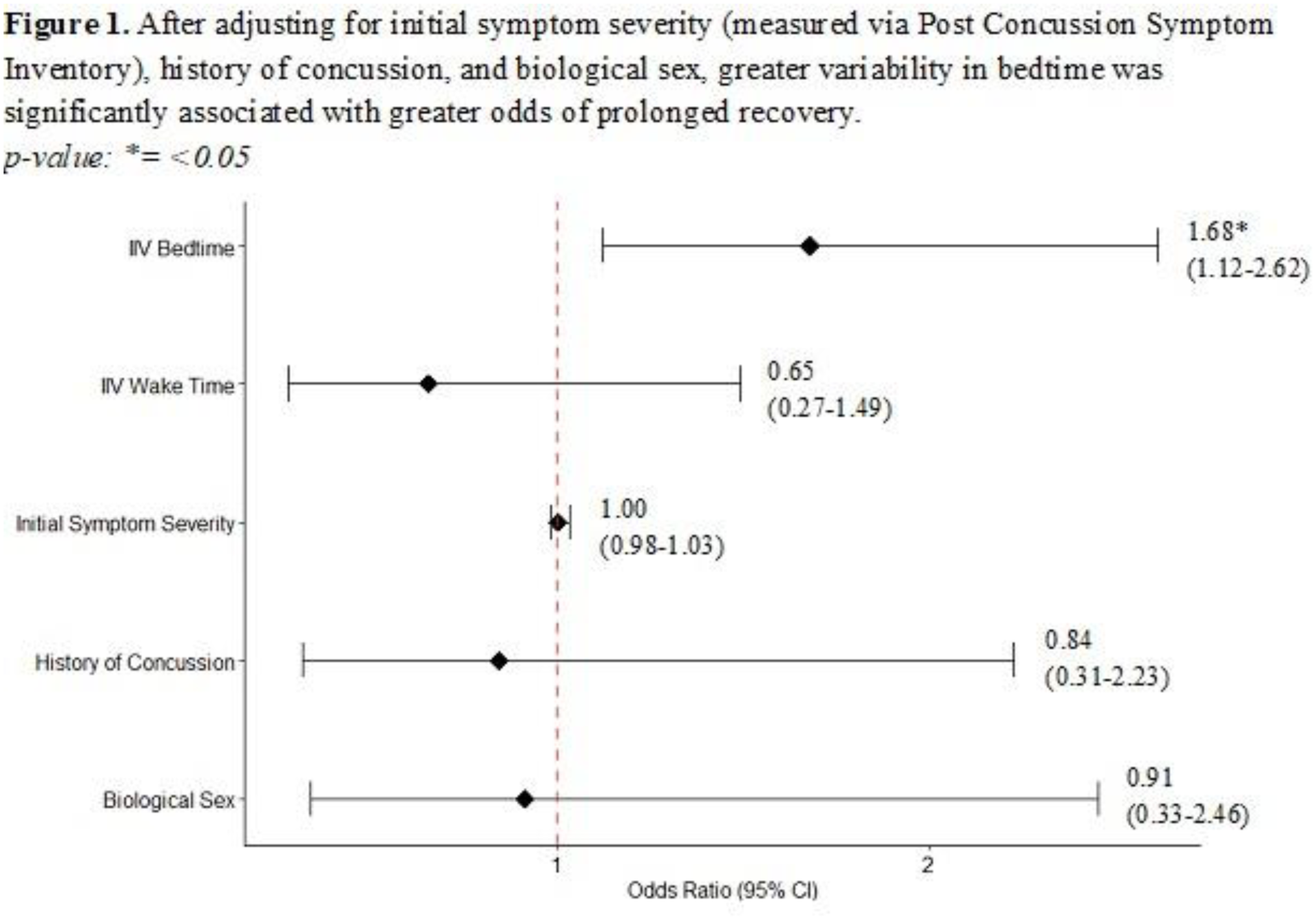
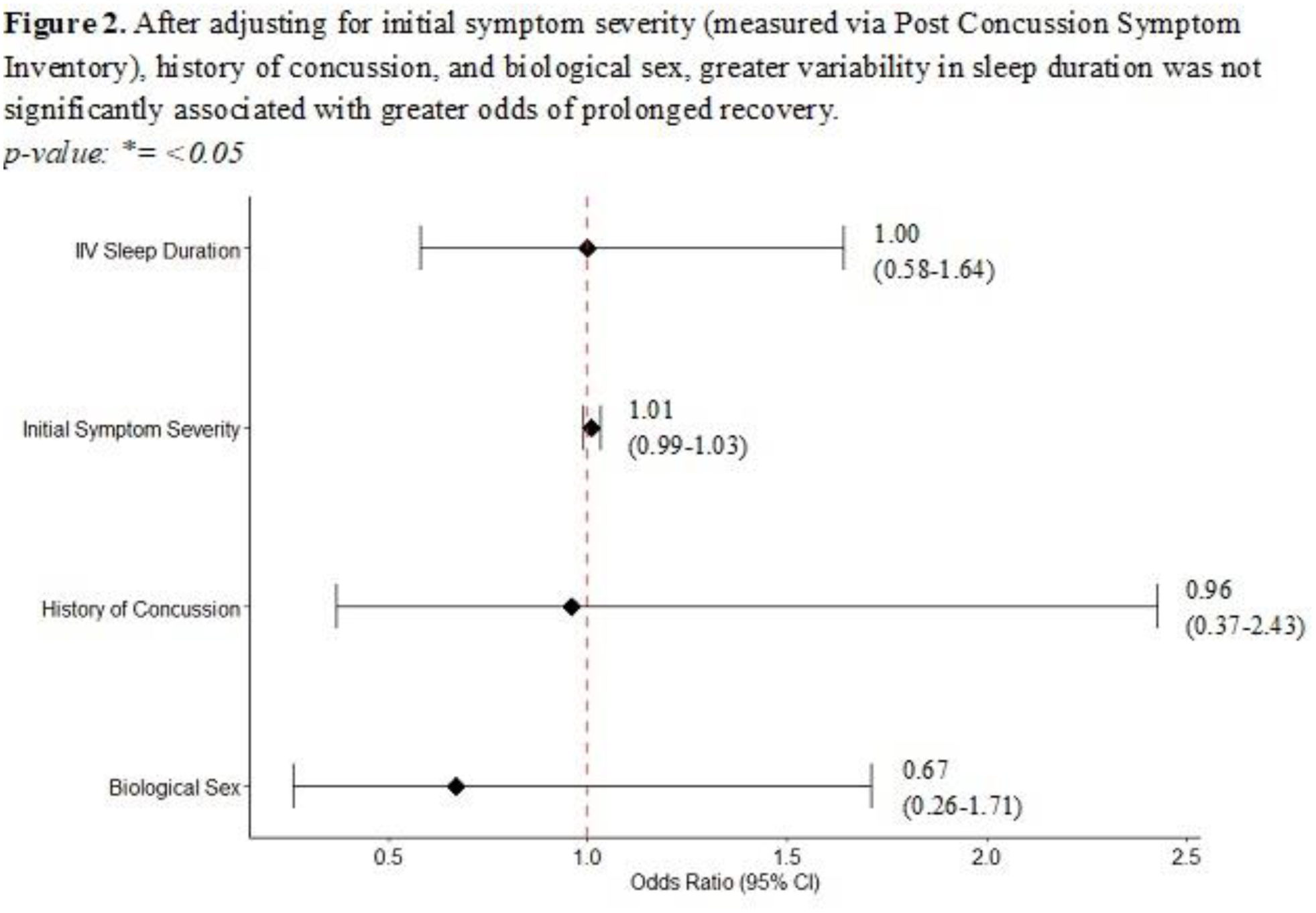
We enrolled 89 adolescents (52% female, 15.4±1.6 years), initially evaluated at a mean of 10.8±3.1 days of concussion. The mean bedtime IIV was 29.9±14.4%, waketime IIV was 10.9±6.2%, and duration IIV was 15.5±9.6%. Greater bedtime IIV, but not waketime IIV (Figure 1) was associated with greater odds of PSaC. Each 10% increase in IIV corresponded to a 68% increase in the odds of PSaC (OR=1.68 per 10% IIV increase [95% CI: 1.12–2.62], p=0.01). Sleep duration IIV was not associated with odds of PSaC (OR=1.00 per 10% increase in IIV [95%CI: 0.58-1.64], p=0.99; Figure 2).
Conclusion:
Greater bedtime variability after adolescent concussion, but not waketime or sleep duration variability, was associated with increased odds of developing PSaC. These results highlight the potential importance of maintaining consistent sleep timing during recovery and indicate that sleep timing interventions may represent a modifiable behavioral factor to support concussion recovery.