Abstract
Background:
Approximately 60 million children ages 5-18 live in the US and Canada, and most participate in active free play outside of organized sports. The Zurich 2008 consensus statement established the first guidelines for sports return after concussion, but there are no guidelines for return to free play activities.
Hypothesis:
Through a modified Delphi process, pediatric concussion specialists will reach consensus on physical activities deemed safe for children and adolescents to participate in during various stages of concussion recovery.
Methods:
Investigators split the Amsterdam 2022 Consensus Statement return-to-play schedule into “green,” “yellow,” and “red” categories. A green activity is one where “a child may begin this activity within 24 hours of injury, even while mildly symptomatic.” In a yellow activity “a child may proceed with caution once asymptomatic for at least 24 hours. Stop if any symptoms return”. With a red activity, “a child may not do this activity until concussion resolves”.
Study participants completed three rounds of a survey to determine their clearance recommendations. The first round requested participants to advise when a patient needs formal medical clearance (“green,” “yellow,” or “red”). The survey subsequently asked participants to categorize 100 different free play activities. Items which reached ≥80% agreement were removed from subsequent rounds.
Results:
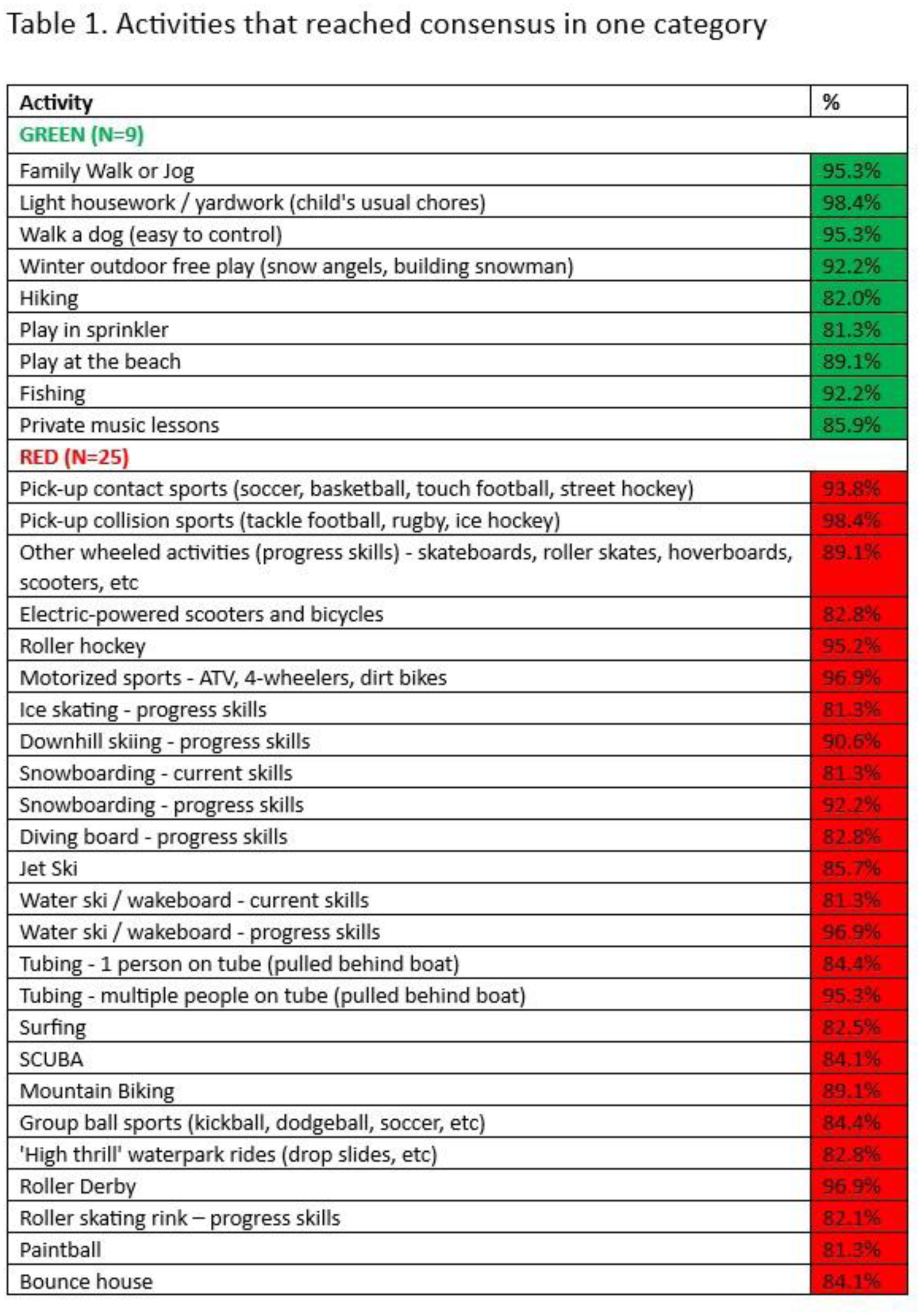
Initially, 64 clinicians completed the survey across the US and Canada. Clinicians reported an average of 13 years providing concussion care, mostly serving at an academic institution (63%) or hospital setting (48%), with concussions making up 19% of their visits. Clinicians came to consensus that physician consult was “not needed” for green activities, “recommended” for yellow activities, and “required” for red activities. After 3 rounds of surveys, 39 clinicians reached consensus on 34 items (9 Green, 25 Red) and hybrid consensus on the remaining 66 items. (Tables 1 and 2).
Conclusion:
This study provides a framework for which clinicians may use as guidance when returning concussed children to free play activities. There are multiple activities which pediatric concussion specialists agree are safe and beneficial while symptomatic, and others which they agree a concussed patient should not attempt until resolution. Those with hybrid consensus either skewed towards green/yellow (safe to do before clearance, disagreement about participation while symptomatic), or towards yellow/red (must be asymptomatic, disagreement about requiring full resolution). Decisions regarding participating in hybrid consensus activities require consideration of individual variables such as personal temperament, symptom profile, baseline skill level, environmental conditions, and the number of other participants.