Abstract
Background:
Sex-based differences among adolescents following anterior cruciate ligament reconstruction (ACLR) are widely published, however there is a lack of knowledge about the influence of physical therapist (PT) gender on clinical decision-making during ACLR rehabilitation. Therefore, this study investigates the influence of gender-based differences on exercise prescription practices, including progression decisions and intensity ratings, among PTs who treat adolescent ACLR patients.
Hypothesis:
Differences in exercise prescription practices exist based on therapist gender among PTs who treat adolescent ACLR patients.
Methods:
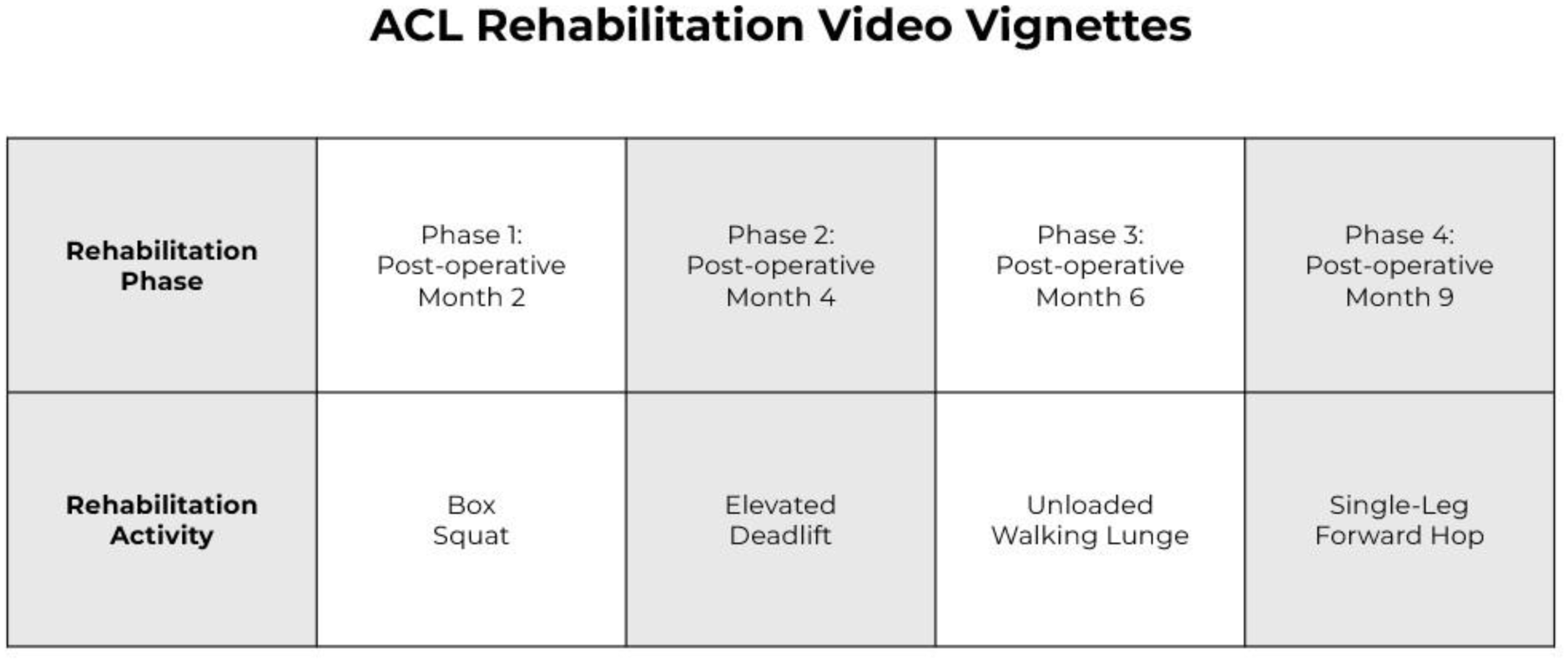
A total of 115 PTs (54.8% women) completed an electronic survey featuring patient vignettes of a boy and girl each demonstrating ideal and poor movement patterns during the performance of four common rehabilitation activities (box squat, elevated deadlift, unloaded walking lunge, and single-leg forward hop) across four distinct rehabilitation phases (post-operative months 2, 4, 6, and 9). For each vignette, PTs rated exercise appropriateness and intensity. Responses were compared by PT gender using non-parametric statistics, with significance set at p<0.05.
Results:
All PTs rated the regression to an easier task as ‘appropriate’ when the boy performed a box squat with ideal technique, but women PTs were significantly closer towards a ‘neutral’ response (p=0.040). Alternatively, women rated the progression to a more challenging task as less appropriate compared to men when the boy performed a box squat with poor technique (p=0.022). Similarly, women rated maintaining the exercise (p=0.039) and progression to a more challenging exercise (p=0.045) as less appropriate than men when the boy performed an elevated deadlift with poor technique. Notably, men PTs provided ratings of ‘appropriate’ to ‘very appropriate’, even though the patient performed the task with poor form. When both the girl and boy performed an unloaded walking lunge with ideal technique, the women rated the regression to an easier task as ‘inappropriate’ while men averaged a ‘neutral’ response (girl: p=0.013; boy: p=0.034). When the girl and boy performed an unloaded lunge with poor technique, both men and women rated the regression to an easier task as ‘appropriate’ with women significantly closer towards a ‘neutral’ response (girl: p=0.043; boy: p=0.046).
Conclusion:
PT gender influenced clinical decisions during ACLR rehabilitation for adolescents as women generally demonstrated more conservative progression strategies, particularly in response to poor movement quality, while men favored more aggressive approaches. These findings suggest that PT gender may contribute to variability in ACLR rehabilitation for adolescents and highlight the need to promote the delivery of equitable, evidence-based care.