Abstract
Background:
Anterior cruciate ligament (ACL) tears are one of the leading injuries for soccer players, especially for female athletes [1]. Prior research has investigated risk factors associated with the swing limb during a soccer kick [2]. However, limited research has focused on biomechanical risk factors of stance limb that may contribute to elevated injury risk when kicking.
Hypothesis:
To quantify the relationship between coronal strike stance angle (SSA) and lower extremity kinematics and kinetics during a soccer kick. It was hypothesized that a greater SSA would be correlated to greater biomechanical risk factors and that correlated findings would differ by dominance.
Methods:
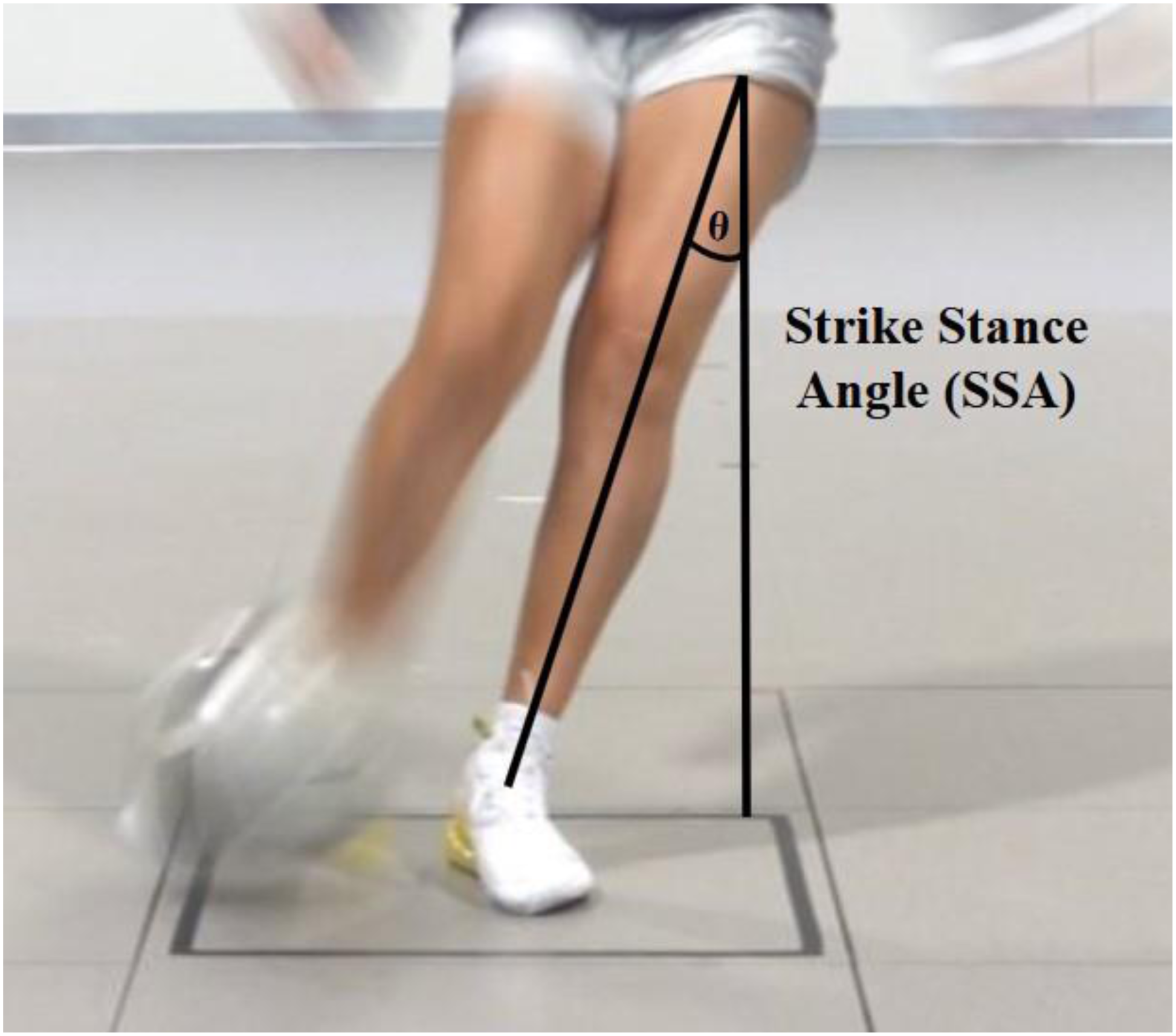
Nineteen healthy female soccer players (15.2±0.9 years) were tested performing a soccer kick on each limb in a motion capture laboratory. Participants completed four trials of soccer kicks, two kicks per leg. The athlete’s typical kicking leg was recorded as their dominant limb and used for comparison to the non-dominant limb. When referring to findings for the dominant kick, kinematics and kinetics were presented for the non-dominant stance limb. Kinematic and kinetic data of the stance limb at ball contact were collected using a 14-camera motion capture system and six embedded force plates, respectively. Segment and joint angles for the pelvis, hip, knee, and ankle were subsequently calculated. SSA was calculated from the coronal angle created by the hip joint center to the ankle joint center of the stance limb from vertical (FIGURE 1). Spearman correlations were performed to identify significant associations between SSA and kinematic and kinetic measures for both non-dominant and dominant kicks at ball contact.
Results:
On average, the stance limb during the dominant kick facilitated greater trunk flexion (p=0.043), pelvic drop (p=0.035), and external hip rotation (p=0.048) than during the non-dominant kick. During the dominant kick, greater hip adduction (r=0.51, p=0.033), knee flexion (r=0.50, p=0.034), and ankle dorsiflexion (r=0.72, p=0.001) were associated with greater SSA. For the non-dominant kick, increased knee flexion (r=0.48, p=0.046), knee valgus moment (r=-0.81, p<0.001), and external knee rotation moment (r=-0.66, p=0.004) were also associated with greater SSA.
Conclusion:
Altered hip mechanics and knee loading risk factors were associated with greater SSA, and associations differed by limb dominance. Improper loading mechanics may outline potential risk factors of injury during kicking. Additional research is needed to better define the relationship between SSA and lower extremity injury risk of healthy youth soccer players and to explore the potential impact on injury prevention.