Abstract
Background:
Opioid use following surgery has been a growing concern, particularly in light of the opioid epidemic, prompting significant changes in prescribing practices. Although opioids have traditionally been a cornerstone of postoperative pain management, changing guidelines and a recent focus on opioid stewardship have likely influenced prescription patterns. However, national trends of postoperative opioid prescriptions for several orthopaedic procedures, including medial patellofemoral ligament reconstruction (MPFLR), have yet to be reported. Therefore, the purpose of this study was to analyze 90-day postoperative opioid prescription trends and morphine milligram equivalents (MMEs) in pediatric patients undergoing MPFLR.
Hypothesis:
Postoperative opioid prescription rates and total MMEs for pediatric patients undergoing MPFLR have significantly decreased over the past decade.
Methods:
The PearlDiver database was queried for pediatric (≤18 years) patients who were diagnosed with patellofemoral instability and underwent MPFLR between 2010 and 2022. Patients were identified using International Classification of Diseases and Current Procedural Terminology codes. All patients were required to be continuously enrolled in the database for at least 90 days after their index surgery and have complete demographic data. The primary outcomes of interest were 90-day postoperative opioid prescription rates and MMEs prescribed (measured on a per patient and per patient per day basis). Prescription trends over the 13-year study period were analyzed via linear regression, with statistical significance set at p < 0.05.
Results:
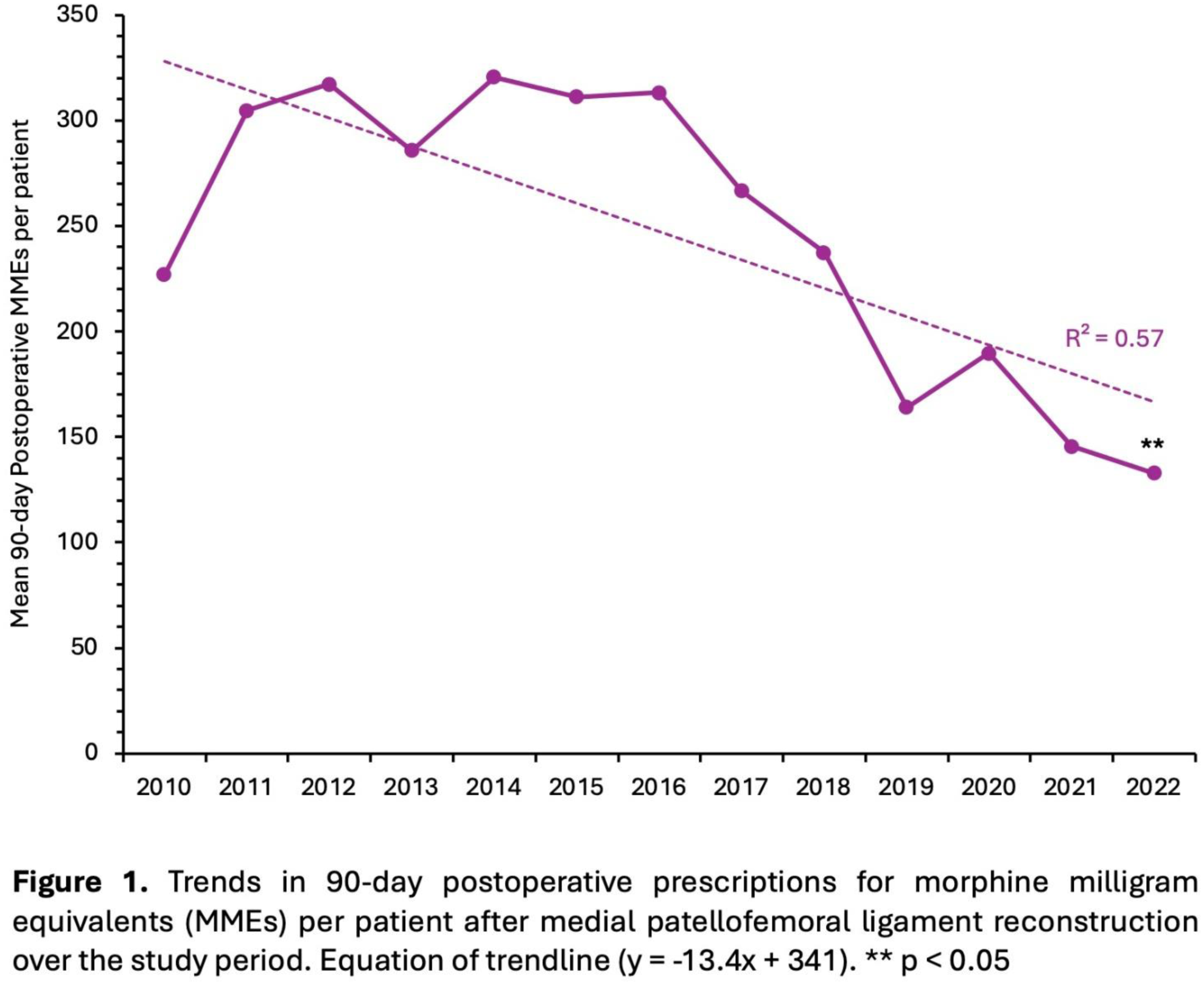
A total of 133,505 pediatric patients with PFI met the inclusion criteria. From this cohort, 2,037 (1.5%) patients underwent MPFLR and had 90-day postoperative follow-up. The average age of the cohort was 15.7 ± 1.8 years and a majority of patients were female (62.9%). Over the 13-year study period, opioid prescription rates after MPFLR demonstrated a significant decline (26.9% to 18.5%, R2 = 0.46, p = 0.010). From 2010 to 2022, there was a 41.4% decrease in mean MME prescribed per patient (226.84 MMEs to 132.89 MMEs, R2 = 0.57, p = 0.003) and a 29.0% decrease in mean MME prescribed per patient per day (48.78 MMEs to 34.64 MMEs, R2 = 0.71, p < 0.001).
Conclusion:
Opioid prescription rates and MMEs significantly decreased for pediatric patients undergoing MPFLR over the 13-year study period. These results suggest that pediatric opioid prescribing practices after MPFLR have become more conservative, reflecting ongoing efforts to reduce opioid use in surgical care while maintaining effective pain management.