Abstract
Background:
While the medial patellofemoral ligament (MPFL) and medial quadriceps tendon–femoral ligament (MQTFL) are considered the primary restraints against lateral patellar translation, studies suggest that combined reconstruction of the MPFL and MQTFL may yield improved clinical outcomes compared to MPFL reconstruction alone. Although MPFL failure loads have been quantified in adults, the biomechanical properties of the MPFL/MQTFL complex have not been studied in skeletally immature patients. This study aims to characterize the biomechanical role and native strength of the MPFL/MQTFL complex to guide appropriate graft selection in pediatric reconstruction.
Hypothesis:
We hypothesize that biomechanical testing of MPFL/MQTFL will demonstrate consistent mechanical properties across pediatric specimens and will be similar to adult MPFL/MQTFL values.
Methods:
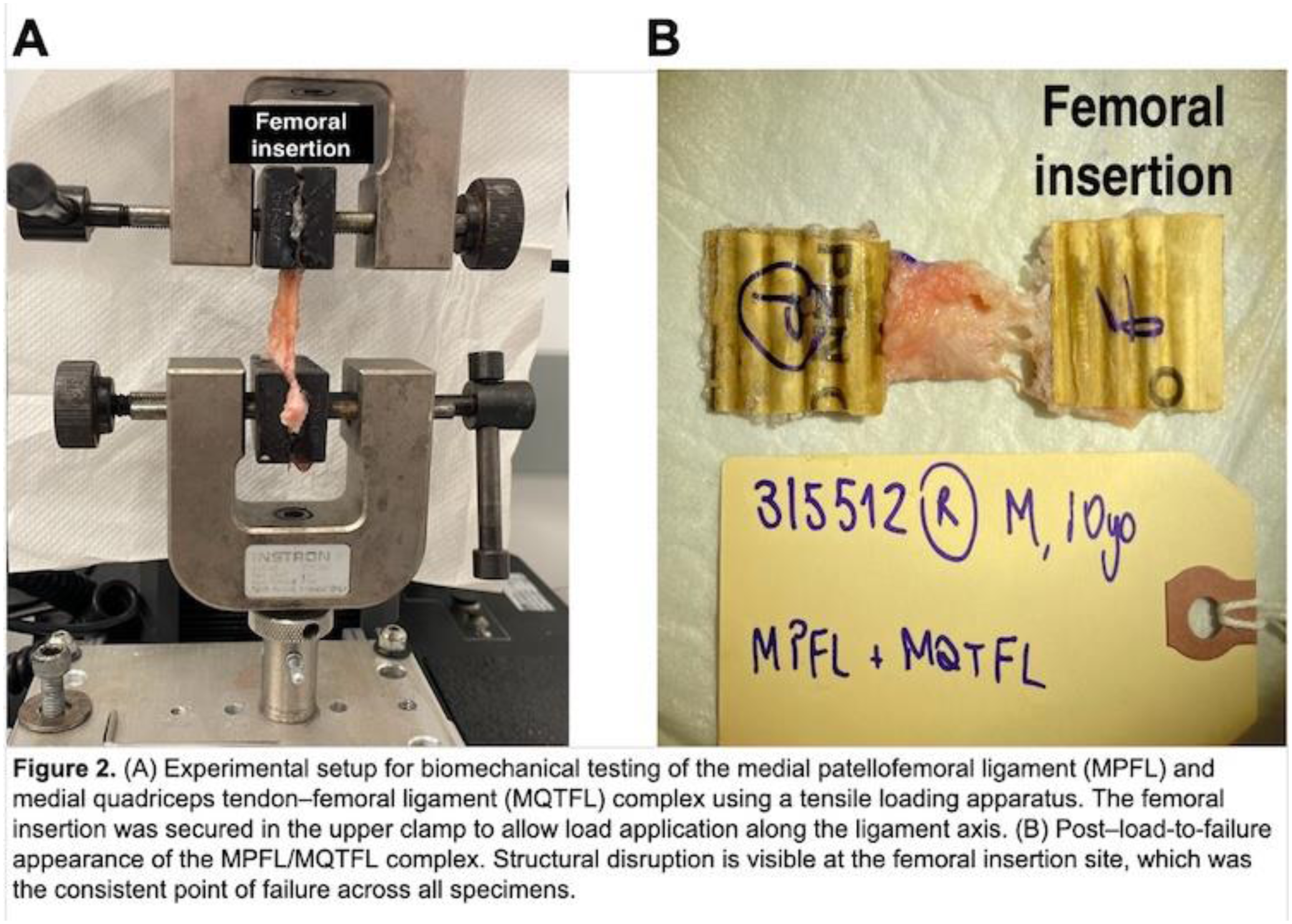
Seven fresh-frozen pediatric cadaveric knees (aged 8–16 years old) underwent stepwise dissection. The MPFL/MQTFL complex was isolated and clamped on an Instron tensile loading apparatus (Figure 2A). Specimens were then tested through preconditioning (20 cycles, 1–10 N), cyclic loading (500 cycles, 10–30 N), and pull-to-failure (all at 100 mm/min). Displacement, stiffness, and maximum load were recorded. Data was summarized using descriptive statistics. Adult values for MPFL/MQTFL strength were obtained from the literature for comparison.
Results:
The MPFL/MQTFL complex had an average failure load of 166.9 ± 52.9 N. Cyclic elongation at 30 N was 0.9 ± 0.6 mm, and stiffness was 30.9 ± 10.1 N/mm (Figure 1). Failures always occurred close to the femoral attachment, and mode of failure involved true ligamentous tear (Figure 2B). The failure load in skeletally immature specimens was comparable to reported adult MPFL/MQTFL values (158.3 ± 76.3 N).
Conclusion:
The MPFL/MQTFL complex demonstrated high tensile strength in skeletally immature knees, and failure always occurred in the femoral side. Additionally, the observed failure loads approximated adult MPFL benchmarks, suggesting substantial native strength in skeletally immature tissue. These data provide important guidance determining minimum graft strength thresholds in MPFL/MQTFL reconstructions, in skeletally immature patients.