Abstract
Background:
Among youth after ACL reconstruction (ACLR), the association between patient reported outcomes (PRO) at the time of return to sport (RTS) and actual physical activity after RTS has yet to be reported.
Hypothesis:
Patient reported function at RTS is correlated with average weekly athletic exposures (AE’s) in the 12 months following medical release to RTS after ACLR. In addition, this association will be significantly different in patients <18 years old (y/o) when compared to patients >18 y/o.
Methods:
Sixty-three patients (age 17.2±2.8 yrs; range 13-26 yrs, 44 females) who participated in a larger prospective cohort study were included in this analysis. Patients who underwent ACLR and planned to return to pivoting and cutting sports were recruited. Initial assessment within 8 weeks of release to RTS included the Tegner Activity Scale (0-10), the Marx Activity Rating Scale (0-16), the Knee Injury and Osteoarthritis Outcome Score (KOOS) Sport and Quality of Life (QoL) subscales (0-100), and the ACL Return to Sport after Injury questionnaire (ACL-RSI) (0-100). In addition, each participant reported athletic exposures (AE’s) in games and practices monthly until 12 months post-RTS. Average AE’s/week was calculated for each participant. Pearson correlation coefficients evaluated the association between AE’s/week in the 12 months post-RTS and each of the RTS PROs. One-way ANOVA was used to determine differences between patients younger and older than 18 y/o.
Results:
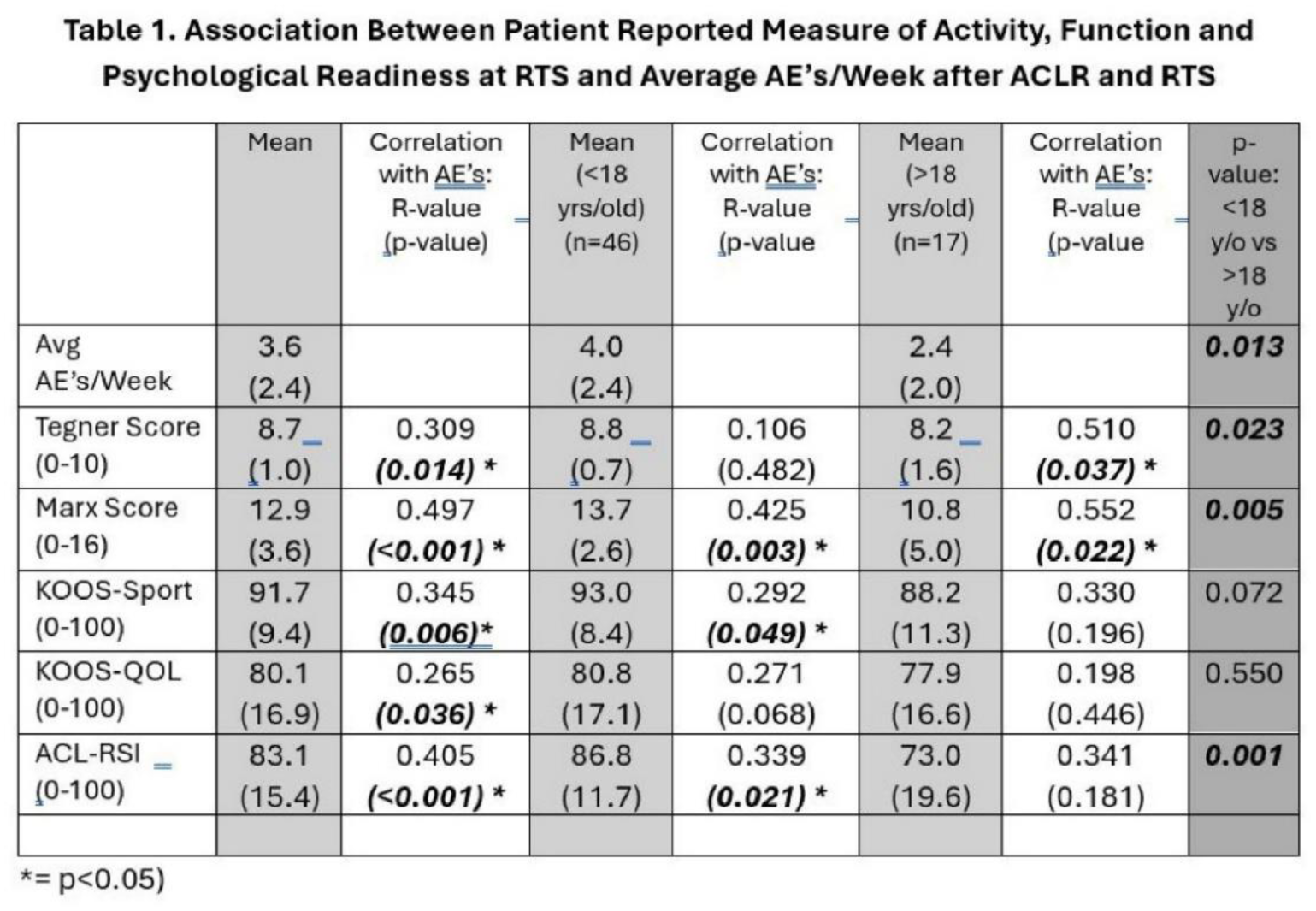
A significant association was seen between AE’s/week and other measures of activity, specifically Tegner score (r:0.309; p=0.01) and Marx Activity score (r:0.497; p<0.001). Average AE’s/week was also associated with KOOS-Sport (r:0.345; p=0.006) and KOOS-QoL subscales (r:0.265; p<0.001), and ACL-RSI score (r:0.405; p<0.001). When sub-grouped by age, patients <18 y/o reported higher AE’s/week (p=0.013), Tegner score (p=0.02), Marx activity score (p=0.005) and ACL-RSI score (p=0.001). Table 1 displays associations found between PRO scores at time of RTS and AE’s/week in the 12 months following RTS, analyzed by age group.
Conclusion:
PRO measures of activity, function and psychological readiness are strongly associated with actual participation in AE’s/ week in the 12 months following RTS after ACLR. Age-specific differences were seen as patients <18 y/o reported higher activity participation and higher levels of psychological readiness than patients >18 y/o. Future work is warranted to analyze the ability of PRO measures to predict future participation in high-risk activity.