Abstract
Background:
Medial elbow pain is a common complaint in youth baseball players. In the setting of normal radiographs, skeletally immature athletes are often diagnosed with medial epicondyle apophysitis (Little Leaguer’s Elbow). However, recent studies suggest that sub-apophyseal avulsions of the ulnar collateral ligament (UCL) may be frequently present in this population(1). Ultrasound, which has higher resolution than MRI for small superficial structures,(2) can visualize sub-apophyseal avulsions. The purpose of this study was to assess the diagnostic accuracy of radiographs compared to ultrasound for medial epicondyle sub-apophyseal avulsions in skeletally immature baseball players with medial elbow pain.
Hypothesis:
Radiographs of medial epicondyle sub-apophyseal avulsions will have a low level of agreement with ultrasound.
Methods:
A diagnostic accuracy comparison study was performed on skeletally immature baseball players presenting with medial epicondyle elbow pain from December 1, 2020, to April 23, 2025, who received both radiographs (minimum AP/Lateral views) and medial elbow ultrasound. Radiographs were interpreted by pediatric and/or musculoskeletal radiologists. Ultrasounds were interpreted by a single physician fellowship trained in musculoskeletal ultrasound. Interpreters were blinded to one another’s results. Demographics, sport information, and injury-related characteristics were collected and analyzed against the presence of avulsion on ultrasound using Chi-Square test. Agreement between ultrasound and radiographs was found using Cohen’s Kappa. Radiographic sensitivity, specificity, positive predictive value (PPV), and negative predictive value (NPV) for sub-apophyseal avulsions were calculated.
Results:
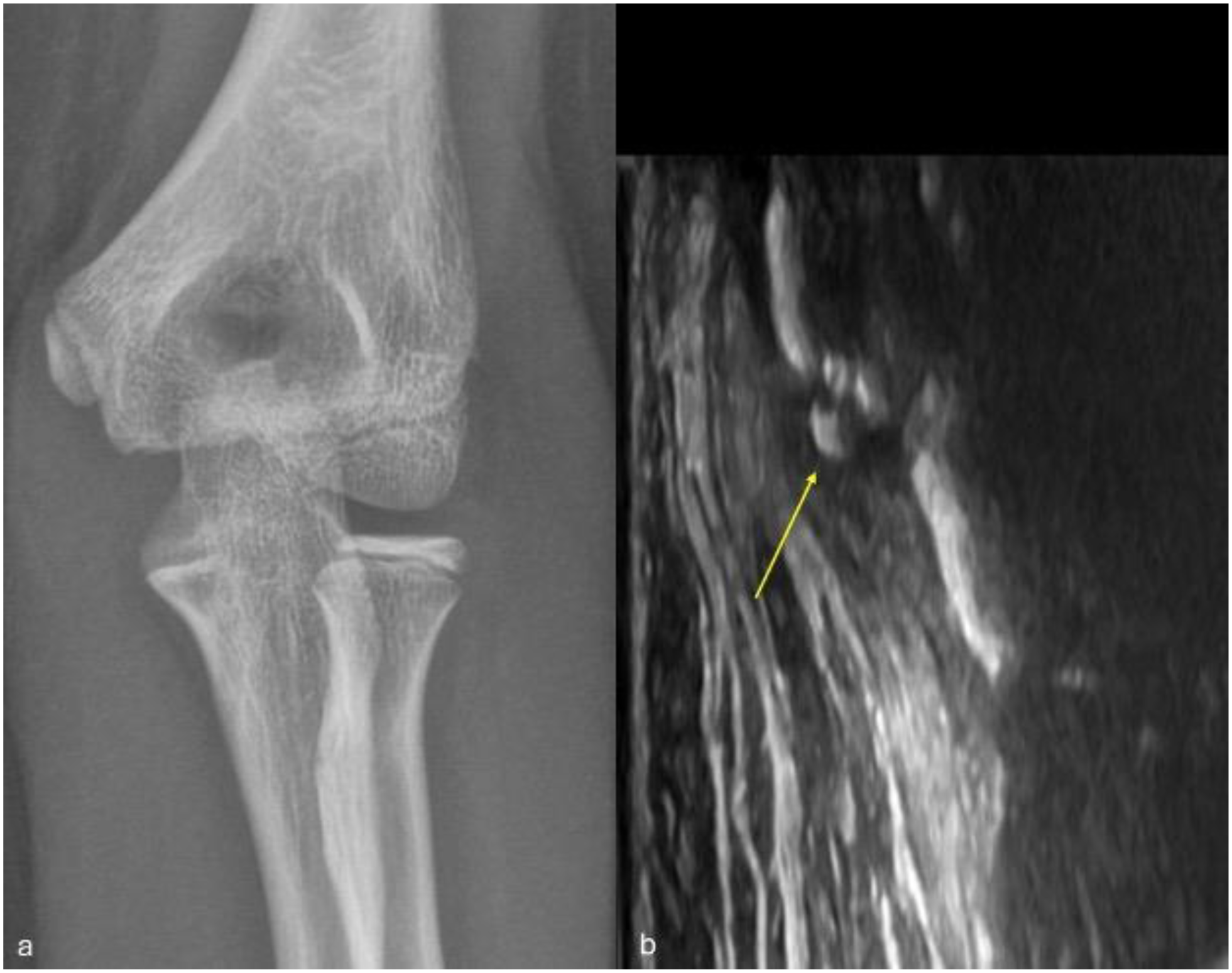
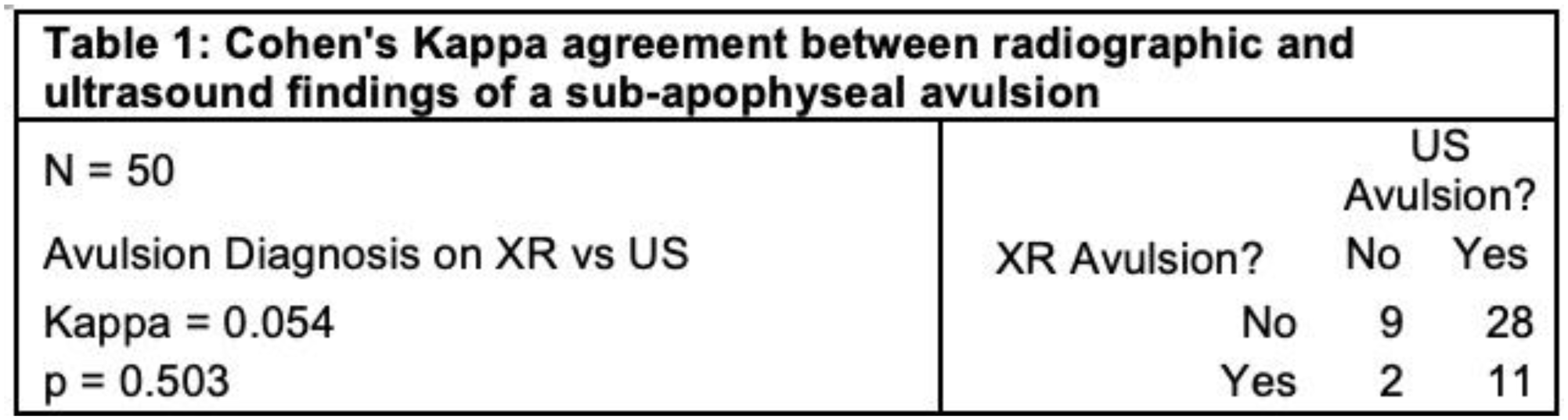
50 male patients (ages 8-16 years) were included in the analysis. Patients presented at a mean age of 12.55 ± 1.57 with 78% Non-Hispanic/Latino, and 92% white. 39 (78%) patients had a sub-apophyseal osseocartilaginous, cartilaginous, or periosteal avulsion of UCL origin present on ultrasound, with 28 (71.8%) being radiographically normal. (Figure 1) No significant UCL tears were seen on ultrasound imaging. There was poor agreement between radiographs and ultrasound avulsion detection (k= 0.054; p = 0.503) (Table 1). The sensitivity of radiographic avulsion diagnosis was 28.2%, and the specificity was 81.8%, PPV was 84.6%, and NPV was 24.3%.
Conclusion:
Radiographs demonstrate poor sensitivity, negative predictive value, and low agreement with ultrasound for the diagnosis of medial epicondyle sub-apophyseal avulsions of the UCL in skeletally immature baseball players. Providers should take this information into consideration when evaluating medial epicondyle elbow pain in skeletally immature patients. This information raises the question of whether Little League elbow is as common as previously reported, suggesting that many of these cases are actually radiographically silent sub-apophyseal avulsions.