Abstract
Background:
Single-leg hop testing (SLHT) is the most widely used functional performance measure during return-to-sport (RTS) testing after anterior cruciate ligament reconstruction (ACLR). The utility of SLHT has been questioned because it lacks evaluation of movement quality, which is strongly associated with reinjury risk. Current movement quality assessments lack sufficient reliability and validity without 3D motion capture technology, necessitating the need for alternative measures. Effective postural control enables athletes to absorb and redirect forces during cutting maneuvers, thereby minimizing stress on the ACL. A simple measure of postural control during SLHT may serve as a valuable clinical tool, removing subjectivity inherent in traditional clinical measures of movement quality, while providing better insight into neuromuscular control.
Hypothesis:
Subjects will have better balance control on their uninvolved limb at 6-months post-ACLR.
Methods:
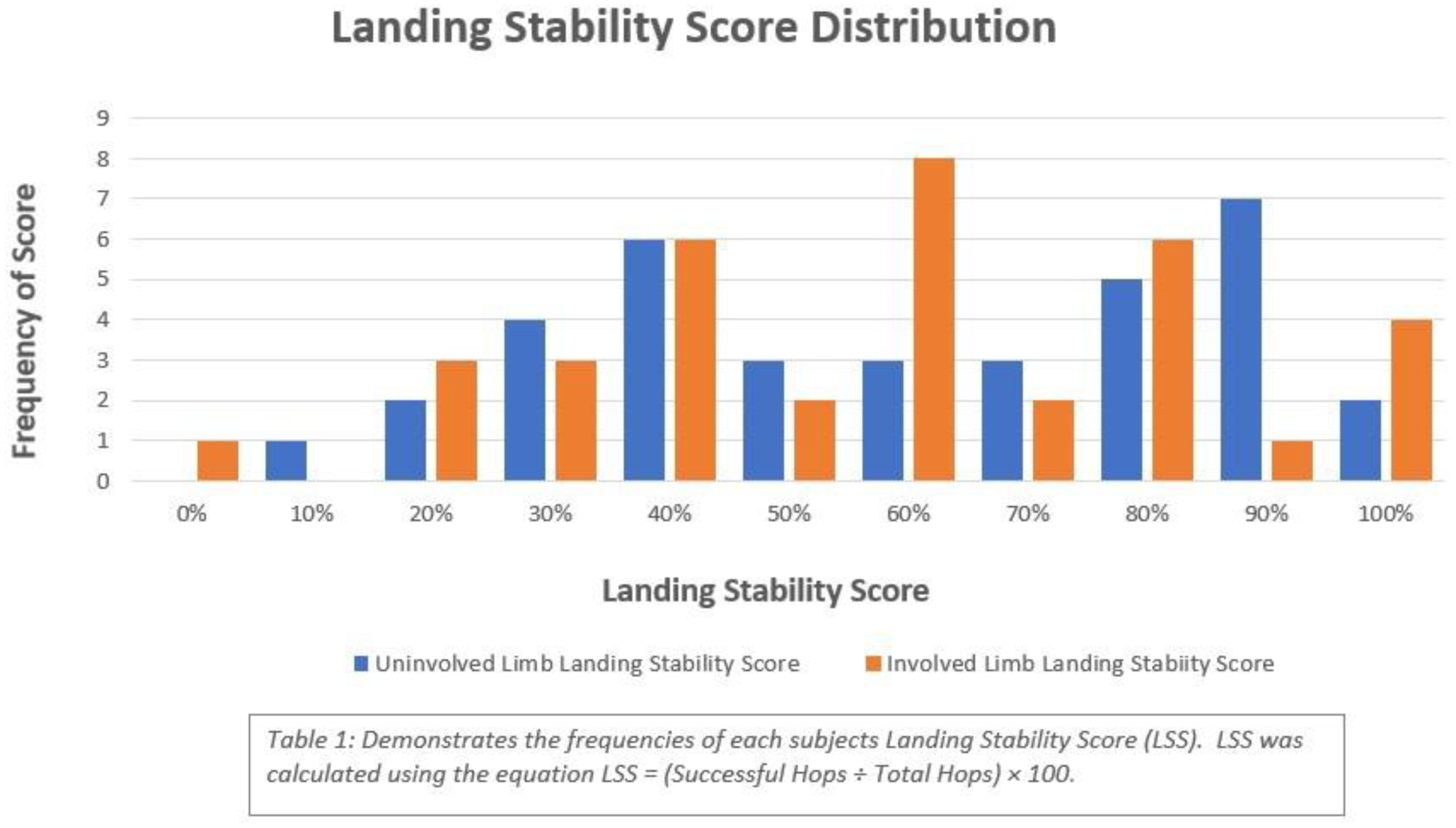
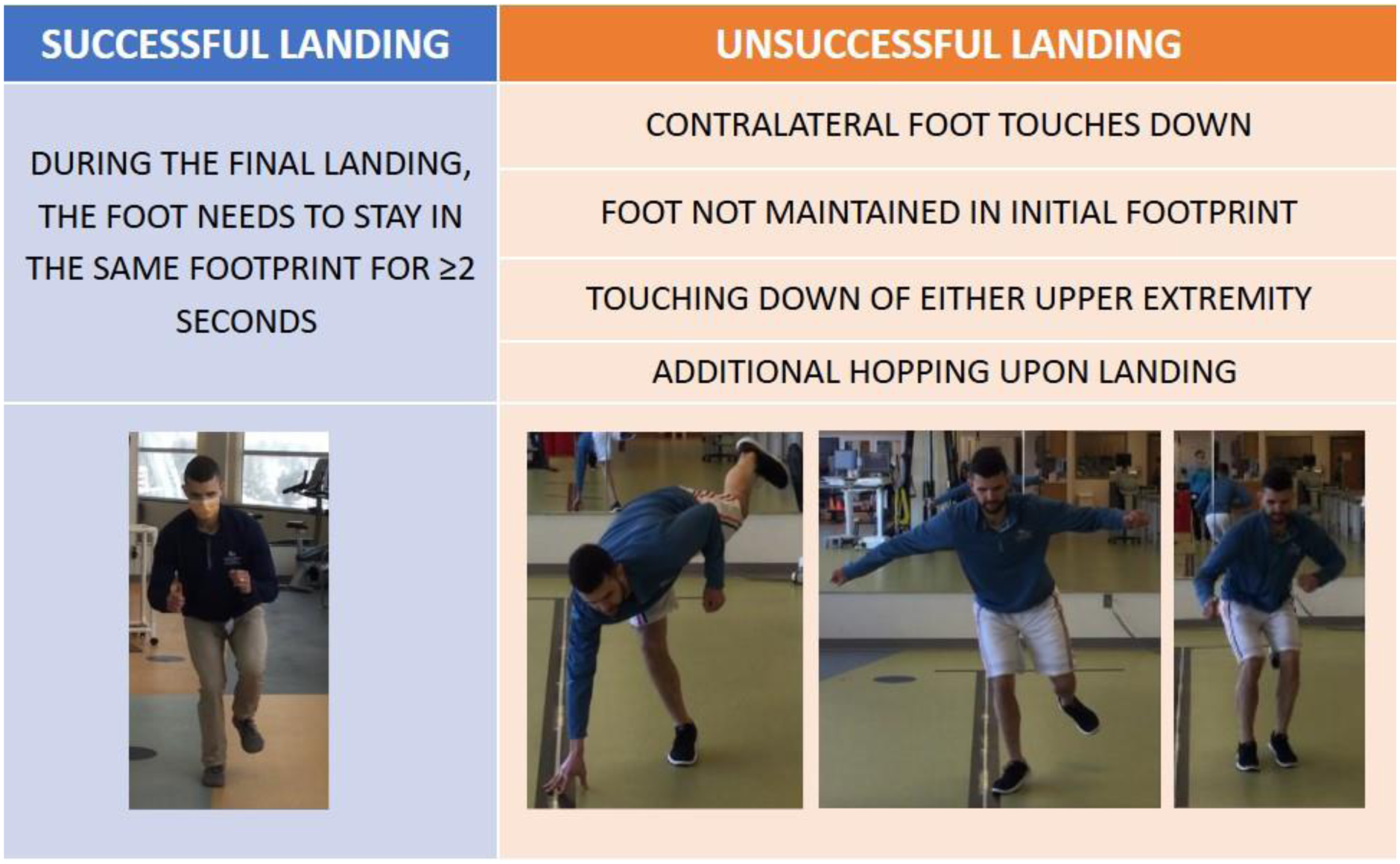
Subjects 10-24 years-old and ≥ 6-months post-ACLR were eligible. Two physical therapists reviewed frontal-view videos of subjects performing single-leg triple hops (SLTH). Subjects completed 5 trials per limb, hopping 3 times consecutively for maximal distance, holding balance on the final landing. Limb order was randomized. Videos were edited to blur faces, and all subjects wore bilateral knee sleeves to blind raters to the involved limb. Raters scored each hop as “successful” or “unsuccessful,” and a Landing Stability Score (LSS) was calculated by the ratio of successful to unsuccessful landings. The intraclass correlation coefficient (ICC) was calculated to measure the reliability of the LSS. Differences in LSS between limbs were assessed using paired-sample t-tests. Objective SLTH distance and limb symmetry index (LSI) measures were collected during routine clinical visits on the same day and extracted from the medical record for comparison.
Results:
Thirty-six subjects (mean age 16.3 years, 53% female) participated at an average of 0.59 years post-ACLR. Inter-rater reliability of the LSS was good (ICC (2,1) = 0.774) and intra-rater reliability was excellent (ICC (3,1) = 0.987). There was no statistically significant difference between mean limb LSS (57% involved limb, 60% uninvolved; p=0.36). The average SLTH LSI was 96%, with only 3 subjects unable to achieve > 90% LSI.
Conclusion:
The LSS is highly reliable. Despite 92% (n=33) of subjects “passing” the SLTH, more than half of the subjects could not consistently achieve successful landings for either limb. Although the LSS does not specifically assess movement quality, it may reveal impairments not assessed in current functional testing and warrants continued research into the relationship between biomechanics and reinjury risk.