Abstract
Background:
Increased levels of physical fitness in dance have been linked to improved performance and reduced injury risk. Resistance training is recommended for dancers; however, perceptions of resistance training vary in the dance community.
Hypothesis:
This study aimed to describe resistance training behaviors and perceived barriers to participating in resistance training among youth and young adult dancers.
Methods:
Dancers aged 12 to 25 years participated in a cross-sectional electronic survey capturing demographics and dance participation, motivation and participation in resistance training, and perceived barriers to resistance training. The intrinsic motivation subscale of the modified Behavioral Regulations Questionnaire (BREQ-2) assessed motivation to participate in resistance training and the Muscle Strengthening Exercise Questionnaire short form (MSEQ) quantified frequency (days/week), duration (0-7 ordinal scale corresponding to minutes/day), intensity (exertion scale from 0-extremely easy to 10-extremely hard), and type of resistance training participation. Each dancer ranked their top perceived barrier from 11 statements related to resistance training. Descriptive statistics including means and standard deviation were calculated for continuous variables, frequencies and percentages were calculated for categorical variables.
Results:
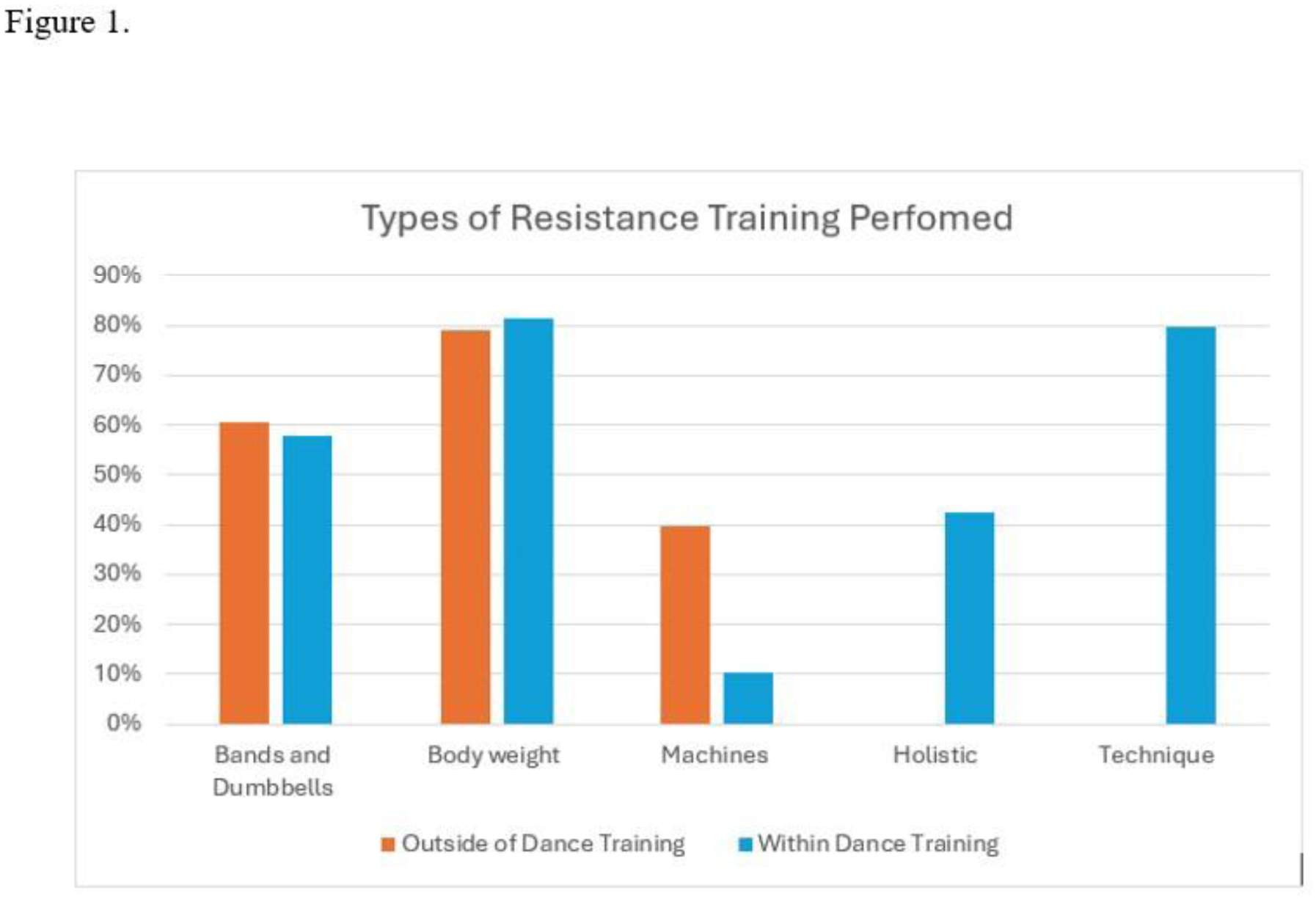
Eighty-nine dancers (15.29±3.35 years; 87 female) completed the survey. On average, dancers reported engaging in resistance training outside of dance 3.14±1.40 days/week, with a mean duration score of 4.28±1.92, equating to an average of approximately 31-40 minutes/day, at a mean intensity of 6.86±1.24. Resistance training as part of dance training was reported at a lower frequency (2.80±1.26 days/week), with a mean duration of 3.81±1.79, equating to roughly 21-30 minutes/day, at a mean intensity of 6.61±1.89. Body weight training was the most common type of resistance training performed both outside (79.07%) and within (81.36%) dance training. Only about 60% of dancers utilized external loading with bands or dumbbells (Figure 1). The mean BREQ score was 3.08±0.74, indicating that dancers generally agree that they are intrinsically motivated to participate in resistance training. The most frequently reported barrier was lack of time (34.25%), followed by perceptions that resistance training is intimidating, difficult to perform safely, may increase muscle bulk, and concerns about equipment availability—each cited by 8.22% of dancers.
Conclusion:
Overall, dancers participate in resistance training at moderate levels, likely supporting the maintenance of muscular strength and hypertrophy. However, the intensity and low frequency of external loading may be insufficient to increase strength and power, particularly for dancers with longer training history and greater adaptive resistance.