Abstract
Background:
Trochlear dysplasia (TD) is an important risk factor for patellar dislocation (PD). While several MRI measurements have been described to assess TD, stratifying its severity is less understood. Most techniques for assessing TD utilize radiographs, three-dimensional CT, or one axial MRI level, such as the Dejour classification adapted to MRI. However, there is no consensus on optimal axial level. Therefore, evaluating multiple axial levels of the trochlear groove (TG) may allow for complete assessment. The objective of the present study was to introduce a method that allows for stratification of TD severity using sulcus angle (SA) measurements at four axial levels.
Hypothesis:
Patients with Recurrent patellar dislocations (RPDs) will have a higher prevalence of more severe grades of TD and a lower prevalence of no TD compared with controls.
Methods:
Pediatric patients were retrospectively categorized into two cohorts: RPDs and controls (patients with no history of patellar dislocation; PD). Cartilaginous SA measurements were completed at four consecutive MRI axial levels (SA1=most proximal, SA2=near-proximal, SA3=near-distal, and SA4=most distal). Cutoff values were identified using Youden’s index. Patients were classified based on the number of elevated SA values: all four elevated values indicated Grade 4 TD; three elevated values indicated Grade 3 TD; two elevated values indicated Grade 2 TD; one elevated value indicated Grade 1 TD; and all normal values indicated Grade 0 TD. Proportions were calculated, and Fisher’s exact tests were used to compare TD severity between RPDs and controls.
Results:
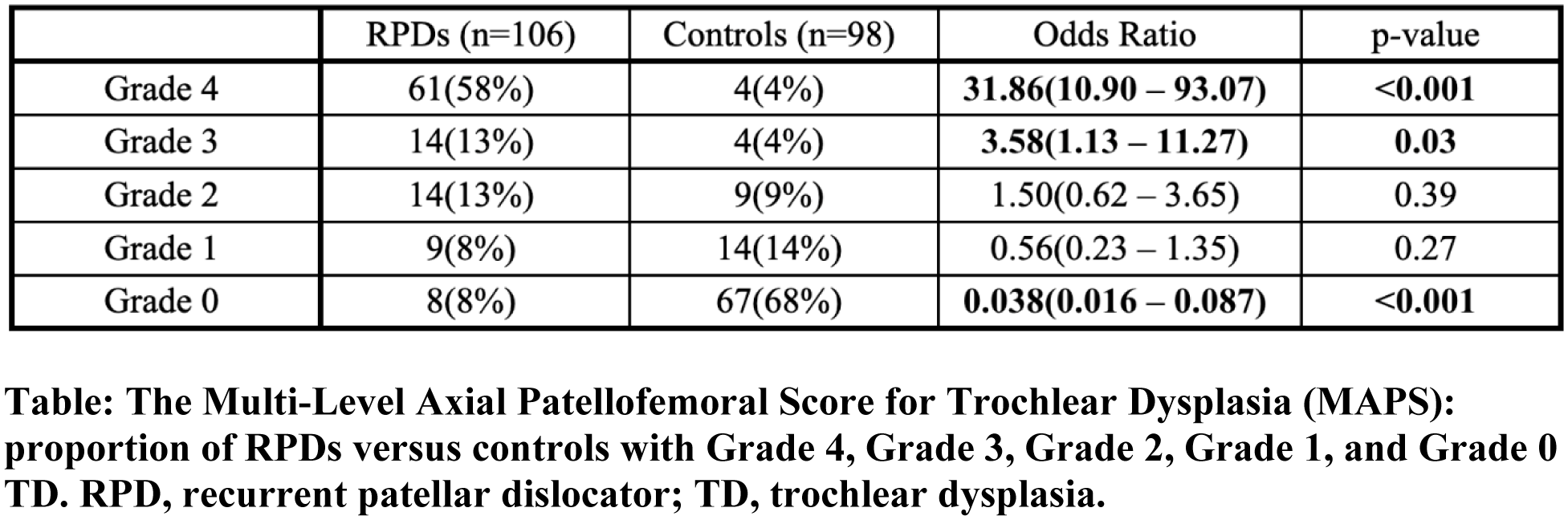
106 RPDs and 98 controls were included. Diagnostic cutoff values were: SA1 160°, SA2 154°, SA3 153°, and SA4 148°. The RPDs were more likely to have Grade 4 TD (58% versus 4%, p<0.001) and Grade 3 TD (13% versus 4%, p=0.03) compared with controls. Conversely, RPDs had less Grade 0 TD (8% versus 68%, p<0.001). There was no difference in the proportions with Grade 2 TD (13% versus 9%, p=0.39) or Grade 1 TD (8% versus 14%, p=0.27) between cohorts.
Conclusion:
The Multi-level Axial Patellofemoral Score for Trochlear Dysplasia (MAPS) is a novel classification system which stratifies TD severity and has demonstrated accuracy and reliability in distinguishing RPDs from controls. Its primary clinical utility lies in differentiating more extensive TD (especially Grade 4) from mild TD (Grades 1 and 2). MAPS-TD may help guide surgical decision-making, possibly even in identifying candidates for surgical procedures to address TD (i.e. trochleoplasty) among those with Grade 4 TD.