Abstract
Background:
There is currently no definitive guidance as to how much volume is appropriate for younger distance runners, and whether too much too soon can produce negative long-term outcomes. To investigate effects of fatigue on young female muscle activation strategies, the kinetic and kinematic data were recorded before and after a run. Motion capture information was used with OpenSim musculoskeletal modeling to simulate the muscle forces, and how they changed as a function of fatigue and age.
Hypothesis:
The hypothesis is that fatigue would affect muscle activations differently, with the younger runners exhibiting higher muscle forces, and that the differences would increase with fatigue.
Methods:
Eleven female subjects 8-17 were recruited. Subjects were separated into 2 age groups to determine if there was a difference in how fatigue affected younger runners (14 and under) compared with those aged 15-17. Subjects ran down the walkway in order to obtain at least 3 acceptable foot contacts. Subjects then performed a 5K within 30 seconds of their PB pace. Post-run data was then collected in the same manner as pre-run. The marker and force data collected were employed to estimate joint reaction and muscle forces in OpenSim.
Results:
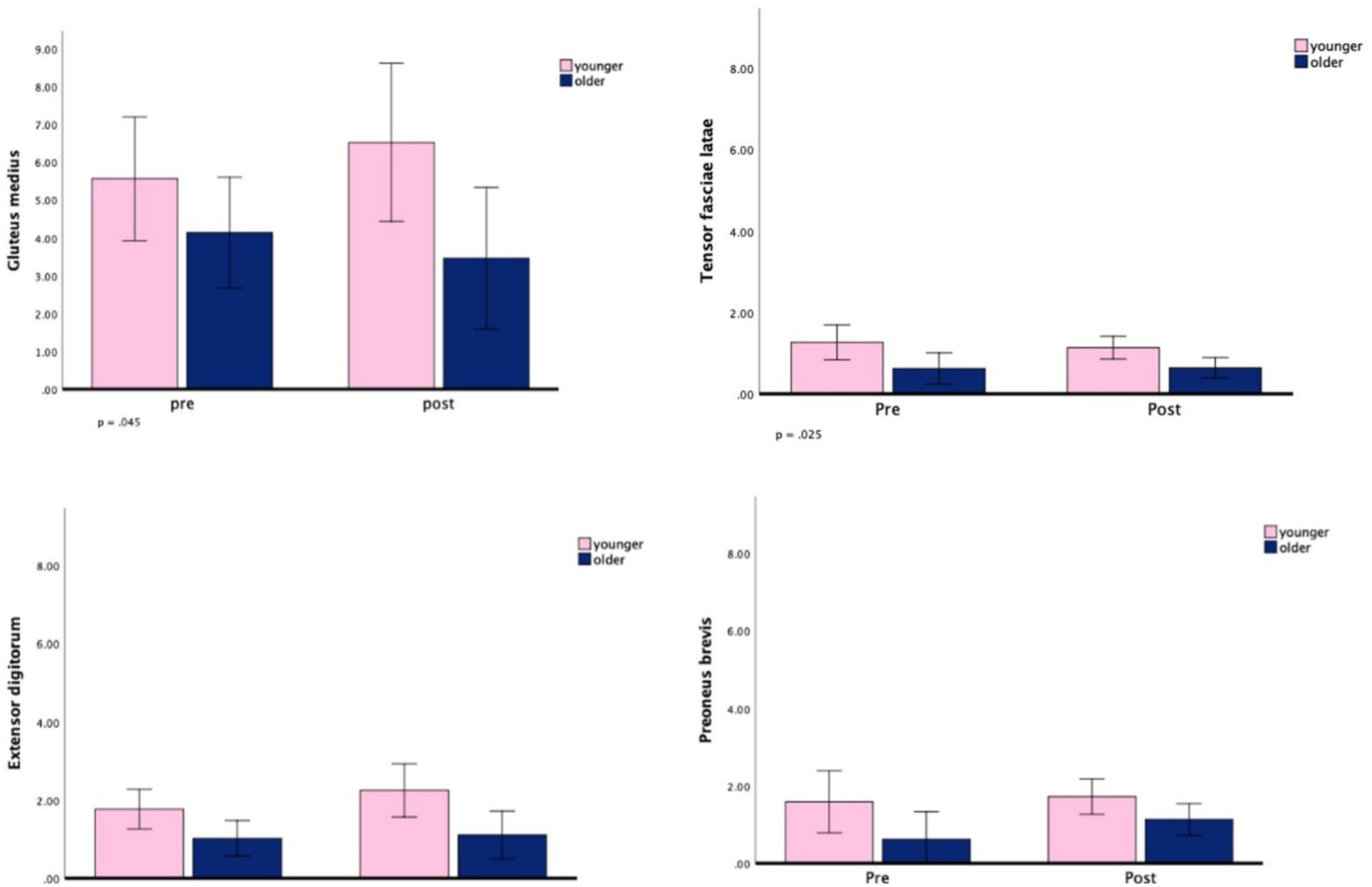
Muscles most affected were the gluteus medius and minimus, sartorius, TFL, gracilis, flexor digitorum, peroneus brevis and longus, and extensor digitorum and hallucis longus. The decrease in TFL force and apparent compensation by the gluteus muscles occurred just prior to foot contact. These changes may place the younger group at higher risk for iliotibial band syndrome, which is the cause of 7% of female high school running injuries [1]. There is also a shift at the ankle towards the dorsiflexors. This can lead to repeated bending of the tibia, with aggravation at higher running volumes. In addition, if development of the tendons lag behind growth of the tibia, the relevant musculotendon units are now acting from a stretched resting position, which would further increase tensile forces that can contribute to mid and distal tibial stress fractures. This ankle imbalance has also been associated with increased shank acceleration and impact, adding to the potential accumulation of stress in the area [2].
Conclusion:
This study is a case in how musculoskeletal simulation can provide more in-depth information regarding musculoskeletal strategies to guide group and age based training recommendations. For example, the idea that younger runners may benefit from hip and ankle strengthening exercises to avoid imbalances that may predispose them to injury.