Abstract
Background:
Factors like younger age, bone loss, and higher activity level place athletes at high risk for shoulder instability [1]. Following a shoulder stabilization procedure, dynamic tests like the Closed Kinetic Chain Upper Extremity Stability Test (CKCUEST) can help identify post-operative deficits [2]. However, arm length may significantly influence performance on the CKCUEST [3, 4] as it greatly influences the athlete’s base of support.
Hypothesis:
It was hypothesized that performance on the arm-length-normalized condition of the CKCUEST would significantly differ from the standard testing position.
Methods:
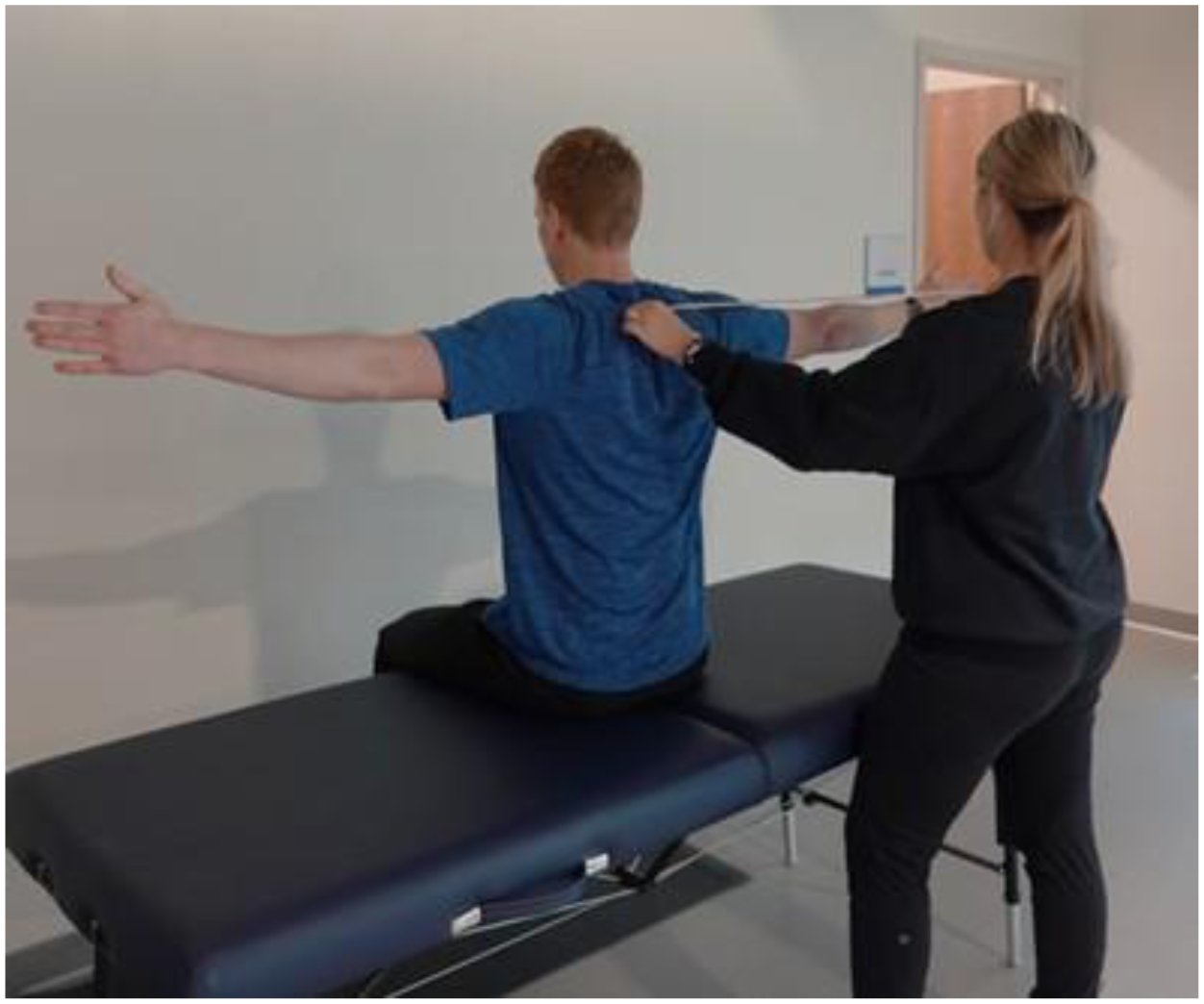
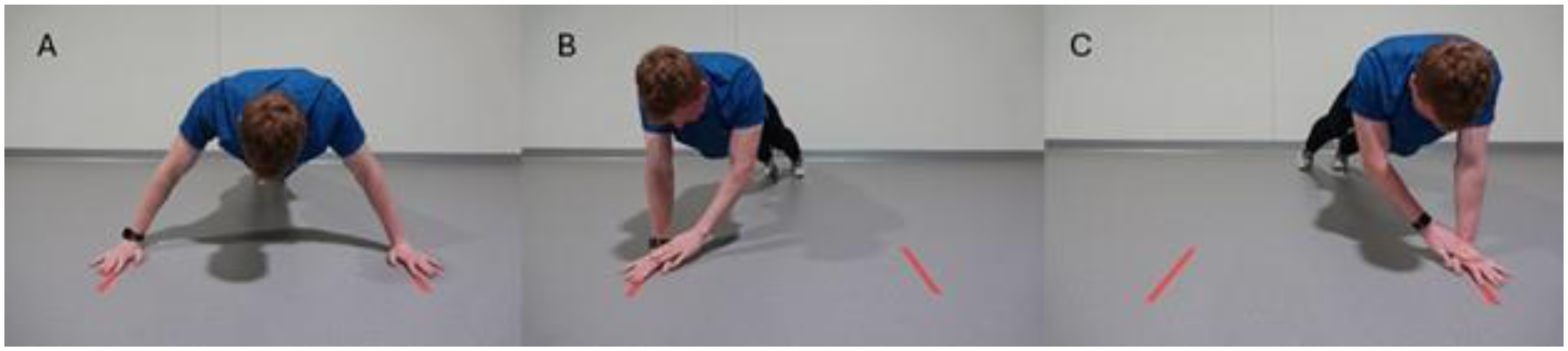
After IRB approval, healthy, adolescent athletes (14-18 years) participating in contact or overhead upper-extremity sports were recruited to participate in this study. The CKCUEST was completed during a series of upper extremity functional tests performed in a randomized order. Standardized instructions were provided to “Begin in a pushup position with feet shoulder-width apart and hands placed on each piece of tape, alternating taps to the top of the opposite hand as many times as possible within 15 seconds” [5, 6]. Each participant completed two trials of a standard-distance (36 inches) (Figure 1) [2, 6, 7] and two trials of an arm-length-normalized distance (C7 to tip of middle finger) (Figure 2) [7, 8], in this order, with 45 seconds rest between trials. An evaluator timed and counted the total number of taps, with the maximum score from each condition recorded for analysis. Significant differences were identified with a Wilcoxon signed-ranks test, and effect size (r) was computed. Additionally, ICCs were computed to identify agreement. Lastly, Spearman correlations were performed to identify significant relationships with age, height, and weight.
Results:
154 participants (121 male, 16.5±1.2 years) were tested. The number of taps during the arm-length-normalized condition was significantly greater (23.9±5.5) compared to the standard-distance condition (23.0±5.8; p<0.001, r=0.29). However, the agreement between conditions was found to be good (ICC=0.86, 95%CI=0.80-0.90). Age was not correlated to the number of taps for either version, but significant correlations were found for both height (standard: r=0.34, p<0.001; normalized: r=0.21, p=0.023) and weight (standard: r=0.17, p=0.033).
Conclusion:
In a cohort of healthy athletes, performance on the arm-length-normalized condition of the CKCUEST was greater than the standard-distance condition, with good agreement between conditions. While age was not correlated with performance, height and weight showed significant correlations across both conditions, suggesting that the arm length-normalized condition may be more suitable for assessment of upper extremity strength and function following a shoulder stabilization procedure.