Abstract
Background:
Bridge-enhanced anterior cruciate ligament repair (BEAR) was developed to assist in the healing of ACL tears using a bovine collagen implant, and has grown in popularity due to preservation of ACL anatomy and promising results at two year follow up.1 However, there is limited data reporting early strength and patient reported outcomes after this procedure in the adolescent population.
Hypothesis:
To describe early strength and patient-reported outcomes at 3 and 6 months after surgery in the adolescent population to further inform clinical practice.
Methods:
This was a retrospective descriptive study of 24 patients between 13-18 years of age who underwent BEAR ACL Repair from January 2022-March 2025. Demographic information, surgical characteristics, knee strength, and patient reported outcomes were recorded from the medical record. Isometric knee flexion/extension strength at 60° and isokinetic knee extension and flexion strength 60°/second were measured using a HUMAC isokinetic dynamometer at three and six months post-operatively. Patient reported outcomes were collected using the Pediatric International Knee Documentation Committee (PEDI-IKDC) and Anterior Cruciate Ligament-Return to Sport after Injury scale(ACL-RSI). Range of motion (ROM) differences were classified using the IKDC classification system comparing limb differences. Descriptive statistics, including means, standard deviations, and frequencies, were used to summarize the data.
Results:
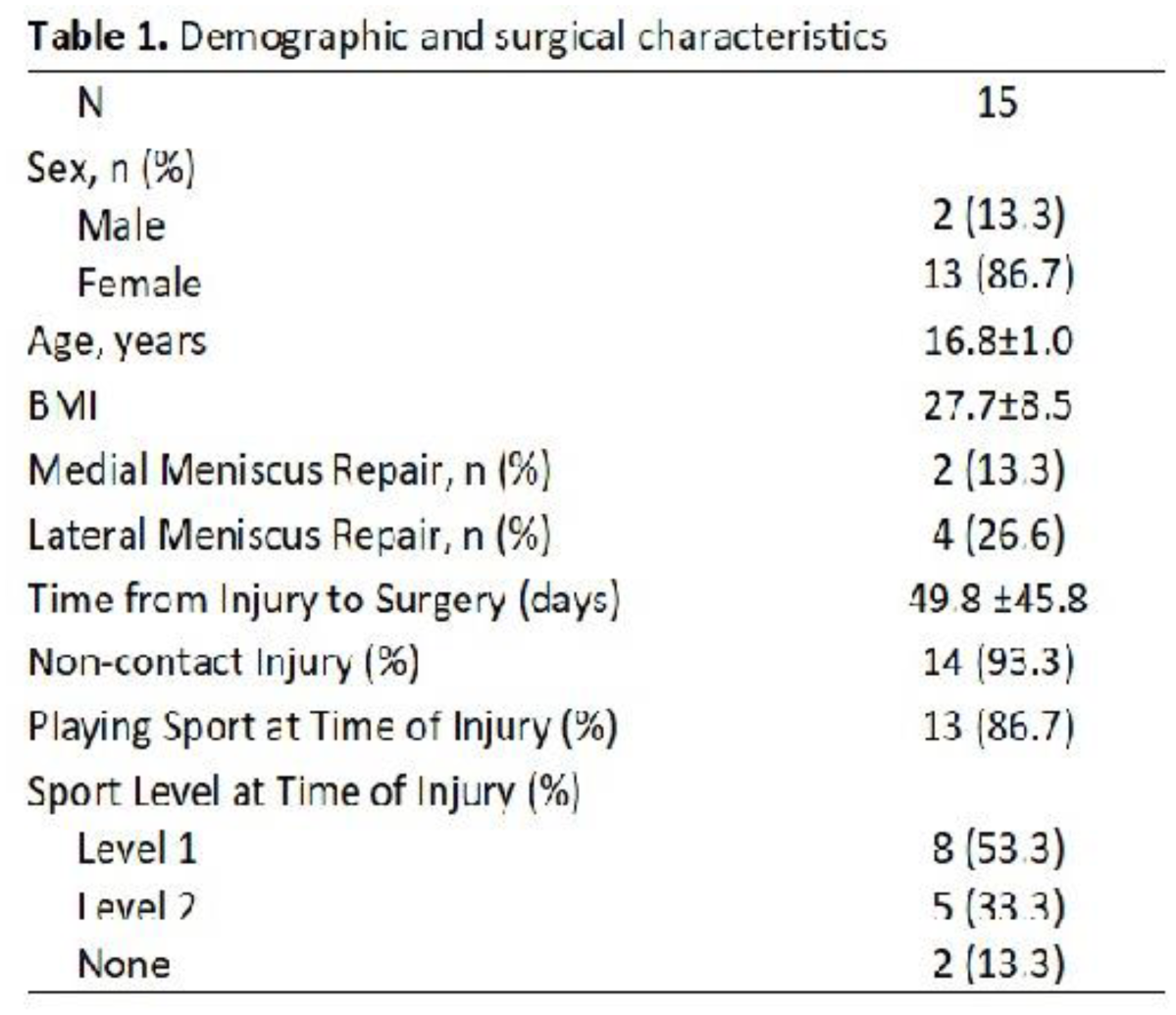
After excluding for missing strength data, 15 patients (Age =16.8±1.0 years; Female=86.7%) were included for analysis at 3 months and 6 months post-operatively (Table 1). Patients showed improvements between time points in patient reported outcomes, isometric knee extension and flexion limb symmetry and normalized peak torque (Table 2). 4/15 patients had abnormal knee extension ROM (6-15° difference) and 9/15 patients reported had abnormal knee flexion ROM (6-25° or greater difference) at 3 months post-operatively. PEDI-IKDC scores improved from 64.5±11.2 at 3 months to 79.8±11.8 at 6 months. ACL-RSI scores improved from 53.1± 20.2 at 3 months to 59.5±23.1 at 6 months. There was one lysis of adhesions and three second ACL injuries greater than one year from surgery reported.
Conclusion:
Adolescents undergoing BEAR ACL repair demonstrated consistent improvements in knee extension and flexion isometric strength and patient reported outcomes at 3 and 6 months post-operatively. Isokinetic strength at 6 months after BEAR ACL repair appears to be consistent with previously reported strength outcomes after ACL reconstruction. This data suggests clinicians should closely monitor ROM limitations as part of clinical care. Future studies should look to compare outcomes to traditional ACL reconstruction in a larger sample.