Abstract
Background:
Single leg hop tests (SLHTs) after anterior cruciate ligament reconstruction (ACLR) are the most widely utilized criteria to inform return to sports readiness. A limb symmetry index (LSI) of >90% is typically considered adequate performance. However recent literature demonstrates adolescents post-ACLR have trouble achieving this criterion, and performance comparison to healthy, age-matched peers has been advocated to improve interpretation of SLHTs performance. ACLR rates amongst skeletally immature children are increasing, however limited SLHT data exist in both ACLR and healthy populations, limiting our understanding of performance expectations. The purpose of this study was to evaluate hop test performance between skeletally immature post-ACLR athletes and matched controls near the time of return to sport.
Hypothesis:
We hypothesized that both cohorts would demonstrate similar LSI and performance on SLHTs.
Methods:
This was a case-control observational study of skeletally immature patients who underwent ACLR and healthy controls who were actively participating in competitive sports. Control subjects’ data were collected on-site during sports activities and were matched to cases by age, sex, and BMI at a 2:1 ratio. Hop test data for cases were acquired between 6-9 months post-operatively by trained physical therapists. Each subject performed SLHT battery (single, triple, triple crossover, timed, and vertical hop). Average performance across 3 trials was utilized for data analysis. Hop distance was normalized to body height and LSI was calculated by dividing distance hopped on the involved by the uninvolved (cases) or non-dominant by dominant limb (controls). Limb dominance was determined by self-reported preferred kicking leg. Data were screened for normality; group comparisons were performed with independent samples t-test for continuous data, chi-square and odd-ratio (OR) analyses for categorical data. Alpha level was p<0.05.
Results:
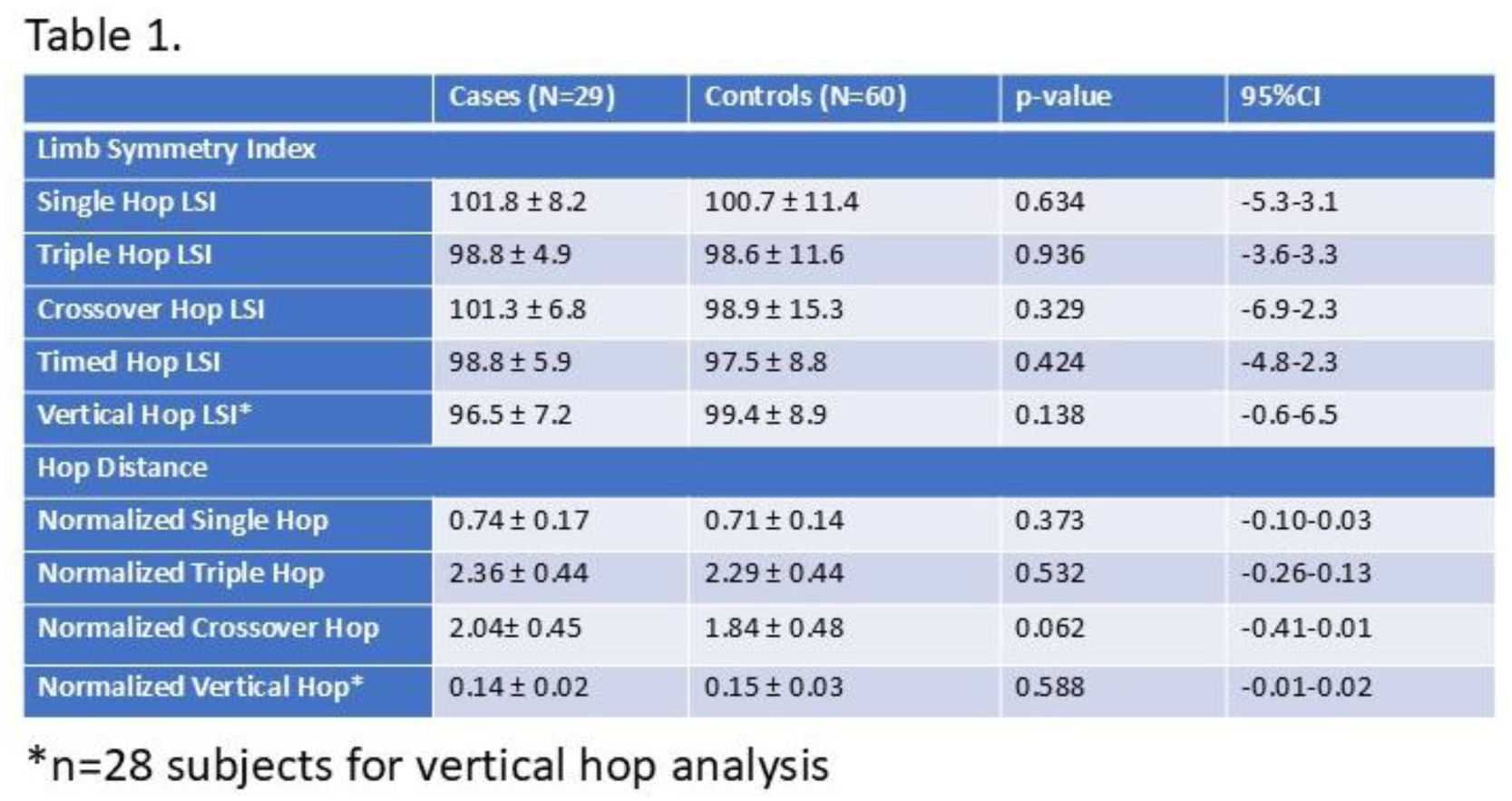
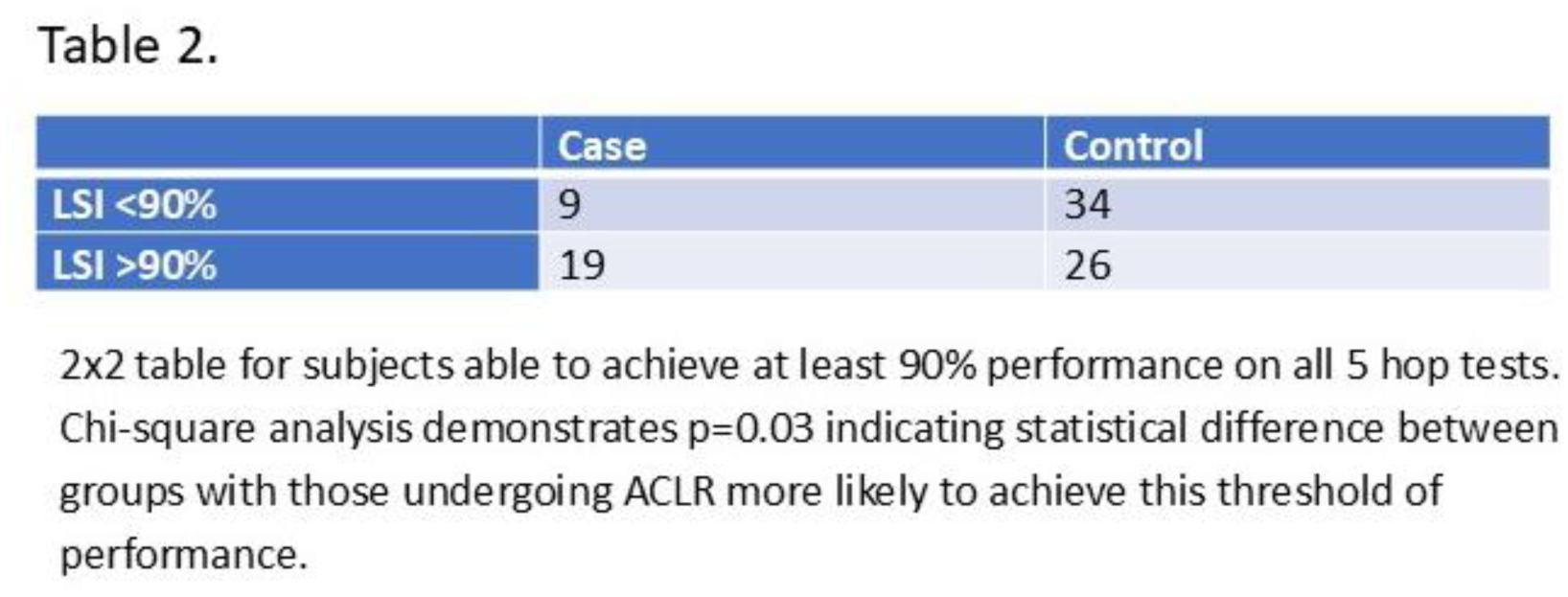
A total of n=29 cases (mean age 9.5 years, 23% female) and 60 controls (mean age 9.7 years, 23% female) were included. Mean time from surgery to hop test was 276 days. No statistical differences were identified between groups for LSI or height-normalized hopping distances for any hop test. (Table 1) However, the post-ACLR group was more likely to achieve >90% LSI across all tests (OR=2.76, 95% CI: 1.07-7.09, p=0.03). (Table 2).
Conclusion:
While mean LSI and normalized hop distances were not different, skeletally immature subjects 9-months post-ACLR were 2.76 times more likely to achieve >90% LSI than matched controls. Performance of specialized exercises during rehabilitation may improve overall neuromuscular control leading to better performance than untrained, yet otherwise healthy athletes.