Abstract
Background:
Treatment of osteochondral lesions of the talus (OLTs) can be challenging due to difficult access/visualization and limited healing capacity. While outcomes after concentrated bone marrow aspirate with extracellular matrix (ECM-BMAC) have been reported for adult populations, its use in pediatric/adolescent patients has not been thoroughly examined. This case series assesses clinical outcomes of ECM-BMAC grafting for young patients with OLTs.
Objectives:
We hypothesized that patients who underwent ECM-BMAC grafting for OLT would demonstrate high rates of return to sport and favorable patient reported outcomes.
Methods:
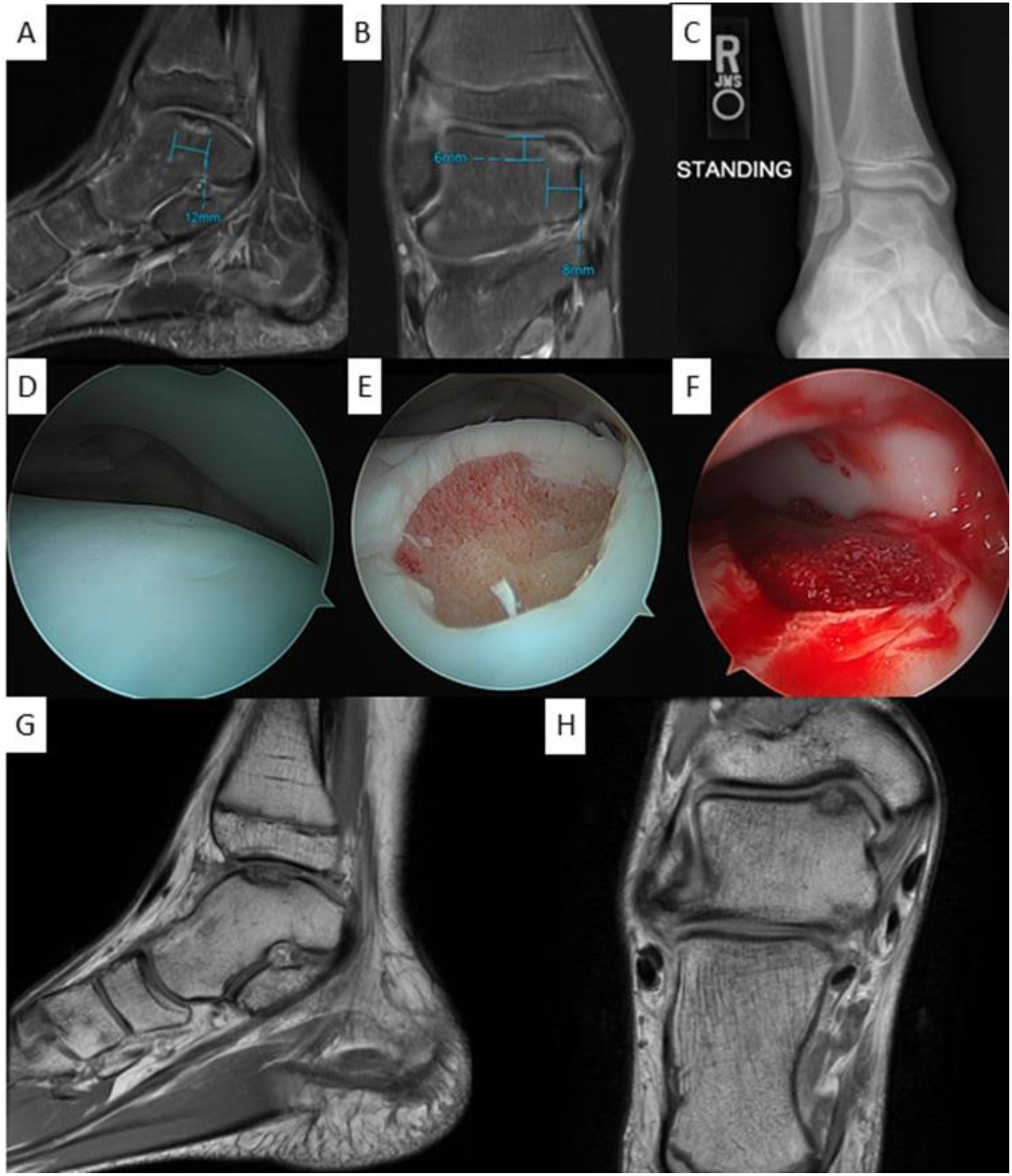
All patients ≤18 years old presenting to two surgeons between 2016-2024 who underwent primary surgery with ECM-BMAC for an OLT with minimum 6-month clinical follow-up were included (Figure 1). Pre-operative primary sport, concomitant procedures, lesion size/location, post-operative complications, requirement for reoperation, and post-operative sports clearance were recorded. Various Patient-Reported Outcomes Measurement Information System (PROMIS) scales were obtained from the medical record where available at minimum 6 months post-operatively. Descriptive statistics were calculated and patient-reported outcomes (PRO) compared using paired sample t-tests.
Results:
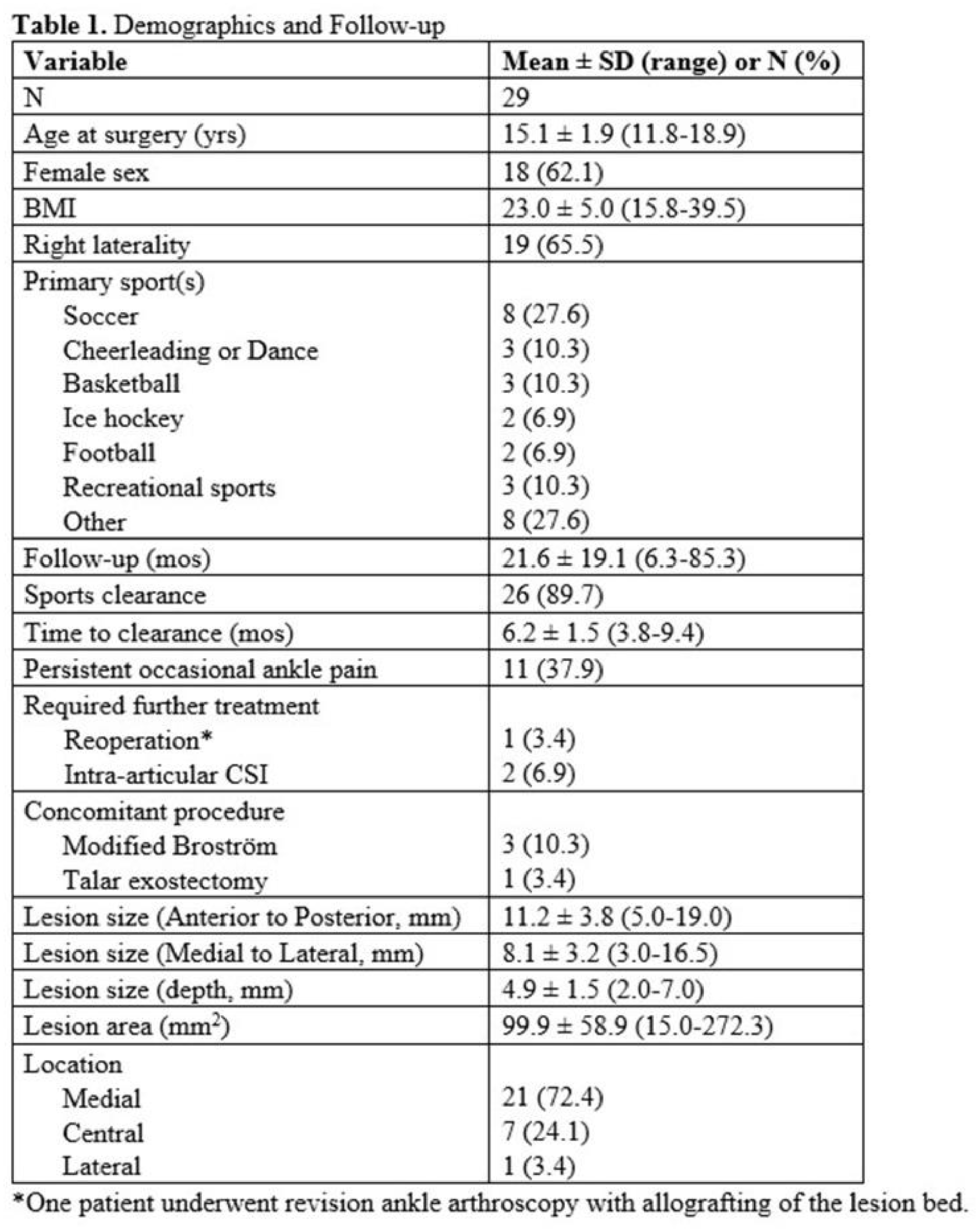
Twenty-nine patients with unilateral OLTs were included in this study (Table 1). Sixty-two percent of patients were female with a mean age of 15.1 ± 1.9 years (range: 11.8-18.9) at surgery and a mean clinical follow-up of 21.6 ± 19.1 months (6.3-85.3). Lesions most commonly affected the medial talar dome (72%) and had a mean depth of 4.9 ± 1.5 mm (2.0-7.0). Three patients (10%) underwent concomitant modified Broström procedure for lateral ankle instability. At an average of 6.2 ± 1.5 months (3.8-9.4), 90% of patients were cleared to return to sport. PROMIS Pain Interference scores improved on follow-up surveys (55.9 ± 5.9 vs. 48.1 ± 7.2, p=0.003) obtained at an average 27.3 ± 20.5 months post-operative. One patient (3%) required reoperation for persistent pain and radiographic abnormality.
Conclusion:
High sports clearance rates and improved PROMIS pain scores with low rates of re-operation provide early evidence that arthroscopic management with ECM-BMAC can achieve favorable outcomes for treatment of OLT in pediatric/adolescent patients.