Abstract
Background:
This study was performed to review treatments for adolescents and young adults with borderline hip dysplasia (BHD) at a multidisciplinary hip center and synthesize a decision-making aid for the surgeon considering periacetabular osteotomy (PAO) versus isolated hip arthroscopy (iHA) in the patient with BHD.
Objectives:
We expected to find FEAR index and ACEA to be predictive of treatment. We also hypothesized that apprehension testing and DHUS parameters would correlate with the decision for PAO.
Methods:
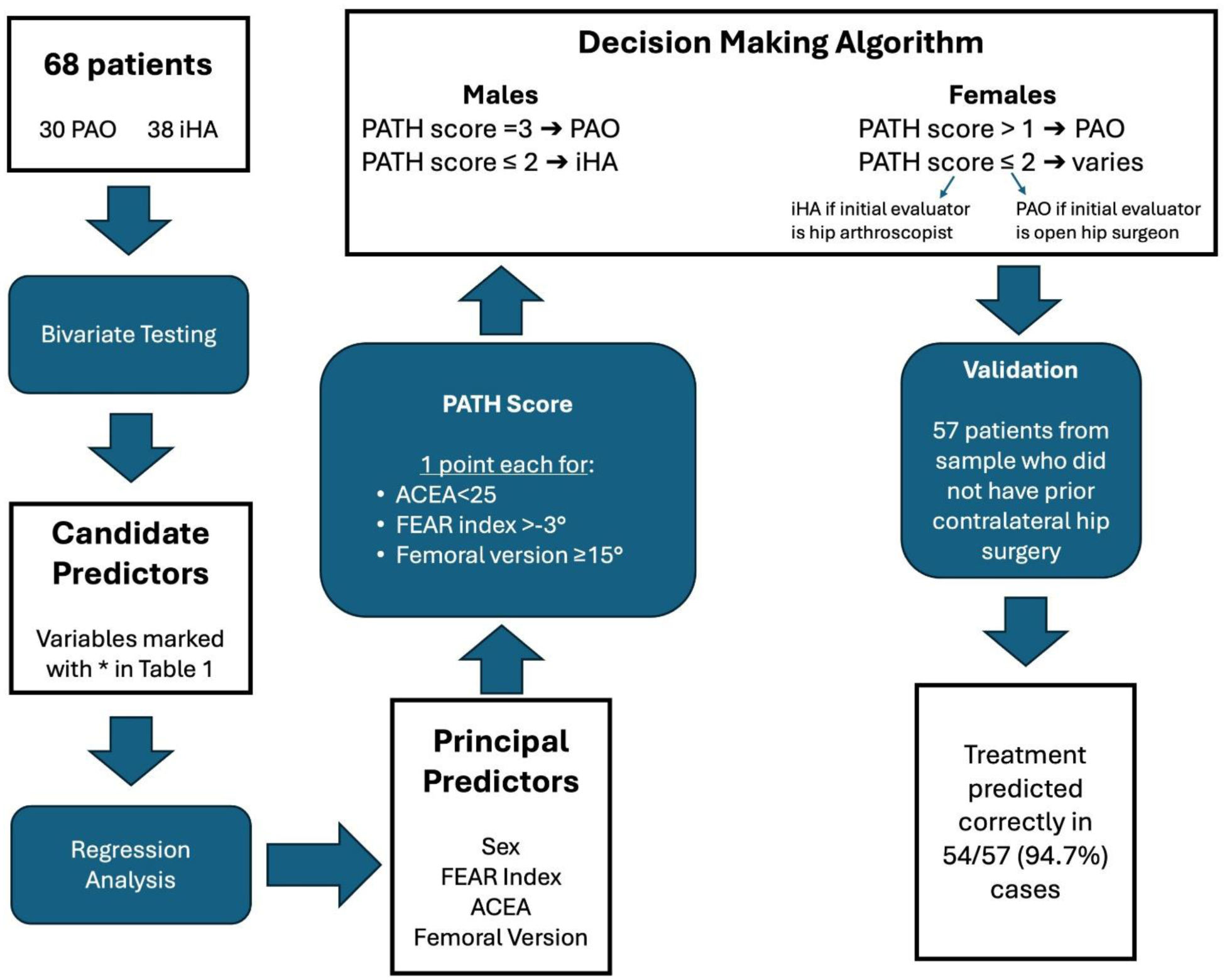
This was a review of prospectively collected data for patients with BHD (LCEA 18-28°) who underwent surgery at a specialized hip center. Pre-operative demographics, radiographic variables, and patient-reported outcome (PRO) scores were recorded. All patients were treated with PAO or iHA. Bivariate testing and regression analysis were performed to identify principal predictors of treatment, which were then used to create the novel PAO versus Arthroscopic Treatment of the Hip (PATH) score; treatment decisions were summarized based on this.
Results:
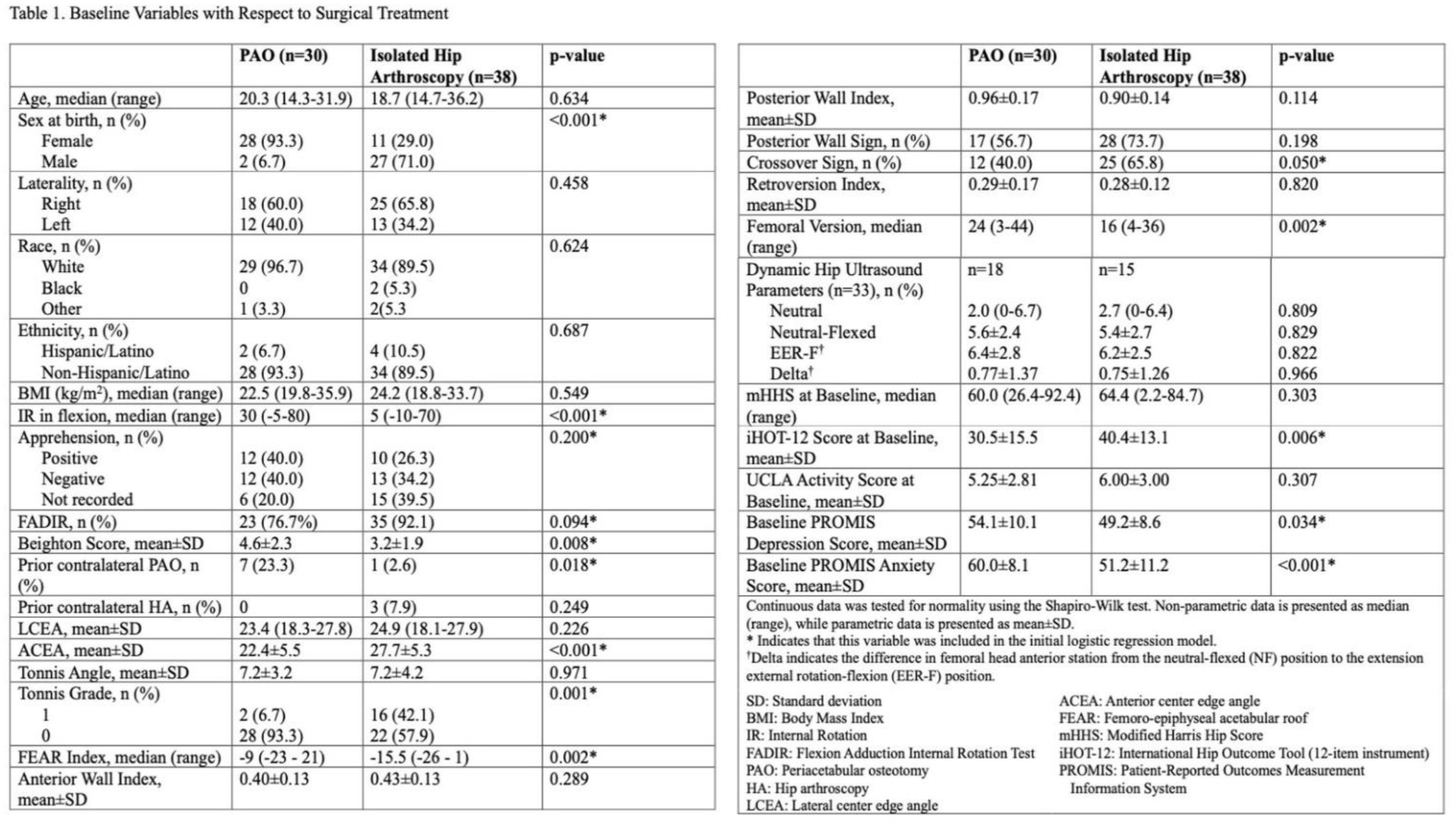
Sixty-eight patients were included in this study (30 PAO and 38 iHA). Table 1 highlights several baseline differences between the cohorts, including higher femoral version, higher FEAR index, and lower ACEA in the PAO cohort. DHUS parameters and apprehension testing was not associated with the treatment decision. Regression analysis identified sex, femoro-epiphyseal acetabular roof (FEAR) index, ACEA, and femoral version to be principal predictors of treatment. The PATH score was then calculated, awarding one point for ACEA <25°, one point for FEAR index >-3°, and one point for femoral version ≥15°. All males underwent iHA unless they had the maximum PATH score of 3. All females with PATH score ≥2 underwent PAO. Among females with PATH score ≤1, 11/14 had treatment in accordance with the initial evaluator’s specialty (Figure 1).
Conclusion:
Despite our surgeons being guided by no formal algorithm, the decision making of the multi-surgeon specialty hip group was predicted correctly in 94.7% of cases using the heuristic described here. Although more prospective outcomes studies are needed to more clearly define indications for PAO versus iHA in the setting of BHD, the PATH score is a pragmatic and objective tool that surgeons may use as adjunctive decision-making aid right now. Females with PATH score ≤1 were variably treated with PAO or iHA, underscoring the need for clearer guidelines regarding indications and improved microinstability testing in this subgroup.