







Abstract
Biological research, including dual-use research of concern and pathogens with enhanced pandemic potential, faces mounting regulatory scrutiny that may impact pandemic preparedness and scientific progress. At a 2024 deliberative workshop in Reno, Nevada, biosafety professionals, biosecurity experts, and life sciences researchers discussed potential barriers to effective governance, including ambiguous regulatory definitions, resource disparities between regulated institutions, and fragmented oversight frameworks that impose burdens without improving safety or security. By incorporating biosafety professionals’ expertise into policymaking, fostering a collaborative dialogue over punitive and inconsistent enforcement, and securing ongoing funding for biosecurity programs, we call for actionable strategies to reduce risk while advancing safe, secure, and transformative biotechnological breakthroughs in the life sciences and strengthening national security.
Keywords
Introduction
R
There have been numerous attempts to manage these risks,10,11 most recently with the publication of 2025 Executive Order (EO) 14292 (titled “Improving the Safety and Security of Biological Research”), 12 the 2024 United States Government Policy for Oversight of Dual Use Research of Concern and Pathogens With Enhanced Pandemic Potential (“2024 DURC/PEPP Policy”) and the introduction of the Risky Research Review Act in the 118th Congress.13,14 However, the oversight of biological research is a perennial issue that requires a renewed focus and direct input from the regulated community. The pressing question is clear: How do institutions uphold safety, security, and compliance without stifling the very innovations these policies are meant to protect?
Aorkshop to Bridge the Policy– Practice Gap
On October 10-11, 2024, a group of 45 biosafety professionals, biosecurity practitioners, compliance experts, and life sciences researchers of diverse identities and backgrounds gathered in Reno, Nevada, to identify and discuss the challenges of implementing US government policies for DURC and use of PEPP.13-15 Through a series of large group discussions and breakout sessions, participants from public institutions, private organizations, government, nonprofit organizations, and academia shared perspectives on the practical realities of managing safety and security at US-funded research institutions. There were recurring themes of ambiguity, resource constraints, and tension between oversight and innovation.
The 2025 EO, 2024 DURC/PEPP Policy, and the proposed Risky Research Review Act expand oversight to encompass a broad range of pathogens and experimental outcomes. However, workshop participants noted these new rules feel like “paper-driven programs” in that they do not appear to improve biocontainment, create safer practices, or increase security for the research. Participants commented that biosecurity policies seem to arise as reactions to high-profile incidents rather than proactive planning. For example, the Federal Select Agent Program was revised in response to the 2001 Amerithrax attacks and other safety lapses involving biological agents, such as issues with biocontainment incidents or pathogen inventory discrepancies.5,16
Workshop participants discussed 3 critical areas where current policies falter: inconsistent definitions, resource disparities, and misaligned oversight mechanisms. Interestingly, participants also noted how they can quickly spot problematic or impractical policies. We argue that integrating the real-world insights of biosafety practitioners into the policymaking process will lead to more practical and effective policies.
Challenges With Definitions
Participants in the Reno workshop repeatedly described how foundational definitions in biosafety and biosecurity policy are unclear, inconsistent, and often difficult to apply in real-world research settings. Many expressed frustration that life sciences research, by its nature, is highly variable, yet policies often rely on rigid terms and text that do not account for this variance. Several participants noted that not all types of research carry the same safety or security risks. Thus, governments develop policies as a means to control “what knowledge is produced and how it is disseminated.” 17
Participants described a persistent misalignment between the intent of policies and how they are implemented on the ground. One recurring example was the term “dual use.” Many participants questioned whether the label truly helps delineate what research requires greater scrutiny. 18 Some pointed to high-profile cases, such as SARS-CoV-2 experiments at Boston University, the synthesis of extinct horsepox virus, and gene drive development as examples frequently cited as high risk.19-21 Others contrasted these with more routine, lower-risk work like PR8 influenza vaccine backbones. 22 However, all of these examples could be, or are, assessed as “dual use” and thus demonstrate the difficulty of establishing frameworks that require increased oversight and research that does not.
Persistently ambiguous and changing definitions of “DURC,” “potential pandemic pathogen,” “enhanced potential pandemic pathogen,” “pathogens with enhanced pandemic potential” (in the 2024 DURC/PEPP Policy), and “dangerous gain-of-function research” (in the 2025 EO), along with new and opaque terms such as “high-consequence pathogens” and “high-risk life sciences research” (in the proposed Risky Research Review Act) highlight challenges with interpretation and implementation. At the Reno workshop, participants also questioned what constitutes “gain-of-function” (GOF), “enhanced transmissibility” of a pathogen, and the threshold for epidemic or pandemic potential. There were also inquiries about when something is “reasonably anticipated,” “nontrivial,” and “highly unlikely” or when research has “significant societal consequences.” Unclear foundational definitions make it difficult for biosafety professionals to assess which activities require additional oversight. Definitions were also deemed as often being situational, thus creating additional regulatory gray areas that amplify compliance burdens and public scrutiny.
Participants noted concerns about the influence of individuals shaping public and policy discussions on biosafety. Several attendees expressed frustrations that some self-identified “biosafety experts” were actively contributing to regulatory debates despite lacking practical experience or formal expertise in biosafety or biosecurity. Participants described biosafety expertise as having a deep understanding of complex legal frameworks, such as the Federal Select Agent regulations, 23 coupled with the practical realities of day-to-day biosafety management. Attendees lamented that when policies are informed by uninformed voices, they risk being hypothetical, theoretical, impractical, and disconnected from the compliance and operational requirements that underpin effective biosafety practices. To promote informed and accurate public discourse on biosafety, participants emphasized that journalists and other media professionals have a responsibility to engage with credentialed experts who possess practical experience and are actively involved in the field. Institutions, often tasked with interpreting definitions and policy intentions independently, face varying enforcement practices that create confusion and uncertainty among researchers. The nuanced, technical, and domain-specific nature of scientific terminology is an added complication. For example, a conversation between 2 experienced molecular biologists can vary significantly depending on their areas of specialization, the organisms they study, their risk tolerance, the specific protocols and techniques that will be used, and the engineering and administrative controls in place for their research. These complexities may lead to misunderstandings, misinterpretations, misplaced concerns about safety and security, and public outcry. Consequently, decisionmakers responsible for approving research often expend disproportionate resources on managing public reactions when the focus should be funding and building robust compliance systems to address realized risks.
Participants also noted that the concept of risk itself is situational, whereas the risk profile changes as a result of controls that are put in place. The risk assessment process evaluates multiple factors, typically starting with key pathogen characteristics of an agent, including transmissibility, virulence, host range, and associated mortality. Research characteristics are then considered, such as any changes to the agent, genetic modifications, experimental manipulations, concentration, volume, and the use of animal or plant models. These assessments inform mitigation strategies, including infrastructure, engineering controls, administrative protocols, and personal protective equipment. This informs resource requirements, as using higher-containment facilities may be wasteful if used for pathogens which only require minimal-containment capabilities. According to attendees, aligning containment levels with the appropriate risk profile is essential, especially for experiments that addresses host susceptibility or transmissibility, for which the stakes and the scrutiny are already extremely high.
Workshop participants also noted that policies governing life sciences research must be sufficiently flexible to adapt to new scientific discoveries and unforeseen challenges. The current reliance on static, list-based regulatory frameworks was voiced as inadequate, and failing to meet the needs of researchers, policymakers, and biosafety professionals alike.
Aatchwork of Policy and Practice
Participants noted that the expanded scope of recent biosafety and biosecurity governance comes at a time when the scientific landscape has far outpaced the frameworks designed to regulate it. Advances in artificial intelligence, machine learning, in silico genetic engineering design, benchtop sequence synthesis, gene drives, mail-order DNA, synthetic virology, and mirror life 24 have introduced potentially novel risks, and repackaged past hazards and opportunities that defy traditional categories. Institutions are left struggling to manage high-risk, high-reward innovations without clear actionable guidance that reflects rapidly evolving scientific realities.
Biosafety and biosecurity officers expressed significant frustrations about the unrelenting pace of policy proclamations without consideration of existing oversight mechanisms. In the past year, there were minor revisions which built upon the Federal Select Agent and Toxin regulations, 23 the National Institutes of Health’s Guidelines for Research Involving Recombinant or Synthetic Nucleic Acid Molecules, 25 and more substantive changes to the Department of Health and Human Services Screening Framework Guidance for Providers and Users of Synthetic Nucleic Acids, 26 in addition to the 2025 EO, 2024 DURC/PEPP Policy, and potential future legislation. However, a change in the scope of 1 policy does not necessarily mean that the change will align with another policy. For example, the Federal Select Agent Program does not regulate exempt quantities of biological toxins that are standard tools in biomedical research, but the 2024 DURC/PEPP Policy does. Such discrepancies introduce prioritization challenges for biosafety professionals as they try to address incongruent requirements with limited resources.
Participants discussed how creating multiple rules that address the same issues unduly increases administrative burdens. For example, incident reporting requirements, which can vary among institutions, often require reporting to multiple agencies for the same incident. Attendees noted that those reviewing research may be forced to apply more than 1 policy to the same biological agent or experiment, resulting in confusion and inefficiency. Workshop members stated that policies lacking connection to institutional realities force organizations to create ad hoc interpretations of requirements, further leading to national inconsistencies in compliance practices. In turn, researchers may feel pressured to prioritize administrative tasks over scientific rigor, which could diminish overall efficiency and stifle innovation. Participants cited examples of researchers who have abandoned their research entirely, deeming the additional effort and bureaucratic hurdles too burdensome to manage.27,28 For example, the establishment of the Federal Select Agent Program resulted in the unintended consequences of institutions choosing to destroy repositories of valuable select agent materials rather than navigate the complex inventory requirements, effectively erasing critical resources for studying pathogens. Some security experts may argue that such destruction reduces risks, but it also limits preparedness for emerging threats, as researchers lose access to these materials and the opportunity to develop medical countermeasures and teach the next generation how to safely and securely work with them. Any decrease in qualified domain researchers, due to retirement or shifts toward less regulated fields, compounds this issue, leaving countries less equipped to respond to emerging or pandemic threats, whether natural or intentional. When regulations are perceived as obstacles rather than necessary precautions, compliance might decline. This could create a cycle of frustration, placing researchers, biosafety professionals, and policymakers at odds over expectations and accountability.
To avoid these problems, policymakers must involve researchers, biosafety professionals, biosecurity experts, policy implementers, and members of the public, early in the policy development process to ensure practical, lasting outcomes. Phased implementation timelines and clear communication can reduce confusion, enabling biosafety professionals to gain trust, clarify compliance expectations, and strengthen safety culture through direct engagement with researchers. Providing rationales for policy changes, opportunities for input, and timely guidance from federal agencies further supports a proactive and trust-based approach that promotes safety and security.
Toward a Culture of Integrity
Workshop participants identified a challenge within the regulated community with individuals potentially reluctant to embrace the spirit of the regulations. Ambiguous or overly burdensome regulatory requirements that seem performative may create frustration regarding expectations and accountability and likely incentivize some researchers to adopt a “check-the-box” mentality where they agree to terms superficially to move their research forward. In some cases, researchers whose work lies on the fringes of regulatory boundaries may inadvertently or casually tune out the intended oversight altogether. A culture of accountability, collaboration, and regulatory adherence can be advanced when researchers recognize compliance as a component of good science, where policymakers and biosafety professionals are partners to promote scientific innovation rather than simply as policy enforcers.
Participants pointed out criticisms within the field, and added their own anecdotes, of biosafety training programs as being superficial or overly generic and failing to meet the specific needs of research programs. These discussions showed how practical training initiatives that meet common standards, and best practices would greatly improve accountability and help to cultivate a culture of responsibility and integrity in the scientific community. Participants argued that federal funding should be devoted to revamping these programs with tailored, scenario-based training programs.
Participants repeatedly discussed how institutions require financial, staffing, and administrative resources to enforce safeguards and to build robust biosafety and biosecurity systems. For example, government funding is needed to develop and centralize biosafety and biosecurity tools and resources, such as tiered risk-assessment frameworks, preapproval templates, and incident reporting mechanisms to streamline oversight. Attendees argued that these resources would reduce disparities among institutions by providing a consistent baseline for compliance practices, ensuring that all organizations, regardless of size or funding, can meet regulatory expectations. A failure to address these challenges has the potential to erode public trust, stall scientific progress, and exacerbate global biosecurity threats.
Reimagining Compliance: Aath Forward
One of the most valuable outcomes of the Reno workshop was the chance to hear directly from individuals implementing biosafety and biosecurity policies at institutions and to learn more about what is happening on the ground. These were not theoretical conversations. They were candid, often passionate, and grounded in years of experience navigating biosafety and biosecurity requirements in institutions of all sizes and types. While participants brought diverse perspectives, a few key themes kept resurfacing. The most consistent messages revolved around what is needed, what is not working, and what could make a real difference.
The first and most consistent request was for clarity. Participants shared how difficult it is to apply vague or inconsistent policies. Terms like “dual use,” “reasonably anticipated,” and “high-consequence pathogen” may sound precise on paper but in practice there is too much room for interpretation. For those responsible for ensuring compliance, the stakes are too high for vague and unspecific terms.
Beyond clarity, there is a real need for investment. Institutions do not start from the same place. Some have teams that are dedicated to biosafety; others have a single person juggling it alongside other roles. Participants spoke openly about how indirect cost allocations from federal grants often fall short of what is needed to support meaningful biosafety and biosecurity programs. Without dedicated funding, even the best policies risk falling short in practice.
Many participants described the current oversight system as fragmented and frustrating. Policies change often and do not always line up with each other. This creates a patchwork of rules that institutions must interpret independently, often without enough guidance or resources. Several attendees noted that the volume of overlapping requirements means more time is spent managing paperwork than addressing real risks.
The tone of enforcement also came up frequently. When oversight feels punitive or disconnected from institutional realities, it can lead to disengagement and noncompliance. Some researchers comply on paper but disengage in spirit, completing forms without internalizing the purpose behind them. Despite these frustrations, the workshop focused on clear, practical solutions (see Table). These included:
Policy Recommendations for Enhancing Biosafety and Biosecurity
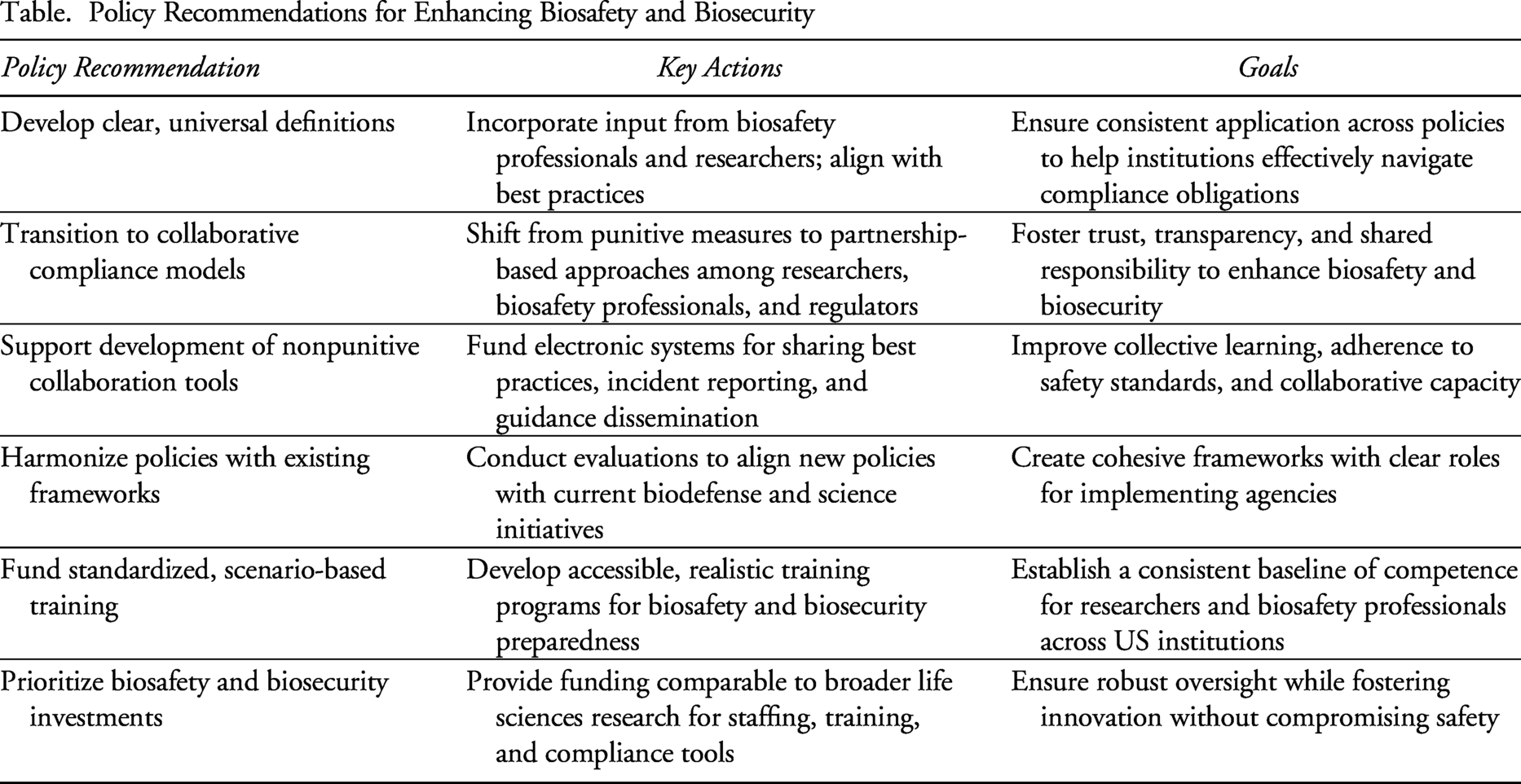
Clarifying the text of the policies to ensure specific and consistent definitions that make practical sense in the field
Establishing a more partnership-oriented approach, where institutions and agencies involve scientists, biosafety professionals, and policy implementers in crafting policies
Making training more useful by developing scenario-based training grounded in real research contexts, supported by federal funding
Streamlining reporting and communication tools and platforms to share guidance, report incidents, and learn from others across institutions
Harmonizing policies before they are rolled out (reviewed against what is already in place) to reduce confusion and administrative burden
Ensuring adequate funding for biosafety and biosecurity by including sufficient resources (staff, training, systems, and time) in grant budgets and eliminating unfunded expectations
Some participants suggested a centralized biosafety agency to bring consistency across policies and oversight efforts. 27 While ideas varied on what that could look like, there was agreement that coordination, whether at the agency level or through interagency collaboration, is badly needed. To ensure a safety net that stretches across all institutions, any new legislative and policy initiatives should be accompanied by substantial investments necessary to support compliance. Workshop attendees proposed several areas in which immediate improvements could be made to improve the governance of “high-risk” biological research (Table).
Conclusion
Given the current political climate, the future of virology research is unclear in the United States. This uncertainty makes it increasingly difficult for stakeholders to anticipate or influence how prospective research will be governed. However, a perennial topic that requires ongoing investigation is ultimately one of authority and expertise: who has a seat at the table and has the authority to advance specific policy options and legislation over others. 29 Direct input from researchers, institutional safety and compliance committees (including Institutional Biosafety Committees and Institutional Animal Care and Use Committees), and biosafety professionals would support policymakers in navigating these challenges. The fragmented approach to policy development and enforcement fosters a culture of mistrust, in which researchers perceive compliance as a burden or punitive obligation rather than a collaborative effort to ensure safety and accountability. In addition, past policies have required unfunded mandates at the institutional level, and no attempt has been made to calculate the costs of these changes. Resource and allocation disparities among institutions further exacerbate these challenges. These issues were further amplified by the 2024 DURC/PEPP Policy, which proceeded with minimal federal guidance and uncertainty stemming from administrative transitions.
This complex risk landscape can be managed without compromising innovation, safety, and security by integrating refined oversight mechanisms, increased transparency, and developing a collaborative approach to compliance. Clear, universally accepted policies and definitions, fair resource allocation, and practical, scenario-based training programs will be essential to overcoming these barriers. Only through such coordinated efforts can the research community align innovation with robust biosafety and biosecurity practices, which will pave the way for safe and transformative biotechnology advancements.
Footnotes
Acknowledgments
The studies involving humans were approved by University of Nevada, Reno Institutional Review Board (IRB# 2102871) and the Arizona State University Institutional Review Board (IRB# 00016457). The studies were conducted in accordance with the local legislation and institutional requirements. The participants provided their written informed consent to participate in this study. We thank participants of the 2024 Workshop on Biosafety and Biosecurity Oversight of Dual Use Research of Concern and Potential Pandemic Pathogens held at the University of Nevada, Reno on October 10-11, 2024.
The 2024 Workshop on Biosafety and Biosecurity Oversight of Dual Use Research of Concern and Potential Pandemic Pathogens and KMV and DRG were supported with funding from the National Institutes of Health