







Abstract
This study investigated how perceptions of supervisor communication competence and source credibility were affected by the valence and synchronicity of a feedback message and the channel used to deliver the feedback message. Results indicated that those receiving feedback preferred phone calls rather than text messages as a channel for managers to deliver feedback. Also, supervisors delivering positive feedback were identified as more positive in general than those delivering negative feedback. Further results and implications are discussed.
Employees do not like receiving negative feedback, even to the point of avoiding their supervisors when they expect such feedback due to poor performance (see Moss, Sanchez, Brumbaugh, & Borkowski, 2009). Likewise, managers are admittedly uncomfortable giving feedback to employees (see Cox, Marler, Simmering, & Totten, 2011). Yet feedback is needed to improve performance, and many organizations mandate some feedback or appraisal process for their employees. With the exception of a few studies, research in this area has focused largely on how feedback affects performance, receiver responses to feedback, and upward impression management. For example, Lam, DeRue, Karam, and Hollenbeck (2011) studied the relationship between feedback frequency and task performance and Papousek, Paechter, and Lackner (2011) examined receiver stress reactions to negative feedback. Moss, Valenzi, and Taggart (2003) focused their study on upward feedback management behaviors; they were interested in how employees manage their bosses’ views of the employees’ performance. What is missing is the downward impression management that can be done by supervisors when they deliver feedback. Feedback is considered an informal process by which employees receive day-to-day assessments of their work (Farr, 1993). Feedback differs from performance appraisals which are often a formal meeting in which the employee’s performance, issues related to the employee, and goals are discussed (Gordon & Miller, 2011).
Although it might not seem as important for supervisors to be concerned with how they are viewed by their employees when providing feedback, there are a number of advantages to maintaining a positive impression with employees. Being seen as likable and an expert can lead to evaluations of supervisors as more effective (Yukl & Falbe, 1991) and being admired and respected by employees is associated with supervisory satisfaction (Podsakoff & Schriescheim, 1985). Thus, it is advantageous for supervisors to deliver feedback in a way that manages employee impressions of them.
This study seeks to examine communication elements that supervisors may use to deliver performance feedback effectively while managing employees’ impressions of them. Impression management may be accomplished simultaneously with other organizational tasks such as delivering feedback. In this study, we test the idea that if supervisors deliver feedback using certain communication elements, this can potentially affect what their employees think about them. More specifically, this study investigates how employee perceptions of a supervisor’s source credibility and communication competence are affected by using different channels to deliver feedback, delivering feedback with different degrees of synchronicity (i.e., in real time vs. with a lag), and delivering positive versus negative feedback.
Impression Management
Impression management consists of the efforts of individuals to put across a certain image to others by attempting to control the information available to and the behaviors observed by others. A great deal of previous work on impression management in organizations has focused on two interactions: job interviews and performance appraisals, both interactions that involve a rater evaluation that potentially leads to a desirable outcome. In this prior work, emphasis has been placed on upward impression management, or how employees manage impressions with their interviewers (e.g., Kristof-Brown, Barrick, & Franke, 2002) or supervisors (e.g., Kacmar, Wayne, & Wright, 1996; Moss et al., 2003). Upward impression management has been of interest because employees are motivated to be seen positively by those who control organizational outcomes such as hiring, retention, promotion, and pay raises. For example, the care taken by employees when communicating with supervisors is demonstrated by work that showed that lower status speakers (e.g., employees) used more politeness strategies to deliver a directive than did higher status speakers (e.g., supervisors; Morand, 2000).
Previous work on job interviews examined upward impression management via personality characteristics, specific impression management tactics, and interview format. For example, job applicant extraversion and agreeableness were studied combined with a self-promotion tactic (Kristof-Brown et al., 2002) as was the use of ingratiation and self-promotion to affect recruiter perceptions (Higgins & Judge, 2004). Research on performance appraisal examined the effectiveness of upward impression management for influencing supervisor performance ratings (e.g., Harris, Kacmar, Zivnuska, & Shaw, 2007; Wayne & Kacmar, 1991). These studies examine the same set of impression management tactics as those in the interview context: tactics of intimidation, exemplification, ingratiation, self-promotion, and supplication were studied (Harris et al., 2007), as were tactics including self-enhancing communication, favor-doing, and other-enhancing communication (Wayne & Kacmar, 1991), and tactics of self-enhancement, exemplification, and other enhancement (Wayne & Liden, 1995). Together, these two lines of research demonstrate that the main thrust of research has focused on upward impression management.
Despite all this research on both job interviews and performance appraisal, these studies neglect to address two important factors: first, downward impression management, or how the ratee (i.e., applicant or employee) views the rater (i.e., interviewer or supervisor), and second, the specific communication elements that may affect those impressions. Therefore, the current study examines these important facets of impression management: (a) how supervisors manage impressions downward in an informal feedback interaction and (b) the impact of specific communication elements of delivery on how managers are seen. Downward impression management will be discussed next, followed by supervisor impressions of source credibility and communication competence, followed by a detailed discussion of communication elements of feedback delivery.
Downward Impression Management
Although supervisors technically have hierarchical status that gives them the right to and mandates them to direct their employees in how best to perform, they still must be thoughtful about their behavior when interacting with employees. Supervisors have important reasons for maintaining good impressions with their employees. Presenting a positive image for employees can help gain their respect and cooperation (Sheer & Chen, 2004) and managers’ own promotions may be facilitated by maintaining perceptions of high regard from employees (Adams, 2005). In addition, managers have an easier time managing if they are seen positively by their employees. Across a variety of studies, when employees rated their supervisors as having expert and referent power, they also had higher rates of supervisory satisfaction (Podsakoff & Schriescheim, 1985). Also, supervisors who were seen as having more expert and referent power garnered stronger task commitment from their employees and were rated as more effective (Yukl & Falbe, 1991).
Managers may want to learn how to effectively manage impressions downward to improve their chances of advancement, to ease their working relationships with employees, and to improve performance. Extending and building on the work of previous researchers, the current work chose to focus on two important managerial impressions: source credibility and communication competence. Source credibility encompasses both expertise and likability (i.e., referent power) and communication competence of supervisors is a crucial element to supervisors’ ability to maintain positive relationships with employees. Each is discussed in further detail below.
Source Credibility
Credibility is one of the keys to a successful performance appraisal (Gordon & Miller, 2011). Higher credibility sources should have more influence than lower credibility sources (Rogers & Agarwala-Rogers, 1976), so efforts to change performance through feedback will be more effective if the source is seen as credible. More specifically, in order for the target of feedback to accept feedback and begin to work on improving performance, he or she must believe that the deliverer of the information is a credible source in three ways. Source credibility (Perloff, 2003) consists of three dimensions: expertise, trustworthiness, and goodwill. Expertise is the level to which the sender is perceived as having knowledge about the subject of the message. Trustworthiness is the degree to which the sender is perceived as likely to share his or her knowledge with the receiver. Goodwill is the degree to which the sender is perceived as caring about the receiver.
Source credibility has been shown to occur in tandem with other desirable perceptions. Each of three dimensions of source credibility including expertise (i.e., qualification), trustworthiness (i.e., safety), and goodwill (i.e., dynamism) was positively associated with employees’ satisfaction with immediate supervision (Falcione, 1974) and with perceptions of subordinates that (a) supervisors responded promptly to their questions and suggestions, (b) supervisors expressed a sincere concern for their welfare, and (c) supervisors gave their subordinates the opportunity to share ideas or information above and beyond that which was requested (Falcione, 1976). Strong positive correlations were also found between the three dimensions of source credibility and positive affect toward a supervisor (Cole & McCroskey, 2003). Supervisor credibility was also found to be strongly positively correlated with feedback satisfaction (Steelman, Levy, & Snell, 2004), and the link between unfavorable feedback and motivation for the employee to use the feedback was stronger when credibility of the supervisor was high (Steelman & Rutkowski, 2004). In other words, supervisors who are seen as credible will generally be liked and have satisfied and motivated employees.
Being seen as credible can be useful for feedback interactions: Gordon and Miller (2011) stated that “the best feedback is . . . delivered by a trustworthy source who knows what he or she is talking about” (p. 21), thus identifying two of the three dimensions of source credibility (trustworthiness and expertise). Gordon and Miller also mentioned that a lack of goodwill among parties can lead to difficulties in performance appraisal interviews. Also important to delivering feedback is one’s communication competence.
Communication Competence
Communication competence (Canary & Spitzberg, 1987) consists of the ability of a speaker to be effective and appropriate. Effectiveness refers to how well the sender was able to complete the communication goal at hand, and appropriateness refers to the degree to which the sender was able to deliver a message without violating the “rules” of a given situation. Perceptions of effectiveness and appropriateness may be affected by aspects of communication such as channel selection and synchronicity of the message. In feedback interactions, whether a supervisor is seen as effective and appropriate may depend on their ability to select a channel preferred by the employee (e.g., some may prefer face-to-face [FtF] delivery; others may prefer to receive an e-mail) and to determine the best timing (e.g., real time or with a delay). When delivering feedback, managers have an opportunity to use these aspects to create the impression that they are both effective and competent.
The sensitivity of feedback information may present a challenge because conveying a message effectively and appropriately is difficult when it involves a sensitive interaction such as feedback delivery (or in a conflict situation; see Canary, Cupach, & Serpe, 2001). Yet managing to deliver feedback competently can pay valuable dividends for the supervisor. For example, subordinates’ perceptions of a supervisor’s communication competence were found to be positively associated with communication satisfaction and job satisfaction (Madlock, 2008). Although supervisors’ communication competence may be challenged by delivering feedback, presenting feedback carefully can positively affect perceptions of communication competence (e.g., see Carson & Cupach, 2000). The feedback interaction presents an opportunity for supervisors to show their employees they are competent, and those perceptions of competence can lead to desirable outcomes such as job satisfaction. The communication elements that may contribute to these perceptions of the supervisor as a competent communicator are discussed next.
Communication Elements of Feedback Delivery
The challenges associated with delivering feedback may influence supervisors’ choice of the medium for feedback delivery. Delivering negative feedback can be difficult for supervisors because it is hard to maintain a positive impression with employees while telling them what they have done incorrectly. Delivering positive feedback can also be difficult as it can create jealousy and other complications among employees. Some research indicates that senders may prefer mediated channels in both organizational and interpersonal contexts. For example, Sussman and Sproull (1999) concluded that when delivering feedback, individuals had higher levels of comfort and satisfaction with computer-mediated communication than with FtF communication. Also, feedback deliverers were quicker to deliver negative feedback when they believed the receiver of the feedback could not see them than when they were visible to the receiver (Bond & Anderson, 1987). Finally, in an interpersonal setting, people chose mediated channels over FtF when they had self-presentational concerns (O’Sullivan, 2000). Taken together, this research seems to indicate that those sending the messages (i.e., supervisors) might have reasons to prefer or select mediated channels when delivering feedback.
This potential preference for using mediated channels for feedback delivery is facilitated by an increase in the availability of new technology, which provides new and different channels supervisors can use to deliver feedback. Some of these channels, such as text messaging, may not have been available or used previously to deliver feedback. They may not be viewed as “appropriate” for delivering feedback; Gordon and Miller (2011) suggest that the best method for feedback delivery is FtF. However, the longer a new channel is available, the more uses it may have, with some of those uses being things not even originally thought of (Rogers, 2003). For example, channels such as e-mail and electronic bulletin boards are now used for interpersonal communication even though some early scholarship suggested they would only be effective for clearly delineated task-related communication (Daft & Lengel, 1984). The number of channels now available has greatly changed the communication landscape in organizations, making it possible for supervisors to use new and preferable channels for delivering feedback.
In addition to the potential preference for mediated channels, a rise in telecommuting (as noted by Golden, 2009) may also compel supervisors to deliver feedback via channels other than FtF. If an employee is telecommuting or out in the field, the supervisor may not be able to wait for an FtF meeting, but may be forced to use another channel to deliver the feedback. Given that supervisors may want to use alternative channels to deliver feedback and, in some cases, may be left without a choice, examining how employees’ perceptions of supervisors differ based on channels and channel characteristics is of practical interest to supervisors.
The effects of using different channels to deliver messages have been examined to some extent in past research. For example, a number of researchers (e.g., Kurtzberg, Belkin, & Naquin, 2006; Kurtzberg, Naquin, & Belkin, 2005; Sheer, 2012) have conducted studies of the effects of delivering information on performance via e-mail. This previous research focuses solely on channels. One problem with this singular focus is that the results of these studies do not tell us anything beyond the channel itself (i.e., what it is about that specific channel that leads to the found effects). For example, studies of the social-networking site Facebook have become popular, but these studies may lose their utility if and when Facebook ceases to exist. Rather than examining only Facebook itself, we should examine relevant characteristics of Facebook such as whether Facebook messages are sent privately or publicly. In other words, instead of focusing on channels alone, research should also look at characteristics of channels. Knowledge about characteristics of channels can transfer across channels such that results related to private or public delivery on Facebook can transfer to private or public delivery using other channels. The current research seeks to address this issue by examining both channels and characteristics of channels (as suggested by Walther & Ramirez, 2010). As a result of this strategy, the findings will separate the effect of a specific channel from channel characteristics. Findings pertaining to channel characteristics will then be applicable to other channels which hold a given characteristic, such as synchronicity, rather than limited only to the channel(s) used in one study.
Technology-driven modes, such as video chatting, texting, or e-mail, can provide an additional method for delivering feedback, but also require supervisors to negotiate another factor: the synchronicity of delivery. Synchronicity refers to whether the feedback (or any) message is delivered in real time, with an expectation of an immediate response (synchronous), or in such a manner that the receiver is not expected or required to respond immediately (asynchronous). One of the main benefits of computer-mediated communication is the potential for receivers to have time to think and edit their response before sending it (even if people often choose to not take advantage of this affordance; Walther, 1996). This could be especially instrumental for negative feedback messages as employees may need or want time to think about negative information before responding. Synchronicity of the message has the potential to affect employees’ impressions of their supervisor as well. Accordingly, this study will examine the effects of valence, channel, and synchronicity of a feedback message on feedback receivers’ impressions of the supervisor’s source credibility and communication competence.
Feedback Valence
Previous research (Hattie & Timperley, 2007; Kacmar et al., 1996; Westerman & Westerman, 2010) has shown that those delivering positive feedback were seen more positively than those delivering negative feedback. For example, Argyris (1991) described an organization in which managers who gave negative feedback were seen as unfair and untruthful. When supervisors were perceived as delivering feedback with interpersonal sensitivity, they were also seen as more credible (Steelman & Rutkowski, 2004). Also, leader-member exchange was found to be positively associated with supervisor credibility (Steelman et al., 2004). Positive feedback was rated as more credible than negative feedback (Jacobs, Jacobs, Feldman, & Cavior, 1973), and when a supervisor used face-threatening messages, they were viewed as having less communication competence (Carson & Cupach, 2000). These studies generally indicate that supervisors who deliver positive feedback will be more trusted, have better relationships with employees, and be seen as more credible. Valence of feedback messages is expected to affect perceptions of the sender’s competence and credibility in the following way:
Synchronicity
Elangovan and Xie (2000) found that employee perceptions of supervisor’s legitimate and coercive power were positively related to employee stress and argued this was because the perception of more power reminded employees that their supervisor was constantly observing and appraising their performance. Given the power supervisors have and are perceived to have over employees’ performance appraisals, promotions, and other important outcomes, it seems inevitable that concerns about how the self is perceived will arise when an employee receives feedback. As noted previously, one of the main advantages of asynchronous delivery is the ability to take the time to think, edit, and compose a message carefully without concern for the immediate responses necessary in an FtF interaction. It also may be helpful in that the employee does not have to interact in real time with the supervisor and thus be reminded of the power of the supervisor to judge the employee’s performance. Perhaps the delay associated with asynchronous delivery will thus be beneficial to (and appreciated by) the employee in that he or she will have time to process any concerns about the self before having to respond to the feedback.
It has been argued above that employees are likely to prefer asynchronous delivery. Based on that argument, it can also be argued that asynchronous delivery of feedback will increase employees’ perceptions of their supervisors as both competent communicators and credible sources. That is, supervisors using asynchronous delivery will be seen as knowing the appropriate and effective way to get their feedback across, will be seen as expert because of their decision to deliver asynchronously, and will also garner the trust and goodwill of the employee. The following hypothesis is proposed:
Media richness theory (MRT; Daft & Lengel, 1984) suggests that equivocal messages are best delivered by means of the richest channel available (i.e., FtF). Arguments for updates to MRT include incorporating multiple goals of the sender and conceptually differentiating equivocality of the message from complexity of the message (see Sheer & Chen, 2004). The current study did not examine goals and generally the expectation is still that more complex, uncertain situations that could have multiple interpretations will probably lead to selection of richer media. It is argued here that although FtF delivery is generally considered to be the gold standard of communication, there may be some advantages to using non-FtF channels to deliver feedback. Some research (e.g., Bond & Anderson, 1987) has shown that senders are more comfortable with media that preclude the receiver from seeing the sender. Also, an increase in telecommuting may render FtF unavailable when immediate feedback is needed. In addition, feedback is considered an informal process, where FtF or e-mail might be seen as more formal means of feedback to be used for the more formal performance appraisal. For these reasons, we chose to investigate two non-FtF channels here: phone calls and text messages. Phone calls are interactions via audio-only connection that are held using a handset of some kind. Text messages are interactions via brief written messages that are sent and received via mobile devices. These channels both have the capability of differing levels of synchronicity and they offer a variety in terms of richness (i.e., phone is richer, text is leaner). Delivering performance feedback is considered to be a relatively equivocal task because of the employees’ likely concerns about how they are viewed by their supervisors. If an equivocal task should be matched with a richer channel, then it would follow that supervisors who violate this expectation will be seen negatively. Based on MRT predictions and the expectation that competent and credible people would follow these expectations to communicate successfully, it can be predicted that supervisors using a richer medium to deliver feedback will be perceived more positively.
Employees may not care how they get feedback when it is positive. However, for negative feedback, the channel itself may be considered a cue as to how things are going. O’Sullivan (2004) suggests that the channel used for delivery of a message can be seen as a sort of metacommunication dubbed “channelesics.” Similar to how cues can be taken from other nonverbal communication factors (e.g., chronemics), the channel selected for a message may carry a symbolic meaning. For example, calling an employee into the supervisor’s office for a closed-door meeting is likely perceived differently than sending an e-mail with the same information. The closed-door meeting is probably seen as involving more serious intent than the e-mail. Based on this, for negative feedback, text messaging may be seen as more desirable for the delivery of negative feedback because it implies a more casual tone. However, it may also be that text messaging is not considered appropriate for the delivery of important messages. The following research question is posed:
To our knowledge, there is no existing research on synchronicity of feedback messages; so it is unclear how synchronicity might interact with valence and channel. Thus, the following research questions are posed.
Method
Design and Participants
The study used a fully crossed 2 (positive vs. negative valence) × 2 (synchronous vs. asynchronous) × 2 (phone vs. text) design to examine responses to the delivery of feedback. The sample included 335 students and 112 working adults, totaling 447 participants and was part of a larger study. Conducting experiments with college students is often criticized, yet today students often hold jobs and thus may have legitimate responses to a study such as this. For this reason, both groups were included in the study to make an empirical comparison of the two. Working adults had to meet the requirement of working at least 35 hours per week and had to be working at their current job for at least 1 year.
The mean age of the student sample was 20.73 (SD = 10.61), with a range of 18 to 63 years. For the student sample, 58.5% were female and 40.9% were male, and 0.6% did not indicate their sex. This sample consisted of 86.2.% Caucasian, 5.5% African American, 2.8% of mixed race, 2.8% Asian American, 1.2% other, 0.6% Hispanic, 0.3% Pacific Islander, and 0.3% did not indicate their ethnicity.
The mean age of the sample of working adults was 39.47 (SD = 14.88), with a range of 19 to 88 years. The sample of working adults consisted of 44.6% females and 54.5% males, and 0.01% did not indicate their sex. This sample consisted of 87.5.% Caucasian, 6.3% African American, 2.7% of mixed race, 0.9.% Asian American, 0.9% other, 0.9 Native American, and 0.9% Hispanic. Working adults reported working an average of 43.28 hours per week (SD = 6.61) and had an average tenure of 7.79 years (SD = 14.88), with a range from 1 to 43.
Independent samples t tests were run on all the dependent variables to determine if there were differences in the responses of the students compared with the working adults. These tests showed that there were significant differences for appropriateness, effectiveness, expertise, and trustworthiness such that students generally had more positive perceptions of the supervisor than did workers. Thus, these two samples were not combined for the current study, and were considered separately on subsequent analyses. Results of the t tests are reported in Table 1.
t Tests Comparing Students and Workers on All Dependent Variables.

Note. df = degrees of freedom. Appropriateness and Effectiveness are on 5-point scales; Expertise, Trustworthiness, and Goodwill are on 7-point scales.
p < .05.
Procedure
Student participants were recruited using a research pool at a large southeastern university. Other students were asked to recruit working adults for participation in the study. Once recruited, all participants were directed to an online survey that randomly assigned them to one of eight message conditions. First, the participants were asked to read a description of a hypothetical scenario depicting them receiving feedback from a fictional supervisor. Then, they were asked to complete measures of communication competence, source credibility of the supervisor, demographic information, and measures serving as manipulation checks.
Measures
Communication Competence
Communication competence was measured with a previously established measure (Canary & Spitzberg, 1987), which assessed effectiveness with eight items and appropriateness with nine items. For example, the effectiveness scale included an item that read, “He or she obtained his or her goal in the interaction” and the appropriateness scale included an item that read, “He or she was a smooth conversationalist.” These items were rated on a scale of 1 (disagree strongly) to 5 (agree strongly), such that higher scores indicated stronger perceptions of communication competence. Confirmatory factor analysis (CFA) was conducted, resulting in 13 items. For appropriateness, two items were dropped resulting in seven items and for effectiveness, two items were dropped resulting in six items. Calculated reliabilities (Cronbach’s alpha) for each scale were as follows: effectiveness was .81 and appropriateness was .87.
Source Credibility
McCroskey and Teven’s (1999) measure, in which source credibility consists of three scales with six semantic differential items each, was used. These scales measure competence (i.e., expertise), trustworthiness, and goodwill. The expertise items included “intelligent . . . unintelligent,” the trustworthiness items included “honorable . . . dishonorable,” and the goodwill items included “self-centered . . . not self-centered.” CFA was performed on all three scales, and the six items for each resulted in a unidimensional solution with acceptable reliability (expertise, α = .93; trustworthiness, α = .92; and goodwill, α = .91). The overall measurement model for communication competence and source credibility was tested with AMOS and an extremely good fit to the data was found (CMIN [minimum discrepancy] = 2.67, degrees of freedom = 428, comparative fit index = .93, root mean square error of approximation = .062). This indicates no issues with multicollinearity or parallelism in the measurement model.
Message Manipulation
Participants were given one of eight message conditions, each of which included a combination of the three factors (valence, synchronicity, channel). For example, a participant might have been assigned to read a positive feedback message delivered synchronously via the phone or a negative feedback message delivered asynchronously via text message.
For the valence manipulation, part of the message read as follows: either “You’ve been doing great work,” to induce a positive valence or “You’ve been doing inadequate work,” to induce a negative valence. Channel was manipulated with a statement that your phone is ringing (synchronous; phone), buzzing (synchronous; text), or blinking (asynchronous; voicemail or text). Then, the next statement set up the channel with an additional prompt “Your boss called/texted about an hour ago . . . ” or “Your boss starts the conversation/message exchange by saying . . . ”
Finally, synchronicity was manipulated by implying whether a real-time interaction was occurring when the “boss” contacted the participant. For the phone and synchronous condition, the message simply read, “Your boss starts the conversation by saying . . . ” and for the text message and synchronous condition, the message read “Your boss starts a message exchange with a text stating . . . ” thus implying an “exchange” or real-time interaction was taking place, whether on the phone or via text message. For the phone and asynchronous condition, the message read, “Your boss called about an hour ago and left a voicemail . . . ” and for the text message and asynchronous condition, the message read “Your boss texted about an hour ago and left a text message . . . ” thus implying that you received a message from your boss but are not having a real time conversation, whether on the phone or via text message.
To bolster the impression of synchronous or asynchronous interactions, a statement was included to suggest whether or not the employee was expected to respond immediately. For the synchronous condition, the supervisor adds, “Come see me in my office,” and for the asynchronous condition, the supervisor adds, “Come see me in my office next week when I get back from my conference.”
A complete message for a synchronous, negative feedback message delivered by phone is as follows: “You’ve just arrived back from lunch and your phone rings. Your boss starts the conversation by saying, ‘You’ve been doing inadequate work. Let’s talk about it. Come see me in my office.’”
Manipulation Checks
Valence
Participants reported the degree to which the message they received was negative or positive. A 7-point semantic differential scale with four items was used to evaluate the valence, with higher scores indicating a more positive message. CFA was performed on this scale, and all four items formed a unidimensional solution with acceptable reliability (Cronbach’s α = .98), so all four items were retained. A t test revealed that the positive condition feedback (M = 6.23, SD = 1.04) was rated significantly higher than the negative feedback condition (M = 2.08, SD = 0.99), t(435) = 42.52, p < .01, η2 = .81. Therefore, the valence manipulation was successful.
Synchronicity
Participants were asked to indicate the degree to which the message was asynchronous or synchronous. Participants completed a five-item Likert-type scale (5 = strongly agree, 1 = strongly disagree) with higher scores indicating synchronous communication. CFA was performed on this scale, and removal of one item led to a unidimensional solution with acceptable reliability (Cronbach’s α = .75), and thus, those four items were kept for further analysis. A t test revealed that participants in the asynchronous condition (M = 2.24, SD = 0.72) rated the message significantly lower than those in the synchronous condition (M = 3.28, SD = 0.78), t(432) = 14.52, p < .01, η2 = .32. Therefore, it was concluded that the synchronicity manipulation was successful.
Results
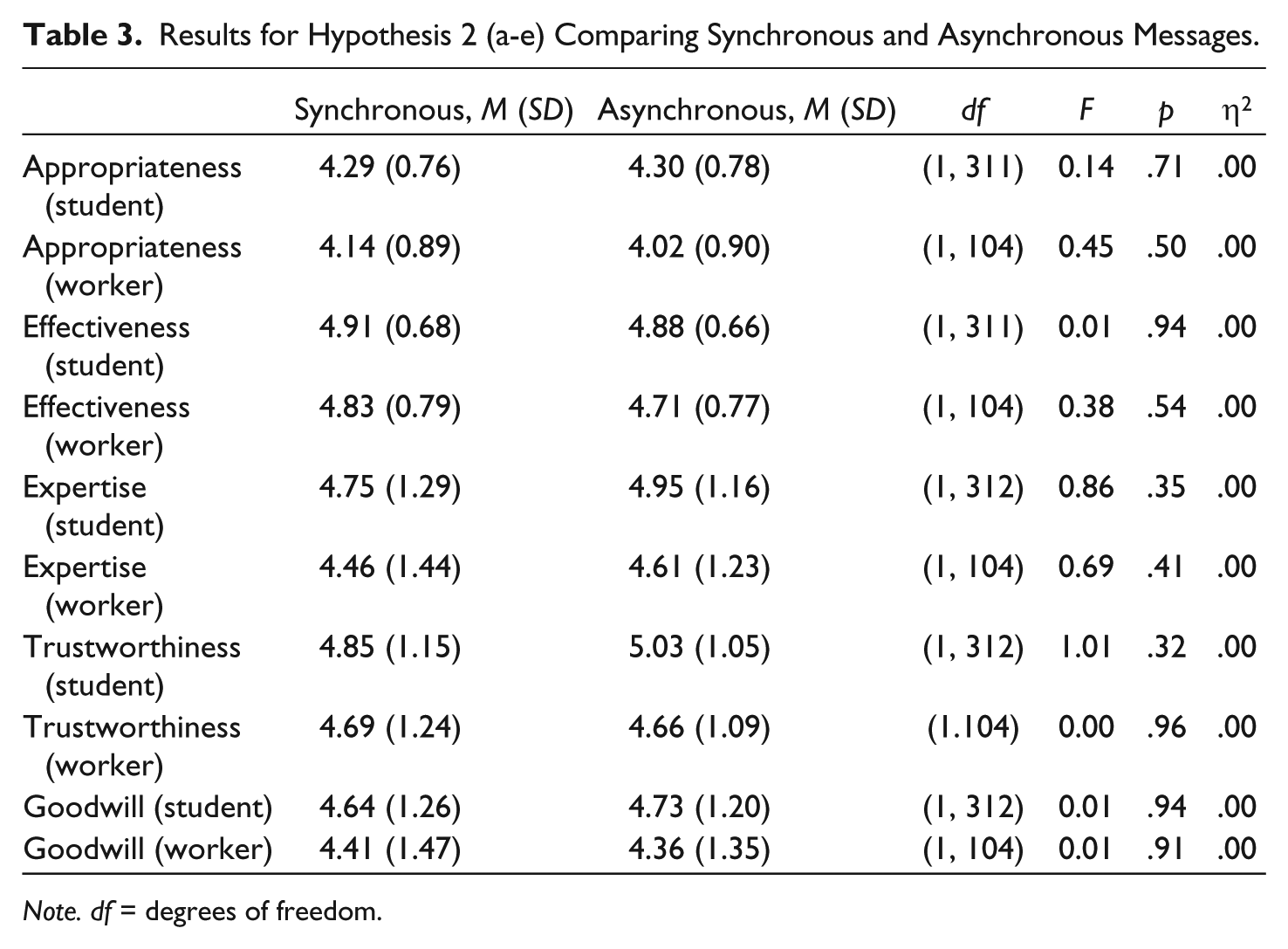
To test the hypotheses and address the research questions, 2 (valence: positive, negative) × 2 (synchronicity: synchronous, asynchronous) × 2 (channel: phone, text) analyses of variance (ANOVAs) were run on the dependent variables. Because there were significant differences between the student and worker samples, all analyses were run separately on the two samples. To simplify the reporting of these parallel tests, detailed results are reported in Tables 2, 3, and 4 with the corresponding hypothesis indicated in the relevant table.
Results for Hypothesis 1 (a-e) Comparing Positive and Negative Valence.

Note. df = degrees of freedom.
Results for Hypothesis 2 (a-e) Comparing Synchronous and Asynchronous Messages.
Note. df = degrees of freedom.
Results for Hypothesis 3 (a-e) Comparing Phone and Text Messages.

Note. df = degrees of freedom.
To summarize the results, for Hypothesis 1, the ANOVA revealed a main effect for valence, such that all impressions of the supervisor were rated more highly for positively valenced messages than for negatively valenced messages. This pattern held across the students and the workers (see Table 2, for full results). For Hypothesis 2, no significant differences emerged between synchronous and asynchronous delivery in any of the dependent variables for either the student or the worker sample. Results of this test are fully illustrated in Table 3. Finally, for Hypothesis 3, all impressions of the supervisor were rated more highly for the use of the phone rather than text messaging to deliver the feedback across both students and workers. See Table 4 for detailed results of this test.
Research Question 1 asked about the interaction between valence and channel. There was no significant interaction effect found in the student sample or worker sample for any of the dependent variables. Research Question 2 asked about the interaction between valence and synchronicity. Again, there was not a significant interaction effect found in either sample for any of the dependent variables. Finally, Research Question 3 asked about the interaction between synchronicity and channel. None of the interactions was significant except for the interaction effect for expertise in the student sample. For this interaction, the condition of synchronous phone (M = 5.30, SD = 1.10) was most highly rated, followed by asynchronous phone (M = 5.17, SD = 1.12), then asynchronous text (M = 4.71, SD = 1.17), and synchronous text (M = 4.29, SD = 1.26), F(1, 312) = 4.51, p ≤ .05, η2 = .01.
Discussion
This study was conducted with the goal of learning how employees’ impressions of their supervisors’ communication competence and source credibility are affected by valence of performance feedback, the channel through which the feedback is delivered, and the synchronicity of the feedback. Results revealed that these impressions were affected by valence and channel but not by synchronicity of the feedback message.
Valence
Previous work (e.g., Hattie & Timperley, 2007; Kacmar et al., 1996; Westerman & Westerman, 2010) has shown that feedback messages with a positive valence are generally associated with positive impressions of those delivering the message. We tested whether this finding would continue to hold true for perceptions of communication competence and source credibility. Positive messages were seen as more appropriate and more effective than negative messages. Positive messages also led to higher judgments of expertise, trustworthiness, and goodwill toward the manager than negative messages. These findings add strength to the general belief that positive messages tend to lead to more favorable outcomes than negative ones.
Channel
A second question was whether the use of a phone call or a text message to deliver feedback would lead to different impressions of the supervisor. The current data suggest that supervisors who used phone calls were seen as more appropriate and effective than text messages, and those using the phone were perceived as more competent, more trustworthy, and having more goodwill than those using text messaging. These data shed some light on O’Sullivan’s (2004) notion of “channelesics,” wherein the channel itself has some meaning in and of itself in these types of interactions. The use of text messaging for feedback delivery seems to have a negative connotation to employees; in other words, the use of text messaging may be operating as a channelesic cue per O’Sullivan (2004).
Delivering feedback via text message may seem like an unusual occurrence in workplaces at this time, but as the workforce moves toward telework (Golden, 2009), texting may become more necessary and perhaps more accepted. In a study of virtual teams using instant messaging to communicate both synchronously and asynchronously, Darics (2014) concluded that new ways of communicating may “require the flouting or rethinking of previously existing communicative norms” (p. 352). If texting becomes more heavily used in organizational settings, particularly for the purpose of feedback, then future research can examine the notion of “channelesics” as well as the development of new norms in much greater detail in the context of workplace feedback messages.
Synchronicity
A major goal was to illuminate the effects of synchronicity on perceived communication competence and source credibility. Interestingly, synchronicity did not have a significant effect on any of the dependent variables in this study, for students or for working adults. This may be because the affordance of asynchronous communication was only considered from the point of view of the receiver. Because senders of feedback are so uncomfortable with delivering negative feedback (e.g., Timmerman & Harrison, 2005), it may be that the benefits of asynchronous versus synchronous communication would be more evident if the focus is on the sender of the feedback. For example, the affordance of time to carefully compose messages and responses to the reactions of feedback receivers might be particularly appreciated by senders of feedback. Although this study did not examine phrasing of the message content, attention to the way a message is phrased could also be impactful. Composing messages carefully is probably a valuable pursuit in combination with carefully managing other aspects of feedback delivery. For example, using asynchronous interaction could help senders communicate less defensively and more constructively because they would have time to think carefully about what they should and should not say. Yet this affordance would be possible mainly because the sender chose an asynchronous method of delivery.
A second interpretation of the nonsignificant findings for synchronicity is that workers do not particularly care whether the supervisor delivers feedback synchronously or asynchronously. For supervisors who are uncomfortable delivering FtF feedback, yet want to maintain a positive impression with their employees, this could mean that asynchronous delivery is possible and acceptable. This could also have implications for supervisors who must deliver performance feedback remotely or on short notice; whether they speak with their employees in real-time does not matter as much as choosing the correct channel.
Student Versus Worker Sample
There were significant differences in how working adults versus students rated their impressions of a supervisor. The students’ impressions appear to be inflated in comparison with the working adults, but the same pattern of results emerged as the hypotheses were tested separately for each sample. Based on this, it may be concluded that the student sample would not be a wholly inaccurate, though a weaker, representation of how workers might respond in terms of impressions of supervisors.
Limitations
Although the message manipulation was effective in conveying to subjects that they had time before responding in the asynchronous conditions, it is possible that manipulating perceptions of synchronicity through a written message is not the most effective method. Not enough research has been done to have a definitive answer about the effects of synchronicity. Another limitation may be the use of an online survey. An online survey may lack realism and subjects may not feel the true effects of synchronicity. Experimental research in a laboratory setting or examining feedback delivered in existing organizations could provide a stronger manipulation of synchronicity. Future studies should seek to examine synchronicity further in settings where stronger experimental realism can be created.
Hypothetical scenarios may be considered to be a limitation; however, this drawback is countered by the benefit of experimental control, which allowed the researchers to isolate potential sources of different impressions. Also, data were collected from workers in an effort to capture the responses of those who have been in a working environment, thus, providing a boost to realism, despite the use of hypothetical scenarios. Interestingly, the responses of those workers differed from the students’ responses not substantively but only in magnitude.
Practical Implications
Managers should become aware of their own patterns of channel selection (e.g., perhaps they tend to send less preferable task assignments on e-mail) and learn how their choice of channel relays information to employees. “Channelesics” (O’Sullivan, 2004) implies that the use of a text message or an FtF meeting itself is sending a message to employees. For example, if a supervisor only holds a closed-door, FtF meeting when an employee is in trouble, getting called to the supervisor’s office implies meaning before the meeting is even held. The same kind of meaning, whether positive or negative, can also be attached to other channels, like phone calls or text messages, depending on the supervisor’s pattern of usage. Awareness of this can help supervisors preempt channelesics by varying the pattern or employing other methods to dispel employees’ incorrect expectations.
This study and others (e.g., Hattie & Timperley, 2007) found that positive feedback elicits a more positive feeling toward the supervisor than does negative feedback. Delivering positive feedback all the time to all employees to look good is not a practical suggestion, but overdoing positive feedback hardly seems like a realistic concern. It is so common to focus only on problems when giving feedback that even a small effort by supervisors to notice and comment on positive behaviors or outcomes may make a big difference for employees. This positive feedback should not be superficial but should focus on behavior and outcomes that are truly meaningful. Given the effect of positive and negative feedback (e.g., Kacmar et al., 1996), supervisors who highlight positive aspects of employee’s performance may create a more appropriate atmosphere that results in better acceptance of negative feedback when it is given.
More work must be done to examine synchronicity, but the findings of this study suggest that supervisors may be able to deliver feedback asynchronously without damage to employees’ perceptions of them. This may be a desirable option because of the discomfort some supervisors experience with delivering feedback (particularly negative; Timmerman & Harrison, 2005) in a synchronous manner. Asynchronous delivery may also be a desirable option for supervisors who are limited in their ability to deliver message content in a sensitive manner.
Future Directions
Future studies may want to examine synchronicity with increased experimental realism; that is, an effort should be made to allow participants to forget that they are participating in a study while retaining the control provided by using an experiment. Future work may also incorporate some studies of feedback delivery in a field setting. Although it may be more difficult to examine specific, controlled channel characteristics, the improvement in realism may be worth sacrificing experimental control. Either of these possibilities may improve the chances of finding differences in perceptions that exist because of channel characteristics.
There may also be other characteristics of the supervisor that would be relevant for feedback delivery. For example, the status of the supervisor-employee relationship in terms of leader-member exchange (Graen & Uhl-Bien, 1995) might make a difference. Also, whether the employee likes the supervisor could have an effect on how feedback is received. Investigating these features of a supervisor in conjunction with message features, such as channel characteristics, could be a fruitful avenue for future research in the field of communication.
Footnotes
Declaration of Conflicting Interests
The author(s) declared no potential conflicts of interest with respect to the research, authorship, and/or publication of this article.
Funding
The author(s) received no financial support for the research, authorship, and/or publication of this article.