






Abstract
Much has been written about the nature of leadership communication; however, the linkage often is limited to a view of communication as a strategic mechanism—or technique—to be employed by leaders in efforts to achieve specific purposes. This limited conceptualization of leadership communication does not fully capture the pervasive role of communication, and it fails to provide a nuanced view of the role communication plays in organizational dynamics, and in business settings, in particular. This article begins with an overview of various dichotomies raised in the leadership literature that have tended to impede rather than advance our understanding. We then discuss the evolution of thinking about communication and conclude with a discussion of several principles that can enhance contemporary organizational and business communication theory and practice.
Interest in the nature of leadership has grown substantially in recent years in professional as well as academic literature. This interest spans disciplines and sectors, and the topic is of particular interest to those involved in the study and practice of organizational and business communication. Communication is a topic frequently linked to leadership; however, the linkage often is limited to a view of communication as a strategic mechanism—or technique—to be employed by leaders in efforts to achieve specific purposes (Ruben & Gigliotti, 2016). This view of communication is pervasive, in part because it is easy to understand and operationalize. However, as discussed in this article, this limited conceptualization of leadership communication does not fully capture the pervasive role of communication, and it fails to provide a nuanced view of the role communication plays in organizational dynamics, and in business settings, in particular.
Recent scholarship has begun to reexamine the important relationship between leadership and communication (e.g., Fairhurst & Connaughton, 2014a, 2014b; Tourish, 2014), but there is a need to further explore and articulate these connections in a way that acknowledges the limitations of traditional models of communication. As there is a need for an integrative view of leadership (Eberly, Johnson, Hernandez, & Avolio, 2011), we believe that there is also a need to advance a more expansive view of communication, one that represents communication as a symbolic process that shapes the human experience.
In much the same way as Thayer (2003) characterized communication as the “sine qua non” of the behavioral sciences, we also recognize communication to be a similarly essential and indispensable condition of leadership. A communication orientation allows us to better understand leadership as planned and unplanned, intentional, and unintentional, shaped by both the leader and the follower (Ruben & Gigliotti, 2016). The existing emphasis on the role of discourse in the writing on leadership communication, while very useful in a number of respects, also has had the effect of diminishing attention to the impact of the material and nonverbal components of communication in leadership influence processes. As will be discussed in this article, the fragmented past of communication theory and practice has tremendous implications for the study and practice of leadership. This more nuanced understanding of communication theory is critical to influencing our understanding of leadership as a communicative process of social influence, an important pivot that enriches our understanding of the scope and role of leadership in a business context.
In this conceptual article, we focus on the communication process and its current and potential contributions to leadership knowledge and practice. We begin with an overview of various dichotomies raised in the leadership literature that permeate the scholarly and professional literature on organizational and business leadership, and in our view, have tended to impede rather than advance our understanding. We go on to explore the evolution of thinking about communication and three distinct ways of understanding leadership communication based on these perspectives—a classical linear model, an interactional model, and a systems model, with the latter being most consistent with a characterization of leadership as a process of social influence. We conclude with a discussion of several principles for leadership communication thinking that can enhance contemporary organizational and business communication. By thinking more deeply about the nature of communication, the principles offered at the conclusion of this essay can inform the practice of leadership communication in organizational life and business practice, in particular.
Leadership Literature Dichotomies
Many leadership authors in both the scholarly and professional literature wrestle with a series of dichotomies, defined by Merriam-Webster (2016) as a “division into two especially mutually exclusive or contradictory groups or entities.” This approach to leadership thinking carries both assets and liabilities. The dichotomous way of thinking about leadership has been popular within the leadership literature, particularly as applied to organizational and business contexts. In our review of the literature, 1 we have identified a number of frequently noted dichotomies, including the following:
Leadership or management: Is management—the knowledge—and skill-set associated with providing effective day-to-day supervision, guidance, coordination, and oversight in an organizational setting—a critical aspect of leadership? Or, does leadership extend beyond management, focusing upon the importance of vision, charisma, creativity, and transformation—perhaps as something even antithetical to those activities typically associated with management and the capabilities needed in managers?
Leader or follower: What distinguishes the role of the leader from the role of the follower, and in what ways does the very existence of leadership require followers?
Formal or informal: Does leadership refer only to situations in which someone with a formalized role, title, or position guides, oversees, or pursues goals? Or, is leadership a phenomenon that can occur without regard to formal roles or titles? Or, as others have characterized this dichotomy, is leadership assigned or emerged (Northouse, 2015)?
Science or art: Can leadership be studied systematically in a manner that will lead to valid and reliable descriptions and explanations and the emergence of generalized concepts and theories? Can these ultimately be used for predicting and controlling leadership and leadership outcomes? Or, is leadership fundamentally an art form—one that is idiosyncratic, a matter of personal expression, largely indescribable, largely unpredictable, and wholly uncontrollable?
Academic field or common sense: Is leadership a complex topic and an appropriate area for academic study? Or, is understanding leadership, and doing it well, essentially a matter of common sense?
Natural or learned: Is leadership a natural capacity or an intuitive capability which some have and some do not—or is it learned over time? What role then do leadership development programs play in leadership knowledge and practice?
Theory or practice: Should leadership learning be focused on identifying abstract characterizations, representations, or models of a particular phenomenon? Or, should the investigation of leadership center on the world of practice, where leadership is manifest, where concepts come to life, and where professionals strive to translate their insights into practice?
Context specific or context general: Does the uniqueness of every organization, community, setting, sector, or discipline mean that the nature of and requirements for leadership in each setting must also be unique? Or, are commonalities across organizations, communities, settings, and sectors, such that general or universal concepts of leadership are cross-cutting and applicable across all social structures and circumstances.
Content area knowledge or personal skill: Does leadership, first and foremost, require knowledge, subject-matter expertise, and experience about a specific domain or sector? Or, is leadership fundamentally about personal competencies and one’s relationship with others, including the ability to listen and learn quickly and work well in team and group settings?
Transparent or opaque: Should leaders and leadership be open, transparent, candid, and marked by free-flowing communication behaviors? Or, are secrecy, partial disclosure, and indirection necessary characteristics of leadership?
Authentic or calculating: Should leaders and leadership be about “being oneself” and “letting people see the real you” as an authentic individual? Or, is the concept of authenticity antithetical to leadership because it creates vulnerabilities and eliminates strategic possibilities for the leader?
Planning or execution: Is leadership fundamentally about deliberation and the methodical development of plans? Or, is leadership ultimately defined not by planning, but by implementation and execution?
Servant or master: Can leadership be meaningfully defined in terms of being a servant to others—to one’s followers? Or does the notion of “servant” imply subservience, and suggest a circumstance where all plans, directions, and goals are set by followers, when in fact, most leadership situations require the establishment of direction by a chosen leader?
Incremental or strategic: Should leaders move cautiously and slowly, striving to make gradual changes with the goal of minimizing stress, disruption, and chaos? Or, does incremental change often fail to create an appropriate rate of change in response to the changing conditions in the environment?
Great influence or influence often overstated: Do leaders play a central, pivotal role in bringing about organizational and community change? Or, is the influence of leaders often overstated, romanticized, and glamorized beyond what is demonstrable or evidenced?
Enactment or empowerment: Is leadership best conceptualized as a “do it yourself,” “the buck stops here,” “you are in charge” process through which goals are pursued and realized? Or, is leadership a process of working with and through others to achieve goals?
Managing down or managing up: Is the focus of leadership on influencing, guiding, and overseeing the behaviors of those followers in lesser or lower positions in an organizational structure? Or, is it is more critical for leaders to influence, guide, and oversee the behaviors of those to whom one reports in an organizational hierarchy?
Directing or role modeling: Is leadership primarily about directing and guiding others in the desired direction? Or, is it more fundamentally about directing and guiding oneself—modeling the directions, behaviors, and aspirations one has for others?
Transactional or transformational: Is leadership about maintaining the status quo as an organization gradually works toward the pursuit of particular collective goals? Or, is it more fundamentally about creating transformative or major changes within an organization or among one’s colleagues?
As we consider the intersections between leadership and communication, note that one’s understanding of this topic is very much informed by one’s posture relative to the aforementioned dichotomies. Those theories that are arguably most relevant to management scholars, including leader-member exchange (Graen & Uhl-Bien, 1995), self-leadership (Manz, 1986; Neck & Houghton, 2006), servant leadership (Greenleaf, 1977; Sendjaya & Sarros, 2002; Spears, 2002), and shared or distributed leadership (Bolden, 2011; Pearce & Conger, 2003), each wrestle with the tensions raised by these dichotomies. As useful as dichotomous thinking can be, this way of characterizing phenomena can also be limiting in many ways as well. For instance, Islam (2016) suggests that many of these underlying positions to leadership thinking “are likely themselves products of social organization that privileges, or at least makes apparent, certain positions at the expense of others” (p. 100).
It is worth exploring four of these dichotomies in greater detail, for they frequently inform our understanding of leadership communication in theory and practice and they seem to be the most closely related to the dynamics of leadership communication in the business sector (Ruben, De Lisi, & Gigliotti, in press). One of the most popular dichotomies that is important for understanding leadership in business contexts considers what are presumed to be the differences between management and leadership. The current literature tends to identify the manager’s role in maintaining order and consistency through the demonstration and accomplishment of activities and routines, where the work of leaders relates to articulating a vision for the future that both privileges and produces change and movement (Bennis & Nanus, 1985; Kotter, 2012; Zaleznik, 2004). This separation between leadership and management highlights a useful distinction; however, it is overly simplistic and it privileges “leadership” as the more glamorous role, while marginalizing the methodical and systematic, if also routine, activities associated with daily organizational and business functioning. In practice, a closer look would often reveal that these two images are blurred in the work of successful leadership in business, and both kinds of activities require competencies in communication for effectiveness.
A second dichotomy that is common in the leadership and management literature is one that emphasizes the important role of a leader while diminishing the role of followers. Much of the literature presents a clear distinction between leaders—those who initiate tasks, make critical decisions, exert influence, create vision, direct activities, manage resources, or exercise power, while followers—are those who simply carry out the directions and receive guidance and supervision from the leader. It may also often be the case that more often than not leaders are presumed to be responsible for initiating the workplace and stakeholder relationship, creating communication linkages, and carrying the burden for providing the direction necessary to maintain these relationship. This delineation has value in some respects, but as we will discuss momentarily, the distinction between leadership and followership oversimplifies what is, in fact, very complex roles—one that is fuzzy and fluid in practice, and frequently characterized by reciprocity and mutual causality. In fact, in the ongoing dynamics of group and organizational life, it may be quite difficult to discern who is leading and who is following at any moment in time, and the roles are dynamic. Paralleling the distinction between leaders and manager discussed previously, in practice, leaders often follow, followers often lead.
Even more fundamentally, recent scholarship goes so far as to suggest that leadership itself is co-constructed between the interactions of leaders and followers through communication (Barge & Fairhurst, 2008; Witherspoon, 1997) and notes that in the most basic sense, without followers there are no leaders (Ruben & Gigliotti, 2016). Values also enter as a consideration here, as many authors argue that leaders have an ethical responsibility to attend to the needs and concerns of his or her followers. While “the romanticization of leadership” (Meindl & Ehrlich, 1987) is common, particularly in professional and popular discourse, for the various reasons noted above, scholars caution about the dangers of falsely dichotomizing leadership and followership, and the tendency to attribute superior power and influence to the former, while failing to recognize the mutually defining nature of the relationship.
Professional and popular discourse, particularly in business and organizational settings, tends also to reify the formal-informal leader dichotomy. In this way of thinking, leadership is generally equated with formal positions of authority, responsibility, and power. However, if one thinks of leadership in terms of social influence (Ruben & Gigliotti, 2016), one quickly realizes that social influence occurs through communication and from the enactment of informal roles and through informal activities, as well as through formal positions and activities. Leadership is understood to be a communicative process (Fairhurst, 2007; Fairhurst & Connaughton, 2014a, 2014b) that extends beyond the role of the titular leader; rather, the possibilities for leadership are present in all social interaction within all groups, organizations, and contexts, and extend across all levels and units of an organization. Similar to the notion of leaders requiring followers, the success of formal leaders is very much dependent upon the perceptions, attitudes, and experiences of informal leaders who often are able to exercise influences which can complement, supplement, or undermine the work of individuals formally vested with leadership responsibilities. The formal-informal dichotomy also raises questions about the nature of leadership as either an assigned or emerged (Northouse, 2015) phenomenon. A broader conceptualization of communication allows for an understanding of leadership as including individuals functioning in informal and emergent roles as well as in roles which are formal and assigned.
Finally, we believe that business practices demonstrate quite dramatically that leadership lies at the intersection of science and art, rather through one or the other alone. From a scientific perspective, a number of generalizable theories and concepts aim to inform and systematize leadership scholarship and practice. But the scientific approach, alone, is insufficient to explaining effective leadership behaviors or outcomes. The translation of science into effective leadership practice is ultimately an art form. As an art, the application and implementation of leadership is understood to be a personal phenomenon—one that is subject to individual idiosyncrasies, styles, strengths, and susceptibilities. Both perspectives are created and blended in organizational and business leadership practice through individual and social communication processes.
Each of the various leadership dichotomies listed add to the richness of the concept of leadership, but they also point to tensions and complexities that further challenge efforts to bring precision to theories of leadership and their appropriate application in professional contexts—organizational and business settings, most particularly. The goal of this essay is not to resolve the tensions raised by these dichotomies—each of which bespeaks a fundamental and useful tension, theoretically and practically (Islam, 2016; Ruben & Gigliotti, 2016). Rather, our goal is to demonstrate how communication and social influence help explain and reconcile the tensions posed by these dichotomies and other challenges to leadership thinking and practice.
Past and Present Conceptualizations of Communication: Classical Linear, Interactional, and Systems Models
Leadership as Social Influence
In our past writing on the subject (Ruben et al., 2016; Ruben & Gigliotti, 2016), we discuss the evolution of leadership theory that ranges from classical, contemporary, competency, and communication approaches. These various approaches focus on specific aspects of leadership, the leadership context, and the leader-follower relationship. Our research in this area and our applied work in the area of leadership development have led us to understand the phenomenon as a process of social influence that is very much informed by and shaped by communication. The process involves both verbal and nonverbal communication and is defined by followers as much as by leaders. Communication theory allows us to broaden our understanding of leadership to consider those moments that are formal and informal, planned and unplanned, intentional and unintentional.
This way of understanding leadership challenges us to consider past and present conceptualizations of communication. Fully understanding the nature and significance of communication requires that many of the assumptions made based on our everyday experience need to be examined more carefully. In much the same way that the dynamics of breathing can be easily taken for granted, so too, it is very easy to assume we understand the nature of communication because we are so complexly enmeshed in the process. But as Lee Thayer (1968) aptly noted in his foundational work in this area, We can’t afford to assume we understand all there is to be known about even the most elementary and obvious aspects of human communication. . . . If we do, there is no way for us to communicate very successfully about communication. (p. 5)
In everyday ways of thinking about communication, it is quite natural to assume that the process involves the creation and transmission of verbal messages to intended receivers, thereby bringing about shared understanding. However, as Watzlawick, Beavin, and Jackson (1967) noted, “One cannot not communicate” (p. 49), which indicates that the study and practice of communication extends beyond talk-in-interaction and must also take account of that which is not said. A more expansive, complex, and nuanced understanding of communication considers the complex arrangement of verbal and nonverbal messages, intentional and unintentional messages, planned and unplanned messages—all of which influence the ways that leadership is constituted in a variety of settings.
As highlighted at the outset of this article, business communication is often cast as a limited, one-way, cause-and-effect phenomenon. In many instances, however, the message sent tends to not equal the message received, which presents a cascading set of challenges for leaders attempting to influence others within the business environment. What follows is a brief summary of past and present conceptualizations of communication and the value of these perspectives in more fully understanding the dynamics of leadership (Ruben & Gigliotti, 2016). Building upon the insights to emerge from these three models, we will outline several principles for leadership communication thinking that can enhance and improve the role of business communication. The notion of leadership as a process of social influence that is planned and unplanned, formal and informal, and defined as much by the leader as the follower (Ruben & Gigliotti, 2016) is an outcome of the systems model, the third approach presented below.
Classical Linear Model
In classical and many contemporary popular writings on the subject, leadership is thought about and described in terms of the intentional creation of messages with particular influence outcomes in mind. As portrayed in Figure 1, this view suggests that if a leader intends to accomplish a particular goal or communicate a specific message, he or she can do so by creating and transmitting a message, and assuming the message reaches the receiver, the process seemingly plays out in a very linear and predictable manner.
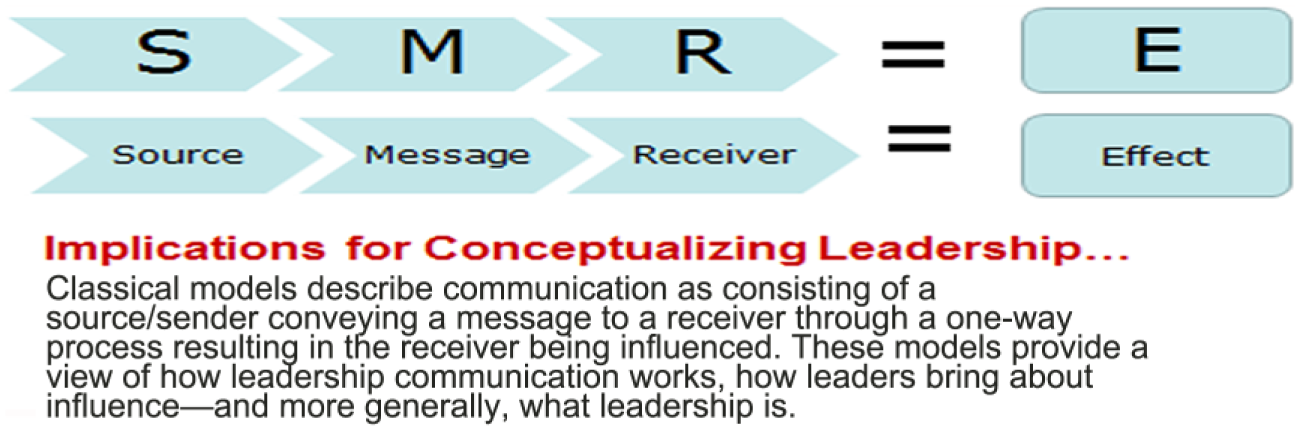
The classical linear perspective.
Essentially, such a view reflects a one-way, cause-and-effect-oriented characterization of the communication and influence process that has been pervasive through much of the history of communication thought. According to Hackman and Johnson (2013), for example, leadership may be considered a special form of communication—it reflects who you are, how you act, what you do, and how you work with others. Their synthesis of the literature leads the authors to define leadership accordingly: “Leadership is human (symbolic) communication that modifies the attitudes and behaviors of others in order to meet shared group goals and needs” (p. 11). Based on this understanding of leadership, successful leadership is a consequence of effective communication—where the implication is that communication is a linear process in which a source/leader, if successful, brings about intended attitudes and behaviors in receivers/followers. From this perspective, a failure in communication may ultimately lead to a failure in leadership itself. Clearly, the concept of “communication failures”—defined as a mismatch between the communication and behavior outcomes and communication inputs—is a logical extension of the linear way of thinking about how the process works. Consistent with this claim are the numerous training programs, curricula, and workshop requirements that increasingly emphasize communication as a critical competency for leadership itself—by following a prescriptive recipe for “effective communication,” one may achieve intended influence outcomes as a leader. This approach to communication is intuitively attractive. It is easy to understand and appealing in its simplicity, and even the most accomplished scholars in our field find themselves periodically slipping into this paradigm in their efforts to describe, explain, predict, and control everyday communication situations.
As much as the “transmission,” “exchange,” or “sharing of information” is a familiar and customary way of describing communication, we know that this portrayal oversimplifies and actually obscures some critical nuances of the process—and leads to an incomplete understanding of the dynamics associated with communication—including the nature and dynamics involved in leadership-followership. The reality is that seldom does message sent equal message received. Seldom does communication operate in such a predictable manner, and neither do the underlying dynamics of leadership-followership and the broader dynamics of social influence. Although this model and the paradigms it reflects have been criticized for their mechanistic characterization (Axley, 1984; Shannon & Weaver, 1949), they continue to provide an apt description of leadership communication practices in many business and organizational settings.
Interactional Model
Unlike the linear model, an interactional perspective, such as that depicted in Figure 2, attempts to capture more of the complexity and two-way influence between a sender and receiver—or, for the purpose of this text on leadership, a leader and follower. The interactional perspective recognizes that communication is not a one-way process, but rather is best understood as “a multidirectional phenomenon with no distinguishable beginning or end” (Ruben, 2003, p. 95). Related to the study of leadership, meaning is not easily controlled by the leader, but rather results from interactions between leaders and followers (Smircich & Morgan, 1982). It also suggests that the greater the extent of mismatch between expectations, attitudes, and values, the less the likelihood that message sent will equal message received (Ruben & Stewart, 2016).
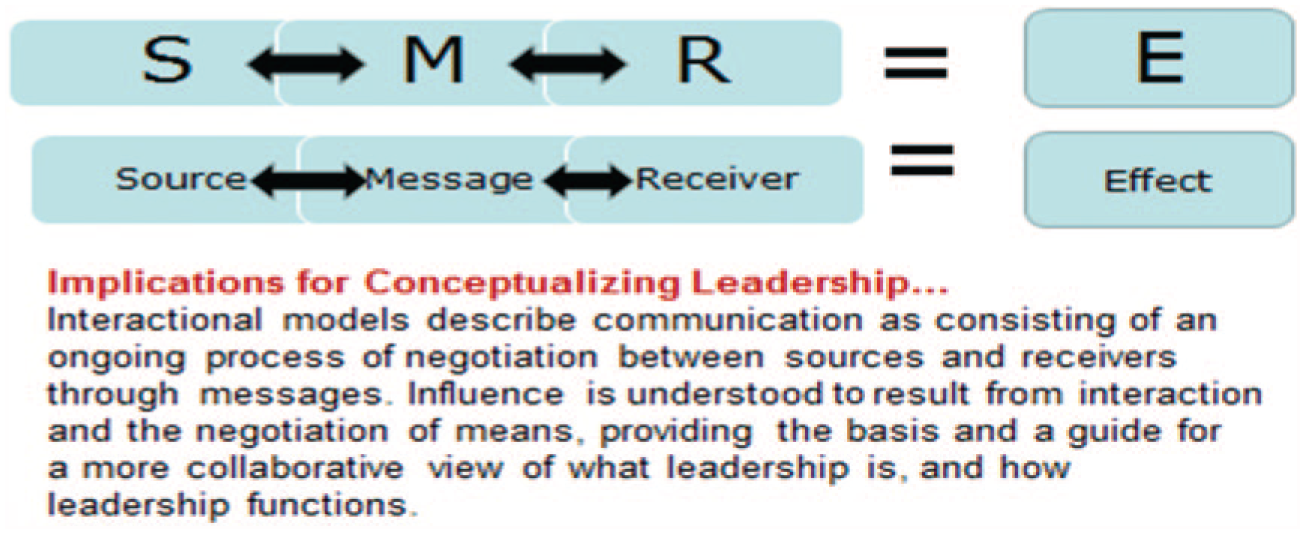
The interactional perspective.
This more contemporary view of communication reminds us that only a fraction of the influence that occurs in communication situations is the result of these kinds of purposeful and intentional acts, as depicted in Figure 2. A multiplicity of factors are at play in even the most basic situation, and the net result is that the communication process associated with influence is far more complex and unpredictable than suggested by one-way models. Indeed, many of the messages that make a difference in communication and influence situations are unplanned and unpredicted, nonverbal as well as very verbal—and the product of ongoing dynamics rather than a single message-sending/message-receiving event. It becomes clear that these key points are not well captured by the linear classic model. Unlike the limited one-way linear model, the interactional model expands the focus to a more complex two-way interchange between sender(s) and receiver(s). Just as the sender communicates with the receiver, the receiver is communicating reciprocally, sometimes simultaneously, with the sender. This transactional communication exchange may include both verbal and nonverbal messages. For example, as a speaker addresses an audience, the messages from members of the audience may be both verbal (including, e.g., nonfluencies, applause, laughter) and nonverbal (including an array of gestures, facial expressions, dress, tears, the nature of the venue, or objects such as signage or displayed artifacts—e.g., weapons or religious objects). Despite the more expansive focus of the interactional model, the emphasis is still primarily on the intentional exchange of messages, and communication continues to be conceptualized in terms of the exchange, sharing, or transmission of information. Even with added nuances of the interactional model, the complexity of communication, and the critical issues for understanding, the dynamics of leadership and influence are often not fully explored. The interactional model is useful in that it helps explain the progression from a linear model to a systems model—one that extends the study of communication and social influence to a more nuanced place.
A systems view of communication, as depicted in Figure 3, overcomes many limitations of earlier conceptualizations and is more useful for capturing the complexity of leadership communication and social influence. This view of communication focuses directly on the way people create, convey, select, and interpret the messages that inform and shape their lives—viewing communication as a basic life process rather than an exchange of information or meaning between people (Ruben & Stewart, 2016). This perspective recognizes that some business messages are intentionally created; others are produced accidentally. Some messages—such as corporate annual reports and individual employee evaluations—are constructed to achieve specific influence goals or intentions; others—such as casual conversation while waiting for a business meeting to start—may be unconsciously or accidentally created by their initiator with no specific purpose in mind. Some messages are constructed to achieve specific influence goals or intentions; others may be unconsciously created by their initiator with no specific purpose in mind. Some messages are created in the moment in face-to-face settings; others occur at remote times and places and are conveyed into a particular setting via print or electronic media (Ruben & Stewart, 2016). And some messages that can be very important to communication outcomes have inanimate sources—a corporate logo, promotional brochures, the menu at a business event, uniforms, or the sound level in an open office.
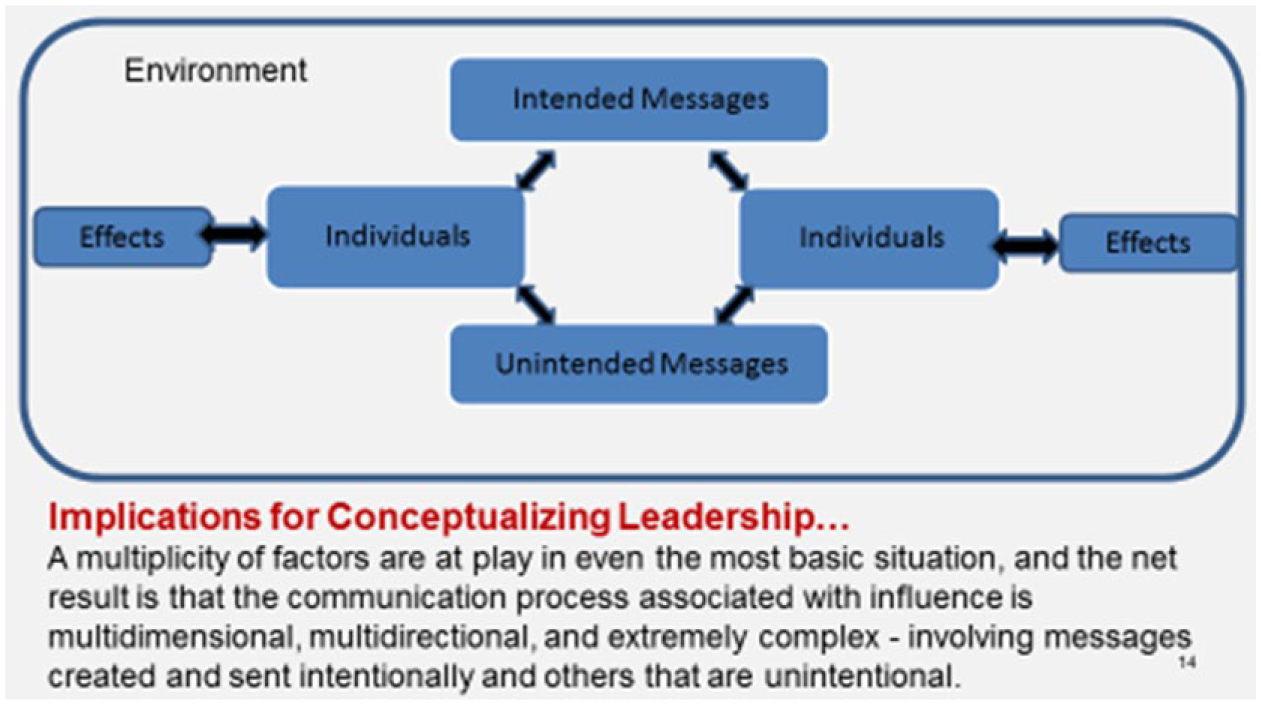
A systems perspective on communication and social influence.
This view of communication takes into account the fact that throughout any message sending/message receiving episode, each party brings his or her own unique “maps” and “personal luggage” to the interaction—each individual’s unique needs, values, attitudes, goals, aspirations, styles, education, cultures, physical and emotional abilities and disabilities, life history, and present life circumstances. These “belongings” travel with an individual and influence every aspect of the way messages are created (or not), made sense of (or not), and reacted to (or not). Thayer (1968) describes these “belongings” as the, needs, values, expectations, attitudes, and goals that are brought to every communication encounter. These predispositions, susceptibilities, and take-into-account-abilities influence the outcome of the interaction and are equivalent to our individual make-meaningful-abilities. (p. 36)
Carrying forth the metaphor, it is apparent that in some situations, the communication “luggage” of one individual does not necessarily align all that well with the expectations, attributes, outlooks, states, and orientations of others with whom they are engaging. Generally speaking, the greater the extent of mismatch, the less the likelihood that message-sent will equal message received (Ruben, 2014; Ruben & Stewart, 2016).
Some of the recent work in the area of communication as constitutive of organization (or what has become known as CCO perspectives) reflects much of the foundational thinking that is present in the systems model. CCO theorizing has emerged as a useful way of thinking about communication in organizations. If organizations are understood to be communicative accomplishments (Fairhurst & Putnam, 2004), CCO offers a way of thinking about the ways that organizational realities are coconstituted in and through communication (Ashcraft, Kuhn, & Cooren, 2009; Cooren, Kuhn, Cornelissen, & Clark, 2011; Putnam & Nicotera, 2009). Communication is understood to be more than something that happens within the walls of an organization. From this perspective, communication is formative of organizing and organizations are best understood as discursive accomplishments. As Cooren et al. (2011) suggest, The time is now ripe for a constructive dialogue across communication and organizational literatures in order to promote a more integrated understanding of the role that communication plays in creating the meaning, the form, and indeed the very possibility of organizational life. (p. 15)
Building upon a systems model, the CCO literature provides a useful lens for further understanding the constitutive role of leadership communication and social practices of communication in business environments.
A systems approach, along with the more recent work in CCO, underscores the limitations of the linear meaning-transmission or information-exchange views of communication and reminds us that single messages and single message-sending events seldom yield momentous message reception outcomes. Rather, communication and social influence are parts of an ongoing process through which messages wash over individuals—somewhat analogous to waves continually washing upon the shore. While the influence of any single wave is likely to be limited, over time, these messages shape the sensibilities and responses of receivers, much as waves shape a shoreline. The exceptions to this subtle process are those rare, life-changing messages that can have a tsunami-like impact on message reception.
Leadership Insights for Contemporary Organizational and Business Communication Practice
An examination of the existing dichotomies offered at the outset of this article, coupled with the brief review of the evolution of human communication thinking, provide a theoretical foundation for thinking through the role of contemporary organizational and business communication practice. The shifting global landscape—a landscape that consists of rapid and constant communication, organizations defined by increasing complexity and differentiation, with colleagues and customers and other key audiences separated from one another in time and space, the need for intercultural communication and inclusivity for negotiating even basic business transactions, increased global competition, the increasing importance of big data, and the need for more personal, responsible, and ethical management practices—calls for a reexamination of concepts and effective principles for business communication. A more nuanced conceptualization of communication theory, one that is not simply tactical, but in fact is responsible for the creation and maintenance of the symbolic environment that constitutes everyday experiences, provides an appropriate and useful theoretical foundation. This view allows for a more thoughtful understanding of the following six critical leadership insights related to organizational communication practice. These principles emerge from an investigation of the earlier dichotomies offered in the paper. Regardless of one’s positioning along the individual dichotomy continua, these six principles capture general communication insights that help to reconcile the various tensions. Furthermore, these principles reflect more nuanced views of communication as discussed in this article. For example, as offered below, the principles extend beyond limited sender-message-receiver approaches to communication, and point to the complex, constitutive, and cultural nature of communication in business environments. Future research on these principles can further unpack the applied connections to leadership communication business environments.
Leadership Communication Strategy Should Be Systematic
Purposeful communication efforts are fundamental to business and organizational leadership strategy and daily practice. Typically, these strategies focus on the creation and dissemination of carefully crafted oral and written messages by leaders in order to inform or influence internal and external constituencies in particular ways. The more expansive view of leadership communication as social influence, as discussed in the previous pages, reminds us that outcomes within an organizational leadership context are often unplanned, unintentional, unpredicted, and unpredictable—nor are these outcomes easily controlled, despite the most skillfully constructed messages may be disseminated by the most adept speaker or writer.
Understanding leadership in terms of this broader perspective of communication and social influence points to the importance of balancing attention to message source, message, and message construction, with a parallel emphasis on the needs, predispositions, and embedded values of intended recipients, and on the broader symbolic environment in which the communication processes will take place. What is it that intended message recipients can hear, need to hear, or are prepared to hear? How may their communicative capabilities and susceptibilities lead them to misunderstand the intended leadership messages? How can the current environmental conditions and culture facilitate or inhibit achieving particular outcomes? How is timing a potentially significant communication variable? In this regard, a leader may find it more useful to envision himself or herself less as the lead performer in a symphony—the individual who controls the musical note and the dissemination of sound, and more like the conductor of the group—the individual who, despite taking primary responsibility for the harmony and progression of the symphony, is very much reliant on the influence of the individual musicians. More broadly, thoughtful leaders must consider how the many factors that affect social influence can best be taken account of in the development of a systematic leadership communication strategy. They also should plan for ample redundancy and repetition as essential to increase the likelihood that the message received will approximate the message sent, and to create mechanisms through which to monitor communication outcomes and adjust strategies as a way of taking account of the inevitable varieties in interpretation that will occur.
Leaders “Cannot Not Communicate”
Given the broader context discussed in the previous section, another important insight with many implications is the notion that “one cannot not communicate” (Watzlawick et al., 1967). What an organizational leader says can be an important message, but equally and sometimes more important, is what a leader does not say, how a leader responds to what others say, or how he or she fails to respond. Silence, for example, can be an extremely powerful message.
Beyond the oral and written messages, nonverbal and material elements are also potentially significant elements of the communication environment. So it is that what is said and not said, written and not written, responded to and not responded to, done and not done are all potentially important elements. One’s presence/absence or early/late arrival to a meeting can become a most influential message to all in attendance, as can open-door or closed-door office hour policies—each representing a nonverbal message that may speak far more loudly than other more carefully planned and scripted verbal messages. The more successful a leader is in understanding, predicting, and controlling these factors, and the more he or she implements mechanisms for systematically monitoring outcomes and recalibrating communication strategies accordingly, the more strategic control he or she is able to exercise over the symbolic environment in which social influence takes place.
Followers Play an Instrumental Role in Making Leadership Work, So Much So That in Many Respects Leadership and Followership Are Inseparable Concepts
Recognizing that leadership outcomes are defined as much by followers as they are by leaders, reinforces the importance of focusing on those who one wishes to lead. In a very real sense, it is the attention and buy-in of “followers” that empowers an individual to be a leader. As noted earlier, “follower” needs, values, and perspectives are fundamentally important components of the communication environment in which the dynamics of social influence occur. A more expansive approach of communication allows us to better understand the interdependent relationship between leaders and followers and between formal and informal leaders in organizational life. This strategy allows a leader to remind himself and others, that leadership is something “we” do together, not something that “I” do alone.
Leadership Communication Always Has Both Content and Relational Consequences
While most leadership communication efforts seem to emphasize message content and task-related activities, in the longer term, relationship outcomes that are a by-product of communication are often even more critical because they create a foundation for supportive or unsupportive communication. This is especially the case in the contemporary workplace, where mediated interactions are becoming increasing prevalent and important. Although it can be difficult to focus on and succeed in establishing supportive relationships in a face-to-face setting, doing so via e-mail, cell phone, and text messaging is considerably more challenging, and equally important. As the ever-increasing dependency on Internet-based messages is apparent in business communication, reminding oneself of the essential and interdependent role of content and relational dimensions of communication becomes increasingly more critical. Particularly when social influence efforts take place among individuals who may not have a strong face-to-face communication history on which to draw, attention to creating and maintaining relationships on-line is as important—perhaps even more important—than focusing on the content of messages. As in all communication and social influence, relationships provide the context and foundation in terms of which individual messages are interpreted and acted upon.
All Leadership Communication Is Intercultural
Culture and cultural differences are a fundamental and influential element of the symbolic environment in which leadership communication dynamics occur. An understanding of and appreciation for cultural differences is critical in developing, maintaining, and navigating local and more so global business relationships where senders and receivers are not necessarily colocated and where there may be a number of intercultural issues associated with information flow and mutual understanding. The array of challenges present in face-to-face and mediated influence efforts are often elevated in direct proportion to the extent of cultural differences that are involved.
The Focus on Leadership Communication Theory and Practice also Extends into the Realm of Training and Development
Existing approaches to leadership training and development, a popular and expensive focus for a myriad of contemporary organizations (Association for Talent Development, 2015), also vary along a continuum from mechanistic/strategic to organic/systemic. For the same reasons that a one-way, linear perspective is limiting as a way of understanding the dynamics of leadership, so too, this approach is often of limited value as a strategy for leadership and communication training and development. The most successful leadership development programs and outcomes occur within symbolic environments where many elements of effective social influence are present, recognized, valued, and rewarded.
Conclusion
The connections between communication thinking, particularly those concepts most germane to the study of organizations and business communication, and the study and practice of leadership are important. Traditionally, the study and practice of leadership tend to focus on the leader and the specific mechanisms and strategies employed to influence others, all of which involve communication. Such approaches merely scratch the surface in exploring the potential relevance of communication to leadership. In fact, such applications are misleading to the extent that they suggest a linear relationship between leadership message sending and leadership influence outcomes. This view is not grounded in what we know to be the nature of communication, contributes to a romanticized view of leadership influence, and will surely lead to disappointing outcomes for practitioners who uncritically embrace this characterization of communication. These distinct views of leadership communication are difficult to reconcile and synthesize, yet the time has come for more fully integrating these concepts to create a broader, more nuanced, and more strategic understanding of leadership as social influence. Nowhere is this expansive, systemic, and strategic view needed more than in our understanding and practice of leadership in organizational and business settings where these challenges related to leadership, communication, and social influence are absolutely fundamental.
Footnotes
Declaration of Conflicting Interests
The author(s) declared no potential conflicts of interest with respect to the research, authorship, and/or publication of this article.
Funding
The author(s) received no financial support for the research, authorship, and/or publication of this article.