







Abstract
Through a cross-sectional online survey, this study examines the moderated mediation model of public skepticism toward organizational altruism and public distrust of CSR messages in the process of corporate social responsibility (CSR) communication. Focusing solely on CSR communication elements rather than CSR practice, this study sheds light on the significant role that effective CSR communication elements play in attenuating public skepticism and further inducing positive public evaluations of an organization. Our results suggest that skepticism toward altruism is significantly reduced by the six effective CSR communication elements—CSR informativeness, transparency, objectivity, consistency, personal relevance, and a less promotional tone. In turn, an organization is able to restore the publics’ positive evaluation of it. Although this study confirms the moderating role of public distrust in the process, it also reveals this moderating role to move in an unexpected direction. That is, the positive effects of effective CSR communication elements are much greater for people who have stronger distrust of CSR messages than those with less distrust. This indicates that public distrust of CSR messages (developed over time) may be overcome with quality CSR communication.
Keywords
In today’s market, one can easily observe a surging public distrust of corporate communication. Consumer publics (hereafter publics) often criticize the influx of organizational promotion, marketing, and advertising with regard to corporate social responsibility (CSR) activities of various organizations. Either through their personal experience with discrepancies in CSR claim performance or media exposure to it, publics tend to resist an organization’s persuasive attempts by deliberately questioning its CSR claims and express skepticism of its true intentions (Yoon, Gurhan-Canli, & Schwarz, 2006). In fact, such public skepticism imposes a hardship on organizations as they strive to communicate their CSR efforts (Bae & Cameron, 2006; Yoon et al., 2006).
Past studies on CSR have identified factors that influence public skepticism such as business-cause fit, prior reputation, CSR history, and proactive versus reactive approaches (Bae & Cameron, 2006; Elving, 2013; Vanhamme & Grobben, 2009; Wagner, Lutz, & Weitz, 2009). However, given that the previously mentioned factors concern noncommunication aspects of CSR, whether consumer skepticism toward organizational altruism can be abated through effective CSR communication is rather unclear. Moreover, how public distrust of CSR messages, developed over time, interacts with an organization’s CSR communication effectiveness remains relatively unknown; to demonstrate such relationships, fresh empirical evidence is needed.
This is in line with Dawkins’ (2004) claim that CSR communication remains “the missing link” (p. 108) between CSR activities and their outcomes as well as with Kim and Ferguson’s (2018) contention that the elements of effective CSR communication and their consequences are relatively understudied. To better demonstrate the role of communication in CSR, these scholars have called for more emphasis on CSR communication and its processes.
This study thus attempts to answer such calls by examining the relationships among effective CSR communication elements, public skepticism toward organizational altruism, public distrust against CSR messages, and public evaluation of organizations. Specifically, in terms of their relationships with public skepticism toward altruism and evaluation of an organization, this study examines six previously identified components of effective CSR communication—informativeness, transparency, objectivity, consistency, personal relevance, and less promotional tone (Du, Bhattacharya, & Sen, 2010; Kim, 2019; Kim & Ferguson, 2018; Morsing, 2006). In addition, based on the dual-process framework of heuristic-systematic processing (Chaiken & Trope, 1999), this study makes predictions regarding the role of public distrust in the process of CSR communication—that is, how public distrust interacts with effective CSR communication components.
Literature Review
Effective CSR Communication Components
Effective CSR communication in this study is defined as communication by a company that can improve publics’ cognitive and affective judgment of the company and its CSR practice (Kim, 2019; Kim & Ferguson, 2018; Morsing, 2006). Previous research on CSR communication has identified various effective communication components that could attract more positive responses from the public toward an organization and its CSR. These communication components include CSR informativeness (Du et al., 2010; Kim & Ferguson, 2014; Pomering & Dolnicar, 2009), third-party endorsement (Crane, 2001), transparency (Jahansoozi, 2006; Kim & Ferguson, 2018), personal relevance (Maignan & Ferrell, 2004), consistency (Du et al., 2010), message tone (Schlegelmilch & Pollach, 2005), communication intensity (Morsing & Schultz, 2006), and still others. Through a national survey, Kim and Ferguson (2018) found that among these components, U.S. consumers expected several to be included in a company’s CSR communication; these included the following: “informativeness, third-party endorsement, personal relevance, self-promotional message tone, consistency, and transparency” (p. 560). To secure effective CSR communication, Kim and Ferguson argued, an organization should strive to meet or exceed public expectations of the corporate communication.
Expectation-confirmation theory (Oliver, 1980) suggests that more positive reactions will follow when an expectation has been confirmed. Based on this assumption, a recent study provided clear positive connections between public responses and CSR communication components expected by consumers (Kim, 2019). Kim (2019) found that publics tend to have higher levels of CSR knowledge and trust in the organization’s CSR commitment, and more favorable corporate reputation when they perceive the following CSR communication components: the communication contains detailed CSR information, such as CSR beneficiary and specific CSR achievement (i.e., CSR informativeness; Du et al., 2010); is personally relevant, transparent, and consistent; and is based on a factual and less promotional tone. Among these CSR communication components, CSR informativeness was found to be the most enduring factor that predicted higher levels of CSR knowledge, trust, and positive corporate reputation regardless of consumer-company identification levels (i.e., the extent to which people identify with a company as being similar to themselves; Kim, 2019). Kim suggested that the factors of personal relevance, transparency, consistency, and factual tone shared similar patterns for their consequences. Indeed, these factors increased positive public responses as consumer-company identification levels increased. One of the unique findings Kim identified was related to promotional tone. Promotional tone increased consumer CSR knowledge, and, in turn, positive corporate reputation. On the other hand, it negatively affected consumer trust in CSR commitment and corporate reputation. Even this detrimental effect of a promotional tone on consumer trust in CSR commitment was not evident among strong company identifiers. Based on this particular finding, Kim proposed that companies need to overcome their fear of promoting their own CSR activities, also known as CSR communication dilemma (Waddock & Googins, 2011). Kim (2019) claimed that companies “should not shy away from actively communicating their CSR activities using a promotional tone” (p. 1156).
Previous studies have provided ample evidence for how quality CSR communication components can lead to publics’ cognitive and affective psychological aspects such as public awareness of CSR or corporate reputation (e.g., Kim, 2019). Nonetheless, researchers are still unclear about what role in this process is played by publics’ skepticism or intrinsic distrust of CSR messages. This study attempts to extend our understanding of the underlying psychological mechanisms in CSR communication through investigating how quality CSR communication components can affect consumer skepticism and judgment of company and its products in addition to their interactions with intrinsic public distrust of CSR messages. For the selection of effective CSR communication factors, this research is indebted to previous studies that have identified and tested communication factors consumers consider essential (e.g., Du et al., 2010; Kim, 2019; Kim & Ferguson, 2018). As such, the current study employs the following six CSR communication components: CSR informativeness, personal relevance, consistency, objectivity, transparency, and promotional tone.
CSR informativeness indicates that CSR communication should be informative about a company’s CSR efforts by sharing specific CSR achievement, potential impacts, the presence of third-party endorsement, and CSR beneficiaries’ information (Du et al., 2010; Kim, 2019; Kim & Ferguson, 2014, 2018). Personal relevance refers to the relevance of CSR messages to people’s personal lives and interests (Kim, 2019). Consistency refers to how steadily the company communicates its CSR efforts (Kim & Ferguson, 2018). Transparency indicates “openness of CSR information disclosure including both good and bad” (Kim & Ferguson, 2018, p. 555). Objectivity in this article refers to whether CSR messages are based on facts or factual information (Schlegelmilch & Pollach, 2005). Promotional tone indicates feeling or attitude expressed by the words in CSR messages is self-congratulatory for the company’s CSR activities (Kim, 2019).
Public Skepticism Toward CSR Altruism of Organizations
CSR skepticism is defined as publics’ inclination to question and doubt an organization’s claim of socially responsible positions and actions (Du et al, 2010; Rim & Kim, 2016). Consumer skepticism toward organizational altruism for supporting CSR generally stems from the paradox between the profit-seeking nature of business and the altruistic nature of CSR (Du et al., 2010). Because for-profit organizations are considered to be seeking profit maximization as their reason for being, people do not perceive CSR practices as genuine or altruistic and often question the ulterior motives of CSR practices. Within the context of this study, skepticism toward altruism refers to the public disbelief that an organization has genuine concern for CSR issues to the point where it would sacrifice its own self-interests.
Previous research on CSR skepticism has consistently provided evidence of its negative impact on consequences of CSR, particularly with regard to skepticism of altruistic motives for CSR efforts by an organization (Ford, Smith, & Swasy, 1990; Kim & Lee, 2012; Webb & Mohr, 1998). Stronger skepticism toward an organizational altruism of CSR negatively influences the outcomes of CSR, regardless of the type of CSR efforts by an organization (Bae & Cameron, 2006; Vaidyanathan & Aggarwal, 2005). Vaidyanathan and Aggarwal (2005) argued that people form less positive attitudes when they are suspicious about an organization’s sincerity in carrying out CSR. Similarly, when the attribution of ulterior motives is triggered, people are more likely to evaluate an organization and its CSR practices or products negatively (Campbell & Kirmani, 2000; Vanhamme & Grobben, 2009).
It would appear then that an important key to an organizations’ CSR efforts succeeding is that the organization attenuate public skepticism toward its altruism. As such, CSR scholars strive to identify factors that affect skepticism toward organizational altruism. These factors include an organization’s long-term commitments to CSR (i.e., the longer the commitment of CSR, the higher the altruism attribution from publics; Webb & Mohr, 1998), CSR history (i.e., the longer the history of an organization’s CSR, the higher the attribution of genuine altruism; Elving, 2013), and the timing of CSR (i.e., proactive vs. reactive: taking CSR as a proactive manner results in higher altruism attribution of CSR motives; Wagner et al., 2009). However, these identified factors are all noncommunication aspects that could reduce public skepticism. What is still relatively unclear, though, is whether public skepticism toward organizational altruism can be abated through effective CSR communication components.
Theoretical Backgrounds and Hypotheses Development
The Mediating Role of Public Skepticism in CSR Communication
Following Friestad and Wright’s (1994) persuasion knowledge model, Forehand and Grier (2003) have argued that consumers’ existing persuasion knowledge tends to activate increased situational skepticism toward a specific message as part of a coping strategy when faced with corporate messages that lack credibility (Dawkins, 2004; Rim & Kim, 2016). However, researchers also argue that since consumer skepticism toward CSR is often situational (e.g., Mohr, Eroglu, & Ellen, 1998), it can be attenuated by quality CSR communication, especially when those elements are effectively aligned (e.g., Forehand & Grier, 2003).
Many studies have recommended avoiding communication that is too conspicuous. Such communication can increase public skepticism about a company’s CSR motives and is thus “counter-productive” (Morsing & Schultz, 2006, p. 332). A promotional tone in CSR communication can indeed be viewed as too conspicuous, often resulting in stronger public skepticism (Schlegelmilch & Pollach, 2005). Pomering and Johnson (2009) asserted that skepticism can be reduced depending on the substantiation of message claims and that diagnostic CSR communication could alter negative consumer perception caused by an organization’s self-promotion. Prior research has also suggested that skepticism often arises from the public having a lack of CSR information or that information being inconsistent (Pomering & Dolnicar, 2009; Singh, Kristensen, & Villasenor, 2009). It is thus important to consistently provide the public adequate CSR information, as this can reduce skepticism and increase public awareness. In addition, following the theory of information economics, scholars have noted that people become less skeptical when message claims are easily verifiable (Ford et al., 1990). Similarly, Helm (2004) explained that skepticism can be minimized if there is evidence to counter it. Wang and Anderson (2011) suggested that perceived argument strength (i.e., perceived quality of arguments featured in a CSR message) affect the consumer’s CSR evaluation. People are also more likely to process CSR messages and to support CSR when the CSR and messages are linked to their own interests (i.e., personally relevant; Pomering & Dolnicar, 2009). Thus, based on these lines of previous research findings, this study proposes that public skepticism of CSR can be attenuated through effective CSR communication by securing components of quality CSR communication.
In addition, building on attribution theory (Kelley, 1973) and previous research addressing skepticism’s consequences (Forehand & Grier, 2003; Rim & Kim, 2016), this study argues that public skepticism of organizational altruism associated with public attributions of firm-serving CSR motives will result in more negative public responses. Attribution theory explains the process of how people interpret an organization’s CSR practice through evaluating the underlying motives of the organization and how such causal inferences affect their subsequent attitudes and behaviors (Forehand & Grier, 2003; Kelley, 1973). That is, public skepticism—possibly induced from ineffective CSR communication—causes publics to doubt an organization’s hidden CSR motives, and such public attributions of the organization’s CSR motives result in more negative evaluation of the organization and its CSR (e.g., Yoon et al., 2006). Thus, this study proposes the mediating role of public skepticism in the process of CSR communication.
The Moderating Role of Public Distrust of CSR Communication
Consequences of effective CSR communication can also be largely affected by individuals’ existing distrust of CSR messages in general (Waddock & Googins, 2011). People often criticize the discrepancy they have either observed or experienced between CSR communication and the action taken by the organization (Bentele & Nothhaft, 2011). Such contradictions climactically burgeon the public distrust of CSR communication and affect how people process further CSR communication messages from the organization; in retrospect, CSR communication and its effectiveness are weakened (Bentele & Nothhaft, 2011; Waddock & Googins, 2011). Distrust toward CSR messages or communication is defined as publics’ inclination to disbelieve organizational CSR communication and its claims in general.
To make predictions about the moderating role of public distrust in CSR communication process, this study adopts a dual process framework—a heuristic-systematic processing (Chaiken & Trope, 1999; Chen, Duckworth, & Chaiken, 1999). The heuristic-systematic processing model proposes two different goals of information processing: accuracy versus defense motivations (Chaiken, Giner-Sorolla, & Chen, 1996). With accuracy motivations, people process information with the desire to make more impartial, open-minded, and logical judgments. This is either through heuristic or systematic information processing, depending on the degree of accuracy goals and cognitive resources available. In contrast, with defense motivations people process information with the desire to protect themselves against personally threatening messages. Defensive motivated information processing also entails both heuristic and systematic processing, but it can consist of a biased use of heuristic cues or elaboration of systematic processing depending on the extent of defensive motivations and available cognitive resources (Chen et al., 1999).
Previous research on the role of distrust in information processing accumulates conflicting directions of information processing goals. Previous research that manipulates distrust as source-specific (i.e., distrust of a specific message source) supports the idea that distrust tends to increase objective systematic processing due to enhanced accuracy goals when a person is processing a specific source’s persuasive messages. This objective systematic processing causes people to positively respond to quality communication with stronger arguments and to negatively respond to inferior communication providing weaker arguments (Campbell & Kirmani, 2000).
In contrast, research that manipulates distrust resulting from experiencing deceptive messages of an organization supports the theory that distrust activates defensive motivations rather than accuracy motivations. This triggers negative stereotypes about marketing and advertising as a whole, and eventually undermines the positive impact of CSR communication of all organizations (Darke & Ritchie, 2007), even in the case of quality communication with strong arguments. More specifically, Darke and Ritchie (2007) suggested that when people are exposed to deceptive messages, the feeling of being deceived provokes biased information processing even when the messages conveyed by other sources are composed of strong arguments (Darke & Ritchie, 2007). In a similar vein, the persuasion knowledge model (Forehand & Grier, 2003; Friestad & Wright, 1994) also suggests that publics’ persuasion knowledge generated by previous experience with deceptive persuasion messages activates defensive motivation as part of public coping strategies.
Since “distrust” in this study is defined as being similar to distrust resulting from claim-fact discrepancies, operationalized as deceptive messages in Darke and Ritchie’s (2007) study, we propose that people with higher distrust levels toward CSR messages will reveal more negative responses to an organization’s quality CSR communication possibly due to defensive stereotyping. In turn, this will undermine the effectiveness of CSR communication for those with higher distrust levels. Drawing from the dual process framework of heuristic-systematic processing and related literature (e.g., Chaiken & Trope, 1999; Darke & Ritchie, 2007), this study thus proposes the moderating role of public distrust of CSR message in offsetting the effectiveness of CSR communication (see Figure 1 for the conceptual model).
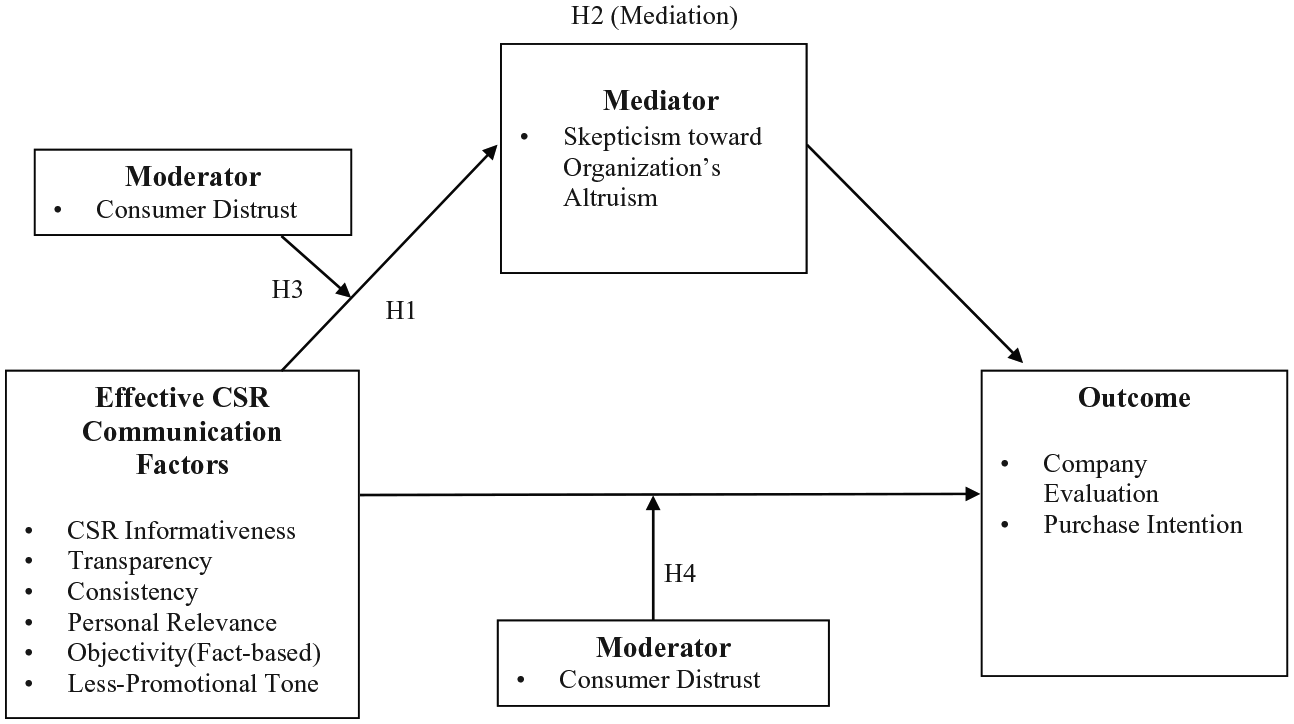
The conceptual model of how effective corporate social responsibility (CSR) communication factors are associated with public skepticism, distrust, and company evaluation/purchase intention.
Method
To test the hypotheses, this study employed an online survey methodology. Participants were recruited from the consumer panel pools of a nationwide market research firm specializing in consumer surveys. E-mail invitations for data collection were deployed on the basis of U.S. census data on gender, age, and race categories. After eliminating unqualified responses (e.g., incomplete surveys, straight liners, etc.), a total of 928 were used for the analysis. Of the participants, 51% were male. About 71% were White or Caucasian (n = 662), while 12% were African American, 6.5% were Asian, 1.1% were American Indian, and so on. Approximately 53% of participants were between 18 and 44 years old, while the rest were older than 45 years.
Procedure
To ensure participants’ understanding of CSR activities, only those who passed the filtering question (asking what activities constituted CSR activities) were directed to move on. The participants were then provided with a list of 27 companies 1 and asked to select one company from it that they thought had been actively engaging in socially responsible activities based on their knowledge. The participants were also given the option to write a company name in a text box, in the case where their chosen company was not an option. After selecting a company, the participants were asked to fill out survey questions that concerned the following: their experience and perception regarding the company’s CSR communication, skepticism toward the company’s altruism, their evaluation of the company, PIs, the extent of either trust or distrust about CSR communication as a whole in the market, and demographic information.
Survey Instrument
Antecedents
The measurements of effective CSR communication elements were adapted from previous research that extracted effective CSR communication factors based on public expectations (Kim, 2019; Kim & Ferguson, 2018). To measure CSR informativeness (Info), the survey used the following five items: I believe the company has been actively providing (a) specific achievement of its previous CSR, (b) potential results of its current CSR, (c) its motives for doing CSR, (d) information about what the company wants to achieve, and (e) who is benefiting from the company’s CSR (M = 5.12, SD = 1.13, α = .94). Personal relevance (REL) was measured with three items: the company has actively informed me how its CSR activities (a) are relevant to me, (b) are personally relevant, and (c) will affect me (M = 4.16, SD = 1.21, α = .93). To measure transparency (Trans), three items were used: I believe the company has provided the consumer information about (a) its CSR failures, not just success, (b) whether its CSR initiative fails, and (c) both good and bad information about its CSR (M = 4.09, SD = 1.27, α = .94). Objectivity (OB) was measured with the following items: the company’s CSR messages have been (a) based on facts and (b) focusing on factual information (M = 4.91, SD = 1.03, α = .86). Finally, promotional tone (PT) was measured using three items: the company’s CSR messages have been (a) promotional, (b) self-congratulatory, and (c) low-key (reverse-coded; M = 3.89, SD = 1.22, α = .87).
Mediator (M)
For skepticism toward the company’s altruism (SA), three items were adapted from a previous study (Rifon, Choi, Trimble, & Li, 2004) and reverse-coded for analyses: the company does CSR because it (a) truly cares about the consumer, (b) has a genuine concern for the welfare of its customers, and (c) really cares about providing a better environment to its customers (M = 2.90, SD = 1.10, α = .96).
Moderator (W)
To measure consumer distrust in CSR communication (DC), five items were adapted from previous studies (e.g., Mohr et al., 1998): (a) I don’t believe most CSR messages, (b) Most CSR messages are intended to mislead the consumer rather than to inform, (c) CSR messages lead people to believe things that are not true, (d) I believe that companies say one thing and do another for CSR, and (e) I see little similarity between what a company says it will do and what it actually does (M = 3.00, SD = 1.39, α = .98).
Outcome Variables
For CE, participants were asked three items (adapted from previous research, e.g., Brown & Dacin, 1997; Kim, 2011) regarding whether they trusted, admired, and had a favorable feeling toward the company (M = 5.36, SD = 1.09, α = .96). PI was measured with: I would (a) purchase, (b) use the company’s products, and (c) recommend the company’s products to others (M = 5.70, SD = 1.14, α = .97). All were measured with a 7-point Likert-type scale anchored by 1 (strongly disagree) and 7 (strongly agree).
Results
Before testing the hypotheses, all variables were tested for reliability, discriminant validity, and convergent validity through a confirmatory factor analysis (CFA). The CFA measurement model revealed a good model fit: χ2 = 1037.18 with 414 degrees of freedom (p < .001) χ2/degrees of freedom = 2.50 < 3.0, comparative fit index = .98, goodness-of-fit index = .93, root mean square error of approximation = .038 < .05, p of close fit = .04 < .05. All of the constructs revealed satisfactory reliability and convergent and discriminant validities, meeting all required criteria 2 (see Table 1; Hair, Black, Babin, Anderson, & Tatham, 2006). In addition, Ramsey RESET tests were performed to examine our model specifications. No sign of misspecification was found in our tested models (ps >.05 for yhat^2 and yhat^3).
Reliabilities, Discriminant, Convergent Validities of All Constructs, and Correlations Matrix.
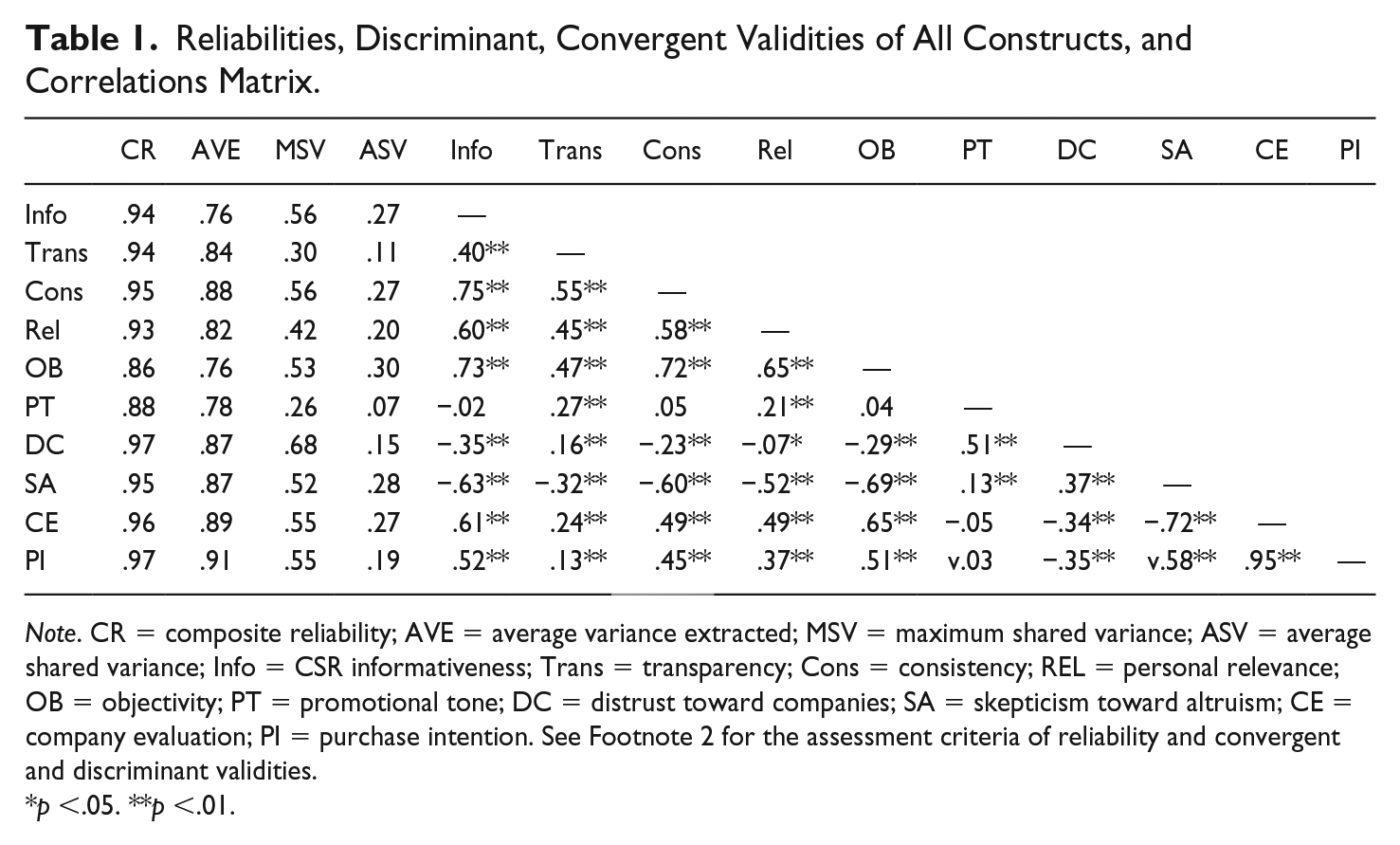
Note. CR = composite reliability; AVE = average variance extracted; MSV = maximum shared variance; ASV = average shared variance; Info = CSR informativeness; Trans = transparency; Cons = consistency; REL = personal relevance; OB = objectivity; PT = promotional tone; DC = distrust toward companies; SA = skepticism toward altruism; CE = company evaluation; PI = purchase intention. See Footnote 2 for the assessment criteria of reliability and convergent and discriminant validities.
p <.05. **p <.01.
Testing Hypotheses
This study employed Hayes’ (2013) PROCESS for testing the hypotheses. The PROCESS is useful as it provides bootstrap confidence intervals (CIs) and model estimations for mediation analyses, as well as the computation of conditional direct and indirect effects (Hayes, 2013). As predicted by Hypothesis 1 (negative relationships between quality communication and skepticism), when an organization provided higher levels of informativeness, personal relevance, consistency, transparency, and objectivity in CSR communication with a less promotional tone, participants perceived lower levels of skepticism toward the organization’s altruism (significance levels for all factors were < .0001; see Table 2 for detailed statistics). Thus, Hypothesis 1 was supported for effects of all CSR communication factors on reducing skepticism.
Relationships Among Effective CSR Communication Factors, Skepticism Toward Altruism, and Public Responses.
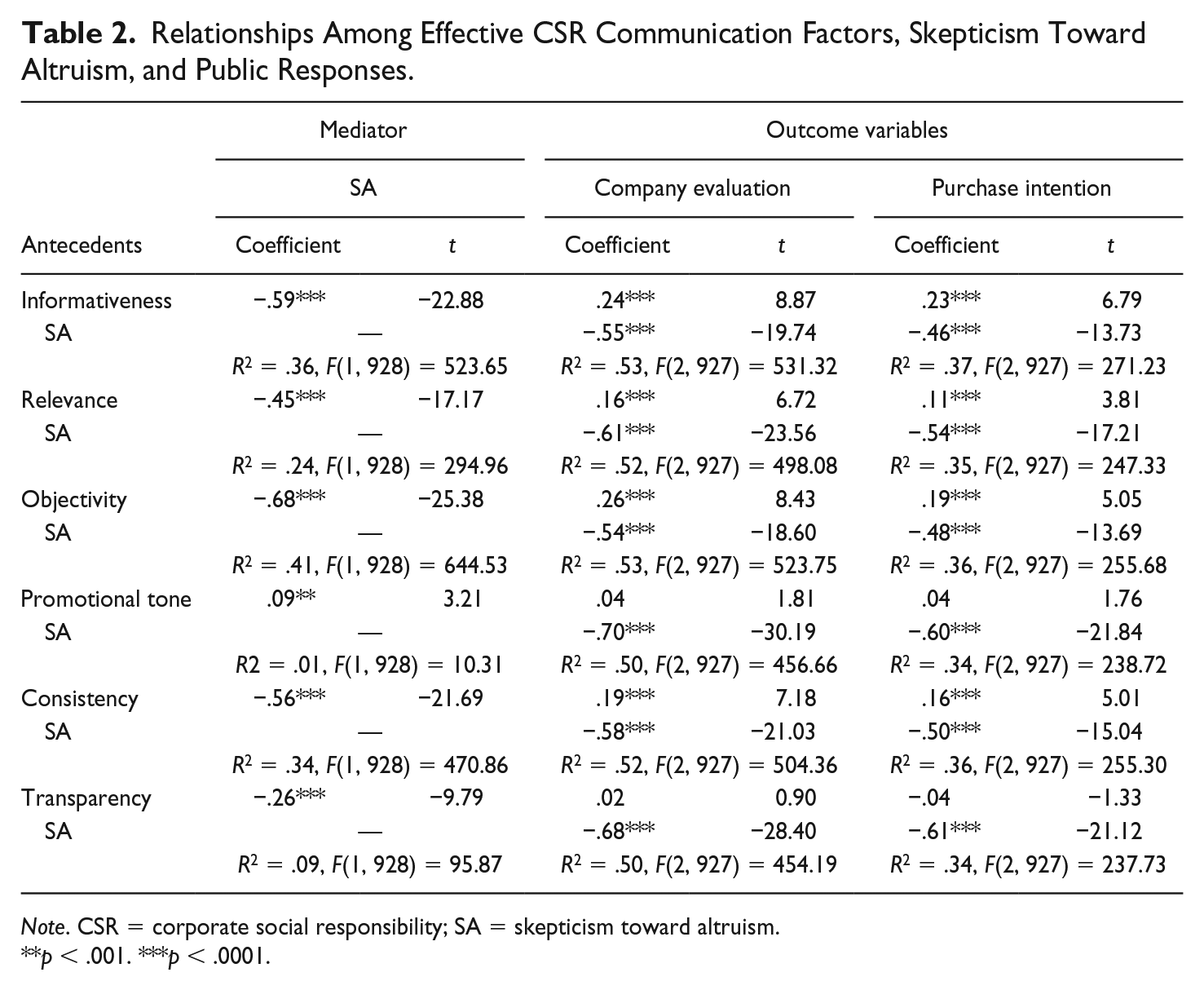
Note. CSR = corporate social responsibility; SA = skepticism toward altruism.
p < .001. ***p < .0001.
The results for Hypothesis 2 (i.e., mediation tests using PROCESS Model 4) showed that skepticism significantly mediated the effects of all CSR communication factors on both CE and PI. CI levels for all communication factors in the mediation models did not include zero, indicating significant mediations of skepticism for CE and PE. This indicated that increased CSR informativeness (CE: b = .32, CIs [.27, .38]; PI: b = .27, CIs [.22, .33]), personal relevance (CE: b = .27, CIs [.23, .32]; PI: b = .24, CIs [.20, .29]), objectivity (CE: b = .37, CIs [.31, .43]; PI: b = .33, CIs [.27, .39]), consistency (CE: b = .33, CIs [.27, .38]; PI: b = .28, CIs [.23, .33]), and transparency (CE: b = .18, CIs [.14, .23]; PI: b = .16, CIs [.12, .20]) significantly lowered public skepticism toward the organization’s altruism. In turn, the decreased skepticism significantly improved publics’ positive CE and PIs. However, an increased promotional tone in CSR communication significantly increased skepticism toward the organization’s altruism, and the resultant skepticism significantly lowered positive CE and PIs (CE: b = −.07, CIs [−.12, −.02]; PI: b = −.06, CIs [−.10, −.01]).
To test whether direct and indirect effects of each CSR communication element on outcome variables were moderated by public distrust (i.e., Hypothesis 3 and Hypothesis 4), conditional process analyses were performed (Model 8). Significant conditional indirect effects of all CSR communication factors were found, except for the CSR informativeness factor. For the CSR informativeness factor, no moderated mediation by distrust was found for both outcome variables as CIs included zero (see Table 3 for moderated mediation index). CSR informativeness significantly lowered people’s skepticism toward altruism, and, in turn, positively affected CE and PI, regardless of the levels of public distrust of CSR communication.
The Moderating Role of Public Distrust Toward CSR Communication.
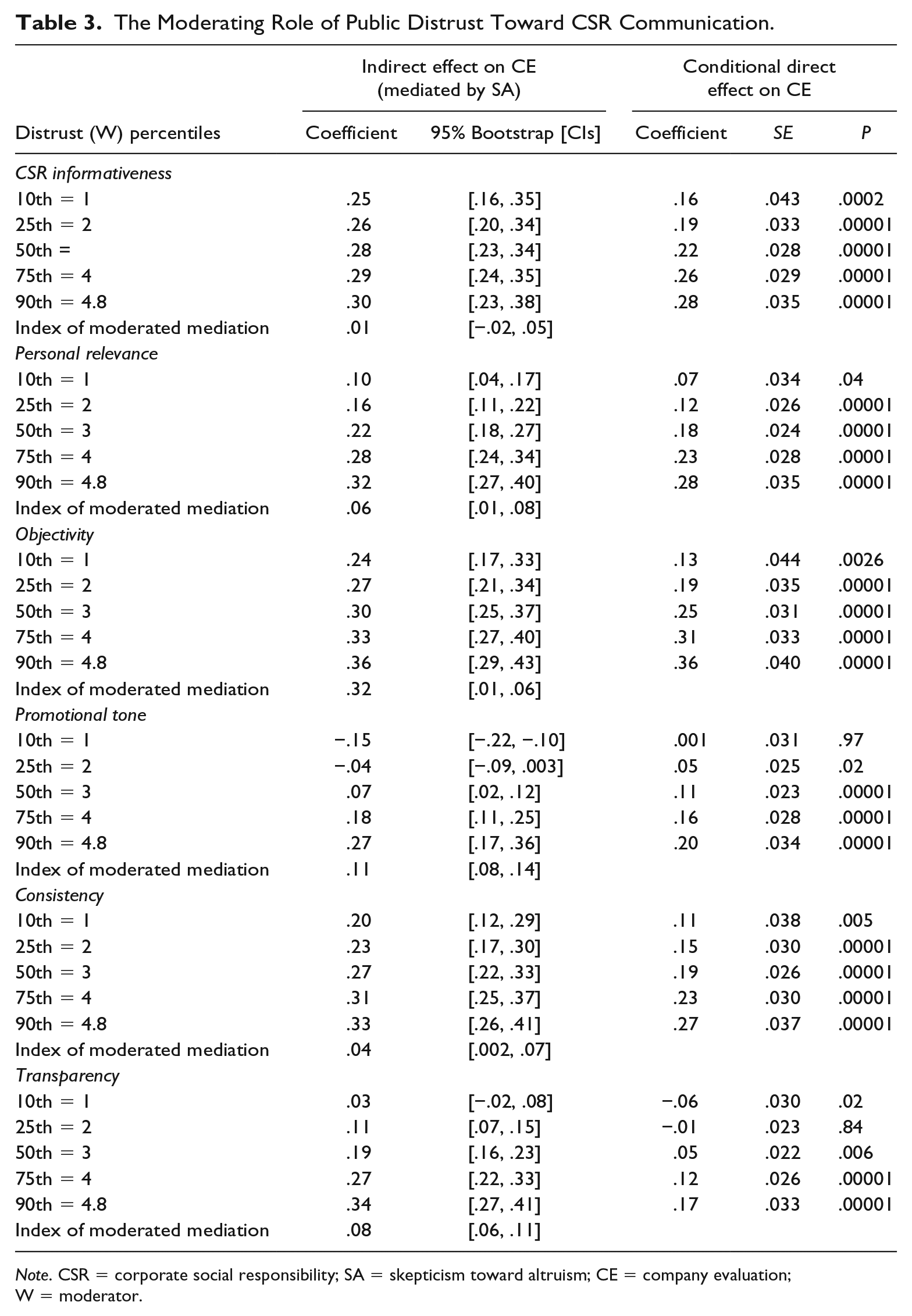
Note. CSR = corporate social responsibility; SA = skepticism toward altruism; CE = company evaluation; W = moderator.
Although the moderated mediation effects were significant for all CSR communication factors except CSR informativeness, the direction of moderation effects was the opposite of our predictions. That is, the consequences of effective CSR communication factors are more positive (i.e., higher CE and PI) for people with higher distrust levels toward CSR messages than for those with lower levels. Due to the opposite direction found, Hypothesis 3 was not supported. Among the communication factors with significant moderated mediations, personal relevance, consistency, and objectivity shared exactly the same pattern. The indirect positive effects of these three factors on outcome variables through the reduction of public skepticism increased as public distrust increased (see Table 3). The transparency factor revealed slightly different conditional indirect effect patterns from the three factors. The CIs of distrust percentiles did not include zero except for the 10th percentile of distrust levels, suggesting skepticism mediated the impact of transparency for all levels of distrust except for those with very low distrust levels (see Table 3). That is, except for people with very low distrust levels, the positive effects of transparency on outcome variables through the reduction of skepticism increased as public distrust levels increased.
In addition, the promotional tone factor revealed significant moderations of distrust (see moderated mediation index in Table 3), but also with a direction opposite of our predictions (Hypothesis 3). An increased promotional tone resulted in increased skepticism for people with very low (10th percentile) distrust levels (t = 6.66, p < .00001), whereas the increased promotional tone significantly decreased skepticism toward altruism for those with moderate, high, and very high distrust levels (50th, t = −4.01; 75th, t = −9.03; 90th, t = −11.15, ps < .0001). This indicates that for people with moderate, high, and very high distrust levels (50th, 75th, and 90th percentiles), promotional tone positively influenced CE mediated by skepticism toward altruism (CIs were positive and significantly different from zero). For people with very low distrust levels (10th percentile), however, the promotional tone negatively influenced CE mediated by skepticism. The CIs did not include zero except for the 25th percentile of distrust levels, suggesting skepticism toward altruism mediated the impact of promotional tone on CE for all levels of distrust except for the 25th percentile (see Table 3). The same pattern was found for the PI outcome variable.
Regarding Hypothesis 4 (i.e., conditional direct effects), the effects of all CSR communication factors on the outcome variables were also moderated by the levels of distrust of CSR communication, but in a direction opposite of our predictions. Thus, Hypothesis 4 was not supported. Regarding CSR informativeness, personal relevance, objectivity, and consistency factors, the positive effects of these factors on the outcome variables increased as people’s distrust levels increased (see Table 3). However, for the transparency factor, positive direct impacts on the outcome variables were significant only for people with moderate, high, and very high distrust levels (50th, 75th, and 90th percentiles; see Table 3), whereas transparency negatively affected CE and PI for those with very low distrust levels (10th percentile). Last, the promotional tone factor positively affected the outcome variables except for those with very low distrust levels toward CSR communication (10th percentile). Positive effects of the promotional tone factor increased as public distrust levels increased, except for those with very low distrust (see Table 3).
Discussion
Major Findings and Theoretical Implications
Our study suggests that each effective CSR communication element—CSR informativeness, personal relevance, objectivity, consistency, transparency, and a less promotional tone—was negatively related to public skepticism toward the organization’s CSR altruism. In turn, these people tend to present more positive evaluations of the organization and PI, supporting the mediation role of skepticism in the process of CSR communication. Consistent with previous research (e.g., Du et al., 2010; Wang & Anderson, 2011), our findings suggest the importance of providing specific information about CSR in mitigating public skepticism toward altruism; such information may include organizational motives for doing CSR, beneficiary from the CSR, and expected outcomes. Moreover, the results confirm previous research (e.g., Morsing, 2006; Pomering & Dolnicar, 2009), suggesting that people give weight to CSR messages that consist of objective and factual information, and that are consistent and transparent. We also found that CSR messages that specifically discussed how CSR affected individuals (i.e., personal relevance) and that used a less promotional tone effectively decreased public skepticism toward organizational altruism and elicited positive public evaluation of the organization (Kim, 2019; Schlegelmilch & Pollach, 2005).
Interestingly, our findings indicate that, with the exception of the CSR informativeness factor, the positive effects of well-planned CSR communication on public responses may vary depending on the levels of public distrust of CSR messages. That is, the positive effect of CSR informativeness was consistent and not moderated by public distrust of CSR messages. This particular finding adds another layer to previous research that has found the positive impact of CSR informativeness to be independent of individual differences such as consumer-company identification levels (i.e., Kim, 2019). Just like consumer-company identification examined in Kim’s study, public distrust of overall CSR messages can be considered as a stakeholder-specific factor denoting individual differences (Darke & Ritchie, 2007; Kim, 2019). The study thus confirms that, of all effective CSR communication elements, the most enduring in terms of positive results notwithstanding individual differences is CSR informativeness (Du et al., 2010; Kim, 2019). With regard to the other effective CSR communication elements (personal relevance, consistency, transparency, objectivity, and a less promotional tone), their positive relationships with the public responses were found to be greater for people with higher levels of distrust of CSR messages than those with lower levels. These findings were inconsistent with our predictions, and require further discussion on theoretical implications of the research.
The study initially posited that people who strongly distrust CSR messages in general would respond to an organization’s CSR communication more negatively, as they would be likely when processing information to activate not accuracy motivations but rather defensive motivations. The logic behind our original predictions was that when a defensive motivation is triggered, people would be negatively biased, performing selective information processing (Chaiken & Trope, 1999). Such selective information processing would result in missing beneficial information communicated by the organization, evoking a generally negative stance toward further CSR communication (Darke & Ritchie, 2007). The unexpected results revealed in this study, however, hint at a notion that people who hold stronger levels of distrust of CSR messages may activate accuracy goals so as to handle such messages with more objective systematic processing.
Previous research on dual information processing suggests that people activate defensive motivations to protect their self-image, self-interests, or material interests (Chaiken et al., 1996). When it comes to CSR communication, however, people may not perceive high threats from it, as the context of CSR is unlikely to encompass realms that threaten their material or self-interests. Therefore, despite the presence of strong distrust, these people may not activate defensive motivations. This unexpected finding may also be explained by the differences between public distrust of the ad deception and distrust of CSR messages. Unlike the distrust of CSR messages examined in our study, previous research has examined the distrust people have regarding ad deception (e.g., Darke & Ritchie, 2007), a realm more likely to be linked with publics’ self-interests or material interests. Because such deception could affect publics’ product purchase and monetary investments, publics may have activated defensive motivations rather than accuracy motivations. Our findings on distrust are thus more aligned with prior studies on information processing that have supported distrust as increasing objective systematic processing with accuracy goals (e.g., Campbell & Kirmani, 2000) rather than defensive goals found in the recent research on ad deception (e.g., Darke & Ritchie, 2007). Since this is one possible explanation of our finding on distrust, further investigation should ensue, specifically through testing the different types of motivation goals activated in processing CSR messages.
Furthermore, the patterns found in this study related to transparency and promotional tone factors are of particular importance to the current knowledge of CSR communication. First, for people who have little distrust of CSR messages, they do not react positively to transparency in CSR communication. They did not appreciate “openness of CSR information disclosure including both good and bad” (Kim & Ferguson, 2018, p. 555). This can be explained through the lens of inoculation theory (McGuire, 1961). Previous research using inoculation theory has suggested that providing positive messages to a favorably inclined audience is more efficient while providing both positive and negative messages is more efficient for an unfavorably inclined audience (Kim & Sung, 2014; McGuire, 1961). Our findings pertaining to transparency are consistent with previous literature suggesting that, for favorable audiences, one-sided messages (only positive) are more effective than two-sided messages (positive and negative). In contrast, for unfavorable audiences, two-sided messages are more effective (Pfau, 1992; Rim & Song, 2016), as they can function as an inoculant to increasing audience resistance to negative messages (Kim & Sung, 2014; McGuire, 1961).
Similarly, but more distinctively, a promotional tone in CSR communication induces greater positive outcomes for people who strongly distrust CSR messages in general. Yet, for people who generally trust CSR messages, the promotional tone induces negative reactions and stronger skepticism. Our findings illustrate how the use of a promotional tone in CSR communication can give rise to both positive and negative outcomes. It can either undermine or amplify public skepticism toward an organization’s altruism, depending on the extent of existing public distrust of CSR messages. This particular finding supports Kim’s (2019) contention that past studies’ recommendations on using a promotional tone (e.g., self-congratulatory communication is counterproductive; Morsing & Schultz, 2006; Schlegelmilch & Pollach, 2005) can be reassessed when considering individual differences in the context of CSR communication. It seems that the adoption of a promotional tone may reduce people’s perceived incongruence between their existing distrust of CSR messages and a particular organization’s CSR communication, further engendering a reduction of perceived corporate hypocrisy (Wagner et al., 2009). To wit, people who strongly distrust CSR messages may in general consider the use of a promotional tone in CSR communication congruent with the organization’s image-promotional purposes of CSR communication, thus viewing it as less hypocritical. Through this process, being transparent and using a promotional tone in CSR communication could undermine perceived corporate hypocrisy, and in turn possibly enhance, for people who distrust CSR messages, the credibility of the organization and its communication.
Practical Implications
The findings of our study provide several practical guidelines for communication practitioners. According to Bowen (2009), increased societal interest in CSR has offered practitioners to gain access to the organizational dominant coalition. However, because of growing consumer scrutiny and resistance toward CSR communication, practitioners also face challenges in managing and communicating an organization’s CSR practices. This study is the latest addition to the recent research attempts that solely focus on investigating commonly known, though relatively less comprehensively examined, communication elements and their relationships with subsequent psychological dynamics (Du et al., 2010; Kim, 2019; Kim & Ferguson, 2018) by providing empirical evidence on the role of public skepticism and distrust of CSR messages in the process of how CSR communication elements work. These communication elements can easily be incorporated into everyday practices in crafting CSR messages and engaging in dialogue with consumers, which can ultimately enhance positive outcomes of CSR and CSR communication.
What is more, our study provides several compelling considerations to practitioners for maximizing positive outcomes of CSR communication. Practitioners should keep in mind that by planning and executing effective CSR communication they can actively manage potentially damaging consumer distrust of such communication. With the advent of social media and computer-based analyses, practitioners can better identify, segment, and target publics who express varying degrees of public distrust. Based on the valence of sentiments expressed toward an organization, topic, or situation, it would be possible to segment publics and to craft better messages that would best work for the targeted publics (Yang & Taylor, 2015). Our findings suggest that when dealing with people who have expressed strong distrust of CSR messages, practitioners should focus more on being transparent and honest about their self-promotional purposes of CSR communication. In contrast, when communicating with people who are rather trusting of CSR messages, practitioners should recognize that a less promotional tone can play a critical role in mitigating consumer skepticism, whereas transparency may, paradoxically, trigger it. These approaches can also be applied to organization-public dialogues in social media when responding to public criticism of a CSR practice.
Future Research and Conclusion
There are several limitations to this study. First, the survey method adopted in this study is limited in its detection of causal relationships. Researchers should cautiously interpret the relationships discovered herein. In addition, since our study asked participants to choose a company that does CSR activities, potential bias regarding existing attitudes toward the company may bring unknown confounding effects. Thus, future research should employ experiments to verify the causal relationships and control potential confounding factors. Second, although our tested models did not reveal any sign of model misspecification, this study did not incorporate the variables of CSR knowledge, CSR engagement, and consumer-company identification that were examined in relations to CSR communication components in previous literature (e.g., Kim, 2019). Future research should examine the roles of public distrust of general CSR messages and CSR skepticism in the process of CSR communication, incorporating such variables to make sure no omitted variable bias in the tested models.
Third, as part of exploratory effort to discover the roles public skepticism and distrust play in processing CSR communication, this study adopted a cross-sectional survey, measuring the related constructs in a more general sense of CSR and CSR communication contexts. Considering that CSR skepticism may differ by a specific CSR type in a given industry (Rim & Kim, 2016), the mediating role of skepticism identified in this study should be further examined in a specific industry or with a specific CSR type. Fourth, the study revealed unexpected patterns in terms of how people highly distrustful of CSR communication evaluate the promotional tone of a company; people who generally distrust CSR communication seem to accept, and even tend to favor, a promotional tone more than those who generally trust CSR communication. For a better understanding of this, further investigation is needed. Last, we propose that future studies should delve deeper into the public evaluation of transparent messages. Given the risk associated with revealing negative information, future studies should thoroughly examine the potential routes of positive and negative outcomes regarding transparent messages.
In conclusion, this study adds an additional layer of understanding to a relatively underresearched area of CSR communication (Kim & Ferguson, 2018). It has shed light on the critical role of effective CSR communication in mitigating public skepticism, and confirmed that quality CSR communication may overcome a consumer’s distrust of CSR communication that has developed over time. The study contributes to CSR literature by filling a gap regarding discrete communication factors’ effects on public skepticism and other public responses. Furthermore, by demonstrating how people respond differently to each CSR communication element, depending on their level of distrust, this study enhances the understanding of consumers’ psychological mechanism in the context of CSR communication and guides communication professionals to better design and implement CSR communication.
Footnotes
Authors’ Note
The findings in the article are original and have not been published previously and that the article is not being simultaneously submitted elsewhere.
Declaration of Conflicting Interests
The author(s) declared no potential conflicts of interest with respect to the research, authorship, and/or publication of this article.
Funding
The author(s) received no financial support for the research, authorship, and/or publication of this article.
