







Abstract
Spokesperson ethnicity research has shown that organizations can benefit from matching spokespersons to their target audiences. However, one facet of Japanese crisis communication can make this approach difficult for foreign organizations facing crises in Japan. The Japanese tendency to focus on collective-level causality and place blame with leaders through proxy logic, frequently forces CEOs into the role of crisis spokesperson. The current study utilized an experimental design to examine the effect of CEO ethnicity and language choice on how culturally matched and unmatched crisis responses were evaluated by a Japanese audience. Specifically, participants’ perceptions of ideological similarity, spokesperson credibility, and organizational reputation were compared between the Japanese CEO baseline and a Caucasian CEO speaking either in English or Japanese. The study found that the foreign CEO condition was evaluated more favorably across all measures independent of response match but found variations in the impact of choosing to forgo a translator in favor of delivering the response in Japanese.
Crises are a natural part of the lives of organizations but can pose a considerable risk to their profitability or even survival. Even in a familiar context, crises can be hard to navigate, but as more and more organizations expand across national and cultural borders, crisis management is further increasing in complexity. Cross-cultural crisis communication has emerged as a field to address this complexity. However, much work remains to be done (Lehmberg & Hicks, 2018). While cultural differences in “what to say” and “how to say it” have received some attention by researchers in this relatively new field, the question of who should deliver crisis messages in a cross-cultural context remains virtually unexplored. Littlefield and Cowden (2006) recognize that “using multiple spokespeople who represent and speak in patterns similar to intended audiences, and using language representative of the target audience, are topics meriting further investigation” (p. 7). They recommend the use of cultural agents who present adjusted crisis messages to the members of their respective audiences. In relatively homogeneous countries, it would seem the logical choice to choose a spokesperson from the host country. However, this might not always be possible. Research has shown that the public and media frequently expect a company’s CEO and upper management to address a crisis (Lucero, Kwang, & Pang, 2009; Turk, Jin, Stewart, Kim, & Hipple, 2012). This is particularly true in Japan, where CEOs are expected to address even minor offenses (Kovacs, 2011). Zemba, Young, and Morris (2006) attribute this need for the CEO to handle crisis communication in Japan to a focus on collective-level causality, which places blame with leaders through proxy logic.
Japanese CEOs bowing deeply in front of cameras and apologizing solemnly to the Japanese public at large during intricately orchestrated press conferences are emblematic of Japanese crisis communication. Any foreign organization operating in Japan runs the risk of finding its CEO in the role of crisis spokesperson, a role that can be difficult to master without extensive cross-cultural knowledge. However, research examining crisis communication differences between Japan and Western countries remains somewhat rare. Pinsdorf (1991), and Haruta and Hallahan (2003), for instance, contrast the crisis communication strategies and public reactions for two major airline crashes in Japan and the United States in 1985 and 1988. Both studies discover significant differences in the use of apology, media strategies, and litigation concerns between the two countries. Other researchers took a cross-cultural approach and investigated crisis communication efforts after the U.S.S. Greenville collided with a Japanese fishing vessel, the Ehime Maru (Drumheller & Benoit, 2004; Hearit, 2006; Takaku, Lee, Weiner & Ohbuchi, 2005; Lingley, 2006). The crisis handling by the United States and the Greenville’s commander, in particular, was deemed highly inappropriate by Japanese audiences who demanded an immediate apology. A 2006 cross-cultural crisis communication failure by Austrian elevator manufacturer Schindler received similar attention by researchers (Kalbermatten, 2011; Nottage, 2006; Rothlin & McCann, 2016), who found that Schindler’s failure to deliver an apology quickly and sincerely, as well as its extensive use of bolstering and ingratiating crisis communication strategies, led to the company being perceived as arrogant, untrustworthy, and ignorant of Japanese culture.
A more recent case of a foreign CEO struggling in the role of crisis spokesperson, is that of McDonald’s Japan’s Canadian CEO, Sara Casanova. In 2014, McDonald’s Japan suffered considerable reputational damage after a tainted chicken meat scandal, when Casanova, initially failed to address the issue herself, and later delivered a lackluster nonapology to its Japanese customers (“2014 nen waasuto,” 2015). While McDonald’s crisis response messages were clearly misaligned with Japanese expectations, Casanova herself and her performance at a key press conference received considerable negative media attention. This raises the question whether spokesperson ethnicity and language choice can affect a Japanese audience’s assessment of an organization’s crisis communication efforts.
With more and more foreign organizations operating in Japan, an increasing number of foreign CEOs will eventually face the challenge of delivering crisis responses to a Japanese audience. The present study aims to explore how spokesperson ethnicity, language choice, and message appropriateness can interact to affect how a Japanese audience perceives a foreign company in crisis.
The Apology Press Conference
In Japan, most crises result in an apology press conference, shazaikaiken. A shazaikaiken, when performed correctly, sends the message that an individual or company feels sorry for the pain, concern or anger that was caused and wishes to repair the damaged relationship with its stakeholders (Tanaka, 2006). On the surface, one or more individuals utter words of apology and bow deeply in front of an audience of reporters. Yet these carefully orchestrated dramas are packed with implicit meaning. In a corporate setting, for example, minute meaning lies in the positions of those chosen to make the apology (CEO or lower level management), the length and depth of the bow (a 90° angle is reserved for the heaviest of offenses), and even the attire and manner of those apologizing (Nakajima, 2007). Kovacs (2011) notices that the Japanese media tends to pay particular attention to inadequate apologies and writes: “When a crisis happens, make a proper apology to the media and they will forget quickly and pay little attention to you” (p. 149). While a well-executed shazaikaiken is in no way a “get-out-of-jail-free” card, it can go a long way in repairing a reputation and speeding up the resolution of a crisis (Tanaka, 2006).
Source Credibility and Homophily
But how could a shazaikaiken be affected by employing a non-Japanese spokesperson? One consideration is source credibility, which has long been established as a key component of persuasion (Pornpitakpan, 2004; Tkalac Verčič, Verčič, & Coombs, 2019). The effectiveness of communication is affected by an audience’s attitude toward the message source (Hovland & Weiss, 1951). Homophily, or the perceived degree of similarity between the audience and message sender, has emerged as having the potential to have significant impact on source credibility (Berscheid, 1966; Brock, 1965; L. L. McCroskey, McCroskey, & Richmond, 2006). While such dimensions as ideological similarity or status similarity have received significant attention, cultural or ethnic similarity remain much less ubiquitous (Arpan, 2002).
Previous studies in marketing and public relations have found evidence for the significance of ethnic similarity for the impact of spokesperson messages with a target audience (DeShields & Ali, 2000). Wang and Arpan (2008), for example, found race to be a powerful predictor for spokesperson evaluations by African Americans in the context of health advertisement. Arpan (2002) tested the applicability of such findings for cross-cultural crisis communication and found that matching the ethnicity of a crisis spokesperson to the audience can significantly impact crisis outcomes. These findings are supported by Littlefield and Cowden (2006), who conducted an in-depth review of intercultural communication literature and recommend matching spokespersons to their target audiences to ensure that both message content and delivery are culturally appropriate.
Liu and Pompper (2012) found that a number of crisis communication practitioners in the United States favor this type of spokesperson-audience matching due to a “greater likelihood of mutual trust based on shared cultural value systems, character traits, ‘code’ and history/context” (p. 137). Most of the previous research in this topic area, however, has focused on ethnic minorities in the United States or examined the reactions of U.S. audiences to foreign spokespersons. This raises the question to what extent these findings are applicable to the Japanese context. To identify the degree of homophily, a Japanese audience is likely to feel with a non-Japanese spokesperson, we first have to delve into an examination of the Japanese cultural identity and perception of the “other.”
Japanese Cultural Identity and Perception of the “Other”
In terms of cultural identity, Japan is dominated by a clear division between the Japanese and foreigners. Lie (2000) described the Japanese identity as continually reaffirmed through a process of othering, which situates non-Japanese as the polar opposite of the Japanese, not only in terms of ethnicity but also culture and class. This active concern with the distinctiveness of the Japanese society, culture, and national character has given rise to a multitude of publications on the topic, often collectively referred to as nihonjinron (theories about the Japanese). 1 Nihonjinron place special emphasis on two aspects of Japanese culture, high context communication and collectivism (Befu, 1993). When examining attitudes of educators and businessmen, Yoshino (1992) found the strong belief that Westerners are incapable of learning to think and act like Japanese.
However, the ever-increasing number of foreign residents and naturalized citizens in Japan, who have acquired a high degree of linguistic and behavioral adaptation, has begun to demythologize the traditional idea of what it means to be Japanese. Nevertheless, with the Japanese conflation of ethnicity and cultural identity, the two homophily dimensions of attitude and ethnicity should become virtually indistinguishable. Simply by virtue of not being Japanese, a foreigner could be considered significantly different in attitudes, behavior, and worldview. However, while social identity theory (Tajfel & Turner, 2004) confirms the existence of a definite in-group bias, Brewer (1999) reminds that “findings from both cross-cultural research and laboratory experiments support the [ . . . ] view that in-group identification is independent of negative attitudes toward out-groups” (p. 429). Extending these findings to our considerations about spokesperson ethnicity, we must take into consideration the status of different out-groups in Japanese society.
Perceptions of Non-Japanese in Japan
In Japan, not all foreigners are perceived or treated equal. Despite an ever-increasing drive toward internationalization and globalization, inequalities persist. The definition of the desirable foreigner—that perfect imagined “other” for intercultural communication—is narrow: White and a native speaker of accent-free English (Fujimoto, 2001). Darker skin or failing to speak English appears to immediately lower a foreigner’s prestige. Kobayashi (2010) noted that “[A]lthough the discourse on ‘internationalization’ and ‘global citizens’ has gained wide currency, it often hides the general public’s discrimination against foreign residents of the same or darker color or English speakers with an ‘accent,’” (p. 324). Kobayashi argued that while perceptions of White foreigners might be positive, many others experience significant discrimination.
Fujimoto (2001) argued that the Japanese media mirrors U.S. race relations, favoring Caucasians over persons of color. Overall, the Japanese media portrays white foreigners in a positive light. Fujimoto (2001) saw in Japan a trend toward “identifying with white Westerners and privileging white bodies” (p. 2). Other researchers have found a paradoxical “tendency for Japanese people to admire Western elements as long as they are ‘outside’ but to consider them harmful when they come too close” (Torigoe, 2012, p. 87). However, the use of foreign, in particular White, spokespersons and models is a common practice in Japanese advertising and entertainment. On the surface, Caucasian foreigners are perceived a stylish and “cool.” However, while they are overwhelmingly portrayed in a positive light, they are often stereotyped in advertisements and TV programs in a way that reinforces their otherness and differentiates them from the Japanese (Hambleton, 2011; Prieler, 2010). This differentiation can be seen as reinforcing the idea of Japanese uniqueness and the value of being Japanese (nihonjinron; Creighton, 1995). Applying these insights to our considerations on spokesperson ethnicity in crisis situations, out-group status could have a negative effect on spokesperson credibility. That effect may, however, be significantly mediated by the positive image and high status of White, native English-speaking foreigners in Japan.
Rogers and Bhowmik (1970) wrote that, while in any communication situation, the message sender and receiver can never be homophilous on all variables, “they should be homophilous on as many as are relevant to the situation, in order for effective communication to occur, and they may be heterophilous on all others” (p. 531). In Japan, being Japanese, seems to be considered a requirement for truly effective communication. When that ideal is unattainable, and a foreign spokesperson has to address a Japanese audience, the question of language arises. The issue that emerges is whether a translator should be used, or whether the foreign spokesperson should speak in Japanese.
Language Perception
Hosman (2002) writes, “The assumption is that language variation affects the impression formation process, and in a persuasion context an important impression affected is that of the speaker. Language variations may affect listeners’ judgments of speaker’s source credibility, attractiveness, likeability, and/or similarity” (p. 372). With language choice a clearly important element of communication outcomes, we now have to turn our attention to how different languages are perceived in Japan. Of particular interest to this study is the perception of nonnative Japanese. While the number of foreign speakers of Japanese is steadily rising, foreigners are primarily assumed to be “unable to communicate fluently in Japanese, and unknowledgeable about Japanese society and culture” (Yamashiro, 2013, p. 151). Some scholars even conclude that most Japanese prefer this linguistic incompetence. Miller (1977) proposed that while the Japanese are quick to praise the most rudimentary efforts made to speak their language, true Japanese fluency by foreigners constitutes an “invasion of sociolinguistic territorial interests that [are] to be defended” (p. 82). Yoshino (1992) identified a similar sense of unease with linguistically competent Westerners and theorized that such role inconsistencies can feel like a threat to the Japanese cultural identity. More recently, however, Azuma (2010) found that Japanese participants appreciated nonnatives’ efforts to speak their language, which contributed to a more positive characterization of the speaker compared with a native speaker. This positive effect extended to a greater tendency to forgive linguistic mistakes when they were made by foreigners rather than Japanese. These findings lead us to posit that a Japanese audience may be more forgiving of cultural misalignments in the content of crisis messages when they are delivered by a foreign speaker in Japanese.
Hypotheses
As demonstrated in the literature review section, there is significant evidence that spokesperson ethnicity has the potential to influence reputational outcomes of crisis communication efforts. The previously discussed research on homophily and source effects suggests that ethnic and ideological similarity can result in higher credibility assessments. In general, the practice of othering to define the concept of self and the strong belief in Japanese uniqueness, which is dominant in the literature on Japanese identity, suggest that respondents should perceive foreign spokespersons as less similar and consequently less credible. Therefore, the following hypothesis was established to confirm the relationship discussed above.
While there is the potential that foreign spokespersons might be perceived as less credible due to the lower degree of perceived homophily, this potential negative impact could be offset by the positive effect of making the effort to deliver a culturally well-adjusted crisis response or a response in Japanese. In addition, a Japanese audience might be more forgiving of a culturally unmatched response (UR) when delivered by a foreigner because he or she might be perceived as incapable of understanding the Japanese way of doing things. With impact significance and directionality unclear, no concrete hypothesis could be formed regarding the impact of CEO ethnicity and language choice on both spokesperson credibility and company image scores. This led the author to ask the general research question Research Question 1 and establish the null hypotheses Hypothesis 20 and Hypothesis 30.
Method
Participants
The present study analyzed responses by a convenience sample of 205 Japanese university students. Participants were assigned to one of the six experimental conditions by a survey web site. The average age of the participants was 21.07 years (SD = 4.80; range: 18-50). Indeed, 59.5% were female and 40.5% were male. An a priori power analysis, using the G*Power software, revealed a required sample size of 162 participants for a medium effect size f = .25, Type I error rate = .05, and power = .80. This sample size was achieved.
Design and Stimulus Materials
A 3 × 2 (Spokesperson Ethnicity and Language Choice × Crisis Response Match) between-subjects factorial experimental design was employed to investigate the research question and hypotheses. Participants were presented with the fictitious case of an international hotel chain experiencing an employee misconduct crisis, and a crisis response delivered by either a Japanese CEO in Japanese, a foreign CEO in English, or a foreign CEO in Japanese. While the inclusion of foreigners of varying ethnicities would have been desirable, feasibility constraints led to the choice to utilize a single ethnicity, Caucasian, for the present study. The crisis response messages were created to be either matched/appropriate or unmatched/inappropriate for the crisis situation. The matched response (MR) consisted of a rebuild strategy, a full apology, while the UR combined an excuse with bolstering. Both statements adhered to the basic guidelines of good crisis communication in that they were timely and expressed regards for the victims. Both responses are considered matched/unmatched both in terms of situational crisis communication theory (SCCT) recommendations (Coombs, 2007, 2017), as well as cultural appropriateness. Both responses were created in Japanese and phrased based on recommendations and warnings found in mainstream Japanese best-practice handbooks for crisis communication (e.g., Nakajima, 2007; Ohbuchi, 2015). To create the English language versions, the Japanese originals were translated and then back-translated by two separate bilingual translators to ensure high fidelity.
The crisis scenario was designed as occurring at a fictitious company in order to prevent any confounding effects such as precrisis reputation or prior relationship, which can affect organizational reputation outcomes (Coombs, 2007, 2017). To ensure that participants would pay equal attention to both message content and source factors (speaker ethnicity and language choice), a crisis scenario eliciting moderate crisis involvement was chosen (Petty & Cacioppo, 1984). No country of origin was specified for either the company or the CEO to avoid potential country of origin effects (Arpan & Sun, 2006).
Participants were provided with a newspaper article detailing the case of customers experiencing skin irritation after a purchasing manager had sourced inferior quality in-room amenity products. After reading the text, participants listened to a short audio recording of a press conference conducted by the company’s CEO while viewing a photo of the press conference provided as a visual stimulus.
Audio Materials
The use of the matched guise technique employing a Caucasian double native speaker of English and Japanese was attempted, but a preliminary test (N = 27) revealed that participants did not believe that the Japanese language message had been spoken by a Caucasian individual. This led to the decision to employ two voice actors instead of one. The use of authentic voice actors from the ethnic and linguistic backgrounds in question is not without precedent (Arpan, 2002). A total number of six separate audio clips were recorded. A recording of an interpreter delivering the Japanese translation of the English statements accompanied the English language versions.
Visual Materials
The visual materials were designed to reinforce the independent variables and depict both the spokesperson’s ethnicity as well as the matched or unmatched nature of the crisis response. Two base images were altered with Adobe Photoshop to manipulate CEO ethnicity. The image representing the matched message condition depicts two individuals bowing deeply behind tables set up in the typical style of a Japanese apology press conference, while the unmatched image depicts one speaker standing behind a podium, head raised confidently, and photographed mid speech. To increase the external validity of this study and as such the generalizability of the findings, 10 different models (5 Japanese and 5 Caucasians) were used to portray the role of the company spokesperson. Two post hoc analyses of variance (ANOVA) confirmed that controlling for response match there were no statistically significant differences between the Caucasian and Japanese models in terms of CEO credibility with F(4,116) = .672, p = .613, η p 2 = .023, and F(4,59) = 1.404, p = .244, η p 2 = .087, respectively. See Figure 1 for a sample of the visual stimulus materials.
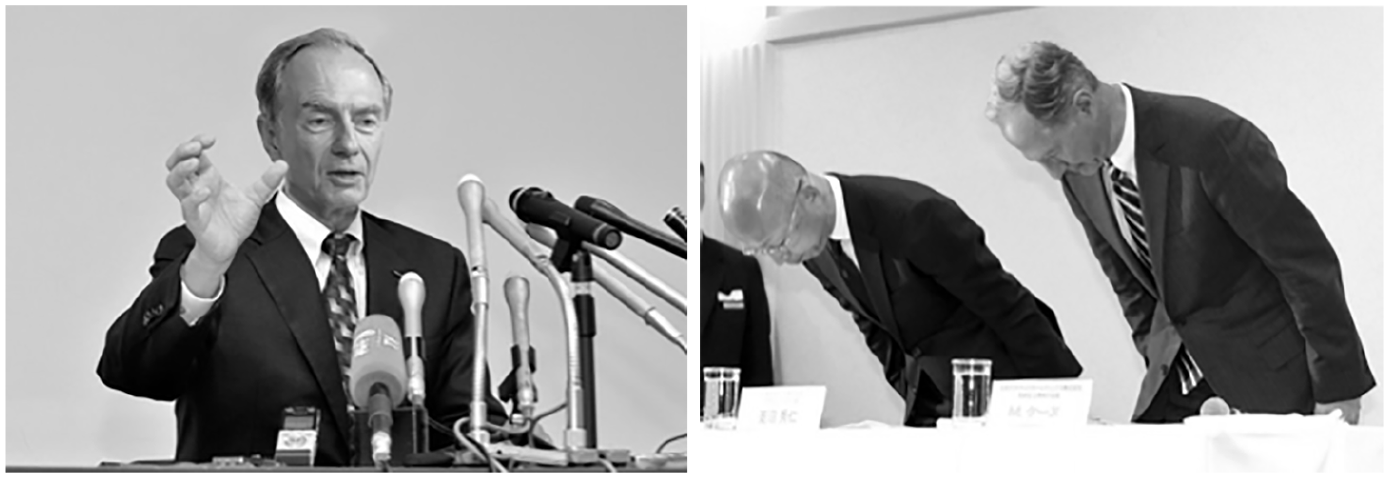
Sample of visual stimulus materials.
Measures
Spokesperson Credibility was measured with 12 bipolar, 7-point items, based on McCroskey’s measurement scales for credibility and ethos (J. C. McCroskey & Young, 1981). Examples of bipolar items include “trustworthy/untrustworthy,” “reliable/unreliable,” and “virtuous/sinful.” The scale exhibited high internal consistency of .913 (Cronbach’s α).
Company Image, or the reputational threat level, was measured with a nine-item, 5-point Likert-type scale. Examples of items include the following: “The company is not concerned with the well-being of its publics,” “The company is well managed,” and “The company is basically honest.” Reliability analysis of the company image items showed an internal consistency of .876 (Cronbach’s α). The degree to which respondents felt the spokesperson was ideologically similar to them was assessed with three bipolar, 7-point items based on McCroskey’s work on measuring homophily (J. C. McCroskey, Richmond, & Daly, 1975) and included items such as “values like mine/values unlike mine.” The scale showed an internal consistency of .838 (Cronbach’s α).
Results
Manipulation Checks
After acceptable reliability scores were established, subscales were summed together to yield a single compound score for each scale. To make sure respondents correctly interpreted the manipulation of the independent variable, CEO ethnicity and language choice, students were asked to indicate whether the CEO was Japanese or foreign, and whether he was speaking English or Japanese. The manipulation checks were considered a success. Removing a total of 10 cases due to misidentifications of either CEO ethnicity or language choice reduced the total number of respondents to 195.
To check whether the crisis response match was successfully manipulated the survey asked respondents to rate how much responsibility the CEO took for the crisis. The bipolar, 5-point item ranged from “denied all responsibility” to “took full responsibility.” A Mann-Whitney U test revealed that responsibility acceptance scores for MRs (mean rank = 125.56) were statistically significantly higher than for the URs (mean rank = 63.79, U = 1,722, z = −7.937, p < .001, with a large effect size of η2 = .296. The MR (rebuild strategy) was correctly identified by respondents as indicating a higher degree of responsibility acceptance and, therefore, accommodation than the UR. The manipulation of the crisis response match was successful.
Hypotheses Tests
To address Hypothesis 1, an independent samples t test was run at each level of response match. For the UR condition, ideological similarity ratings were lower for the Japanese CEO condition (M = −2.88, SD = 3.54) than the foreign CEO condition (both languages combined; M = −0.62, SD = 4.24), a statistically significant difference, M = −.2.26, 95% confidence interval [CI: −4.02, −0.49], t(85) = −2.539, p = .013, d = .58. For the MR, a Welch t test was performed due to unequal variances. There was no statistically significant difference in ideological similarity scores between Japanese (M = −0.05, SD = 4.11) and foreign CEOs (M = 0.39, SD = 3.11), M = −0.45, 95% CI [−1.99, 1.09], t(57.973) = −.583, p = .562, d = .12. Contrary to expectations, the foreign CEO was perceived as considerably less dissimilar than the Japanese CEO in the unmatched condition and approximately equally dissimilar/similar in the matched condition. These findings offer no support for Hypothesis 1.
Hypothesis 20 was addressed with a two-way ANOVA. The interaction effect between response match and CEO ethnicity/language on credibility was miniscule and not statistically significant, F(2, 189) = .378, p = .686, η p 2 = .004. The main effect for CEO ethnicity/language was statistically significant, F(2, 189) = 17.737, p = .001, η p 2 = .076, power = .98 (Figure 2). The unweighted marginal means of company image scores for matched and URs by a Japanese CEO (JJ), a foreign CEO speaking English (FE), and a foreign CEO speaking Japanese (FJ) were 1.9 (standard error [SE] = 1.44), 8.65 (SE = 1.50) and 9.27 (SE = 1.56), respectively. A response delivered by JJ was associated with a mean company image score 6.77, 95% CI [1.76, 11.79], points lower than a response delivered by FE, p = .004, and 7.40, 95% CI [2.26, 12.52], points lower than a response delivered by FJ, p = .002. These results allow us to reject Hypothesis 20.
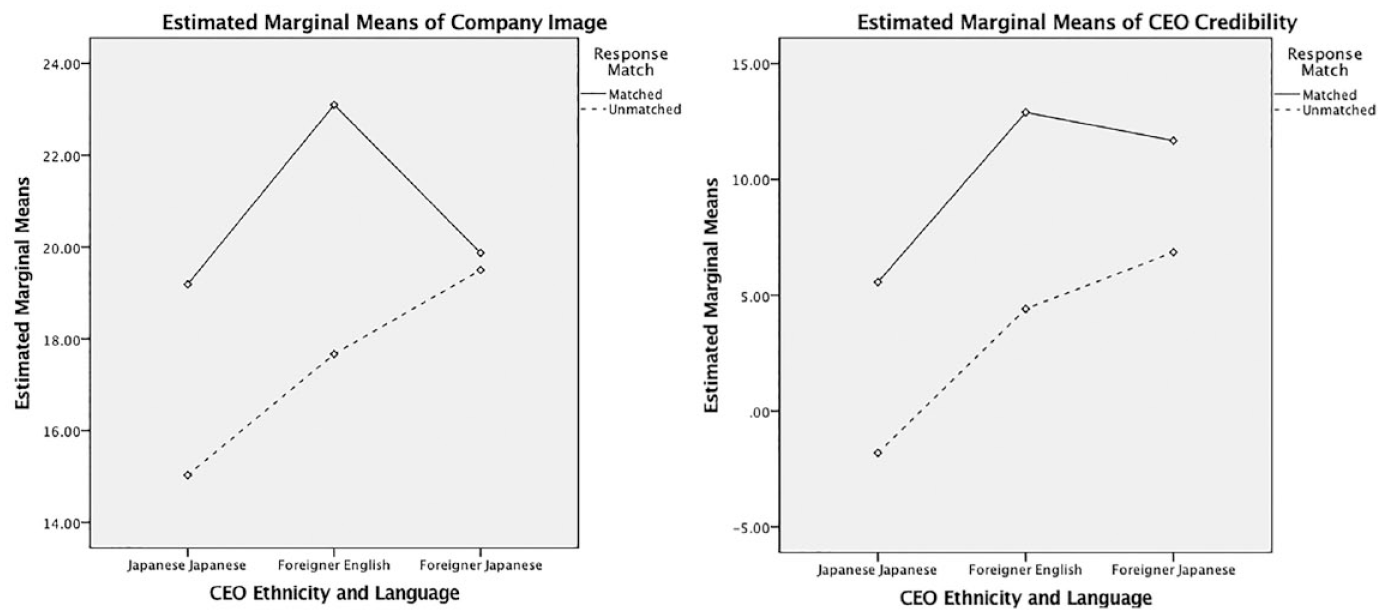
Estimated marginal means for company image and credibility: CEO ethnicity * response match.
To assess Hypothesis 30, a two-way ANOVA was conducted. The analysis failed to detect a statistically significant two-way interaction between CEO ethnicity/language choice and response match for company image, F(2, 189) = 2.822, p = .062, η p 2 = .029, power = .54. There were, however, statistically significant main effects of both CEO ethnicity/language, F(2, 189) = 5.287, p = .006, η p 2 = .053, power = .83, and response match, F(2, 189) = 14.070, p < .001, η p 2 = .069, power = .96. The FE condition was associated with a mean company image score 3.27, 95% CI [0.71, 5.84], points higher than the JJ condition, a statistically significant difference, p = .007. This result allows us to reject Hypothesis 30 and answer Research Question 1, CEO ethnicity and language choice seem to have a positive moderating effect on both CEO credibility and company image outcomes following a crisis. However, a visual inspection of the estimated marginal means plot (Figure 2), as well as the fact that the present study was powered to detect medium rather than small effect sizes, led to the decision to continue the investigation and run a complex interaction contrast. The contrast compared the difference in the differences between MR and UR delivered by FE and FJ. UR delivered in Japanese (M = 19.50, SE = 1.16) had a company image score that was 1.833 higher than UR in English (M = 17.67, SE = 1.18), whereas MR in Japanese (M = 19.90, SE = 1.10) had a mean company image score that was −3.197 lower than MR in Japanese (M = 23.10, SE = 0.97). The difference between the differences was statistically significant, 5.030 (95% CI [0.67, 9.39]), p = .024. For all mean scores see Table 1.
Estimated Marginal Means Table: Response Match * CEO Ethnicity and Language.

Discussion
This study examined whether having a foreign CEO deliver the crisis response to a Japanese audience—either in English or Japanese—was detrimental to reputational outcomes, and whether these effects were moderated by response match. The author found no support for the hypothesis that respondents would perceive the Japanese CEO as more homophilous in terms of ideological similarity independent of response match. Foreign and Japanese CEOs were perceived as roughly equally neutral in terms of ideological similarity when delivering a MR. For the UR on the other hand, Japanese CEOs were judged as significantly dissimilar while the evaluation of the foreign CEO remained neutral. These findings seem to imply that respondents held no inherent belief that foreign individuals are significantly different in terms of ideological similarity but that they judge harshly when fellow Japanese deviate from expected behavior patterns (i.e., delivering a culturally insensitive and inappropriate crisis response).
In line with findings on ideological similarity, the study failed to find support for the hypothesis that a foreign CEO would be perceived as less credible than their Japanese counterpart. In fact, independent of language choice and response match, the foreign CEO condition received significantly higher credibility ratings. In terms of reputational outcomes for the company, we can unequivocally say that having a foreign CEO deliver a company’s crisis response did not negatively influence reputational outcomes. In fact, having a foreign CEO deliver the crisis response in English resulted in significantly better company image outcomes than the Japanese CEO baseline. When the foreign CEO delivered the message in Japanese, however, results were less straight forward. While the Japanese version outperformed the English version in the UR, the Japanese version of the MR received company image scores closer to that of the Japanese CEO.
Linking these findings to the review of literature, we can posit that foreigners are held to less stringent standards, which leads to URs being perceived as less offensive, resulting in less reputational damage. On the other hand, making the effort to deliver a culturally appropriate crisis response seems to result in more positive outcomes compared with the Japanese CEO baseline. The effect of delivering the message in Japanese is more puzzling. One possible explanation is, while respondents respect the linguistic efforts in terms of spokesperson credibility, imperfectly spoken Japanese makes the content harder to understand (i.e., speaking imperfect Japanese hides how inappropriate the UR is, but also reduces the perceived quality of the MR).
Limitations and Future Research
Survey style research reflects how people report their feelings about given stimulus materials, not how people really feel about these materials. The social desirability bias, for example, might skew participants’ reported evaluations of other ethnicities and languages. A between subject experimental design was employed to avoid comparative bias, and participants were not informed of the ethnicity and language focus of the study. One indication that there was minimal self-reporting bias was the fact that the positive evaluation of credibility of the foreign CEO condition was largely reflected in company image outcomes.
A second limitation is that results might differ with an older audience as older generations usually experience a lesser degree of international exposure than university students. Future studies should address this limitation. In addition, this study was limited in scope. Only one type of foreigner was considered in this analysis. It would be of particular interest to see whether the positive effect of CEO ethnicity persists even for individuals from countries that have a historically less positive relationship with Japan, such as China or Korea.
It is also essential to mention the potential impact of gender on these findings. Female CEOs could potentially be judged much more harshly than male CEOs. While the author initially suspected that the harsh judgment of Sarah Casanova’s McDonalds crisis response was due not only to her culturally inappropriate crisis response but also her status as a foreigner, the above findings give weight to the suspicion that gender issues, rather than ethnicity alone, might have further aggravated the situation. While a foreign male might have been forgiven for what was perceived by many Japanese as an arrogant crisis response, her gender could have made the response more jarring for the Japanese audience. Finally, this study focused on a single crisis type, corporate misconduct, and the crisis was of moderate severity. Other crisis types and more severe crisis damage could potentially impact results and should be examined in future studies.
Despite its limitations, the present study offers considerable insights into how foreign CEOs might fare when faced with the task of presenting a crisis response to a Japanese audience. Findings imply that there might be little reason for foreign companies to fear how their non-Japanese-speaking Caucasian CEOs will fare in a crisis situation in Japan, as long as the appropriate use of consultants ensures a culturally matched message choice and presentation. Further examination of the impact of CEO ethnicity and language choice in crisis communication situations in a Japanese context certainly seems warranted.
Footnotes
Declaration of Conflicting Interests
The author declared no potential conflicts of interest with respect to the research, authorship, and/or publication of this article.
Funding
The author received no financial support for the research, authorship, and/or publication of this article.