







Abstract
The extent to which employees convey or withhold useful information has important implications for organizational effectiveness. Nevertheless, employee voice is under-researched in the public relations literature. Grounded in social exchange theory and internal communication literature, the current study addressed this research gap by arguing that leaders’ communication style plays a pivotal role in employee voice behavior. Drawing data from the U.S. (N = 441) and India (N = 354), this study tests a normative model linking leaders’ motivating language, team culture, employee-team relationships, and employees’ voice behavior. Notably, in both samples, motivating language was positively related to a healthy team culture, which in turn, is positively associated with employees’ relationship quality with their working unit, and ultimately, employees’ voice. The Indian sample showed similar patterns as the U.S. sample, except that there was no direct relationship between leader motivating language and employee voice for the Indian sample.
Keywords
The extent to which employees convey or withhold useful information—such as suggestions, ideas, or issues of concern—has important implications for organizations’ survival and effectiveness (Van Dyne & LePine, 1998). Employee voice refers to employees’ informal and discretionary communication of ideas, suggestions, concerns, and opinions about work to people with the ability to take actions, and in turn enhancing organizational or team functioning (Morrison, 2011, 2014). It is a form of extra-role communication behavior that challenges organizations’ status quo. When employees speak up, managers can identify previously unnoticed problems, take timely actions, and change or terminate current practices before they escalate. When employee voice is stifled, leaders end up havin0g a distorted view of the organizational reality and fail to properly evaluate organizational decisions and performance (Tourish & Robson, 2006). As a result, organizational crises and tragedies tend to occur. Just a case in point, the British Petroleum oil-rig explosion, and the Columbia space disaster are partly attributed to employees not reporting irregularities to management (Morrison, 2011). The 2018 Google Employee Walkout also indicated the consequence and risks when employee voice isn’t given attention internally, resulting in a crisis the organization could have avoided (Singh & Vanka, 2019).
There is ample evidence that employees often remain silent with their ideas or concerns (Detert et al., 2010). The main reason is that they perceive their workplace as not conducive to it. They may worry that raising an issue will hamper their career development, interpersonal relationships, and personal image, including being labeled as a complainer or troublemaker. Unfortunately, management often assumes that employees can communicate upward freely and fail to recognize employees’ hesitancy and fear of speaking up (Morrison, 2014).
It is no secret that leadership styles play a considerable role in employee voice behavior (Detert & Burris, 2007). While numerous scholars have demonstrated the immense influence of leadership behaviors (e.g., authentic leadership, Hsiung, 2012; transformational leadership, Liu et al., 2010) on employee voice, few studies examined specific communication behaviors of team leaders. Grounded in social exchange theory and internal communication literature, the current study addressed this research gap by arguing that leaders’ communication styles play a pivotal role in cultivating employee voice behavior. We focused on leaders’ motivating language, consisting of meaning-making language (linking personal goals to organizational vision), direction-giving language (communicating clear task specifics and work expectations), and empathetic language (offering emotional support; J. Mayfield & Mayfield, 2018). Specifically, we examined if and how team leaders’ use of motivating language can encourage employees to speak up with suggestions within their team.
Furthermore, this investigation answered whether and how a positive team culture and employees’ relationships with their teams can mediate the impact of supervisors’ motivating language on employee voice. While organizational culture has received extensive research, most work exclusively focused on the cognitive culture and overlooked the affective, emotional side of organizational culture (Barsade & O’Neill, 2014). To fill this research gap, the current study examined the positive emotional culture, which consists of cultures of joy, companionate love, pride, and gratitude, and viewed it as a mediator in our proposed model. This study also included employee-team relationships as another mediator, which refers to employees’ levels of trust, satisfaction, commitment, and control mutuality toward their working unit. Although employee-organization relationships have received substantial attention in public relations literature (Huang & Zhang, 2015), there is a dearth of research that examines team-level relationship building and its nomological network. In summary, this study proposed a theoretical model in which employees’ voice is viewed as an outcome of the interplay between leaders’ motivating language, perceived positive emotional culture within the team, and employee-team relationship quality.
We chose to conduct two field studies in the United States and India to examine the proposed predictions. We designed our research this way in part because “testing proposed relationships in two historically contrasting cultural settings provides a strong test of substantive hypotheses” (Botero & Van Dyne, 2009, p. 91). Moreover, cross-national research is considered one of the most deserving areas for future research in employee voice (Park & Nawakitphaitoon, 2018).
Literature Review
Leader Motivating Language (LML)
Initially proposed by Sullivan (1988), Motivating Language Theory (MLT) is rooted in Speech Act Theory (Searle, 1969) and was developed as “an oral communication alternative to the prevailing management focus on uncertainty reduction in organizational leadership” (J. Mayfield & Mayfield, 2019, p. 370). Today, Leader Motivating Language (LML) is a well-developed framework of speech that has been shown to predict numerous worker and workplace outcomes such as organizational identification, attendance, retention, self-efficacy, engagement, performance, and job satisfaction (J. Mayfield & Mayfield, 2007, 2010; Sharbrough et al., 2006; Tao et al., 2022; Yue, 2021; Yue et al., 2021a). Through motivating language, a leader’s spoken words nurture a high level of motivation among employees that positively impact their attitudes and job behaviors (Van Quaquebeke & Felps, 2018).
Motivating language is an important component of communication that occurs when leaders engage in three distinctive speech acts: direction-giving language, empathetic language, and meaning-making language (Sullivan, 1988). Direction-giving language occurs when leaders articulate expectations and provide task and goal-oriented messages to reduce followers’ uncertainty and role ambiguity (J. Mayfield & Mayfield, 2018, Sullivan, 1988). This type of language focuses on providing concrete information regarding when and how tasks need to be accomplished, communicating required actions that will lead to goal attainment, and articulating performance evaluations and reward contingencies.
The second dimension, empathetic language, occurs when leaders convey a genuine sense of humanity by expressing concern and care for the emotional well-being of a direct report and connecting with followers on personal events (Sun et al., 2016). Leaders use this type of language to support followers in various work situations, such as validating their workplace stressors (e.g., negative performance results or personal problems) and praising them for their good work (Sullivan, 1988). Empathetic language develops and maintains an emotional connection between leaders and workers through social reciprocity and trust. When emotional bonds are missing, employees are less likely to work hard proactively.
MLT’s third dimension, meaning-making language, promotes understanding of the culture and meaning of the organizational environment and aligns an employee’s personal goals with the organization’s vision (Gutierrez-Wirsching et al., 2015). Through meaning-making talk, employees understand how things are done and grasp the unwritten rules that govern the organization (J. Mayfield & Mayfield, 2010). Meaning-making language can play a crucial role in the organizational socialization process of employees and help them see their roles as meaningful, which is vital in influencing job performance (Oldham & Fried, 2016).
Employee Voice
Employee voice has been defined as an informal and discretionary behavior that seeks to bring about change through the expression of concerns, suggestions, ideas, or opinions about work-related issues to persons who might be able to take appropriate action (Detert & Burris, 2007; Morrison, 2014). As noted by Hirschman (1970), voice refers to “any attempt at all to change rather than escape from an objectionable state of affairs” (p. 30). It is one of the most important ways that employees can demonstrate their proactivity in the workplace (Morrison, 2014) and to improve processes, detect errors, and increase innovation in their organization (Knoll & Redman, 2016).
Concepts like voice include helping, upward communication, and organizational dissent (Botero & Van Dyne, 2009; Morrison, 2011). Although similar to these other constructs, voice is unique due to its grounding in the organizational citizenship literature (Organ, 1988). First, voice is change-oriented behavior and thus involves more risk than helping behavior, which is more affiliative, cooperative, and less controversial (McAllister et al., 2007). Second, while both upward communication and voice behavior involves the flow of information from a subordinate to a supervisor, the content of upward communication is broader as it includes any communication, such as task-related communication and information solicitation (Morrison, 2011). In addition, while voice and organizational dissent both involve objections and suggestions for change, only voice is uniquely oriented toward benefiting organizations and groups. In comparison, organizational dissent may be intended to benefit the self or the organization (Botero & Van Dyne, 2009).
The content of voice can vary, from expressing new ideas or suggestions for improving the organization to conveying concerns about problems and harmful behaviors within the workplace (Liang et al., 2012). The former is known as promotive or suggestion-focused voice because it focuses on future ways of doing things better, whereas the latter has been referred to as prohibitive or problem-focused voice as it serves to prevent or stop harm (Liang et al., 2012; Morrison, 2014). Thus, prohibitive voice is considered riskier for employees. Moreover, the recipient of the voice messages can also vary, ranging from supervisors to senior managers and coworkers (Morrison, 2014). Notably, many studies have restricted focus to upward and internal voice (Morrison, 2014). This is because when employees want to express their opinions and ideas to bring about changes, they often communicate with, or even confront, their supervisors (Hsiung, 2012).
Empirically, employee voice has been related to various positive outcomes such as improved work processes, crisis prevention, improved team innovation, employee organizational engagement, and workgroup performance (Grant, 2013; Liang et al., 2019; MacKenzie et al., 2011; Morrison & Milliken, 2000; Ruck et al., 2017). In a complex and rapidly changing business environment, voice is essential to help organizations develop and achieve sustainable growth (Hsiung, 2012). The importance of voice is compounded considering the wide range of negative outcomes that may occur when employees remain silent and choose not to speak up. Some of these outcomes include lower levels of creativity and productivity (Perlow & Williams, 2003) and increased cynicism, resentment, stress, isolation, absenteeism, and turnover (Morrison & Milliken, 2000; Perlow & Repenning, 2009; Perlow & Williams, 2003).
Despite the positive impact of reducing silence and encouraging voice, employees are often afraid to share their thoughts. This fear is not surprising, as research has shown that voice can lead to marginalization and dissatisfaction among employees and negatively impact promotions and salary increases 2 years later (Dundon et al., 2004; Seibert et al., 2001). Given these risks, studies have shown that individuals that are more likely to raise concerns tend to be those with long tenure, strong moral courage, and high performance (Detert & Burris, 2007; Lee et al., 2017). Overall, employees will be more likely to speak up if they perceive that these behaviors will be effective and low risk (Wei et al., 2015).
Research suggests that power distance impacts employees’ willingness to speak up and make suggestions (Botero & Van Dyne, 2009; Kwon & Farndale, 2020). Power distance is an individual’s belief about the extent to which superiors are entitled to their power and authority and therefore, dictates the extent to which subordinates are willing to accept the views of superiors (Hofstede, 1980). In high-power-distance countries, such as India, China, and Malaysia, voice directed toward superiors can be especially risky as it could trigger punishment and other negative consequences (Botero & Van Dyne, 2009). In contrast, the U.S. maintains a relatively low score on power distance, meaning that people are less dependent on hierarchy and more focused on creating equality. Correspondingly, employees from low-power-distance cultures are less concerned with power hierarchy and are more comfortable speaking up.
Linking LML and Employee Voice
The way leaders conduct themselves can be critical to employee voice (Detert & Burris, 2007). Over the past decades, researchers have found that different leadership styles such as transformational, ethical, self-sacrificial, and empowering leadership have a significant impact on employee voice (Avey et al., 2012; Biemann et al., 2015; A.-Y. Chen & Hou, 2016; Liu et al., 2010; Zhang et al., 2020). While there is no explicit test of how supervisors may use specific communicative acts to facilitate followers’ voice behaviors, we argue that LML opens such possibilities.
First, leaders’ use of empathetic language can help leaders develop emotional ties with employees (J. Mayfield & Mayfield, 2010). Empathetic language also involves considering the listener’s point of view (J. Mayfield & Mayfield, 2010), which promotes a sense of safety among employees. In an environment defined by psychological safety, employees can express themselves without fearing negative consequences (Edmondson, 1999) and will be less likely to avoid disagreements and keep their thoughts and suggestions to themselves. Research has shown that psychological safety is positively related to voice behaviors (Liang et al., 2012; Walumbwa & Schaubroeck, 2009). Second, meaning-making language aligns employees’ personal goals with organizational goals. This merging of goals and interests would motivate employees to speak up about risky topics related to organizational operations. In addition, it is reasonable to argue that employees would be more capable of identifying and pinpointing organizational problems and system gaps when they deeply understand their organization’s needs, values, and cultural norms (M. Mayfield & Mayfield, 2019). Third, by using direction-giving language, supervisors can eliminate role ambiguity and help employees experience a sense of control over their tasks (Gutierrez-Wirsching et al., 2015). In fact, a critical precondition for voice behavior is experiencing control and having a positive influence over the work setting (Edmondson, 1999; K.-Y. Ng et al., 2019). Hence, the following hypothesis is proposed:
The Mediating Role of Positive Emotional Culture
Organizational culture is a concept that has received a wide range of diverse interpretations (Barney, 1986). Given its conceptual vagueness, studying culture has often been perceived as challenging. Despite this ambiguity, culture is often understood as an organization’s system of shared values, meanings, symbols, and beliefs that drive the behaviors of its members (Ortega-Parra & Sastre-Castillo, 2013; Sriramesh et al., 1992).
Scholars have noted that an organization’s culture is a group learning process that includes a cognitive and an affective dimension (Schrodt, 2002). The literature has traditionally conceptualized organizational culture from a cognitive perspective (e.g., O’Reilly et al., 1991). As noted by Barsade and O’Neill (2016), cognitive culture refers to “the shared intellectual values, norms, artifacts, and assumptions that serve as a guide for the group to thrive” (p. 60). The cognitive culture is essential because it gives employees the necessary information to determine how risk-taking, innovative, flexible, creative, hierarchical, or results-oriented they should be. The other critical but often neglected component is the group’s emotional culture (Barsade & O’Neill, 2014). Barsade and O’Neill (2016) define emotional culture as “the shared affective values, norms, artifacts, and assumptions that govern which emotions people have and express at work and which ones they are better off suppressing” (p. 60). The emotional culture of an organization will guide employees as they decide whether or not it is appropriate to display certain emotions within their work groups (O’Neill & Rothbard, 2017; Yue et al., 2021a). Interdisciplinary scholarship on emotions suggests that organizations that emphasize the importance of employees’ feelings and encourage positive employee emotions experience favorable business outcomes (Seppala & Cameron, 2015). As a result, a higher number of organizations are focusing on how employees feel at work to develop a healthy workplace culture (Barsade & O’Neill, 2016).
The current study focuses on a positive emotional culture of joy, companionate love, pride, and gratitude within teams. Joy is one of the most prevalent manifestations of positive affect (Fredrickson, 2013). Joy is a high-arousal emotion that arises in safe contexts after experiencing a pleasant situation and increases people’s propensity to be connected to others (Fredrickson, 2013). When an emotional culture of joy characterizes a team, members will share their joy by, for example, having fun through lighthearted activities, smiling and sharing their positive feelings during conversations, joking around, and maintaining a playful atmosphere in team meetings (Barsade & O’Neill, 2016). Companionate love is a fundamental emotion in the human experience that includes feelings of affection, care, compassion, and tenderness for others (O’Neill & Rothbard, 2017). Companionate love is not as intense as romantic love because it is based on warmth and connection instead of passion (Hatfield & Rapson, 2000). In a culture with strong companionate love, coworkers safeguard each other’s feelings, collaborate when possible, and support each other in work and non-work-related issues. When companionate love is low among teams, expressions of affection, compassion, tenderness, or care are minimal or non-existent and often perceived as unnecessary or even inappropriate (Barsade & O’Neill, 2014; Lilius et al., 2008). A culture of pride builds through success and cohesiveness within groups at work (Swanson & Kent, 2017). Proud work groups have a high self-evaluation and feel meaningful, useful, and valuable (Ng et al., 2019). When a group’s self-evaluation is positive, and their performance is attributed to internal causes, they feel pride (Kraemer et al., 2017). Employees’ sense of pride increases when they sense that their work groups are performing in ways that are superior to other firms or groups (Tsachouridi & Nikandrou, 2016). Finally, a culture of gratitude highlights collective thankfulness and appreciation that is shared by the members of an organization (Fehr et al., 2017). When employees’ individual experiences of gratitude come together to manifest as a shared phenomenon, collective gratitude occurs (Rousseau, 1985). Gratitude is a highly social emotion and is usually expressed through action and words of thanks (Eisenberg et al., 1991). As a result, team members are likely to be aware of their peers’ gratitude, which facilitates emotional contagion (Fehr et al., 2017).
In this study, we argued that perceived positive emotional culture mediates the impact of LML on employee voice. To verify the mediating role of perceived positive emotional culture, it is important to substantiate the interrelationships between LML and perceived positive emotional culture as well as the linkage between perceived positive emotional culture and employee voice. We articulated these proposed associations in the ensuing section.
Linking LML with positive emotional culture
Language is a powerful tool that leaders can use to inspire employees and cultivate a healthy organizational culture (Toor & Ofori, 2009; Yue et al., 2021a,b). Research has shown that LML is positively related to a plethora of favorable outcomes, such as employee organizational commitment (Madlock & Sexton, 2015), organizational identification (Yue et al., 2021a), job performance (Guo & Ling, 2020), perceived organizational authenticity, and employee advocacy (Yue, 2021a). In this study, we argue that the three facets of LML contribute to the development of a positive emotional culture characterized by joy, companionate love, pride, and gratitude. Through direction-giving language, supervisors provide feedback to their employees. Studies have shown that employees feel grateful when their leader offers valuable feedback on their development that helps them learn and improve their skills (Fehr et al., 2017; Ostroff et al., 2003). Research has also found that responsive leadership communication, which is other-oriented, gentle, friendly, and compassionate, can cultivate a positive emotional culture (Men & Yue, 2019). Similarly, we argue that through empathetic language, supervisors demonstrate concern and compassion and can therefore contribute to fostering a positive emotional culture within teams. Finally, leveraging meaning-making language to convey an organization’s culture and values helps employees realize the meaning of their work, which likely generates joy and pride in work. Therefore, the following hypothesis is proposed:
Linking positive emotional culture with employee voice
While voice scholars have recently integrated emotions and affect into voice scholarship, they have focused primarily on negative emotions such as fear and anger (Heaphy et al., 2022). In comparison, there is a dearth of research on how prosocial emotions affect voice behavior. However, this line of research is critically important given that voice is fundamentally prosocial. In addressing this research gap, the current study proposes that a positive emotional culture of companionate love, joy, pride, and gratitude can motivate employees to participate in extra-role behaviors such as voice. Specifically, emotions of joy facilitate goal achievement and increase self-esteem (Bono & Judge, 2003). As a result of this higher level of confidence, individual employees may be more willing to voice their thoughts and ideas within their teams. Feeling companionate love could engender an other-centered frame, which would propel employees to be more collectivistic and interdependent and thus focus more on the collective interest of the team than the potential damage to the self-image (e.g., being viewed as a troublemaker or complainer; Markus & Kitayama, 1991). Heaphy et al. (2022) similarly noted that employees are more likely to heed other people’s suffering and engage in voice behaviors in organizations with companionate love cultures. In addition, research on gratitude suggests that employees’ in-group identity would arise from workplace gratitude, which motivates them to go the extra mile to make contributions to their team and perform in ways that surpass their expected obligations (L. Chen et al., 2020). Thus, we propose that:
Considering the interplay between LML, positive emotional culture, and employee voice, as previously articulated, it is safe to posit that perceived positive emotional culture serves as a mediator. In other words, the motivating language used by an employee’s supervisor should promote employee’s voice behavior indirectly by enhancing employee perception of a positive emotional culture in their team. Hence, the following hypothesis was suggested:
The Mediating Role of Employee-Team Relationships
As one of the key outcomes in public relations research and practice, organization-public relationships (OPRs) have been examined in numerous contexts and settings (e.g., Bruning & Ledingham, 1999; Huang, 2001). Four indicators have been extensively used to measure the quality of relationships between organizations and their publics (Grunig & Huang, 2000; Hon & Grunig, 1999): (1) trust (the extent to which one party is confident in and willing to be open with the other party), (2) satisfaction (the extent to which each party feels favorably toward the other and satisfied with their relationship), (3) commitment (the extent to which both parties believe that the relationship is worth spending energy to maintain), and (4) control mutuality (the extent to which each party agrees on who has the rightful power to influence one another). When the publics provide high scores on each indicator, their relationship with the organization is considered to be of high quality. Within an internal communication context, researchers studying employee-organization relationships (EORs) have viewed this variable “as a conceptual extension of the OPR in the employee relations context” (Kang & Sung, 2017, p. 84). Given this relationship, the four dimensions included in the OPRs measurement scale are among the most frequently cited indicators of EOR quality in the public relations literature (e.g., J. N. Kim & Rhee, 2011; Men, 2014).
Instead of examining relationships between employees and their organization, the current study directed attention to employee-team relationships, which can be understood as the perceived quality of interactions between employees and their team members that are characterized by trust, commitment, satisfaction, and control mutuality. During the past decades, team-centered structures within organizations have become increasingly prevalent (Mesmer-Magnus & DeChurch, 2009). As the fundamental unit of the contemporary organizational structure, work groups are integral in accomplishing specific organizational goals (Cicero & Pierro, 2007). It is worth noting that individuals tend to generalize from their group-level exchanges to the broader social units to which they belong, such as an organization (Lawler & Thye, 1999). For instance, employees’ emotional and affective withdrawal from their work groups is likely to reduce their affective commitment to the overall organization (Ozcelik & Barsade, 2018). Given this reality, exploring the quality of relationships within work groups and conducting research that can help increase our understanding of how to achieve high-quality relations within work groups is necessary (Leary, 2007; Liao et al., 2010; Silva & Sias, 2010).
The Social Exchange Theory (SET), which focuses on fulfilling expectations of mutuality that go beyond pure economic obligations as perceived by employees, can help provide a unique explanation regarding the investigation of employee-team relationships. SET suggests that employees can develop two distinct types of relationships within organizations: economic exchanges and social exchanges (Blau, 1964). Whereas those who develop economic exchanges calculate their short-term costs and benefits, social exchange relationships are long-term-oriented, and tend to develop stronger feelings of appreciation, trust, and reciprocity (Blau, 1964). Social exchange relationships within teams are signals of high-quality relationships employees have with their supervisor and team members and are characterized by reciprocal exchange and mutual obligations (Rousseau, 1995).
The current study proposed that employee-team relationships mediate the impact of LML on employee voice. To establish employee-team relationships as a mediator, we need to validate the interconnections between LML and employee-team relationships as well as the linkage between employee-team relationships and employee voice. The following section elaborated on the proposed associations.
Linking LML with employee-team relationships
Previous literature has identified an assortment of antecedents of EORs, such as internal communication, organizational authenticity, and leadership factors (J. N. Kim & Rhee, 2011; Lee & Kim, 2017; Men & Stacks, 2014). Regarding the influence of leadership, abundant evidence shows that leaders who convey a strong sense of purpose, cultivate employees’ growth and success, and demonstrate empathy will positively influence followers’ perceptions of the organization (Jiang, 2012; Jin, 2010; Thelen & Yue, 2021). At the team level, supervisors who practice transformational (Braun et al., 2012) and servant leadership (Malingumu et al., 2016) can create an environment in which employees develop high-quality exchanges with their colleagues. Furthermore, various dimensions of EORs have been linked to supervisory communication. Specific to the current investigation was the research conducted by motivating language scholars, who have empirically attributed employees’ job satisfaction (Sharbrough et al., 2006), trust (Ling & Guo, 2020), organizational commitment and identification (Madlock & Sexton, 2015; Yue et al., 2021a) to supervisors’ use of motivating language. Based on the principle of social exchange and the preponderance of empirical evidence, the following hypothesis is proposed:
Linking employee-team relationships with employee voice
High-quality relationships between team members are characterized by respect, trust, cooperation, collaboration, and a higher likelihood to exchange information and resources (Hoegl, & Wagner, 2005; Seers, 1989). These conditions boost employees’ motivation to verbalize their opinions and suggestions for change and improvement (LePine & VanDyne, 1998). When there are higher levels of emotional attachment between team members, employees are more likely to feel that their opinions will be valued and will therefore be more willing to express their voice (Morrison & Milliken, 2000). When employees feel satisfied with their groups, they are likely to proactively engage in voice behaviors to ensure the long-term viability of the group (George, 1996; LePine & Van Dyne, 1998). As voice behaviors involve risks (T. W. H. Ng & Feldman, 2012), employees may feel more comfortable expressing their views when they enjoy quality relationships with their peers. On the other hand, expressing voice will likely be thwarted when employees perceive a lack of social protection due to weak relationships (Lepper et al., 1973). Previous research has indicated that team-member exchanges are positively related to different forms of extra-role behaviors such as organizational citizenship behavior and helping behavior (Love & Forret, 2008). Following this reasoning and empirical evidence, we contend that when employees experience high-quality relationships with their work groups, it creates feelings of comfort, assurance, and psychological safety that will enable employees to freely express their thoughts and perspectives. The following hypothesis was proposed.
Just like we previously suggested that a positive emotional culture mediates the relationship between LML and voice, we also propose that employee-team relationships mediate the relationship between these two variables. Based on SET and previous empirical evidence supporting the role of EORs as a mediating factor connecting organizational behaviors to employee behaviors (e.g., Kang & Sung, 2019; Lee, 2021), we believe that a supervisor’s motivating language indirectly promotes followers’ voice behavior via enhancing their relationship quality with the team. Therefore, the following hypotheses are proposed:
Positive Emotional Culture and Employee-Team Relationships as Serial Mediators
Finally, this study proposed that perceived positive emotional culture and employee-team relationships may serially mediate the impact of LML on employee voice. For the serial mediation to hold, we still need to establish a link between perceived positive emotional culture and employee-team relationships.
Siehl and Martin (1990) asserted that culture influences employee attitudes and that those attitudes, in turn, impact organizational effectiveness. Emerging studies have begun to empirically look at the connection between emotional culture and employee attitudes and behaviors in the workplace. Research shows that cultures of companionate love and joy lead to higher job satisfaction, organizational commitment, identification, organizational citizenship behaviors, and lower absenteeism (Barsade & O’Neill, 2014; Men & Yue, 2019; Yue et al., 2021a). Organizations that cultivate appreciation and gratitude have witnessed higher employee job satisfaction, organizational commitment, and retention rate in return (Cain et al., 2019; Stegen & Wankier, 2018). Fehr et al. (2017) argued that workplace gratitude can fundamentally change how employees think about workplace relationships, moving from a relationship rooted in exchange-based norms to communal relationships based on trust, closeness, altruistic norms, and long-term orientation. In a nutshell, we believe that a positive emotional culture can induce high-quality relationships within the workplace. Hence, the following hypothesis is proposed.
Based on the preceding hypotheses (H4, H7, and H8), it is reasonable to posit that by promoting a positive emotional culture, LML fosters quality relationships employees have with their teams, which subsequently leads to employee voice behaviors. Hence, the hypothesis concerning the serial mediation is proposed:
Method
Sample
Approval from the Institutional Review Board was obtained prior to the data collection. We conducted two online surveys to collect participants from two countries: the U.S. and India. By comparing our model across two highly divergent settings, we would be able to examine whether settings make a difference in the predictions and the generalizability of our model (Dorfman et al., 2004; M. Mayfield & Mayfield, 2021). The survey was administered on Qualtrics. Data was collected through Amazon’s Mechanical Turk (MTurk) in August 2021. MTurk samples are more diverse than traditional convenience samples. In fact, MTurk samples are comparable to professional online panels in demographic representativeness (Buhrmester et al., 2016; Kees et al., 2017).
The samples comprised 441 participants from the U.S. and 354 from India. They all work for organizations with over 100 employees. The average age for American and Indian participants was 36 (SD = 9.76) and 32 (SD = 5.77) years old, respectively. Of the U.S. sample, 72.7% were males and 27.3% were females. For the Indian sample, there were 65.5% males and 33.3% females. For both samples, over half of the participants identified being in the middle management (US: 71.2%, India: 55.9%) followed by lower-level management (US: 20.2%, India: 18.5%). Similarly, most participants from both countries indicated that they have been with their current employers for 2 to 4 years (US: 32.3%, India: 45.2%). In addition, most participants held a bachelor’s degree or higher (US: 88.7%, India: 98%).
Measures
All key constructs in the current study were measured from a 1 (strongly disagree) −7 (strongly agree) Likert scale taken from established literature. Tables 1 and 2 showed the bivariate correlations, reliability coefficients, means, and standard deviations for the main variables.
US Sample: Bivariate Correlations, Reliability Coefficients, Means, and Standard Deviations for the Main Variables.
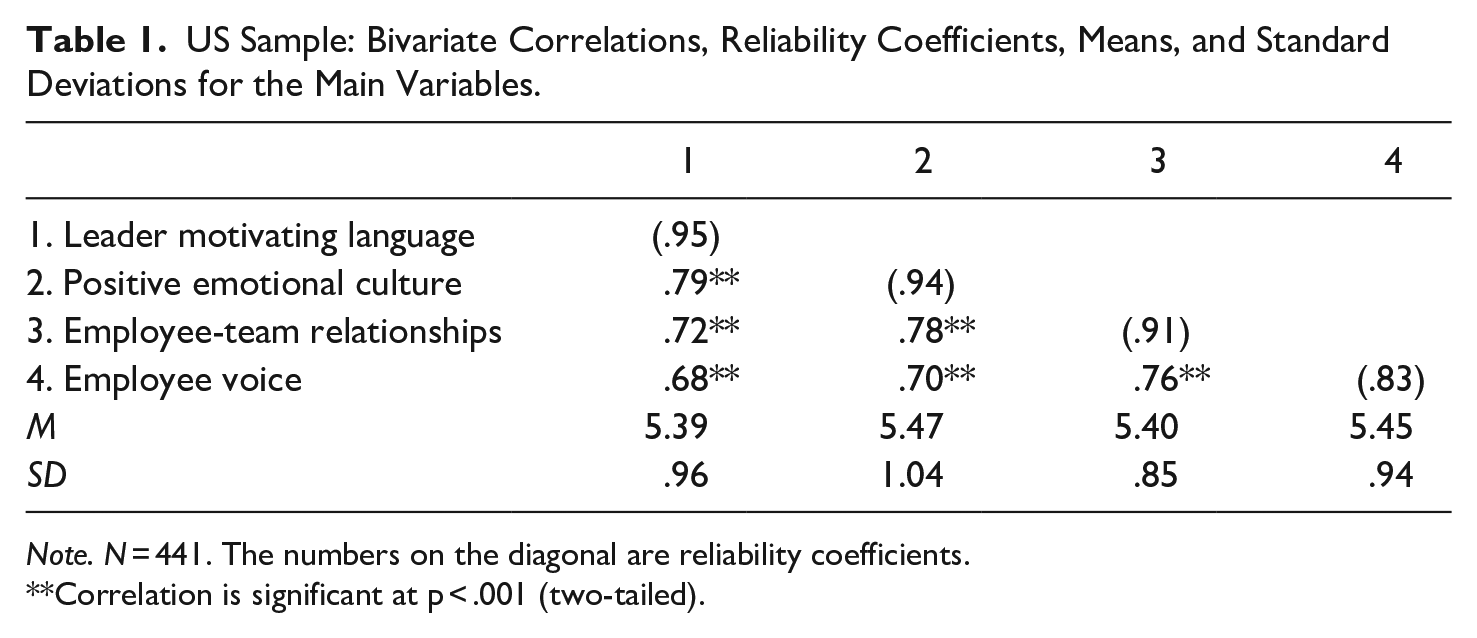
Note. N = 441. The numbers on the diagonal are reliability coefficients.
Correlation is significant at p < .001 (two-tailed).
Indian Sample: Bivariate Correlations, Reliability Coefficients, Means, and Standard Deviations for the Main Variables.
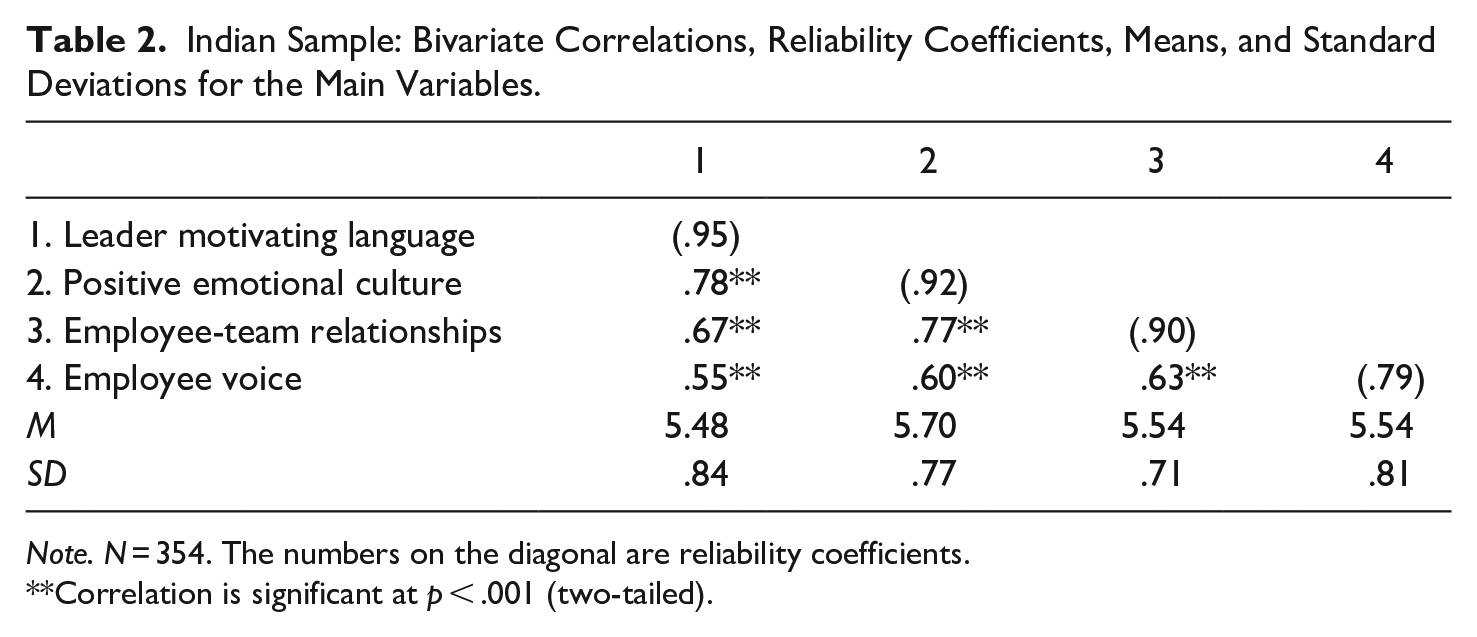
Note. N = 354. The numbers on the diagonal are reliability coefficients.
Correlation is significant at p < .001 (two-tailed).
Leadership motivating language
We borrowed from J. Mayfield and Mayfield (2018) to measure supervisors’ motivating language as perceived by their followers. The scale consists of 10 items measuring direction-giving language (e.g., “Offers me helpful directions on how to do my job”), 6 items measuring empathetic language (e.g., “Gives me praise for my good work.”), and 8 items measuring meaning-making language (e.g., “Offers me advice about how to “fit in” with other members of this organization”). Both samples showed good reliability (αUS = .95, αIndia = .95).
Positive emotional culture
Items to measure a positive emotional culture were adopted from Yue et al. (2021a). The 13-item scale encompasses questions measuring a team culture of joy (i.e., delighted, happy, joyful, and excited), companionate love (i.e., affectionate, loving, and companionate), pride (i.e., proud, superior, and worthy), and gratitude (i.e., grateful, thankful, and appreciative). We should note that we asked participants to indicate how frequently most employees in their teams express those emotions as opposed to their own emotions. The reliability was good across both samples (αUS = .94 and αIndia = .92).
Employee-team relationships
Employee-team relationships were measured with 16 items taken from Huang (2001) with minor adaptions. The scale comprising trust (e.g., “My team has the ability to accomplish what it says it will do.”), satisfaction (e.g., “Both my team and people like me benefit from the relationship.”), commitment (e.g., “There is a long-lasting bond between my team and people like me.”), and control mutuality (e.g., “My team really listens to what people like me have to say.”) demonstrated good reliability across the U.S. (α = .91) and Indian (α = .90) samples.
Employee voice
We borrowed the 6-item scale from Van Dyne and LePine (1998) to measure employees’ voice behavior within their team. Sample items included “I develop and make recommendations concerning issues that affect my team,” and “I get involved in issues that affect the quality of work life here in my team.” The reliability was satisfactory across both samples (αUS = .83 and αIndia = .79).
Results
This study used Hayes’s PROCESS macro on SPSS for data analysis. The bootstrapping procedure was applied (N = 5,000 samples; Hayes, 2013). To run the serial mediation model, Model 4 was selected. Figures 1 to 3 displayed the model results for the U.S. and Indian samples, respectively.
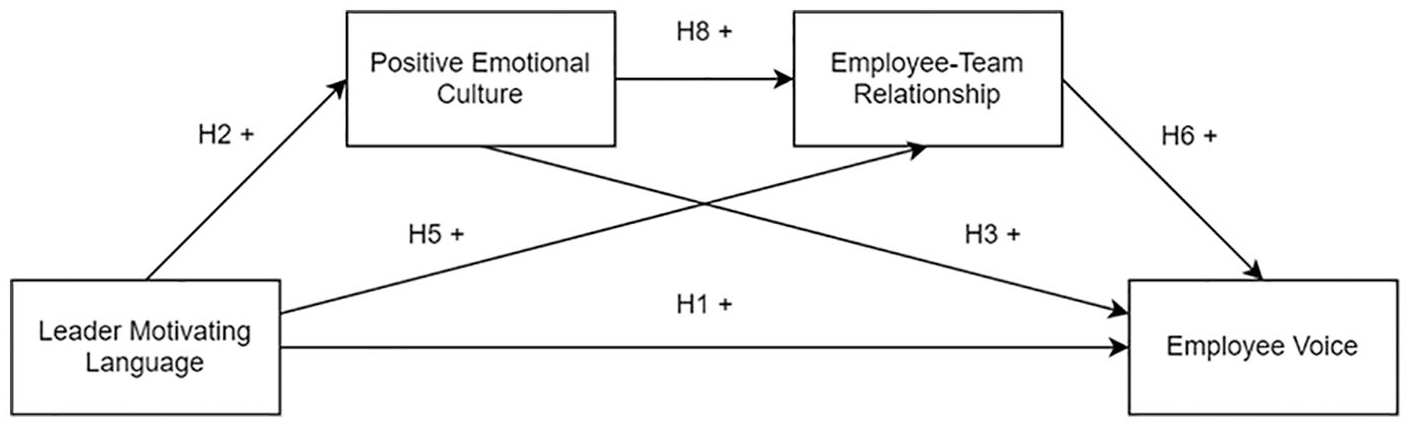
The conceptual model.
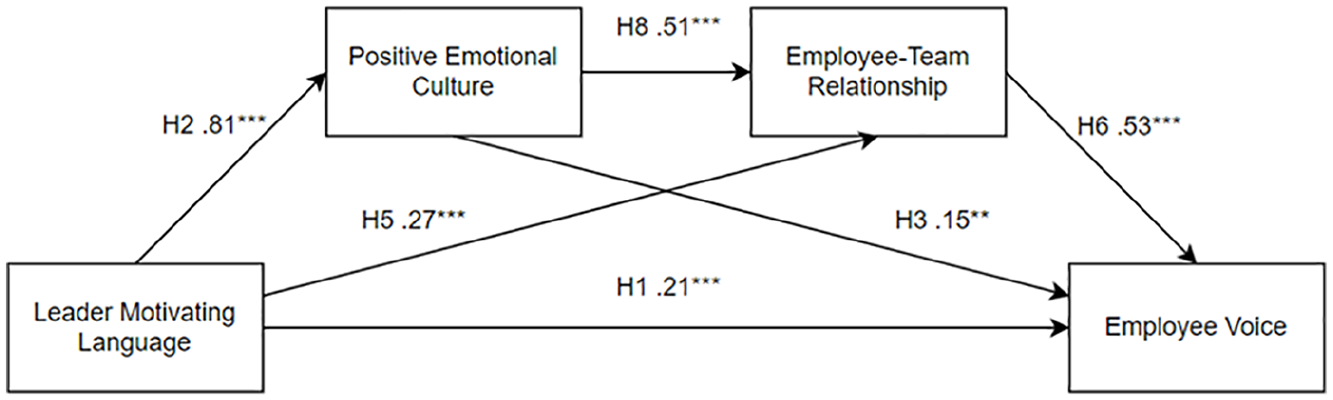
US sample: final model with standardized path coefficients.
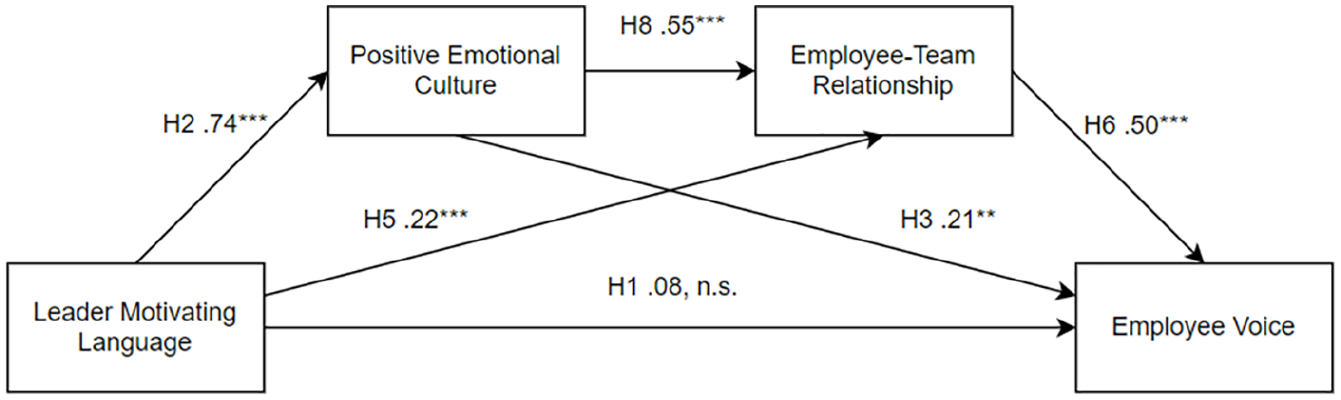
Indian sample: final model with standardized path coefficients.
Demographic variables such as age, gender, organizational tenure, position, education, and organizational size were controlled when running the two models. The comparison of results between the U.S. and Indian samples can be found in Table 3. We first ran the model with the U.S. sample. Our findings supported H1 as leader motivating language was positively related to employee voice (β = .21, p < .001). H2 predicted a positive association between perceived leader motivating language and perceived positive emotional culture, which was also supported (β = .81, p < .001). Our findings further supported H3, demonstrating a positive relationship between perceived positive emotional culture and employee voice (β = .15, p < .01). H4 proposed perceived positive emotional culture as a mediator between leader motivating language and employee voice. This hypothesis was, however, not supported by our mediation analysis: β = .12, SE = 0.06, 95% CI [−0.01, 0.24]. H5 put forth a positive connection between leadership motivating language and employee-team relationships. This hypothesis was confirmed (β = .27, p < .001). Next, H6, which hypothesized a positive connection between employee-team relationships and employee voice, was also supported (β = .53, p < .001). H7 argued that employee-team relationships mediated the impact of leader motivating language on employee voice. This was supported (β = .15, SE = 0.06, 95% CI [0.04, 0.27]), signaling the mediating role of employee-team relationships. In addition, our findings supported H8 (β = .51, p < .001), confirming a positive link between perceived positive emotional culture and employee-team relationships. Finally, H9 proposed perceived positive emotional culture and employee-team relationships as serial mediators, which was confirmed: β = .22, SE = 0.06, 95% CI [0.01, 0.34].
Hypothesis Testing Results Between the U.S. and Indian Sample.
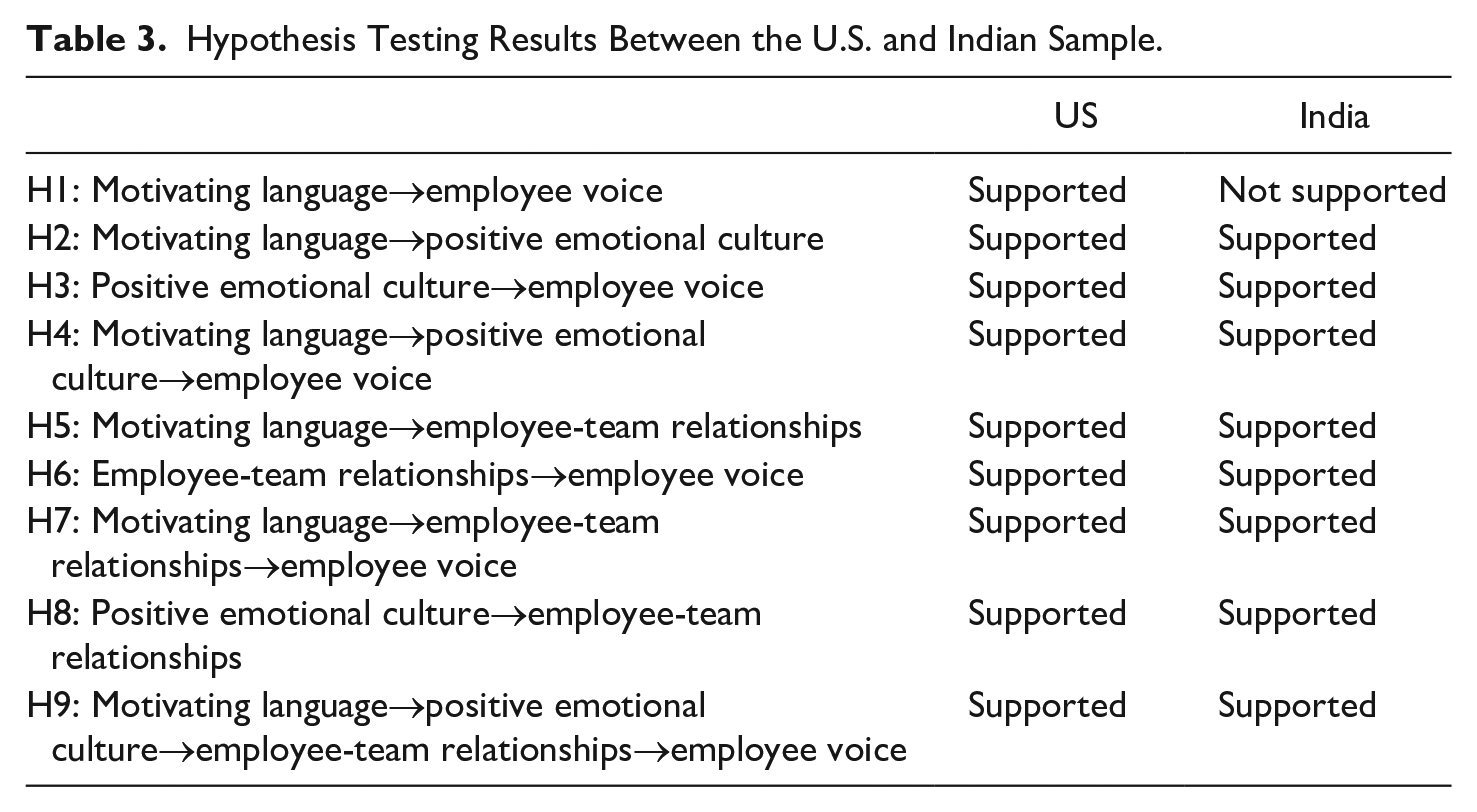
The Indian sample has largely showed similar patterns as the U.S. sample except for H1. We did not find a significant relationship between leader motivating language and employee voice (β = .08, p = .23). Therefore, H1 was rejected. There was a significant and positive association between leader motivating language and perceived positive emotional culture, thus supporting H2 (β = .74, p < .001). Furthermore, H3 was supported as shown by a positive association between perceived positive emotional culture and employee voice (β = .21 p < .01). Perceived positive emotional culture significantly mediated the influence of leader motivating language on employee voice: β = .16, SE = 0.06, 95% CI [0.05, 0.29], lending support to H4. Moreover, H5 and H6 were both supported, as seen in a positive relationship between motivating language and employee-team relationships (H5: β = .22, p < .001), and between employee-team relationships and employee voice (H6: β = .50, p < .001). H7 posited the mediating role of employee-team relationships between motivating language and employee voice, which was supported: β = .11, SE = 0.04, 95% CI [0.05, 0.18]. We also found a positive association between perceived positive emotional culture and employee-team relationships, therefore supporting H8 (β = .55, p < .001). Last, perceived positive emotional culture and employee-team relationships proved to be serial mediators, supporting H9: β = .21, SE = 0.05, 95% CI [0.10, 0.31].
Discussion
The purpose of this study was to examine whether leaders’ motivating language can engender employee voice and the mediating process through which it occurs. Findings from U.S. and India mostly confirmed our hypotheses. In the discussion, we provide a detailed interpretation of our findings and the contributions of this study to theory and practice.
Antecedents of Employee Voice
Our model enriched scholarship on employee voice by broadening its predictive factors. First, we identified a positive and direct association between leader motivating language and employee voice for the U.S. sample. This finding corroborated prior research, which identified the value of employing motivating language in eliciting positive employee behaviors (Madlock & Sexton, 2015; Sharbrough et al., 2006; Yue, 2021a). Moreover, this finding contributed to employee voice literature by identifying leadership communication as a direct antecedent of employee voice. However, we did not find a direct association between leader motivating language and employee voice for the Indian sample. Instead, this association was fully mediated by a positive emotional culture and employee-team relationships. This finding substantiated the mediating role of emotional culture and relationship quality in connecting leadership communication and employee voice, which is discussed below.
This study further identified that perceived positive emotional culture can motivate employees to speak up. Previous research has focused primarily on how negative emotions, such as anger and fear, affected employees’ perceptions of risks and motivations to voice (Heaphy et al., 2022; Kish-Gephart et al., 2009), leaving the role of prosocial emotions unexplored. However, the current study corroborated a recent investigation, showing that employees working in companionate love cultures are more likely to care for others, attend to others’ sufferings, and speak up about problems and issues (Heaphy et al., 2022).
Quality employee-team relationships also served as a critical precursor to employee voice. The role of good workplace relationships in facilitating employee voice has received much attention in the literature (e.g., Botero & Van Dyne, 2009; Wijaya, 2019). The focus of this interest has, however, been mainly directed at the dyadic relationship between leaders and followers. The current study added to these research streams by suggesting a perspective that zooms in on the function of employees’ relationships with their teams. Specifically, we provided evidence that suggests employees who perceive high-quality relationships with their work units feel the need to help their unit improve through voice behavior.
Furthermore, we found that a positive emotional culture and employee-team relationships mediated the association between supervisors’ motivating language and employee voice. In other words, supervisors exerted influence on employees’ voice behavior by fostering a positive emotional culture and quality employee-team relationships. This finding first corroborated several studies which identified the role of organizational culture in mediating the effect of leadership behaviors on employee outcomes (e.g., Liden et al., 2014; Toor & Ofori, 2009). In addition, we found that employee-team relationships mediated several pathways to employee voice. Not only did employee-team relationships mediate the association between positive emotional culture and employee voice, but it also served as a mediator connecting motivating language and employee voice. Previous studies have argued that quality EORs significantly mediated the relationship between organizational behaviors and employees’ in-role and extra-role behaviors (e.g., Kang & Sung, 2017, 2019; Men, 2014; Thelen, 2019). Our findings aligned and expanded these studies by underscoring the importance of employees’ relationships with their work unit.
It is important to note that for the Indian sample, the direct relationship between motivating language and employee voice became insignificant after accounting for the two mediators. In other words, workers from India are more likely to voice opinions and recommendations only if they perceive a positive, safe working culture and experience strong, long-lasting relationships with their work units. While leaders’ use of motivating language is instrumental, this influence is only indirect for Indian employees. In comparison, for the U.S. sample, emotional culture and employee-team relationships partially mediated motivating language and employee voice. Put it differently, this study found the impact, both direct and indirect, of leaders’ motivating language on employee voice in the U.S. sample.
This result may be explained by the difference in power distance orientations of the two countries. Research suggests that individuals who have grown up in a high-power-distance culture have higher respect for power differences (Morrison, 2014). As a result, they are inclined to inhibit their voice as speaking out is considered insubordination (Kwon & Farndale, 2020). Therefore, it is reasonable to speculate that workers from India, who have higher power distance orientations than U.S. workers, are more comfortable with the authority of their supervisors, more likely to conform to the status quo, and less likely to speak up with suggestions for change.
LML, Organizational Emotional Culture, and Employee-Team Relationships
It is no secret that leaders and managers are influential players in workplace culture (Holmes et al., 2007; Sims, 2000). The current study demonstrated the substantive role of supervisors in fostering the emotional dimension of workgroup culture. To elaborate, we found that supervisors have the power to cultivate a team culture of joy, companionate love, pride, and gratitude when they adopt motivating language in communication. That is, employees benefit from leaders’ meaning-making language to decode organizational norms, history, and heritage, and find meaning and value in fulfilling their work role, which in turn, generates joy and pride. The use of empathetic language not only conveys leaders’ emotional support for followers but also normalizes the expression of care, openness, and reassurance in the workplace, which contributes to the formation of a working culture replete with companionate love and gratitude. Likewise, direction-giving language, featured by clear work expectations and timely feedback, can induce employees’ gratitude and enjoyment of work. Overall, the results from this study attested to existing literature that delineated the positive links between effective leadership communication and a healthy, welcoming culture on the organizational level (e.g., J. Mayfield & Mayfield, 2018; Yue et al., 2021a). Complementing previous research, our study provided additional evidence in demonstrating that the communication styles of team leaders have an immediate and direct influence on team culture.
Last but not least, the current study added to a growing line of research by pinpointing the relationship-building function of supervisors (Myers, 2015; Thelen & Yue, 2021). Specifically, our finding indicated that when supervisors employ motivating language, team members are more likely to develop trust, satisfaction, commitment, and control mutuality with their team. Thus, our investigation reinforced and supplemented existing literature that illustrated a positive association between effective internal communication and EORs (cf. Kang & Sung, 2017; Y. Kim, 2021; Li et al., 2021; Men & Stacks, 2014).
Theoretical Implications
This study makes several theoretical contributions to leadership communication literature and scholarship in emotional culture, employee-team relationships, and employee voice. First, utilizing leader motivating language as a theoretical lens, this study provides empirical support for the direct and indirect effects of supervisory communication on various employee outcomes. In academic literature, much has been discussed on how various leadership styles can shape or reinforce the workplace culture (e.g., Holmes et al., 2007; Tsui et al., 2006) and employee-organization relationships (e.g., Lee et al., 2021; Men & Stacks, 2014). Nevertheless, there remains a gap in understanding how supervisors can affect the development of team culture and relationships through effective oral communications (Yue et al., 2021b). In addition, while the relationship between motivating language and employee voice was theoretically proposed (cf. M. Mayfield & Mayfield, 2021), it has not been empirically verified. Therefore, this study contributes to the broad leadership communication research and motivating language theory in particular by including employee voice, employee-team relationships, and positive emotional culture in the nomological network of the motivating language construct.
The current study also deepens our understanding of the emotional motivator of voice behavior by incorporating a variety of positive emotions that have previously been overlooked (Morrison, 2014). By establishing a positive association between employee voice and a positive emotional culture, we contribute to the body of knowledge on why emotional culture matters (Barsade & O’Neill, 2014; Yue et al., 2021a). Furthermore, our results suggest that the more individuals perceive quality relationships with their team, the more they will engage in upward communication. Although prior research has consistently shown the positive impact of EORs on employees’ in-role and extra-role behaviors (e.g., Kang & Sung, 2017, 2019; Men, 2014; Thelen, 2019), we made one of the first attempts to link employees’ voice behavior with employees’ perceptions of relationship quality with their teams.
Practical Implications
This research yields several practical insights for organizations, managers, and professionals in human resources and internal communication. To encourage employees’ voice behavior, organizations should implement developmental interventions to foster the use of motivating language among leaders at different levels. Communication professionals should highlight the substantive role of supervisors in fostering employee voice and equip supervisors with the valued oral communication skills that feature meaning-making, direction-giving, and empathy. The use of effective communication should also be emphasized during recruitment and promotion processes. Senior managers should adopt motivating language so as to influence mid-level and front-line supervisors to do the same, thereby building effective communication into the foundation of organizational culture.
Furthermore, this study identified a positive emotional team culture and quality employee-team relationships as the proximal driving force of employee voice behavior among both Indian and U.S. employees. Therefore, it is crucial for leaders to cultivate rituals, practices, and policies that make cultures of joy, companionate love, gratitude, and pride a desirable outcome. In addition to training leaders to become more effective communicators, organizations may utilize other tools to boost positive team-level outcomes, which ultimately enhances employee voice. For instance, implementing an internal listening system (e.g., regular town hall meetings and pulse surveys) that emphasizes employee participation and feedback likely generates employees’ positive emotions and facilitates the formation of a trusting relationship. Internal communication and human resource professionals can help devise strategies and tactics that facilitate strong team bonds and coach team leaders to instill trust by instituting channels for dialogue. While creating such forums, internal communicators can also identify ways to make it easier and safer for staff to participate—for example, addressing the needs of onsite and remote workers and demonstrating cases of employee suggestions and recommendations that were acted upon. Such approaches can create a ripple effect among employees as they trust the measures taken. Finally, the current study provides insights for practitioners to tailor organizational interventions that fit different national cultures. While a strategy focusing on grooming leaders’ communication skills is valuable, cultivating a positive emotional culture and favorable employee-team relationships is more likely to exert an immediate and direct influence on employees’ voice behavior in the high-power-distance culture, such as India.
Limitations and Future Directions
This study is not without limitations. First, this study adopted a cross-sectional design, which is limited in making rigorous causal claims. We cannot rule out reverse or reciprocal causality in our model. It may be that one’s perception of the supervisor’s motivating language is affected by one’s relationship with the team or perception of team culture. While we cannot establish causality in the current study, the causal ordering of constructs makes theoretical sense and is consistent with extant empirical work (e.g., Avey et al., 2012; Dvir et al., 2002). We invite future researchers to investigate the longitudinal and cyclical nature of these relationships.
Second, this study only administered an online survey at one time point. Therefore, common method variance may be an issue affecting the nature of the proposed relationships. Future research should administer data collection at different time points in order to reduce common method bias (Podsakoff et al., 2003).
The third limitation is that all of our variables were self-reported. To obtain a more objective measure of employee voice and team culture, future researchers can invite the target employee’s direct supervisor and coworkers for additional assessment. Furthermore, this study adopted motivating language theory—an oral communication framework—as the theoretical lens. Future research should strive to understand how leaders’ interpersonal nonverbal communication may influence employees’ voice behaviors.
Finally, from a cross-cultural perspective, this research indicates that employees in different cultures may be motivated by similar organizational factors to speak up, but the magnitude or the mechanism of the influence may vary. Future research can continue to conduct cross-cultural comparisons to investigate antecedents of employee voice.
Footnotes
Declaration of Conflicting Interests
The author(s) declared no potential conflicts of interest with respect to the research, authorship, and/or publication of this article.
Funding
The author(s) received no financial support for the research, authorship, and/or publication of this article.
