







Abstract
We reviewed 440 interview-based articles in the top business communication articles since 2000. We evaluated the sampling and storytelling in these articles. Those articles that are most cited in the 5 years following publication tend to sample managers in for-profit organizations more often and include more storytelling of interview participants. Savvy researchers are able to report perspective stories and plot stories of interview participants in concise and compelling ways. Yet, qualitative researchers could report more plot stories, especially success stories. Guidelines are provided for qualitative researchers to engage in storytelling in ways that do not sacrifice rigor.
Introduction
A common debate, or at least dilemma, for qualitative researchers is whether storytelling in research is possible or advisable given the theoretical demands, rigor, and editorial processes (e.g., word limits) required in academic publishing (Eisenhardt, 1991). In the context of case studies (generally predominantly developed through interviews), Dyers and Wilkins (1991) advocate for research-based, theoretically sound stories that create “aha” moments for readers. Part of their logic for powerful stories in research is that “stories are often more persuasive and memorable than statistical demonstrations of ideas and claims” (p. 617). In practice, however, is good storytelling in research a realistic aim?
Storytelling is widely considered an effective approach to communication in the workplace, in schools, and in personal lives (Forman, 2007; Schank, 1990). In the business communication field, storytelling is encouraged in presentations, entrepreneurial pitches, interpersonal communication, job interviews, and other communication situations (Forman, 2007; Harter, 2017; Martens et al., 2007; Pérez et al., 2020; Smart & DiMaria, 2018; Yang, 2013). Since storytelling is considered an important part of business communication practice, it is worth considering how storytelling is integrated into business communication research (Suchan, 2004). We suggest the most natural place to examine storytelling in research is interview-based research. Qualitative interviews allow participants to share their stories in rich detail.
Qualitative interviews can contribute to research in many ways: facilitating exploratory inquiry, examining issues with rich and thick description, making sense of complex interactions and behaviors, and building theory (Creswell & Creswell, 2018; Geertz, 1973; Merriam & Tisdell, 2016). Many authoritative books and primer articles exist with guidance on interview research. While an important outcome of qualitative research is to tell the stories of research participants (Bailey & Tilley, 2002; Kendall & Kendall, 2012; Lewis, 2011), little guidance is available to researchers about how to report the stories of participants in ways that advance research and create impact.
In part, effective storytelling in research relies on effective sampling: finding the right participants and interviewing enough participants to provide theoretically-driven and memorable stories. As a result, we seek to develop guidance that is based on successfully published qualitative research in top journals. Guidance for many best practices in qualitative research often emerge from “rules of thumb” or imprecise and vague recommendations in research handbooks (Merriam & Tisdell, 2016). By examining patterns in successfully published qualitative work in hundreds of articles, the guidance for qualitative researchers can be more systematic and helpful (Marshall et al., 2013).
In this study, we evaluated interview-based research in the top business communication journals since 2000. We specifically addressed the following purposes: (a) evaluate the degree to which interview-based research is told through stories; (b) evaluate whose stories are told (and not told); and (c) explore best practices in storytelling based on high-impact articles. Since interview-based research is often particularly challenging to publish (Fawcett et al., 2014), we view this latter objective as the most important purpose for our research.
Literature Review
We focus our literature review on three areas. First, we address characteristics of storytelling. Since storytelling is often discussed in ambiguous terms (Georgakopoulou, 2007), we identify two forms of storytelling: plot stories and perspective stories. Second, we discuss storytelling as an outcome of interview-based research. Extensive guidance evaluates storytelling by interview participants as an important input or method for qualitative research (Heath & Porter, 2018). This is not our focus. To fill a needed gap in guidance for qualitative researchers, we focus on storytelling in the reporting of qualitative research. Finally, we review sampling and saturation guidelines for interview-based research.
We address sampling and saturation in the context of storytelling for several reasons. First, achieving saturation allows researchers to tell stories that are theoretically and thematically sound. Researchers are first and foremost bound by reporting trustworthy findings. Once researchers know sampling and saturation align with trustworthiness, they are positioned to report stories that highlight these findings in memorable ways. Second, we entered the project with a working hypothesis that to report memorable and compelling stories, researchers often need to conduct a lot of interviews—sometimes even beyond the point of saturation. In our experience, while all participants in interview-based studies provide valuable information that contributes to study findings, some participants articulate their experiences in ways that are more interesting, more concise, and better fits for research reporting. Practically speaking, we have continued interviews slightly past the point of saturation in some our projects to highlight our research with more compelling stories. We suspect other researchers have done this as well.
Characteristics of Story and Storytelling in Qualitative Research
While storytelling is often encouraged in qualitative guidebooks, it is challenging to find a clear definition of what constitutes storytelling. In business communication literature, stories are often described in terms of plots. Martens et al. (2007) suggest a story has a narrative subject, an ultimate goal, and “a set of forces that enable or impede the subject from attaining the desired object or goal” (p. 1109). Stories should include a sequencing that creates a sense of plot. Barker and Gower (2010) further suggest that action is essential. Pentland (1999) suggests the following elements of narrative text: sequence in time, focal actor/s, identifiable narrative voice, evaluative frame of reference, and other indicators of content and context. Ralston et al. (2003) explain that a story is “discourse that is organized more or less chronologically and tells what characters did in a particular situation and what came of their actions.” They suggest stories vary widely in terms of detail and elaboration. Similarly, Bourbonnais and Michaud (2018) describe stories in the following ways: Stories are often defined as presenting goal-based events. They have a setting, a beginning, and an ending, and they trigger an emotional response. Stories can play various functions. These include preserving a culture, instructing others, solving social problems, and restructuring an experience to usher in deeper understanding. As such, stories are considered therapeutic.
For the purposes of this study, we define plot stories as those that, at a minimum, include a protagonist, a clear sequence of events, and a clear outcome.
Not all storytelling, however, contains each element of a plot. Scholars even debate what constitutes story and narrative (Georgakopoulou, 2007). Some scholars emphasize that the foundations of stories are people’s interpretations and perspectives of their experiences. Storytelling often refers to individual and collective efforts to make sense of life experiences and provide an explanation of specific and abstract events (Colville et al., 2012; Whittle & Mueller, 2012). We refer to this sensemaking approach to explaining events as perspective storytelling. In this form of storytelling, there may be a plot, but it is not necessary. Rather, interview participants share their voice and values as a reflection of their experiences (Barker & Gower, 2010; Barton et al., 2018). The perspective storytelling approach reflects a core principle of interpretive research to include the voice of participants. Indeed, giving voice to participants is a way to honor and value them, producing knowledge that is useful to people (Tracy, 2002).
Storytelling as an Outcome of Interview-based Research
Often in reference to Geertz’s (1973) class work “Thick Description: Toward an Interpretive Theory of Culture,” qualitative researchers emphasize their goals of reporting thick, rich, vivid, and contextual accounts of their interview participants. The details provided by participants—their stories—allow qualitative researchers to explore, build, and test theory in nuanced and naturalistic settings. As a result, many qualitative guidebooks suggest storytelling as a strategy to report interview-based research to bolster the trustworthiness of the research.
Storytelling as an outcome of qualitative research has other important benefits. Bartunek et al. (2006) suggest that storytelling makes research more interesting, allows more knowledge transfer, attracts and retains researchers in higher education, and increases the visibility of management research. They stated: We believe that there are benefits to making research more interesting, so long as the core elements of high-quality research (e.g., importance, rigor, and validity) are present. One such benefit is that scholars who produce interesting research have more influence on others. (p. 10)
Researchers themselves benefit from storytelling (Bartunek, 2019). Druskat (2005) suggests participant stories help researchers understand complex social phenomena more than abstract explanations. As a result, storytelling positions researchers to develop better theory. Moreover, storytelling is often central to the identity of qualitative researchers. After receiving the Association for Business Communication’s Researcher of the Year Award, Suchan (2004) wrote an essay about his career struggles in which the notion of a “research article” often leaves stories out. His fundamental approach to research and teaching was simple: “I think of myself as a storyteller rather than a researcher” (p. 302). He felt that this process of storytelling had profound impacts on his identity. He stated, “Effective teaching is the art of weaving for learners a coherent story about communication. For that story to have power and impact, I believe we have to create, to write, part of that story.” (p. 303).
Storytelling as an outcome of research also honors research participants. Klages et al. (2019) state, “The role of the researcher is to describe participants’ lives, collect their stories and document their accounts . . . The analysis of stories can become a living dialogue when there is a mutual appreciation between the story, the storyteller and the researcher. In this way, researchers will be . . . allowing the stories to animate or bring to life the participants’ experiences, which can then change how others see the world.” Interviewees are “advice givers” (Bisel et al., 2020).
Qualitative guidebooks often include advice to report “thick, rich” examples and stories in research writing. Yet, the advice is generally limited to a few short sentences or paragraphs. Consider for example an entire section from Taylor et al. (2015): “Qualitative research should yield rich descriptions. Illustrative quotations and descriptions convey a deep understanding of what settings and people are like and provide support for your interpretations. Your account should be filled with clear examples” (p. 194). This is the extent of advice from a 426-page guidebook. Our experience suggests that more concrete guidance is required that emerges from successfully published, interview-based research. Since qualitative research is often challenging to publish (Fairhurst, 2014; Tracy et al., 2014), understanding how to introduce storytelling into research findings would be valuable.
Sampling and Saturation for Qualitative Interviews
We’re not aware of any research that has explicitly tied standards of sampling and storytelling together. Our experience in qualitative research suggests sampling and saturation are essential to effective storytelling. We suggest that to report theoretically-grounded, compelling stories requires interviewing many participants until hearing new themes and patterns emerge is rare. We also suggest, based on our own experiences, that even when theoretical saturation may have occurred, one benefit of conducting additional interviews is to gather better stories to illustrate key findings. Sampling (i.e., how many interviews and with whom) and saturation are notoriously challenging to justify and report in qualitative work (Marshall et al., 2013), and editors and reviewers often reject qualitative work when they view sampling and saturation as insufficient (Fawcett et al., 2014; Vasileiou et al., 2018).
Scholars have explored the justification for sampling of qualitative interviews. Generally, various studies suggest qualitative scholars rarely justify saturation. Marshall et al. (2013) examined 83 (Information Systems) IS qualitative studies in leading journals to see how well researchers justified their sample sizes for interviews. Very few studies provided rigorous justification for their sample sizes by citing methodologists’ recommendations, acting on precedent from similar studies, or statistically demonstrating saturation. They concluded that most high-impact articles include at least 20 to 30 interviews for grounded theory research and 15 to 30 interviews for case studies. Saunders and Townsend (2016) selected 248 management articles that used interviews as a data source. They found the median number of interview participants was 32.5 and suggested that a norm should fall between 15 and 60 participants. Boddy (2016) suggests qualitative sample sizes range from 12 for a homogeneous population to up to 30 to 50 for more diverse populations. Sim et al. (2018) found that justification for sample size in qualitative interviews is only addressed in 17% to 50% of articles, depending on discipline.
Methodology
To evaluate interview research in business communication literature and develop best practices based on successful publications, we examined qualitative interviews since 2000 in the four major business communication journals: International Journal of Business Communication (IJBC), Business and Professional Communication Quarterly (BPCQ), Journal of Business and Technical Communication (JBTC), and Management Communication Quarterly (MCQ). These journals are considered the top business communication journals (Rogers et al., 2007; St. Clair Martin et al., 2012). Thus, our first step was to collect all articles that involved qualitative interviews. Altogether, we collected 440 articles.
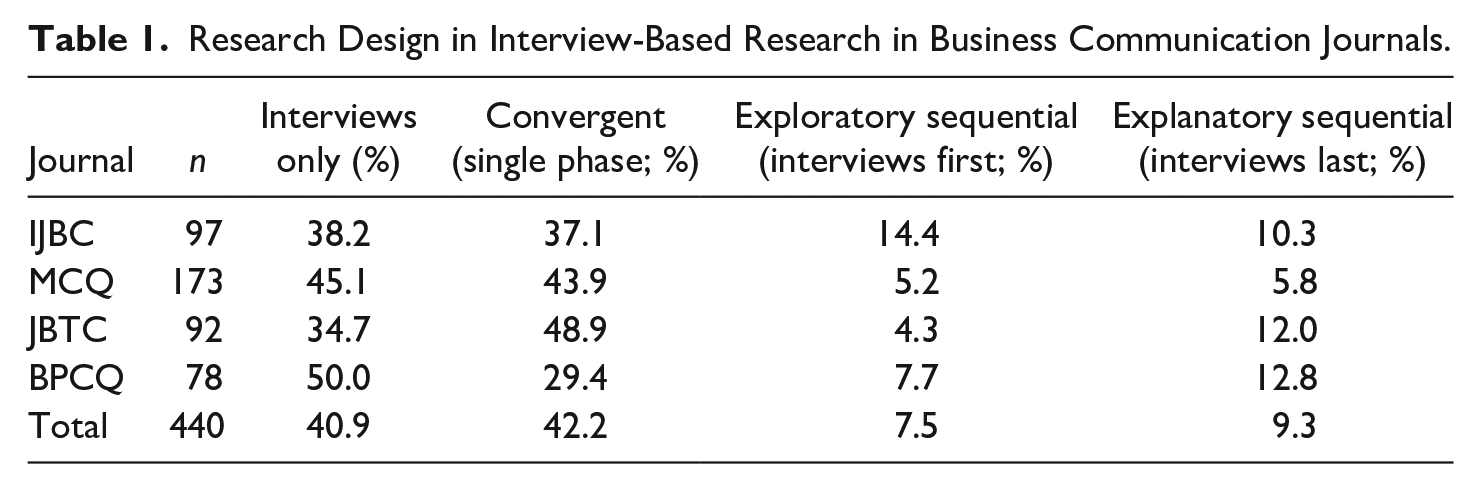
Next, we evaluated the role of qualitative interviews in these articles. We used Creswell and Creswell’s (2018) categories of interviews only, convergent mixed methods design (qualitative interviews and other forms of data collection collected in a single phase), explanatory sequential mixed methods design (a quantitative study followed by qualitative interviews), and exploratory sequential mixed methods design (qualitative interviews followed by quantitative research) (Creswell & Creswell, 2018). Table 1 shows the breakdown of research designs by journal. The two most common research designs were those with interviews only and convergent mixed methods. Most convergent mixed method designs were cases that in addition to interviews, typically included participant observation and/or analysis of documents or websites.
Research Design in Interview-Based Research in Business Communication Journals.
To identify patterns of sampling and storytelling in high-impact articles, we adopted an approach used by Marshall et al. (2013) in a study of qualitative interviews in IS journals. They evaluated how saturation was reported and identified best practices based on reporting in the highest impact articles. Impact was measured by citation counts in Google Scholar. In similar fashion, we collected the 5-year citation counts in Google Scholar for all articles published between 2000 and 2018. Table 2 presents averages based on each journal. In the Findings section, we report based on quartiles.
Five Year Citation Counts for Interview-based Research in Business Communication Journals.
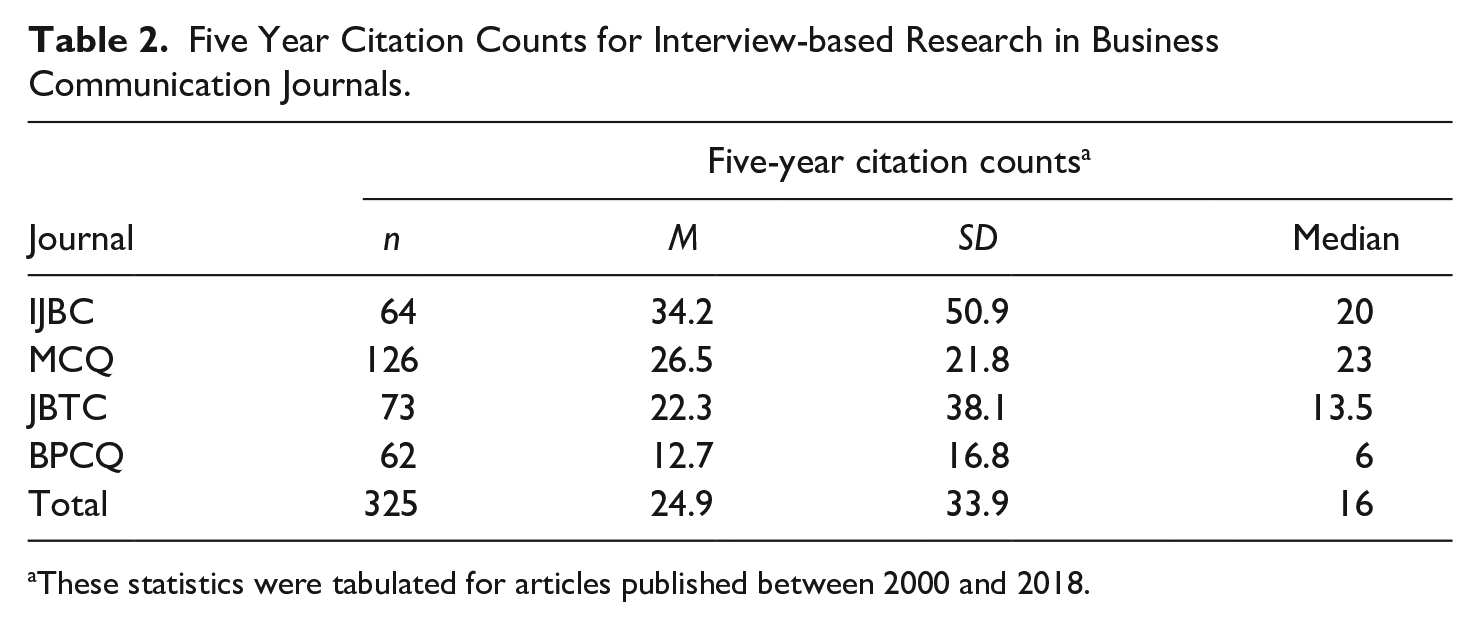
These statistics were tabulated for articles published between 2000 and 2018.
We coded each article to understand the nature of the interview research. We identified the number of interviews, the number of interviewees, the length of interviews, and how saturation was reported. To evaluate sampling, we coded the presence of the following among interview participants: managers, employees, functional experts, external stakeholders, instructors, students, and diversity populations. For diversity populations, we coded for groups explicitly identified as the focus of the study and who were in some way marginalized or disadvantaged. The most common studies in this category focused on women, LGBT individuals, and immigrants. We also coded for organizational type and distinguished between for-profit and non-profit organizations based on the available information. We included government agencies, schools, and hospitals in the non-profit organization category. When informants came from a mix of organization types, we coded for the predominant background. For example, some studies included participants from private industry and government. When it was clear most participants were in the private sector, we coded the study as “for-profit organizations.” To evaluate storytelling, we specifically focused on the degree to which the stories of interview participants were told. We coded plot stories based on examples from interview participants that contained the following: a protagonist, a clear sequence of events, and a clear outcome. In our examination of perspective stories, the best measures we could find involved direct quotes. It was in direct quotes that researchers appeared to capture and illustrate the voices of interview participants, highlight how these interview participants made sense of events and phenomena, and weaved individual voices into broader storylines. We coded perspective stories in terms of the number of direct quotes and the number of words in these direct quotes. In some cases, direct quotes included partial or complete plot stories.
Findings
We group our findings into the following areas: sampling, saturation, storytelling, and variation based on impact. In the variation section, we also report exemplar articles to highlight the findings. Each of these exemplar articles is considered a high-impact article (top quartile in terms of 5-year Google Scholar citation counts).
Sampling in Interview-based Research
Across the business communication journals, there is substantial variation in whose stories are told (see Table 3). For example, researchers focus much more on managers (57% of interview-based articles) in for-profit organizations (81%) in IJBC. Researchers focus heavily on non-managerial employees (75% of interview-based articles) in MCQ. Researchers focus on instructors and students much more in the JBTC and BPCQ. Diversity populations receive the most attention in IJBC and MCQ.
Sampling in Interview-Based Research in Business Communication Journals.
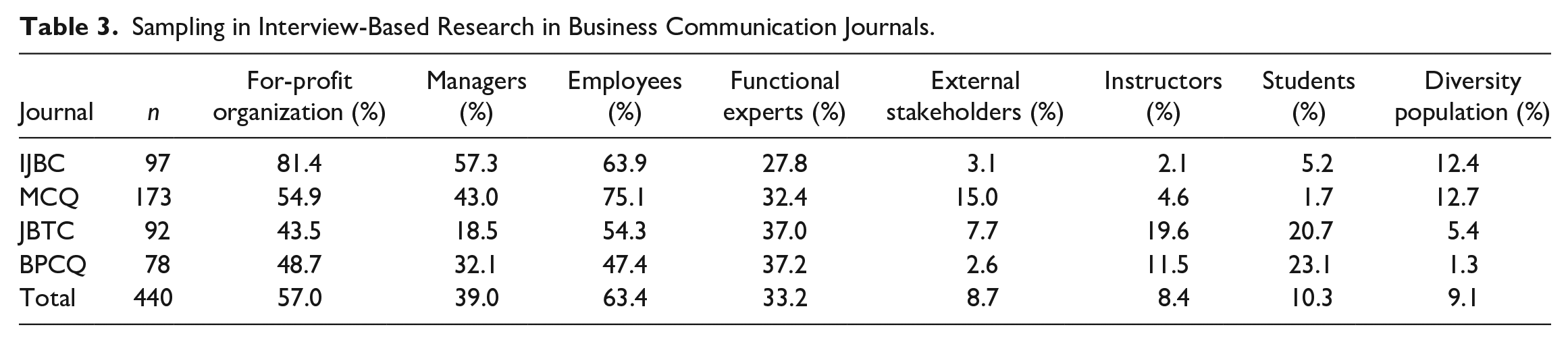
As far as functional expertise, researchers in BPCQ focused most often on HR directors and managers, communication directors, social media specialists, and lawyers. Researchers in IJBC focused most often on executives, corporate communication specialists, and IT professionals. Researchers in JBTC focus most often on technical communicators, engineers, and corporate communication specialists. Researchers in MCQ focused most often on public safety workers (e.g., fire fighters, police officers), healthcare workers (e.g., nurses, physicians), HR directors and managers, IT experts, and sustainability experts.
Saturation in Interview-based Research
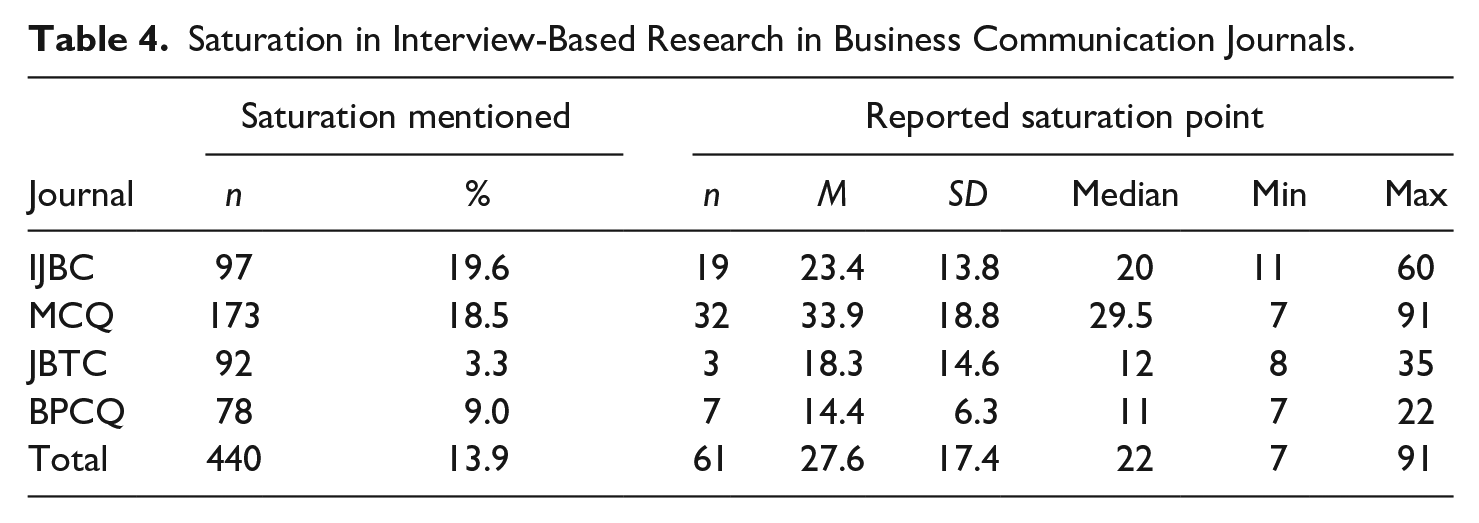
Existing research from other fields has demonstrated how infrequently saturation is reported. Our review of business communication research suggests that only 14% of interview-based articles reported the point at which researchers identified saturation (see Table 4). In nearly each instance, the researchers simply stated it was the point at which they saw no new themes emerging with no further explanation. When researchers did report saturation, there was wide variation in the point at which it was achieved. The range was from 7 to 91 interviews. This variation in reported saturation also occurs across journals, with the median point of saturation occurring at roughly 30 interviews in MCQ articles, 20 interviews in IJBC articles, 12 interviews in JBTC articles, and 11 interviews in BPCQ articles.
Saturation in Interview-Based Research in Business Communication Journals.
We acknowledge that saturation is not a goal for all interview-based research. Many of the studies we evaluated stated rationale for not focusing on saturation. Some involved small groups of key insiders in a case study or difficult-to-find populations (e.g., whistleblowers, male victims of sexual harassment). These difficult-to-find populations were most common in MCQ.
Storytelling in Interview-based Research
We evaluated storytelling in terms of perspective stories and plot stories. Perspective stories are included in nearly all interview-based studies. On average, articles contain roughly 10 direct quotes from participants (see Table 5). These direct quotes average 49 words in length.
Indicators of Perspective and Plot Storytelling in Business Communication Journals.
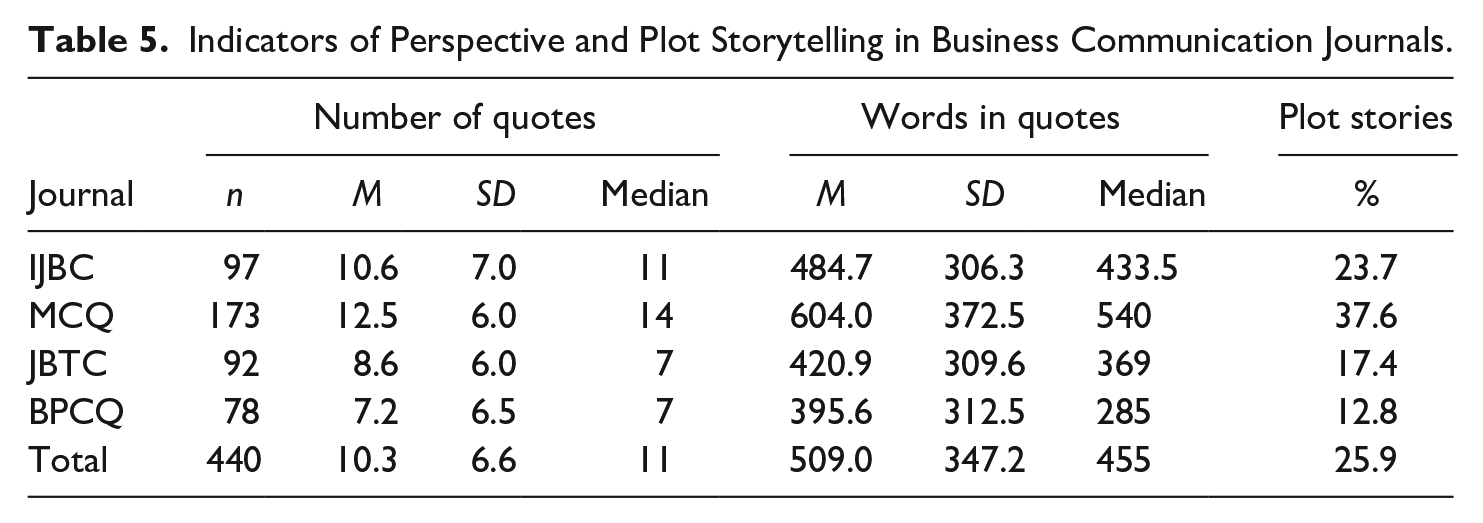
By contrast, plot stories are not common. We identified plot stories in just 26% of these articles. MCQ contained the most plot stories (38% of articles). The most common types of stories involved challenges or barriers faced by individuals (often with a focus on what they were unable to accomplish as a result), emotional states experienced during communication events and work episodes, the adoption of new technologies or tools in the writing process, the implementation or execution of educational or training programs, and working with professionals across cultures.
Variation in Sampling, Saturation, and Storytelling by Impact
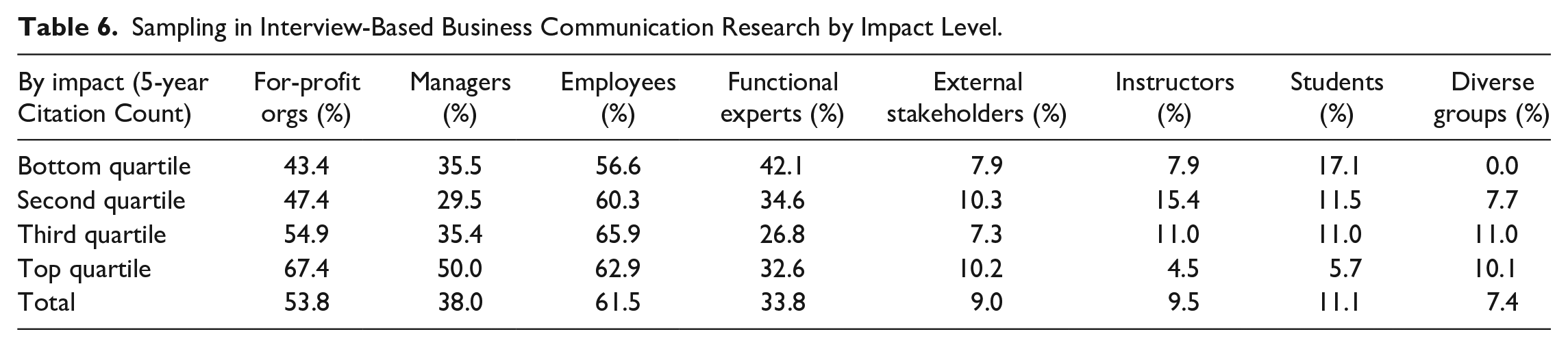
For articles that are considered high impact (top quartile as far as 5-year citation counts), several characteristics stand out. First, researchers for these articles are more likely to have sampled among for-profit organizations. Second, they are more likely to have sampled managers as part of their interview groups. Table 6 presents additional information about the sampling.
Sampling in Interview-Based Business Communication Research by Impact Level.
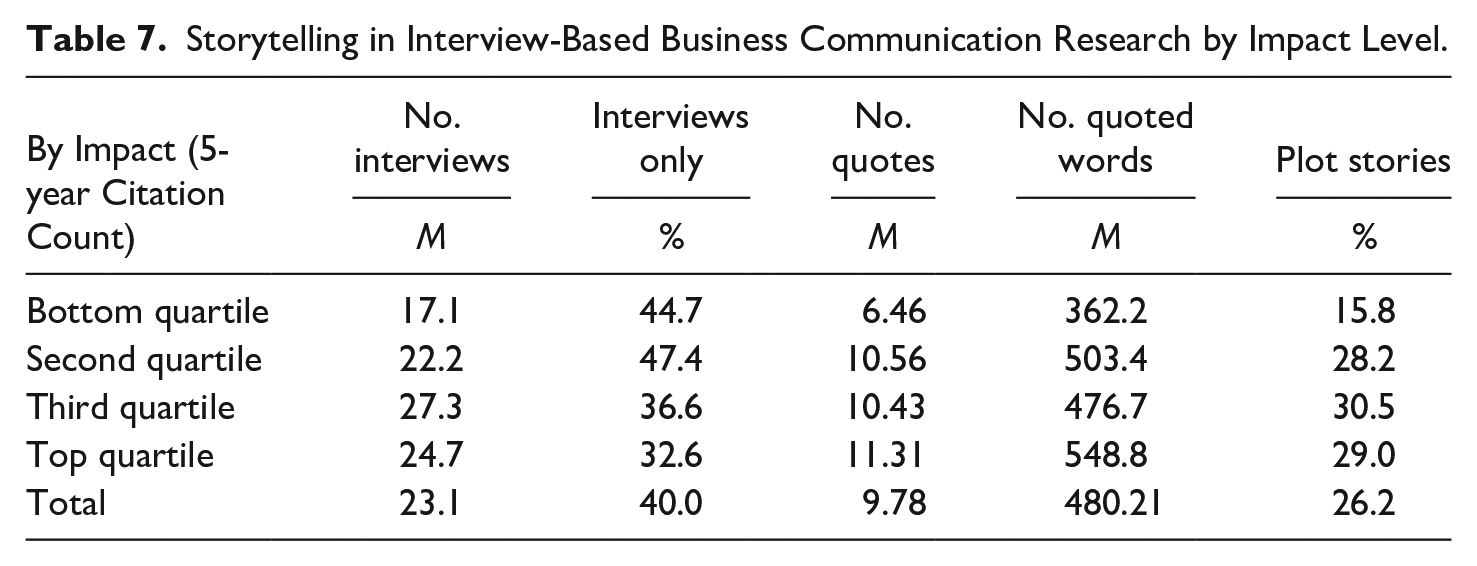
Several additional characteristics stand out related to research design and storytelling. Those articles that are bottom quartile tend to be much thinner in terms of data. Researchers of these articles tend to interview fewer people and are less likely to triangulate their findings with other forms of data. They also engage in far less storytelling, quoting their participants less and providing fewer plot stories. Researchers of top quartile articles quote their participants the most even though they are least likely to rely only on interview data. In other words, while they are more likely to have other data to present and bolster their case, they are still able to allocate more space in their articles for storytelling from interview participants’ comments (Table 7).
Storytelling in Interview-Based Business Communication Research by Impact Level.
Among high-impact articles, researchers clearly focus on theoretical contributions and rigor yet also often find ways to introduce storytelling. Aten and Thomas (2016), in a case study of crowdsourcing strategizing in the U.S. Navy, combined technology affordances and communicative-as-constitutive frameworks to advance theory. Their interviews of 81 influential members of this effort was a small fraction of data that included emails, documentation and reports, and website information. Facing constraints in space, they ensured that each of roughly 10 subsections in the Findings section contained one to two direct quotes that highlighted key themes and triangulated other information. Similarly, Madsen (2016), in a case study of an enterprise social network at a bank, relied primarily on analysis of 40 online discussions. Still, she used interviews to help her interpret these discussions and validate the importance of employee views.
In perspective stories, researchers often choose quotes that not only illustrate key theoretical insights and highlight themes, they choose quotes that also contain vivid and memorable language. For example, Fatima Oliveira (2013) in a study of the cultural influences on crisis communication, shared quotes that included interesting metaphors (e.g., “the human brain is like a parachute,” p. 264), counterintuitive statements (e.g., “reporting not impressive profits can be interpreted as a sign of honesty,” p. 265), and other catchy statements (e.g., “individuals forgive mistakes, but they don’t forgive lies,” p. 266). Similarly, Cowan (2012), in a study of the complicated nature of defining workplace bullying according to HR professionals, selected quotes with intriguing thoughts (e.g., “people can see someone that perhaps has a high directive style as someone who is a bully,” p. 388), interesting analogies (e.g., “bullying is much more subtle and much more covert . . . it’s kinda like the old Supreme Court justice talking about hornets,” p. 390).
One challenge of plot stories is the amount of space they may take. Yet, savvy researchers find ways to use a combination of summarizing, paraphrasing, and direct quotes to concisely share these stories. For example, Burgess (2005), in 97 words shared a compelling, vivid example of company divisions fighting for resources. The story highlighted a key theme and reinforced an earlier survey study. In a study of organizational storytelling, McAllum (2014) used short examples of participants to bring the theory to life. Emphasizing reciprocity and relational rewards involved in volunteering, this researcher highlighted this quote, in just 53 words, from a participant: “I went to grab her hand to say goodbye to her. She pulled me down and gave me a big kiss on the cheek and she said, ‘Thank you dear. That was such a wonderful drive back. You’re just such a lovely lady.’ It was so nice. I love doing jobs like that. She was just so full of appreciation and so genuine about it. It was absolutely rewarding.” (p. 95)
Some researchers attempt to catch the attention of readers immediately with storytelling. Some use the title of the article with quotes from participants. For example, Panke and Gaiser (2009), in their article about social tagging, called it “’With My Head in the Clouds’”: Using Social Tagging to Organize Knowledge.” Others use metaphors that present a storyline. For example, Kopaneva (2019), in an article about mission and vision alignment according to employees, used the following title: “Left in the Dust: Employee Constructions of Mission and Vision Ownership.” Others open their articles with a storytelling approach. For example, Hale et al. (2005), in an article about crisis communication, started their article in this way: “The same day the authors completed a near final draft of this article, the power grid that linked major portions of the Eastern United States and Canada became overloaded and shut down. We have since learned that a tree fell on a power line somewhere in Ohio, caused the lines to overheat, and triggered a rolling shutdown. The general public seemed shocked to learn the power systems throughout major parts of the country are tightly linked and dependent on one another. But the public should not have been surprised, however. The event is simply one more reminder that the world is interconnected and that a crisis occurring in rural Ohio may have worldwide consequences.” (p. 112).
In exploratory sequential (interviews first), researchers often used fewer quotes but chose those that directly led to hypothesis development. For example, Turner and Reinsch (2007) presented the following quote from a participant: “If it’s somebody that works for me and I go talk to them, then you know, to be honest, I’m their boss I have priority and you [they] need to pay attention to that. I just say, “I need to talk about this” and then they stop what they’re doing and we talk. If it’s an equal . . . then I’m pretty tolerant of [multicommunicating].” (p. 45). This blunt and persuasive comment led directly to the following hypothesis that was used in an experimental design: “The status (rank) of one’s communication partner will affect the perceived likelihood of multicommunicating; higher interlocutor status will discourage multicommunicating” (p. 48).
Discussion of Conclusions and Recommendations
Our review of interview-based research in business communication journals since 2000 revealed several key conclusions: storytelling is aligned with high-impact research; perspective stories are common while plot stories are rare; some professionals’ stories are told more than others; the number of interviews likely influences the capacity to engage in storytelling; and storyteller researchers are needed. For each of these conclusions, we present our recommendations for researchers.
Storytelling Is Aligned With High-Impact Research
This evaluation of interview-based research in top business communication journals suggests that researchers can engage in storytelling in their research findings without sacrificing impact. In fact, researchers in top-quartile articles, particularly in comparison to bottom-quartile articles, allocate more space for plot stories and perspective storytelling. They are more likely to provide plot stories, and they find ways to use quotes that highlight theoretical contributions in meaningful and memorable ways.
Many qualitative researchers struggle with how to present so much data within journal constraints. We believe our review suggests that researchers can safely allocate two or three plot stories and 500 to 1,000 words of direct quotes in their manuscripts. Of course, these quotes should be considered strategically to illustrate theoretical contributions while also capturing the imagination of readers with vivid, catchy, and sometimes metaphorical language.
It’s worth noting that high-impact articles are less likely than low-impact articles to rely exclusively on interviews. Roughly two thirds of high-impact articles rely on other data sources besides interviews. Still, even with other data sources, authors of high-impact articles are able to engage in as much or more storytelling of interview participants compared to lower-impact articles.
Perspective Stories Are Common While Plot Stories are Rare
While perspective stories are included in nearly all articles, just one third of articles include plot stories. We consider this a major missed opportunity for business communication scholars. Plot stories, as illustrated with several exemplar articles, can be told in 50 to 100 words. These plot stories can make articles more interesting and serve as theoretically sound examples to use in training situations.
Perhaps most surprising to us was the almost complete absence—across nearly a quarter century of business communication research—of success stories. Most business communication textbooks and popular press books for practitioners emphasize the ability to tell success stories. Job interviews are an example of situations in which job interviewees are advised to have a catalog of success stories. We urge qualitative researchers to focus on providing more plot stories that are theoretically driven examples of successful business communication.
Some Professionals’ Stories Are Told More Than Others
As we evaluated the samples of professionals, we were also surprised how infrequently professionals with various types of business functional expertise were sampled. Among business functions, corporate communication, HR, and IT specialists were sampled many times. Yet, there is little representation of finance, consulting, marketing, and operations professionals. Since these areas of functional expertise are more popular among students in business schools, we suggest the sampling appears misaligned with the needs of business students. Outside of business functions, the most common samples include occupational areas of expertise, such as emergency workers, healthcare workers, and instructors. It seems that many other occupational groups could be sampled.
The Number of Interviews Likely Influences the Capacity to Engage in Storytelling
The highest performing articles tend have a median around 25 interviews. The lowest performing articles have a median closer to 17 interviews. We suggest this indicates that the collective wisdom (of authors and reviewers) is that more rigorous, credible interview-based research places the minimum range of saturation at between 20 and 30 interviews. There are clear exceptions we have identified (small, difficult-to-find samples such as whistleblowers).
We also suggest that reaching this threshold of 20 to 30 interviews generally better positions researchers to engage in storytelling. For examples, the median number of interviews for articles that include plot stories is 26. Yet, it’s likely—based on our own experiences and based on the correlation between more interviews and more storytelling in journal articles in this study—that interviewing more participants gives researchers more material from which to select concise and compelling stories that highlight theoretical insights. We emphasize, however, that researchers must focus first and foremost on trustworthy findings.
Storyteller Researchers Are Needed
We conclude with a short appeal for researchers to engage in storytelling more often in research. With the many advantages of storytelling, Lewis (2011) asked, “If story is central to human meaning why, in the research world, is there not more storytelling?” We believe one reason, as noted by Suchan (2004), is that there are biases against storytelling among editors and reviews. In some cases, the lack of storytelling in research may be a result of self-censorship by authors. This study reveals that more storytelling is aligned with higher impact research in business communication articles. In other words, what many researchers view as a risk may in actuality be an advantage. We believe that more storytelling in research can better engage readers, increase a researcher’s influence, and allow more theoretically sound conversion of stories to learning environments.
Footnotes
Acknowledgements
None.
Declaration of Conflicting Interests
The author(s) declared no potential conflicts of interest with respect to the research, authorship, and/or publication of this article.
Funding
The author(s) received no financial support for the research, authorship, and/or publication of this article.
Ethical Approval and Informed Consent Statements
This research complied with all requirements at the University of Southern California.
