







Abstract
This study examines the impact of social media influencers (SMIs) on public attitudes toward corporate social responsibility (CSR) campaigns. Using Balance Theory and parasocial relationships (PSRs) as key frameworks, it explores how PSRs influence CSR hypocrisy, positive moral emotions, and corporate-related outcomes, while considering the role of SMI-CSR fit. A survey with vignette featuring fictitious partnerships between real corporations and SMIs was conducted. Findings suggest that stronger PSRs reduce CSR hypocrisy perceptions, enhance positive moral emotions, and improve corporate outcomes, but only when SMI-CSR fit is moderate to high. This study advances CSR communication research and informs SMI-related business decision-making.
Keywords
Introduction
Corporate social responsibility (CSR) encompasses business efforts aimed at promoting societal well-being and sustainability (Kotler & Lee, 2005), with effective CSR communication being essential to maximizing its impact (S. Du et al., 2010). As social media becomes increasingly prominent in CSR communication (Okazaki et al., 2020), social media influencers (SMIs)—individuals with large followings on social media platforms—have emerged as key players in shaping public perceptions (Lou & Yuan, 2019). For instance, in 2022, Bausch + Lomb partnered with Lauren Singer (Trash Is For Tossers, 2022) to promote contact lens recycling, significantly increasing awareness through her Instagram video highlighting the campaign.
Despite the growing partnerships of SMIs in CSR communication practices, there remains a gap of scholarship exploring the mechanism of the SMIs’ impact. The extensive research on influencer marketing is helpful but may not be sufficient—unlike marketing activities, CSR activities are more value-related and thus require a more intricate assessment that includes positive moral evaluations (Ellemers & Chopova, 2021) and negative perceptions such as cynicism (Chon & Kim, 2021) and hypocrisy (Christensen et al., 2020). Therefore, it is valuable to explore whether influencers are contributing to CSR communication success, and if so, how these contributions are realized.
Scholars have highlighted several benefits of SMI partnerships in CSR communication, including improved message creation (M. T. Lee & Theokary, 2021), enhanced persuasiveness (Li, 2022), and opinion leadership that drives support (Cheng, Hung-Baesecke, & Chen, 2021). We argue that SMIs offer more than these functions—they also cultivate parasocial relationships (PSRs), enduring one-sided bonds formed between followers and SMIs (Horton & Wohl, 1956; Yuan & Lou, 2020). Unlike other mechanisms, PSRs are unique to followers. Given their persuasive and affective power in business contexts (e.g., Farivar et al., 2021), PSRs warrant further exploration for their potential to enhance CSR communication.
To this end, our research focuses on the impact of PSR in CSR communication with SMI partnerships. Drawing from the balance theory framework, we depict a triadic relationship involving followers, the SMI, and the corporate. We examine how PSR (follower-SMI) can positively followers’ evaluations of both the CSR efforts and the company (follower–company), within the context of SMI–company collaboration. Through an online survey targeting SMI followers, we provided empirical evidence for the hypocrisy-reducing impact of PSR in the CSR communication context, as well as the role of SMI–CSR fit as a factor that conditions this effect. We expect our findings to contribute to the current scholarship about CSR communication and offer an alternative perspective on the significance of SMI partnership in this process. Our findings will also advise CSR communication practitioners in partner selection and evaluation.
Literature Review
SMIs in CSR Communication
Social media influencers (SMIs) represent a unique category of social media users and have been recognized as highly influential channels for disseminating business information (Karp, 2016). SMIs play diverse roles in business communication (Childers et al., 2019), including crafting more favorable messages (Campbell & Farrell, 2020), serving as credible sources (Djafarova & Rushworth, 2017), and acting as opinion or taste leaders who set trends and inspire mimicry (De Veirman et al., 2017). Moreover, they may also be perceived as “distant friends” (Abidin, 2016), exerting influence on followers through this personal connection.
SMIs can also wield considerable influence on social issues, particularly in low-controversy topics such as environmental protection (e.g., Buvár et al., 2023; Dekoninck & Schmuck, 2022, 2024). Both green influencers, whose expertise centers on sustainability topics (e.g., Boerman et al., 2022; Dekoninck et al., 2023; Knupfer et al., 2023), and non-green influencers, whose primary expertise lies outside such topics (e.g., Buvár et al., 2023), can influence public attitudes and behaviors toward environmental issues. Given the influence of SMIs on business communication and environmental issues, their role in CSR communication warrants further investigation.
In the CSR communication context, SMIs can enhance CSR message credibility (Panopoulos et al., 2022), foster trust (Pittman & Abell, 2021; Zhao et al., 2024), and act as opinion leaders driving support and inspire mimicry (Cheng, Chen, & Hung-Baesecke, 2021; Cheng, Hung-Baesecke, & Chen., 2021). While these are key mechanisms, they may not fully capture the unique impact SMIs have on their followers. For instance, Li (2022) argued that knowledge of an SMI’s expertise and popularity metrics influences how audiences process CSR messages. However, because this information is typically visible in the SMI’s profile and accessible to both followers and non-followers, its impact extends beyond followers alone.
To address this gap, we advocate for a focus on follower-oriented influences, particularly the parasocial relationship that followers form with SMIs. This relationship between SMIs and their followers represents a unique dynamic that non-followers do not experience. While it has received limited attention in SMI-involved CSR communication (e.g., Vrontis et al., 2021), prior research has found that it is significantly associated with attitude and behavior change regarding social causes, products, or viewpoints (e.g., Ballantine & Martin, 2005; Rubin et al., 1985). We believe this effect may also extend to CSR communication, potentially shaping followers’ attitudes toward CSR initiatives.
SMI, PSR, and CSR Communication
Parasocial relationships (PSRs) were originally defined as one-sided psychological bonds between audiences and television media personas (Horton & Wohl, 1956) and have since been extended to celebrities (Kim & Song, 2016) and SMIs (Yuan & Lou, 2020). Compared to the similar concept of parasocial interaction (PSI) which focuses on audiences’ engagement with the media persona, PSR emphasizes the long-term relationship rather than the process of its formation (Horton & Wohl, 1956).
PSR is typically characterized as non-reciprocal because media figures generally have minimal knowledge of the audience (Escalas & Bettman, 2017). SMIs’ relationships with followers may differ from traditional PSRs, as social media enables interaction that makes the relationship more “collectively reciprocal” and “co-created” (Lou, 2022, p. 11). However, this relationship still lacks balanced bidirectional communication—while followers can comment, like, or share SMIs’ posts, SMIs may only selectively reply, often without deep knowledge of their followers (Breves et al., 2021). Given that PSR remains a widely used concept in SMI scholarship (e.g., Bi & Zhang, 2022; Dekoninck & Schmuck, 2024; Sheng et al., 2024), this study still terms the SMI-follower relationship as PSR. Nonetheless, we adopt Yuan and Lou’s (2022) operationalization of this PSR type, adapting it to the context of SMIs while acknowledging its distinction from traditional media personas.
The impact of PSR on shaping attitude has been well testified (Tukachinsky et al., 2020). In business communication, PSR fosters consumers’ positive attitudes and pro-corporate behaviors by enhancing credibility and reducing counterarguing (e.g., Bi & Zhang, 2022; Breves et al., 2021; Reinikainen et al., 2020). In the context of sustainability issues, green influencers’ ability to shape public attitudes and behaviors also hinges on the strength of their PSRs with followers (Dekoninck et al., 2023), particularly among younger audiences (Knupfer et al., 2023). At the intersection of business and sustainability—such as in green advertising—emerging evidence supports PSR’s persuasive power. Stronger PSRs enhance perceived SMI trustworthiness and lead followers to interpret corporate green ads as affect-driven rather than calculative, resulting in more favorable product evaluations and purchase intentions (Breves & Liebers, 2022). While CSR communications share themes with green advertising, it emphasizes non-product-related outcomes and long-term corporate relationships (Kim et al., 2020). Breves and Liebers’s (2022) findings offer empirical support for PSR’s relevance to such topics, underscoring the need to explore its role in CSR communication.
The Impact of PSR in CSR Communication: A Balance Theory Perspective
To understand the role of SMIs in CSR communications, we drew inspiration from the Balance Theory, which theorizes how individuals establish cognitive consistency when faced with multiple objectives of attitude (Heider, 1946, 1958). While existing scholarship on SMIs’ social influence often relies on the advertising value framework to explain content effects (e.g., Lou & Yuan, 2019) or applies opinion leadership and social influence models to assess source effects (e.g., Cheng, Hung-Baesecke, & Chen, 2021), these approaches primarily focus on dyadic relationships. In contrast, Balance Theory allows us to conceptualize the triadic relationship among the company, the SMI, and the follower/consumer, accounting for how attitudes toward any two entities can influence perceptions of the third.
As Balance Theory posits, when shaping social perceptions, individuals establish connections, that is, unit relations, between various entities based on sentiment (affective feelings) or cognitive interpretation (e.g., relatedness or similarity; Heider, 1958). These unit relations can create either a balanced or unbalanced mental state, with individuals naturally preferring the former (Heider, 1958). A balanced state occurs when all unit relations are positive (e.g., liking) or when two negative evaluations (e.g., disliking) are paired with one positive. If these conditions are not met, individuals may find themselves in an unbalanced state, leading to undelightful psychological experiences. To restore balance, they may adjust their perceptions or relationships to alleviate this inconsistency.
Heider’s (1958) triadic p–x–o model depicts these relational patterns. Here, p represents a first person, and o and x represent a second person and another entity, respectively. Each dash (“–”) signifies the unit relation between two entities. Adopting the p–x–o model, we also proposed a triadic framework involving the consumer/follower (p), the influencer (o), and the corporate (x) to describe the dynamics among different parties in SMI-mediated CSR communication. As discussed earlier, unit relations can be cognitive and/or sentiment. We use PSR to signify the unit relation between consumer/follower (p) and influencer (o), considering the cognitive and affective component of PSR (Klimmt et al., 2006). We argue that the unit relation between influencer (o) and corporate (x) is intentionally established through the CSR partnership, representing a cognitive unit relation. Finally, the association between consumer/follower (p) and corporate (x) is reflected in the attitude toward the corporate following exposure to the CSR campaign. With these connections established, followers seek psychological balance; if not, they may need to adjust some of the unit relations to restore it (Heider, 1958). If a strong PSR exists between the consumer/follower and the SMI (p–o), and the consumer/follower recognize an established partnership between the influencer and the corporation (o–x), they are more likely to develop a favorable attitude toward the corporation (p–x) to maintain balance. If this balance is unsettled, they may adjust their perceptions of one of these relationships to regain balance. Therefore, we hypothesized that within the context of an SMI-mediated CSR communication campaign. . .
CSR Hypocrisy in SMI-Involved CSR Communication
Both news sources (X. Du, 2015) and consumers (Lyon & Montgomery, 2013) have been voicing concerns about the motivations behind corporate involvement in social responsibility. Companies engaging in social issues can associate themselves with socially desirable attributes (Brown & Dacin, 1997). However, if their actual performance fails to meet the expectations set by their CSR commitments, they might face accusations of hypocrisy (Wagner et al., 2009). Therefore, to better understand how PSR influences corporate attitudes, we incorporated consumers’ perceptions of hypocrisy into our analysis.
The original concept of corporate hypocrisy describes “the belief that a firm claims to be something that it is not” (Wagner et al., 2009, p. 79). This conceptualization is closely connected to CSR—Wagner et al. (2009) proposed corporate hypocrisy as part of the link from CSR information/policies to CSR beliefs and general corporate attitudes. Consumers see the corporate as hypocritical when they encounter inconsistency between a corporate’s CSR statements and its actions. They may then hold less favorable CSR beliefs and less favorable attitudes toward the corporate accordingly (Arli et al., 2017).
Wagner et al. (2020) argued that perceptions of hypocrisy can take different forms: behavioral hypocrisy, which stems from a corporation’s inconsistent actions, and moral hypocrisy, which arises from deceptive practices. Both forms can lead to hypocrisy attributions, where stakeholders view hypocrisy as an inherent corporate trait (Wagner et al., 2020) and interpret the company’s actions as being driven by insincere motives, such as self-interest (Effron et al., 2018). In an influencer marketing context, PSR can be associated with fewer external ulterior motives to explain behind why the SMI collaborates with a corporate (Breves & Liebers, 2022). We argue that this can also extend to corporate-related evaluations, such that PSR with the SMIs is associated with lower perceptions of self-serving motives behind a company’s CSR efforts and reduced perceptions of corporate hypocrisy in these CSR campaigns. Therefore, we hypothesized that within the context of an SMI-mediated CSR communication campaign. . .
Research has shown that perceived hypocrisy undermines consumers’ attitudes toward the corporate (Wagner et al., 2009) and diminishes their willingness to pay for a product (Guèvremont & Grohmann, 2018). Moreover, hypocrisy can detrimentally impact stakeholders’ evaluations concerning CSR beliefs, corporate attitudes, and corporate reputation (Arli et al., 2017), leading to inferences of egoistic corporate motives (Marín et al., 2016). Consequently, it is unsurprising that when consumers perceive a CSR activity as hypocritical, they may correspondingly lower their assessment of the corporate. Conversely, reducing perceived hypocrisy of the CSR could potentially alter these negative outcomes. So, we hypothesized that within the context of an SMI-mediated CSR communication campaign. . .
In addition, corporate hypocrisy emerges as a pivotal psychological mechanism explaining how inconsistent CSR messages influence consumers’ evaluation of CSR and corporate attitude (Wagner et al., 2009). Therefore, we further hypothesized that within the context of an SMI-mediated CSR communication campaign. . .
Moral Emotions in CSR Communication
To acknowledge the moral nature of CSR and enhance our analysis of its impact, we have incorporated moral emotions into our exploration of CSR and CSR communication. Understanding consumers’ emotional responses is essential for comprehending the full scope of CSR efforts and communications (Fernandez et al., 2022). Specifically, moral emotions, defined by Haidt (2003) as “emotions that are linked to the interests or welfare of society as a whole or at least of persons other than the judge or agent” (p. 853), play a significant role in public reactions to CSR initiatives. Positive moral emotions (PMEs), in particular, generally represents “positive feelings that arise when another individual adheres to moral principles” (Greenbaum et al., 2020, p. 96). Therefore, such emotions are indicative of consumers’ positive evaluations of corporate initiatives.
Corporates’ CSR initiatives have the potential to evoke PMEs, such as awe, gratitude, and elevation, among consumers—these emotions serve as mediators in predicting consumer reactions (Xie et al., 2015, 2019). For instance, gratitude can arise when companies undertake environmentally friendly initiatives (Xie et al., 2015), as consumers perceive the potential benefits stemming from these actions (Algoe & Haidt, 2009). Similarly, consumers may experience elevation or awe even in the absence of direct benefits from CSR efforts, as they witness displays of virtue and the contributions to the community (Xie et al., 2015). Meanwhile, PMEs, such as gratitude, elevation (Romani et al., 2013; Xie et al., 2015), and pride (Kim & Johnson, 2013), can drive positive consumer responses toward the corporate. PMEs have bridged a link between CSR efforts and public reactions.
As posited, we employed the concept of CSR hypocrisy to capture consumers’ perceptions of CSR initiatives. Wagner et al. (2020) argued that organizational moral hypocrisy can lead to affective consumer responses, including negative moral emotions (such as anger, contempt, and disgust) due to the deceptive practices. Moral hypocrisy, as a facet of organizational hypocrisy, pertains to cases where organizations portray themselves as more virtuous than they actually are (Wagner et al., 2020). Considering the hypocrisy-sincerity continuum in corporate communication (Fassin & Buelens, 2011), lower perceived hypocrisy in CSR initiatives showcases higher authenticity, leading consumers to believe the corporate is genuinely striving for virtue. This, in turn, is likely to reduce negative moral emotions and enhance positive ones. Consequently, it is reasonable to predict that reduced CSR hypocrisy fosters more PMEs.
Building on the established role of PMEs in predicting public evaluations of CSR initiatives, and recognizing the effect of hypocrisy on corporate evaluations, we propose that PMEs may mediate the relationship between CSR hypocrisy and corporate attitude. In other words, within the context of an SMI-mediated CSR communication campaign.
Meanwhile, PSR encompasses an affective component, and can exert influence by evoking more positive emotions (Klimmt, et al., 2006). Influencer endorsement itself is emotion-based (Wei, 2017), and including an evaluation of consumers’ emotional reactions can be necessary if we aim to link PSR to the outcomes. In the influencer marketing context, the one-sided interaction with influencers has been found positively connected with corporate affect (Liu et al., 2019). Though not directly related to CSR, this showcases the potential impact of PSR on affective consumer reactions. Moreover, since PSR tends to make followers attribute more voluntary rather than calculative motives to influencers’ CSR-related efforts (Breves & Liebers, 2022), we argue that this may also elevate consumers’ feelings of “morality,” making them more grateful and experiencing more PMEs such as awe. So, we hypothesize that within the context of an SMI-mediated CSR communication campaign. . .
SMI-CSR Fit in CSR Communication
In addition to our earlier discussion, it has been highlighted in both research and practice that perceived fit or alignment in an CSR campaign is crucial (e.g., corporate-issue fit, De Jong & van der Meer, 2017; consumer-issue fit, E. M. Lee et al., 2012). In the current context, the endorser, that is, the SMI, is anticipated to align with the CSR activity (Yang et al., 2021), too. The assessment of SMI-CSR fit is determined by the compatibility between SMIs’ characteristics and CSR initiatives they endorse (Yang et al., 2021). Such characteristics might encompass issue expertise, personal image (Yang, Chuenterawong, Lee, et al., 2023), or more.
The “match-up” hypothesis posits that the congruence between the endorser and the product is a prerequisite for how the favorable attributes of endorsers translate into the endorsed product evaluation (Kamins, 1990). The same pattern has also been observed in online celebrities (H. J. Park & Lin, 2020). We believe that the “match-up” hypothesis holds true for influencer-involved CSR communications, considering the ample evidence of how this congruence or fit helps consumers establish a quality connection and consequently form their own evaluations. Additionally, as argued earlier in the p–x–o model we proposed, the establishment of the connection between the influencer and the brand relies on the quality and strength of the partnership. We assume that whether the SMI is fit for this CSR campaign can be a part of the quality of such connection. Therefore, we propose the following research question:
Figure 1 provides a visual representation of the conceptual model for the hypotheses and research question.
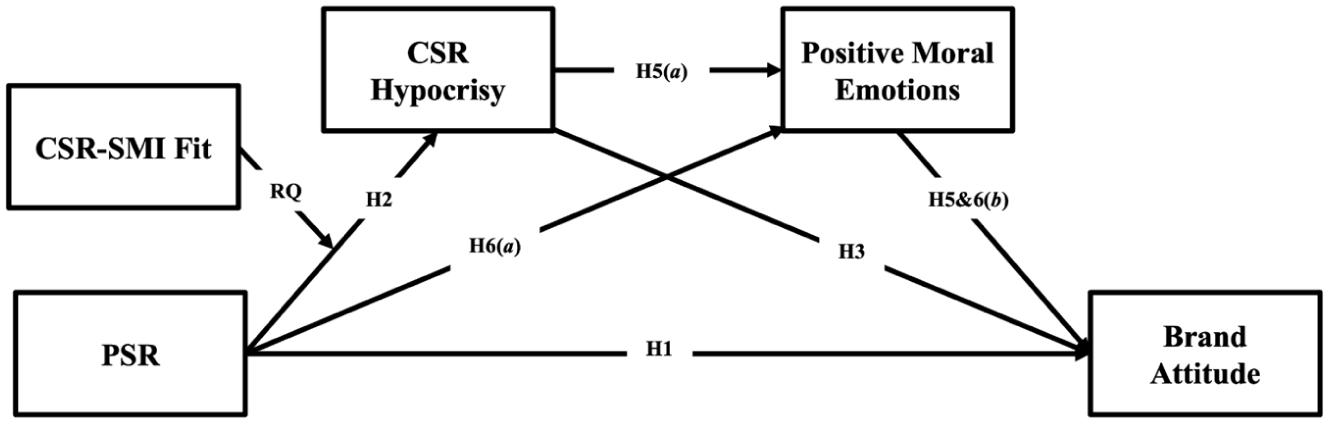
The conceptual model.
Method
To test the hypothesized model, we conducted an online survey using vignettes, targeting adult SMI followers in the U.S. Participants were recruited from Prolific.com and received $2.50 for completing the study. Only those who passed a screening question confirming their followership of at least one SMI were included.
Procedure
After providing consent, participants were prompted to identify one of their favorite SMIs and the corresponding social media platform. They also shared their levels of engagement with and understandings of this particular SMI.
Next, participants were presented with a list of five companies—Coca-Cola, Hershey, PepsiCo, Nike, and Kellogg—all of which were ranked among the top performers in CSR by the Wall Street Journal in 2023. These companies were chosen because CSR campaigns from highly rated brands are generally easier for participants to imagine. A pretest (N = 107) confirmed that these five brands were also the most familiar to our target sample. Participants were then asked to select the company they were most familiar with from this list. We followed this approach from prior research (e.g., Li et al., 2024), as brand familiarity is often associated with a generally positive attitude toward the company (Ladeira et al., 2022). Allowing participants to envision a CSR campaign from a familiar company increases realism and reduces the likelihood that negative brand perceptions (e.g., brand hate) would interfere with responses to the vignette.
Later, participants were asked to imagine an environmental CSR campaign involving the selected SMI and corporate. The campaign focused on green packaging. We selected this issue for two reasons: first, all five companies we selected have made some environmental CSR efforts; second, environmental CSR is considered a valence issue with low controversy (Fröhlich & Knobloch, 2021), allowing us to minimize the confounding effects of other issue-related factors. After reviewing the post, participants were asked to provide their evaluations of the CSR issue, the campaign, as well as the SMI and corporate involved.
Vignette Design
To assist participants in envisioning this hypothetical partnership, we provided a vignette featuring an Instagram post created by the SMI for this campaign. A vignette serves to provide context, helping participants immerse themselves in the scenario and respond to the questions (Skilling & Stylianides, 2020). Specifically, the vignette mimicked a real-world SMI Instagram post themed “Embracing Change for a Greener Tomorrow.” The post stated that the SMI was collaborating with the designated brand on an eco-friendly packaging initiative. Pretests were conducted to ensure that participants clearly understood the message and were able to respond appropriately to the questions. A sample vignette message is provided in Appendix A.
Measurements
All variables were measured using seven-point Likert scales using previously validated measurement scales. PSR (α = .906) was measured using a 13-item modified version of Rubin et al.’s (1985) scale, adapted to specify the SMI as the target. CSR Hypocrisy (α = .972) was measured using Wagner et al.’s (2009) nine-item corporate hypocrisy scale, tailored to the present context by adding the phrase “considering the corporation’s CSR campaign via their partnership with my favorite influencer” to each item. Positive Moral Emotions (α = .954) were measured using Watkins and Bastian’s (2019) scale with five discrete emotions. Corporate Attitude (α = .970) was measured using the updated 2020 version of Park and Kang’s scale of four items, adapted from the original measure by MacKenzie and Lutz (1989). The moderator, perceived SMI–CSR Fit (α = .964), was measured using Chen et al.’s (2023) scale of four items, which assesses whether the SMI is relevant and a good fit for the CSR activity. All measurement items are presented in Appendix B.
Results
Descriptive Statistics
Our valid sample consisted of 491 participants with a mean age of 36.97 (SD = 12.31). Of the participants, 43.8% identified as male, 53.5% as female, and others reported non-binary gender or preferred not to say. 66% of them were non-Hispanic white, followed by Black/African American (11.4%), Asian American/Pacific Islander (8.1%), Hispanic or Latino (4.7%), and Native American (1.2%). Other participants reported multiracial or others (7.9%). The majority of the participants received some college or higher education (85.3%).
The influencers participants followed encompassed those from YouTube (39.1%), Instagram (28.3%), TikTok (14.7%), and other platforms (17.9%). These influencers span various categories, such as fashion & beauty, health & wellness, sports and fitness, etc. 73.5% of participants followed these influencers for over one year. Participants rated their PSR (M = 5.56, SD = 0.98), CSR hypocrisy (M = 3.68, SD = 1.72), PME (M = 3.68, SD = 1.72), and corporate attitude (M = 5.14, SD = 1.57). The average level of fit between the CSR activity and the influencer is 4.08 out of 7.00. See Table 1 for descriptive statistics and bi-variate correlations.
Summary Statistics and Correlations Among Examined Variables.
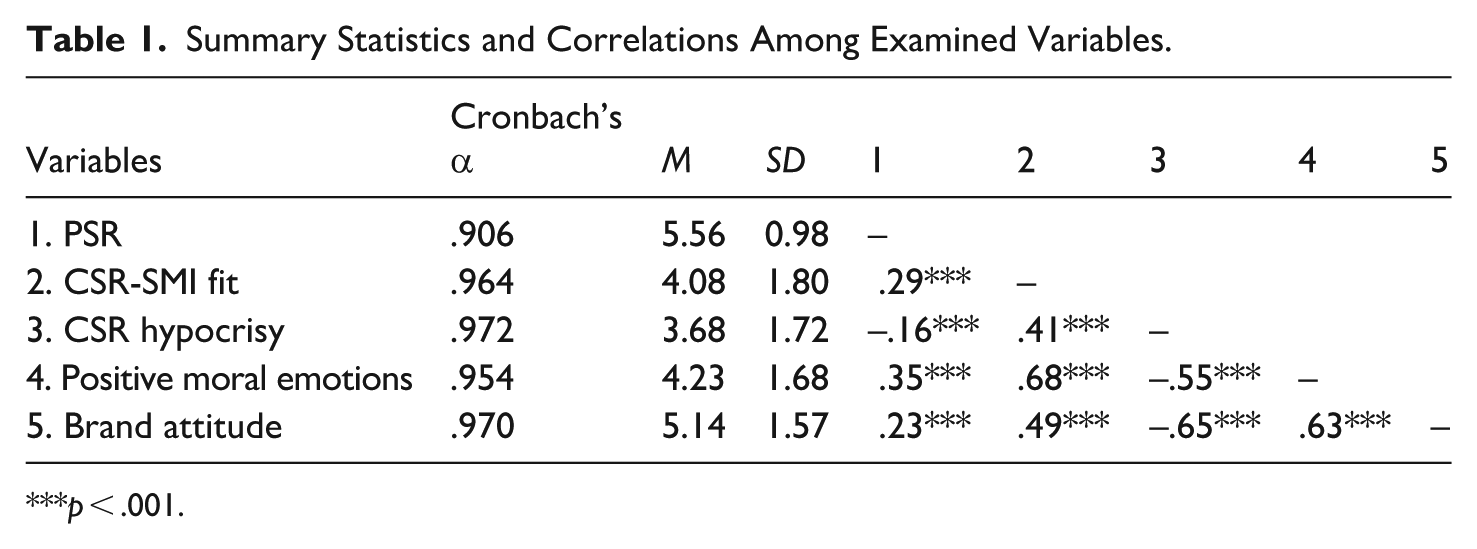
p < .001.
Hypotheses Testing
To test the hypotheses, we performed two regression analyses using SPSS PROCESS with Model 6 (without the moderator) and Model 83 (with the moderator). We conducted two rounds of analysis because H1 to H6 focused on examining the associations between the proposed variables, while the RQ aimed to identify boundary conditions. By separately testing the moderation effect of SMI-CSR fit, we were able to explain the impact of PSR on outcomes before introducing the conditioning influence of the moderator. In these analyses, we included PSR as the independent variable, CSR hypocrisy and positive emotions as mediators, corporate attitude as the dependent variable, and SMI-CSR fit as a moderator. Participants’ gender, age, and issue involvement were controlled. See Table 2 for the regression results.
Regression Analyses Results.
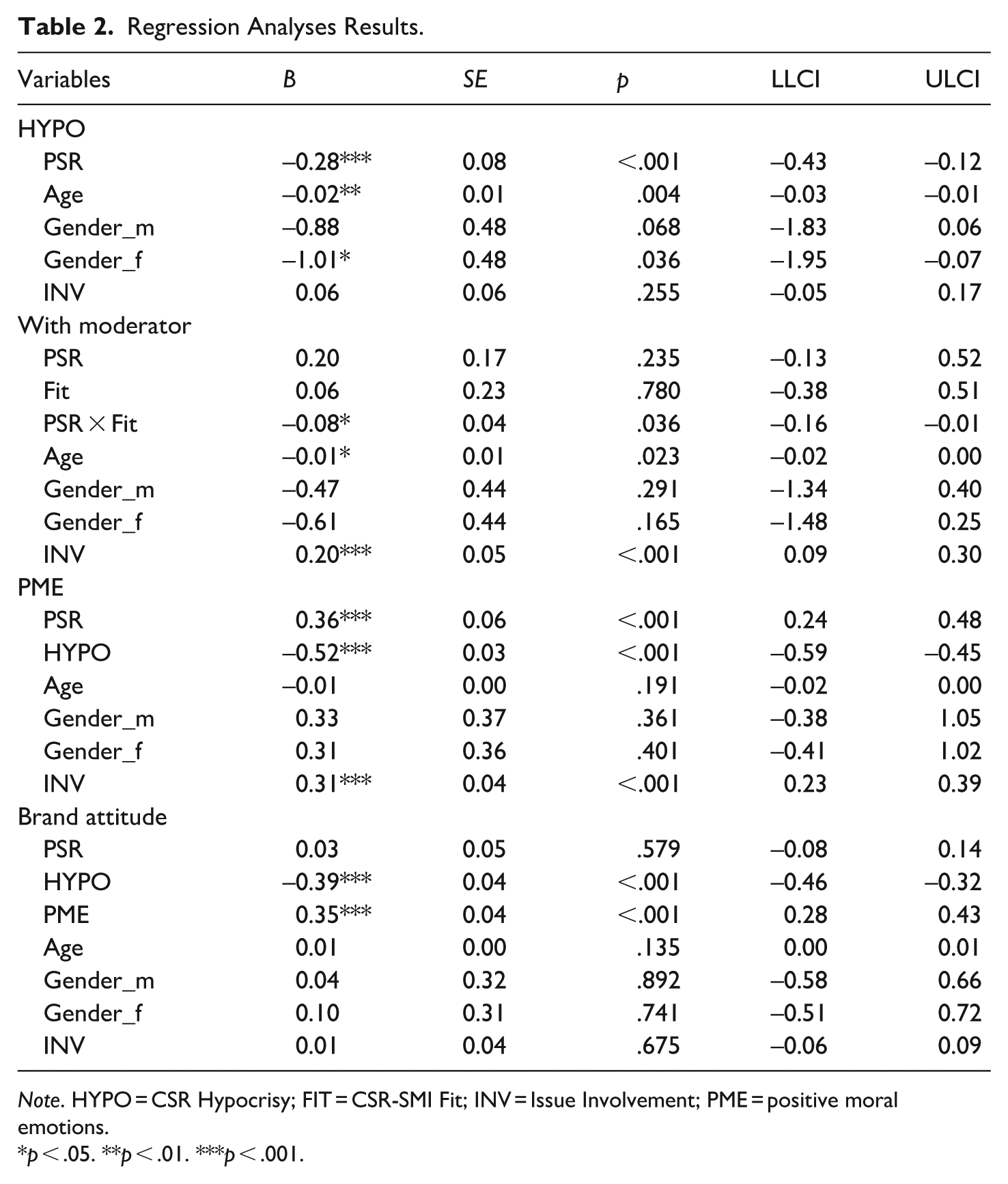
Note. HYPO = CSR Hypocrisy; FIT = CSR-SMI Fit; INV = Issue Involvement; PME = positive moral emotions.
p < .05. **p < .01. ***p < .001.
In
In
In
Our
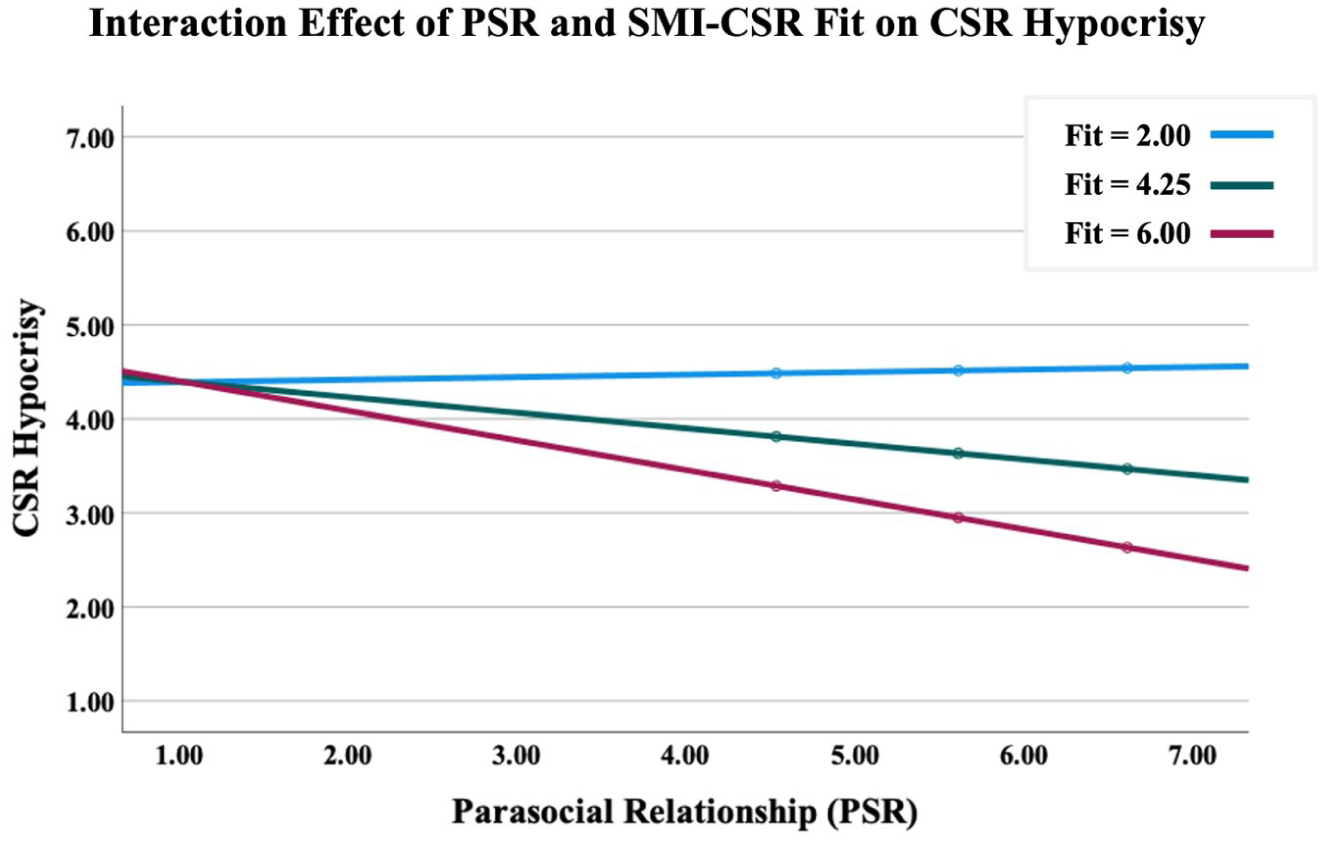
Interaction effects of PSR and SMI-CSR fit on CSR hypocrisy.
Discussion
The objective of this study is to unpack the role of PSR in SMI-mediated CSR communication. Employing the Balance Theory, our findings show that stronger PSR with the SMI leads to more favorable corporate attitudes by reducing perceived hypocrisy and amplifying positive moral emotions. Additionally, we found that the perceived fit between the SMI and the CSR campaign moderates the relationship between PSR and perceived hypocrisy. These findings contribute to the growing scholarship on SMI influence and CSR communication.
Discussion on Major Findings
PSR and Its Impact on CSR Communication
First, our findings highlight the role of PSR in SMI partnerships within CSR communication. This focus allowed us to examine this unique relationship between influencers and their followers—a deeper, more resilient connection rooted in perceived personal relationships (Horton & Wohl, 1956; Yuan & Lou, 2020). When followers engage with CSR content shared by SMIs, they are influenced not just by the message, but by their perceived relationship with these “distant friends” (Campbell & Farrell, 2020). SMIs invest significant effort into nurturing these relationships (Hess et al., 2022), and our findings extend the value of such relationships to the CSR partnerships they form with brands.
We explained this mechanism using the lens of Balance Theory. By framing the triadic relationship among the corporation, the SMI, and the follower, we posited that PSR plays a central role in shaping followers’ responses. Once a partnership is established between an SMI and a company, followers who have strong PSR with the SMI are motivated to maintain psychological consistency, thereby adjusting their perceptions of the company in a more favorable direction. This suggests that PSR with SMIs can function as a form of relational capital that companies can leverage to shape consumer attitudes, particularly regarding moral judgments and CSR evaluations. In this way, CSR communication moves beyond message dissemination and becomes a form of relationship-centered persuasion, emphasizing the relational dynamics between the messenger and the audience that shape how the message is received.
The Roles of CSR Hypocrisy and Moral Emotions
Second, this study found that CSR hypocrisy could explain how PSR makes a difference. We found that PSR can diminish followers’ perception of the CSR hypocrisy, suggesting that endorsements from these SMIs can make the corporation involved in such partnerships appear less hypocritical and more authentic. SMI-involved communication is often associated with authenticity and sincerity (e.g., Amini, 2025), and the hypocrisy-reducing function of PSR identified in this study supports this association. As CSR hypocrisy typically stems from a perceived gap between corporate words and actions (Wagner et al., 2009), partnering with a well-aligned SMI may help demonstrate authentic action, thereby narrowing this gap. PSR with influencers then acts as a form of “rose-tinted glasses,” beautifying consumers’ perceptions of the corporation and its commitment to CSR.
Our integration of moral emotions into the model adds an emotional element to CSR communication involving SMIs. Specifically, we found that the PSR with the influencer, as well as the diminished hypocrisy of the CSR efforts, elicits more PMEs among followers. These emotions, in turn, can lead to consumers’ favorable evaluation of the involved corporate. Aligned with previous research (e.g., Xie & Bagozzi, 2019), this study demonstrates PME as a mediator in predicting public evaluations of CSR communication. In other words, it is the emotional reaction—shaped by both relational and evaluative factors—that drives support for the company. Influencer marketing research suggests that SMIs depend on cultivating emotional connections to retain their audiences and deliver significant value to companies (Holiday et al., 2023). Our findings echo these perspectives, demonstrating that such an approach is also applicable in the context of SMI-mediated CSR communication. Given that our findings revealed full mediation through these two mediators, this suggests that the impact of PSR is primarily realized through reduced perceptions of hypocrisy and heightened moral emotions.
Conditional Effects of Perceived Fit
The insights gained from our RQ results help define a boundary condition for the tested paths discussed above: PSR reduces perceptions of CSR hypocrisy only when the perceived fit between the SMI and the CSR campaign is moderate to high. Our findings provide further evidence underscoring the importance of fit between the collaborating SMI and the CSR campaign as a conditioning factor. Our results show that when the SMI does not align with the CSR campaign, the PSR cannot fully leverage its potential to enhance the evaluation of the CSR partnership. However, when the level of fit exceeds a certain threshold—in our study, 4.26 out of 7—PSR not only aids in reducing perceived hypocrisy but also benefits from an amplified impact due to such fit. This indicates that fit acts as a prerequisite for successful influencer collaboration in CSR communication.
Building on the identified threshold, we further examined the characteristics of high-, low-, and threshold-level fit influencers to better understand how followers formed their fit judgments. As part of the study, participants rated the perceived expertise of their favorite influencers both within the influencers’ primary content category and on environmental issues. When comparing influencers within the same category, we found no significant differences in perceived category-specific expertise between those classified as “low-fit” and “high-fit” (i.e., below or above 4.26 on a 7-point scale). In both groups, the majority of influencers fell into the entertainment category, followed by lifestyle, gaming, and other types in similar proportions.
However, we did observe a significant association between influencers’ expertise in environmental issues and their perceived fit (r = .71, p < .001). In other words, compared to influencers’ knowledge about the CSR issue, their primary expertise might be of lesser importance. For example, in our findings, participants identified @witt_charity on Instagram as an SMI with high CSR expertise. Although primarily known as a fitness influencer, this individual was also perceived as knowledgeable about environmental issues due to their consistent posting of pro-environmental content across multiple platforms. In contrast, @barnardco on Instagram was perceived as having low CSR expertise (rated 1 out of 7), likely because their posts were entirely unrelated to environmental issues. While they are recognized as experts in their own field of logo design, their content did not reflect any engagement with environmental concerns. We also examined influencers near the fit threshold. Among those rated around 4.25, the average CSR expertise was 3.91—mid-range on the 7-point scale. One example is @shoelover99 on TikTok, a lifestyle influencer. Although they were not known for posting green content specifically, their efforts to promote positivity and social responsibility is evident and suggest potential CSR alignment to some extent, leading to a moderate rating of 4.75 for environmental expertise.
Although these expertise ratings were subjectively assessed by followers, they indicate that an SMI’s public image can serve as an important cue in evaluating perceived fit with a CSR campaign. As such, assessing “fit” requires a closer look at an influencer’s content beyond their core expertise—particularly whether they have previously engaged with or expressed concern about the CSR issue in question. While follower perceptions ultimately shape fit evaluations, clear indicators of CSR-related engagement can help organizations make more informed decisions when selecting CSR partners.
Theoretical Implications
Our findings contribute to the CSR communication literature by recognizing the shifting nature of message sources in the digital era and addressing the growing involvement of SMIs in sustainability-related business communication. As SMI partnerships become increasingly common in CSR efforts, it is essential to deepen our understanding of how such third-party involvement shapes public perception, including the underlying mechanisms that drive their impact. The mechanisms we propose introduce a relational and emotion-oriented perspective for understanding how SMIs influence CSR communication effectiveness—an area that current CSR communication research has yet to fully explore in the context of SMIs as third-party endorsers. Our findings suggest that CSR communication is no longer solely a function of corporate messaging but is co-constructed through relational and emotional dynamics involving third-party endorsers with strong audience ties. These insights advance both CSR and CSR communication scholarship and broaden the understanding of SMI endorsements within this evolving research domain. They also underscore the need for updated CSR communication models that account for decentralized, personality-driven message delivery.
We also aim to contribute to the growing scholarship on the role of SMIs in broader business communication. While influencer marketing research has offered valuable insights into how SMIs support advertising and promotion, their impact in non-marketing contexts—such as value-driven communication—remains underexplored. This study addresses that gap by examining how SMIs influence CSR communication through PSR, perceived hypocrisy, and moral emotions—factors that shape how audiences morally evaluate corporations. These findings extend the theoretical relevance of PSR beyond entertainment and marketing into the domain of values-based persuasion. In doing so, we position PSR not only as a mechanism of attitude change, but also as a source of moral trust and relational credibility in CSR contexts. Ultimately, our findings advance a more relational and emotionally grounded perspective on CSR communication and broaden the theoretical understanding of how SMIs operate as influential actors in value-based business communication.
Furthermore, our application of Balance Theory introduces a novel lens for understanding how cognitive consistency motivates CSR evaluations within the influencer–brand–follower triad. Although Balance Theory has traditionally been used to explain interpersonal attitude alignment, our findings extend its application to digital, parasocial environments—particularly when emotional bonds (PSR) and perceived SMI–CSR fit are present. This expands the theory’s relevance to contemporary, socially mediated communication and offers a deeper understanding of how decentralized, personality-driven message sources shape public perception in complex, value-oriented domains.
Additionally, our identification of perceived SMI–CSR fit as a key boundary condition advances theoretical understanding of parasocial influence. Recognizing moderators in established relationships is critical for revealing when and under what conditions these mechanisms are effective. This moderator is relevant to both the influencer and the campaign, as it captures the perceived alignment between the two entities. Given that our framework is grounded in Balance Theory—which emphasizes the dynamics between pairs of entities—introducing a moderator that reflects the tie between the SMI and the CSR campaign is both theoretically consistent and practically informative. This adds theoretical nuance by showing that relational closeness alone may not be sufficient for persuasion in values-based contexts like CSR communication.
Building on this insight, it is important to explore additional moderators that may further refine our understanding of how parasocial influence operates in CSR communication. For example, cross-cultural differences may shape how SMIs are perceived. Prior research suggests that consumers in Asian cultures such as China may view SMIs differently than their U.S. counterparts (H. Lee et al., 2025). Yang, Zhou, et al. (2023) found that individual differences in relational-interdependent self-construals—defined as “a cognitive component of thinking of oneself in terms of close others” (p. 19827)—can influence the formation of PSR. This tendency may be more pronounced in collectivist cultures, highlighting the need to test whether the proposed mechanism functions similarly across cultural contexts. Therefore, we call for future research to continue identifying such moderators to further enrich both CSR communication theory and the growing field of SMI-involved business communication.
Practically Implications
This study offers practical insights into partnering with SMIs for CSR communication. The effectiveness of SMI-mediated CSR efforts heavily relies on the quality of the relationship between SMIs and their followers, not just on message creation. This suggests that evaluating relational dynamics is as important as assessing content creation skills. Notably, follower count may not be a reliable metric for success; for instance, PSRs are often stronger with nano-influencers than with micro- or macro-influencers (Brewster & Lyu, 2020). Business decisions related to SMI partnership in CSR communication should also consider a more in-depth evaluation of an SMI’s impact beyond just their follower numbers. Given that engagements with macro-influencers may be more costly, alternative elements could be instrumental in guiding related business decisions.
Moreover, our findings show that the fit between the CSR initiative and the SMI is crucial and not merely an additive effect alongside other SMI-related factors. There is a threshold level for PSR to effectively impact CSR efforts, and a strong fit between the SMI and the specific CSR issue is necessary to achieve positive outcomes. As discussed, SMIs with demonstrated expertise in the CSR issue are more likely to signal high fit. Therefore, companies should carefully evaluate potential partners by reviewing their content and assessing how followers perceive their expertise and alignment with the CSR initiative.
Limitation and Future Research
This study has several limitations. First, although we controlled for age, younger generations often view SMIs more positively (Childers & Boatwright, 2021); future research should use age-stratified sampling to capture generational differences. Second, our U.S.-based findings may not generalize across cultures, as SMI influence varies internationally (Nanevi et al., 2022); comparative studies are needed. Third, because environmental CSR is relatively less controversial, results may not extend to more divisive CSR initiatives or brand activism. Future work should test whether the proposed relationships hold in more contentious contexts. Fourth, our model does not fully explain consumer responses to SMI-involved CSR communication. Such responses may also be shaped by factors such as prior CSR experience (e.g., S. S. Lee et al., 2019), business cynicism (e.g., Utkutug, 2024), or personality traits (e.g., Pérez & Rodríguez del Bosque, 2013). Future research should examine how these variables influence consumer reactions and contribute to CSR communication effectiveness.
Footnotes
Appendix A
Appendix B

Funding
The authors disclosed receipt of the following financial support for the research, authorship, and/or publication of this article: This study is supported by the School of Journalism and Strategic Media, College of Media and Entertainment, Middle Tennessee State University, and by Department Professional Development Funds at Weber State University.
Declaration of Conflicting Interests
The authors declared no potential conflicts of interest with respect to the research, authorship, and/or publication of this article.