







Abstract
In innovation-driven firms, internal communication about “failing fast” often clashes with the everyday practices that define what counts as failure. Cadence routines, KPI dashboards, and release meetings tend to equate failure with missing a ship date, quietly pushing safety and learning to the margins. Using structuration theory and structurational divergence as a lens, this article analyzes 98 interviews, meeting observations, and artifacts from a public-safety software company to show how these communication practices order risk, authority, and participation. The study extends organizational communication theory by specifying cadence selection and language convergence/meaning divergence as communicative mechanisms that link temporal routines and failure definitions to whose expertise travels when. Practically, it identifies designable communication interventions that help leaders keep learning and reliability decision-visible under deadline pressure.
Keywords
Introduction
The fail-fast mantra has become prominent in innovation-driven industries, especially technology. It frames failure as a vehicle for rapid learning and continuous improvement: discard low-value ideas quickly, iterate with feedback, and reallocate resources to promising options (Vogt et al., 2021). Implementing fail-fast practices is difficult in organizations with legacy routines, mission-critical responsibilities, and profitability constraints, where experimentation risks are amplified. When innovation is promoted rhetorically but structurational support is absent, discourse decouples from practice, producing rule-preserving delivery routines rather than learning (Meyer & Rowan, 1977).
For managers, the appeal of fail-fast is not failure for its own sake but disciplined learning—shortening feedback loops through experimentation, rapid iteration, and early error detection rather than celebrating failure as an end in itself (Cannon & Edmondson, 2005; Edmondson, 1999; Thomke, 1998). In software organizations, this logic is typically operationalized through cadence choices (e.g., release rhythms, gate timing, sprint/quarter planning), experimentation policies (what can be tried, by whom, and when), and performance dashboards (what “counts” as success or failure). However, in public-safety software—where defects can shape emergency response outcomes—learning speed must be designed alongside reliability safeguards. This makes fail-fast a particularly instructive case for business communication research because it foregrounds how internal communication systems (dashboards, gate decks, review meetings, escalation channels) can either (a) enable timely learning before commitments harden or (b) convert “fail-fast” into “ship-fast,” where failure is treated primarily as missing a date.
This study examines structurational divergence at Geo Precision Solutions (GPS; pseudonym), a midsized technology firm that publicly embraced a fail-fast innovation strategy following a 2010 private-equity acquisition. Leadership promoted fail-fast goals, yet day-to-day work remained constrained by profitability targets, client commitments, and legacy routines. To analyze this tension, the study draws on structuration theory (Giddens, 1984) and a multi-level discourse lens—macro (institutional logics and profitability pressures), meso (organizational norms and team routines), and micro (local talk and practice)—to explain how innovation is enacted or obstructed.
Prior work notes a rhetoric–reality gap in innovation, but most accounts emphasize broad narratives or macro framings; less is known about how everyday communicative practices reproduce or challenge structurational contradictions in public-safety software contexts where errors carry life-or-death consequences (Fu, 2022). Because communication constitutes organizing, these micro-level practices shape whether innovation advances or stalls. Foregrounding these interactional dynamics, the study links macro discursive frameworks to situated practices and theorizes a cadence-selection mechanism in which quarter-end schedules make one meaning of failure operative at release gates. This study specifies how cadence selection and KPI bundles operate as communication technologies that privilege particular meanings of “failure” at decision points—sometimes accelerating learning and sometimes producing structurational divergence in safety-critical work.
Organizations across sectors now invoke fail-fast to signal agility, yet members must enact that ideal under temporal cadences and profitability targets that make some meanings of failure more actionable than others. In safety-critical domains (e.g., public-safety software), these selections carry high stakes: when cadence tilts decisions toward on-time delivery, communicative pathways that surface frontline risk cues narrow and learning work is deferred. The problem is not simply rhetorical inconsistency; it is a communicative structuring problem—how cadence, decision artifacts (e.g., gate rules, KPI dashboards), and participation routines together select what counts as failure and channel whose knowledge is heard, and when.
Organizational communication scholarship has richly theorized contradiction, paradox, and structuration but lacks mechanistic accounts that connect multilevel discourse to the moment-to-moment selections by which meanings, rules, and resources are ordered at decision points. This study specifies a cadence-selection mechanism: under quarter-end regimes, temporal cadence selects which meaning of failure becomes operative at release gates and, in turn, reproduces rules—key performance indicators (KPIs) and gate rules—and reallocates attention, authority, and resources (time, people, budget). Identifying this selector advances work grounded in structuration theory and structurational divergence by moving from describing tensions to explaining how contradictions become immobilizing in practice.
Substantively, the study contributes to organizational communication in three connected ways. First, it specifies how a quarter-end cadence and KPI bundles can quietly redefine “failure” as “late delivery,” sidelining quality and safety concerns even in firms that publicly champion fail-fast learning. Second, it extends structurational divergence theory by showing how incompatible meanings of failure—innovation loss, customer churn, or missed deadlines—are organized through everyday gate decks, dashboards, and meeting talk rather than through abstract “culture” alone. Third, it illustrates how cadence selection travels beyond software: in safety-critical domains such as emergency response or hospital shift changes, temporal routines and performance bundles also decide which risks are foregrounded and which concerns are muted. By tracing these dynamics at GPS, the study clarifies how internal communication about failure channels whose knowledge is heard, when, and with what consequences for innovation work.
Structuration Theory and Organizational Communication
Organizational communication scholarship has developed several extensions of structuration theory to explain how rules and resources are enacted in interaction and how contradictions become durable in practice (e.g., DeSanctis & Poole, 1994). Building on this tradition, the present study uses structurational divergence theory to examine how cadence and KPI artifacts organize what “counts” as failure at release-gate decision points.
Positioning Structurational Divergence (SD) Theory
Structurational divergence (SD) theory extends structuration by specifying what happens when people are positioned at the intersection of incompatible but equally compelling structures. SD theory addresses “an institutional positioning at a nexus of incompatible meaning structures that creates recurrent conflict cycles” (Nicotera & Mahon, 2013, p. 92). In such situations, actors are “stuck in the same place, repeatedly facing the same problems, with no end to the impasse in sight” (Nicotera et al., 2010, p. 363). Nicotera and colleagues differentiate between the SD nexus—the structural positioning at the intersection of contradictory demands—and the SD cycle, a recurrent pattern of contradiction → immobilization → erosion of development (Nicotera et al., 2010; Nicotera & Clinkscales, 2010; Nicotera & Mahon, 2013). The SD nexus names the structural condition; the SD cycle captures how that condition unfolds over time in communication, practice, and outcomes. This study draws on that distinction to examine how cadence, KPI design, and participation pathways can position actors at an SD nexus and how SD cycles emerge or are disrupted.
SD and Discursive Contradictions
SD theory is especially useful for understanding discursive contradictions in organizational change efforts. Engeström and Sannino (2011) showed how contradictions surface in talk as tensions, dilemmas, and conflicts that point to underlying structural misalignments. In SD terms, such contradictions are not just interpretive disagreements; they are symptoms of an SD nexus in which equally legitimate structures pull action in incompatible directions. When people experience that positioning over time, communication can become immobilized—near misses are normalized, workarounds substitute for structural change, and development erodes as problems recur despite local fixes (Engeström & Sannino, 2011; Nicotera & Clinkscales, 2010; Nicotera & Mahon, 2013).
In fail-fast, quarter-driven regimes, these dynamics are visible in stories of muted safety concerns, late-stage escalations, and “quiet” workarounds that keep products shipping while leaving underlying contradictions unresolved. SD theory provides the vocabulary to name when those patterns mark the presence of an SD nexus and to distinguish single-loop responses (e.g., local workaround, heroic effort) from double-loop repairs that alter cadence, KPI bundles, or decision structures. This framing guides the present study’s focus on cadence selection as a mechanism that both generates discursive contradictions and shapes whether they lead to immobilizing SD cycles or to learning-oriented change.
Multi-Level Discourses in Organizational Change
Organizational discourse operates across interconnected levels—macro, meso, and micro—that together shape the innovation climate (Grandien & Johansson, 2016). Macro-level logics and policies (e.g., profitability, industry standards) flow through meso-level routines and devices such as release-gate meetings, KPI dashboards, and mission statements, which in turn organize micro-level talk and practices (testing, escalation, workarounds). Through structuration, these micro practices also reproduce or revise rules and resources (Giddens, 1984). This multilevel view positions quarter-end cadence as a meso mechanism that selects which meaning of failure is operative at the gate (e.g., on-time delivery vs. learning signal) and channels which knowledge travels upward. Recognizing this interplay enables organizations to align policies and practices so that failure functions as information for learning rather than only as a delivery breach.
Taken together, this framework positions the present study as a structurational analysis of how cadence, KPIs, and gate communication organize structurational divergence in innovation work. Rather than treating fail-fast as a free-floating narrative, the analysis follows how quarter-end cadence, KPI bundles, and release-gate decks function as communication technologies that privilege some meanings of failure and background others. In doing so, the study extends adaptive structuration work by showing how temporal routines and performance metrics become media through which institutional logics of innovation and profitability are enacted in everyday talk and decision making.
The study also advances structurational divergence theory by clarifying when incompatible meanings of failure become immobilizing rather than simply tense. By examining how language about failure, rules encoded in KPI bundles and gate criteria, and access to resources interact across levels, the analysis specifies how LC/MD dynamics emerge, escalate, and occasionally are repaired. Analytically, the article proceeds in two layers: first, it applies Giddens’s (1984) modalities—signification, legitimation, and domination—to show how cadence and gate routines structure talk about failure across units; second, it examines focal episodes of double-loop learning in which actors attempt to retune cadence, metrics, or definitions of failure and thereby intervene in the SD cycle.
Research Questions
Building on this framework, the study examines how fail-fast cadence, KPIs, and decision routines organize structurational divergence through everyday internal communication about failure, performance, and innovation at Geo Precision Solutions. The analysis focuses on four questions. RQ1: How does internal communication under the acquisition-era quarter-end cadence shape which meanings of “failure” are foregrounded and which are backgrounded across units? RQ2: How do formal communication rules and KPI bundles (e.g., on-time delivery, churn, safety metrics) privilege certain meanings of failure and marginalize others at key decision points? RQ3: How are participation pathways and voice channels for frontline expertise communicatively structured in relation to cadence and KPIs, and how do these pathways enable or constrain responses to emerging contradictions? RQ4: When actors attempt to repair structurational divergence, what communicative, double-loop learning efforts emerge around cadence, KPI bundles, and definitions of failure, and with what consequences for the SD-cycle?
Method
Case Background
GPS is a Midwestern public-safety software firm founded in the 1990s that builds GIS-enabled 911 solutions. After acquisition by River City Equity in the early 2010s, leadership introduced a quarter-end reporting cadence with KPI families and release-gate controls emphasizing on-time delivery.
Acquisition context and confidentiality. Because the acquisition shaped cadence and reporting routines central to this study, additional context is provided while protecting anonymity. Participants described the acquisition as motivated by scaling operations and customer support with post-acquisition governance emphasizing quarter-end reporting, KPI families, and formal release-gate controls. Interviewees varied in whether they attributed the acquisition to pre-existing performance concerns. Some referenced operational strains such as variability in release predictability and technical debt, while others emphasized strategic repositioning rather than a precipitating “failure.” Importantly, the analysis does not treat acquisition as a dependent variable to be explained; it treats the post-acquisition cadence-and-KPI bundle as the structuring condition that reorganized how “failure” was talked about and managed at decision points.
Participants, Access, and Ethics
Organizational leadership granted access but did not influence participant selection, interview content, or reporting. Invitations were extended to all employees; participation was voluntary, with the option to decline questions or withdraw. To support rapport and informal conversations, the author maintained an onsite office with walk-through access. Confidentiality was emphasized during recruitment and before each interview; all organizational and personal identifiers (e.g., GPS, River City Equity, “Jacob Abernathy”) are pseudonyms, and no individual responses were shared with leadership.
Recruitment and Participation Rate
Invitations were extended to all employees, and interviews were scheduled in flexible blocks during work hours to reduce burden. Recruitment occurred via an all-staff email invitation, with follow-ups emphasizing voluntariness and confidentiality. The organization’s bounded size and onsite access made scheduling feasible, and employees could decline, skip questions, or end the interview at any time without explanation. No incentives were tied to participation, and leadership did not receive any individual-level data. While a 100% interview rate is uncommon, participants described a combination of low-friction access (onsite office and walk-through availability) and strong interest in the topic as contributing factors.
The Institutional Review Board at the author’s institution determined this project was not regulated as human participants research, and the study followed standard protections for confidentiality and voluntary participation. Data were collected by the first author, who maintained an office at Geo Precision Solutions during the study and had no prior relationship with the leadership team or staff.
Data Collection
Because the focus is internal communication about failure and cadence, data collection centered on communicative events—interviews about how people talked and made sense of failure, internal artifacts that conveyed official messages, and observations of meetings and informal talk about releases and risk.
Interviews
In-depth, semi-structured interviews were conducted with all 98 organizational members (i.e., every employee at the time of the study). All interviews were conducted by the first author, audio-recorded with participants’ consent, and transcribed verbatim, yielding over 1,000 single-spaced pages. Interviews probed how the organizational framework shaped, and was shaped by, perceptions and responses to failure and innovation (e.g., “Describe a time when a decision about a mistake was made behind the scenes. How did that affect your work or team?”; “How do messages about innovation or ‘fail-fast’ align—or conflict—with what your unit expects?”). To elicit candid responses on a sensitive topic, the term mistakes was often used in lieu of failure (American Psychological Association, 2020).
Interviews averaged approximately 50 min (range: 30–80) and were conducted in-person in a private office on site at GPS to support candid discussion. Audio files were transcribed by the primary researcher and identifying details were removed during transcription. All files were stored on password-protected systems accessible only to the research team.
The interview guide was organized into four clusters aligned with the research questions. Questions about how people defined “failure” and experienced the acquisition-era cadence addressed RQ1. Questions about rules, KPI bundles, and release gates addressed RQ2. Questions about escalation paths, cross-functional meetings, and whose input counted addressed RQ3. Questions about attempts to change cadence, metrics, or definitions of failure addressed RQ4.
Artifacts
Twelve internal artifacts (~85 pages)—mission and values statements, onboarding materials, internal newsletters, and leadership slide decks—were collected to triangulate interview accounts and examine formal messaging around innovation, failure, cadence, and customer commitment (Lindlof & Taylor, 2017).
Observations
The same researcher conducted non-participant observations of release meetings, stand-up huddles, and informal interactions, producing walk-through field notes on everyday communicative routines (e.g., gate reviews, huddles, deadline practices). These observations documented how cadence and KPI bundles shaped talk about failure and release decisions in real time.
Analytical Approach
Analytically, interviews, artifacts, and observations were treated as communication data, focusing on how actors talked about cadence, failure, KPIs, and participation. All transcripts and artifacts were imported into NVivo for open coding. Coding was conducted by two researchers: the first author and a second qualitative researcher familiar with structuration theory. First, codes were generated inductively from participants’ language to capture lived experience (e.g., “We’re told to fail fast, but never fail in front of a customer” → contradictory expectations). Next, codes were reorganized using structuration modalities—signification (meanings), legitimation (norms/rules: KPIs, gates), and domination (resources/authority)—to analyze how meanings, rules, and allocations shaped talk about innovation and failure (Giddens, 1984). Cross-source triangulation compared interview themes with artifacts and field notes (e.g., “sense of urgency” training language vs. narratives about deadline–quality trade-offs). Constant comparison and memoing refined codes into broader themes across roles and data types (Feldman & Orlikowski, 2011; Lindlof & Taylor, 2017).
Structurational Divergence Analytic Procedure
Following inductive and theory-informed coding, a focused SD pass identified episodes where cross-level meanings, rules, and resource allocations conflicted in ways that immobilized action and eroded development. For each episode, the analysis (1) mapped evidence to modalities (signification, legitimation, domination); (2) located levels (macro discourse, meso unit practice, micro interaction); (3) traced escalation from tension to contradiction → immobilization → erosion of development (e.g., waived checks, late escalations, rework, deferred refactors/learning); (4) required multi-source corroboration with temporal anchors (e.g., quarter-end); and (5) coded interrupters—practices that averted or reversed SD. Coder disagreements were resolved through joint review of transcripts and analytic memos until consensus was reached, and the codebook was refined where needed. Three representative “SD in action” episodes are presented with a compact diagnostic table.
Trustworthiness and Reflexivity
Credibility was supported through triangulation of interviews, artifacts, and observations; transferability through thick description; dependability via a documented coding workflow; and confirmability through reflexive journaling and analytic memos (Tracy, 2010). Member checking was conducted with a subset of participants (n = 10) after preliminary themes were identified; feedback affirmed interpretations and prompted minor wording clarifications (e.g., “risk-taking” → “calculated risk-taking”). The author’s positionality and outsider status were documented in a positionality statement and monitored through reflexive notes after each interview.
Results
Results for RQ1: Cadence-Related Communication and Meanings of Failure Across Units
RQ1 asked how the acquisition-era quarter-end cadence shapes which meanings of “failure” are foregrounded and which are backgrounded across units. This section shows how the new cadence recast time as the primary organizing logic and elevated “late delivery” as the default failure referent, while older unit-specific meanings of failure were pushed into the background.
Before the acquisition, participants described a collaborative rhythm with flexible timelines and routine opportunities for frontline input. During the transition, “fail fast” language entered everyday talk and experimentation became more visible, while dates remained negotiable. After the acquisition, quarter-end targets and KPI checkpoints set fixed delivery dates and shortened review windows. Participants attributed the stronger temporal pressure to alignment with the parent company’s reporting cadence and revenue milestones. Authority clustered at release gates, and resources shifted toward meeting dates. The sections that follow present data under three headings: temporalization of work, meanings of “failure,” and participation pathways. Quotations and brief data displays are provided to foreground the structures and lived experiences; interpretation appears in the Discussion.
Temporalization of Work After the Acquisition
Across accounts, the acquisition recast time as the primary organizing logic. Deadlines, KPIs, checkpoints, and quarter-end release gates became the rules by which work was paced and evaluated; these rules in turn reallocated authority and resources toward meeting delivery dates. Participants repeatedly framed the day-to-day as schedule-first. Jordan Evans, a senior systems engineer, stated, “We’ re always racing the clock—getting it done fast matters more than getting it done right.” Clark McAllister, a project manager, reflected, “We were all just sprinting to hit the deadline—there wasn’ t any breathing room.” Compressed review windows and escalation paths shortened opportunities for experimentation or refactoring, participants described a cadence in which the “right” move was the one that protected the date. Table 1 summarizes the shift in work cadence across the pre-, transition, and post-acquisition periods (see Table 1).
Pre-/Post-Acquisition Timeline and Work Cadence.
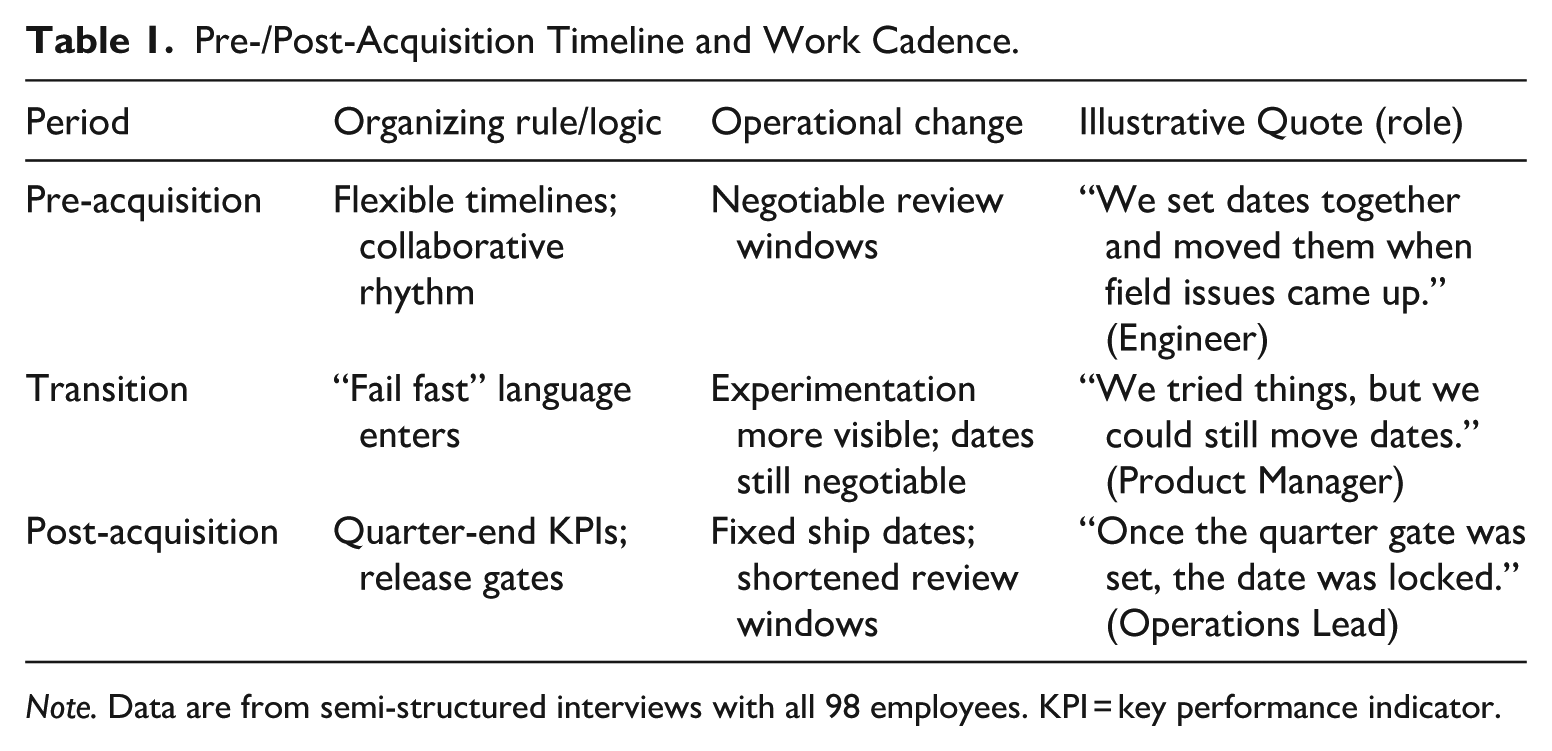
Note. Data are from semi-structured interviews with all 98 employees. KPI = key performance indicator.
Meanings of Failure Across Units
Participants used the term “failure” in role-specific ways, tying it to different indicators and time horizons. Together, the post-acquisition quarter-end cadence made “failure = late” the dominant gate-visible referent, while other meanings (e.g., defects, churn, safety risk, data quality) became decision-relevant mainly when they threatened on-time delivery (Table 2).
Unit-Specific Referents for “Failure.”
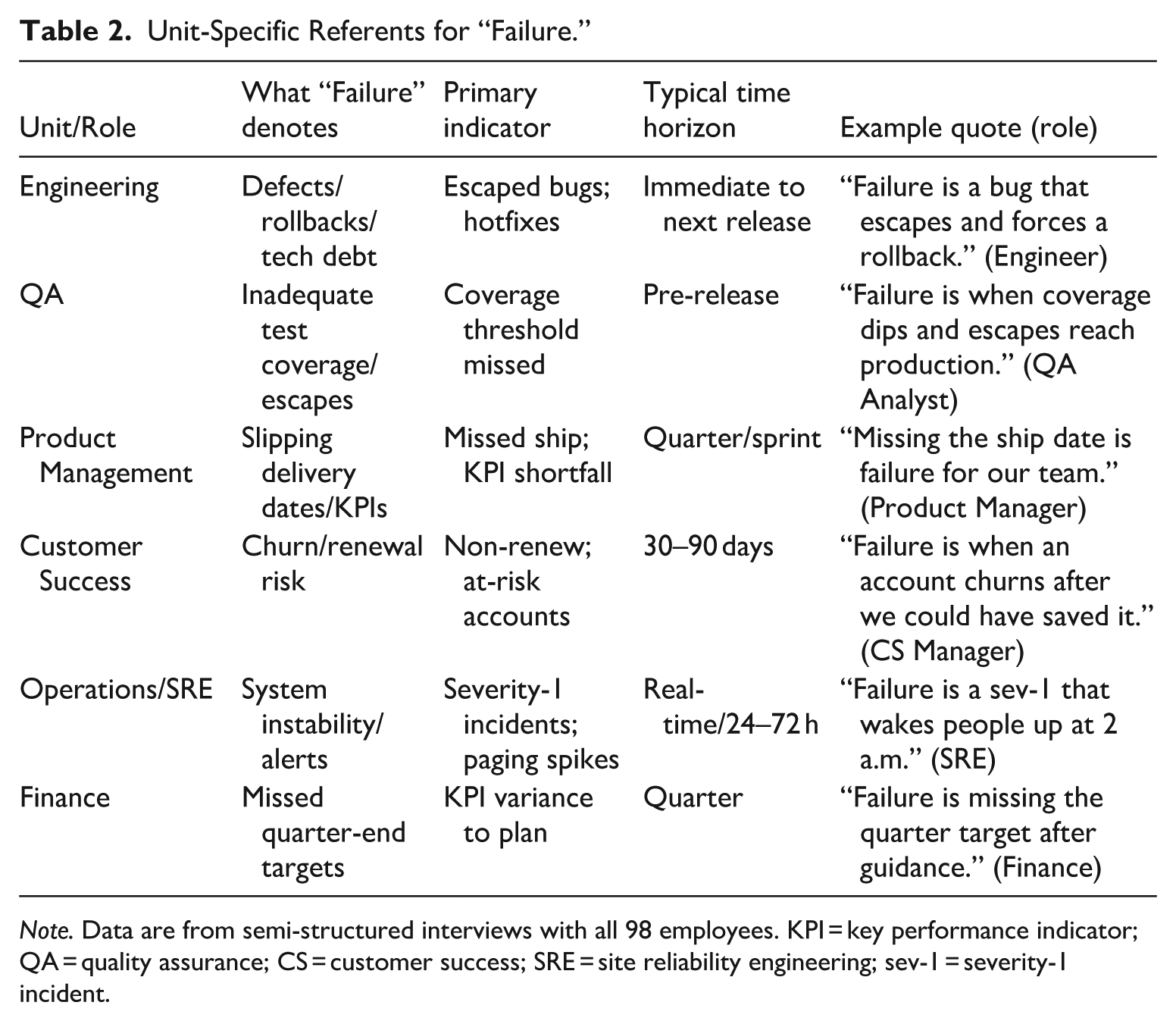
Note. Data are from semi-structured interviews with all 98 employees. KPI = key performance indicator; QA = quality assurance; CS = customer success; SRE = site reliability engineering; sev-1 = severity-1 incident.
Results for RQ2: Gate Communication, Rules, KPI Bundles, and Release Decisions
RQ2 asked how formal rules and KPI bundles privilege certain meanings of failure and marginalize others at key decision points. Across accounts, release-gate communication consistently elevated schedule adherence and quarter targets as the dominant failure referent.
At release gates, the central artifacts were go/no-go slides and quarterly KPI dashboards. These foregrounded on-time delivery, incident counts, and churn risk, while indicators tied to experimentation, refactoring, and longer-horizon learning were weakly coupled to the gate conversation or omitted altogether. As a result, timeline-based indicators were highly visible at the moment of decision, whereas many quality and learning indicators remained background context that was easier to acknowledge than to act on.
Participants across functions described different failure definitions (e.g., defect escape and coverage risk; technical debt and loss of refactor windows; customer churn and trust; operational stability and on-call burden). However, when these concerns entered gate talk, they were typically translated into the delivery-focused KPI bundle rather than treated as independent reasons to delay, redesign scope, or reopen assumptions.
These patterns answer RQ2 by showing that KPI bundles and gate rules privileged schedule-based failure definitions in release-gate communication. Viewed as communication, gate artifacts and talk functioned as structural cues that made “on-time delivery” easy to invoke as the relevant failure referent and made it harder to foreground quality or learning failures at the moment of decision.
Results for RQ3: Participation Pathways and Voice in Gate Communication
RQ3 asked how participation pathways for frontline expertise are structured in relation to cadence and KPIs, and how these pathways enable or constrain responses to emerging contradictions. This section describes who can surface concerns at different stages, how escalation works, and where cadence and gate routines narrow or widen the channels for frontline voice.
Participation Pathways for Frontline Expertise
Differences in how “failure” was used across units—together with the time-driven cadence noted earlier—were reflected in how input entered decisions. Accounts indicated narrowed pathways for early input from those closest to implementation and service. Participants recounted meetings where notes were recorded but not discussed and plans presented as already decided. “The deck went by fast—there wasn’ t really time for questions or discussion,” said Taylor Brooks, product analyst. “We were told the decision had already been made, so there wasn’ t much point in pushing back,” said Jackson Shah, implementation specialist. Escalation often became the primary route to change late in the process, after shipping decisions had effectively been set. “Once the deadline’ s locked in, it’ s too late to raise flags. You just have to push through, even if something feels off,” said Jamie Lee, product manager. Table 3 outlines the entry points, gatekeepers, and outcomes for frontline input (see Table 3).
Pathways for Frontline Expertise to Influence Decisions.
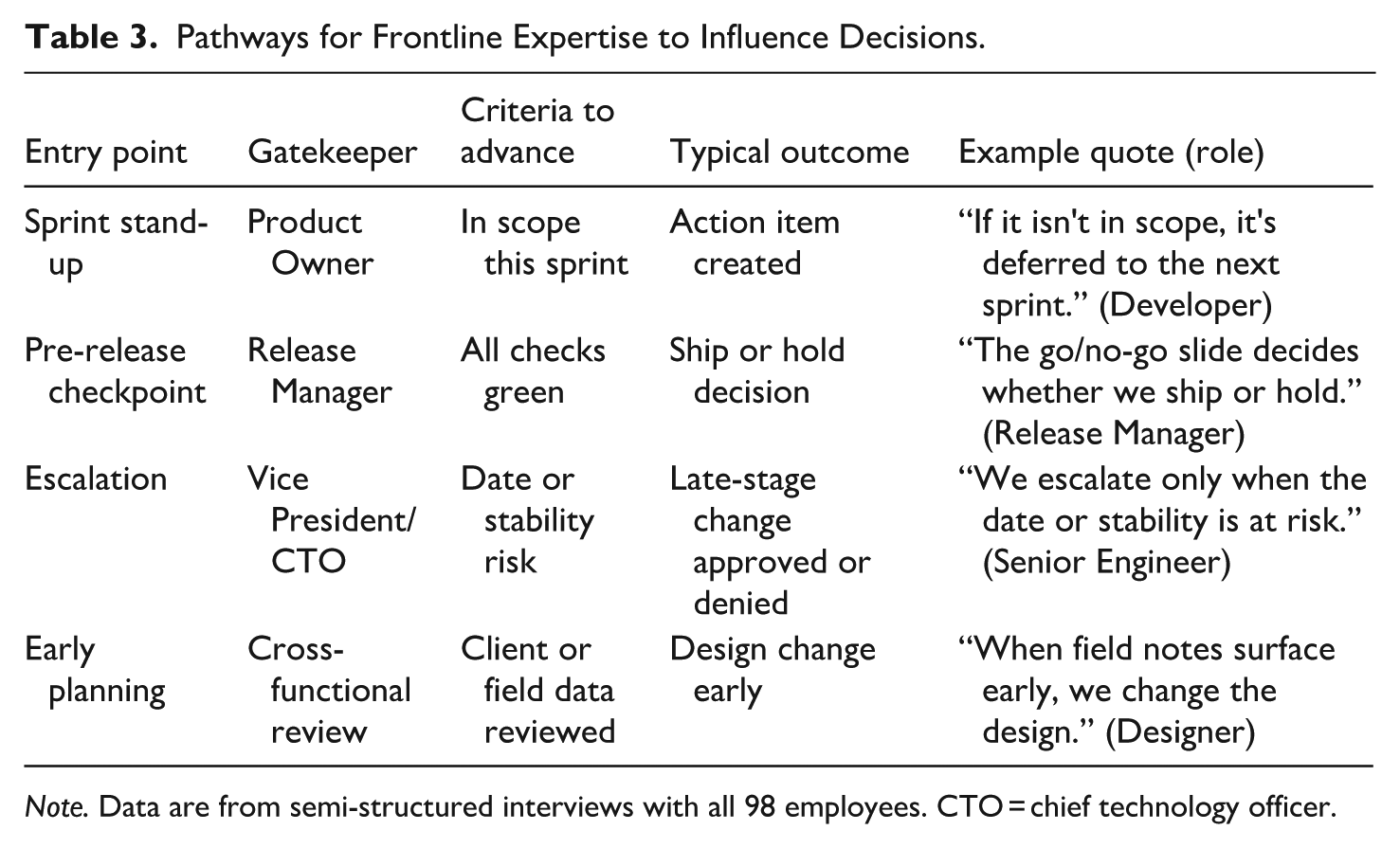
Note. Data are from semi-structured interviews with all 98 employees. CTO = chief technology officer.
Illustrative Episode
This episode shows how participation pathways narrow when quarter-end cadence pressure peaks. In a pre-release checkpoint for a feature with known stability concerns, frontline notes were captured in a shared document but received little deliberation during the meeting; the go/no-go artifact still read “ready to ship,” and participants described the interaction as acknowledgment rather than decision-making. As Jamie Parker, quality lead put it, “If you raise the same concern more than once, people start to see you as negative or not a team player.” Several interviewees linked this narrowing to reputational cost—raising concerns repeatedly risked being seen as “negative”—and to process rigidity once plans were set. A later change was approved through a separate escalation after the release plan had already been communicated, illustrating how frontline expertise can surface, but often too late to shape gate communication in real time.
Results for RQ4: Communicative Double-Loop Repairs to Cadence, Metrics, and Failure Definitions
RQ4 asked what double-loop learning efforts emerge around cadence, KPI bundles, and definitions of failure, and with what consequences for the SD-cycle. This section presents three episodes that trace how people at different levels tried to change gate routines, KPI credit, and shared definitions of “failure” to disrupt immobilizing patterns.
For readability, Table 4 provides an at-a-glance map of the three episodes (SD nexus, cycle evidence, and key interrupters), and the narrative that follows traces how each intervention either reproduces or disrupts the contradiction → immobilization → erosion sequence. Each episode centers on an SD-nexus under quarter-end cadence and shows how specific communicative moves and structural adjustments can reproduce or interrupt the SD cycle.
SD Diagnostic (Compact).
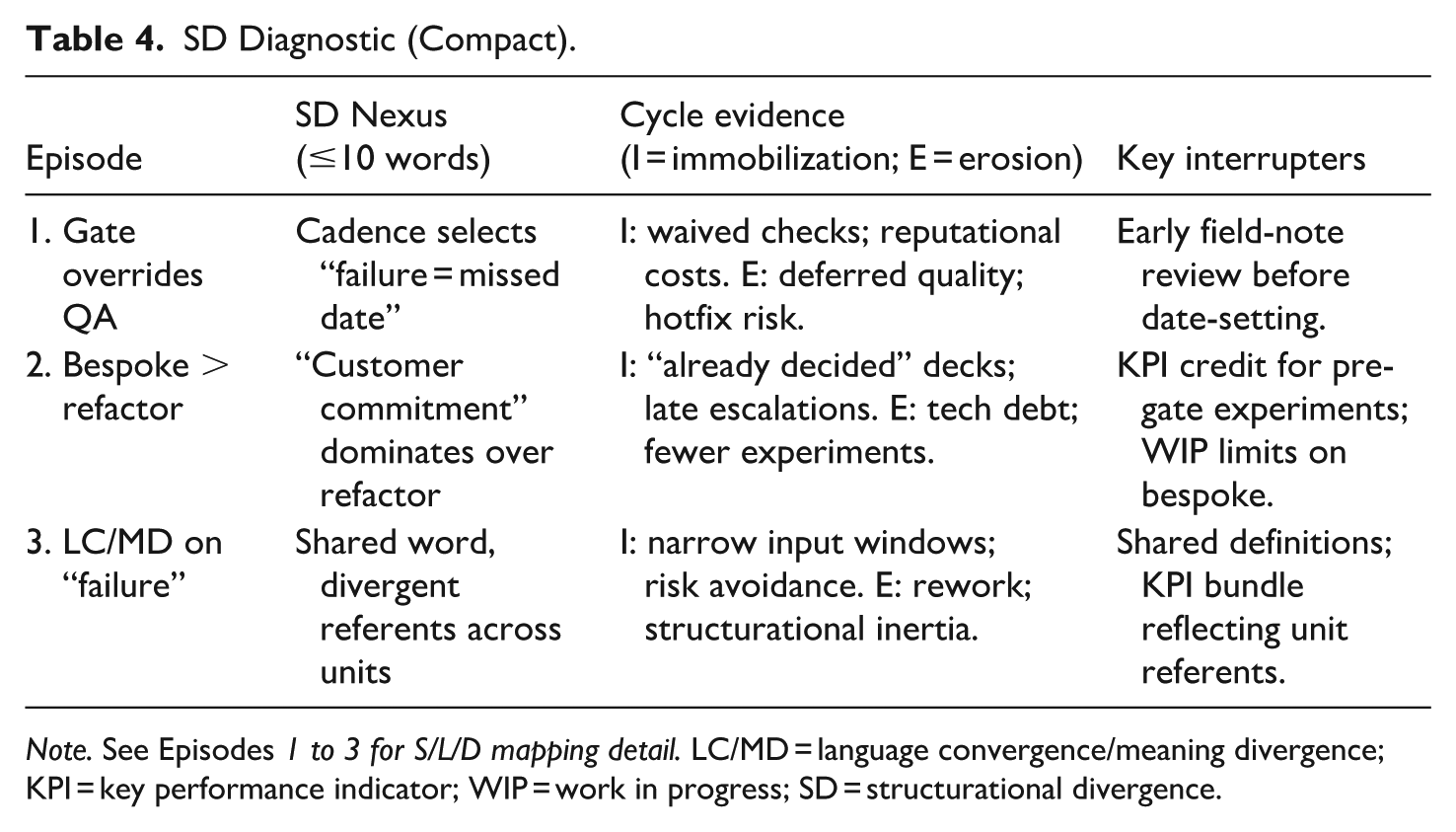
Note. See Episodes 1 to 3 for S/L/D mapping detail. LC/MD = language convergence/meaning divergence; KPI = key performance indicator; WIP = work in progress; SD = structurational divergence.
Episode 1—Gate Overrides QA Concerns (Cadence Selection in Practice)
This episode directly addresses RQ4 by tracing an attempted double-loop intervention at a late-stage release gate. It shows how quarter-end cadence and on-time KPIs positioned engineers at an SD-nexus where safety obligations and delivery commitments collided. Nexus: Quarter-end gate selects “on-time delivery” as the operative meaning of failure. Modalities/levels: Signification (innovation talk vs. “failure = missed date” at gate); legitimation (go/no-go slide, compressed checks); domination (leadership clearance reallocates time/people to ship).
Immobilization evidence: Notes captured but not discussed; checks waived to protect the date; reputational cost for dissent.
Erosion: Deferred quality work; hotfix risk; limited retrospective.
Interrupter: Early planning that surfaces field notes before date setting, enabling re-scoping and preventing escalation.
Mechanism link: Under quarter-end cadence, gate artifacts and KPI visibility made delivery timing the operative failure referent, narrowing deliberation, and reproducing the SD cycle. The early-planning interrupter functions as double-loop repair by shifting when frontline signals enter—before the date hardens—so scope can be re-set without late escalation.
Episode 2—Bespoke Client Accommodations Crowd Out Refactoring
Episode 2 addresses RQ4 by examining efforts to reframe what counts as “success” when bespoke client promises compete with planned learning work.
Nexus: “Customer commitment” discourse collides with scoped learning work. Modalities/levels: Signification (customer success frames failure as churn risk); legitimation (rules privileging urgent tickets); domination (people/time pulled from experiments to custom builds). Immobilization evidence: “Already decided” decks; late escalations as the only path to change. Erosion: Accumulated tech debt; shrinking experiment windows; sedimented workarounds. Interrupter: KPI credit for pre-gate experiment completion and defect-escape reduction alongside delivery.
Mechanism link: Under the same cadence and resource constraints, customer-commitment talk and learning-work needs collide, producing immobilization (“already decided” decks; late escalations) and erosion (tech debt; shrinking experiment windows). KPI credit for pre-gate experiment completion and defect-escape reduction operates as double-loop repair by changing what counts as “success” in the bundle, making learning visible at gate moments rather than discretionary.
Episode 3—LC/MD Around “Failure” Fragments Decision Authority
Episode 3 addresses RQ4 by showing how competing definitions of “failure” at macro, meso, and micro levels produce structurational divergence around the LC/MD tension.
Nexus: Shared word failure, divergent referents (defects, coverage, sev-1s, churn, missed ship, quarter variance). Modalities/levels: Signification fragmented across units; legitimation set by KPI family; domination concentrated at gates. Immobilization evidence: Narrow channels for frontline input; risk-avoidant defaults. Erosion: Rework; muted cross-unit learning; structurational inertia. Interrupt er: Definition-reconciliation workshops plus KPI realignment so what “counts” at the gate reflects cross-unit reality.
Mechanism link: Language convergence around the word “failure” masked meaning divergence across units, so gate authority concentrated around the KPI family while frontline signals narrowed. Definition-reconciliation workshops plus KPI realignment function as double-loop repair by aligning signification and legitimation—so the gate reflects cross-unit failure referents rather than collapsing failure to a single dominant metric.
Across the three episodes, actors’ efforts to redesign cadence, KPI credit, and shared definitions of failure show what double-loop repairs to SD can look like in practice. Some interventions—such as early gate resets and KPI credit for experiment completion—opened space to disrupt the SD-cycle, while others stalled at the SD-nexus when quarter-end commitments or existing KPI families could not be altered. These patterns answer RQ4 by clarifying both the possibilities and the limits of double-loop learning in a fail-fast, quarter-driven regime.
Discussion
Under the post-acquisition, quarter-end cadence, a recurring tension emerged between customer commitment and profitable growth. Teams defaulted to custom requests that drifted from strategy, consuming time needed for scoped experiments and learning. Apparent customer-centricity became a constraint when it overrode feasibility and longer-term goals, especially near release gates. The cadence privileged on-time delivery as the operative failure referent, rewarding risk-averse behavior and further narrowing space for iteration. To counter this drift, leadership can recalibrate competing discourses through designable communication interventions (see Implications for Practice).
Extending Structuration and Structurational Divergence in Business Communication
Taken together, the case extends structuration-based communication research in three ways. First, it theorizes cadence selection as a communicative mechanism that links temporal routines and KPI devices to the ordering of meanings of failure, rules, and resources at decision points. Second, it shows how language convergence/meaning divergence (LC/MD) around “failure” can function as a governance device under profitability cadence, hierarchically ordering which failure referents count at gates. Third, it conceptualizes participation pathways as structurally patterned routes for voice that connect signification, legitimation, and domination in everyday internal communication about innovation and risk.
Mechanism—Cadence Selection as Communicative Structuring
The findings specify a cadence-selection mechanism: under quarter-end schedules, temporal cadence selects which meaning of failure is operative at release gates and, in doing so, reproduces rules and reallocates attention and authority. The mechanism couples the structuration modalities across macro–meso–micro levels—signification (which failure meaning is salient: learning/innovation vs. on-time delivery), legitimation (KPI and gate rules), and domination (control of time, people, and budget). It shows how a SD nexus forms and can escalate into the SD cycle (contradiction → immobilization → erosion of development) when an on-time-delivery referent persistently suppresses learning work.
Performative Paradox, Located
Consistent with Fairhurst and Putnam (2024), who treat paradox as performative and processual, the analysis examines how contradictions between innovation and profitability were enacted in talk, artifacts, and embodied practice at Geo Precision Solutions. Participants did not merely report tensions; they performed them—in narratives of missed deadlines, embodied strain (e.g., “walking on eggshells” around leaders), and material routines (e.g., revised training modules that emphasized urgency). Whereas Fairhurst and Putnam (2024) foreground paradox as lived, structurational divergence provides the analytic vocabulary to map when such enactments become immobilizing by showing how communicative practices that might enable learning instead restrict members’ capacity to act. In this case, the cadence-selection mechanism explains the turn: quarter-end schedules made on-time delivery the operative failure referent at release gates, channeling attention away from learning and into risk-averse routines.
When LC/MD Becomes Structurationally Consequential
The study clarifies when language convergence/meaning divergence (LC/MD) around failure becomes structurationally consequential: under a profitability-driven quarter-end cadence, delivery rules gain relative weight at release gates, so cross-unit meanings of failure are not merely different—they are hierarchically ordered at critical moments. This ordering helps explain why frontline expertise travels only in narrow windows and indicates where gate communication can be redesigned to keep learning and reliability decision-visible (see Implications for Practice). Together, these contributions refine SD’s account of how modal misalignments become immobilizing in cadence-driven organizations and how structurational inertia can be reduced. When that ordering consistently privileges delivery over learning and safety, LC/MD becomes a structurational divergence nexus rather than a benign difference in terminology.
Theoretical Implications
Structuration and SD
Cadence density can be treated as a selector variable in structuration: as quarter-end cadence intensifies, the operative meaning of failure shifts. Comparative designs (e.g., weekly vs. quarterly gates; high- vs. low-density release calendars) can trace changes in modality ordering—signification → legitimation → domination—at decision points.
SD Prevention and Repair
Nicotera et al. (2014) outlined communicative practices for preventing and disrupting structurational divergence in nursing units, including explicit boundary negotiation, structurally supported forums for voice, and alignment between formal procedures and frontline expertise. The double-loop repairs identified in this study parallel those recommendations but relocate intervention from individual coping to the design of cadence-linked decision routines (see Implications for Practice). Rather than only teaching individuals to cope with contradictions, these interventions reconfigure cadence and decision structures so SD-nexuses are less likely to form. This suggests a complementary SD agenda in which interventions target both local interaction patterns and meso-level mechanisms, such as cadence and KPI design, that select which structures are activated at release gates.
Paradox as Performed
Findings align with performative views of paradox. Future research can measure when cadence makes the delivery pole publicly dominant (e.g., “on-time” KPIs) while muting learning, and map communicative sequences that flip that ordering (e.g., pre-gate deliberation that reintroduces learning talk).
Language Convergence/Meaning Divergence (LC/MD)
Under profitability-driven cadence, LC/MD around failure operates as governance, not drift: unit referents (defect-escape rate, test coverage, sev-1 reduction, churn risk, quarter targets) are hierarchically ordered at gates. Modeling LC/MD as hierarchical ordering enables tests of predictions for immobilization (e.g., escalation delays, near-miss capture rates).
Clarifying Fail-Fast Versus Profitability
The mechanism explains why fail-fast rhetoric collapses into ship-fast under quarter-end profitability: cadence selects a delivery referent of failure, reconfiguring rules and reallocating resources. One resulting proposition is that higher cadence density increases the odds that delivery becomes the operative failure referent at release gates.
Implications for Business Communication Research
For business communication research, the model highlights cadence selection and KPI design as internal communication mechanisms in safety-critical, commercial contexts. Rather than treating fail-fast rhetoric or innovation culture as background, future studies can use cadence selection and LC/MD as portable constructs to examine how internal messaging, dashboards, and meeting formats make some definitions of failure speakable and others unsayable. Comparative work across industries, tools, and cadence regimes can test whether the patterns observed here—delivery-oriented failure referents, narrow participation pathways, and quiet workarounds—generalize beyond emergency-response software firms.
For scholars designing business communication studies, the findings illustrate the value of treating familiar artifacts—KPI dashboards, gate decks, release calendars—as communication technologies whose features and use can be coded alongside talk. Operationalizing cadence density, participation pathways, and failure referents as communication variables allows researchers to link meso-level design choices to micro-level interactional outcomes and macro-level performance. In turn, this approach helps bridge organizational communication theory and the concerns of business communication practitioners who must design internal communication systems that hold profitability, safety, and learning together.
Future Research
Looking ahead, the model yields three testable expectations. First, cadence density—the frequency and intensity of scheduled release gates—functions as a selector: as cadence density increases, the likelihood that a delivery-only meaning of failure (i.e., missed on-time delivery) becomes operative at release gates also increases. Second, KPI design should moderate that selection. Bundles that pair delivery metrics with learning/safety indicators are expected to weaken the impact of cadence density on delivery-only selection, making it less likely that on-time delivery becomes the sole failure referent under high cadence. Third, participation timing matters. Establishing pre-gate deliberation windows should increase the probability that frontline knowledge enters the process before meanings are selected at the gate, thereby reducing late escalation and increasing the chances that a learning-oriented meaning of failure is operative.
Significance and Contribution of the Study
This study advances organizational communication by specifying a cadence-selection mechanism: under quarter-end schedules, temporal cadence selects which meaning of failure is operative at release gates and thereby reallocates attention, authority, and meaning in product work. In mission-critical settings that selection is consequential: cadence determines whether frontline warnings surface as learning signals or are muted as noise—much like hospital shift handoffs, where schedule cadence can determine whether a near-miss triggers improvement or is absorbed as a quiet workaround. Tracing this selection across episodes explains why well-intended fail-fast rhetoric often converts, under quarter-end pressure, into risk-averse delivery routines.
Theoretically, the study specifies a cadence-selection mechanism that links signification (competing meanings of failure), legitimation (KPIs and gate rules), and domination (control of time, people, budget) across macro–meso–micro levels, clarifying the fail-fast versus profitability tension by showing how quarter-end logics privilege on-time delivery as the default failure referent at release gates. Empirically, multisource evidence (interviews, field notes, and episodes at release gates) demonstrates how discourse and cadence co-produce outcomes. Practically, the analysis identifies designable communication interventions that help organizations hold innovation and reliability together under deadline pressure (see Implications for Practice).
Implications for Practice
What leaders can do in safety-critical software. This case shows that cadence and KPI bundles function as communication technologies: they decide which meaning of “failure” will be treated as real at gates (e.g., missed ship date vs. defect escape, sev-1 risk, churn, or data integrity). For leaders and business communication professionals, the actionable takeaway is to redesign gate communication so reliability and learning remain decision-visible before schedule pressure peaks.
(1) Build a one-page Failure Definition Map. In a short cross-unit session, document what “failure” means to each function (e.g., defects, coverage, sev-1 incidents, churn, missed ship, quarter variance). Use the map in planning and go/no-go decks so teams are not “agreeing on a word” while diverging on the referent.
(2) Repair the KPI bundle so learning and safety count. Pair on-time delivery with at least one learning metric (e.g., experiment completion or refactor capacity) and one reliability metric (e.g., defect escape, sev-1 reduction, coverage thresholds). Make these visible on the same dashboard and on gate slides so the dominant failure referent does not collapse to “late.”
(3) Create a pre-gate deliberation window with decision rights. Time-box an early review (before dates harden) where frontline signals (field notes, QA coverage, incident learnings) must be discussed and where someone has formal authority to pause or reshape scope based on reliability criteria.
(4) Bound bespoke work with a portfolio scaffold. Use explicit WIP limits and a standing “tradeoff checkpoint” (what gets dropped when a bespoke request enters) so customer commitment does not silently crowd out refactoring and learning work.
Transferability and boundary conditions. These recommendations are most transferable to organizations that operate under strong reporting cadences (e.g., quarterly cycles), coordinate across product/customer-facing and reliability functions, and face high-consequence error conditions (public safety, regulated domains, safety-critical infrastructure). In such settings, the mechanism is portable: cadence and KPI bundles shape which concerns become speakable in the meeting formats where commitments are made.
Limitations and Conclusions
This is a single-case study situated in an emergency-response software firm, so findings are context-bound. Comparative cases across firms with different cadence densities (and pre/post interventions that adjust KPI bundles or pre-gate windows) could test how acquisition cadence shapes the meaning of failure and the movement of frontline knowledge. Overall, the study specifies a cadence-selection mechanism showing how temporal cadence determines what counts as failure at release gates, reallocates attention and authority, and explains why fail-fast talk can become risk-averse delivery. It also identifies designable communication interventions that reduce structurational inertia and keep learning and reliability decision-visible at commitment points.
Footnotes

Funding
The author received no financial support for the research, authorship, and/or publication of this article.
Declaration of Conflicting Interests
The author declared no potential conflicts of interest with respect to the research, authorship, and/or publication of this article.