







Abstract
Chinese milk tea consumption is characterized by strong social engagement and a high degree of mediatization. This means that when crises occur, related incidents can rapidly escalate on social media, eroding public trust and undermining brand reputation and market performance. However, existing research on trust repair has paid relatively limited attention to emerging industries like the milk tea sector. This study adopts a multidisciplinary paradigm, integrating Image Repair Theory, Situational Crisis Communication Theory, the organizational trust model, and a linguistic approach to examine the dominant crisis types faced by Chinese milk tea companies, their trust repair goals, and corresponding linguistic realizations. The findings show that human error product harm, technical error accidents, and management misjudgments are the primary crisis types faced by Chinese milk tea companies. Across crisis types, these companies consistently prioritize repairing the benevolence dimension of trust. To restore this and other trust dimensions, they employ differentiated response strategies; notably, corrective action is necessary in nearly all crisis types. Chinese milk tea companies favor strategies such as admitting, appreciation, requesting, and exhortation. Further analysis shows that these strategies facilitate trust repair by constructing positive corporate images and mitigating responsibility attribution. By situating trust repair practices in the Chinese cultural context, this study extends Situational Crisis Communication Theory and Image Repair Theory by broadening the typology of crisis types and trust repair strategies. The paper concludes by offering practical suggestions for crisis management and trust rebuilding in similar industries.
Keywords
Introduction
This study explores the trust repair goals and strategies adopted by Chinese milk tea companies in response to various crisis types. Milk tea, a beverage made from tea concentrates blended with milk, cream, or fresh fruits, has gained widespread popularity worldwide and is regarded as an integral part of modern, fashionable lifestyles (Zhu & He, 2026). Given this rapid market growth, crises can quickly gain visibility and spread through social media. While social media can foster positive interactions between companies and the public, it can also amplify distrust and damage corporate credibility (Waters et al., 2009). Given the highly social and mediatized nature of milk tea consumption in China, such crises can undermine stakeholder trust and threaten organizational legitimacy (Poppo & Schepker, 2010). Therefore, a systematic investigation into crisis types, trust-repair goals, and discursive strategies in this industry is imperative.
Scholars across various disciplines, including communication (Parmelee & Greer, 2023), business (Chan et al., 2024), management (L. Liu et al., 2022), and linguistics (Zhang et al., 2025), have examined how companies attempt to rebuild trust following crises. Despite these contributions, several gaps remain. First, prior studies often focus on isolated cases or generic crises (Karsak & Şekerci, 2025), leaving sector-specific patterns comparatively underexplored. Second, the definition of corporate trust varies across disciplines (Kramer & Lewicki, 2010; Saunders et al., 2010), which obscures the specific trust repair goals and limits a systematic understanding of what organizations seek to restore following a crisis. Third, drawing on theoretical frameworks such as pragmatics (Breeze, 2021; Kampf, 2009a), genre theory (Kampf, 2009b), appraisal theory (Q. Wang et al., 2021), and (multimodal) discourse analysis (Fuoli & Paradis, 2014; Jaworska, 2023), existing studies have examined how various textual and visual semiotic resources contribute to the formulation of crisis response strategies. Nevertheless, relatively few studies have integrated Situational Crisis Communication Theory (SCCT) or Image Repair Theory (IRT) with linguistic theories (but see Koller, 2023). This research addresses this gap by examining how trust repair strategies are realized linguistically.
In response to the identified gaps, this study explores the trust repair goals of Chinese milk tea companies and their responses to crises. Drawing on IRT, SCCT, and Mayer et al.’s (1995) integrative model of organizational trust, the current study will answer the following questions:
Literature Review
Corporate Trust and Trust Repair
Given the service-oriented nature of the milk tea industry, this study adopts the influential definition of trust proposed by Mayer et al. (1995, p. 712), which has been widely applied in service-related research contexts (e.g., Isaeva et al., 2020). According to this definition, trust is “the willingness of a party to be vulnerable to the actions of another party based on the expectation that the other will perform a particular action important to the trustor, irrespective of the ability to monitor or control that other party.”
Mayer et al. (1995) further distinguish between trust and trustworthiness. While trust is understood as a psychological state of the trustor, reflecting their willingness to accept vulnerability, trustworthiness pertains to the perceived attributes of the trustee that collectively determine whether the trustee is considered deserving of trust (Isaeva et al., 2020). Trustworthiness is determined by three core dimensions: ability, benevolence, and integrity. Ability refers to “that group of skills, competencies, and characteristics that enable a party to have influence within some specific domain”; benevolence captures “the extent to which a trustee is believed to want to do good to the trustor, aside from an egocentric profit motive”; and integrity reflects the trustee’s adherence “to a set of principles that the trustor finds acceptable” (Mayer et al., 1995). These dimensions underscore that in the event of trust violations, organizations seeking to restore damaged trust must demonstrate enhanced trustworthiness across these key attributes (Poppo & Schepker, 2010). In this context, the concept of trust repair becomes particularly relevant.
Trust repair generally refers to the improvement in a trustor’s trust following a violation that has compromised the original trust relationship (Gillespie & Siebert, 2018; Kim et al., 2009). As trust is primarily based on perceptions of the trustee’s trustworthiness, effective trust repair typically involves reconstructing these perceptions (Tomlinson & Mryer, 2009). In light of this, one of the central objectives of this study is to examine whether Chinese milk tea companies actively seek to restore all three dimensions of trust.
Prior studies have distinguished verbal, behavioral, and structural trust repair mechanisms (e.g., Lewicki & Brinsfield, 2017). This study focuses on verbal strategies and linguistic realizations of trust repair strategies, as these are the most immediate and visible forms of organizational responses to crises.
In this regard, Fuoli and Paradis (2014) developed a model of trust-repair discourse grounded in Mayer et al.’s (1995) three trust dimensions, and applied it to the analysis of CEO letters by integrating linguistic resources such as engagement, evaluation, and affect (Martin & White, 2005; White, 2003, 2012). Their findings underscored the central role of discourse in trust repair, particularly highlighting its discursive and pragmatic dynamics. Considering the context-dependent nature of trust-repairing practices, Wang and Yao (2022) further extended this model by incorporating China’s cultural context of trust. Building on prior stance analysis of corporate reports (Fuoli, 2018), Fuoli and Hart (2018) employed experimental methods to validate the effects of corporate trust repair strategies on restoring the public’s perceptions of benevolence and integrity. From an argumentation perspective, Palmieri and Musi (2020) proposed an analytical framework for examining trust-oriented polylogues in rhetorical (sub-)arenas.
Collectively, these studies demonstrate the analytical value of Mayer’s trust model and the relevance of linguistic approaches to trust repair. However, existing research adopts a predominantly top-down approach, limiting the understanding of how different dimensions of trustworthiness are dynamically constructed through the interaction of multiple linguistic resources across varying crisis types.
Crisis Types and Response Strategies for Corporate Trust Repair
This study integrates SCCT and IRT to analyze the crisis types confronting Chinese milk tea companies and their corresponding response strategies aimed at repairing trust.
Situational Crisis Communication Theory
SCCT (Coombs, 1995) classifies crises into three primary clusters based on the audience’s perceived crisis responsibility level: victim (weak attribution of responsibility), accidental (minimal attribution), and preventable (strong attribution) clusters. Each cluster comprises more specific subtypes, such as natural disasters, human error accidents, technical error product harm, etc.
The SCCT framework also includes a range of strategic responses tailored to the perceived level of responsibility acceptance (Barkley, 2020). The organizations can restore trust by adopting four main categories of crisis response strategies: denial (e.g., attacking the accuser, denial, scapegoating), diminishment (e.g., excuse and justification), rebuilding (e.g., compensation and apology), and bolstering (e.g., reminding, ingratiation, and victimage; Coombs, 2022a, 2022b).
The application of SCCT for analyzing crisis response strategies at the textual level can be broadly grouped into three main research approaches. First, most studies focus on examining the crisis response strategies adopted by various actors (Castro Samayoa et al., 2023; Tian & Yang, 2022). Some of these studies further integrate response strategies with additional communicative factors to enhance discursive effectiveness, such as communication channels (Ketter, 2016) and emotions (Zizka & Chen, 2024). Second, a number of studies conduct comparative analyses of crisis response strategies across different countries (Šuligoj, 2024) or temporal stages of crisis development (W. Liu et al., 2018). Third, other studies investigate the antecedents and consequences of crisis response strategies, including the factors influencing strategy selection (Farrell & Littlefield, 2012) as well as their effects on public perception and organizational outcomes. For example, Claeys et al. (2010) examine whether aligning crisis types with appropriate crisis responses leads to more positive corporate reputation perceptions. Similarly, Holland et al. (2021) integrate message transparency with SCCT to investigate the synergistic effects of transparency, crisis types, and response strategies on organizational perceptions and behavioral intentions.
No matter from which research perspectives, research applying SCCT at the textual level consistently underscores the centrality of crisis type in shaping crisis communication. Specifically, crisis type influences the selection, formulation, and effectiveness of response strategies, as well as the factors that condition their use.
Image Repair Theory
In IRT, Benoit (1995) outlines a repertoire of strategies, which are grouped into five main categories: denial (simple denial, shifting the blame, deflect attention and straw denial); evasion of responsibility (provocation, defeasibility, claiming accident and good intentions); reducing the offensiveness of the act (image bolstering, minimization, differentiation, transcendence, reducing the credibility and compensation); taking corrective action; and mortification (admitting guilt and apologizing). These strategies can be used individually or in combination to shape public perceptions of a corporation’s trustworthiness and facilitate trust repair (Masngut & Mohamad, 2021).
Studies that apply IRT for analyzing crisis response strategies at the textual level are similar to those applying SCCT. The difference is that the studies employing IRT focus more on a detailed rhetorical analysis of crisis response strategies. For example, by combining Goffman’s (2009) concept of stigma, 1 Lauwo et al. (2020) examined how a major mining company in Tanzania employed various strategic responses to distance itself from corporate stigmatization. Additionally, some scholars have narrowed their analysis to a specific crisis response strategy in IRT. For instance, Thomsen (2023) examined Southwest Airlines’ apology strategy in response to a large-scale flight cancellation incident. The study examined how the company utilized an apology framework to construct counter-narratives that portrayed the airline and its leadership as heroic figures striving to protect employees’ livelihoods amid an uncontrollable crisis.
Following the above review of SCCT and IRT, this study adopts an integrated approach for three main reasons. First, regarding both the theoretical foundations and applied research, SCCT provides a systematic framework for aligning crisis response messages with specific crisis types (Coombs & Holladay, 2002). In contrast, IRT, rooted in rhetorical theory, offers a deeper understanding of the verbal strategies used by the accused or suspected parties during crisis communication (G. Hu & Xu, 2020). Second, although SCCT and IRT share several elements in their crisis response strategies, they differ in analytical focus and categorization schemes (Jiang et al., 2025). Third, while SCCT primarily aims at understanding how companies minimize reputational damage, IRT emphasizes cultivating positive perceptions to actively restore the organization’s reputation. This makes their integration particularly valuable.
Research Methodology
Sampling
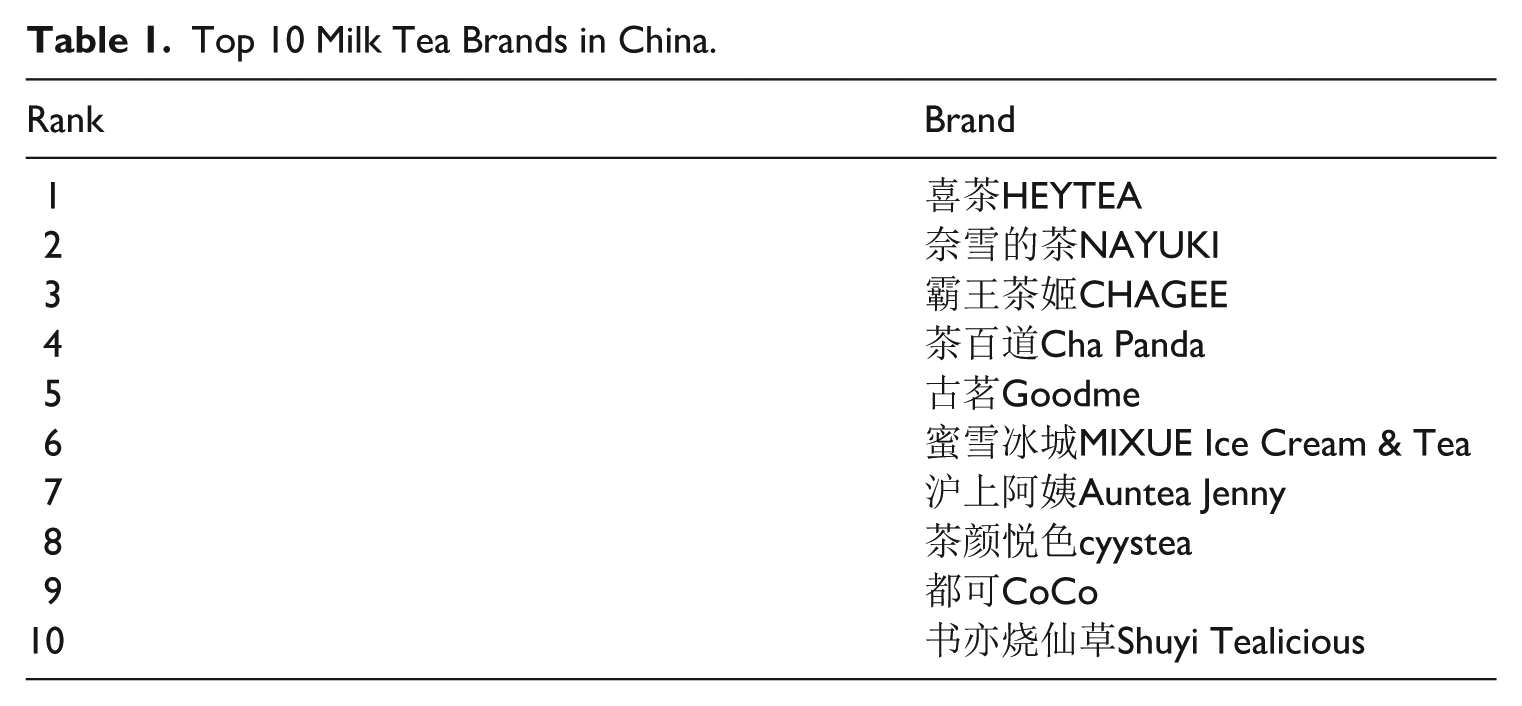
First, this study selected the top 10 milk tea brands in China for 2024 based on rankings published by Chinabgao (中国报告大厅) (Table 1). Chinabgao 2 is a leading market research platform established in October 2002. It provides a wide range of services for corporate users, including in-depth industry reports, market surveys, and statistical analyses.
Top 10 Milk Tea Brands in China.
This study systematically identified crisis events involving the 10 selected brands between January 1, 2019, and January 31, 2025, based on relevant news reports and trending topics on the social platform Sina Weibo. This platform, which integrates features of Twitter, YouTube, and Instagram, is one of the most widely used platforms in China (Zhao et al., 2023). According to its 2024 earnings report 3 Sina Weibo reached 590 million monthly active users and 260 million daily active users by the end of 2024. More than 1.5 million companies, including milk tea brands, have verified official accounts on the platform. Given its broad user base, particularly among younger demographics, Weibo offers significant potential for marketing and public engagement within the milk tea industry.
We then retrieved crisis-related responses posted by the companies on their official Sina Weibo accounts, including official corporate statements, CEO letters, and regular corporate posts. All relevant posts were manually extracted and compiled into a Microsoft Excel spreadsheet. In total, 23 crisis response posts, comprising approximately 20,000 Chinese characters, were collected for analysis.
Coding Scheme
Data analysis was conducted using NVivo 12. The coding process was performed by the first and second authors. To ensure reliability, 50% of the texts were randomly selected and independently coded, resulting in high interrater reliability (Cohen’s kappa = .81). The first author then completed coding the remaining texts. Any discrepancies were discussed and resolved through consensus. The first author then coded the remaining data following the agreed coding scheme. Each sentence served as the unit of analysis.
This study adopts a hybrid coding approach that integrates deductive and inductive procedures. Deductive coding was first applied to address the three research questions based on established theoretical frameworks. To answer the first research question, crisis types were coded based on the crisis clusters proposed by Coombs (2022b). For the second research question, we coded the trust dimensions reflected in the texts based on the model proposed by Mayer et al. (1995). As ability, benevolence, and integrity are all essential components of trust and may function independently of one another, sentences reflecting more than one dimension were coded for more than one category.
To answer the third research question, trust repair strategies were primarily coded using a top-down approach informed by IRT and SCCT. Given that these two frameworks have similarities and differences in their classification of response strategies, this study adopts an integrative coding scheme. In cases where comparable strategies are identified in both frameworks, the terminology of SCCT is adopted to ensure conceptual consistency. At the same time, strategy categories unique to IRT are retained to preserve the theoretical comprehensiveness of the coding framework. The coding process also responds to the specific characteristics of the dataset. When the original theoretical frameworks did not explicitly cover strategy types, supplementary codes were developed to accommodate these additional strategies.
This study adopts a bottom-up approach to coding linguistic features. Through systematic close reading, we identify relevant devices such as social actors and process types (Halliday & Matthiessen, 2013, pp. 244–329), evaluation, speech acts, metaphor, pronouns, and intensifiers.
Findings
Crisis Types Faced by Chinese Milk Tea Companies
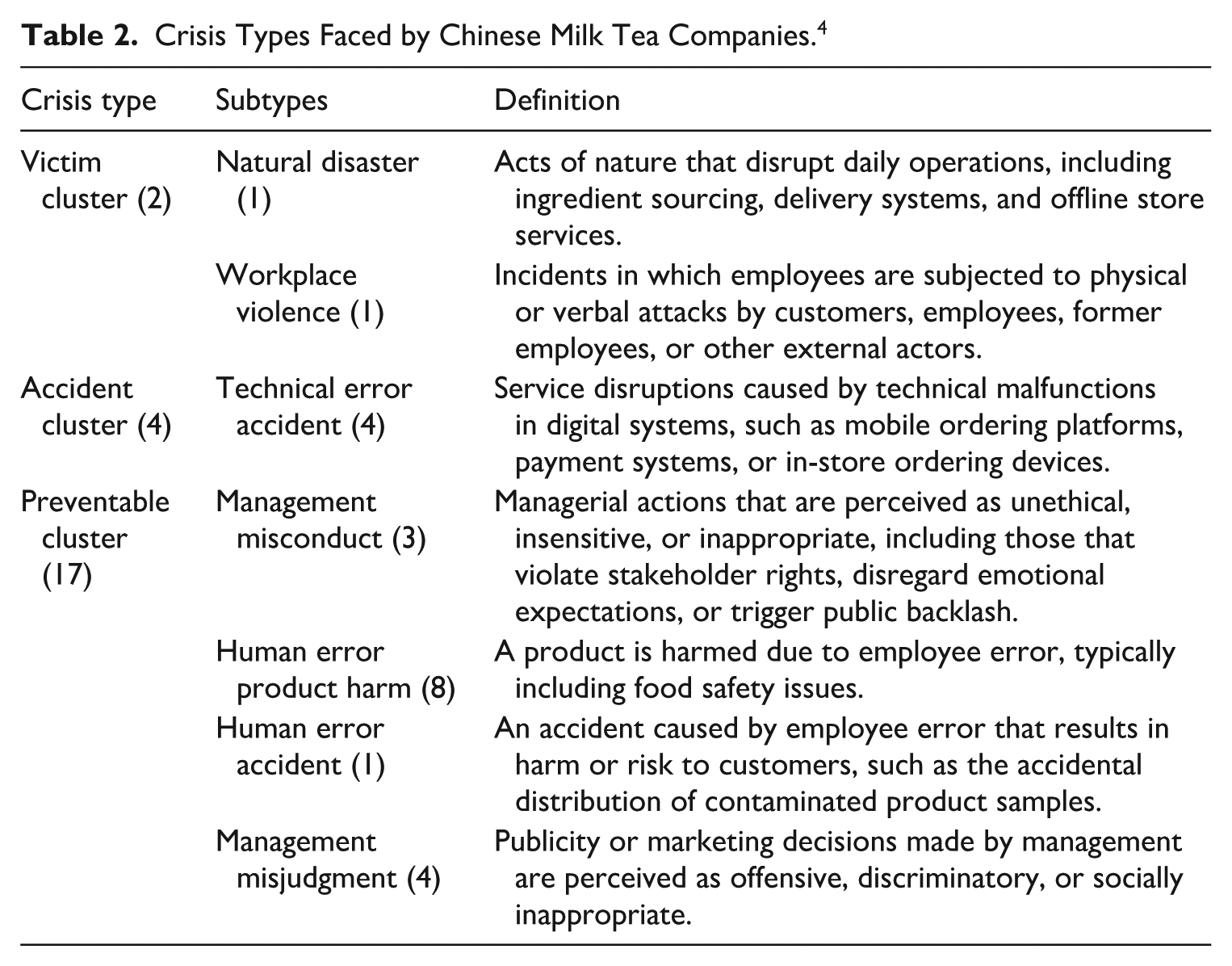
As shown in Table 2, the most frequent type is human error product harm, encompassing quality issues with product and co-branded merchandise, particularly those involving food safety, which draw widespread public attention. In addition, technical error accidents, such as disruptions in online ordering systems and the termination of live broadcasts used for promotional collaborations, are also relatively common. Notably, management misjudgment represents a distinctive crisis type and serves as a supplementary category beyond those listed in the original SCCT framework. These misjudgments typically involve controversial marketing or promotional activities that offend certain social groups. For instance, Cyystea issued a public apology for insulting women, while Goodme apologized for disrespecting workers.
Crisis Types Faced by Chinese Milk Tea Companies. 4
Corporate Trust Repair Efforts
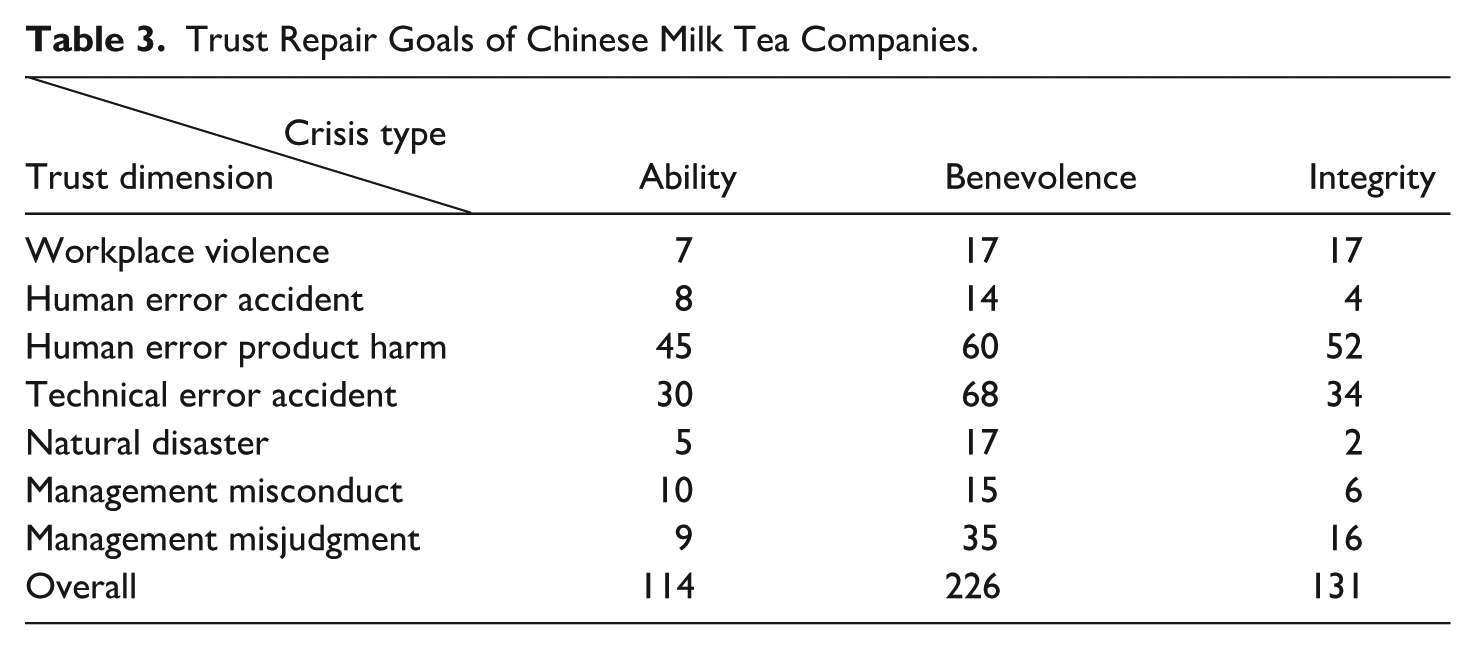
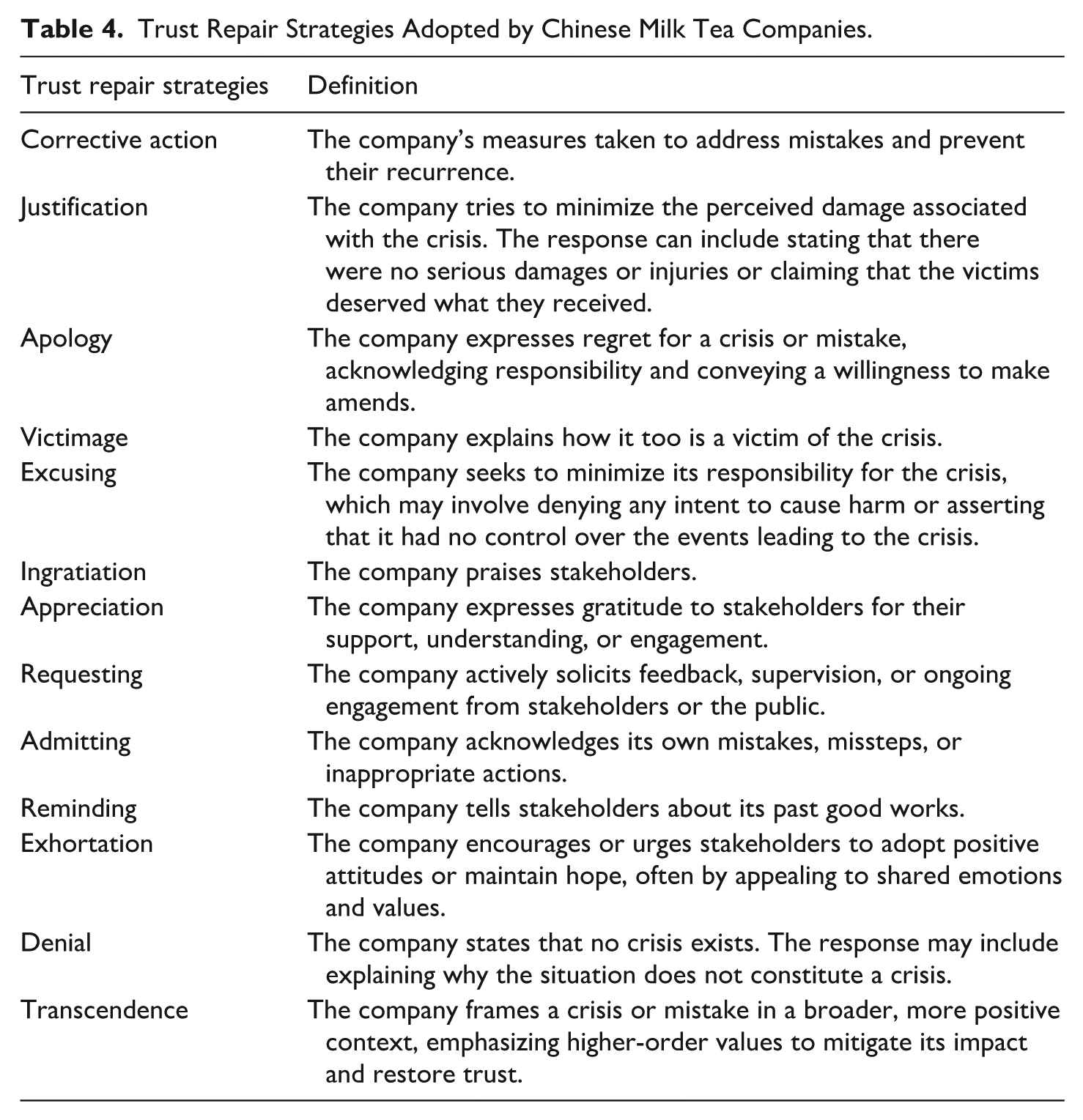
As shown in Table 3, irrespective of crisis type, Chinese milk tea companies consistently prioritize the repair of benevolence. In addition, for crisis types such as human error accidents, natural disasters, and management misconduct, companies place greater emphasis on rebuilding their ability rather than their integrity. Conversely, in cases involving workplace violence, human error product harm, technical error accidents, and management misjudgments, the focus shifts toward repairing integrity over ability. Table 4 presents the categories of trust repair strategies employed by Chinese milk tea companies, and the details are illustrated in the following section.
Trust Repair Goals of Chinese Milk Tea Companies.
Trust Repair Strategies Adopted by Chinese Milk Tea Companies.
Benevolence
To repair benevolence, companies commonly express care, empathy, and appreciation toward affected customers or employees. They also frequently express hope and issue apologies.
Care is manifested through personalized attention to customer concerns and responsiveness to stakeholders’ feedback (Example 1), which aligns with the concept of operational benevolence identified by Isaeva et al. (2020). Even when such responses incur additional operational costs, these actions are considered essential for enhancing consumer trust (Sirdeshmukh et al., 2002).
1. 对于315晚会曝光的书亦烧仙草门店更改食材效期标签的情况,书亦集团保持高度的关注。Shuyi Group is highly concerned about the change to the expiry date labels of ingredients in Shuyi Telicious shops, which was exposed by the 315 evening party. (Shuyi Telicious was reported to have changed the expiry date labels on their products-human error product harm)
Using the reminding strategy, the company states that it attached great importance to the problem revealed by the media and sincerely admitted wrongdoing. The intensified relational process “is highly concerned signals the company’s active and responsible stance regarding the incident, while the social actor “Shuyi Group” underscores that this concern originated at the corporate level rather than being limited to individual branches.
Empathy is reflected when companies express an understanding of their customers’ emotional or material losses. In example 2, the company employed the reminding strategy to convey its awareness of customers’ expectations regarding the co-branded merchandise. The mental processes “understand” and “value,” intensified respectively by “deeply” and “highly,” demonstrate that the companies were actively engaging with consumers’ psychological and emotional states. The absolute referents “all our customers” and “everyone” de-individualize the crisis and mitigate potential confrontation by framing the issue as a general concern.
2. 我们深知各位星星 5 对于此次活动的期待,也非常重视每一位旅客 6 的体验。We deeply understand the expectations of all our customers for this event and highly value the experience of everyone. (Auntea Jenny’s co-branded merchandise was found to have quality issues-human error product harm)
Companies often express appreciation for public oversight or support, which helps reinforce their connection with stakeholders.
In example (3), the company employs the speech act of thanking which is realized by the relational process “are grateful.” The company also adopts ingratiation strategies to acknowledge the support of various stakeholders, such as “媒体朋友 (media friends),” “监管部门 (regulatory authorities),” and “大家 (everyone).” Positive evaluative expressions, including “指导 (guidance),” and “鞭策 (constructive criticism),” further demonstrate that the company attempts to maintain a good relationship with the public.
3. 我们非常感谢媒体朋友们帮助我们发现问题,感谢监管部门给予我们的指导,感谢大家这段时间以来给予我们的鞭策。We are very grateful to our media friends for helping us discover the problem, to the regulatory authorities for their guidance, and to everyone for the encouragement and constructive criticism we’ve received during this time. (Chapanda was reported to have changed the expiry date labels on their products-human error product harm)
Expressing hope is a distinctive phenomenon in reacting to management misjudgments and natural disasters. The involved companies express their hope that the situation will not have wider negative consequences and will be better soon; for example (4), Goodme wished that things would improve soon.
4. “一曲天地远,山水总相逢”。我们相信好事多磨,虽有风雨,但终将守得云开见月明。“A melody drifts across the boundless sky and land, and mountains and rivers shall meet once again.” We believe that good things take time, and although there may be storms, the clouds will eventually clear and the moon will appear. (Goodme apologized for canceling the drone show due to the typhoon-natural disaster)
In example (4), an excerpt from a statement issued by Goodme following a typhoon that forced the suspension of a drone performance, the company employed the exhortation strategy to give customers hope that they would have another chance to watch the drone performance. The company cited a sentence from a Chinese poem, “一曲天地远, 山水总相逢” (A melody drifts across the boundless sky and land, and mountains and rivers shall meet once again), to arouse shared feelings with their customers. The mental process “we believe. . .” as well as the metaphorically used words “storm,” “clouds,” and “moon” also reflected that the company was attempting to restore their benevolence through expressing a hopeful outlook.
Issuing an apology is also a common tactic for companies to prove their sincerity. In our data, apologies strategies are often combined with other strategies. Example (5) exemplifies a combination of “excuse” and “apology” strategies. The company justifies its actions by highlighting its good intention of reducing customer waiting time, thereby softening the negative perception caused by the service failure. Then, the apology is conveyed through a direct speech act, intensified by the adverb “实在 (sincerely)” and the exclamation mark, both of which enhance emotional resonance and foreground the company’s sincerity. The use of the collective pronoun “we” further constructs a unified corporate voice and signals collective accountability.
5. 本想让南京的茶友们获得更好的体验、不再有排队的焦虑, 我们首次在开业期间启动了线上小程序点单、线下不排队的方法, 但最终我们并没有让每一位茶友都获得舒适的体验,实在抱歉! To allow tea friends in Nanjing to have a better experience and to be free from the frustration of long queues, we launched an online mini-program for ordering for the first time during the opening period. However, we were ultimately unable to ensure a smooth experience for every tea friend. We sincerely apologize! (CHAGEE’s online ordering mini-program crashed at Xinbai Flagship Store at New Intersection, Nanjing-technical error accident)
Ability
Companies rebuild trust in their ability in three ways. First, they highlight future actions by outlining specific measures they plan to implement in the long term (example 6).
6. 我们将加强服务培训,持续提升“雪王冰杯“的产品体验,向大家提供更好的产品与服务。
We will strengthen service training, continue to improve the product experience of “Snow King Ice Cup,” and provide better products and services to everyone. (MIXUE Ice Cream & Tea refused to sell the 1-yuan Snow King Ice Cup due to overwhelming demand, and some employees even mistreated customers-management misconduct)
The company’s future actions are highlighted through material processes, instantiated by verbs such as “加强 (strengthen),” “提升 (improve),” and “提供 (provide),” foregrounding the concrete measures the company plans to implement to enhance services and products. The collective “we” highlights the company as a unified and active agent, reinforcing its responsibility and proactive stance. Moreover, the future marker “将(will)” further amplifies the company’s determination to act. Collectively, these linguistic choices served to construct the company as a powerful and capable actor, one that can effectively prevent similar issues from occurring in the future.
Second, they highlight immediate responses, detailing what actions were taken either immediately after the onset of the crisis or even prior to the official statement (example 7).
7. 由于夏季高温潮湿,蚊虫增多,奈雪的茶所有门店都相应加强了防虫措施的力度,并通过第三方专业公司,每月进行4次防虫害工作。Due to the high temperature and humidity in the summer, the number of mosquitoes has increased. All Nayuki stores have strengthened their insect prevention measures accordingly and carried out pest prevention work four times a month through a third-party professional company. (Some customers reported that small flying insects appeared in their tea bought at Nayuki’s Longhua store-human error product harm)
The company’s immediate response following the media exposure of the issue is realized through material processes such as “have strengthened” and “carried out.” These verbal choices not only highlight the specific measures taken by the company but also encourage favorable evaluation from the audience: according to Martin and White (2005, p. 61), evaluation is not limited to explicitly positive or negative lexis; it can also be conveyed through factual information that, in a given culture or context, invites reader judgment. The phrase “Nayuki stores” functions as the grammatical actor of these actions, while the quantifier “all” serves as an intensifier, highlighting the company’s comprehensive and unified commitment to solving the issue. In addition, the reference to a “third-party professional company” enhances the credibility and appropriateness of the company’s corrective measures. The quantitative expression “four times a month” further adds rhetorical weight through specificity, emphasizing the company’s organizational capacity and operational transparency.
Example (7) also employs the “excusing” strategy. By providing background (“Due to the high temperature and humidity in the summer, the number of mosquitoes has increased”), the company implies that they have no control over the events that led to the crisis, thereby transferring the responsibility to external factors.
Third, companies invoke past achievements, which occurred before or after the onset of the crisis, to reinforce their competence and reliability. To this end, the reminding strategy is widely used to convey the company’s prior popular products (Example 8).
8. 回想霸王茶姬走过的这五年的历程,我们推出过伯牙绝弦、春日桃桃、寻香山茶等很多款倍受茶友们喜爱的产品。Looking back at the five-year journey of CHAGEE, we’ve launched many beloved products, such as Jasmine Green Milk Tea, White Peach Oolong Snowy Frappé, and Camellia Oolong Milk Tea etc. (CHAGEE’s coconut water series was criticized for its bland taste-human error product harm)
By employing evaluative lexis (“beloved”), the company highlighted the public’s prior approval and emotional attachment to CHAGEE’s other products. This is further intensified by listing the specific names of those well-selling milk teas, increasing the credibility of the brand’s competence. Besides, the metaphor “five-year journey” conceptualizes CHAGEE’s development as an experienced, perseverant, and tested entity, implicitly suggesting its capacity for long-term excellence and continuous product innovation.
Integrity
The integrity dimension of trust refers to the extent to which a company demonstrates honesty, consistency, transparency, and adherence to ethical principles (Moorman et al., 1993; Rendtorff & Mattsson, 2009).
First, demonstrating honesty involves acknowledging wrongdoing, which companies most commonly do through the admitting strategy, a pattern observed across all crisis types. As illustrated in example (9), the company explicitly condemns the store’s disclosure of a former employee’s personal information, using strong evaluative lexis (“extremely inappropriate”) to convey disapproval. Furthermore, the use of negation (“had no right,” “was not in line with”) intensifies the company’s stance, functioning as a contractive dialogic resource (Martin & White, 2005) that limits alternative viewpoints and reinforces the company’s ethical stance.
9. 涉事门店处理方式极不妥当,也无权对伙伴信息进行公示,该内容也不符合公司价值观。The shop’s handling of the incident was highly inappropriate. It had no right to post the partner’s [ex-employee’s] information publicly, and the content disclosed was not in line with the company’s values. (CHAGEE’s former employee’s personal information was publicly disclosed-management misconduct)
However, admitting wrongdoing is often strategically constructed. In example (9), the social actor is not the company itself but the shop involved, thereby shifting agency and responsibility from the corporate level to the individual store. Such discursive maneuvering allows the company to maintain an image of integrity while mitigating reputational damage.
Second, consistency is reflected in instances where corporate actions are congruent with the company’s words. In example 10, combining a corrective action strategy with a commissive speech act (“promise”) and the intensifier “solemnly,” the company demonstrates its sincere commitment. Moreover, the future tense (“will”), together with the negation “not go to waste,” reinforces both the certainty and enforceability of the promise, signaling to consumers that the commitment will be carried out in practice.
10. 在此我们对大家郑重承诺:凡是在各平台购买、领取的优惠券我们绝不会让大家白白浪费掉。Here, we solemnly promise to you: none of the vouchers purchased or received on these platforms will go to waste. (CHAGEE’s online ordering mini-program crashed at Xinbai Flagship Store at New Intersection, Nanjing-technical-error accident)
Third, transparency is demonstrated through openness to external oversight, including public and media scrutiny. In this context, Chinese milk tea companies employ a requesting strategy. In example (11), the company performs the speech act of a request through a verbal process with “we” as the sayer. By proactively inviting external oversight, the company projects an image of openness and accountability.
11. 我们接受所有的批评和鞭策,在此也恳请媒体对书亦集团的调查和整改行动进行持续的监督。We accept all criticism and guidance, and we sincerely request that the media continue to monitor Shuyi Telicious’s investigation and rectification efforts. (Shuyi Telicious is reported to have changed the label of the expiry dates of the food-human error product harm)
Lastly, adherence to moral principles is conveyed through statements that emphasize core ethical values, particularly in human error product harm. A reminding strategy is employed to reaffirm these commitments. In example (12) Shuyi Telicious explicitly positions food safety as a top priority. Metaphoric use of material process verbs such as “put” reflects the company’s cognitive stance, while intensifiers like “first” underscore its prioritization of this value. These linguistic choices signal that the company’s guiding principles remain aligned with public expectations despite the crises.
12. 作为以加盟为主的餐饮企业,书亦集团始终将食品安全问题和卫生问题放在首位。As a franchise-based catering company, Shuyi Telicious always puts food safety and hygiene issues first. (Shuyi Telicious is reported to have changed the label of the expiry dates of the food-human error product harm)
Discussion
Contextualizing Emerging Crisis Types in the Chinese Milk Tea Market
Human error product harm has become one of the most prevalent crisis types in China’s milk tea industry, primarily due to heightened public concern over food safety (Li et al., 2018). Further, the rise of social media accelerates the process by which food safety problems can quickly become the focus of online debates. Under these conditions, consumers tend to perceive the affected product as harmful, and as a result, they may change their purchasing habits, that is, stop buying the product or switch to alternatives (Yeung & Morris, 2001). The high frequency of technical error accidents is related to the ongoing digital transformation of service industries. While digital transformation can bring benefits to organizations in terms of both operational efficiency and organizational performance (Lóska & Uotila, 2024), it can also lead to decreased customer satisfaction with the product or service experience (Mogire et al., 2023). Management misjudgment, as an additional crisis type, highlights the need to expand the SCCT framework. It also reflects the increasing sensitivity of Chinese consumers to social issues such as gender equality (Chen et al., 2023) and labor dignity (M. Liu & Chen, 2025).
Repairing Benevolence: Socio-Cultural Factors
The data reveal that repairing benevolence is prevalent across all crisis types. This can be explained by the concepts of rapport management and face culture in China. Individuals attempting to manage rapport with others need to attend to face, sociality rights and obligations, and interactional goals, where face involves people’s sense of worth, dignity, and identity; sociality rights and obligations include people’s behavioral expectations for themselves and others; and interactional goals involve facilitating others to achieve their goals of interaction (Spencer-Oatey, 2008). When corporations publicly convey caring, issue apologies, give thanks, convey empathy, and express hopes, they are addressing these concerns of the public or primary actors affected by the crisis (Yang & Chuenterawong, 2025). This is particularly common in China, where the concepts of “face” and face-saving are considered traditional values (Yu & Wen, 2003). Face-saving, which involves protecting one’s own image or that of others, is applied at the organizational level in our data.
Flexible Combination of Trust Repair Strategies and Linguistic Devices
First, this study finds that Chinese milk tea companies tend to use different trust repair strategies and linguistic devices to reconstruct the three dimensions of trust. For the ability dimension, companies tend to adopt reminding and corrective action strategies. For the benevolence dimension, companies more frequently employ strategies such as apology, appreciation, reminding, exhortation, and ingratiation. For the integrity dimension, commonly used strategies include admitting, excusing, reminding, and requesting. However, in practice companies often employ a combination of strategies within a single response. This finding is in line with earlier research describing the relevance of strategy selection and combination in discussions of trust repair (D. Wang et al., 2021; Youk & Park, 2023).
Second, this study finds that, compared with research conducted in Western contexts (e.g., Zizka & Chen, 2024), Chinese milk tea companies rarely adopt denial or scapegoating strategies in response to crises. Instead, they tend to employ an extended repertoire of response strategies that are not fully accounted for in either the IRT or the SCCT frameworks, including admitting, appreciation, requesting, and exhortation. While both IRT and SCCT offer valuable frameworks for analyzing crisis communication, scholars have noted their limitations in incorporating East Asian cultural perspectives (Y. Hu & Pang, 2018).
Third, this study reveals that the corrective action strategy is most frequent across nearly all types of crises. This finding aligns with previous research (Zizka & Chen, 2024). Benoit and Pang (2008) have argued that corrective action is one of the most effective image repair strategies, a claim that has received empirical support from Ferguson et al. (2012). By outlining concrete measures taken to address the crisis, companies aim to demonstrate their capability to contain the damage, thereby restoring stakeholder confidence. Additionally, the reminding strategy is employed to address all three dimensions of trust. This is because a positive reputation in the past can impact current reputation (Coombs, 2007). By invoking past achievements and consistent values, the company seeks to mitigate the negative impact of the crisis and reaffirm its ability to produce quality products and maintain regulatory compliance.
Fourth, this study also finds that Chinese milk tea companies employ various linguistic devices in their trust repair strategies to construct a positive corporate image and mitigate public attribution of responsibility. Specifically, companies frequently employ material and mental processes, evaluative expressions, intensifiers, metaphors, and collective pronouns such as “we” to portray themselves as proactive, capable, benevolent, and ethical. Conversely, hedging and the backgrounding of social actors are used to deflect blame from the organization as a whole. These findings align with the principles of IRT and SCCT, which assert that maintaining a positive reputation and reducing responsibility attribution are core aims of crisis communication (Benoit, 2024; Coombs, 2022).
Conclusion
Based on the above analysis and discussion of trust repair practices in Chinese milk tea companies, we make the following suggestions for trust repair. We see these as relevant to the wider food and beverages industry in China.
First, particular attention should be paid to three prevalent crisis types. In cases of human error product harm, companies should respond by emphasizing quality control and food safety measures, disclosing relevant information, and addressing public concerns promptly and transparently. For technical error accidents, established practices indicate that companies often address consumer expectations regarding the stability of product and service experiences by explaining system-related issues, demonstrating progress with rectifying mistakes, and outlining subsequent improvement plans. For management misjudgment, companies must exercise greater caution in articulating their value positions to avoid further reputational risks arising from their stance being interpreted as insincere or misaligned with public perceptions.
Second, companies should recognize that repairing benevolence is essential across all types of crises. Although this study shows that milk tea companies vary in their emphasis on ability or integrity depending on the crisis type, no consistent pattern was observed. This suggests that organizations should strategically calibrate and dynamically adjust their focus according to the nature of the crisis, the attribution of responsibility, and the primary concerns of stakeholders.
In line with Coombs’ (2022a) insistence on an “ethical base response,” companies should recognize that corrective actions are essential in almost all types of crises, as they not only clarify the steps taken to address the issue but also foster positive public responses. In particular, it could make an apology more sincere and convincing. In this process, referencing verification from third-party professional organizations and employing data-based demonstrations can enhance the rigor and credibility of remedial measures. Even though admitting strategies are widely used by Chinese milk tea companies, companies could also leverage excuse and justification strategies to emphasize their good intention and minimize the damage of the crisis. However, they must carefully assess the nature and attribution of the crisis, as misapplication of these strategies could backfire and further damage the company’s reputation.
Taking further, companies can employ linguistic means like evaluative expressions, mental processes, collective pronouns, and intensifiers, etc. to cultivate a responsible and proactive corporate image while mitigating public blame. In this process, incorporating face culture and interpersonal relationship management principles enables companies to communicate sincerely, reduce antagonistic reactions, and create favorable conditions for post-crisis trust repair.
Overall, this study contributes to both the theoretical and practical understanding of crisis communication in the milk tea industry. First, it bridges macro-level crisis response strategies with their micro-level linguistic realizations, enabling a systematic decoding of how trust is strategically constructed and negotiated through language. Second, this study situates SCCT and IRT within the context of the Chinese market. It not only evaluates the applicability of these theories in a localized setting but also refines and extends their typologies of crisis and response strategy frameworks. Third, the findings can provide recommendations for tailoring crisis response strategies to different crisis scenarios in the milk tea and similar industries.
Despite its contributions, this study has two main limitations. First, the data are confined to the Chinese milk tea industry, which may limit the generalizability of the findings. Future research could examine other industries or conduct cross-industry comparisons to gain deeper insights into trust repair practices. Second, the study does not evaluate the effectiveness of corporate trust repair strategies from the audience’s perspective. Subsequent studies will need to explore how stakeholders perceive and respond to these strategies, providing more practical guidance for companies seeking to restore trust.
Footnotes

Ethical Considerations
This study was completed with the help of public data; therefore, ethical approval was not required.
Author Contributions
Wenshu Zhang: Conceptualization, Data Curation, Investigation, Formal Analysis, Writing Original Draft, Visualization, and Manuscript Preparation.
Veronika Koller: Conceptualization, Validation, Data Coding, Supervision, and Review & Editing.
Hongli Wang: Supervision, Methodology, Project Administration, Review & Editing, and Correspondence.
Funding
The authors disclosed receipt of the following financial support for the research, authorship and/or publication of this article: This work was supported by the project “Crisis Communication of Chinese Enterprises in Western Contexts: An Empirical Research and Practical Exploration” under Grant No. SK2025139.
Declaration of Conflicting Interests
The authors declared no potential conflicts of interest with respect to the research, authorship, and/or publication of this article.
Data Availability Statement
The data and materials supporting the findings of this study are available from the corresponding author upon reasonable request.*