






Abstract
This paper explores how communicative coworkership is enacted in relation to colleagues on internal social media (ISM) in a Danish hospital. The study conducts a multi-level discourse analysis of 142 posts and 534 comments shared by employees on the hospital’s ISM during the Covid-19 pandemic. The study demonstrates how employees discursively construct communicative coworkership on ISM, and extends the understanding of communicative coworkership and organizational agency. Communicative coworkership is an inherent part of modern organizations, and especially valuable during a crisis. Consequently, organizations should nurture communicative coworkership by providing an ISM arena where employees can share thoughts, frustrations and knowledge with each other. This study adds to the emerging research on communicative coworkership by showing how it is discursively constructed on ISM between employees.
Keywords
Introduction
Although there is a growing recognition of the importance of employees’ communication and active participation to organizing and the construction of organizational reality (Andersson et al., 2024), research in communicative coworkership in relation to colleagues is still scant (Andersson, 2022). The coworker-to-coworker relation calls for deeper insights and understanding since the growing adoption of internal social media (ISM) in organizations (Sievert & Scholz, 2017; Zerfass et al., 2022) enables communication and interactions between coworkers across the organization that were previously difficult, if not impossible. ISM exerts agency (Cooren, 2010; Saludadez, 2022) and provides opportunities for employees to voice their opinions and concerns, listen to each other and conduct responsible dialogs (Gode, 2019; Madsen et al., 2023). Moreover, communication and interactions between colleagues on ISM in open communication environments may foster open strategy processes (Aten & Thomas, 2016), organizational identity co-construction (Madsen, 2016), dialog strategies to cope with uncertainty in open innovation processes (Gode, 2019), spirals of voices (Madsen and Johansen (2019), and horizontal listening (Madsen et al., 2023).
Within organizational communication, coworkers are broadly considered active and strategic communicators (Andersson, 2022; Heide & Simonsson, 2011; Madsen & Verhoeven, 2019; Mazzei et al., 2012; Mazzei & Quarantino, 2017; Verhoeven & Madsen, 2022), and their informal communication fosters information-sharing, coordination, belonging and connectedness (Denner et al., 2025; Koch & Denner, 2022), all of which are central for organizing. In that sense, coworkers enact agency (Cooren, 2004, 2010), and the concept of communicative coworkership (Andersson, 2022) captures this perspective by emphasizing that their interactions construct organizational reality. This aligns with the constitutive view of communication which conceptualizes communication “as the ongoing process of interaction, sensemaking, and meaning negotiation, and thus the site where the practice of organizing unfolds” (Schoeneborn et al., 2025, p. 2). From this perspective, organizations are not seen as “ordered, fixed, and stable” entities, but continuously constituted by communication (Schoeneborn et al., 2025, p. 2).
To explore how communicative coworkership is enacted on ISM, we adopt a discourse approach, understanding organizing as discursive constructions (Connaughton et al., 2017; Schoeneborn et al., 2025). While discourse analysis has become central to examine the dynamics of organizing, an overly focus on language without linking discourse to organizational or societal context may lead to linguistic reductionism (Connaughton et al., 2017; Coreen et al., 2014). There is no consensus on how to bridge these levels (Alejandro & Zhao, 2024; Kuhn & Putnam, 2015), and scholars have called for more multilevel approaches that connect the micro-level of locally produced texts with the macro-level of broader societal practices (Phillips & Oswick, 2012).
This article responds to these gaps by examining how coworkers discursively construct communicative coworkership on ISM and how it shapes organizing. Drawing on the Communication Constitutes Organizations (CCO) perspective (Putnam & Nicotera, 2009) we conducted an exploratory single case study in a large Danish hospital that explored how communicative coworkership was enacted on ISM during the Covid-19 pandemic. During this crisis, the employees faced severe pressure due to staff-shortages, limited resources, a nurses’ strike, and uncertainties related to Covid-19. In this context, communicative coworkership was salient, and ISM offered an opportunity to explore communicative coworkership in its natural setting (Kozinets et al., 2014), and specifically how communicative coworkership was discursively constructed in relation to colleagues.
Theoretical Framework
In the following, we present the theoretical framework that guides our analysis of how communicative coworkership is constructed on ISM. The framework is developed within a CCO perspective, and we consider the notion of agency as central to understanding the construction of communicative coworkership on ISM. The framework consists of two sections. The first section elaborates on the concept of communicative coworkership to explain how agency is enacted among coworkers. The second section outlines our understanding of discourse in relation to the CCO perspective, including how micro- and macro-discursive levels intertwine and how agency is accomplished in talk-in-interaction (Fairhurst & Putnam, 2004).
Communicative Coworkership
The concept of communicative coworkership was introduced by Heide and Simonsson (2011), and Andersson (2022, p. 463) has defined it as “an abstraction of the various communication roles performed by a coworker in interactions with managers, colleagues, and external stakeholders and that has implications for organizing, and in extension for the performance of the organization as a whole.” Central to this definition is the idea that employees hold communication responsibilities. These responsibilities have expanded in post-bureaucratic organizations characterized by decentralization and employee decision-making (Andersson, 2019a). When employees act as organizational ambassadors (Andersson, 2019b), generate ideas on ISM (Andersen & Gode, 2023), or conduct responsible dialogs (Juholin et al., 2015), they take communication responsibility. Communication responsibility is by Andersson (2019a, p. 62) defined as “an internalized sense of responsibility for communication that influences employees’ observable communication behavior.” It has both an extrinsic dimension emerging through the organization’s expectations to the employees, and an intrinsic dimension formed by the employees’ own acknowledgment of their communication responsibility (Andersson, 2019a).
From a CCO perspective, communicative coworkership is closely tied to the notion of agency, understood not as an individual trait but as something that emerges through communication and in interaction with non-human agencies such as ISM. In that sense, and according to the materialization perspective of CCO (Saludadez, 2022), we understand coworker agency and ISM agency not as a fixed trait, but as materialized when human and non-human agencies “come to appear and make themselves present throughout space and time” in communication (Cooren, 2020, p. 2). This perspective differs from the sociomaterial way of looking at digital media as an agent which primarily considers the “intrinsic properties” of digital media “that are relatively stable throughout space and time” (Cooren, 2018, p. 280). Consequently, employees exert agency when their ideas, concerns, or interpretations are taken up and acted upon by others, or when they successfully mobilize organizational values, policies, or experiences in interaction (Cooren, 2004, 2010). In this view, voice on ISM gains agency when it is recognized, and listening on ISM enables agency by granting relevance and consequence to others’ contributions. Thus, communicative coworkership involves not only taking communication responsibility but also participating in the communicative processes through which agency is constituted, distributed, and made consequential for organizing.
Andersson et al. (2021) suggest three overarching roles coworkers should take responsibility for, namely contributing to (1) creating a shared understanding and meaning, (2) creating an open communication climate and developing the organization, and (3) reinforcing trust and reputation of the organization. To enact these communication roles, employees must voice their ideas, suggestions, concerns and opinions as well as listen to each other, managers and external stakeholders (Heide & Svingstedt, 2024). When exploring communicative coworkership, it can be argued that employee listening should be addressed on equal footing with employee voice (Morrison, 2011), considering that voice has no value without listening (Macnamara, 2020). In their study of vertical and horizontal listening on ISM, Madsen et al. (2023) found that voice has value not only when listened to by managers, but also as horizontal listening where employees listened to each other. Sometimes horizontal listening even replaced employees’ need for vertical listening and provided support to coworkers during a time of crisis.
Andersson (2022) has structured contemporary research on communicative coworkership according to the relationships the employees have with their organization, their manager, and their colleagues. The limited research in communicative coworkership in relation to colleagues has explored how employees take responsibility for contributing in various ways to the collective sensemaking of their organization (Madsen, 2016; Spear & Roper, 2016; Strandberg & Vigsø, 2016), for developing innovative ideas on ISM (Andersen & Gode, 2023; Gode, 2019; Gode et al., 2019), for performing communicative leadership on ISM in interaction with other coworkers as they enacted various communicative leadership roles and conducted peer leadership communicative acts (Madsen, 2021), and for listening to each other (Madsen et al., 2023). Consequently, when employees collectively make sense of their organization, listen to each other or generate ideas online, they act as responsible dialog partners and feedback providers (cf. Heide & Simonsson, 2011), that is, they enact communicative coworkership.
Discourse and the CCO Perspective
The CCO perspective offers a useful lens to understand how communicative coworkership is constructed on ISM. It posits that organizations emerge, persist and transform via communicative practices. Communication thus plays a central role not only as a reflection of organizational reality but as a performative force that enact and sustain organizational reality (Schoeneborn et al., 2019, 2025). Talk-in-interactions are thus socially situated actions where organizational members construct, maintain and transform organizational reality. So when conversations appear on ISM, the agency of the platform facilitates and influences communication among employees (Cooren, 2010, 2013; Saludadez, 2022), such as fostering communication and interaction across hierarchies, professional functions and departments, or mobilizing crowds of employees to participate (Gode, 2019). Thus, ISM is not a neutral platform but an agent in communicative coworkership.
Different theoretical approaches to CCO have different understandings of the relationship between discourse and communication (e.g., Jian et al., 2008; Kuhn & Putnam, 2015; Schoeneborn et al., 2019). Along with Jian et al. (2008) we perceive that “organizational actors operate in communication and through discourse” (Jian et al., 2008, p. 314). This means that in communication on ISM organizational members interact with each other in a context influenced by the agency of ISM as well as the organizational and societal context. Coworkers form relationships with other coworkers, managers and the organization as a whole, and they challenge and co-create organizational identity and reality. They voice their opinions and listen to each other through discourse, where discourse is “language that is used for some communicative purpose” (Ellis, 1992, p. 84, cited in Jian et al., 2008). In other words, discourse is not simply a tool for communication, but a process that actively shapes and constructs organizational realities. It is through discourse that meanings, identities, and organizational structures are produced and reproduced.
Employees who communicate on ISM engage in discourse with both a little “d” and a big “D” (Alvesson & Karreman, 2000; Alvesson & Kärreman, 2011). Both little “d” and big “D” discourses constitute organizational discourse (Konja et al., 2014). Little “d” is talk-in-interactions (Fairhurst & Putnam, 2004), the utterances that appear on ISM providing an insight into how coworkers voice and listen for example, through puzzlements, proposals or questions. Big “D” is a form of “interpretive repertoire” (Potter & Wetherell, 1987), “general and persistent systems of thought” (Connaughton et al., 2017, p. 3), or “the formation and articulation of ideas in a historically situated time” (Fairhurst, 2007, pp. 6–7), such as a Covid-19 Discourse that were omnipresent in the Danish society during the Covid-19 pandemic, and that the coworkers drew on to strengthen their arguments and to make sense. The coworkers are in other words “immersed in macro discourses” that shape how they interact (Hamrin et al., 2016, p. 224).
Most studies focus on either the micro or the macro level of discourse (Connaughton et al., 2017) whereas we along with Kuhn and Putnam (2015) find the two to be entangled so that they constitute and reinforce each other. To illustrate how communicative coworkership, the different levels of discourse and talk-in-interactions on ISM mutually influence each other we have developed Figure 1. The figure is inspired by the three dimensions in critical discourse analysis (Fairclough, 2003), namely text, discursive practice and social practice but understood in a different manner to fit the purpose of our study. The employees’ posts and comments on ISM are talk-in-interaction, that can be observed and analyzed. The discursive practices are the recurrent patterns identified in the way the employees voice and listen to each other, and where d/D discourses are drawn upon and intervowen. The social practice is communicative coworkership enacted by the discursive practices.
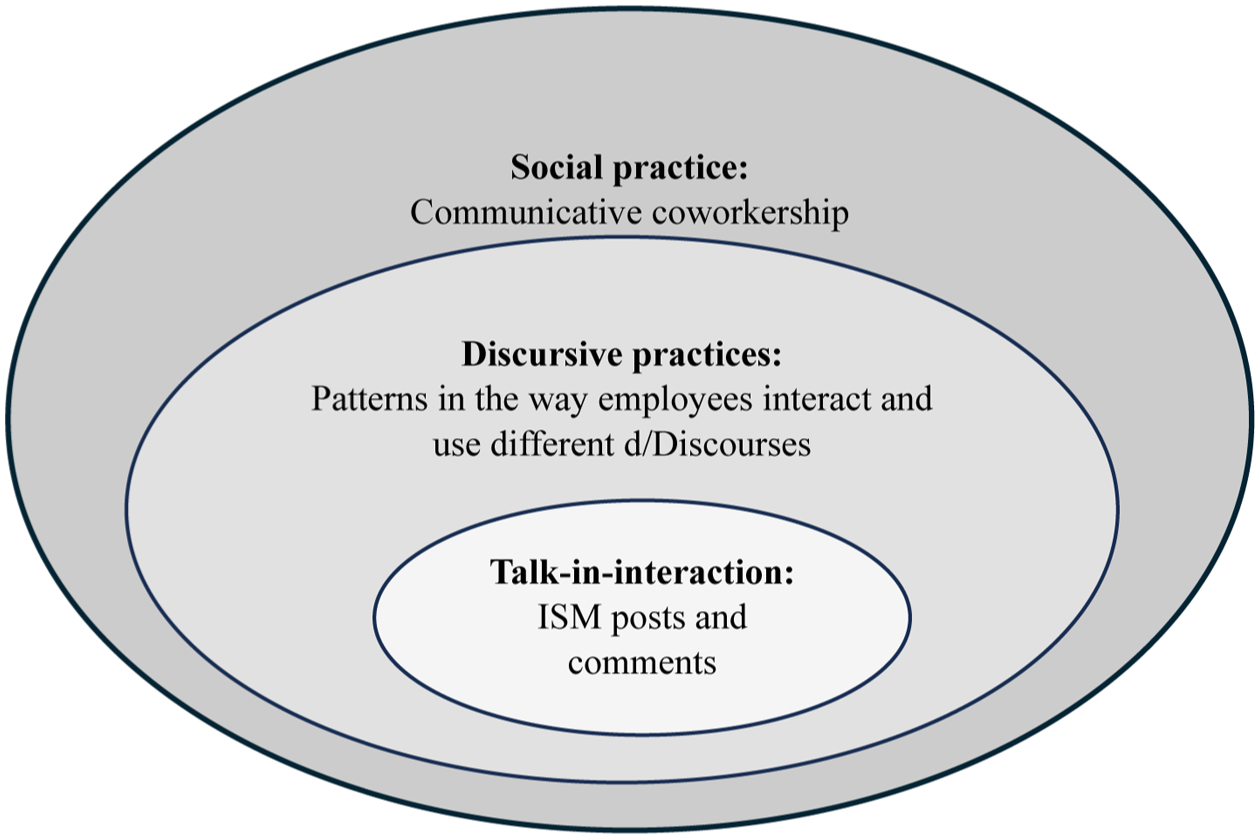
ISM posts and comments, d/Discourses and communicative coworkership mutually influence each other.
The aim is to study the construction of communicative coworkership on ISM, and how it shapes organizing. We will therefore seek to answer the following research question.
RQ: How do coworkers discursively construct communicative coworkership on ISM, and how does it shape organizing?
Methodology and Research Design
Qualitative researchers should reflect on the epistemology that has guided their research (cf. Alvesson & Sandberg, 2022), and a social constructionist approach has formed the backdrop for our research. We perceive social reality to be created in interactions between human and non-human actors (Cooren et al., 2014) and that communication is constitutive of organizations (CCO; Putnam & Nicotera, 2009). Language is thus performative (Albu & Flyverbom, 2019).
The Case Study
An exploratory single case study was conducted in a large Danish hospital with 11.000 employees to study communication on ISM before, during and after the Covid-19 pandemic, a period that also included a nurses’ strike in 2021. The hospital and the time around the Covid-19 pandemic was selected as an extreme case (Eisenhardt, 1989; Neergaard, 2007) based on an assumption that the situation would provide an opportunity to study communicative coworkership in action since the Covid-19 pandemic was characterized as a time full of uncertainty and stressful working conditions.
Since 2007, all employees at the hospital, such as nurses, doctors, communication consultants, managers, hospital porters, cleaning staff and temporary staff, had the opportunity to voice their opinion on an ISM platform called The Word is Free. The platform was open to all internally in the organization, and no employees were denied access to The Word is Free. So, at the time of the study, ISM was an established communication arena where employees regularly shared their concerns, critiques and questions thus providing an opportunity to study how coworkers communicated with each other. Employees accessed the platform through the intranet on computers or mobile devices, which made it easily accessible and simple for all staff to contribute. The employees could start posts and comments through written text, emojis and visuals such as drawings or photos, and when interacting on the The Word is Free, the employees’ names were visible on the platform.
Three factors indicated that the communication forum had an impact. First, depending on the topic, posts were viewed and revisited by thousands of employees. Second, most posts received comments from other employees. Third, support functions or managers responded to and took action to concerns raised by employees within a few days or a week.
Collecting and Analyzing the Empirical Material
First an interview was conducted with the hospital’s communication manager to get an insight into the context, internal communication at the hospital and the story behind the hospital’s ISM. Then 142 posts with 534 comments from January 2019 until March 2022 were downloaded from The Word is Free as PDF files, and in line with our social constructionist approach a discourse analysis was conducted to analyze the empirical material. Our approach to analyze discourse at the micro and the macro level is to conduct a textual analysis combined with a structured investigation of the broader discourses and the societal context (Phillips & Oswick, 2012, p. 445). In this respect the posts and comments were perceived as texts where we identified the recurrent patterns in the discursive practices employees used to formulate a post or a comment. This helped us shed light on the social practice of communicative coworkership (See Figure 1).
Discourse analysis is an umbrella term, and there is not as such one method (Castor, 2022). Most studies combines different approaches (Boivin et al., 2017), and we designed a method in four steps that helped us identify how coworkers discursively constructed communicative coworkership on ISM. First, we read all the threads several times to familiarize ourself with the empirical material and to get a first impression of the discursive practices the employees used to voice their opinion and listen to each other, and that exerted agency. Second, purposes of the threads were identified and analyzed, and characterized as problem solving, knowledge sharing or sense making. Third, we coded for (a) how posts were initiated either as a question, a proposal, a call for action, a briefing or a search for a missing item, acknowledging the importance of conversational openings (Schegloff, 1968); (b) how other coworkers listened to the post in a confirmatory, responsive or challenging manner (Madsen et al., 2023); (c) how rhetorical strategies were used in posts and comments (see Table 1), and (d) how employees drew on Discourses (see Table 2) . Finally, notes were made about observations of the dynamics and interactions in the discussions. The coding process thus involved both description and interpretation, which is a key characteristic of discourse analysis (Castor, 2022) . Both researchers coded all the material and compared codes and notes to achieve intercoder reliability (O’Connor & Joffe, 2020).
Employees’ Rhetorical Strategies on Internal Social Media.
Macro-Level Discourses Used by the Employees on Internal Social Media.
Interviews with the employees could have helped interpret the ISM discussions and confirm our analysis (Cardon et al., 2025). Unfortunately, and due to a new health crisis, that emerged during our research, we were not given permission to interview the employees. Instead, a second interview was conducted with the communication manager after reading all the posts and comments which helped provide some context and understanding even if it was from a communication department and manager perspective. Our observations and analysis of communication on ISM live up to ethical academic standards. The communication manager gave informed consent and gave the researchers access to The Word is Free, and we have followed ethical guidelines (Langer & Beckman, 2005) by anonymizing both the employees and the hospital as well as obtained ethical statements from each author’s institution.
Findings: Discursive Practices on Internal Social Media
The purpose of most of the communication on ISM appeared to be to present and solve problems, while sharing knowledge and making sense of things happening in and around the organization especially due to the context of the Covid-19 pandemic were found in several discussions. Digging a bit deeper the discussions revealed patterns in the way employees voiced their concerns or questions, the way the employees listened to and responded to each other, and how they wove different rhetorical strategies and Discourses into their communication to strengthen their argumentation. It provided an insight into how communicative coworkership was enacted, which will be described more in detail in the following sections.
Micro-Level Discourses: Initiation of Posts
The employees formulated a first post in five different ways. It could be expressed as a question, a proposal, a call for action, a briefing or a search for a missing item. They especially used questions formulated as puzzlements with undertones of frustrations and/or humor. It seemed like a norm had developed around how to formulate a first post where the intension was to encourage and open for dialog by using especially questions, proposals and puzzlement. In this way, they might try not to offend someone in line with the uncertainty strategies found by Gode (2019), but at the same time they pinpointed short-comings, challenges and paradoxes that needed to be addressed. Sometimes the author of a first post might even address the audience by writing “dear all,” “dear colleagues” or “hi.” In this respect, they displayed an awareness of addressing a community. Direct calls to action also occurred, but these posts came across as less sensitive and less diplomatic, emphasizing why the norm of using questions, proposals, and puzzlement had developed. The communication on ISM was thus not only a matter of highlighting concerns but also a matter of nurturing relationships with colleagues, support staff and managers.
Micro-Level Discourses: Listening
The employees listened to each other in three different ways, namely in a confirmatory, responsive or challenging manner (Madsen et al., 2023). Most of the listening occurred as confirmatory listening acknowledging that the raised problems or concerns existed, and that they were not the only ones dealing with the problems or concerns raised, as expressed in: “How nice it is, that finally someone writes about this huge problem [. . .]” (Entrance/exit from [Parking X, 01.12.2021). Approximately one third of the listening consisted of responses to the presented concerns or problems. These responses could be from other colleagues or support functions that helped to solve the problem: “As healthcare employee, you can make an appointment for blood sampling on behalf of the patients at [. . .]” (Appointment for blood sampling, 01.06.2021). Finally, listening also occurred in a challenging way in one out of five. Challenging listening occurred as not agreeing with what was articulated in the first post or in the comments, and this could be either in relation to a colleague’s post or an answer from the support functions. As an example, a coworker did not agree with a posted critique of a Danish optician chain in relation to a discussion about the hospital’s partners: “[The Danish optician chain] is not in tax haven. If you investigated at bit, you would know that no companies pay taxes of an operating deficit [. . .]” (Screen glasses, 18.05.2020). The analysis demonstrated that communicative coworkership was enacted not only by voicing their opinion, but also by taking responsibility for the communication and relations among coworkers by listening to each other.
Micro-Level Discourses: Rhetorical Strategies
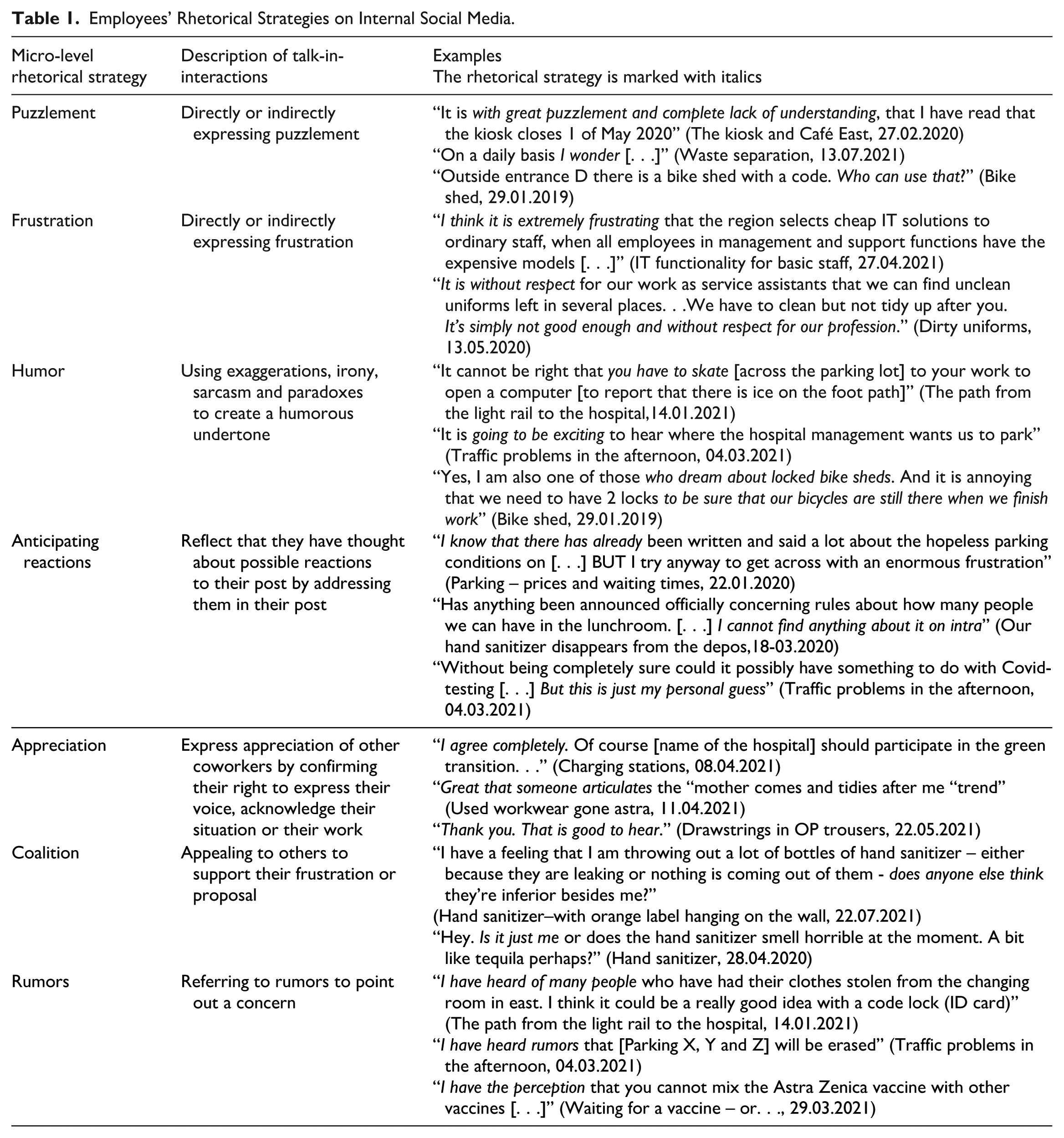
The employees used seven rhetorical strategies in their talk-in-interactions to frame and phrase their posts and comments (see Table 1). First, puzzlement was often used to raise a concern or ask a question. The puzzlement could be directly expressed as “with great puzzlement,” “I wonder” or more implicitly “Does anyone know where the sign is with?”. It was in other words a recurring rhetorical strategy. Second, the employees often expressed frustration. Either directly by stating it: “We have with puzzlement and frustration learned that . . .” (The kiosk at entrance G closes in May, Why?, 17.02.2020) or indirectly: “Do you really accept that rashes occur among employees, and what do you wash the trousers with, since they cause a rash?” (Rashes after use of new uniforms, 25.01.2021). Third, the employees used exaggeration, irony, sarcasm and paradoxes to point out absurdities or lack of meaning. It all contributed to a humorous undertone as in: “I am neither very tall or weigh very much, so I am drowning in the new uniforms (followed by frustrated smileys)” (OP upper part, 13.01.2021).
Fourth, in some of the posts it was apparent that the employees had thought about possible reactions or comments from their colleagues as they addressed them in their communication for example by writing: “And no, it is not everyone that can bike or take a bus/light rail to or from [name of the hospital]” (Entry/exit from [Parking X], 01.12.2021). Furthermore, they might indicate that they already checked the intranet where they could not find the information or had asked someone who should have the knowledge. Fifth, the use of appreciation was an indication that the employees were aware of being part of a community that they had to nurture. It was expressed in at least three different ways. First, the employees supported each other by agreeing that their concern or frustration was legitimate. “You are completely right. It is not your job to remove it [. . .].” (Dirty uniforms, 13.05.2020). Second, they supported a description of a situation. In line with: “Absolutely totally agree–it is a great time waster” [A comment to a frustration about a malfunctioning it-system], (Main manager, 05.05.2021). Thirdly, they could also appreciate an answer from someone or that an effort had been done to solve an issue.
Sixth, the rhetorical strategy of appreciation was related to the coalition strategy in terms of being aware of the hospital community, when an employee appealed to the community to support a viewpoint or a description of a situation in line with: “Hey. Is it just me or does the hand sanitizer smell horrible at the moment [. . .]?” (Hand sanitizer, 29.04.2020). Finally, the employees would raise their concerns by referring to rumors implying that the Covid-19 period was a time with a lot of contradicting information but also that rumors generally circulate around workplaces, and that employees can have a need to verify or falsify them.
The rhetorical strategies demonstrated that the employees had developed discursive practices that interacted with the agency of ISM and demonstrated an awareness of addressing all organizational members. They acted as responsible communicators, when they raised concerns about issues in the workplace and nurtured relationships with their coworkers.
Macro-Level Discourses
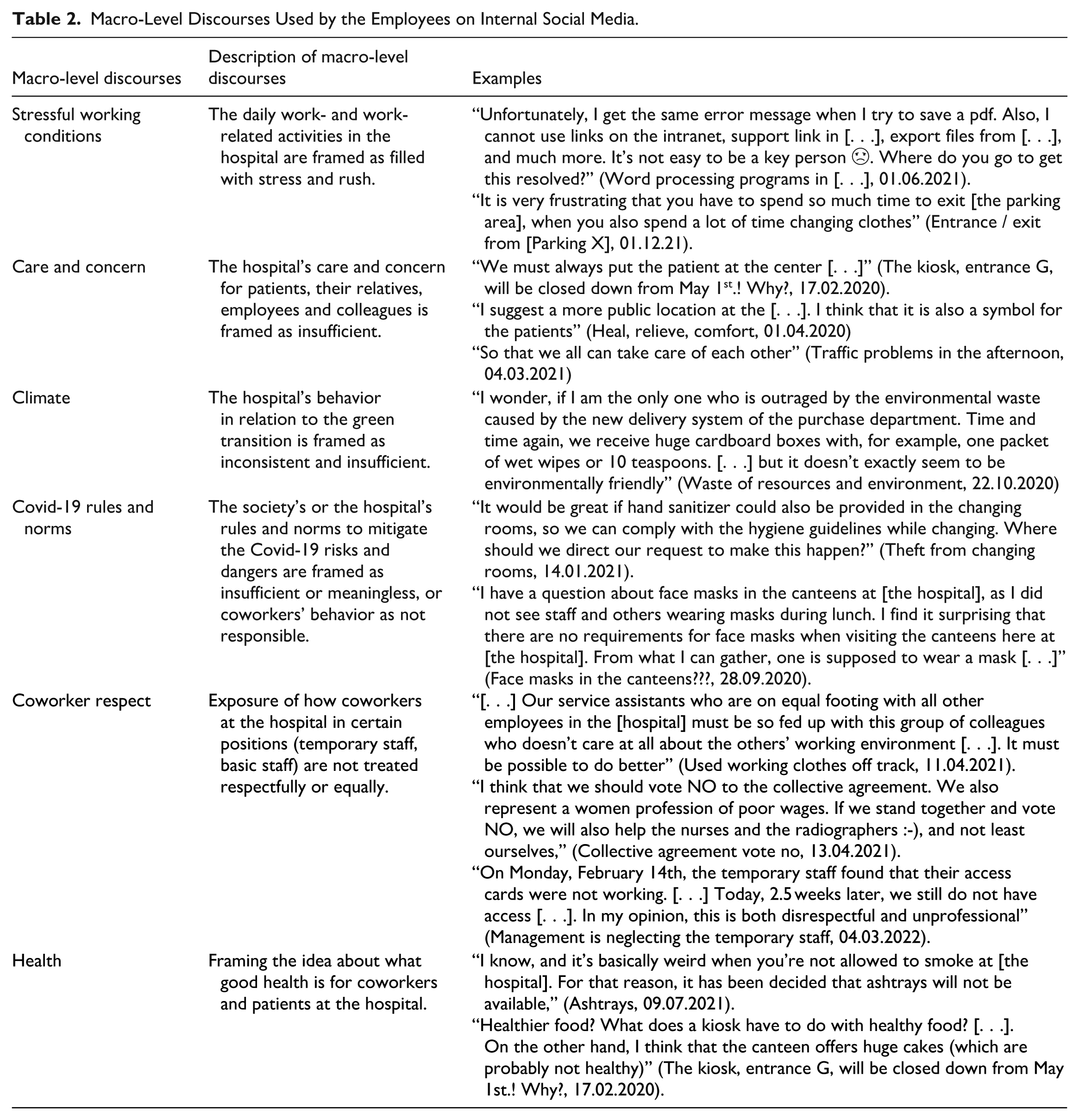
The findings showed how the micro-level discourses were tied to macro-level Discourses as broader persistent systems of thought, ideas or values, often situated in the historical context of crisis due to the Covid-19 pandemic, the nurses’ strike, and staff shortage, but also related to societal and democratic values of the Danish society. Six Discourses were identified, and these Discourses were intertwined in various, but not all communication threads. Discourses of stressful working conditions, care and concern, climate, and Covid-19 rules and norms were the dominant Discourses represented in more than two thirds of the communication threads in which Discourses emerged and were identified.
A stressful working conditions Discourse was identified and related to how difficult it was to work under extreme pressure at the hospital due to the ongoing Covid-19 pandemic, the nurses strike and staff shortage. This was demonstrated when an employee constructed herself as a key person (“it’s not easy to be a key person”) to voice her frustrations about the hospital’s word processing programs and other digital solutions: “Also, I cannot use links on the intranet, support link in [. . .], export files from [. . .], and much more” (Word processing programs in [. . .], 01.06.2021). In another post, an employee uttered her frustrations about spending “so much time” to exit the parking area and discursively related it to her frustrations about also spending “a lot of time changing clothes” (Entry/exit from [Parking X], 01.12.2021). These rhetorical strategies of frustration are bridged to the historical and societal context of the critical healthcare situation in Denmark where lack of hospital staff, the nurses’ strike and the Covid-19 pandemic put extra pressure on the healthcare system. When issues not directly connected to the core tasks of a hospital, such as parking, changing clothes, and IT do not function well, it seemed to be the last straw under such stressful working conditions. Consequently, the stressful working condition Discourse offered the employees discursive resources to legitimate their frustrations and create support among their colleagues to construct an organizational reality of a hospital under severe strain and in lack of resources.
A care and concern Discourse emerged when employees articulated a concern for their own, coworkers’, patients’ and their relatives’ wellbeing. In one of the many posts and comments about the parking conditions at the hospital, an employee voiced her “huge frustrations on behalf of patients and relatives” who due to the parking problems arrived too late to their appointments. A cancer patient’s mother had often paid “300-350 DDK for the parking during the 5-6 days the patient is hospitalized. [. . .]. Can’t we really do better?” (Parking – prices and waiting time, 22.01.2020). This employee constructed the hospital’s care for the patients and their relatives as inferior and criticizable. The rhetorical strategy of frustration was entangled with a Discourse in Denmark of patients’ fundamental rights to be treated well and with integrity (c.f. the Danish Health Act), and the care and concern Discourse provided the coworker with a repertoire of arguments, so that the hospital’s parking challenges became an issue of the hospital not taking enough care of patients and their relatives.
A climate Discourse in favor of the green transition was used by employees when they experienced inconsistencies and paradoxes in the organization’s behavior in relation to the green transition. In the thread “Charging stations” (08.04.2021), an employee reflected on the hospital’s strive for the green transition: “[. . .] the Region wants the green transition and sustainability [. . .]. During 2020, one out of six newly purchased cars was an electric car. Nevertheless, the largest workplace [the hospital] only has two parking lots for electric cars – and none of them at the parking lots for employees.” As he juxtaposes on the one hand the region’s wish for a greener world, the rise in the number of electric cars, and the hospital as the largest workplace in the city with, on the other hand, the two parking lots for electric cars, he constructed the behavior of the hospital as inferior, paradoxical and inconsistent with the Region’s green goals. This rhetorical strategy of pointing out paradoxes and absurdities in the hospital’s behavior is tied to the macro-Discourse in a societal Danish context in favor of the green transition, and which gave legitimacy to the coworkers’ argumentation and viewpoint of installing more parking lots for electric cars at the hospital.
A Covid-19 rules and norms Discourse was drawn upon when the employees constructed the Covid-19 pandemic as a threat, such as “during this difficult time, when the facility is not itself, and we all face challenges” (Guards at entrances, 31.03.2020). These rhetorical strategies of acknowledging the difficult times were interwoven with broader societal Discourses about pandemics and their mortality risks. Within this discursive frame, rules and norms could help mitigate the Covid-19 risks as expressed through an employee’s fears about the risk of exceeding the vaccination interval: “I “must” have injection no. 2 no later than in week 20” (Interval between first and second dose of the AstraZenica vaccine, 20.02.2021). The employees were often frustrated and framed the Covid-19 rules as insufficient or meaningless, or some coworkers’ behavior as not responsible. Also, they were often concerned about themselves, colleagues or patients not being able to comply with the organization’s guidelines. For example an employee who applied the rhetorical strategy of wondering to reveal how meaningless the Covid-19 rules were since a maximum of 10 people gathering in the canteen was a challenge for the many employees to get lunch during lunch break. This Discourse both supported arguments of Covid-19 restrictions as well as pointing out absurdities caused by the situation and other regulations.
A coworker respect Discourse was used when employees urged coworkers and management to show a more respectful behavior toward all colleagues. For instance when the temporary staff again and again were equipped with access cards that did not work, a temporary employee applied the rhetorical strategy of frustration and constructed a reality where the temporary staff was treated with no respect: “In my opinion, this is both disrespectful and unprofessional” (Management is neglecting the temporary staff, 04.03.2022). In another post, an employee found “[. . .] it extremely frustrating that the region chooses cheap IT solutions for basic staff, while all employees in management and support functions have the expensive models” (IT functionalities for basic staff, 27.04.2021). These rhetorical strategies of frustration were entangled with an egalitarian and democratic macro-Discourse of the Danish society in which people should be treated respectfully and equally no matter their roles and positions. As the coworkers drew on this Discourse, they were offered the linguistic resources to argue that the opposite happened in the hospital, and that coworkers in certain positions (temporary staff, basic staff) were not treated respectfully or equally.
A health Discourse emerged from time to time when the employees used arguments related to the perception of their own, colleagues’ or patients’ good health, such as the presence of not so healthy food in the hospital’s kiosks and the canteen, or the reasons for no ashtrays in the hospital. Within this Discourse, the hospital was presented from a health perspective through utterances and meanings such as smoking is not allowed, and cakes are not healthy. In a post, an employee asked for ashtrays to be installed next to a specific entrance due to the many cigarette butts on the staircase, and another employee from a support function used the rhetorical strategy of sarcasm, as she argued: “[. . .] it’s basically weird when you’re not allowed to smoke [. . .]. For that reason, it has been decided that ashtrays will not be available,” (Ashtrays, 09.07.2021). The rhetorical strategy of sarcasm was intertwined with the macro-level Discourse and ongoing debates in the Danish society of what the good health is based on the Danish health and lifestyle factors KRAM (acronym for diet, smoking, alcohol and physical activities), which provided the employee with specific linguistic resources to argue for her viewpoints of not having ashtrays in the hospital.
The findings revealed that the employees drew on six different Discourses to strengthen not only their arguments but also their agency when they reframed these Discourses into their own daily work. They demonstrated that they took responsibility for society, the organization, the patients, and their colleagues. The findings showed how communicative coworkership was constructed when employees’ framed their daily working life in the hospital as stressful, concerned with the wellbeing of patients and coworkers, the hospital’s green transition, the Covid-19 risks, the respect for each other, and health, and how they took communication responsibility in exposing these challenges in order to solve them or make sense of them.
Concluding Discussion
Communicative coworkership has gained relevance in organizational communication (Andersson, 2022; Andersson et al., 2021) as organizations increasingly have to navigate in uncertain and complex organizational and societal contexts (Falkheimer et al., 2025). The employees in the hospital demonstrate that they are responsible communicators on ISM during a time of crisis. They point out contradictions, tensions and problems, and they take responsibility for the organization, their colleagues, and managers, a responsibility that is inherent in communicative coworkership (Andersson, 2022), which we will argue at the same time becomes a matter of taking responsibility for society. Thus, pinpointing that communicative coworkership plays a decisive role in organizing and in society.
For employees, communicative coworkership fosters a sense of agency, that is developed and given greater significance through the agency of ISM that facilitates and influences communication among employees (Saludadez, 2022). Through questions, proposals, calls for action and rhetorical strategies such as puzzlement, humor and coalition-building, and by listening to each other, employees pointed out contradictions, tensions and problems, and due to coworkers agency and the ISM agency it becomes hard for the organizations to ignore their concerns if they argue well for them or other organizational members support them (Madsen & Johansen, 2019). This reveals a distributed and collective agency (Cooren, 2010; Cooren et al., 2014).
For managers, communicative coworkership provides a vital force in post bureaucratic organization, making self-managing organizations realistic. Consequently, the question becomes how to foster and cater for communicative coworkership, and the answers could be found in communicative leadership (Hamrin et al., 2016; Johansson et al., 2014) and organizational listening (Lewis, 2019; Macnamara, 2016, 2023).
At the organizational level, communicative coworkership supports knowledge sharing, problem solving and development of shared sensemaking. So overall, communicative coworkership is not merely a supportive function in organizations. It is a strategic resource that is fundamental to organizational communication and organizing.
For society, communicative coworkership nurture employee agency and through the use of Discourses, it brings societal concerns, issues and values into the organization that employees seek to make sense of in relation to their daily work practices. It might also spark off engagement in society and develop employees’ agency in their roles of democratic citizens.
Theoretical Implications
The study of coworkers’ discursive practices on ISM in a hospital in a crisis situation provide nuanced insights into how communicative coworkership is discursively constructed on ISM. Employees present and solve problems, share knowledge and make sense of things happening in and around the organization. The agency of ISM provided opportunities for employees to develop discursive practices with a little “d” that were entangled with discourses with a big “D” not only to strengthen their arguments, but also their agency. This illustrates how the micro- and the macro levels are interwoven, and that they constitute and reinforce each other (Kuhn & Putnam, 2015). This combination of d/Discourse can be considered to have “communicative purpose” (Ellis, 1992, p. 84, cited in Jian et al., 2008) through which the employees pursue their “ideas, interests or ideologies” (Coreen et al., 2014, p. 4). As the coworkers enact communicative coworkership on the Word is Free, they take communication responsibility (Andersson, 2019a) which is realized in their purposefulness and hope to change organizational reality. Drawing on the CCO perspective, we understand these discursive practices not as reflections of pre-existing structures, but as constitutive of organizational realities (Schoeneborn et al., 2019). We will therefore argue that the constitution of communicative coworkership have consequences for organizing, the construction of organizational reality and perhaps even for society.
The study also demonstrates the agency of digital media (Saludadez, 2022), in this case ISM. ISM is not a neutral communication platform, it exerts agency. It offers opportunities for communication and therefore action, and in this way it becomes an agent in the organization, and its agency and potential is known and experienced by employees (and managers). Furthermore, the platform develops the discursive practices of the employees. They learn from previous conversations, and through our analysis it became apparent that patterns had developed in the way the employees voiced their opinions and listened to each other. In other words, ISM influenced and shaped the dialogs of the employees and thus exerted agency.
The study demonstrated that when coworkers engaged in dialogs on internal social media, they acted as competent and supportive coworkers in relation to other coworkers, showing that communicative coworkership distributed agency among the coworkers communicating on the Word is Free in a similar way as communicative leadership distributes agency between leaders and coworkers (Hamrin et al., 2016). At the hospital the context was the Covid-19 pandemic, a stressful and intensive crisis time, and the crisis situation was likely to intensify the agency of communicative coworkership as the situation demanded it. The connection between the talk-in-interaction, the discursive practices and the social practice of communicative coworkership on ISM appears in at least two ways. First, the employees formulate their first posts in a way so that they nurture their relations with other coworkers through their discursive practices. They used questions, proposals and puzzlement to encourage and open for dialog in line with the uncertainty strategies found by Gode (2019), and they expressed themselves in a way, so that they showed concern and consideration for other coworkers even when being critical toward the organization. Second, the ISM agency of facilitating and influencing communication and dialogs among all organizational members made the coworker dialogs on the Word is Free hard to ignore for support functions and managers, especially if frustrations and proposals were supported by other coworkers (Madsen & Johansen, 2019). In this way, the talk-in-interaction become influential to organizing regardless of whether things are changed or not. Talking an issue into existence is enough to make a difference in an organization. This connects to Garner’s (2013) idea of dissent as not a single event but related to former and future dissent events. A seed has been planted for other possible organizational realities.
The findings of the study suggest that communicative coworkership extends the understanding of organizational agency. Rather than viewing agency as residing within formal leaders or managerial structures, our empirical material illustrates how coworkers actively participate in shaping organizational discourse, norms, and decisions through everyday discursive practices. This aligns with the CCO perspective, which conceptualizes agency not as a fixed attribute of individuals or roles, but as an emergent property of communicative interaction (Schoeneborn et al., 2019). ISM therefore serves as a communication arena where agency is distributed and negotiated, allowing coworkers to speak not only for themselves but also on behalf of colleagues, patients, patients’ relatives, and even the organization as a whole. While exerting agency, coworkers drew on and reframed societal Discourses into their daily work at the hospital which contributed to shaping organizational reality at the hospital.
Furthermore, the study extends the understanding of communicative coworkership to not only being a matter of enacting “various communication roles” (Andersson, 2022, p. 463) but also to include listening roles, such as confirmatory, responsive or challenging listening. Consequently, listening is particularly important if communicative coworkership should succeed. Thus, building on the definition by Andersson (2022) communicative coworkership ought to be defined as an abstraction of the various communication and listening roles performed by a coworker in interactions with managers, colleagues, and external stakeholders and that has important implications for organizing, and in extension for the performance of the organization as a whole.
Practical Implication
Organizations and leaders should cultivate and develop communication arenas and situations where communicative coworkership can thrive. A promising approach is to introduce ISM, if it is not already part of the internal communication mix. ISM exerts agency, and it can connect employees across organizational divides and geographies and provide an accessible communication opportunity. An important next step involves leaders actively and consistently signaling that employee voice is genuinely valued. Not only on ISM but also in other organizational communication arenas. This could be facilitated through leadership training focused on developing communicative leadership, recognizing communicative coworkership and communicative leadership as complementary social practices (Hamrin et al., 2016).
Managers, who cultivate and make room for communicative coworkership, might benefit from enhanced trust, reduced resistance to change and create more resilient organizations (Madsen & Johansen, 2019). It shifts organizational communication from being one-way communication to a more distributed dialog, where leadership is co-constructed (Johansson et al., 2014). Furthermore, communicative coworkership has the capacity to develop agility, innovation and cohesion (Gode, 2019; Madsen, 2016), and organizations that cultivate communicative coworkership are likely to be better equipped to adapt to change, manage complexity and enhance employee identification with the organization.
Limitations
The study was conducted in a Danish hospital, and the concept of communicative coworkership is based on certain societal values and ways of leading organizations, which are typical in a Scandinavian context (e.g., Heide & Simonsson, 2011). In this respect, the dialogs on ISM might be an outcome of what could be called a Scandinavian work environment characterized by flat hierarchies and open communication environment. Furthermore, the Discourses that the employees draw on are tied to a Danish societal context, and they are likely to be different in other countries. However, there is a big chance that the entanglement between discourse and Discourse in discursive practices will still be the case in other countries. The discourses/Discourses might just be different. Future research will have to explore how communicative coworkership is discursively constructed in other countries and in other cultural work environments to find similarities and differences from one cultural context to another, since the adoption of ISM increasingly enters global organizations. Furthermore, future research might also explore how communicative coworkership can be intentionally supported through communicative practices and structures in different cultural context.
Footnotes
Acknowledgements
We thank Mona Agerholm Andersen for valuable feedback on early draft of the manuscript.

Ethical Considerations
The research complied with all requirements at each authors’ institution, and in May 2022 the communication manager at the hospital gave the researcher access to posts and comments on internal social media on the grounds that we anonymized employees and the hospital in publications.
Funding
The authors received no financial support for the research, authorship, and/or publication of this article.
Declaration of Conflicting Interests
The authors declared no potential conflicts of interest with respect to the research, authorship, and/or publication of this article.
Data Availability Statement
We have consented to keep the employees anonymous, and therefore, we cannot provide other researchers access to the empirical material.