






Abstract
Anonymous employee platforms such as Blind and Glassdoor have transformed workplace communication dynamics, enabling employees to voice grievances without fear of retaliation. This study examines how anonymous employee dissent about workplace bullying influences public perceptions of corporate responsibility attribution, reputation, and word-of-mouth intentions. Using survey data from 400 employed Korean adults exposed to anonymous employee dissent narratives on Blind, we examine the effect of narrative transportation and the mediating roles of perceived similarity and personal relevance. Findings reveal that narrative transportation into employee dissent prompts audiences to attribute greater responsibility to companies, leading to reputational damage and negative WOM intentions. This effect is mediated by higher perceived similarity with the dissenting employee and higher personal relevance of the bullying issue. By integrating narrative transportation and defensive attribution theories, this study highlights reputational risks companies face when anonymous dissent narratives resonate with audiences, transforming internal issues into public concerns.
Keywords
Introduction
Workplace issues have traditionally circulated only within organizational boundaries, with employees hesitant to voice concerns publicly due to fear of repercussions (Kim & Lee, 2026). However, the emergence of anonymous workplace platforms such as Glassdoor and Blind has fundamentally altered this dynamic. These platforms enable employees to share workplace experiences publicly while maintaining anonymity. Blind, in particular, is an online platform where verified employees from different companies can engage in anonymous discussions (Yarbrough & Ramos Salazar, 2023). In South Korea, over 80% of Korean employees actively use Blind, with approximately 56% classified as heavy users (Cho, 2023). Through this platform, negative workplace issues such as bullying, sexual harassment, and power struggles have been actively shared across companies and even brought to the public’s attention (Kim & Lee, 2026).
Among the various workplace issues shared on these platforms, workplace bullying has emerged as a particularly serious concern. This is especially evident in South Korea, where the number of reported workplace bullying cases reached 12,253 in 2024 — the highest since the Anti-Workplace Bullying Act took effect in 2019 — representing a nearly sixfold increase (Korean Ministry of Employment and Labor, 2024). Research has underscored the importance of establishing strong internal relationships with employees and fostering transparent, symmetrical communication, allowing grievances to be resolved within the organization (Kim, 2018; Lee, 2017). However, employees frequently find it challenging to openly discuss negative experiences with supervisors or human resource teams, fearing potential repercussions (Lee & Kim, 2020; Thompson et al., 2020). The hierarchical organizational culture in Korea, characterized by high power distance (Hofstede, 2001), further discourages employees from voicing concerns through internal channels. In this situation, anonymous communication platforms have enabled employees to bypass these internal channels, making sensitive workplace issues immediately visible to the public and creating new challenges for corporate reputation management (Lee & Kim, 2020).
Employee disclosures on anonymous platforms are often perceived as highly credible, stemming from their “witness” perspective (van Zoonen & van der Meer, 2015). Additionally, employees frequently craft their dissent stories in vivid and compelling ways to engage a broader audience and seek emotional support (Kim & Scott, 2019). Through the use of screenshots, audio files, and engaging narratives, employees create immersive experiences that resonate with audiences, making them feel as if they are experiencing the situations firsthand. Although these vivid narratives can significantly shape public perceptions (Green & Brock, 2000), existing research in corporate communication has primarily focused on the organizational consequences of employee dissent (e.g., Dube & Zhu, 2021) or the motivations behind it (e.g., Ninova-Solovykh, 2023). The psychological mechanisms through which narrative characteristics of employee dissent shape public perceptions remain largely unexplored. In particular, it remains unclear how the immersive and emotionally engaging nature of employee dissent narratives influences audiences’ attribution of corporate responsibility and subsequent reputational outcomes. This study addresses this gap by examining how vivid storytelling, a defining feature of employee dissent on anonymous platforms, shapes public perceptions and attitudes toward companies.
To understand this phenomenon, we draw on narrative transportation theory (Green & Brock, 2000) and defensive attribution theory (Shaver, 1970). Narrative transportation refers to the immersive experience individuals undergo when exposed to narratives, which can significantly shape their beliefs and attitudes (Thomas & Grigsby, 2024). This engagement increases perceived similarity with the characters (Chen et al., 2024) and personal relevance of the issues (de Graaf, 2023), often resonating with the audience’s own experiences. In the context of employee dissent, when audiences become absorbed in a dissenting employee’s story, they are more likely to empathize with the employee’s perspective and adopt their interpretation of the situation.
While a company may not bear direct responsibility for specific instances of workplace bullying, such emotional and cognitive immersion can trigger defensive attribution among audiences (Shaver, 1970). According to defensive attribution theory, this effect is particularly pronounced when individuals perceive the situation as personally relevant (Zhou & Ki, 2018) or feel similar to the victim (Chung et al., 2023; Ul Haque et al., 2023), which are conditions that narrative transportation naturally activates. People tend to assign greater responsibility beyond the direct perpetrator as a psychological defense, ultimately placing significant responsibility on the company (Coombs, 2007). In this sense, perceived similarity and personal relevance serve as the psychological bridge linking the two theories — narrative transportation activates these conditions through immersion in employee dissent stories, which in turn trigger defensive attribution processes leading audiences to hold organizations accountable.
Building on these theoretical foundations, the present study examines how narrative transportation influences corporate responsibility attribution and its subsequent effects on reputational damage and negative word-of-mouth(WOM) intentions. Specifically, we investigate the direct effect of narrative transportation on responsibility attribution as well as indirect effects mediated through two key mechanisms identified in defensive attribution theory: (a) higher perceived similarity with the dissenting employee and (b) higher personal relevance of the workplace bullying issue. We further examine how heightened corporate responsibility attribution translates into reputational damage and negative WOM intentions.
Theoretically, while SCCT has been the dominant framework for explaining how corporate responsibility attribution leads to reputational damage, it primarily applies to situations where organizational wrongdoing is clear and direct. However, in today’s media environment where employee narratives circulate widely on anonymous platforms such as Blind and LinkedIn, companies increasingly face reputational threats even when their direct wrongdoing is limited. By integrating narrative transportation theory with defensive attribution theory, this study offers a theoretical framework to address this gap, demonstrating that cognitive and emotional immersion in employee dissent narratives bypasses rational judgment and activates defensive attribution processes, leading audiences to attribute greater responsibility to organizations than their actual wrongdoing warrants. Practically, our findings underscore the need to address employee concerns through transparent internal communication before they escalate to external platforms, as anonymous dissent narratives are difficult to control once public.
Literature Review
Employee Dissent on Anonymous Online Platforms
Due to its potential impact on organizations, employee dissent externalized through anonymous online platforms can pose challenges for companies (Kang, 2025; Ravazzani & Mazzei, 2018). Recently, employees have increasingly turned to platforms such as Glassdoor and Blind to voice their grievances anonymously. These platforms are online communities specifically designed for organizational employees to share their information, thoughts, and experiences, which can harm corporate reputations. Anonymity acts as a safeguard, protecting employees from uncomfortable confrontations or negative consequences and allowing them to express candid opinions without fear of retaliation (Scott & Rains, 2005). Consequently, employees may feel less vulnerable and more inclined to engage in active communication (Johansson & Carey, 2016).
Given this dynamic, recent research has examined how employee communications on these platforms influence organizational outcomes, demonstrating significant effects on organizational behaviors and reputation. For example, Dube and Zhu (2021) found that firms respond to negative employee reviews by improving workplace practices, while Soens and Claeys (2023) and Kim and Lee (2021) demonstrated that employee posts substantially affect corporate reputation and consumers’ behavioral intentions toward organizations.
Given the substantial impact of such employee communications, understanding the underlying motivations for employee dissent is critical. Research has explored these motivations, categorizing them into (a) venting negative feelings, (b) warning others, and (c) seeking support. First, studies have argued that employees may utilize anonymous social media to vent their frustration, anger, or dissatisfaction to other users when facing negative organizational issues (Krishna & Kim, 2015). This venting behavior is an emotion-focused strategy through which individuals alleviate negative emotions by sharing them with others (Zeng et al., 2022).
Second, employees utilize anonymous social media for altruistic purposes, such as warning other users to help them avoid similar negative situations (Ravazzani & Mazzei, 2018). Employees voluntarily disclose their organization’s unethical activities to inform others (Bhal & Dadhich, 2011), or to help them make better decisions about the organization (Lee & Kim, 2020).
Finally, employees share their negative workplace experiences to seek emotional support or guidance from individuals who had experienced similar situations (Lee & Kim, 2020). For instance, Kim and Scott (2019) argued that lower-status employees, in particular, are more likely to seek support from others on anonymous social media because they have difficulty accessing social and instrumental resources compared to individuals with established status, both in terms of job rank and organizational tenure. Seeking support in this manner provides employees a feeling of empowerment and solidarity within a large audience (Stohl et al., 2017).
Across these motivations, engaging a broad audience is essential for achieving desired outcomes. To accomplish this, employees employ various narrative techniques to enhance their stories and capture attention. They share firsthand experiences, offering emotional depth by quoting instances of verbal abuse, such as being referred to as “useless garbage.” Additionally, they share their experiences of undergoing mental health therapy or suffering from insomnia as a result of the bullying. Sometimes, events are described in a chronological format to heighten authenticity; additionally, employees may exaggerate or dramatically express their feelings of anger and sadness or they may attach audio files or message screenshots, when necessary. In sum, employees craft their stories with vivid and compelling narratives to capture the attention and sympathy of a large audience.
Theoretical Framework
This study integrates two theoretical frameworks — narrative transportation theory and defensive attribution theory — to explain how anonymous employee dissent narratives influence public perceptions of corporate responsibility and reputation.
Narrative transportation theory (Green & Brock, 2000) explains how audience immersion in narratives influences real-world beliefs and attitudes. Transportation refers to a mental state where audiences become absorbed in the story, distancing them from their real-world experiences and immersing them in the narrative world. Through this immersion, audiences vicariously experience the emotions and thoughts of characters, making them less likely to counterargue and more likely to adopt beliefs consistent with the story’s message (Green et al., 2004; Slater & Rouner, 2002). The persuasive power of narrative transportation stems from two mechanisms. First, transportation reduces resistance to the message by enhancing emotional involvement over cognitive processing (Dal Cin et al., 2004; Slater & Rouner, 2002). Second, deep immersion blurs the boundary between audience and narrative, making people feel personally connected to the story and aligned with the protagonist. In an employee communication context, Kang (2021) applied narrative transportation theory, finding that transportation into employee testimonials increased perceptions of organizational hypocrisy and reputational damage — suggesting that narrative immersion can persuade audiences to adopt the employee’s perspective and form negative evaluations of the organization.
Defensive attribution theory (Shaver, 1970) explains that people attribute causes to events in ways that protect themselves and their security. When people perceive a situation as highly relevant to them or feel similar to a victim, they tend to attribute greater responsibility to broader entities as a psychological defense mechanism. This effect is particularly pronounced in situations where the direct perpetrator is unidentified, making broader entities such as organizations more salient targets for blame. Empirical studies have confirmed this mechanism across various contexts, demonstrating that perceived similarity and personal relevance trigger defensive attribution toward broader entities such as organizations (Chung et al., 2023; Zhang & Lim, 2024; Zhou & Ki, 2018). For example, Chung et al. (2023) demonstrated that individuals who perceived themselves as similar to COVID-19 victims were more likely to attribute responsibility to external entities rather than blaming the victims themselves, confirming that higher perceived similarity activates defensive attribution toward broader entities as a psychological self-protection mechanism.
Together, these two theories explain the proposed research model. Narrative transportation into employee dissent stories activates two key psychological conditions identified in defensive attribution theory — perceived similarity with the dissenting employee and personal relevance of the issue. These conditions, in turn, trigger defensive attribution processes, leading audiences to attribute greater corporate responsibility than the organization’s actual wrongdoing warrants, ultimately resulting in reputational damage and negative WOM intentions.
Narrative Transportation and Corporate Responsibility Attribution in Anonymous Employee Dissent
Narratives are stories depicting characters encountering specific events and playing roles in relation to one another (Green & Brock, 2000). They can come in various forms, such as personal stories, exemplars, testimonials, and anecdotes (Bilandzic & Busselle, 2013). Through these narratives, audiences become both emotionally and cognitively engaged, which allow them to experience the event rather than simply being informed about it. This cognitive and emotional involvement is defined as narrative transportation (Green & Brock, 2000).
Empirical research on narrative transportation has primarily been conducted in health communication (e.g., Kim et al., 2025), social issues (e.g., Riggs & Knobloch-Westerwick, 2024), and marketing (e.g., Hamby & Jones, 2022), generally demonstrating persuasive effects on attitudes and behavioral intentions (Oschatz & Marker, 2020; Shen et al., 2015). However, in employee communication contexts, these persuasive effects can be detrimental to organizations. For example, Kang (2021) examined employees’ video testimonials about toxic workplace allegations and found that narrative transportation into these firsthand accounts increased perceptions of organizational hypocrisy, ultimately damaging organizational reputation. This suggests that while narrative transportation generally facilitates persuasion, its effects in employee dissent contexts can pose significant reputational threats to companies.
In particular, when audiences become transported into anonymous employee dissent stories, they may extend responsibility attribution beyond individual perpetrators to the organization itself (Heley et al., 2020). This broader corporate attribution occurs because the identities of individual perpetrators in anonymous employee dissent often remain undisclosed, making the identified organization an easier target for blame (Small & Loewenstein, 2005). Dissenting employees may not explicitly attribute workplace bullying to corporate culture or leadership, particularly when incidents involve interactions among lower or mid-ranked employees. Nevertheless, the affiliated organizations, publicly labeled in anonymous posts, become salient targets for audience attribution.
The identifiability of the targets of blame (i.e., perpetrators) appears crucial in attributing responsibility to them (Small & Loewenstein, 2005). In their experimental research, Small and Loewenstein (2005) argued that people tend to hold more punitive opinions toward identified perpetrators compared to equivalent unidentified ones. Furthermore, they explained that affective reactions, whether positive or negative, are generally stronger toward an identified target than an unidentified one. People may readily attribute responsibility to an identifiable company compared to an unidentified perpetrator because punitive opinions can be formed based on the attribution of responsibility (Jeong et al., 2018).
Furthermore, research on the association between narrative messages and responsibility attribution suggests that narratives typically lead to assigning responsibility to greater entities rather than to individual perpetrators (e.g., Heley et al., 2020; Niederdeppe et al., 2011, 2014), and can shape perceptions of injustice and attributions of blame toward broader social entities (Freel & Bilali, 2022). For example, Heley et al. (2020) found that narratives addressing prescription opioid addiction increased attributions of responsibility toward larger entities like pharmaceutical companies, rather than toward addicted individuals only. Similarly, Niederdeppe et al. (2011) indicated that narratives about an individual experiencing obesity can shift the attribution of responsibility toward government policy rather than blaming the character suffering from the disease, encouraging the pursuit of policy solutions to support the character in the narrative. In the present study, when audiences immerse themselves in employees’ bullying narratives, they are likely to adopt the employee’s perspective and seek accountability. In such cases, the identified organization becomes a more salient target for blame than the unidentified individual perpetrators. Therefore, we propose the following hypothesis.
Reputational Damage and WOM Intention
Higher attribution to the company can be associated with corporate reputational damage and negative behavioral intentions. While the present study does not examine a formal organizational crisis as traditionally defined (see Coombs, 2007), anonymous employee dissent about workplace bullying can generate significant reputational threats similar to those observed in paracrisis situations — publicly visible organizational challenges that fall below the crisis threshold yet still threaten reputation (Chen et al., 2022).
The Situational Crisis Communication Theory (SCCT) framework, dominant in crisis communication research, posits that the public seeks to determine responsibility when negative events occur, and this attribution influences corporate reputation evaluation (Coombs, 2007). Although SCCT was developed primarily for formal crisis situations, its core mechanism of linking corporate responsibility attribution to reputational outcomes is applicable to contexts where organizational issues become publicly visible through employee narratives (Chen et al., 2022). Therefore, the greater the corporate responsibility attribution in employees’ anonymous online dissent, the more the damage to their reputation (Fannes & Claeys, 2023; Vigolo et al., 2025).
Furthermore, multiple empirical studies confirm that a positive relationship exists between corporate responsibility attribution and negative WOM intention (e.g., Jeuring & Haartsen, 2017; Tan et al., 2024; Zhang et al., 2025). For example, Zhang et al. (2025) demonstrated that responsibility-oriented perceptions in crisis situations directly influence consumers’ tendency to share negative feedback, confirming the positive relationship between corporate responsibility attribution and negative WOM intentions. Negative WOM intention refers to an individual’s likelihood to share unfavorable or critical information about a company (Coombs & Holladay, 2007). When people attribute more responsibility to the company, they may tend to share their negative opinions with friends, family, colleagues, or even a broader audience through social media. Therefore, we propose the following hypotheses.
The Mediating Role of Perceived Similarity and Personal Relevance
When individuals experience transportation and engage with a story, they tend to align themselves with the characters and arguments in the story (Green & Brock, 2000), perceiving the characters as more similar to themselves and the issue as more relevant. This process of self-projection onto the character (perceived similarity) and the content (personal relevance) can play important mediating roles between narrative transportation and corporate responsibility attribution.
Perceived similarity refers to the degree to which individuals perceive themselves as similar to another person in terms of demographic characteristics, personality, behavioral tendencies, or life experiences (Hoffner & Buchanan, 2005). Research has consistently shown that perceived similarity fosters interpersonal attraction and a desire to emulate the attitudes and behaviors of others (e.g., Abbasi et al., 2024; Wang & Liao, 2023). Importantly, people who perceive similarity to another person tend to adopt that individual’s perspectives and attitudes, as perceived similarity signals that it is both possible and appropriate to align oneself with the other person (Abbasi et al., 2024). Notably, this perception of similarity is not an objective indicator but rather a subjective attitude reflecting how one perceives the situation (Liu & Yang, 2020). Liu and Yang (2020) revealed that perceived similarity after reading a narrative story can differ from objective indicators such as geographical proximity or demographic characteristics. Thus, when people are deeply engaged in narrative storytelling, they may perceive greater similarity than what objectively exists.
Several empirical studies (e.g., Igartua & Guerrero-Martín, 2022; Huang & Green, 2023; So & Shen, 2016) and meta-analysis (Chen et al., 2024; Huang et al., 2024) have confirmed that narrative engagement can increase perceived similarity with characters, leading to stronger persuasive effects. For example, a meta-analysis of 19 empirical studies confirmed that character-recipient similarity leads to stronger identification and self-referencing, which in turn enhanced persuasive effects (Chen et al., 2024). Dragojević et al. (2024) empirically demonstrated that perceived similarity mediated the effects of narrative exposure on risk perceptions and behavioral intentions in a health communication context. Similarly, So and Nabi (2013) analyzed the influence of perceived similarity as a mediator between narrative engagement (i.e., transportation and identification) and risk perception in the context of health communication. They revealed that the processes of transportation and identification increase perceived similarity with the character, consequently leading to higher risk perception of sexually transmitted disease diagnosis. Building on these findings, the current study suggests that narrative transportation to the employee dissent regarding workplace bullying can increase perceived similarity with the dissenting employee. Given that perceived similarity signals the relevance of the character’s experiences to one’s own life (Abbasi et al., 2024), this increased sense of similarity may in turn lead audiences to adopt the dissenting employee’s perspective and attribute greater responsibility to the organization.
Personal relevance refers to the extent to which a topic or issue leads to significant personal consequences or intrinsic importance (Sherif & Hovland, 1961). When people consider an issue as personally relevant, they are more likely to think it can affect their own lives. In fact, previous research suggests that personal relevance increases the perceived salience of an issue, which in turn triggers a more active response (e.g., Liu & Yang, 2020).
When people are transported into a narrative, the situations in the story resonate with their own experiences, consequently becoming more meaningful to them. Furthermore, they are more likely to relate the situation to their own lives, increasing the perceived personal relevance of the event in the story (Green & Brock, 2002). McDonald et al. (2015) suggested that narrative engagement triggers self-referencing through autobiographical memories. Narratives can recall specific moments from the audience’s own lives while they engage with the story, often leading to personal reflections (McDonald et al., 2015). Similarly, de Graaf (2023) demonstrated that self-referencing serves as a key mechanism of narrative persuasion, mediating the relationship between narrative exposure and story-consistent beliefs, suggesting that narratives prompt audiences to connect story events to their own lives and experiences. For example, they might ask questions like, “What if my boss bullies me?” or “How would my company respond if I experienced bullying?” Naturally, the current study suggests that the process of self-reflection through immersion in the workplace bullying issue presented by the dissenting employee should lead the audience to perceive the issue as more personally relevant.
Perceived similarity and personal relevance could theoretically function as antecedents of transportation or as moderators on the transportation–attribution relationship (Cohen & Tal-Or, 2017; Thomas & Grigsby, 2024). For example, individuals with higher issue involvement may experience stronger narrative persuasion effects, suggesting that personal relevance can amplify the impact of transportation rather than being produced by it (Zhou & Kim, 2023). While these alternative pathways are plausible, the present study focuses on a theoretically distinct mechanism through which narrative immersion can actively construct or amplify perceived similarity and personal relevance even among individuals who had little prior connection to the issue. This is particularly relevant in the context of anonymous employee dissent, where the central concern is how emotionally engaging narratives lead audiences to attribute corporate responsibility even when organizations bear no direct wrongdoing. Understanding how narrative transportation actively constructs or amplifies these psychological states — rather than merely reflecting pre-existing levels — is key to explaining this process.
Grounded in defensive attribution theory (Shaver, 1970), the present study therefore conceptualizes perceived similarity and personal relevance as mediators that are actively constructed through narrative immersion and subsequently drive attributional responses. Specifically, defensive attribution theory posits that when individuals perceive themselves as similar to a victim or find a situation personally relevant, they are motivated to attribute responsibility to external entities as a psychological defense — by holding a broader entity accountable, individuals reassure themselves that the situation can be controlled and that they can avoid a similar fate. Empirical research has consistently supported this mechanism across various contexts: higher perceived similarity with a victim has been shown to increase blame attribution toward external entities such as organizations (Chung et al., 2023; Ul Haque et al., 2023; Zhang & Lim, 2024), and higher personal relevance has been found to activate the motivation to hold broader entities accountable for negative outcomes (Zhou & Ki, 2018). As discussed above, narrative transportation serves as the key antecedent that activates both of these conditions simultaneously — immersion in employee dissent stories increases perceived similarity with the dissenting employee (e.g., Chen et al., 2024) and heightens the personal relevance of the workplace bullying issue (e.g., de Graaf., 2023). When audiences become transported into workplace bullying narratives, these two core mechanisms of defensive attribution work together, leading audiences to attribute greater responsibility to the company — even when the organization is not the direct perpetrator — as a way to psychologically protect themselves from similar workplace victimization. Therefore, we propose the following hypotheses.
Methods
Study Design and Context
This study employed an online survey design to examine public perceptions of, and responses to, anonymous employee narratives about workplace bullying shared on Blind in the Korean context. The Korean workplace is characterized by hierarchical organizational structures and high power distance (Hofstede, 2001), which often discourages employees from voicing concerns through formal channels, making anonymous platforms particularly appealing. Blind, a popular anonymous workplace community, has recently become a prominent platform for raising workplace bullying issues in Korea, with some cases attracting significant public attention and becoming major threats to corporate reputations (Kim & Lee, 2026).
Participants
A total of 400 currently employed Korean professionals, aged 20 to 60 (M = 39.6, 50% male), were obtained from Macromill-Embrain, one of the largest online panel providers in South Korea with 1.7 million members. Quota sampling was employed to ensure balanced representation of gender (50% male) and age groups, with approximately 100 participants from each decade of age (20s, 30s, 40s, and 50s).
Employment tenure ranged from less than 1 to 35 years, with approximately 51% having worked for their current company for more than 5 years. Participants represented various industries: manufacturing/engineering (28%), health care (14%), IT/Tech (10%), retail and trade (10%), finance/law (7%), journalism/media (3%), and others (28%).
Procedure
After obtaining approval from the Institutional Review Board, an online survey was conducted in October 2023. To minimize common method bias, a procedural step was taken (Podsakoff et al., 2003). Demand effects were reduced by asking participants to evaluate the reputations of three well-known Korean companies in the IT, manufacturing/technology, and financial sectors. By embedding the target company among multiple companies, participants were less likely to identify the study’s true focus, thereby reducing response bias. This baseline measurement served to establish pre-exposure perceptions of corporate reputation prior to stimulus exposure. Subsequently, participants read a Blind post 1 ostensibly written by an anonymous employee of “Company N,” which was described as “one of Korea’s largest IT companies.” This description was designed to evoke associations with a well-known Korean IT company without explicit identification, allowing participants to infer the connection based on contextual cues.
The narrative was constructed based on workplace bullying incidents widely shared on Blind, enhancing authenticity and credibility. The post included vivid descriptions such as “slammed the table with a loud bang” and “called me useless garbage with unspeakable profanity.” The post highlighted the perpetrator’s misdeeds and the victim’s ordeal but did not attribute blame to the company or management.
After reading the employee’s story, participants responded to measures assessing how immersed they were in the story (narrative transportation), how much they related to the employee who wrote the post (perceived similarity), and how personally relevant they felt the workplace bullying issue was (personal relevance). Following this, they indicated how much responsibility they believed Company N had for the incident and rated Company N’s reputation using the same items used at baseline. By using identical items, we were able to capture reputational change before and after exposure to the dissent narrative. Finally, they reported their intention to share the story with others (negative WOM intention). This sequence was designed to capture participants’ immediate psychological responses before measuring evaluative judgments, minimizing potential cross-contamination between measures.
Measurements
The survey questions were adopted from previous literature and translated into Korean to ensure a clear understanding of their meaning. Participants responded on a 7-point Likert scale (1 = strongly disagree, 7 = strongly agree).
Narrative Transportation
Transportation was measured using four items adapted from Green and Brock’s (2000) Transportation Scale: (a) I could vividly picture what was happening in the story; (b) I was mentally involved in the narrative while reading it; (c) I wanted to learn how the narrative ended; (d) The story affected me emotionally. Items were averaged to create a transportation index (Cronbach’s α = .89).
Perceived Similarity
Perceived similarity with the dissenting employee was measured using McCroskey et al.’s (1975) perceived homophily scale, adapted to a 7-point format. The four similarity items were: (a) The dissenting employee is psychologically similar to me; (b) the dissenting employee seems to have similar social status to me; (c) the dissenting employee seems to have similar values to me; (d) the dissenting employee seems to be from a similar background to me. Items were averaged to create a perceived similarity index (Cronbach’s α = .88).
Personal Relevance
Personal relevance was measured on three items from So and Nabi (2013), which were modified for this study. Participants rated the extent to which the workplace bullying issue: (a) has a significant impact on my daily life; (b) is closely related to my life; (c) feels personally important to me. Items were averaged to create a personal relevance index (Cronbach’s α = .89).
Corporate Responsibility Attribution
Corporate responsibility attribution was measured utilizing the scales suggested by Yum and Jeong (2015). The three items were modified and adopted as follows: (a) The corporation is responsible; (b) the corporation is to blame; (c) the corporation did something wrong concerning the workplace bullying issue. The items were averaged to construct an index of corporate responsibility attribution (Cronbach’s α = .84).
Reputational Damage
Reputational damage was operationalized as the change in perceived corporate reputation from before (T1) to after (T2) reading the employee dissent post, following Parasuraman et al.’s gap analysis approach. To capture perceptual change, we used identical reputation items at both time points. Given that workplace bullying is primarily an ethical issue, we focused on the morality dimension (Kang, 2021). Five items were used: (a) I have a good feeling about the company; (b) I love the company; (c) the company is well managed for employees; (d) the company looks like a company I would work for; (e) the company looks like a company that would treat employees well. Participants rated these items for the target IT company at baseline (T1: M = 4.91, SD = 1.11, Cronbach’s α = .92) and for Company N after reading the post (T2: M = 3.26, SD = 1.36, Cronbach’s α = .94). Reputational damage was calculated as T1 minus T2, with higher scores indicating greater damage (Cronbach’s α = .92).
WOM Intention
WOM refers to the public’s intention to share information that they have received. The current study adapted the scales from Moisio et al. (2021): (a) I will discuss this story with friends (or colleagues) during break time or lunchtime and (b) I will share this story with those around me. The items were averaged to construct an index of WOM intention (inter-item correlation r = .81).
Results
Measurement Model and Model Fit
To examine the associations among all variables and test the hypotheses, structural equation modeling (SEM) was conducted using R (lavaan package, version 0.6-21). CB-SEM was employed as it is most appropriate for theory-driven research aimed at confirming hypothesized relationships among reflectively measured latent constructs (Hair et al., 2011). Means, standard deviations, and correlations among all variables are presented in Table 1.
Correlation Among the Key Variables.
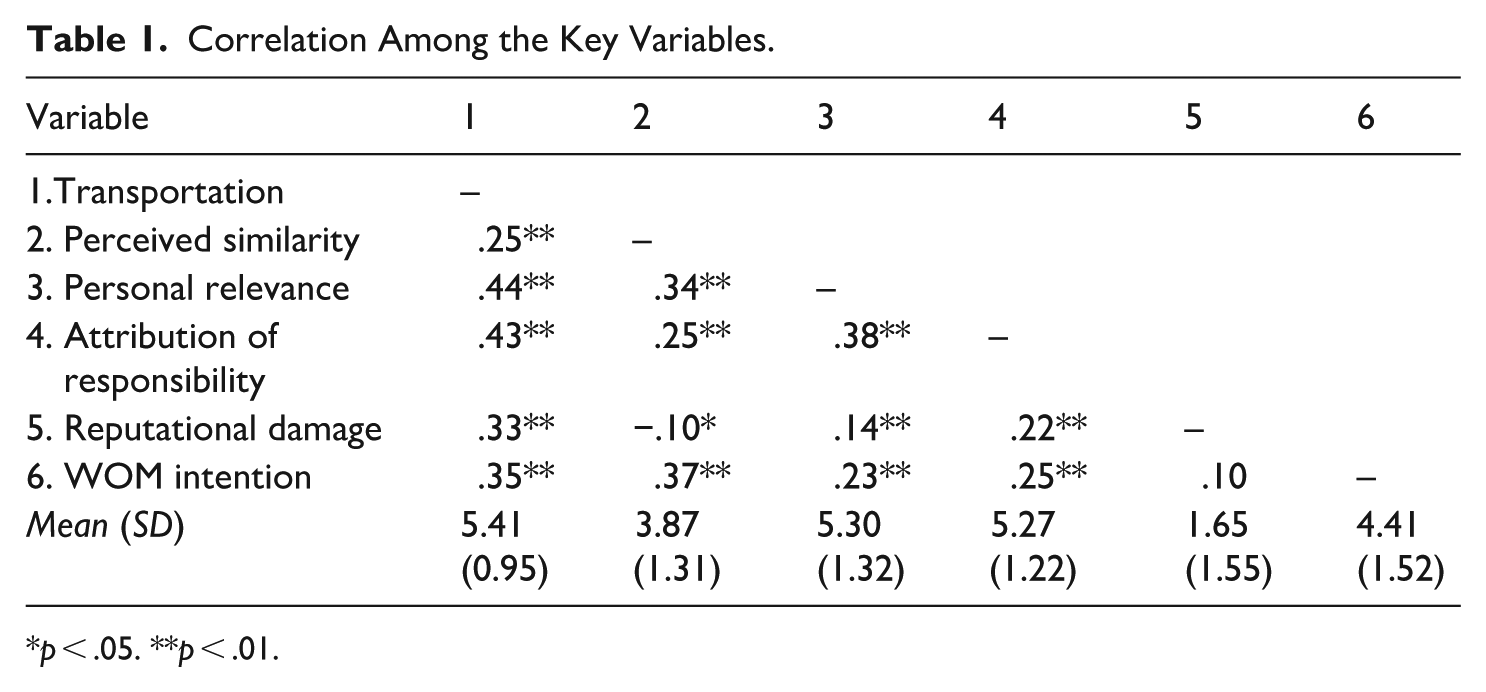
p < .05. **p < .01.
Prior to hypothesis testing, multivariate normality was assessed using Mardia’s test (Mardia, 1970). The results indicated a violation of multivariate normality (skewness: b1p = 77.15, p < .001; kurtosis: b2p = 649.33, p < .001). In line with recommendations for addressing non-normality in CB-SEM (Gaskin et al., 2025; Zhang et al., 2021), bootstrapping with 5,000 iterations and bias-corrected confidence intervals (BCa) was employed throughout all analyses to address the violation of multivariate normality.
Additionally, confirmatory factor analysis (CFA) was performed to assess the measurement model. The reliability of measurements was established as the values of composite reliability (CR) and Cronbach’s α exceeded 0.8. Additionally, overall validity was satisfactory. Convergent validity was achieved, as all average variance extracted (AVE) values exceeded the recommended threshold of 0.5. Discriminant validity was assessed using the heterotrait-monotrait (HTMT) ratio of correlations (Henseler et al., 2015). All HTMT values were below the recommended threshold of 0.85 (range: .071–.498), confirming discriminant validity for all constructs. The highest HTMT value was observed between Transportation and Attribution (.498), and the lowest between Reputational Damage and WOM (.071).
The measurement model (CFA) was first evaluated to assess the fit of the measures. According to the criteria set by Hu and Bentler (1999) (CFI > 0.90, TLI > 0.90, SRMR < 0.08, and RMSEA < 0.08), the measurement model demonstrated good fit with the data: χ² = 470.42, df = 174, χ²/df = 2.70, CFI = .95, TLI = .94, RMSEA = .07, SRMR = .05 (see Table 2). Subsequently, the structural model (SEM) incorporating gender and age as control variables was evaluated to test the hypothesized relationships. The structural model demonstrated good fit: χ² = 590.17, df = 209, χ²/df = 2.82, CFI = .93, TLI = .92, RMSEA = .07, SRMR = .07 (see Table 2).
Model Fit Indices.
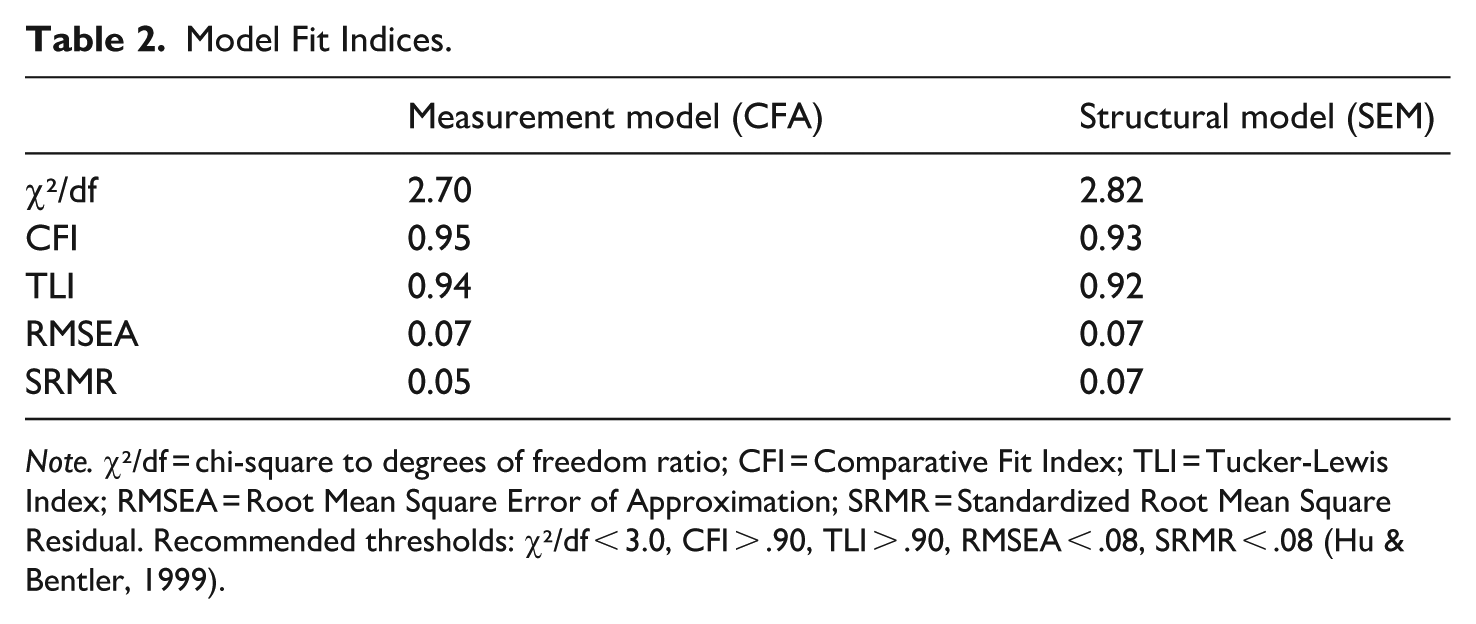
Note. χ²/df = chi-square to degrees of freedom ratio; CFI = Comparative Fit Index; TLI = Tucker-Lewis Index; RMSEA = Root Mean Square Error of Approximation; SRMR = Standardized Root Mean Square Residual. Recommended thresholds: χ²/df < 3.0, CFI > .90, TLI > .90, RMSEA < .08, SRMR < .08 (Hu & Bentler, 1999).
Hypothesis Testing
The hypotheses of this study were tested using SEM with gender and age included as control variables. Specifically, H1 predicted that transportation affects corporate responsibility attribution. Transportation significantly predicts corporate responsibility attribution (β = .29, p < .001) (see Table 3 and Figure 1). The more immersed audiences are in the story, the higher the corporate responsibility attribution becomes. Thus, H1 was supported.
Hypothesized Relationship Results.
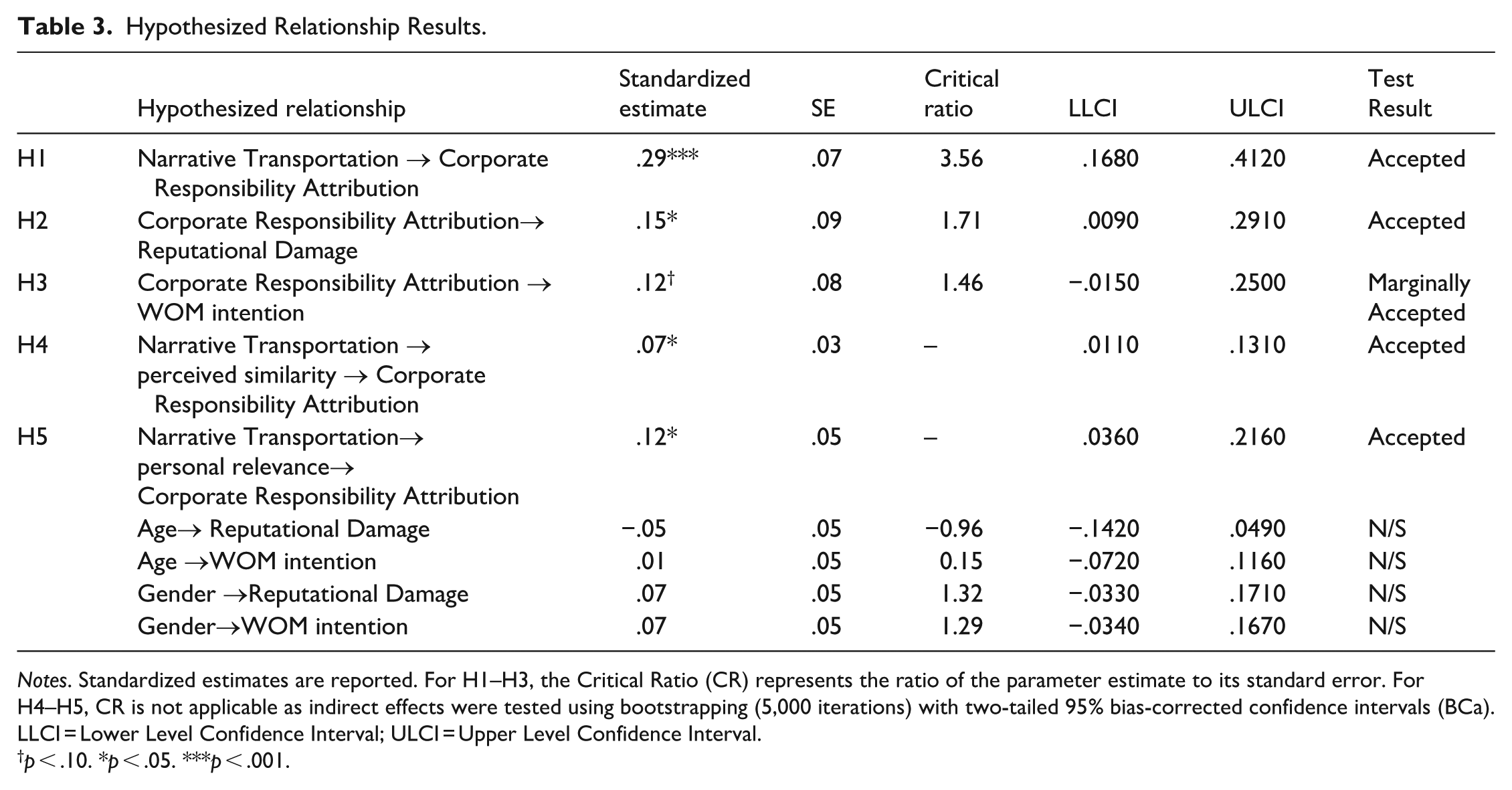
Notes. Standardized estimates are reported. For H1–H3, the Critical Ratio (CR) represents the ratio of the parameter estimate to its standard error. For H4–H5, CR is not applicable as indirect effects were tested using bootstrapping (5,000 iterations) with two-tailed 95% bias-corrected confidence intervals (BCa). LLCI = Lower Level Confidence Interval; ULCI = Upper Level Confidence Interval.
p < .10. *p < .05. ***p < .001.
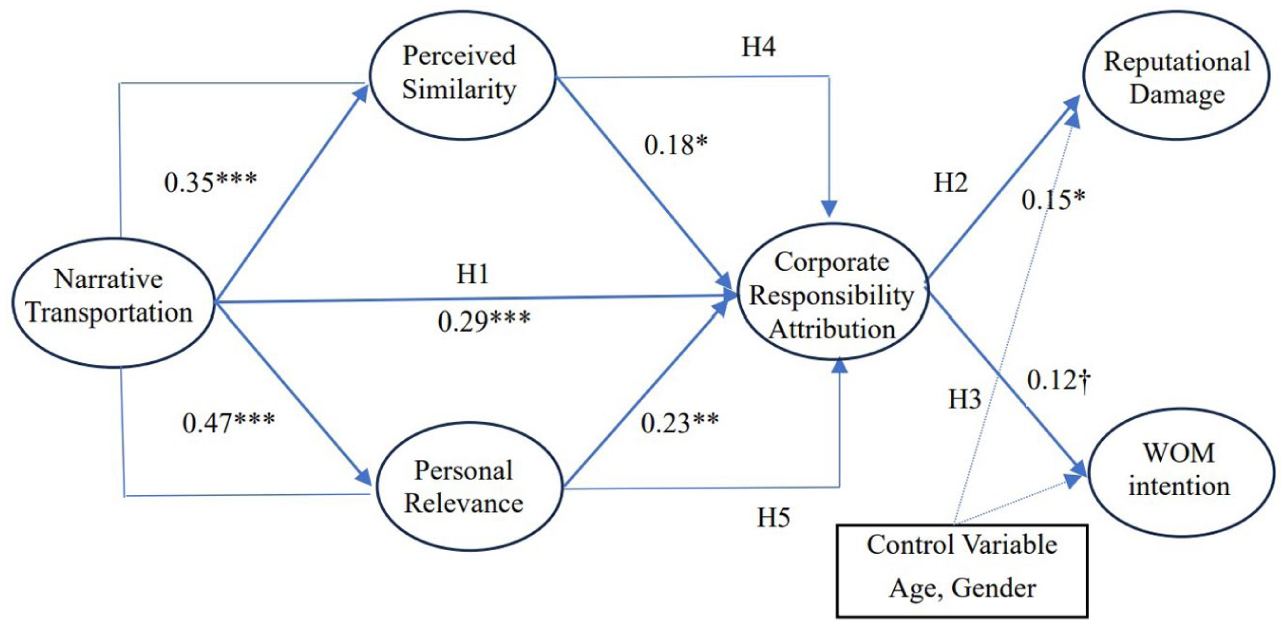
Structural equation modeling results of the hypothesized model.
H2 and H3 predicted that corporate responsibility attribution is positively associated with reputational damage and WOM intention. As shown in Table 3 and Figure 1, corporate responsibility attribution significantly predicted reputational damage (β = .15, p < .05), supporting H2. The more individuals believed that the company was responsible for the workplace bullying issue, the greater the decrease in favorability toward the company. Regarding H3, corporate responsibility attribution showed a marginally significant positive relationship with WOM intentions (β = .12, p = .061). Reporting p values between .05 and .10 as marginally significant has been observed across organizational communication research (e.g., Chen et al., 2024; Huang et al., 2010; Olsson-Collentine et al., 2019), and Botella et al. (2021) demonstrated that such reporting has minimal impact on meta-analytic estimation of effect size. Thus, H3 was marginally supported.
Finally, H4 and H5 predicted that higher perceived similarity and higher personal relevance would mediate the relationship between narrative transportation and corporate responsibility attribution. To test these hypotheses, we examined the direct and indirect effects, using bootstrapping with 5,000 iterations and two-tailed 95% bias-corrected confidence intervals (BCa). When examining each indirect path separately, the indirect effect through perceived similarity (β = .07, SE = .03, 95% CI [.0110, .1310]) and the indirect effect through personal relevance (β = .12, SE = .05, 95% CI [.0360, .2160]) were both significant. This indicates that greater narrative transportation leads to higher perceived similarity with the dissenting employee and higher personal relevance of the workplace bullying issue, which in turn increase corporate responsibility attribution. Thus, H4 and H5 were supported.
Discussion
The present study examines the direct and indirect effects of narrative transportation on corporate responsibility attribution, leading to reputational damage and negative WOM intentions. By focusing on the narrative characteristics of employee dissent on anonymous platforms such as Blind, this research elucidates why audiences attribute greater responsibility to companies for workplace bullying issues, even when the company is not directly responsible. The key findings and implications of this study are discussed below.
First, this study highlights the robust impact of narrative transportation in anonymous employee dissent. Our findings demonstrate that narrative transportation significantly influences corporate responsibility attribution, resulting in greater reputational damage and negative WOM intentions. This study extends narrative transportation theory, which has primarily been explored in persuasion research focusing on health, political, and marketing communication (e.g., Kim et al., 2025; Riggs & Knobloch-Westerwick, 2024), to the context of employee dissent. While previous studies have focused on the persuasive power of narrative transportation in these domains, our findings highlight its role in shaping negative attitudes toward companies in employee dissent contexts. Building on Kang’s (2021) study, which found that narrative transportation in employee testimonials induced perceptions of organizational hypocrisy and reputational damage, the present study further confirms the impact of narrative transportation in anonymous employee communication. Unlike testimonials where identified employees intentionally expose corporate misconduct, anonymous dissenting employees may disclose workplace issues simply to vent negative feelings or seek empathy from others (Kang, 2025). However, this study shows that when audiences become transported into anonymous dissent stories, they tend to blame the company even when corporate mistreatment is not explicitly mentioned. This finding is particularly noteworthy as it extends Kang’s (2021) examination of direct corporate misconduct; our results demonstrate that narrative transportation leads to corporate responsibility attribution even in peer-to-peer workplace bullying where the organization is not the direct perpetrator. This suggests that increasingly sophisticated storytelling by employees poses significant threats to corporate reputation management. Organizations must not only address the substance of employee dissent but also recognize the power of the narratives through which these dissents are communicated. In anonymous employee communities where members share similar workplace experiences, emotional resonance can sometimes outweigh factual accuracy in shaping perceptions. Consequently, companies may need to rethink their crisis communication strategies to address the emotional dimension of employee dissent.
Second, the results support H2 and marginally support H3, confirming that corporate responsibility attribution predicted reputational damage and showed a tendency to influence WOM intentions. These findings are consistent with SCCT (Coombs, 2007), which posits that the public’s attribution of responsibility to an organization directly influences its reputation evaluation. Prior empirical research has similarly demonstrated that higher responsibility attribution is associated with greater reputational damage (Fannes & Claeys, 2023; Schoofs et al., 2019) and increased negative WOM intentions (Tan et al., 2024). Notably, our findings extend this body of research by demonstrating that these reputational consequences can emerge even in anonymous employee dissent contexts where the organization is not the direct perpetrator of workplace bullying, suggesting that the mechanisms of responsibility attribution and reputational damage operate beyond formally defined crisis situations.
Third, by highlighting the significant mediating effects of perceived similarity and personal relevance, this study offers a comprehensive explanation of why individuals attribute responsibility to companies in workplace bullying cases. The results show that as individuals perceive workplace bullying as more personally relevant and experience higher perceived similarity with the dissenting employee through narrative transportation, they tend to attribute higher responsibility to the company. These findings are consistent with defensive attribution theory (Shaver, 1970), which explains that when individuals perceive an issue as something that could happen to them, defensive attribution is activated, resulting in greater blame placed on broader entities to protect themselves (Chung et al., 2023; Zhang & Lim, 2024; Zhou & Ki, 2018). Since the company is generally perceived as capable of addressing workplace bullying issues, the audience’s blame may extend beyond individual perpetrators to the organization.
While the current study focused on the mediating roles of perceived similarity and personal relevance, it is worth considering that these variables may also operate in alternative roles. This is particularly relevant in anonymous employee communities like Glassdoor and Blind. Members on these platforms, who are mostly employees from various companies, may have experienced negative workplace issues themselves or discussed workplace bullying with colleagues. This shared background fosters higher perceived similarity and personal relevance (Becker et al., 2023), as dissenting narratives emotionally resonate with their own workplace experiences. In this sense, pre-existing levels of perceived similarity and personal relevance could have moderated the relationship between transportation and attribution (Thomas & Grigsby, 2024). This is distinct from the confirmed mediating roles of perceived similarity and personal relevance in the present study, where these variables were actively constructed through narrative immersion rather than serving as pre-existing conditions. Future research should therefore examine these alternative pathways, including the potential antecedent and moderating roles of perceived similarity and personal relevance, to provide a more comprehensive understanding of narrative persuasion in employee dissent contexts.
From a theoretical perspective, the present study provides a comprehensive understanding of anonymous employee dissent by integrating narrative transportation theory (Green & Brock, 2000) and defensive attribution theory (Shaver, 1970). Specifically, we extend narrative transportation theory, which has primarily been explored in persuasion research, to the realm of informal employee communication such as anonymous online dissent. Through this extension, we confirm that narrative transportation in employee dissent is a crucial factor influencing perceptions and attitudes toward companies. Importantly, this influence operates not through rational evaluation of organizational wrongdoing, but through the activation of perceived similarity and personal relevance. These psychological mechanisms trigger defensive attribution even when companies lack direct responsibility, leading to reputational damage that exceeds what objective culpability would warrant. This suggests that emotionally resonant employee narratives pose reputational risks that existing attribution-based frameworks such as SCCT alone cannot fully account for.
Furthermore, this study highlights how anonymous employee community platforms such as Glassdoor and Blind facilitate the escalation of reputational threats. These platforms’ technical features — particularly anonymity combined with company verification — fundamentally alter employee communication dynamics (Bucher & Helmond, 2018). Traditionally, workplace issues such as bullying have been discreetly shared through internal communication networks and have not been publicly disclosed due to potential threats to employee reputation (Burt, 1992). However, these platforms guarantee anonymity for individual employees while disclosing company identities through reliable verification processes, enabling employees to freely share negative workplace experiences. Consequently, issues that were once discussed and resolved internally now reach external audiences, transforming them from organizational problems into social concerns and thereby increasing pressure on companies.
Practically, this study underscores the need to foster transparent communication rather than suppress employee dissent online. Given the widespread use of anonymous platforms such as Blind, preventing internal information from reaching external audiences is nearly impossible. While previous studies have highlighted the importance of fostering strong internal relationships to encourage employees to raise concerns internally (Kim, 2018; Lee, 2017), Korea’s hierarchical organizational culture further complicates internal resolution of workplace grievances. Therefore, rather than simply trying to prevent employee dissatisfaction from being shared on these platforms, companies should recognize them as channels for employee communication. Furthermore, based on the present study’s findings, we suggest several actionable implications for corporate communication practitioners. First, since narrative transportation, rather than factual accuracy, drives corporate responsibility attribution, companies should establish real-time monitoring systems for anonymous platforms and proactively issue factual clarifications before emotionally charged narratives gain traction and shape public perceptions. For example, official company statements or verified employee responses can serve as effective tools to counter misinformation at an early stage. Second, given that perceived similarity and personal relevance are the core mechanisms through which narratives resonate with audiences in communities like Blind, companies should develop platform-specific crisis communication protocols. These protocols should go beyond traditional denial or apology strategies by incorporating empathetic messaging that acknowledges employees’ emotional experiences while addressing factual inaccuracies. Third, when responding to employee dissent that has already reached external audiences, companies should craft responses that first validate the emotional concerns raised before providing factual corrections, as audiences who have become narratively transported are less persuaded by purely rational rebuttals.
Despite its theoretical and practical contributions, the present study has limitations. First, our research assumed that rich narrative storytelling is characteristic of employee dissent on anonymous platforms and did not experimentally verify the effects of narrative characteristics themselves. Prior research has demonstrated that narrative richness plays a significant role in shaping persuasive outcomes through heightened transportation and character identification (Boukes & LaMarre, 2021; Zhou et al., 2025). Future research should explore how the impact of employee dissent varies according to narrative richness or vividness (e.g., highly vivid storytelling with emotional details and multimedia elements vs. factual reporting). Second, the present study treated perceived similarity and personal relevance solely as mediating outcomes of narrative transportation. However, individuals may bring pre-existing levels of these variables to their encounter with employee dissent narratives — particularly in anonymous employee communities like Blind, where members share similar workplace experiences (Becker et al., 2023). Such pre-existing perceived similarity and personal relevance may have moderated the relationship between narrative transportation and responsibility attribution (Thomas & Grigsby, 2024), or even served as antecedents of narrative engagement, as individuals who already feel similar to the narrator may be more readily transported into the narrative (Cohen & Tal-Or, 2017). Future research should examine these alternative roles to provide a more comprehensive understanding of how perceived similarity and personal relevance function in narrative persuasion contexts.
Footnotes

Ethical Considerations
This study was approved by the Institutional Review Board of Korea University (Approval No. KUIRB-2023-0334-01).
Consent to Participate
Informed consent was obtained from all individual participants included in the study.
Funding
The authors received no financial support for the research, authorship, and/or publication of this article.
Declaration of Conflicting Interests
The authors declared no potential conflicts of interest with respect to the research, authorship, and/or publication of this article.
Data Availability Statement
The data that support the findings of this study are available from the corresponding author upon reasonable request.