







Abstract
This article reports a discourse analysis of journals from adult learners during a 1-week residency in Cape Town, South Africa. The theoretical posture is a critical dialogic perspective, making use of a postcolonial understanding of intercultural interactions. The purpose of the study was exploratory. The analysis suggests that demographic variables (e.g., race), prior international travel, and experiences during the residency influence the amount and pace of cognitive change. Results include both questions for future research and suggestions for educators.
As U.S. universities enlarge and enrich the international dimensions of their curricula, they are making greater use of short (e.g., 1-week) international residencies. International travel—and the associated intercultural communication—is widely (and correctly) seen as beneficial. But theory for understanding how and why those experiences produce effects is still being developed (Kramer, Lewis, & Gossett, 2015).
American participants in international service projects have sometimes described the experience as “life changing” (Anderson, Lawton, Rexeisen, & Hubbard, 2006, p. 467). But how does it produce such effects? Are all learners similarly affected? This exploratory, ex post facto study was conducted to better understand a specific international residency. The residency appeared to have positively affected learners. Yet the mechanisms that contributed to the impact remained largely opaque.
We draw from the journal entries of six adults enrolled in a graduate leadership degree program. The learners were participating in a 1-week residency in Cape Town, South Africa. Their team project consisted of developing and delivering a workshop on the subject of managing volunteers for faith-based and other service-oriented organizations. Four team members were assigned to develop and present the workshop; the other two team members were assigned to conduct an informal ethnography, observing and recording the activities of other team members and of South African clients and workshop participants. The team interacted for several weeks by email and video conference with the South African client (a Cape Town church whose ministerial staff agreed to guide the team). The project team then traveled to South Africa for a 1-week residency and delivered the workshop.
Despite thoughtful discussion (e.g.,Holmes, Smith, Lockstone-Binney, & Baum, 2010;Jones, Rowan-Kenyon, Ireland, Niehaus, & Skendall, 2012), scholars have not established a consistent vocabulary for describing activities such as the one reported here. Our preferred description would be a short-term, voluntary, international, project-focused residency. We designate the experience—1-week in-country—asshort-termto distinguish it from longer sojourns (Nishida, 1999). The activity can be termedvoluntary, using an “inclusive” definition of volunteerism (Holmes et al., 2010, p. 256; cf.Botero, Fediuk, & Sies, 2013;De Wet, 2012;Lewis, Gossett, & Kramer, 2013;McGehee & Andereck, 2009). We describe the residency asinternationalbecause the assignment was conducted outside the United States by a U.S. university. And we describe the exercise as project-focused because the U.S.-based students were positioned as “consultants,” given the task of producing a work product for a South African client, and graded (by a faculty member) based on input from the client.
In other words, the project was positioned as useful work for—and evaluated by—South Africans. This is consistent with the recognition that the role of benefactor is a morally dangerous one, posing “the risk of arrogance” (Greenleaf, 1977/2002, p. 325). Indeed as discussion will demonstrate, the power differentials revealed by such activities merit continual reexamination (Xu, 2013).
The next section of this article will describe the residency and the project. It will be followed by a description of the collection and analysis of data and the generation of questions for future research. The discussion also includes some theoretical speculations and some suggestions for educators.
Residency and Project
The business school at Georgetown University offers a 13-month, master’s in leadership degree. The program consists of weekend classes on the Georgetown campus, interspersed with multiday, off-campus residencies. One of the residencies includes a team-based consulting project for an international client and culminates in a weeklong residency in South Africa.
The individuals who enroll are accomplished, midcareer professionals. They come with a variety of backgrounds (e.g., business, education, military, government, NGOs) and, in many cases, already hold graduate degrees. Most are between the ages of 35 and 45 years. They average more than 10 years of work experience.
The Residency and the Elsiesrivier Project
The international residency occurred at a midpoint of the program. The 2013 to 2014 cohort, for example, began classes in March 2013 and traveled to South Africa in August. During the residency, the participants were exposed to South African history and culture. Each team also consulted directly with a designated client to deliver a work product.
The consulting project assignment is designed to encourage intercultural communication over a period of many weeks, mediated communication at first and culminating in sustained face-to-face interaction during the residency. Throughout the experience, the South African client is positioned as the team’s client or customer. The U.S.-based team members are asked to understand the needs of the client and to prepare and deliver a satisfactory work product.
In May 2013, the entire cohort was given descriptions of several projects and asked to rank them by personal interest. One of the six potential projects was titled “Leading Volunteers in Faith-Based Organizations: Elsiesrivier, A Colored Neighborhood.” The project description said that it would consist of “developing and delivering a workshop to assist leaders . . . in the challenging task of ‘managing’ (recruiting, training, motivating, supervising) volunteer workers.” Six persons (identified in this report as Team Members 1 through 6) were assigned to the Elsiesrivier team, four to develop and deliver the workshop content, and two to support and observe.
The South African vocabulary for describing races and their assigned living areas during apartheid is complex. As noted byThompson (2000; Chap. 6; see alsoPinchuck, McCrea, Reid, & Mthembu-Salter, 2005), the apartheid system identified four racial categories: White (both Afrikaans-speaking and English-speaking), Colored (mixed race, typically Afrikaans-speaking), Indian (typically English-speaking), and Black (typically speaking a tribal language such as !Xhosa as a first language, in addition to Afrikaans and English). For example, Elsiesrivier is called aneighborhoodby its residents—not atownshipbecause that term was reserved by the apartheid government for residence areas forBlackSouth Africans. The heritage of South African Colored persons includes ancestors from Malaysia, Madagascar, India, China, and, of course, both Africa and Europe. Today, some Colored communities are plagued with poverty, substance abuse, and gang violence. Indeed, Elsiesrivier is one of the most troubled neighborhoods in the Western Cape and, consequently, has attracted the attention of many service organizations. Most of the helping organizations rely on volunteer workers.
Workshop Development
The project client was a protestant church in Cape Town that conducted a community service ministry in Elsiesrivier. Ministerial staff of the church made local arrangements for the workshop and advertised the event to service-oriented organizations in Elsiesrivier.
One of the challenges that the team faced was the task of converting their knowledge and experience in managing people into a useful body of knowledge for workshop attendees, that is, managers of volunteers (Beck, Lengnick-Hall, & Lengnick-Hall, 2008). The team members had diverse backgrounds. Two of them had extensive military experience and were transitioning to business. The others had extensive business and/or government experience. Several of them had done volunteer work in faith-based organizations. All of them had supervisory experience. But none of them had been responsible formanaginga small, not-for-profit service organization.
The process of moving knowledge from one domain to another might be termed metaphorically astranslation, “a wide-ranging enterprise involving movement . . . between discourses, or between disciplines” (Forman, 1998, p. 51). In fact, the translation process included at least the following dimensions: (a) from the domains of military, for-profit, and government supervision to the domain of not-for-profit supervision; (b) from the culture of the United States to the culture of South Africa; and (c) from American English to South African English (a second language for many Colored South Africans).
The Elsiesrivier team drew on a variety of materials to understand the challenges of managing volunteers (e.g.,Akintola, 2010;Solansky, Duchon, Plowman, & Martínez, 2008) and to develop training materials for a workshop (e.g.,Blunt & Jones, 1997;Hager & Brudney, 2011;Morgan & Stevens, 2005). They periodically reviewed their developing plans with the client to better adapt their efforts. The completed plan included interactive sessions devoted to motivational analysis; cultural sensitivity; best practices for selecting workers; and methods for recruiting, motivating, and retaining volunteers.
As the team was conducting a final practice session at their hotel in Cape Town, some of them expressed uncertainty; one of the presenters confided in his journal a feeling that he knew “so little” about the workshop attendees. That same team member described his PowerPoint slides as “simple,” explaining that such slides allowed him to adjust the complexity and detail of his presentation while he spoke: My intent [in preparing my slides] was to hedge my bets as we knew relatively little about our audience. My presentation . . . dealt in statistics, and other empirical data which could have been potentially lost on volunteers from the impoverished townships. With simple slides, I left myself the option to delve as deeply into a discussion of the data and research methodologies as I felt the audience could bear. (Team Member 1)
The presenter was, in short, planning to adjust his knowledge translation efforts in response to audience reactions.
During the same practice sessions, the project manager (who had reviewed the list of scheduled attendees) cautioned team members about using the wordchurchbecause individuals from other faith communities were expected to attend. As one observer noted, “this necessitated some revisions to the wording of a few of the slides and several people were afraid they would forget” (Team Member 4). This concern illustrates the effort required to engage in “behavioral code switching” from a “church” vocabulary to a more inclusive “organization” vocabulary (Molinsky, 2007), a by-product of the translation process.
Workshop Delivery
When the Elsiesrivier team arrived at the workshop venue, they almost immediately encountered skepticism. One team member reported, Before the workshop started, there was coffee and tea and mingling. The very first conversation that I had with . . . [a South African man] started with his question about our school. When we explained that the Master’s in Leadership is under the . . . [Georgetown University] School of Business, there was immediate distrust expressed by crossed arms and the question, “Faith based volunteer work is different from business—how can business school students help us? What experience do you have that is relevant to us?” We were frankly surprised and a bit taken aback by the intensity of the questions. We explained that by taking lessons learned from business, faith-based volunteer work can become more effective, efficient, and reach more people, thereby doing more good. This was met with skepticism and raised eyebrows. The man walked away clearly unconvinced. (Team Member 4)
As reported by another one of the team members, “since we were from the Georgetown Business School, they wanted to know what we wanted from them” (Team Member 6).
These preliminary exchanges revealed that the problem of domain translation (from for-profit into not-for-profit) appeared to be a challenge to at least some South Africans. Furthermore, there seemed to be suspicion that persons associated with a business school were likely to have an ulterior—perhaps a profit-seeking—motive.
However, once the workshop began, it went well. The attendees represented a variety of not-for-profit efforts, including volunteers who helped the intellectually handicapped, who ran a shelter for women and children, who worked with senior citizens (“You’re never too old to learn”), and who conducted a variety of activities as part of a local church (“We bake, we cry, we laugh, we dance—we make soup on Saturday”). Postworkshop oral and written comments were uniformly positive (“It exceeded my expectations”) and in favor of repeating the experience. As one previously quoted observer reported, Final note and best of all, at the end of the session the person who initially questioned . . . [me about the value of training from a business school] volunteered . . . that he now has a different opinion and can see how the lessons of business can be applied to faith-based organizations . . . [in] a positive way that can make a difference! (Team Member 4)
It was only in response to questions about improvements that some limitations were noted. One South African suggested that the training might be offered in Afrikaans, and another recommended “less academic jargon.” Both comments indicate that the translation process was less than perfect. Indeed, in response to a question about additional topics that might be covered, one participant wrote explicitly (if metaphorically) about translation, asking for more attention to “how this information can practically translate into a third-world setting.”
Research Study: Seeking a Postcolonial Perspective
Endeavors, such as the one described, would appear to be valuable both to local residents and to the visiting Americans. However, much of the available literature appears to be more practitioner-oriented than theoretically oriented (for some notable exceptions, seePitts, 2009;Smith, 2013a,2013b). As a result, a comprehensive theoretical understanding is not yet available. As we began our investigation, we searched for conceptual tools that could help us better understand such experiences and wrestle with questions about effectiveness.
One response to the question about theoretical understandings is the large and growing literature on intercultural communication (e.g.,Beamer, 1992;Devoss, Jasken, & Hayden, 2002;Kim, 2001;Varner & Beamer, 2010). However, much of the literature has been described as overly “functional” or “colonial” (e.g.,Joy & Poonamallee, 2013) and as failing to “allow people of different cultures to participate equally” (Xu, 2013, p. 394).
As data analysis began, we reviewed literature to identify useful theoretical concepts. We were particularly keen to understand the intense self-awareness that some team members had reported. Our literature search located the work ofXu (2013), who drew on sources such as Martin Buber, Emanuael Lévinas, and Mikhail Bahktin to develop acritical dialogic perspectivetoward intercultural communication. That perspective calls for (among other things) an increased sensitivity to the complexity of the self and seemed, therefore, ideally suited to our project.
The focus of the current effort became, therefore, to draw onXu’s (2013)critical dialogic perspective in order to advance our conceptual understanding of the ways in which participants were affected by voluntary, short-term, international consulting. The resulting study is a meso-level discourse analysis (Oswick, 2012) of team member journals. As “a longitudinal chain of texts—revealing continuity, progress and/or coherence over time” it can be described as discourse analysis, which makes a positivist use of critical theoretical insights (Oswick, 2012, p. 484).
Data Collection and Analysis
The primary data for this report consist of personal journal entries from all six team members and the written report of the two team members assigned to function as ethnographic observers. Two of the team members (one of the developers/presenters and one of the observers) conflated events from multiple days in their journal entries. The other four team members provided day-by-day descriptions. After the content analysis of the six journals, sequential thematic maps were prepared for the four journals that provided day-by-day descriptions. By chance, the four day-by-day journals had been submitted by two African American women and two European American men; one of the women and one of the men were military veterans and experienced international travelers, and the other two were not. These demographic differences allowed us to make some exploratory comparisons by race/sex and by international/military experience.
The journal entries were content analyzed for five themes through a multistep procedure. First, one of the authors read all journal entries and conducted an open coding of themes (Orcher, 2005). Unsurprisingly, the most common themes included descriptions of activities, sights, and events in South Africa. Second, a dictionary of terms and expressions was developed for each of five themes derived fromXu (2013)as follows: (a) positive (or, at least, neutral) reaction to difference; (b) the complexity of personal identity; (c) experiencing relationship with someone who is other; (d) recognition of power differentials (e.g., poverty vs. wealth); and (e) acknowledgment of the uncertainty of knowledge. These dictionaries began with terms fromXu (2013)and dictionary synonyms of those terms, and with examples of the themes that had been identified in the initial open coding.
Third, in an iterative process, the journal texts were searched, passages identified as thematic were read in context, the dictionaries were (in some cases) revised, and the files searched again until all relevant passages had been located. Finally, a “map” was developed for each of the four team member journals that allowed day-by-day analysis.
These methods are somewhat subjective and may introduce unrecognized bias. For example, the fact that the team members were writing a journal (to be read by a professor, but not for a grade) may have influenced what they wrote. And content analysis requires some exercise of human judgment. On the other hand, the journal entries were written without any expectation of their use as research data. We aimed at replicability by developing a dictionary which, in most cases, allowed a computerized search for specific words and expressions. Our goal was a nuanced understanding of a specific data set rather than confirmation of preexisting hypotheses.
Operational Definitions
The operational definitions of the five themes consisted of lists of specific terms and expressions that could be used as search terms. In the case of single words and short expressions, these searches were completed by computer. In the case of more complicated indices (e.g., “a series of sentences reporting an interaction”), the searches were computer assisted.
Theme 1: Reactions to Difference
The manifestation of either a positive or negative attitude toward otherness appears in many studies of international education and intercultural communication. For example, theCampinha-Bacote (2002)model of intercultural competence includes a dimension of “cultural desire,” described as “a genuine passion to be open and flexible with others, to accept differences and build on similarities” (pp. 182-183; see alsoPenington & Wildermuth, 2005).Xu (2013)argued that the two “major attitudes towards difference are defensive and adaptive,” asserting that it is adaptive attitudes which “view difference in ways that avoid misunderstanding and conflict” (p. 380).
For coding purposes (seeFigure 1), we identified an adaptive reaction to difference when a journal entry noted a difference between South Africa and the United States (i.e., described something in South Africa and also referenced the U.S. equivalent) without expressing a negative evaluation of South Africa. Some passages explicitly offered a positive reaction to South Africa (e.g., “neat,” “wow”); most described a difference without an evaluation (e.g., the sale of meat from the roasted heads of sheep—known in the townships as “smileys”—was described as “very interesting” by Team Member 3). We interpreted both positive and nonevaluative statements as adaptive rather than defensive (Xu, 2013).
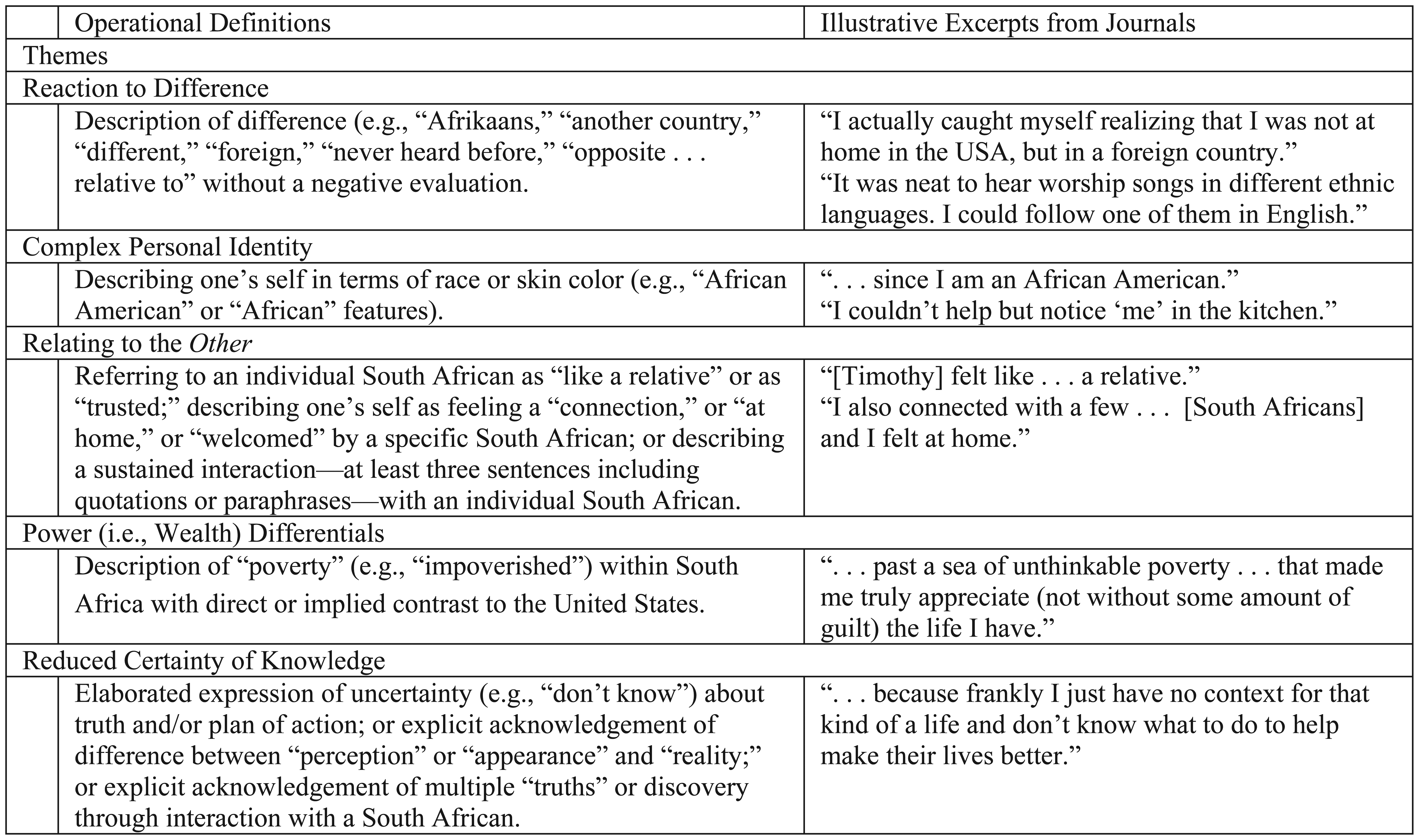
Operational definitions of themes.
Theme 2: Relating to the Other
International travel almost unavoidably includes interacting with persons who differ from one’s self.Xu (2013)noted that the philosophy of Lévinas may be said to be “built on the relationship between the self and the other” (p. 384).
For purposes of coding (seeFigure 1), we identified the theme of self-other relationships when a journal entry described a positive feeling about a specific South African, described the journal keeper as feeling close to one or more South Africans, or offered a detailed description (at least three sentences) of an interaction with a South African, quoting or paraphrasing the conversation. In the case of a described conversation, the tone of the interaction did not have to be overtly positive. For example, one participant reported a lengthy interaction with a township resident who was acting as a guide, including multiple exchanges such as the following: I asked our tour guide about the chance to stop and get some coffee. Our tour guide, Sugar, clearly told me “we don’t sell coffee here—you do that stuff at home” and added “if a man asks you out for coffee—no.” I thought “wow, coffee is really offensive to Ms. Sugar.” She then went on to tell me “we sell barbeque.” I thought, “that’s great but when it is cold outside, I think coffee is better.” (Team Member 6)
In exchanges like this, the participants did not always agree. But they were engaged in “situated dialogue,” struggling toward “relation, and interculturality” (Xu, 2013, p. 384).
Theme 3: Complex Personal Identity
Xu (2013)observed that “cultural identities are often nomadic, ambivalent, and in-between” (p. 382). And interaction with the other can produce not only heightened consciousness of self but awareness of the realized or potential complexity of one’s self. In a study of a number of significant, transformative people (including Nelson Mandela),Daloz (2000)identified “the only experience common to all [the exemplars]” as something the researchers calledconstructive engagement with otherness, or a “sense of empathetic connection with people different from themselves” (p. 110).Daloz (2000)wrote, Everyone described at least one significant experience . . . when they developed a strong attachment with someone previously viewed as “other” than themselves. . . . But regardless of the specifics, for the experience to be more than simply an encounter, for it to be aconstructive engagement, there had to be some sense of empathetic connection with people different from themselves. (p. 110)
Such engagement alerts the self to elements, which resonate to others, revealing that the self is, in some respects,likethe other and, therefore that the self is complex rather than simple.
In coding the presence of the complex personal identity theme (seeFigure 1), we searched the texts for references to self in terms of race or skin color (one aspect of one’s person that links self to some and distinguishes self from others, and one aspect that is particularly salient for both Black and White Americans while in South Africa). We also searched for references to self as having ahyphenated identitysuch as, for example,African American.
Theme 4: Power Dynamics
Interpersonal communication, particularly intercultural interpersonal communication, does not occur in a power-free zone.Xu (2013)called attention to the “pervasiveness of power relations and power differentiations between cultures” (p. 388).Lévinas (1947/1987), quoting an expression found in the Hebrew Bible, wrote, But already, in the very heart of the relationship with the other that characterizes our social life, alterity appears as a nonreciprocal relationship. . . . The Other is, for example, the weak, the poor, “the widow and the orphan,” whereas I am the rich or the powerful. (pp. 83-84)
International service efforts are inherently arenas in which some of the sinews of power become visible. The volunteer—typically from thefirst world—has access to resources that make it possible to travel and to work without expectation of remuneration. Thenativesorlocalsare in need of knowledge, training, materials, or money. Thus, the encounter between first-world voluntourists and third-world residents seems likely to provoke awareness of power differentials.
On the other hand, the current activity was designed to position local individuals as clients rather than supplicants. The intent was to privilege local knowledge, providing local persons with something of a countervailing power base to that of the visiting Americans, and so to require the visiting Americans to try to understand and meet South African needs.
In coding for the theme of power differences (Figure 1), we began by searching for explicit references to the expertise or power of South Africans vis-à-vis the visiting Americans. We did not find any examples. We did find many positive references to South Africans (e.g., “the spirit of these children was amazing,” Team Member 6). And we found a few comments which made it clear that the participants recognized South Africans as the ultimate judges of project value. We also noted a good deal of attention to another aspect of power—wealth, as in “the rich” (Lévinas, 1947/1987, p. 84).
We found several references to differences in wealth between the United States and South Africa. However, because of the disparities within South Africa (the team members and their classmates were visiting townships and neighborhoods while staying in a five-star Cape Town hotel), comments about wealth and poverty more often referenced South Africa. Indeed, the client—a congregation of mostly White, and relatively well-to-do, South Africans doing ministry in a Colored neighborhood—is a good illustration. Furthermore, comments about the wealth of some South Africans sometimes explicitly acknowledged that almost all Americans live like wealthy South Africans rather than poor ones and, thus, that some South Africans live as well as Americans. The theme of power dynamics was, therefore, assessed on the basis of references to poverty and/or wealth with an explicit or implicit comparison with the United States.
Theme 5: Dialectical Epistemology (Knowing)
A final theme—the complexity of knowing—was discussed byXu (2013)in terms of dialectical epistemology. As he noted, interacting with (and relating to) the other not only complicates understanding of self (as previously discussed) but also demonstrates that knowledge or truth is not simple. AsXu (2013)stated, “dialogue is often constrained by the context, the ideologies of different cultures, and conflicting interpretations of communication” (p. 387). As a result, Deetz argued, the point of dialogue is to develop understanding beyond any “present individual point of view” rather than to “convince the other” (1990 as cited inXu, 2013, p. 387).
This is a relatively sophisticated concept. But one of the early steps—the partial deprivileging of the subject’s knowledge claims—may be apparent in journal entries. Consequently, we reported the dialectical epistemology theme when a journal entry acknowledged the existence of “multiple truths,” or diversity within human perception (Figure 1). We also coded for this theme when a journal entry reported a significant shift in personal views during an interaction with a South African. For example, one team member wrote, What surprised me the most was the fact that it was a black employee preventing our black cab driver from entering [an establishment] which threw everything I thought I knew about the inequalities out the window. It was then that I realized there is more of a social caste system in South Africa than I knew. (Team Member 1)
Thematic Maps
Once a series of journal entries had been coded (each theme was either present or absent in each entry), a day-by-day “map” was prepared for four of the journals. Comparing the maps generated several insights that will be reported in the next section. The four journals had been compiled by two African American women and two European American men, allowing a comparison between pairs of journals. Furthermore, two of the individuals had extensive international travel experience (as military veterans), and the other two did not. This allowed a comparison between more experienced and less experienced travelers.
Results
A review of the thematic maps showed that each theme had appeared between 5 and 12 times (out of a potential 28 appearances). The most frequently occurring theme was that of difference (n= 12), with most of those occurrences (n= 7) concentrated in the opening days of the residency (seeFigure 2). The other themes occurred less frequently as follows: complexity of self (n= 5), relating to the other (n= 7), power dynamics (n= 10), and complexity of knowing (n= 5). Viewed differently, one of the four team members touched on all five themes at least once; two of the team members touched on four of the five themes at least once; and one team member’s journal entries reflected only two of the five themes.

Number of persons whose journal entry articulated a particular theme on each day of the residency.
Thematic Sequences
One of the first patterns that can be noted (seeFigure 2) was a pattern for observations of difference made during the opening days of the residency, which persisted at a reduced level in subsequent days. For example, one newly arrived European American male wrote as follows: What a beautiful day! After traveling thousands of miles, it felt good to get out and experience the topography of Cape Town—the mountains, the water, and the cars driving on opposite sides of the road relative to the states, the palm trees, and the obvious disparity in living standards that coexists side by side. (Team Member 5)
On the other hand, entries that acknowledged the complexity of knowing did not occur during the opening days but did start to occur (though never with great frequency) in the second half of the residency. One team member wrote, I experienced South Africa in its post-Apartheid years. . . . Although externally, South Africa doesn’t “look” like everything and everyone has changed, I know that change has happened and is still occurring. I know this because externally I look the same as I did when I arrived in South Africa. Assuredly, on the inside, I have changed. (Team Member 6)
These observations suggest an initial theoretical speculation that the experiences referenced by the themes derived fromXu (2013)may have a partially predictable sequence during an international residency, beginning with observations of difference and eventually (perhaps) achieving a more complex personal epistemology.
The Moderating Effects of Identity
One of the most striking patterns within the set of maps were differences in the entries that described the individuals’ initial days in South Africa (seeFigure 3A). Both of the African American women offered comments that reflected the complexity of the self in their very first journal entries. One of those read, When I arrived at Cape Town Airport on Friday night it didn’t quite feel like I was in another country. . . . But when I went outside the airport into the fresh night air, I had an overwhelming sense of being “home.” Never before had I thought about Africa as being home for me albeit strange since I am an African American. Throughout my life I have considered taking a trip to Jerusalem in acknowledgment of my religious . . . [faith]. I guess those first few moments were like an awakening of my ethnic heritage. I remember smiling as I looked into the sky with optimism about what the next 10 days would be like. I recall having a huge smile on my face that I couldn’t really explain. (Team Member 6)
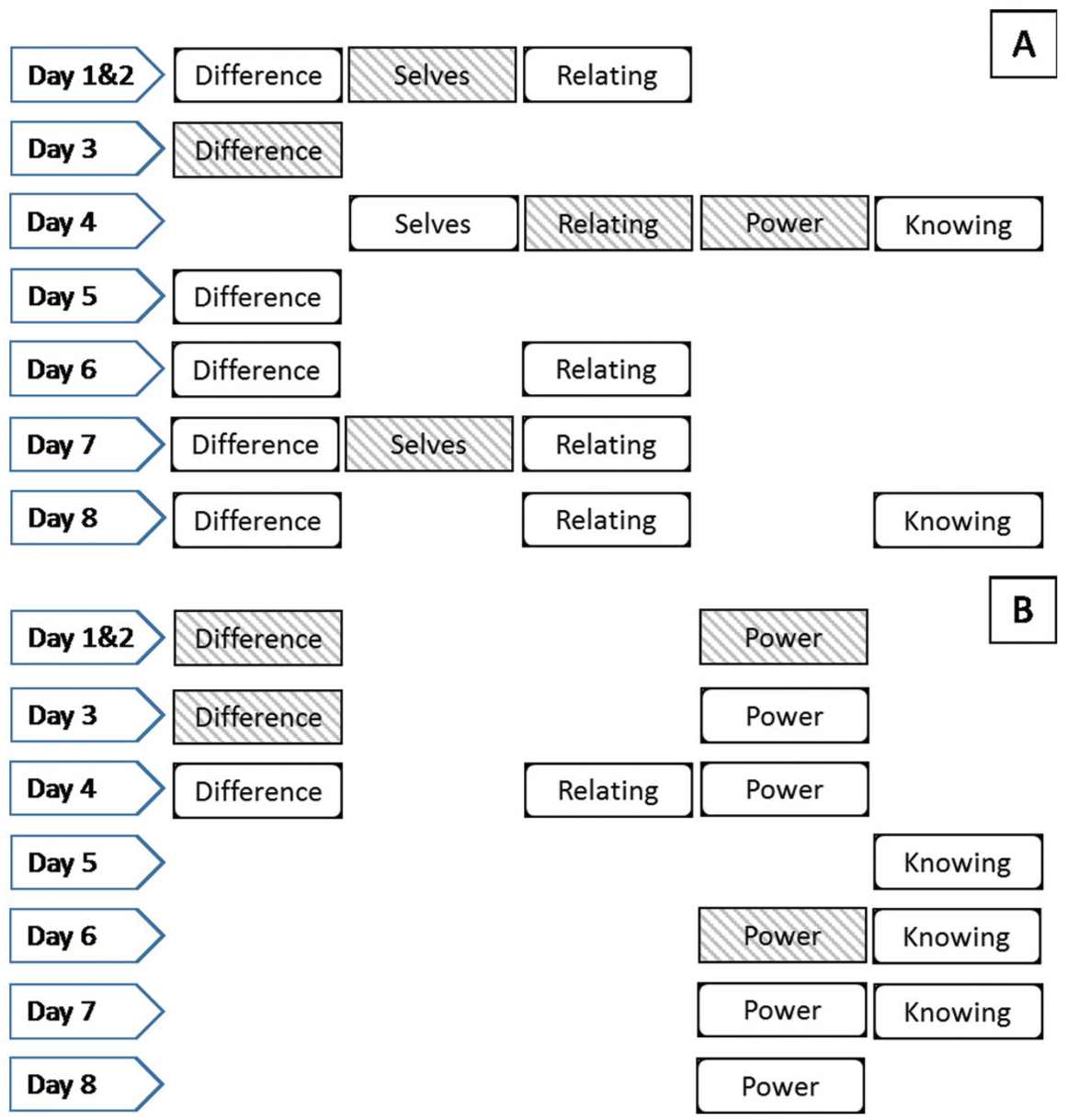
Comparison of two pairs of students (race and sex). This includes a combined map for two African American females (A, upper portion); and a combined map for journal entries from two European American males (B, lower portion).
In contrast, neither of the European American men (seeFigure 3B) offered a comment reflecting the complexity of self. Instead, both of them sounded themes of difference and of power differentials. Here is what one of them wrote about power differentials: Within minutes of leaving the airport I was struck by the socio-economic inequalities in South Africa. From a reasonably westernized urban area, the cab ride to the . . . [hotel] took me past a sea of unthinkable poverty. The shanty town that separated Cape Town proper from the airport was a true eye-opener. I have been exposed to such inequalities in [the Middle East] . . . but the contrast here was truly remarkable. . . . That made me truly appreciate (not without some amount of guilt) the life I have. (Team Member 1)
These observations suggest a second theoretical speculation that a student’s reactions to an international sojourn are likely to be moderated by the student’s identity (as can be partially gauged by demographic attributes). In the current instance, the differences in race and sex were confounded. But it seems noteworthy that both of the African American women referenced race (rather than sex) in their early comments about self-identity.
In the interest of exploring the data thoroughly, we then examined the four individual maps with an eye to themesequence. We noted (as shown inFigure 4) what appears to be a difference in sequence between the African American women and the European American men. After expressing an awareness of difference, the women reflected on the complexity of the self before progressing toward relating and epistemology. On the other hand, after reflecting an awareness of difference, the men appeared to focus on power before progressing toward relating and epistemology. These observations suggest that personal identity (e.g., sex and/or race) may affect both the themes that emerge and the sequence in which they do so.

Hypothesized sequence of reactions to a foreign residency.
The Moderating Effects of Experience
Examination of the thematic maps also suggested another pattern—the epistemological theme was found in only two of the journals. When information about the four participants was reviewed, two differences were noted. The individuals who commented on the epistemological theme (an African American woman and a European American man) were both experienced international travelers and military veterans (seeFigure 5A); the other individuals (seeFigure 5B) were less internationally experienced. Here is a passage describing a dinner in a private residence from the more traveled African American woman: Upon . . . entering the home, I immediately noticed the [Black] lady in the kitchen dressed in attire that reminded me of house slaves as depicted in movies or books. I couldn’t quite figure out why she was dressed this way or what my emotions were when I saw her. I think I initially felt a little shock and then anger. I opted to suppress those thoughts and be open-minded about the experience. . . . This was a very memorable event for me because I’ve never seen a black person dressed in such attire. . . . I couldn’t mentally reconcile why this lady had to be dressed the way she was and why she remained in the kitchen, quiet and unnoticed. (Team Member 6)
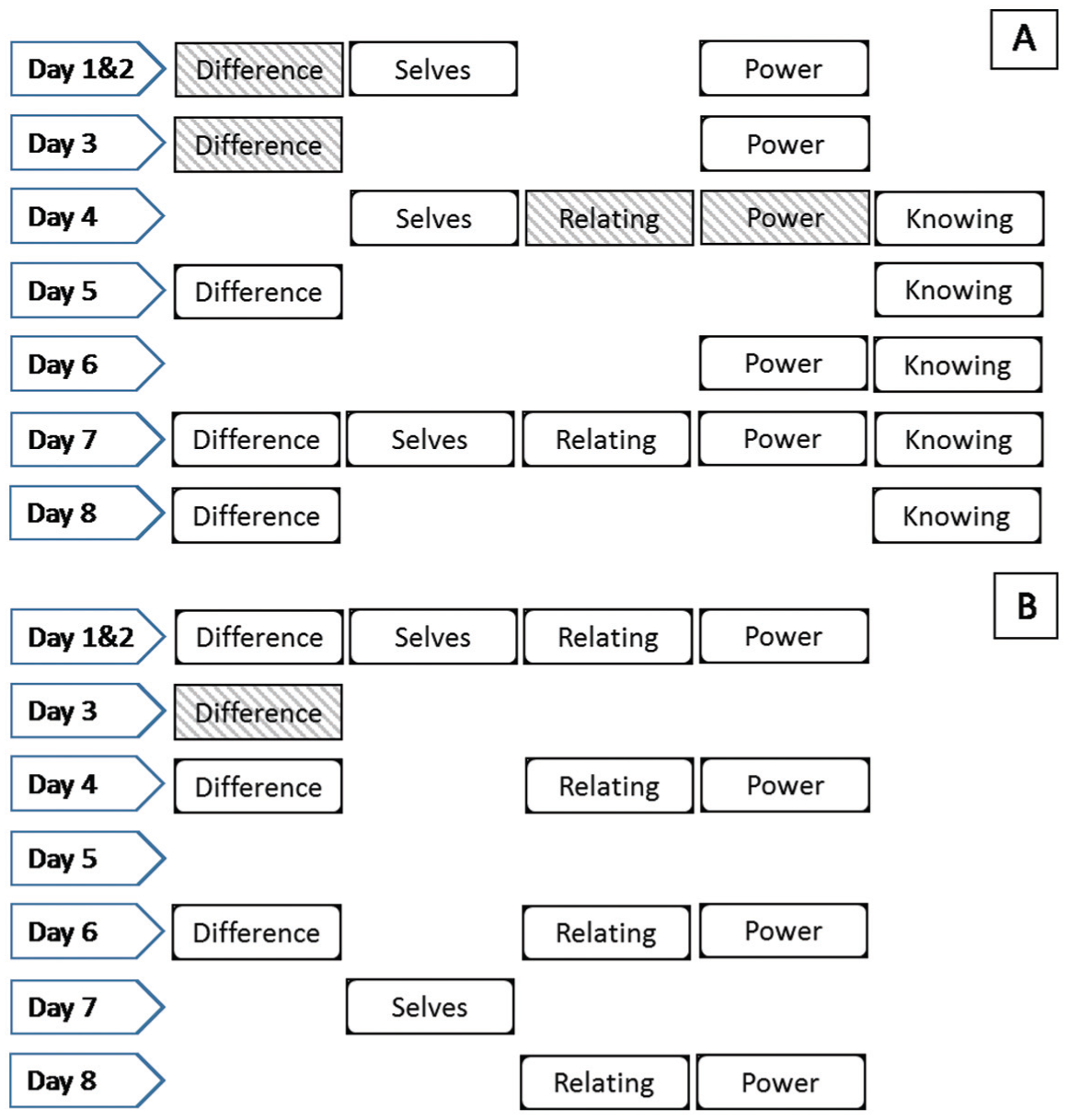
Comparison of two pairs of students (travel and military experience). This includes a combined map for two military veterans and experienced international travelers (A, upper portion); and a combined map for two non-military-veteran, less experienced travelers (B, lower portion).
Of course—as just demonstrated—the lady in the kitchen didnotgo unnoticed. Many of the journals from students who attended the event also commented on the woman in the kitchen and her very modest and somewhat old-fashioned attire (e.g., “like something fromGone With the Wind,” Team Member 4; “I couldn’t help but notice ‘me’ in the kitchen,” Team Member 2). However, within the Elsiesrivier team, only the individual quoted extensively here commented at length and finally offered an epistemological comment that “perception isn’t always reality.”
The Critical Dialogical Perspective
Both the explanations given in the original text (Xu, 2013) and subsequent research suggest that Xu’s theoretical analysis was focused on individuals responding to a dominant culture during long exposure such as, for example, Chinese workers in a U.S. subsidiary. Persons in such circumstances can identify imposed norms and develop coping strategies that allow them to function effectively at work (Deng & Xu, 2014). In the current study, we have usedXu’s (2013)work in a very different context. We have sought to better understand members of a “dominant” culture (voluntourists from the first world) during a relatively short-term exposure to a new culture.Xu’s (2013)work provided us with significant insights into our data, and this suggests to us that those insights have wide applicability in the field of intercultural communication.
Some Pedagogical Suggestions
The theoretical speculations deriving from this exploratory analysis are summarized inFigure 6.Figure 6also summarizes some pedagogical suggestions, which are discussed in the following paragraphs.

Summary of theoretical speculations and suggestions for educators.
While we grant that a short residency—even an immersion experience—is not likely to have the same impact as a lengthy one, our experiences indicate that a short residency can have a significant impact. Furthermore (while the belief emerges more from experience than from data analysis), we believe that the impact of a residency can be expanded with appropriate preresidency activities. For example, significant preresidency interaction by video or audio conference with foreign nationals, particularly interaction that privileges the expertise of the foreign nationals, is helpful in beginning the recognition of difference and initiating the learning process.
Analysis of data suggests that identity (e.g., personal characteristics) of the participants interacts with features of the international location. For example, in this case, the African location had a particularly powerful effect on African American participants. Some European Americans might have a similar reaction in Europe. It also seems reasonable to anticipate that encounters with persons who share a professional identity (e.g., farmer, miner, nurse) with the voluntourist could encourage intense self-awareness. In any case, if an intense reaction seems possible, an educator should give thought to preresidency education and to the preparation of some midresidency activities designed to assist learners in processing their reactions. Our sense is that the assignment of keeping a daily journal during the residency is one excellent technique.
We also recommend that an educator responsible for an international residency should build in one or more mechanisms designed to assess the unfolding reactions of individual participants. This could be as unobtrusive as informal visits with participants at the end of each day. It could also be as formal as midresidency surveys or one-on-one interviews with participants. The goal is to keep the educator informed about how participants are responding to their experiences.
Both experience and data analysis indicate that a participant’s reactions are likely to change as the residency progresses, and there appears to be a somewhat-predictable sequence to those reactions. This means that a participant’s mental state on Day 2 may well change by Day 3. But it is important to avoid the assumption that all participants are responding in the same way or moving through stages at the same rate. An educator who wishes to stay in touch with a cohort of participants will need to engage in ongoing monitoring and to be sensitive to differences between individuals.
To the extent that reactions (and their sequences) are predictable, it is possible to plan some midresidency activities focused around appropriate themes. For example, an early (or a preresidency) emphasis on adaptive reactions to difference is a good idea. And, based on the current data set, the themes of power differentials and relating to the other are widely experienced and could be the focus of activities designed to crystalize learning. It seems important, however, that an educator avoids giving anyone the impression that all participants are expected to experience all themes. Our data suggest that an international residency affects different people in different ways and at different rates, and that personal identities and past experiences shape the effects. For example, no participant should be made to feel deficient because his or her prior experiences have not prepared him or her for a new level of epistemological understanding. Instead, each participant should be encouraged to fully experience and to benefit from the lessons that come to him or her.
Finally, whatever planning has been done should be regarded as tentative. International residencies are inherently unpredictable. Local nationals say and do unexpected things. Traveling participants react in ways even they do not expect. Current events in the international (or the home) location shape concerns and feelings. The skillful international educator must be prepared to adjust to circumstances and to the agenda of individual learners.
Discussion
The primary value of this project is found in a deepened understanding of the impact of short-term, international residencies and a clearer identification of some variables that moderate the effects. Specifically, a discourse analysis of the journals of four adult team members suggests (a) that experiences during a 1-week residency are cumulative, including an early focus on difference and, in some cases, subsequent achievement of a more sophisticated awareness of the complexity of knowing; (b) that student identity (e.g., demographic variables such as race and sex) may moderate both the reactions to international experience and the sequence and speed with which the reactions occur; and (c) that prior international experience (or intercultural training received in the military) may moderate the reactions to international experience.
These results—while exploratory—are consistent withXu’s (2013)arguments for adopting a critical dialogic perspective. The concepts identified by Xu coincide naturally and well with the concept of transformative learning. For example, transformative learning can be defined as the process by which we transform our taken-for-granted frames of reference . . . to make them more inclusive, discriminating, open, emotionally capable of change, and reflective so that they may generate beliefs and opinions that will prove more true or justified to guide action. (Mezirow, 2000, pp. 7-8)
The theoretical notions that have emerged suggest a complex, multifaceted, individualistic, recursive learning process (Taylor, 2000) that moves toward a transformation of our taken-for-granted frames of reference.Lévinas (1969)argued that “the absolutely foreign alone can instruct us. And it is only man who could be absolutely foreign to me” (p. 73). Thus, the engagement with the other—on the other’s home ground—is a potent learning opportunity.
Limitations
The largest limitations would seem to be the exploratory nature of the project and the limited number of journals that were analyzed. Several specific limitations (e.g., working with service-oriented organizations) have been previously noted. In short, the current study is, at most, a pointer toward additional work yet to be done.
Future Research
Our work provides a foundation for additional research. We offer, for example, the following research questions: (a) To what extent do learner reactions during an international residency unfold in a predictable sequence? (b) To what extent do the predominance and sequence of reactions depend on learner identity? (c) What are the relevant dimensions of identity, and which ones are of greater or lesser significance? (d) How does prior international experience influence a learner’s reactions to a new culture? (e) How can the educational process be improved? The discussion of our results not only points to these as interesting and important questions but also offers (at least implicitly) hypothesized answers which can now be investigated more systematically.
Conclusion
In our view, the international learners who describe their experience as “life changing” are correct; and the most fruitful way to understand the effect is to use the lens of intercultural communication (and theoretical tools such as a critical dialogical perspective). Indeed, intergroup communication appears to be an important factor in the individual development of human beings. That certainly seems to have been the case in the development of a number of extraordinary people.
For example, in her previously referenced report concerning the role of constructive engagement in the maturation of a number of transformative people,Daloz (2000)observed about one specific South African, “Nelson Mandela was not born special” (p. 103). Instead, a series of experiences and decisions allowed him to become acquainted with people from other African tribes, with Jews, and with Afrikaners, and through those experiences and his own reactions to those experiences to become extraordinary. Our study suggests that short-term, project-focused residencies have the potential to produce transformative learning among postgraduate professionals from the United States and, thereby, to move them toward the possibility of becoming genuinely transformative people.
Footnotes
Acknowledgements
The authors are grateful for assistance from the following persons: Richard America, Shyam Chidamber, Deloris Freeman, Michael Freeman, John Muir, Stanley Nollen, Mackenzie Price, Namitha Shivaram, Paul Smith, Anna Marie Trester, and the reviewers and editorial staff ofBusiness and Professional Communication Quarterly.
Authors’ Note
A paper based on this project was presented at the 78th annual meeting of the Association for Business Communication, Philadelphia, PA, USA, 2014. This study was approved by the institutional review board of Georgetown University. Participant comments are reproduced by permission.
Declaration of Conflicting Interests
The author(s) declared no potential conflicts of interest with respect to the research, authorship, and/or publication of this article.
Funding
The author(s) received no financial support for the research, authorship, and/or publication of this article.
Author Biographies