







Abstract
Recent reports have suggested that many employees in the workforce today lack essential soft skills. This research analyzes the effectiveness of multiple classroom assignments for teaching soft skills in a Business Communication course. Five distinct pedagogical strategies were used in an effort to teach soft skills, including a self-analysis, an interview, a guest lecturer, a journal article, and a soft skills video. Results offer insights into students’ perceptions of the most helpful pedagogical approaches for teaching soft skills.
Recent reports have indicated that soft skills are in demand by employers, and yet many employees lack these essential attributes (Klaus, 2007;Mitchell, Skinner, & White, 2010;Robles, 2012;“The Value of Soft,” 2015;Yarbrough, 2015). Soft skills refer to nontechnical skills such as listening, communication, teamwork, time management, self-management, empathy, integrity, flexibility, emotional intelligence, and related social skills (Andrews & Higson, 2008;Goleman, 1998;Klaus, 2007;Robles, 2012). This study aims to evaluate the efficacy of several modes of teaching soft skills in the classroom in order to improve pedagogical approaches. We assigned five distinct assignments and analyzed students’ perceptions of the relative helpfulness of each assignment to make recommendations for business and professional communication educators.
Literature Review
Students graduating from college assume they possess skills that make them ready for the workforce, but this assumption may not be true with regard to soft skills. Some reports have suggested that college—and even some MBA graduates—lack important soft skills, such as communication, writing, oral presentation skills, and interpersonal skills (Andrews & Higson, 2008;Bedwell, Fiore, & Salas, 2013;Mitchell et al., 2010;Tugend, 2013). Because soft skill attributes like interpersonal skills are vital to achieving promotions and other benefits in the workplace (Bedwell et al., 2013;DeKay, 2012), businesses may take steps to train workers in fostering soft skills (Hynes, 2012). Researchers have reported that recruiters may prioritize a job candidate with soft skills over someone with technical skills (Robles, 2012;Russell, Russell, & Tastle, 2005). Moreover, in higher education, soft skills are increasingly recognized as vital for success across academic disciplines, as evidenced by an emphasis on soft skills in courses ranging from information systems (Russell et al., 2005) to engineering (Pulko & Parikh, 2003) to business (Bedwell et al., 2013;Mitchell et al., 2010). Because many college graduates lack these skills that are important to their employment (Mitchell et al., 2010;“The Value of Soft,” 2015;Yarbrough, 2015), it is important to help students develop soft skills in the classroom.
The term “soft skills” encapsulates many different social skills that are distinct from hard, technical skills. These include attitudes and personal characteristics (Guffy & Loewy, 2016) as well as teamwork, cooperation, empathy, and listening (Goleman, 1998;Russell et al., 2005). In one analysis, business professionals rated the top 10 soft skills as courtesy, communication, flexibility, integrity, interpersonal skills, positive attitude, professionalism, responsibility, teamwork, and work ethic (Robles, 2012). Additionally,Robles’s (2012)10 categories have multiple qualities subsumed within those skills. In educational settings, soft skills are sometimes taught alongside related qualities such as professionalism, civility, etiquette, and social intelligence (Guffy & Loewy, 2016). Others connect soft skills to effective organizational skills, motivation, and empathy (Marques, 2013). In sum, the term soft skills is multidimensional and relates to a plethora of different aptitudes, so teaching it as one concept is challenging.
Several challenges face educators who wish to add soft skills material to their courses. New activities geared toward teaching soft skills may sacrifice content for lectures, which is an important challenge (Anthony, 2014). Furthermore, the end product of educating students on soft skills is often elusive and difficult to document (Robles, 2012). Anecdotally, many students discount material that they will not be tested on. Increasingly, business schools recognize that hard skills are not enough for workplace success; therefore, they are trying to teach soft skills because they recognize them as vitally important for higher level management and leadership positions (Bedwell et al., 2013;Korn & Light, 2011).
Students are required to adapt to trends such as increasing company use of teamwork (Guffy & Loewy, 2016;Hughey & Hughey, 1999;Keyton, 2006). Indeed, many consider teamwork skills such as collaboration and flexibility as essential components of soft skills (Goleman, 1998;Robles, 2012;“The Value of Soft,” 2015;U.S. Department of Labor, 2010). Thus, educators who wish to prepare students for interpersonal interaction and teamwork should incorporate assignments into their curriculum that evaluate and emphasize soft skills, which benefit students regardless of their field of study.
Method
This research seeks to advance our understanding of best practices for teaching soft skills in business and professional communication courses by evaluating the strengths and weaknesses of several modes of teaching soft skills. Students (N= 55; 34 male, 21 female,M age= 22.09 years, age range: 19-40 years) from two undergraduate business communication courses were exposed to multiple methods for teaching soft skills. This course is required of all business majors, and thus the two sections were largely composed of business students (47 out of 59 total students). The course is intended for sophomore-level students, though in practice students often delay taking the course until their junior or senior year. The university is formerly an associate’s degree-granting institution that has recently been consolidated with a traditional 4-year university to produce a 4-year university with some master’s programs spanning across multiple campuses. At the conclusion of the spring 2015 semester, we assessed student perceptions of their learning gains, including questions about what activities increased their knowledge of soft skills the most. The assignments under evaluation included a self-analysis of soft skills, an interview with a boss or manager, a guest speaker, a review of an academic journal article, and a video demonstrating the need for soft skills in the workplace. All methods and procedures were approved by our university’s institutional review board. The paragraphs below detail the procedures for each of the five teaching modules.
To begin, students completed a self-analysis assignment in which they were asked to analyze their own soft skills and communication. This short assignment encouraged students to take a personal inventory of their strengths and weaknesses in regard to soft skills.
Next, students were assigned to interview their boss or manager about soft skills that are desirable for new hires. One of the objectives was for students to ask professionals what soft skills are needed in a given industry, especially for new hires entering the workforce. Students were given seven possible questions they could ask the boss during an interview, but students were also allowed to form their own questions. Pedagogical research has demonstrated that active engagement with business professionals is a useful means for providing students a greater exposure to real business exchanges and ideas (Helms, 2014;Robles, 2012). This assignment sought to extend our understanding of such methods.
For the next assignment, a speaker from the community was invited to talk with the students about the soft skills needed in that individual’s industry. There are several benefits to this pedagogical practice. According to the literature, inviting speakers can provide much-needed variety to the classroom teaching style, offer students new content, and expose students to a credible business professional (Hughes Miller, 2014;van Hoek, Godsell, & Harrison, 2011). Instructors do not need to get the highest ranking professional—for instance, a director, project manager, or technical expert may in fact be more pedagogically effective than a seasoned CEO (van Hoek et al., 2011). If done effectively, students can make connections and see the way industries function on a daily basis (van Hoek et al., 2011).
All students were also instructed to read a specific journal article (Robles, 2012) relating to soft skills, complete an article report form, and discuss the article in class. This method is most similar to traditional pedagogical teaching that involves reading and discussion. Because academic journal articles are written at a different reading level than textbooks, the ideas may be more challenging for undergraduates to comprehend. The goal was to provide students a sample of a detailed and nuanced academic reading to evaluate the degree to which this type of learning was helpful. In other words, we were curious to see how the challenging reading would be rated on the survey in terms of student perception of learning efficacy.
Finally, students watched a short video clip relating to soft skills. Following the video, they participated in class discussion. The video was produced and edited by one of the authors, and the content contains interview comments from eight different business leaders from a large metropolitan area in the South discussing the importance of soft skills.
At the end of the spring 2015 semester, students completed a questionnaire (see theappendix) to evaluate the relative effectiveness of each of these modes of teaching. Students rated each assignment and provided qualitative comments about how to improve the teaching of soft skills in business and professional communication courses. We also surveyed students to get their qualitative insights into the strengths and weaknesses of the task of interviewing their bosses, since that was one of the more innovative and experimental approaches to teaching soft skills.
Results
There are several interesting findings from this research, including student assessment of the relative benefit (in terms of perceived learning gains) of various content delivery formats.Table 1reflects the percentage of students who ranked each assignment as most helpful. A total of 47 out of 55 students completed this ranking correctly. Eight participants did not complete this question correctly, either putting multiple number one answers or leaving it blank. Their scores were not included in the results for this question. AsTable 1indicates, students reported that the guest speaker was the most influential and helpful method for learning. The self-analysis and journal article were clearly helpful for students as well. Interestingly, students found the boss assignment—in which they interviewed their manager—and the video on soft skills to be the least helpful of the five assignments. This finding is somewhat surprising given the increasing trends toward media-based experiences for students, such as in the case of online learning or flipped classrooms.
Ranking of the Most Helpful Assignments.
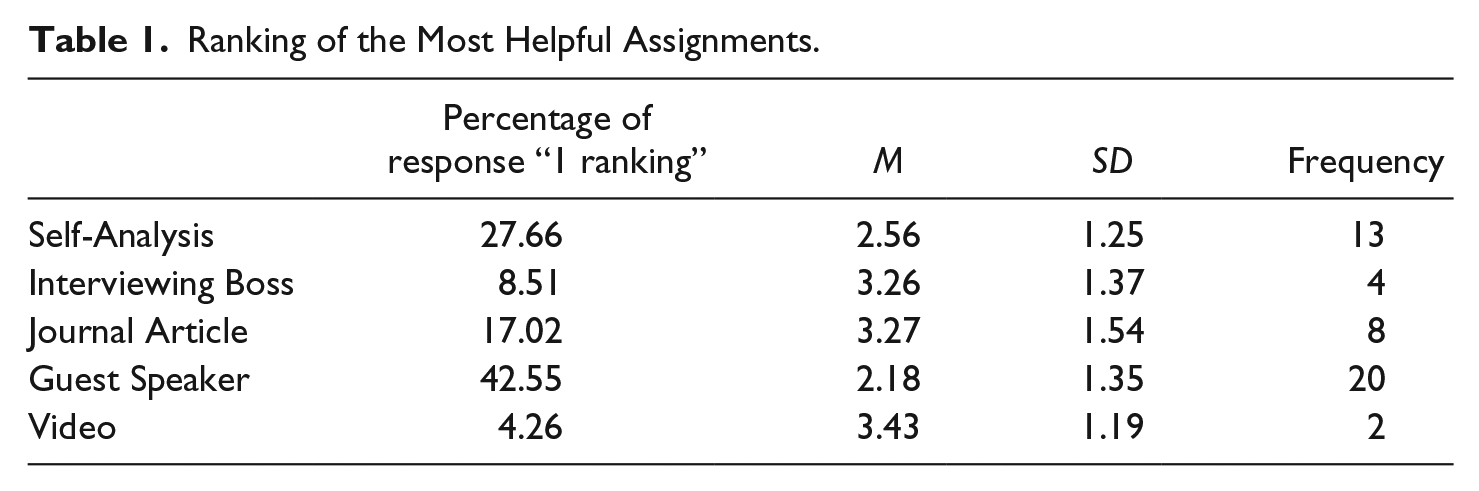
Interestingly, the mean scores of student ratings of the relative benefit of each assignment (Table 2) suggest that there is not a significant difference among many of the assignments. The mean score of the guest speaker (4.4) is markedly higher than the video (3.9), but the self-analysis (4.2), boss assignment (4.1), and journal article (4.0) achieved relatively similar scores. Interestingly, the only contradiction between the ranking question (Question 16) and the question for which students rated the effectiveness of each assignment was the fact that students’ mean scores for the boss assignment were higher (4.1) than the mean scores for the journal article (4.0). This occurred despite the fact that more students (n= 9) ranked the journal article as the number one most helpful assignment in terms of helping them learn about soft skills compared with the number of students (n= 5) who ranked the boss assignment most helpful for learning.
Survey Results (N= 55).
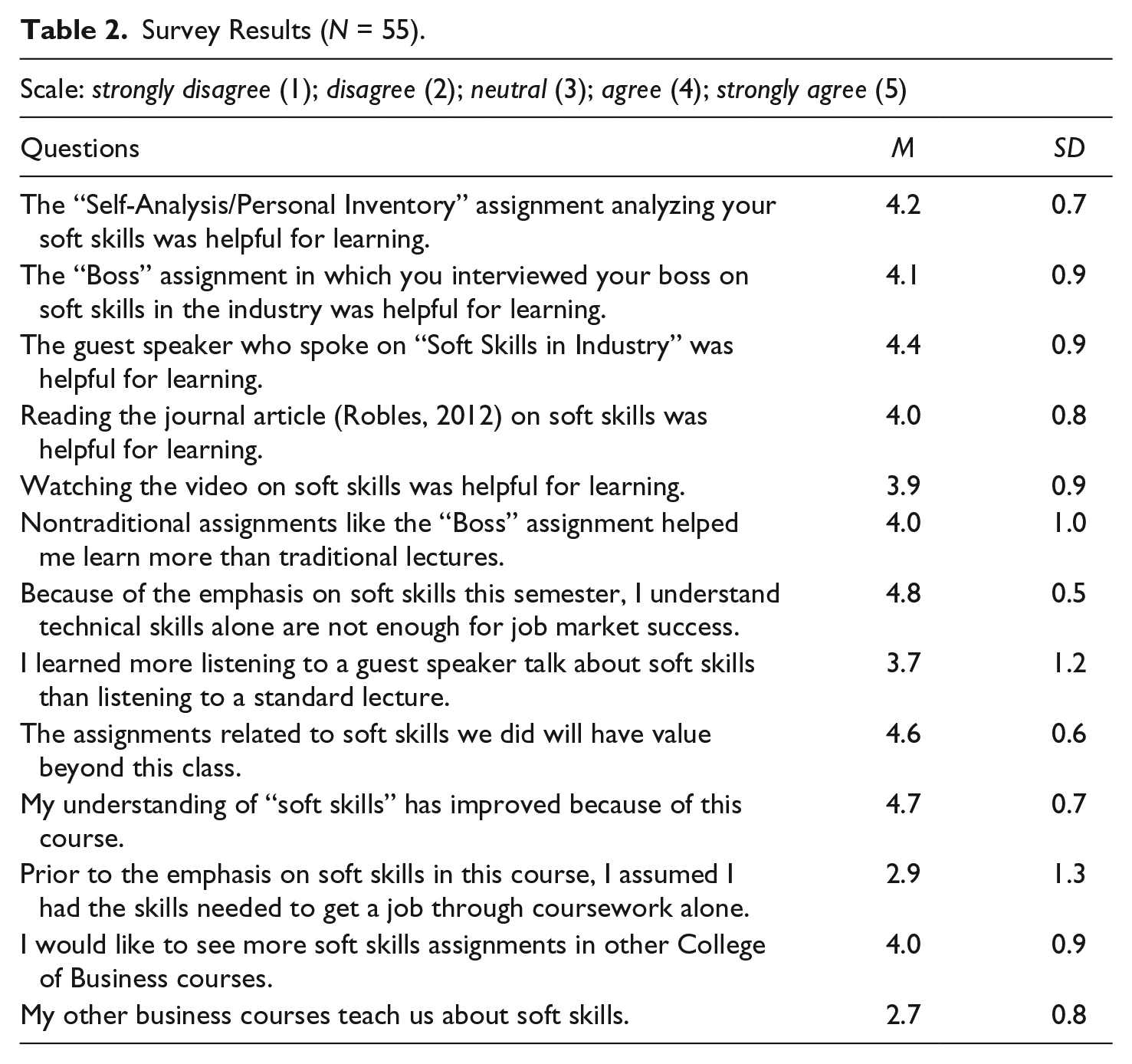
Another interesting finding was that students perceived that they were not getting soft skills coverage in their other business courses. The mean score for the question about whether other business courses teach soft skills was 2.7, which indicates that students generally did not feel soft skills were emphasized in other courses.
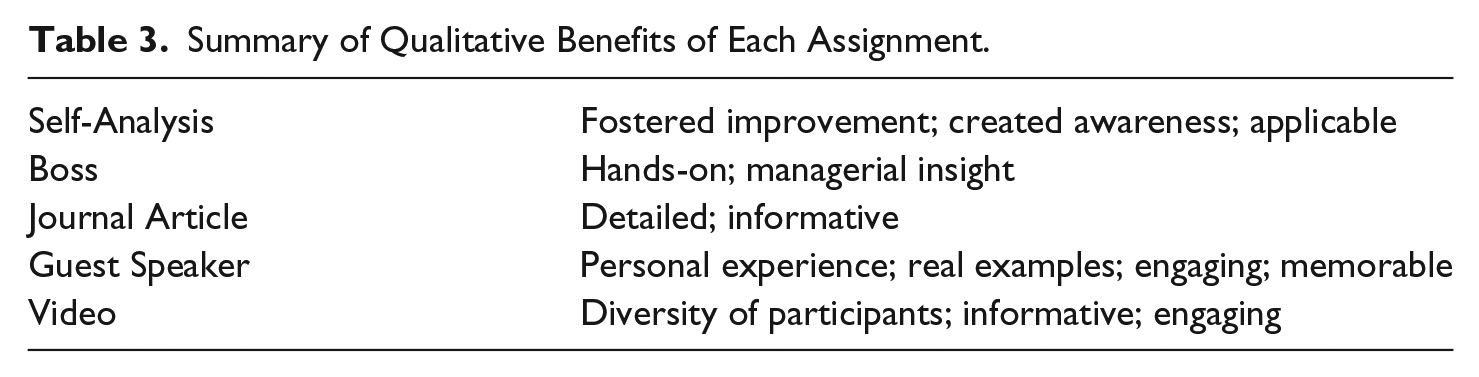
Table 3reflects student comments regarding why they ranked a particular assignment the most helpful for learning soft skills. The qualitative comments regarding why students ranked a given assignment as most helpful were categorized into major themes for each assignment. As mentioned above, the highest number of students (n= 22) rated the guest speaker as the most helpful. For the guest speaker, students found the personal experiences of the speaker helpful, appreciated the real examples, perceived the speaker as engaging, and thought the experience was memorable. Students who rated the self-analysis most helpful (n= 14) reported that it created awareness of personal skills, encouraged improvement, and was practical. In terms of the journal article, nine students valued the detailed and informative nature of the article. Those students (n= 5) who rated the boss assignment as most helpful mentioned that it was hands-on and provided insight into managers’ perspectives. More on this theme will be explored below. Finally, the small minority of students (n= 3) who listed the video as most helpful said that it was engaging, had diverse participants, and was informative.
Summary of Qualitative Benefits of Each Assignment.
Strengths and Weaknesses of the “Boss” Interview Assignment
We were particularly interested in students’ perceptions of the “Boss” interview assignment in which students were asked to interview their manager about soft skills, as this was one of the most interactive and innovative assignments of the course. Therefore, in addition to looking at qualitative comments from students who ranked a given assignment number one, we added an additional component evaluating the strengths and weaknesses of the boss assignment to learn how to improve this assignment for future semesters. This assignment seemed more untested and warranted additional probing. After coding the qualitative comments for dominant and reoccurring themes (Braun & Clarke, 2006;Ryan & Bernard, 2003), we uncovered several avenues for improvement. With all of the thematic groupings below, there were other outlier suggestions, but we have extracted the more frequently mentioned themes.
First, the most dominant themes relating to the benefits of the boss assignment included that it (a) provided helpful insight into managerial perspectives, (b) was informative about the importance of soft skills, (c) afforded a beneficial interview process, and (d) offered real-life applications. The most significant of these was that students gained a better understanding of their boss and their boss’s expectations for what managers are looking for in effective employees. Others mentioned that the assignment was very informative, the interview format was helpful, and the assignment had a practical application to “real life.”
In terms of the weaknesses of the boss assignment, the four major comments students repeated were time constraints, lack of access to a boss or manager, lack of bosses’ interest in completing the interview, and lack of accountability to ensure students completed the assignment. Students also had suggestions for improving this assignment, including to (a) have a more objective assessment of soft skills by a manager or peers, (b) bring in more guest speakers from various businesses, (c) use more peer interaction, and (d) engage in role-playing or a demonstration of soft skills. Future assignments could consider ways to incorporate these student insights, such as providing more diverse types of objective feedback and engaging in role-playing.
Conclusion
In sum, this research has provided comparative insights into the assignments students find most helpful for learning soft skills in a business communication course. We uncovered several valuable themes—for example, that a guest speaker provides a worthy contribution to traditional lecture and curricula. This finding echoes other research that has noted the benefits of guest speakers (Hughes Miller, 2014;van Hoek et al., 2011). These findings also suggest that assignments that engage students or have practical application are the most helpful. Students also desired more guest speakers, more interaction with peers in class, and assignments that relate to real-world application. However, the relatively low ranking of the boss assignment (fourth most beneficial) is somewhat surprising given that it is practical and appears to be engaging. The qualitative comments regarding the challenges of meeting with the boss may partially explain this lower ranking. Despite our expectations that students would not appreciate the dense journal article on soft skills, we were surprised to find that students ranked it as helpful as they did, higher than the boss assignment and the video on soft skills. As mentioned above, the mean scores for the boss assignment were slightly higher than the journal article, though the difference was minimal. While the guest speaker was clearly rated the most effective and the video on soft skills was clearly the least helpful, the middle three assignments appeared to be relatively similar in terms of the mean scores.
The implications of this research suggest that business educators should bring guest speakers into their classrooms to improve learning gains. These findings also imply that assignments that involve real-world application and examples, as well as assignments that encourage engagement, are perceived as most helpful. Reading a journal article can be beneficial for providing detailed information. Yet it is possible some students find this type of reading challenging. The boss assignment was also positively rated by students, but students ranked it less helpful than a journal article. However, the mean scores suggest that these two assignments are roughly equivalent in value. Finally, the results suggest that videos may not be the most helpful for some students to learn about soft skills.
Given the fact that industry is calling for students with better soft skills, this research suggests that business schools should consider emphasizing soft skills across the curriculum—not merely in business and professional communication courses. The lowest mean score (2.7) suggests that students perceive that soft skills are not emphasized in other business courses. To truly improve students’ soft skills by the time they graduate, a change at the curriculum level may be more effective for building up these competencies.
Limitations and Future Research
This research had several limitations. The sample size (N= 55) was limited, and a larger sample with different instructors could provide more robust results. Both courses were administered by the same instructor. Another limitation was that ranking the assignments, while helpful, may have given the impression that the other assignments were not perceived as effective for teaching soft skills. It is important to compare both the ranking question and the mean scores data to gain a complete picture of the relative effectiveness of each assignment. For example, four of the five assignments were rated a 4 out of 5 or higher, with the video being the only assignment that had a lower score at 3.9. One of the challenges that future research could address is how to maintain accountability for ensuring students complete all of the assignments in an ethical and honest way. Another limitation is that we used the pedagogical approaches in this study that we were most familiar with, yet future research could experiment with other strategies such as peer or manager feedback or role-playing. Future research could also examine ways to provide students who do not work access to managerial-type feedback. It could also be helpful to assess soft skills across different business and professional communication courses.
Footnotes
Appendix
Authors’ Note
This study was approved by the Institutional Review Board of the University of North Georgia.
Declaration of Conflicting Interests
The author(s) declared no potential conflicts of interest with respect to the research, authorship, and/or publication of this article.
Funding
The author(s) received no financial support for the research, authorship, and/or publication of this article.
Author Biographies