







Abstract
The purpose of this study was to explore what corporations with good reputations communicate on social media. Based on a content analysis of 46 corporate Facebook pages fromFortune’s “World’s Most Admired Companies,” this study found that corporations communicate noncorporate social responsibility messages more frequently than corporate social responsibility (CSR) messages. When communicating CSR activities, corporations employed an informing strategy more often than an interacting strategy and included internal publics’ activities more than external publics. This study also found that publics engage more with noncorporate social responsibility messages than CSR messages, which may reflect public cynicism of CSR communication.
Due to the growth of social media, corporations are eager to adopt it for daily communication with their publics (Kaplan & Haenlein, 2010;“Social Media Usage,” 2012). Compared with traditional media, social media have strengthened organizations’ abilities to engage with their publics beyond simply disseminating information, which publics have come to expect from them (Cone Communications, 2008;Kelleher & Miller, 2006). Gone are the days when corporate websites were sufficient means of disseminating information to the media and other stakeholders (Callison, 2003). Today’s corporations take advantage of the opportunity to engage with publics by actively utilizing various types of social media, and of those media, Facebook is the most popular (Sareah, 2015).
Social media also allow publics to easily express their expectations or opinions about an organization and its practices. In this sense, CEOs from Fortune 50 companies and many others view social media not as emerging but mature enough to be actively used and monitored to better understand public expectations (Arthur W. Page Society, 2013). While understanding the raison d’être of profit organizations, publics also have expected corporate citizenship. To meet such expectations, it is imperative that corporations not only conduct but also communicate their corporate social responsibility (CSR) activities.
Tang, Gallagher, and Bie (2015)have asserted that CSR can be understood as a discourse, or “an interrelated set of texts, and the practices of their production, dissemination, and reception, that brings an object into being” (as cited inPhillips & Hardy, 2002, p. 3). Yet constructing this discourse or communicating CSR is challenging because corporations need to gratify different expectations from various publics, which oftentimes conflict (e.g., shareholders vs. community members;Carroll, 1991;Porter & Kramer, 2002). More importantly, publics are quick to criticize CSR activities and have negative attitudes toward explicit CSR communication, as they are perceived as self-serving for the corporation rather than truly caring for the community (Coombs & Holladay, 2012;Waddock & Googins, 2011;Wagner, Lutz, & Weitz, 2009). However, communicating CSR is still crucial to enhancing corporate reputation and public support (Coombs & Holladay, 2012;Ihlen, Bartlett, & May, 2011). In particular, utilizing interactive media to communicate CSR issues is considered an effective means for building organization-public relationships and gaining legitimacy from publics (Capriotti & Moreno, 2007;Esrock & Leichty, 1998;Fieseler, Fleck, & Meckel, 2010).
The main purpose of this study was to explore what CSR efforts corporations deemed to have good reputations are communicating on Facebook. More specifically, this study examined CSR communication, by adoptingMorsing’s (2006)informing and interacting strategies. It also explored the major stakeholders portrayed in CSR activities and how stakeholders engage with CSR messages on Facebook. In doing so, this study provides academic and practical implications for CSR communication. More specifically, for those who teach business communication in an academic or organizational setting, this study could provide knowledge about how corporations are and should be communicating their CSR activities on Facebook.
Literature Review
Defining CSR and CSR Communication
The concept of CSR has been actively used in modern business practice, although the term has evolved over several decades (Carroll, 1991). CSR has often been used interchangeably with corporate citizenship or corporate sustainability that incorporates corporate economic, social, and environmental commitment, but there is no clear definition of the term (van Marrewijk, 2003). However,Laasch and Conaway (2015)distinguish CSR from corporate sustainability and argue that sustainability, responsibility, and ethics performance comprise a definition of responsible business. Regardless of the discrepancies in definitions, most literature and practices highlight the importance of making proactive efforts to facilitate both business success and social well-being. WhileCarroll’s (1991)four dimensions of CSR—economic, legal, ethical, and philanthropic—have been widely used to explore corporate socially responsible activities, there are some scholars who have tried to refine CSR activities by distinguishing economic responsibility activities from other performances because these activities, such as product quality and customer satisfaction, heavily focus on business success but not greater social benefits (Brown & Dacin, 1997;Kim, Kim, & Sung, 2014). For example, after an extensive review of literature,Dahlsrud (2008)specified CSR activities with five dimensions: environmental, social, economic, stakeholder, and voluntariness. Similarly,Kim et al. (2014)proposed six categories of CSR, such as environmental stewardship, philanthropic contribution, educational commitments, community/employee involvement, public health commitments, and sponsorship of cultural/sports activities. So, while the concept and practice of CSR is difficult to define and a unified or widely accepted definition does not exist, CSR is nonetheless pervasive in business practices and communication and thus warrants scholarly attention.
As CSR has become increasingly important in business management, CSR communication has also become a hot topic (Bartlett, 2011;Moreno & Capriotti, 2009), given that all knowledge and ideas are formed, accepted, or rejected through communication (Ihlen et al., 2011). To understand and meet their publics’ expectations, corporations should not only act socially responsible but also communicate their CSR activities strategically (Brønn & Vrioni, 2001;Unerman & Bennett, 2004). Yet many corporations that are indeed committed to CSR efforts often fail to communicate their good deeds effectively (Lewis, 2003).
Communicating CSR poses a unique challenge because it may generate stakeholder skepticism of an organization’s intentions for engaging in CSR (Farooq, Merunka, & Valette-Florence, 2013). This occurs when publics perceive CSR as an instrument for glossing corporate images (Coombs & Holladay, 2012;Ihlen et al., 2011;K. Lee, Oh, & Kim, 2013;Schlegelmilch & Pollach, 2005;Waddock & Googins, 2011). Moreover, corporations often deal with conflicting expectations from various stakeholders. For example, investors may expect high financial performance, whereas community members anticipate corporate philanthropic or volunteer activities.O’Connor and Shumate (2010)found that CSR communication also varies by industry—specifically that corporations in the mining and chemical industries focus CSR communication on responsibility to employees and the environment, while industries such as retailing tend to emphasize philanthropic and education-related CSR.
Thus, corporations should carefully develop CSR communication plans to provide consistent information, satisfy the expectations of each stakeholder, and ultimately build public trust. In order to avoid public skepticism of CSR and build trusting relationships with publics, corporations need to communicate authentic CSR efforts at the core of corporate values (Waddock & Googins, 2011).
CSR Communication in the Digital Media Age
Social media have changed information sharing and relationship building practices online by allowing previously passive information consumers to become their own creators and transmitters of information (K. Lee et al., 2013). They have also opened up a new door for businesses to reach stakeholders. Social media are attractive to organizations because of the opportunities they provide to interact with publics (Kelleher & Miller, 2006;Kent & Taylor, 1998;Yang & Lim, 2009).
In general, three characteristics of social media have reshaped corporations’ public identities (K. Lee et al., 2013). First, social media allow a company to maintain relationships with its stakeholders (Kent & Taylor, 1998;Unerman & Bennett, 2004). Second, social media are uncontrollable, meaning the information flow is multidirectional and hardly predictable, as social media users can easily create, share, and even alter information (Friedman, 2006). Last, social media make all content—good and bad—easily searchable and accessible to anyone (K. Lee et al., 2013). These characteristics make it easy for publics to act against any perceived signs of misinformation and/or manipulation, which poses challenges to companies who decide to use social media to reach stakeholder groups.
Even with these challenges, many scholars have highlighted the positive effects of message or media interactivity on organization-public relationships, brand/corporate attitudes, and publics’ support (Kelleher, 2009;Kelleher & Miller, 2006;Ko, Cho, & Roberts, 2005;H. Lee & Park, 2013;Yang & Lim, 2009). Focusing on CSR communication, social media allow corporations to set and present a CSR agenda without being modified by traditional media or gatekeepers. They also change the communication patterns from traditional one-to-one or one-to-many communication to any-to-any and many-to-many communication (Capriotti, 2011;Springston, 2001).
Because of these benefits, it is recommended that businesses communicate CSR activities through interactive media, yet research has found that corporations’ use of social media is limited in terms of volumes and topics (Capriotti & Moreno, 2007;Etter, 2013;Fieseler et al., 2010;Moreno & Capriotti, 2009). To explore the current state of CSR communication on social media, this study addressed the following research question:
CSR Communication Strategies: Informing Versus Interacting
Despite extensive research on CSR, researchers have rarely explored CSR message strategies. Filling this gap,Morsing and Schultz (2006)introduced three CSR communication strategies that describe different levels of stakeholder engagement: information, response, and involvement. These strategies are rooted in three public relations models suggested byGrunig and Hunt (1984): public information, two-way asymmetry, and two-way symmetry. They also proposed the press agentry/publicity model as a primitive public relations practice, but this model does not describe CSR communication well because it does not embrace ethical and transparent communication (Morsing & Schultz, 2006). SimplifyingMorsing and Schultz’s (2006)strategies to informing and interacting strategies,Morsing (2006)proposed a model for strategic CSR communication. The two CSR communication strategies have seven core issues to be integrated in CSR communication.
First, the informing strategy involves providing coherent messages with both internal and external publics to enhance corporate visibility and public trust (Morsing, 2006). To meet this goal, there are four issues the informing strategy should address: (a) emphasis of CSR as a shared concern between a business and its publics, (b) linking CSR to core corporate business, (c) visible evidence that demonstrates corporate support, and (d) CSR results. These four CSR issues are identified internally and announced to external publics without expecting feedback from publics (Grunig & Hunt, 1984;Morsing, 2006;Morsing & Schultz, 2006).
Alternatively, a main focus of the interacting strategy is corporate efforts to engage with publics in developing and implementing CSR programs (Morsing, 2006). The interacting CSR strategy includes (a) having social partnerships with community leaders and nonprofit organizations; (b) local articulation, which is denoted as corporate engagement with a community by inviting or being invited to external publics for open communication; and (c) receiving proactive endorsements from external publics about corporate good deeds.
These two CSR communication strategies are compatible with public relations’ one-way and two-way communication models (Grunig & Hunt, 1984). Even though corporations can disseminate trustworthy CSR information, the informing strategy is limited to unidirectional communication, from an organization to publics. Corporations taking this approach try to “give sense” to their publics (Gioia & Chittipeddi, 1991;Morsing & Schultz, 2006). However, the interactive strategy allows corporations to have open communication to reflect public feedback in building and implementing CSR initiatives. Through a continuous dialogic loop of communication (Morsing & Schultz, 2006), both corporations and publics cocreate sense with the interactive strategy.
Scholars assert that corporations should utilize two-way communication to highly engage publics (Capriotti, 2011;Capriotti & Moreno, 2007;Morsing, 2006;Morsing & Schultz, 2006). However, given that the existing literature has not explored CSR communication strategies on social media and that social media offer various interactivity opportunities, the following research question was posed:
Some corporations manage specialized social media accounts to only deal with CSR-related issues, which, in many cases, are managed by CSR experts within the organization.Etter (2013)found that, compared with general Twitter accounts, corporations engage more with their publics via CSR-specific Twitter accounts. Reflecting the previous studies, this study further addresses the following hypothesis:
Major Stakeholders in CSR Communication
Along with the CSR message strategies, it is imperative to involve actions and voices of both internal and external stakeholders in CSR communication, to ensure these efforts are successful and minimize public cynicism toward CSR programs (Cornelissen, 2004;DeKay, 2011;Morsing, 2006;Waddock & Googins, 2011). First, from an organization’s internal aspect, even though CEOs and top senior managers usually determine CSR initiatives, employees’ voices are often directly or indirectly reflected in the programs (Morsing, 2006;S. Young & Thyil, 2009). Employees’ active involvement in fundraisers or volunteer programs has become a common CSR practice, which enables corporations to demonstrate that the company, as a whole, is concerned about social well-being. Additionally, given that publics trust regular employees more than CEOs (Edelman, 2013), corporations should involve voices from various internal stakeholders to demonstrate genuine CSR efforts.
The importance of including external stakeholders in CSR communication is also well documented (Morsing & Schultz, 2006;Morsing, Schultz, & Nielsen, 2008;Waddock & Googins, 2011). According to Edelman Trust Barometer, publics trust CSR information more when it comes from activist consumers or independent organizations over a corporate internal spokesperson (Edelman, 2013). This means CSR messages that include a third-party endorsement or involvement in CSR programs help corporations decrease public criticism, making CSR information more trustworthy. To explore which stakeholders corporations include in their CSR messages, this study proposed the following research question:
Three Engagement Levels on Facebook
Facebook is a leading social media site, as more than 1 billion people had Facebook accounts as of 2012 (Grandoni, 2012). Like other social media, one of the most significant benefits of Facebook is the engagement opportunity it provides between an organization and its publics. Specifically, Facebook offers three distinct engagement tools—Like, Share, andComment—that allow Facebook users to interact with each other.
These three engagement features represent different levels of engagement between an organization and its publics on Facebook (Cho, Schweickart, & Haase, 2014). As a low level of engagement, the Like tool is used when people like, enjoy, or agree with certain posts without the extra effort to show verbal expression. Also adopting this conceptualization of Like,Jiang, Huang, Wu, Choy, and Lin (2015)have examined the liking behavior of publics during an organizational crisis. By clicking the Share button, a medium level of engagement, publics can voluntarily disseminate organizational information and even express their own opinions or thoughts to their Facebook friends. Finally, the Comment tool is considered the highest level of engagement, as it requires more effort and allows publics to directly engage with an organization and other publics by responding to organizational postings.
Wei, Xu, and Zhao (2015)adopted the three levels of engagement on Facebook in a study of China Fortune 500 firms. The results indicated that “information overload” from information updates led to decreasing levels of engagement by publics (Wei et al., 2015, p. 626).Kim et al. (2014)also used Like, Share, and Comment as a way to examine publics’ participation in dialogue with Fortune 100 companies on Facebook, finding that fans liked posts more often when the Facebook messages were personalized. More specifically, seeking specific responses from Facebook fans increased the frequency of likes and comments as well as how often companies responded to their fans. In a study of nonprofits’ Facebook messages, publics were more likely to comment on the messages based on two-way symmetric communication than ones based on either public information or two-way asymmetric communication (Cho et al., 2014). Adopting the three engagement tools offered by Facebook for CSR communication, the current study posits the following hypothesis:
With the popularity of social media, both scholars and practitioners are eager to learn people’s motivations for following corporate social media. One of the main reasons publics become a Facebook fan of brands is to show their loyalty, receive promotional benefits, and get regular updates (Bosker, 2013;Porterfield, 2010). Because of public skepticism toward CSR-related messages or activities (Coombs & Holladay, 2012;Ihlen et al., 2011;Schlegelmilch & Pollach, 2005;Waddock & Googins, 2011), CSR messages may not be viewed as favorably as noncorporate social responsibility (non-CSR) messages, like freebies, promotions, or corporate updates. Thus, the following hypothesis is proposed:
Method
Research Design and Sample
To address the hypotheses and research questions, a quantitative content analysis was conducted. For the sample, the study purposively focuses on corporations that practice high CSR performances. Even though many corporations are reluctant to communicate their CSR activities to avoid possible public cynicism (Coombs & Holladay, 2012;Ihlen et al., 2011;Waddock & Googins, 2011), corporations with long-term commitments to CSR and a good reputation may communicate their social values more often. In this regard, this study adopted the 2013 list ofFortune’s “World’s Most Admired Companies.” This list represents the companies with good corporate reputations, and CSR performance is one of the key factors to being selected.1Previous studies have also adopted this list to explore corporate reputation (Musteen, Datta, & Kemmerer, 2010).
Of the 50 corporations listed, 44 have official corporate Facebook pages. In addition, two (Chase Bank and Home Depot) have CSR-specialized Facebook pages, which were added to the sample for a total of 46 pages. As most CSR studies are cross-sectional, short term, and have a single level of analysis (Aguinis & Glavas, 2012), this study sought to extensively analyze CSR-focused messages for a 1-year period (from January 1, 2013 to December 31, 2013). The unit of analysis in this study is corporate Facebook messages. A total of 3,766 corporate messages were collected for final data analysis.
Measures
CSR Communication Strategy
Morsing’s (2006)two CSR communication strategies, informing and interactive, were used to measure CSR communication strategy. The informing CSR strategies are further exemplified with four CSR communication issues, including (a) corporate promise to consider CSR as a core concern of business, (b) plans for how to incorporate CSR activities into corporate values, (c) visible evidences for corporate support, and (d) CSR results accomplished. Facebook messages that (a) announce corporate partnership with community leaders and nonprofit organizations, (b) highlight corporate engagement with local communities, and (c) include external publics’ endorsement were coded as the interactive CSR strategy.
Additionally,Kim et al.’s (2014)six categories were adopted to classify the CSR topics or issues. The topics include environmental stewardship, philanthropic contribution, educational commitments, community/employee involvement, public health commitments, and sponsorship of cultural/sports activities. These topics include both internal and external CSR commitments that were communicated via Facebook. Facebook postings that did not fall into any of these categories were coded as non-CSR issues, which include product/service information, corporate information, holiday/events/condolences, and legal compliance.
CSR Major Stakeholders
The study coded the major stakeholders in CSR messages into two categories: internal and external stakeholders. Internal stakeholders were further classified into CEO, C-suite/top management, employees, and corporate general, whereas nonprofit organizations, community members, and suppliers were coded as external publics. The study also counted whether postings included endorsements and identified the endorsers.
Three Engagement Levels on Facebook
To measure the levels of engagement, the number of Likes, Shares, and Comments on each posting was coded. Additionally, basic information about the Facebook pages, such as the number of people who liked the Facebook page, the number of people talking about it, and the number of people who visited it, was coded.
Intercoder Reliability
Two trained coders assessed intercoder reliability by selecting 10% of the total sample data. Scott’s π was used to measure reliability, and the average scores were .94, ranging from .89 to .98.
Results
Descriptive Analysis of Data
At the time period of coding, an average of 16923088.45 (SD= 33846420.83) people liked the sampled corporations, ranging from a minimum of 12,883 to a maximum of 141,555,999 Likes. An average of 406804.52 (SD= 1561585.30) people were talking about the corporate pages, ranging from 96 to 7,538,037 people. Additionally, an average of 1883560.50 (SD= 4201389.26) people visited the corporate Facebook pages, ranging from 2,740 to 10,449,009 visits. On average, the corporations created 83.67 new posts (SD= 28.88) over the 1-year period, with the frequency ranging from 14 to 157 posts. Out of 702 CSR messages, 556 (79.2%) were presented on corporate Facebook pages and 146 (20.8%) were placed on CSR-specialized Facebook accounts.
Evidence for Hypotheses and Research Questions
To answer Research Question 1 that addressed to what extent corporations communicate CSR messages on Facebook, frequency counts were checked. AsTable 1shows, non-CSR issues (n= 3,064 or 81.4%) were communicated more than CSR messages (n= 702 or 18.6%).
Frequency of Corporate Facebook Postings.
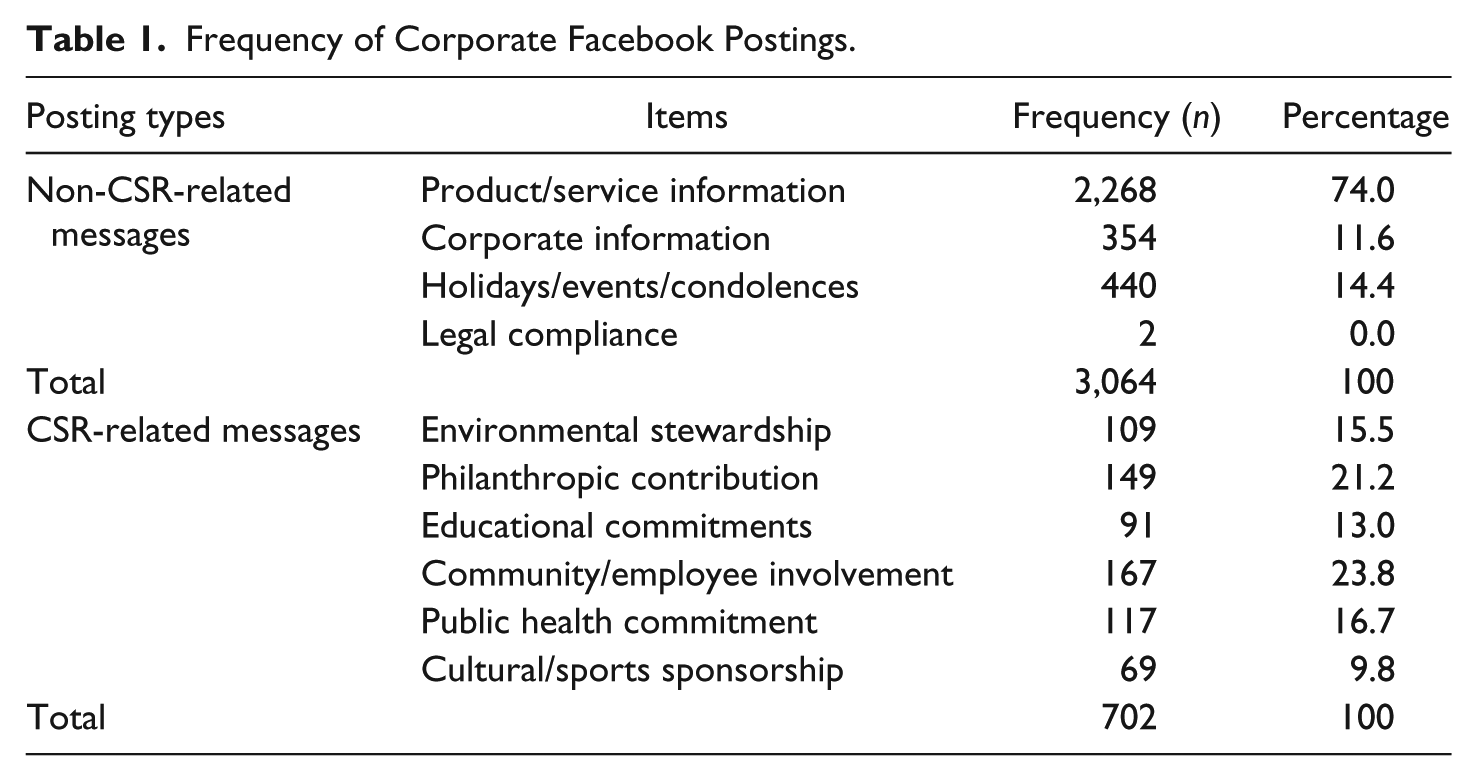
More specifically, the majority of non-CSR messages was related to product/service information (n= 2,268 or 74.0%) or corporate information, such as governance and employment (n= 354 or 11.6%). A total of 440 (14.4%) of the non-CSR messages was related to holiday greetings, national/international events (e.g., NFL, PGA, NASCAR, Women’s Day, etc.), sharing photos, condolences, and time change reminders. Two Facebook messages addressed corporate legal compliance (0.0%).
Turning to CSR messages, most were related to corporate community/employee involvement (n= 167 or 23.8%), followed by philanthropic contribution (n= 149 or 21.2%), public health commitment (n= 117 or 16.7%), environmental stewardship (n= 109 or 15.5%), educational commitment (n= 91 or 13.0%), and sponsorship of cultural/sports activities (n= 69 or 9.8%).
The second research question examined which CSR communication strategy was the most frequently used on Facebook. From a total of 702 CSR messages, 493 (70.3%) adopted the informing CSR strategy and 209 (29.8%) utilized the interacting CSR strategy. Of the informing strategy, 181 (25.8%) Facebook posts contained visible evidence for corporate support, followed by corporate promise to CSR as a shared concern (n= 153 or 21.8%), and corporate plans to link CSR to corporate value. Only 28 (4.0%) Facebook messages reported the actual results of CSR programs. In the interacting strategy, 178 (25.4%) posts announced a corporate partnership with community leaders and nonprofit organizations, while 66 (9.4%) portrayed corporate engagement with communities, and 16 (2.3%) included endorsements from external publics.
The first hypothesis anticipated that the interacting CSR strategy would be used more often in CSR-specialized Facebook pages than general corporate accounts. Chi-square tests demonstrated significant differences between the two types of Facebook pages in terms of CSR strategies. While the CSR-specialized Facebook accounts utilized interacting strategies more than informing strategies, corporate Facebook pages used informing strategies more often, χ2(1,n= 702) = 37.80,p< .001. As a result, Hypothesis 1 was supported.
The third research question explored which stakeholders were prominent in CSR messages. From a total of 702 CSR messages, about 70% (n= 492) included internal stakeholders’ CSR involvement, while 210 portrayed external publics’ CSR activities. Among the CSR messages focusing on internal publics, most (n= 406 or 57.83%) described major stakeholders as corporate overall or corporate special CSR campaigns, followed by employees’ participation in CSR activities (n= 64 or 9.1%). The number of CSR messages that portrayed CEO and C-suite/top managers were 10 (1.4%) and 12 (1.7%), respectively. Among the external publics, nonprofit organizations (n= 154 or 21.9%) were the main stakeholders, followed by community members (n= 51 or 7.3%) and suppliers (n= 5 or 0.7%).
To test the second hypothesis that explored different levels of engagement (number of Likes, Shares, and Comments) between the informing and interacting CSR strategies, a series of independentttests was used. Results indicated no differences between the two CSR strategies in the number of Likes,t(700) = 0.45,p> .05; Shares,t(700) = −0.61,p> .05; and Comments,t(700) = 0.59,p> .05). More specifically, the informing strategies (n= 2276.89,SD= 15295.70 for Like;n= 268.83,SD= 2015.04 for Share) outnumbered the interacting strategies (n= 1834.93,SD= 5861.03 for Like;n= 188.54,SD= 1106.25 for Share) in the number of Likes and Shares, whereas the number of Comments for the interacting strategies (n= 208.43,SD= 1794.73) exceeded the informing strategies (n= 140.96,SD= 1126.08). Therefore, Hypothesis 2 was not supported.
Hypothesis 3, which predicted different levels of engagement (the number of Likes, Shares, and Comments) between non-CSR and CSR messages, also used a series of independentttests. First, for the low level of engagement (Like), this study found there was a statistically significant difference between non-CSR messages,M= 8027.26,SD= 27501.47, and CSR messages,M= 2113.20,SD= 12645.99,t(3,764) = 5.56,p< .001. More specifically, non-CSR messages received higher numbers of Likes than CSR messages, and similar results were presented for Share and Comment. Publics shared non-CSR messages more often,M= 820.11,SD= 3855.98, than CSR messages,M= 239.09,SD= 1734.37,t(3,764) = 3.90,p< .001, and non-CSR messages,M= 308.05,SD= 1371.47, received more comments than CSR messages,M= 165.95,SD= 1410.28,t(3,763) = 2.46,p< .01. Thus, Hypothesis 3 was supported.
Discussion
The purpose of this study was to explore how corporations with good reputations communicate their CSR activities and how publics engage with CSR messages on Facebook. To this end, the study analyzed Facebook postings of companies from the 2013 list ofFortune’s World’s Most Admired Companies.
Of the total sample of Facebook postings, less than 20% of the messages portrayed CSR activities; the focus was mainly on non-CSR communication. These findings are consistent with previous studies (Etter, 2013;Fieseler et al., 2010;Kim et al., 2014). While Fortune 500 companies have a tendency to actively communicate CSR messages on their websites to reinforce their corporate reputation (Esrock & Leichty, 2000), these companies did not use similar strategies on Facebook.
Publics’ perceptions and use of social media may provide a possible explanation for the importance of CSR communication. Publics, in general, have negative attitudes toward corporate social media marketing and consider it as invasive (Cohen, 2012). This, coupled with publics’ tendencies to have a high level of skepticism toward CSR, could explain why corporations, even with good reputations, may want to avoid CSR communication, in order not to harm corporate legitimacy (Colleoni, 2013;Coombs & Holladay, 2012;Etter, 2013).
To examine CSR communication strategies on Facebook, this study adoptedMorsing’s (2006)communication strategies and found that the majority of CSR-related posts utilized an informing strategy rather than an interacting one. This echoes previous research, which asserted that organizations—across the sectors of corporate, nonprofit, and government—do not utilize the benefits social media offer (e.g., engaging with publics and building relationships;Bortree & Seltzer, 2009;Culnan, McHugh, & Zubillaga, 2010;Waters, Burnett, Lamm, & Lucas, 2009;Waters & Williams, 2011). Like organizations from other sectors, corporations use social media to supplement traditional media. While scholars have asserted that communication between organizations and publics should move from a one-way to a two-way direction, the findings show a gap between this concept and reality. These findings reveal that corporations are likely unwilling to engage with publics in an effort to minimize public criticism.
This study also explored two Facebook pages dedicated solely to CSR activities. Results indicated that the CSR pages used interacting strategies more often. The small number of CSR-specialized accounts could result from a lack of resources or importance placed on CSR activities; however, having a separate CSR account allows corporations to directly communicate and engage with specific publics who are more interested in learning about corporate good deeds (Etter, 2013). This could also allow them to receive a higher volume of public attention and participation in their CSR programs.
This study further explored the main stakeholders in CSR communication and found corporations clearly favor the use of internal publics, specifically, emphasizing the corporation’s general role in CSR activities when communicating on Facebook. In other words, CSR communication failed to include various publics—both internal and external—possibly influencing/being influenced by CSR activities (Cornelissen, 2004). For example, employees provide great input to complete CSR programs (Liu, Liston-Heyes, & Ko, 2009). Also, involvement of community members and nonprofits is crucial to help corporations build the credibility of their CSR programs (Edelman, 2013;Morsing et al., 2008). A failure to portray CSR activities with high involvement of multiple stakeholders may invoke a sense of skepticism toward the corporation and its CSR activity, making the CSR communication solely self-serving and less credible.
Applying the three engaging features—Like, Share, and Comment—that Facebook offers, this study also examined whether there were differences in the interactivity levels between the two CSR communication strategies. Although a recent study found that adopting a two-way communication strategy increased publics’ engagement levels with nonprofit Facebook (Cho et al., 2014), the similar assumption was not supported in the corporate settings for CSR communication. Given the overflowing public distrust toward the sincerity of CSR, publics may not react to CSR messages, which are often based on corporate self-serving motives to justify their goodwill.
This explanation is more plausible with the study’s finding that publics have a greater tendency to engage with non-CSR messages than CSR messages. In other words, publics liked, shared, and commented more on non-CSR messages, such as product/service information, corporate information, and governance than socially responsible contributions by corporations. Corresponding with the existing literature, one of the main reasons for publics to friend or follow corporate social media is to receive promotional deals and follow corporate updates (Bosker, 2013;Porterfield, 2010).
By exploring corporate use of Facebook for CSR communication, this study revealed that corporations do not optimize the social media venue, despite its potential value. Rather, corporations rarely communicate CSR activities and heavily rely on a one-way communication strategy with an emphasis on internal voices when they reluctantly communicate about this issue.
These findings demonstrate the dark side of today’s CSR communication: corporate reactiveness to communicate CSR activities with publics and publics’ indifference to CSR messages on social media. Based on the findings, this study urges corporate public relations professionals to develop CSR communication strategies that encourage publics to engage with corporations and demonstrate various aspects of CSR by including both internal and external publics involved in the programs. More specifically, this study provides corporate public relations managers and academics teaching CSR communication with a possible solution to reduce the gap between the ideal and reality of CSR communication: proposing the use of CSR-specialized Facebook accounts. By focusing on concerned publics on the CSR-designated page, corporations may easily create public awareness and positive attitudes toward corporations and their CSR programs without dealing with apathetic or skeptical publics. However, more empirical research is needed to test the effectiveness of CSR-specialized Facebook accounts and other social media platforms to identify other possible solutions to addressing skeptical publics.
Pedagogical Implications
In addition to providing business communication managers with practical solutions for improving CSR communication on Facebook, this study also offers relevant topics to discuss in the classroom. In a review of public relations and business and professional communication literature,Penrose (2015)revealed the overlaps between theory and practice of the two disciplines and also identified how public relations can enrich business and professional communication instructors and curriculum. The author provided sample assignments that encapsulate both public relations and business and professional communication, one of which suggests that students “analyze a corporate website for its position regarding corporate social responsibility” (Penrose, 2015, p. 506). This is clearly a valuable exercise for students to complete in order to understand the varying positions of corporations regarding CSR. However, it lacks the added benefit that analyzing CSR communication on social media provides—namely, understanding how varying CSR positions are perceived and evaluated by relevant stakeholders. This study demonstrates that not all CSR positions and communication are uniformly received by stakeholders. Furthermore,Tang et al. (2015)stated that CSR “is a discourse constructed through the constant dialogue and negotiation between corporations and their different stakeholders” (p. 205). As such, business and professional communication students would benefit from examining CSR positions and communication on social media that provide a platform for examining constant dialogue between corporations and stakeholders. In the same vein, the September 2012 issue ofBusiness Communication Quarterlyincluded in the “My Favorite Assignment” section a valuable social media assignment that has students conduct research on a company’s social media use and provide recommendations for improvement (Whalen, 2012). There is clear value in enhancing students’ understanding and education of social media as it relates to business and professional communication (Knight, 2014), particularly because it leads to increased marketability for students in the job market (A. M. Young & Hinesly, 2014).
Despite the contributions to corporate public relations and CSR communication, this research has several limitations that should be noted. First, this study provides only an overview of the current state of CSR communication by corporations via Facebook. It does not, however, look at other social media platforms or seek any factors for the effects of this communication on behaviors, attitudes, and the like. Future research should consider the ever-changing social media environment and choose digital platforms for analysis that are being used for CSR communication accordingly. Employing various research approaches, future research should explore the causal effects of CSR communication and public engagement with CSR messages. Additionally, this study serves as a platform for future researchers to use a qualitative approach for analyzing CSR messages. In terms of generalizability, the study’s findings can be applied to large corporations with good reputations. This study will hopefully encourage future analyses of CSR communication by expanding to various business sizes and settings—small- and medium-sized enterprises or international corporations—to build a strong body of knowledge of CSR communication strategies and public engagement.
Footnotes
Acknowledgements
The authors would like to thank the editor and the two anonymous reviewers for their valuable comments and suggestions.
Authors’ Note
This article is based on a paper presented at the annual conference of the Association for Education in Journalism and Mass Communication, Montreal, Canada, 2014.
Declaration of Conflicting Interests
The author(s) declared no potential conflicts of interest with respect to the research, authorship, and/or publication of this article.
Funding
The author(s) received no financial support for the research, authorship, and/or publication of this article.
Author Biographies