






Abstract
Modern workplace demographics are changing and so too are workplace relationships. This research explores the impact of poor leader relationships on voice behaviors—more specifically, defensive silence. Results indicate a negative relationship between leader-member exchange (LMX) and defensive silence, a positive relationship between communicative anxiety and defensive silence, and a negative relationship between communicative anxiety and LMX. Additionally, a significant interaction is found between age, years of supervisory experience, LMX, and defensive silence. Theoretical and practical implications for workplace relationships are discussed.
Keywords
As populations age (Tamir, 2019), so too do modern workers. Labor force participation rates of seniors in the United States have doubled in the last three decades, leading to an increasingly common reality of four or even five generations present in one workplace (Ansberry, 2023; Fry & Braga, 2023). This reality creates new communication challenges, as age-related differences become apparent in workplace affect (Scheibe et al., 2019), motivation (Inceoglu et al., 2012), and supervisor-subordinate relationships (e.g., Vecchio, 1993). Poor relationships between employees—especially between supervisors and subordinates—are linked to lower task performance, lower organizational citizenship behavior, and counterproductive work behaviors (Martin et al., 2016). These environmental and relational factors can lead to defensive silence.
Defensive silence refers to the withholding of information relevant to the workplace based on fear (Van Dyne et al., 2003). Research on the disintegration of workplace relationships has become increasingly relevant in the current workplace landscape, but literature on the connection between these relationships and defensive silence has remained scarce. Upward dissent in organizations is essential in preventing illegal and immoral behavior, addressing mistreatment or injustice, and creating actionable solutions to employee problems (Detert & Edmondson, 2011). Strong relationships between leaders and subordinates are associated with prosocial dissent strategies (Okafor et al., 2021), while weak relationships are associated with latent—or ineffectual—dissent (Kassing, 2000). Defensive silence is destructive to organizational learning (e.g., Qi & Ramayah, 2022), and research into its origins and mechanisms is important for workplace development, especially in the current era of fragmentation and separation (Dundon, 2018). Therefore, this research examines defensive silence in the context of poor relationships between supervisors and subordinates, as well as traits that exacerbate these issues.
This research is important for several reasons. First, research on defensive silence is timely, as rates of anxiety are increasing at an unprecedented pace among young adults (Goodwin et al., 2020). Defensive silence arises from feelings of fear and trepidation (Van Dyne et al., 2003), which are often interrelated with anxiety (Suinn, 1969). Second, feelings of anxiety among youth—which may be exacerbated by relational and contextual factors in the modern workplace (Afonso et al., 2021)—lead to (1) lower leader-member relational quality and (2) a greater propensity for defensive silence. Third, the intersection of demographic traits and leader-member relational quality in relation to defensive silence is tested in this research, with results indicating significant differences between age and experience levels. This intersection is a novel contribution and may have practical implications for managers attempting to navigate the modern workplace.
Theoretical Framework
Defensive Silence
Defensive silence is the reluctance or refusal to share information relevant to the workplace based on fear or trepidation over potential workplace outcomes (Van Dyne et al., 2003). Defensive silence represents one of three forms of employee silence, the others being acquiescent silence and prosocial silence. In contrast to defensive silence, the motive for acquiescent silence is resignation, and the motive for prosocial silence is to benefit others in the organization (Van Dyne et al., 2003). Defensive silence might entail omitting facts in the reporting of an event to protect oneself. Conversely, individuals who are acquiescently silent might withhold information based on feelings of low self-efficacy, while individuals who are prosocially silent may remain quiet in order to protect others. Although leaders may also engage in silence behaviors (Chang et al., 2021), this study focuses specifically on the defensive silence of subordinates as it relates to other workplace variables.
Defensive silence is a communicative act. It represents a decision on behalf of the silent individual to not share information with workplace others, an act in and of itself signaling the values and motivations of the individual. Chou and Chang (2020) assert that employee silence may include solicitation from a target (e.g., a boss) or no solicitation (i.e., unsolicited) and a basis for the employee’s decision (e.g., predetermined, issue-based). In this case, the focus of this research would be classified as solicited target-based employee silence, which is shaped by social relationships and relational experiences in the workplace (Chou & Chang, 2020).
As mentioned previously, the motivational force behind defensive silence is fear (Van Dyne et al., 2003). Fear arises, in this case, from the perceived risk of negative repercussions from voice. Negative repercussions can take many forms, including reprimand, loss of privileges, or even dismissal. As defensive silence is a communicative act, so, too, are its antecedents. The upward communication of relevant information can be of great value to organizations (e.g., Detert & Edmondson, 2011; Lewis, 2020). Therefore, to instill fear in subordinates over such acts may be the result of poor leader-member relational quality.
Leader-Member Exchange (LMX)
Leader-member exchange (LMX) is a relational leadership theory detailing the negotiation process between leaders and subordinates as it pertains to roles in the group (Graen & Uhl-Bien, 1995). The role negotiation process occurs in three stages: role taking, role making, and role routinization (Kramer & Danielson, 2016). In the role-taking phase, directions are given to the subordinate, and the subordinate accepts and attempts to meet leader expectations. In role making, the leader and follower co-construct the duties and characteristics of the follower’s position. Lastly, in role routinization, the nature of the subordinate’s role is decided and the subordinate is firmly planted in out-group or in-group status (Kramer & Danielson, 2016).
Members who are high LMX (in-group) tend to receive special privileges from the leader, such as the disclosure of restricted information, advice seeking, and frequent contact. Leaders tend to be more receptive to the upward dissent of high-LMX followers. Conversely, members who are low LMX (out-group) tend not to receive privileges from the leader. Conversations will be limited to professional matters, with the leader dictating expectations to the subordinate. Contact between leader and low-LMX members will be more infrequent, and the leader is less likely to be receptive to their upward dissent (Graen & Uhl-Bien, 1995).
Strong LMX relationships require that followers feel listened to (Lloyd et al., 2017), cared for, and supported by the leader (Graen & Uhl-Bien, 1995). Low-LMX relationships are associated with several negative workplace outcomes. Lee et al. (2021) found that subordinates who are out-group members (i.e., low-LMX) are more likely to respond to workplace bullying maladaptively—specifically, through acquiescence, exit, or retribution—than their high-LMX counterparts. Low-LMX members are also more likely than their high-LMX counterparts to leave when they are dissatisfied in the workplace (Lee & Varon, 2020). Perhaps most consequential for this study is the finding from Thompson et al. (2011) that high-LMX employees experience greater feelings of safety in the workplace than out-group members. Reduced feelings of safety and heightened punitive action can contribute to feelings of anxiety.
Communication Anxiety
Communication anxiety refers to “an individual’s level of fear or anxiety associated with either real or anticipated communication with another person or persons” (McCroskey, 1984, p. 13). Communication anxiety is conceptualized in two ways—context communication anxiety and state communication anxiety. Context communication anxiety refers to an enduring, trait-like orientation toward fear or apprehension in certain communicative contexts (McCroskey, 1984). State communication anxiety refers to a “here and now” fear response of an individual to a communicative situation (Booth-Butterfield & Gould, 1986). This project focuses on context communication anxiety—more specifically, a dyadic context. Communication anxiety can lead individuals to avoid, withdraw from, and disrupt communication (McCroskey, 1984), which will naturally have an effect on workplace relationships.
Communication anxiety is associated with age and experience. In Marcel (2022), the author investigated levels of communication anxiety in a sample of over 3,000 college-educated adults, aged 20-72 years. Results indicated that levels of communication apprehension fell as age, full-time work experience, and presentation frequency increased. Additionally, communication anxiety is associated with relationship quality between leaders and subordinates. Madlock et al. (2007) found that communication anxiety was the greatest predictor—among several communication traits—of LMX quality. Based on this previous work, the following section presents the authors’ hypotheses. (See Figure 1 for the hypothesized model.)

Hypothesized structural model.
Hypotheses
This research focuses on defensive silence, LMX, communication anxiety, age, and supervisory experience. Hypothesis 1 predicts a negative relationship between LMX and defensive silence. Hypothesis 2 predicts a positive relationship between communication anxiety and LMX. Hypothesis 3 predicts a positive relationship between communication anxiety and defensive silence. Hypothesis 4 predicts a negative relationship between age and defensive silence, and Hypothesis 5 predicts a negative relationship between years of supervisory experience and defensive silence. Hypothesis 6 predicts that age will intensify the negative effect of LMX on defensive silence. Hypothesis 7 predicts that years of supervisory experience will attenuate the negative effect of LMX on defensive silence. The following paragraphs provide a rationale for these posited relationships.
Self-protection and fear are two core components of defensive silence (Van Dyne et al., 2003). The desire to protect oneself in the workplace may arise from a variety of factors, such as lack of trust in management (Dedahanov & Rhee, 2015), lack of choice or paralysis in the workplace (i.e. structurational divergence; Zanin & Bisel, 2023), and lack of receptivity on behalf of management (Sijbom et al., 2015). These factors are characteristic of low-LMX relationships (Graen & Uhl-Bien, 1995). Prosocial dissent strategies are associated with high-LMX relationships (Okafor et al., 2021), whereas latent dissent strategies (e.g., complaining to coworkers instead of management) are associated with low LMX (Kassing, 2000). Accordingly, we conceptualize defensive silence as a subtle dissent strategy—because of the absence of observable dissent—and therefore propose the following hypothesis:
Hypothesis 1: LMX is negatively related to defensive silence.
High-LMX relationships require careful cultivation and frequent communication between supervisors and subordinates (Graen & Uhl-Bien, 1995). However, frequent communication may be a challenge for those with high communication anxiety. Communication anxiety can lead individuals to maladaptive communication behaviors that are not conducive to relationship development (McCroskey, 1984). Power differences between superiors and subordinates may exacerbate this issue (Liu et al., 2023), which is supported by the findings of Madlock et al. (2007). Therefore, the following hypothesis is posed:
Hypothesis 2: Communicative anxiety is negatively related to LMX.
Individuals who experience high levels of communication anxiety will grapple with enduring fear in communicative encounters. Given their predisposition toward maladaptive behaviors and the likelihood of a lower-LMX relationship, their propensity to dissent and their supervisor’s receptivity (to that dissent) is unlikely. Individuals who enact defensive silence often do so as a fear response (Van Dyne et al., 2003). Therefore, the following hypothesis is offered:
Hypothesis 3: Communication anxiety is positively related to defensive silence.
As mentioned previously, increases in age lead to decreases in communication anxiety (Marcel, 2022). Communication anxiety is rooted in fear and trepidation (McCroskey, 1984), much like defensive silence. If communication anxiety lowers with age, so too should defensive silence:
Hypothesis 4: There is a negative relationship between an employee’s age and their level of defensive silence.
Marcel (2022) also found a negative relationship between experience in the workplace and communication anxiety. Accordingly, we hypothesize as follows:
Hypothesis 5: There is a negative relationship between an employee’s years of supervisory experience and their level of defensive silence.
Although some individuals leave and reenter the workforce, change industries, or start later in life, it is often the case that as a person ages, they gain organizational knowledge through their tenure with the organization. As a result, they may come to know their boss or supervisor better. In this case, those who have a poor relationship (i.e., low-LMX) with their supervisor will come to know that dissent may not be received well. Conversely, those with strong leader-subordinate ties will have cultivated a relationship in which they can confront their supervisor. Therefore, we present the following hypothesis:
Hypothesis 6: Age moderates the effect of LMX on defensive silence, such that, as age increases, the negative effect of LMX on defensive silence increases.
Although age and supervisory experience may be related—in the sense that one would naturally age as they gain years of supervisory experience—the two are not equivalent. As mentioned, many people follow nontraditional career paths, and some do not pursue supervisory roles. In contrast to Hypothesis 6, as supervisory experience increases, those with high-LMX relationships may be more likely to engage in defensive silence. Fear and trepidation may arise when considering the risk of damaging a well-established (i.e., high-LMX) relationship. For those who are low LMX, the relationship is already poor, so the potential cost of dissent is lower. In addition to this, those with supervisory experience may better understand the consequences of speaking up in the workplace.
Hypothesis 7: Years of supervisory experience moderates the effect of LMX on defensive silence, such that, as years of supervisory experience increase, the negative effect of LMX on defensive silence is attenuated.
Method
Participants and Procedures
Data was collected using a survey deployed on Prolific, a platform offering high-quality survey data in terms of participant attention, honesty, and adequate time given to responding (Douglas et al., 2023; Peer et al., 2021). Participants were required to (1) have a boss and (2) be working 30 hours a week or more in order to participate. Participants with inappropriate responses to any of the five attention checks, as well as responses from participants who did not have a supervisor at the time, were excluded (n = 29), with 312 responses retained for the analysis. All participants were 18-65 years of age and living in the United States. The typical participant was male (54.0%), in his 30s (M = 35.1, Mdn = 33.0, SD = 10.7), college educated (0.3% some high school, 9.9% high school diploma or GED (General Educational Development), 15.0% some college, 6.7% associate degree, 4.4% bachelor’s degree, 1.6% some graduate school, 16.9% master’s degree, 5.4% doctorate degree), and White (74.4%; 10.8% Asian, 5.4% Black, 6.0% Hispanic or Latino, 0.6% Middle Eastern, 0.9% Native American, 1.6% not listed), as well as fairly inexperienced as a supervisor (years of experience M = 3.10, Mdn = 1.0, SD = 4.4). At the time of data collection, 39.3% of the participants were working as supervisors (number of supervisees M = 6.7, Mdn = 5.0, SD = 6.7). The study was approved by the investigators’ institutional review board.
Measures
To test our hypotheses, we used previously validated measures. For full wordings of all items, see Appendix.
Defensive silence
The measure for defensive silence in organizations is the original five-item measure from Van Dyne et al. (2003) with two additional items from Zanin and Bisel (2023) measured on a 5-point scale (strongly disagree to strongly agree). Example items include “I withhold relevant information due to fear” and “I avoid expressing ideas for improvements, due to self-protection” (M = 2.05, SD = 0.97, α = .93). Previous factor analytic work has confirmed the unidimensionality of this measure (Guo et al., 2018; Jahanzeb & Fatima, 2018, Zanin & Bisel, 2023).
Leader-member exchange
LMX, or workers’ perceived strength of relationship with supervisors, was measured using Graen and Uhl-Bien’s (1995) 5-point scale (from rarely to very often). Items include “How well does your leader understand your job problems and needs?” and “How well does your leader recognize your potential?” (M = 3.45, SD = 1.67, α = .72). Previous work has indicated the unidimensionality as well as construct and criterion validity of this measure (Furunes et al., 2015; Joseph et al., 2011).
Communication anxiety
Participants were also asked to respond to the six-item communication anxiety scale, which measures an individual’s experienced anxiety in communication settings, with possible responses on a 4-point scale ranging from almost always to almost never (Booth-Butterfield & Gould, 1986). Example items include “I avoid talking with individuals I don’t know very well,” and “My body feels tense when I talk with someone I don’t know very well” (M = 2.44, SD = 0.88, α = .81). Previous work has indicated the convergent validity of bio-behavioral indices with this measure (Yadav et al., 2022). Responses to measures of upward dissent, imagined interactions, and supervisor communication competence were also collected for use in an unrelated study (Bisel et al., 2024).
Results
Before the main analysis, five missing values were imputed for the communication anxiety measures (0.11% of the data) using expectation maximization (R Core Team, 2022; Rockel, 2022). A measurement and structural model were then specified in a latent framework to account for measurement error (Brown, 2015) using the lavaan package (Rosseel, 2012) with maximum likelihood estimation. First, the measurement model was tested. As similarly worded items tend to produce artificially correlated residuals (Bandalos, 2021), error variances were allowed to covary between two pairs of items in the scales with high modification indices for defensive silence (Items 2 and 3) and communication anxiety (Items 4 and 5; see Appendix). These modifications were retained for all subsequent model tests. The three-factor measurement model demonstrated acceptable global fit according to conventional cutoffs (i.e., comparative fit index [CFI] > .95, root mean square error of approximation [RMSEA] < .06, standardized root mean square residual [SRMR] < .08; Hu & Bentler, 1999): χ2(165) = 347.8, p < .001, CFI = .95; RMSEA = .06, 95% CI [.05, .07]; SRMR = .06. All items loaded significantly onto their specified factors (all p < .001).
Next, we tested a structural model (see Figure 2). Fit of this model was also acceptable: χ2(165) = 347.8, p < .001, CFI = .95, SRMR = .06, RMSEA = .06, 90% CI [.05, .07]. The model also provided support for Hypothesis 1, as defensive silence (R2 = .21) was negatively associated with LMX, γ = −0.36, p < .001. Hypothesis 2, which stated that communication anxiety (R2 = .06) is negatively associated with LMX, was also supported, γ = −0.25, p = .001, as well as Hypothesis 3, which stated that communicative anxiety was positively associated with defensive silence, γ = 0.22, p = .001. (For the covariance matrix of the structural model, see Appendix.)
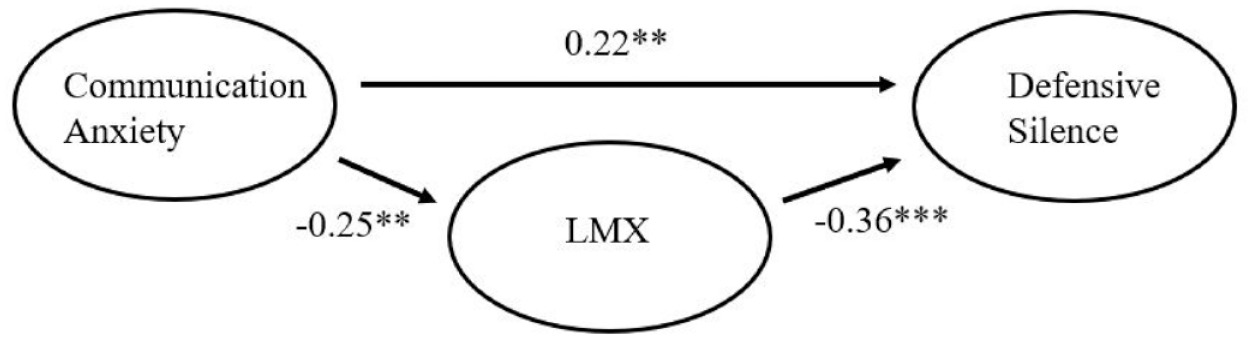
Results for the structural model.
To test the moderation effects, we used regression modeling. First, we specified a model without interactions using the demographic variables of age and years of supervisory experience, as well as a factor-score item of LMX using Bartlett’s approach, which uses maximum likelihood to produce unbiased estimates of the weighted contribution of each item on a factor (DiStefano et al., 2009; Hershberger, 2005; see Table 1 for descriptive statistics and bivariate correlations). No multicollinearity was detected for any of the predictor variables in either of the regression models (variance inflation factor all < 5.0). The effect of these predictors was significant, F(3, 308) = 20.23, p < .001, R2 = .16, and LMX was significantly associated with defensive silence (β = −.36, p < .001; see Table 2 for results.) However, as neither age nor years of supervisory experience were significantly associated with defensive silence, Hypotheses 4 and 5 were not supported by the full model. However, when limited models were tested with only defensive silence and age and years of supervisory experience as single independent variables, both age, β = −.14, F(1, 310) = 5.66, p = .018, R2 = .02, and years of supervisory experience, β = −.17, F(1, 310) = 8.49, p = .004, R2 = .03, were associated with defensive silence, suggesting that the small influence of these variables on defensive silence may be attenuated by their mutual influence upon each other. 1 In a model with both independent variables as predictors of defensive silence, neither age, p = .314, nor years of supervisory experience, p = .052, were significant, F(2, 309) = 4.76, p = .009, R2 = .03.
Descriptive Statistics and Correlations.

Note. LMX = leader-member exchange.
p < .05, **p < .01.
Hierarchical Regression Results for LMX Interaction Predicting Defensive Silence.

Note. LMX = Leader-member exchange, Years sup. exp. = Years of supervisory experience.
p = .05, *p < .05, ***p < .001.
F(3, 308) = 20.23, p < .001.
F(5, 306) = 13.61, p < .001.
F(2) = 3.2, p = .04.
Following the testing of a model without interactions, a second nested model was then run with the interaction terms, F(5, 306) = 13.61, p < .001, R2 = .18, which was a significant improvement in comparison to the model without interactions, F(2) = 3.2, p = .04, ΔR2 = .02. In this model, years of supervisory experience was a marginally significant predictor of defensive silence, β = −.12, p = .05, rendering ambiguous support for Hypothesis 5. In support of Hypothesis 6, however, the interaction of LMX and age was significant, β = −.14, p = .02 (see Figure 3). Also, in support of Hypothesis 7, the interaction of LMX and years of supervisory experience was a significant predictor of defensive silence, β = .12, p = .04.
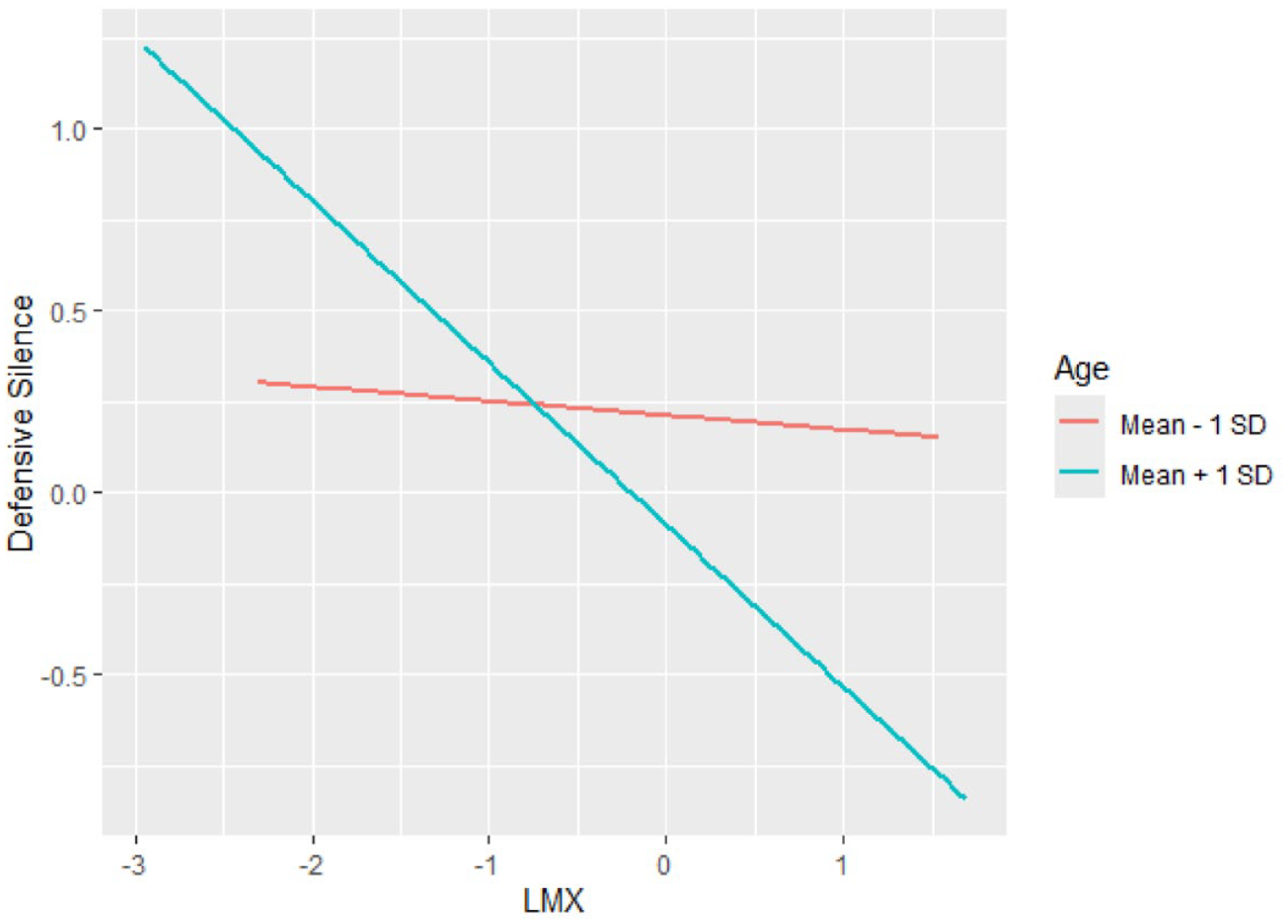
Interaction of leader-member exchange (LMX) and age.
Discussion
Theoretical Implications
This research presents several contributions to defensive silence literature. First, through Hypothesis 1, we have demonstrated the negative relationship between LMX and defensive silence. Previous literature has shown the positive relationship between LMX and prosocial dissent—a form of upward dissent (e.g., Okafor et al., 2021). Our findings solidify the necessity of strong relationships between supervisor and subordinate in order to avoid the suppression of upward dissent (i.e., organizational silence).
Additionally—through Hypotheses 2 and 3—we have demonstrated the negative ramifications of communication anxiety in the workplace, both in terms of supervisor-subordinate relationships and voice behaviors. Previous research has focused on the leader’s communication style and its relationship to LMX. This research has examined the supervisor-subordinate relationship from a different perspective, focusing on follower communication style (i.e., anxiety) and LMX. Individuals who experience greater levels of communication anxiety tend to avoid, withdraw from, and disrupt communication (McCroskey, 1984). These behaviors are not conducive to high-LMX relationships, which characteristically feature frequent communication and greater transparency between supervisors and subordinates (Graen & Uhl-Bien, 1995). The tendency for high communication anxiety individuals to avoid or withdraw from communication aligns with the behaviors of those who are defensively silent. Defensively silent individuals will also withdraw, withhold, and omit information in their communicative encounters (Van Dyne et al., 2003). Fear is characteristic of both communication anxiety and defensive silence. Future research may investigate the role of fear in other work-related outcomes.
Although Hypotheses 4 and 5 were not unambiguously supported, we were able to demonstrate a relationship between LMX and defensive silence through age and supervisory experience as moderators (Hypotheses 6 and 7). In relation to defensive silence, having a strong relationship with a boss or supervisor increases in importance as an individual ages. As subordinates age, they may come to know the leader more, and their relationship with the leader will increase or decrease the likelihood of defensive silence behaviors. If an older subordinate has a strong relationship with their boss (i.e., high-LMX), they will be less likely to engage in defensive silence behaviors, because of the nature of high-LMX relationships (e.g., trust, open exchange; Graen & Uhl-Bien, 1995). Conversely, if an older subordinate has a poor relationship with their boss (i.e., low-LMX), they will be more likely to engage in defensive silence behaviors. Organizational knowledge gained through age will have shown these employees how their boss will react, increasing or decreasing their propensity to be defensively silent. This is a significant theoretical contribution to defensive silence research, as the intersection of age and LMX has scarcely been addressed.
With respect to supervisory experience, as an employee’s years of supervisory experience increase, a strong relationship with the boss or supervisor will matter less in relation to defensive silence. Supervisory experience grants employees new knowledge and perspective (e.g., Sheu et al., 2017). Employees with higher supervisory experience may come to realize the potential negative ramifications of expressing dissent. High supervisory experience may allow these employees to understand dissent from a supervisor’s perspective, which may inform their decision to engage in defensive silence behaviors, regardless of their relationship to the supervisor. As previously mentioned, supervisory experience and age—although related—do not always increase in tandem. Many employees do not pursue supervisory roles, which contributes to the importance of LMX relationships—subordinate employees may not have leadership experience to inform their dissent choices. The finding that LMX relationships matter less in relation to defensive silence as an employee’s years of supervisory experience increase has significant theoretical and practical implications. Theoretically—similar to Hypothesis 6—research on the intersection of supervisory experience, LMX, and defensive silence is limited. Practical implications are detailed in the following section.
Practical Implications
This project contains a number of practical implications for managers to implement in their workplaces. To begin with, this project has clearly demonstrated the importance of cultivating strong relationships between supervisors and subordinates in order to prevent defensive silence behaviors. Because of the role of fear and intentionality in defensive silence (Van Dyne et al., 2003), supervisors should very clearly communicate to employees the value of their ideas, opinions, and other relevant information. Individuals who share unflattering or undesirable information should be rewarded for their disclosure, not punished. A culture of punishment and reactionary behavior is not conducive to upward dissent (Kassing & Kava, 2013). Upward dissent can have many valuable outcomes for supervisors, such as greater discernment in decision-making and improved deliberation over workplace outcomes (Lewis, 2020). Turnage and Goodboy (2016) found that email was a better venue for out-group members to express their dissent. Supervisors may consider encouraging email over face-to-face or Zoom confrontations.
Additional practical implications include how to manage individuals with high communication anxiety. According to the findings of Hypothesis 2, supervisors should make a conscious effort not to assume the motivations of employees who may be less vocal and more reticent. It may be the case that quiet employees are experiencing fear and discomfort. This does not mean that supervisors should not seek advice from or trust subordinates with greater communication anxiety. These subordinates may still possess valuable information for the supervisor. Conversely, subordinates with greater communication anxiety may consider avenues to improve or remedy their fear, in order to improve supervisory relationships. In relation to this, the findings of Hypothesis 3 indicate that supervisors should understand the tendency for communicatively anxious individuals to be defensively silent. Similar to earlier recommendations, supervisors should work to cultivate a culture of openness in which individuals who share unflattering or displeasing information are not punished.
The findings of Hypothesis 6 suggest a critical period for supervisors to cultivate a relationship and atmosphere of trust. As employees age, their relationship with the supervisor increases in its impact on defensive silence. As such, if supervisors wish to prevent defensive silence, they must intervene early and cultivate strong relationships before an employee has aged to the point that a poor relationship will lead to defensive silence. The findings of Hypothesis 7 suggest that employees with supervisory experience may be more likely to withhold information. Therefore, upper management should use alternative channels for dissent, such as anonymous tips, to conceal the identity of the dissenter and prevent defensive silence from occurring.
Limitations and Future Research
This research contains limitations. First, this sample is American, and cultural differences among populations could result in different findings. Second, because of the cross-sectional design of the study, we are limited in our ability to make causal claims. Future research should investigate non-American populations and consider an experimental design.
Conclusion
Fear can be a destructive force in the workplace. This study has demonstrated that subordinates with poor supervisory relationships perceive threats or risks in the workplace and feel obligated to self-protect via silence behaviors. Additionally, individuals with high communication anxiety tend to have poor supervisory relationships due to poor communication skills. Highly communicatively anxious individuals also engage in protective behaviors, leading to defensive silence. Age intensifies the negative relationship between LMX and defensive silence. Conversely, years of supervisory experience attenuate the relationship between LMX and defensive silence. This research has demonstrated the connection between poor leader relationships and defensive silence. If interventional measures are not enacted to prevent the disintegration of workplace relationships, defensive silence may become an increasingly observed phenomenon.
Footnotes
Appendix
Acknowledgements
The authors would like to thank Dr. Ryan Bisel for his mentorship and access to the dataset. Additionally, the authors would like to thank Drs. Ioana Cionea and Mark Bolino for their feedback toward making this manuscript a stronger piece.
Declaration of Conflicting Interests
The author(s) declared no potential conflicts of interest with respect to the research, authorship, and/or publication of this article.
Funding
The author(s) received no financial support for the research, authorship, and/or publication of this article.
