







Abstract
Internationally operating business professionals communicate using English as a business lingua franca (BELF), which differs from “standard” English usage, leading to calls for innovations in business English (BE) pedagogy. However, how BE instructors incorporate BELF research findings in the classroom remains unexplored. Therefore, in this mixed methods explanatory sequential study, we used a questionnaire and semistructured interviews to collect data from BE instructors who had been exposed to BELF research. The findings revealed that while the exposure to BELF raised their awareness and understanding, there remain contextual, theoretical, and mindset-based obstacles to implementing BELF principles in the classroom.
Keywords
In today’s global business environment, English communication skills are considered “vital soft skills in all workplaces” (Roshid & Kankaanranta, 2025, p. 1). Professional communication is a broad subject, with different disciplines offering a variety of perspectives. For example, the field of business communication has traditionally focused on curricula in U.S. business schools (Lentz et al., 2020), while corporate communication focuses on the organizational level (Frandsen & Johansen, 2014), and business English (BE) concerns the development of English language learners’ BE communication (Chan, 2014; Frendo, 2005). Emerging from this landscape is the concept of English as a business lingua franca (BELF). Identified by researchers two decades ago (Louhiala-Salminen et al., 2005), BELF is defined as a shared language used in the business domain by speakers with different first languages (L1s) (Peltonen & Hu, 2024). Focusing on interactions between individual professionals engaged in international business, BELF has delineated the contexts and characteristics of global professionals’ communication: BELF necessitates absolute clarity of meaning, strategies to ensure understanding, and accommodation practices to enable people from different regional or corporate cultural backgrounds to communicate (Chan, 2014; Hodges & Seawright, 2023; Peltonen & Hu, 2024; Roshid & Chowdhury, 2024). BELF interactions are fluid, negotiated, and real-time, often using nonstandard and improvised yet functional language forms to complete business tasks (Kankaanranta & Louhiala-Salminen, 2013).
The identification of these BELF characteristics has led researchers to call for changes in how business English is taught and learned. Like English language teaching (ELT) in general, BE pedagogy has been based on standard Anglo-American English to which learners are expected to aspire (Hodges & Seawright, 2023). However, BELF research has illuminated the fact that most transnational business communication is between non-native English speakers, and these exchanges may stray far from what would be considered “standard” English (Kankaanranta & Louhiala-Salminen, 2013). How to address such changes pedagogically remains an open question.
Amid this communicative backdrop and calls for pedagogical change are BE instructors. Functioning in a variety of roles, contexts, locations, and with disparate backgrounds (Lentz et al., 2020), BE instructors are expected to stay abreast of the latest trends in business, business communication, and teaching (Chan, 2014), a challenging endeavor in light of their complex employment situations in which they juggle multiple responsibilities while prioritizing efforts that generate income. As such, BE instructors report having little time for or access to the latest research findings (Sato & Loewen, 2019), a situation that has contributed to a growing research-practice divide in the BE realm. This widening gap manifests in two ways, conceptual and practical (Rose, 2019). Conceptually, there is a dearth of resources aimed at translating BELF research findings into tangible classroom practices that BE practitioners can implement (Medgyes, 2017). Practically, BE practitioners, like many ELT professionals, do not have access to academic journals, so findings from BELF studies might not reach the classroom (Macalister, 2018; Sato & Loewen, 2019). To address the above issue are activities and resources provided by the IATEFL Business English Special Interest Group (BESIG), the Association for Business Communication (ABC), and this study’s focus, the Conversations about BELF (C.A.B.) initiative. Whereas the IATEFL BESIG and the ABC encompass business communication and pedagogy more broadly, the C.A.B. initiative is specific: It is a forum in which researchers and practitioners can gather to access BELF research findings and consider their pedagogical implications.
Literature Review
BE Instructors and Their Teaching Contexts
BE instructors function in a fragmented landscape. They work in three main contexts: universities (with pre-experienced learners), privately (as freelancers or in training institutions), and in-company, the latter two of which are usually with job-experienced learners (Frendo, 2005). Their classes might be online, face-to-face, hybrid, group, or one-to-one, and they can be synchronous or asynchronous. Learners might be of similar or different language levels and from numerous geographical and cultural contexts and industries (Frendo, 2005; Lentz et al., 2020). Because job-experienced learners know more about their workplace and job functions than BE instructors, these instructors might position themselves as consultants or facilitators. In contrast, with pre-experienced learners, BE instructors might consider themselves subject authorities and providers of input (Bereckzky, 2009; Frendo, 2005). A consequence of the complex and unstructured nature of the BE teaching industry is that BE instructors often function in isolation from others and “therefore have limited availability of a community to connect to, whether in the workplace or at events such as conferences” (Macalister, 2018, p. 248). Further, BE teachers represent a wide variety of backgrounds (Basturkmen, 2019), ranging from having worked in business roles to migrating from mainstream ELT. Business English practitioners are also expected to be knowledgeable and well-trained (Chan, 2014; Frendo, 2005), but BE teacher training opportunities are highly decentralized, with dozens of certificates offered without a central authority or quality-control standard, leading Hutchinson and Waters (1986) to term the field of BE “the Wild West of ELT” (p. 158). In sum, specialized training and exposure to the latest research relevant to BE teachers is difficult to find and often inaccessible, hence the importance of initiatives such as C.A.B. to facilitate professional teacher development focusing on BELF.
BELF and Pedagogy
The nature of BELF communication, as described in the introduction, raises several unique pedagogical challenges: the first is how to address real-time, nonstandard usage that, by definition, does not adhere to codified standards (Dogancay-Aktuna & Hardman, 2018). The second challenge is how to address linguacultural competence, as, in the business context, there are many cultural groups at the regional, organizational, and team/department levels (Peltonen & Hu, 2024; Roshid & Chowdhury, 2024). The third challenge is how to assess BELF, as it is, by nature, function and execution rather than standardization (Kankaanranta & Louhiala-Salminen, 2013). The fourth challenge, an amalgamation of the above and directly related to this study, is how to educate practitioners to address these challenges in the classroom (Soruç & Griffiths, 2023). BELF, as a theoretical construct, is the result of research into how professionals communicate when they function at the international level. However, how practitioners can connect its theoretical principles to tangible classroom practice is an open question that this study addresses.
There have been investigations to address the pedagogical challenges that BELF entails. Studies have examined facilitating BELF users’ awareness of their own and interlocutors’ discourse habits, conventions, and linguacultural backgrounds to help them be flexible and successful BELF communicators (Louhiala-Salminen et al., 2005). Pullin (2010) approached BELF pedagogy by implementing task-based language teaching (TBLT), focusing on meetings and interviews, highlighting the alignment between the meaning-focused nature of BELF and TBLT. Beckisheva et al. (2015) endeavored to bridge the theory-practice gap by investigating how to incorporate case studies into BELF-informed classrooms. Further investigations have examined postgraduate business students communicating in multicultural team meetings, focusing on relationship-building (Komori-Glatz, 2017). There have also been investigations evaluating textbooks from a BELF-informed perspective, examining the cultural aspects of their content (Peltonen & Hu, 2024). However, none of the extant studies addressed practitioners’ perspectives on the impact of BELF research on teaching practices, a question this study addresses.
The Research-Practice Divide
ELT practitioners often have limited exposure to academic research because of obstacles such as time constraints, lack of access to research journals, and practitioners’ negative attitudes and mistrust toward research and researchers (Macalister, 2018). Some believe that academic research does not positively impact practitioners because the research, conducted by academics, is totally removed from the realities of the classroom (Medgyes, 2017). Others counter that research has “been able to broaden and deepen understanding of teaching and learning in ways that can be applied to both the classroom and to language teaching materials” (Paran, 2017, p. 499). Researchers who propound the importance of research-informed practice have endeavored to bridge the research-practice divide, with suggestions for changes to or improvements in research journal accessibility and dissemination (Macalister, 2018; Marsden & Kasprowicz, 2017; Rose, 2019), information literacy for practitioners (Williams & Coles, 2007), researcher-practitioner partnerships and communities of practice (CoPs) (Becker, 2024; Sato & Loewen, 2022; Winch et al., 2015), and attitudinal change (Sippel & Sato, 2022; Williams & Coles, 2007). Further, much of the extant literature regarding researcher-practice relationships has focused on practitioners’ perspectives in primary, secondary, and university-level teaching (Hosseini et al., 2024; Marsden & Kasprowicz, 2017; McKinley, 2019; Sippel & Sato, 2022). There have been no such investigations into the BE context, considering the instructors of adult learners, a gap this study addresses.
Given the above contextual information and identified research gaps, this study considers the following research problem: After two years of the C.A.B. initiative, how much impact has exposure to BELF as a theoretical construct had on BE instructors’ classroom practices? Within this research problem are this study’s specific research questions:
To what degree have BELF research findings and awareness-raising impacted BE instructors?
From BE instructors’ perspectives, what are the pathways versus obstacles to implementing BELF-informed pedagogy?
Methodology
This study adopted a mixed methods explanatory sequential design “in which the researcher begins by conducting a quantitative phase and follows up on specific results with a subsequent qualitative phase to help explain the quantitative results” (Creswell & Plano Clark, 2018, p. 77). This study’s quantitative data focused on BE instructors’ perceptions of the impact of the C.A.B. sessions as a means of exposure to BELF, while the qualitative data explored the nuances behind those answers. See Figure 1 for a visual of the research design.
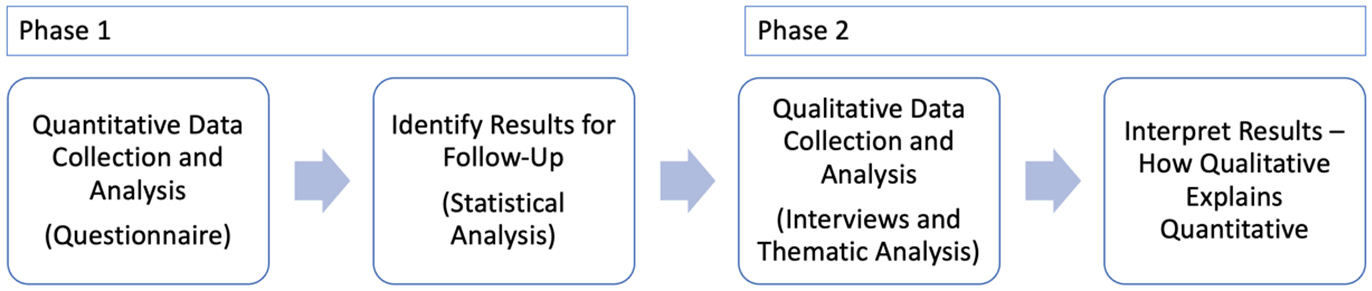
This study’s explanatory sequential research design.
Context
C.A.B. is a practitioner-researcher learning community intended “to foster a bi-directional flow of knowledge and to produce practical tools that are mutually beneficial for researchers and practitioners” (Shu et al., 2024, p. 42). Specifically, it is a forum for BE instructors and researchers to gather to examine the concept of BELF and consider how to implement its principles in BE classrooms. Founded in 2022 by BE instructors based in Germany, Brazil, Argentina, and Hong Kong, C.A.B.’s stated goals are to (1) encourage a conversation about BELF research and what it means for language teaching and learning in the business context (e.g., monthly sessions), (2) promote live events about BELF (e.g., conferences and seminars), and (3) share links and resources about BELF (e.g., research articles). Attendees include researchers, experienced corporate BE trainers, university BE instructors, and practitioners transitioning into BE training. There are three types of sessions: (1) a BELF researcher or practitioner presents their findings (Presentation and Discussion); (2) a group discussion based on a topic selected by the organizers or recommended by participants (Group Discussion); and (3) participants discuss a research article, without the author(s) present (Article Discussion). See Table 1 for a list of session topics thus far.
List of C.A.B. Session Topics.
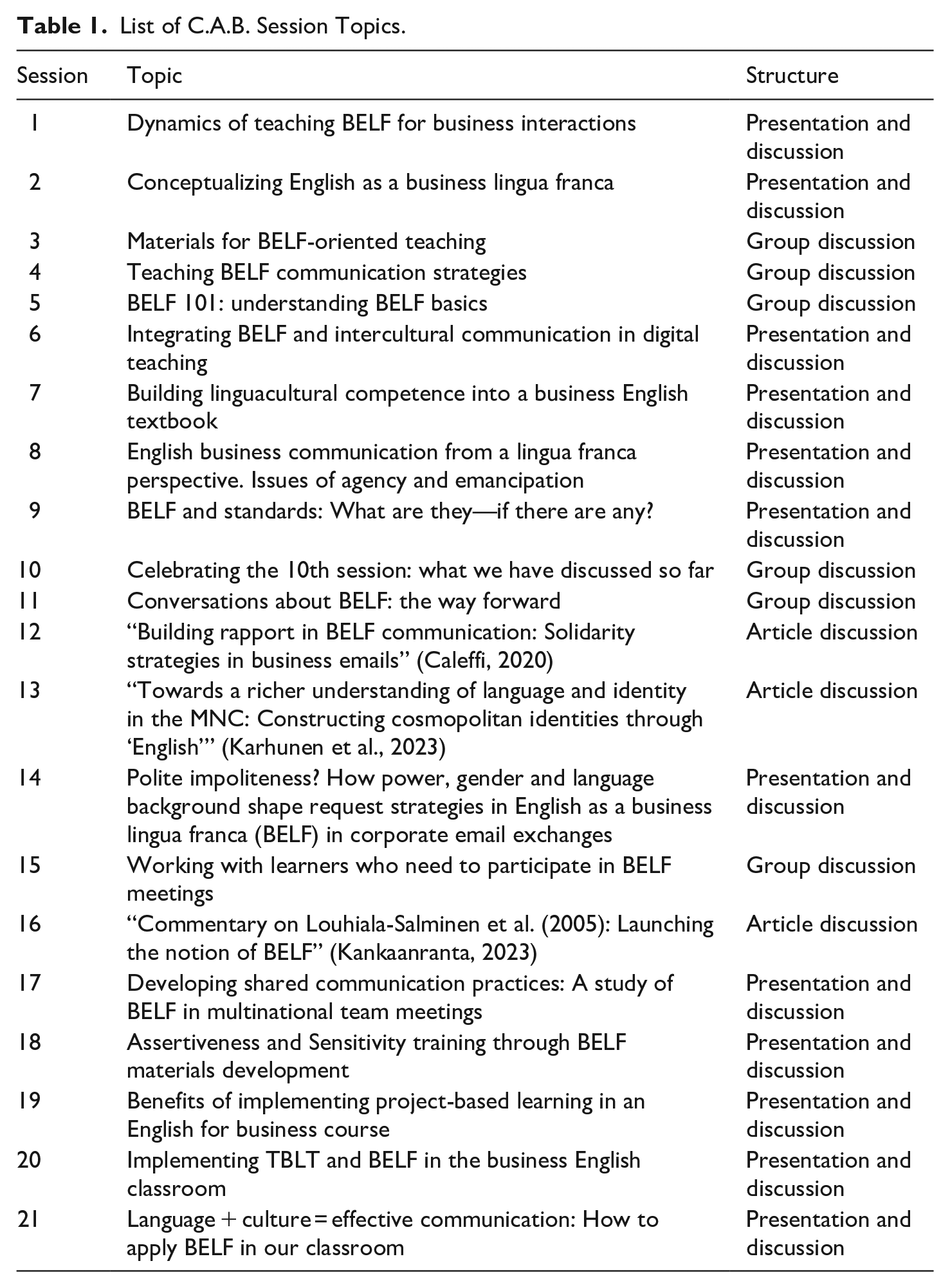
C.A.B. sessions occur monthly, and its attendees are from all over the world. At the time of this writing, there have been 21 sessions, and attendance has ranged from 10 to 50 people. The sessions take place on Zoom and are 90 minutes long. Most sessions begin with a researcher or experienced trainer presenting theory or research findings about BELF. Then, participants are divided into smaller groups in breakout rooms to discuss the topics. After that, each group reports back to the main group about what they discussed. Figure 2 illustrates the structure of a typical C.A.B. session. Session recordings are placed on the C.A.B. YouTube channel, and open-access journal articles and resources are available on the C.A.B. website.
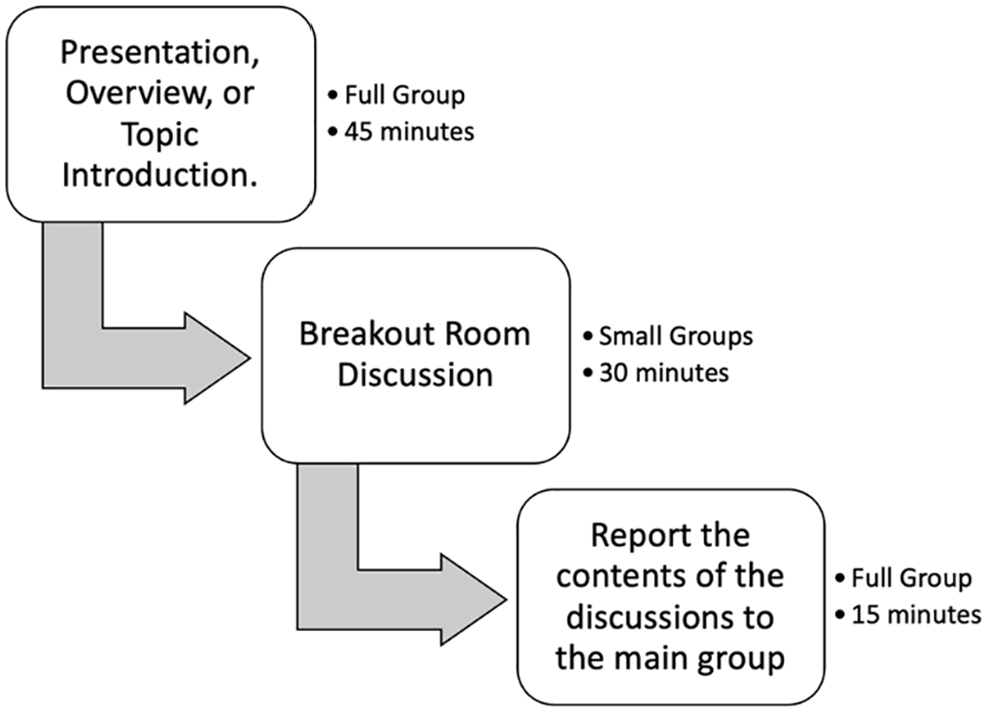
Structure of C.A.B. sessions.
Participants
To address the research questions, we sought BE instructors who had been exposed to BELF. Therefore, we used purposeful sampling (Creswell & Plano Clark, 2018) to recruit participants who had attended at least 1 C.A.B. session. A total of 57 participants from 21 countries who completed the questionnaire had attended at least 1 session, thus fitting our profile. Respondents reported a range of teaching contexts, including online (n = 39), face-to-face (n = 29), group (n = 33), and one-to-one (n = 33). They also reported a variety of employment situations such as freelance (n = 28) as well as working for private training organizations (n = 17), government or public organizations (n = 5), and universities (n = 21). Most respondents reported a combination of the above. Forty-two respondents held postgraduate degrees (master’s degree or higher), and 26 had teaching certificates such as the CELTA or cert-IBET. See Appendix A for detailed demographic information.
The interviewees were a subset of the questionnaire respondents. They were selected using purposeful sampling’s criterion-i strategy, to “identify and select all cases that meet some predetermined criterion of importance” (Palinkas et al., 2015, p. 535). They were selected according to the following criteria: (1) completed the questionnaire, (2) expressed willingness to participate in the interviews, (3) hailed from a variety of countries and teaching contexts, and (4) represented a range of teaching experience. Ultimately, we interviewed 10 respondents from 7 different countries with experience levels ranging from 1.5 to 40 years. See Appendix B for detailed demographic information about the interviewees. All participants, for both the questionnaire and interviews, signed informed consent.
Data Collection
The questionnaire items were adapted from an existing questionnaire that focused on perceptions of and satisfaction with the contents of a course aimed at developing teachers’ ability to implement English as a lingua franca (ELF) principles in the classroom (Kordia, 2021). The adaptations specified how the C.A.B. sessions impacted the participants’ understanding of BELF and classroom implementation. The finalized questionnaire included six self-report items on a 6-point Likert scale (1 = strongly disagree, 6 = strongly agree), seven questions about demographic information, one open-ended question, and one question asking if participants were willing to be interviewed. The questionnaire was hosted on the SurveyMonkey platform, and links to it were disseminated through C.A.B.’s emails, social media platforms (Facebook, Instagram, and LinkedIn), and during the C.A.B. sessions. Responses were collected between April 21, 2024, and June 15, 2024. This timing enabled the questionnaire to be active during two C.A.B. sessions, so the authors could leverage the repeated messaging in social media announcements and the sessions themselves to get as many participants as possible. Participants spent an average of 2 minutes 56 seconds on the questionnaire.
Semistructured interviews were conducted because they are flexible and versatile and have “been found to be successful in enabling reciprocity between the interviewer and participant” (Kallio et al., 2016, p. 2955). An interview guide was developed after analyzing the results of the questionnaire, designed to explore the factors affecting the findings. See Appendix C for the interview guide. The interviews were conducted between May and August 2024, and they lasted from 22 to 44 minutes. They were conducted online using Zoom, recorded, and transcribed via TurboScribe for later analysis. The second author conducted the interviews and wrote field notes, while the first author performed preliminary open coding on the transcriptions immediately after the interviews, so issues that arose in completed interviews could be addressed in subsequent interviews. When both authors recognized that topics appeared repeatedly, without mention of new topics, they concurred that they had reached theoretical saturation, a concept usually attributed to grounded theory (Corbin & Strauss, 2014) but useful for determining when to discontinue the interviewing process.
Data Analysis
Questionnaire
The results of the questionnaire were first analyzed to ascertain validity and reliability. Cronbach’s alpha was calculated using SPSS, resulting in α = .90, indicating that the items were highly reliable. Next, to establish the validity of the construct we were targeting, we performed a principal components analysis (PCA) in SPSS and found one component, regardless of orthogonal or oblique rotation. These findings show that the questions pertained to a single construct: participants’ perceptions of the impact of the C.A.B. sessions and exposure to BELF. With the validity and reliability of the questionnaire established, we examined the descriptive statistics (the mean scores) of the Likert scale item responses.
Interviews
The aim of the interviews was to gain insight into the results of the questionnaire. The interviews were analyzed according to thematic analysis (Braun & Clarke, 2006). In the open coding phase, we examined the interview transcripts independently, marking passages we deemed important and attributing preliminary codes to them. Then, we combined the separately coded transcripts using MAXQDA software. After discussion and finalization of the code labels, we examined the passages within the codes together to identify recurrent patterns. Once the patterns were identified, and to establish intercoder agreement, we reexamined each coded segment to finalize theme labels and contents. Different perspectives on theme contents or labels were resolved through discussion (O’Connor & Joffe, 2020).
Findings
Overall, the questionnaire participants held a positive view of the C.A.B. sessions as a means for helping them learn more about BELF and determining pedagogical implications. The average of all questionnaire responses was 4.78 of 6. See Table 2 for the questionnaire items and descriptive statistics of the scores.
Questionnaire Items and Scores.
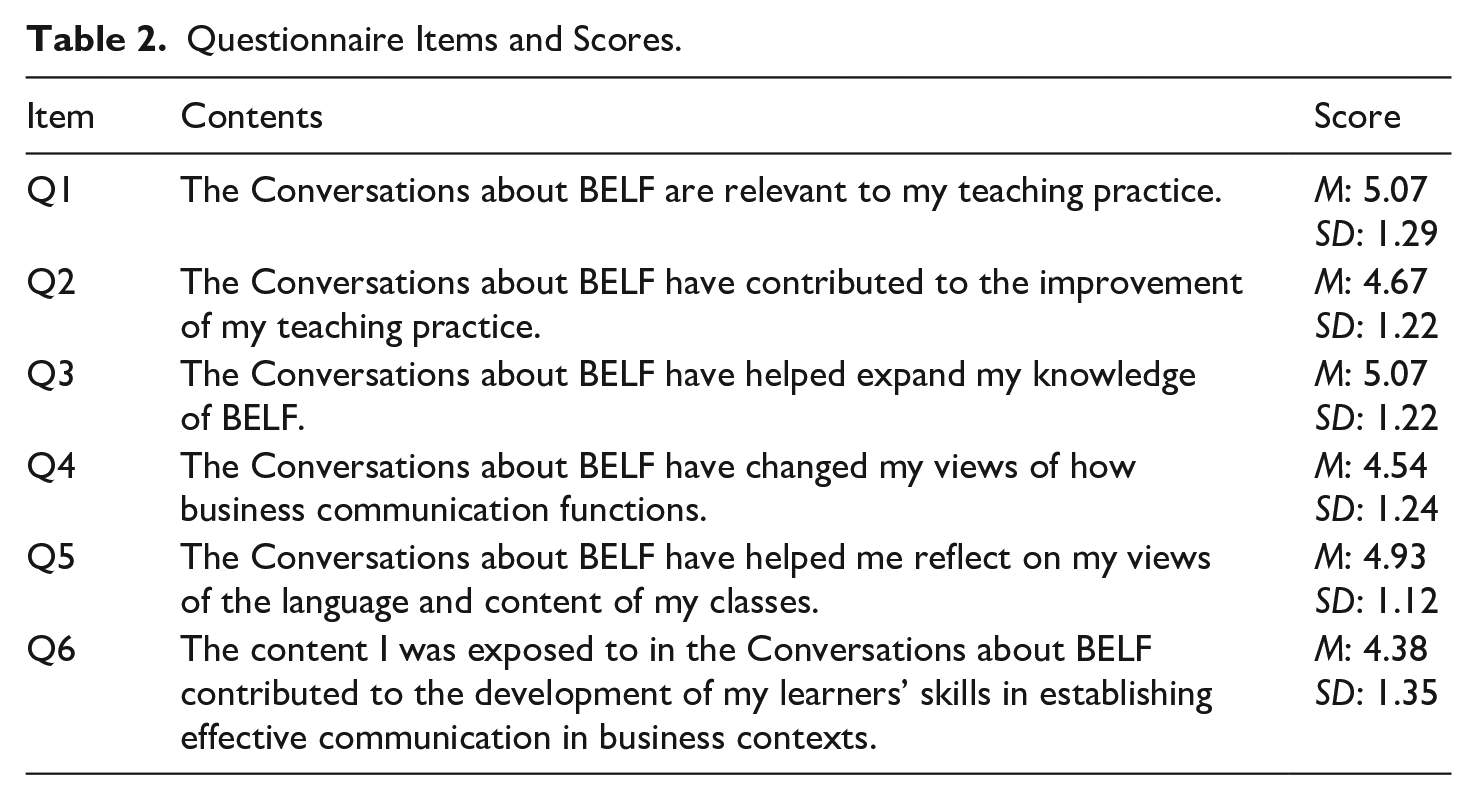
However, there was a subtle difference between two groups of questionnaire responses even though the PCA determined that the items represented a single construct: Q1, Q4, and Q5 asked about the impact of theory on the participants and had a slightly higher mean score (M = 4.85). Meanwhile, Q2, Q3, and Q6 asked about the application of BELF principles in classroom practice and had a slightly lower mean score (M = 4.71). Therefore, the interviews had to explore the dichotomy in the quantitative data by examining the pathways versus obstacles to bridging the BELF research-practice gap and implementing BELF-informed teaching in the classroom.
The thematic analysis of the postcourse interviews revealed 5 themes from 146 coded segments. See Table 3 for the categories, themes, and their definitions.
Themes: Categories and Definitions.
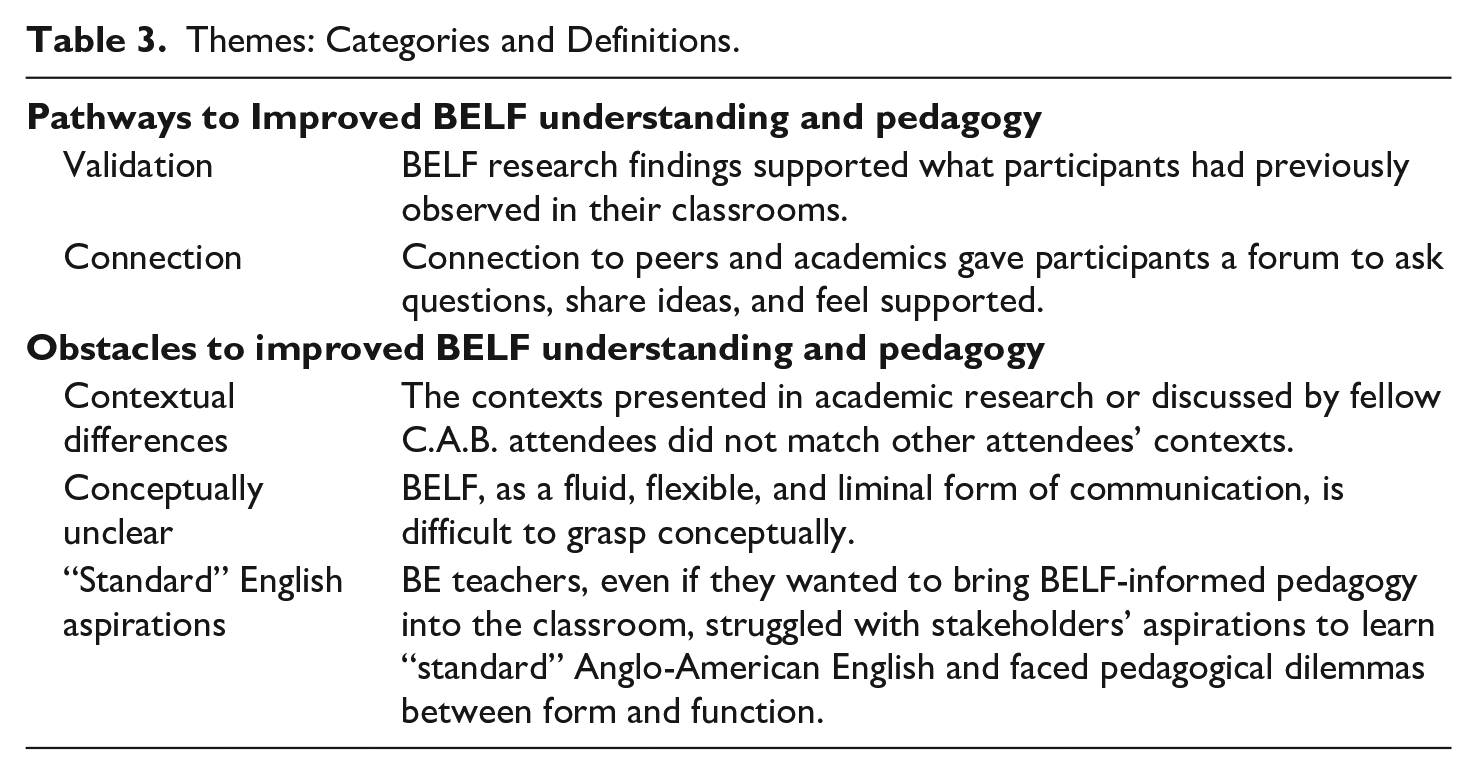
There were two categories of themes: One delineated pathways to improved BELF understanding and BELF-informed pedagogy. The other outlined obstacles to improved BELF understanding and BELF-informed pedagogy, offering insight into the difference between the scores of the two groups of items in the questionnaire. Note: In the following sections, participants are identified by pseudonyms.
Validation
Learning about BELF validated what experienced BE instructors had already observed in their classes and learners’ professional communication, a sentiment present in 15 coded segments. Interviewee Diana explained:
So that’s why BELF speaks to me because I can see the, well, what I understand of BELF, I can see the logic behind it. And it corresponds to some of the things that I think about how to teach a language. Well, that’s amazing.
Several other experienced BE teachers echoed this sentiment (e.g., Charles, Grace, and Michelle). This finding is crucial for two reasons: First, it provides ground-up evidence of the presence of BELF in professional communication and BE classrooms globally. Second, BELF offered instructors a way of understanding what they had found through experience, illustrating its relevance to BE teaching practices.
Connection
Participants expressed that the community aspect of the C.A.B. sessions was beneficial, mentioned in 26 coded segments. Diana explained that “it’s very important to be part of a community of people who are continuing to reflect on their trade and their profession.” For her, the community aspect of the C.A.B. sessions drove reflective practice. Alternately, Louisa highlighted how the community aspect offered her practical benefits, saying, “I always receive suggestions and recommendations.” Meanwhile, Rachel emphasized the emotional support she received when connecting with peers, stating, “[it] helped me feel less of an imposter.” Rachel went on to explain that the connections and support she received from the sessions contributed to her having a more confident and positive disposition toward her teaching. Furthermore, the community aspect of C.A.B. was particularly impactful because interviewees repeatedly explained that they often function in isolation and lack access to researchers, research literature, colleagues, or managers who could serve as support or with whom they can connect, discuss pedagogical challenges, and learn, echoing previous studies (Macalister, 2018). In this sense, the C.A.B. initiative functioned how research-practice partnerships and communities should function; a reciprocal and supportive environment benefiting both the individual and the group (Becker, 2024) by enabling the cultivation of improved awareness and understanding of BELF for BE instructors.
That said, despite the stated benefits of validation and connection, they did not necessarily connect to classroom practice: When asked how the learnings, connections, and validation derived from the sessions impacted their teaching, participants were circumspect. Max’s response was representative: “Well, I’m not sure how much [the findings] actually do impact.” Diana concurred, explaining, “[W]hatever you are mulling over in your head, it’s going to make an effect on, I mean, I haven’t seen any particular effect.” In other words, though perhaps validating, intellectually satisfying, or contributing to self-improvement, the practical impact was negligible. Louisa summarized the issue: “[A]ll the sessions and the group members contribute positively to my personal and professional growth. I don’t know if I am a better teacher.” The connection, validation, and increased BELF knowledge arising from the C.A.B sessions did not necessarily transfer into the classroom. Reasons for this disconnect are explored below in considering the three obstacles to implementing BELF-informed teaching.
Contextual Differences
Contextual differences were provided as a reason for being unable to implement BELF-informed teaching, present in 49 coded segments. Interviewee Charles highlighted his difficulty with relating the findings of European-based research to his own context: “But my situation in China, situation in Asia, is a bit different from the situation in Europe.” Francine was more direct, declaring that she “cannot relate” to the findings from other contexts, pointing out that much of the research presented in C.A.B. sessions eschewed the Global South, where she operated. Another source of disconnect was the participants’ teaching context: Charles explained that findings from a corporate instructor’s context might not apply to a university BE instructor or an instructor specializing in private, one-to-one classes. Relatedly, Louisa struggled because, in the Argentinian context, she did not have multilingual classrooms, so she endeavored to “start building the context that I don’t have. In order to help them to apply what I’m trying to know.” In other words, her context required conceits in order to try to bring BELF into the classroom, something that she ultimately felt was impractical. That said, several participants appreciated the contextual diversity of the sessions: Grace highlighted the “cross-pollination” that could arise from mixing different contexts, while Kerry appreciated gathering information from around the world. In sum, BELF—and its classroom practice—is extremely context-specific (Kankaanranta & Louhiala-Salminen, 2013), and the interviewees highlighted mismatches between their contexts and struggled to adapt BELF findings from other contexts to their own.
Conceptually Unclear
Another challenge to BE teachers’ ability to implement BELF theoretical findings in the classroom was the issue of conceptual clarity (specifically, lack thereof) expressed in 26 coded segments. For example, even after attending several C.A.B. sessions, referring to BELF, Francine said, “the concept is still blurry to me.” Interviewee Kerry expressed a similar sentiment when describing BELF as “nebulous.” She went on to ask: “What do you mean by BELF practices in the classroom? What do those look like?” In other words, even after attending several C.A.B. sessions, she still did not grasp how to translate BELF findings into the classroom. Further evidence of participants’ struggles with BELF at the conceptual level arose when participants were asked if they could define BELF: They were unable to offer clear answers. Kerry’s response is illustrative: “Like if somebody really drilled down and tried to ask me [to define BELF], I don’t know if I would be confident enough to answer.” An inability to define BELF, even after attending multiple sessions, suggests (1) conceptual inaccessibility and (2) the sessions’ inability to decode it adequately for participants. Another aspect of the conceptual inaccessibility is that attendees such as Raymond felt the sessions were “too advanced” for them, a sentiment echoed by Michelle and Rachel, who felt that the session topics were too academic and intellectual for their abilities to understand them as teachers. The lack of conceptual clarity prompted calls for more practical sessions from almost every interviewee, with specific suggestions including “more case studies” (Charles) and simulations and role-plays (Diana). In sum, conceptual inaccessibility was a consequential obstacle to translating BELF findings into classroom practices, thus leading to calls for more practical session content.
“Standard” English Mindsets
Interviewees described the tension between ingrained language beliefs about “standard” native English and BELF realities when performing corporate training, a sentiment present in 30 coded segments. Charles recalled arguments he had with stakeholders on the topic:
Understanding BELF is different from believing or from agreeing or accepting. It’s different. They might understand it, but they won’t accept it.
Learners and stakeholders expected to be taught standard English in which their mistakes were corrected as they strove for accuracy and native-speaker proficiency. The essential dilemma was that, even if BE instructors wanted to make their classrooms more BELF-informed, the learners and stakeholders might not acquiesce to the changes. Those who did attempt to bring BELF findings into the classroom faced difficulties. For example, because her learners “want to achieve that native-like competence,” Louisa struggled with how to “correct and how to assess [her] students.” She offered the example of teaching verbs to express the future. When students made small mistakes, she wondered,
How did you deal with it? I mean, did you try to correct them? Because that was the purpose of the lesson. Or did you just tell them like, ah, it doesn’t matter. Because we are getting the job done.
By saying “getting the job done,” Louisa was referencing Louhiala-Salminen and Kankaanranta (2011), who asserted that BELF communication prioritizes clarity of meaning over form and accuracy to execute business tasks. In her earnest efforts to bring BELF concepts into the classroom, Louisa faced constant dilemmas, deciding between the “standard” English to which the learners aspired, and lingua franca English that she knew was how BELF actually operated in the workplace. Ultimately, Louisa chose to explain how BELF functioned but focused on teaching the standard language forms. As illustrated, bringing BELF findings into the classroom not only clashed with stakeholders’ mindsets and aspirations but also caused pedagogical dilemmas that were difficult to reconcile.
Discussion
Research question 1 (RQ1) asks, To what degree have BELF research findings and awareness-raising impacted BE instructors?
Overall, the answer is “to a high degree” because the average combined score of the questionnaire items was 4.78/6. This finding reinforces extant literature arguing that “starting a dialogue to mutually learn about practitioners’ and researchers’ roles, activities, and contributions to language learning is indispensable” (Becker, 2024, p. 275). That said, there was a divergence between items that asked about BELF’s theoretical impact on participants versus implementation in classroom practice. These findings revealed that exposure to BELF was relevant, validating, and contributed to knowledge development. However, participants were slightly less certain about BELF’s direct impact on the improvement of their teaching practice, or their learners’ skills, which aligns with findings from extant literature which found that practitioners “do not use research findings to a great extent” (Sato, 2024, p. 5). In short, C.A.B. sessions exposing BE instructors to BELF were perceived as successful in raising awareness and generating knowledge, but less so in prompting tangible classroom application. The reasons for this finding are explored in RQ2.
Research question 2 (RQ2) asks, From BE instructors’ perspectives, what are the pathways versus obstacles to implementing BELF-informed pedagogy?
Pathways to BELF-Informed Pedagogy
Exposure to BELF validated what participants had already observed in their practice. Incorporating research into teaching practices provides practitioners with positive affective benefits such as emotional support and enhanced professional confidence (Becker, 2024; Macalister, 2018; Sato & Loewen, 2019). Put another way, if instructors feel validated, they will be more confident to innovate in the classroom, experimenting with and refining BELF-informed teaching. Therefore, the validation gained from exposure to BELF’s findings and its affective benefits represents one pathway toward BELF-informed pedagogy.
Couros (2015) argues that innovation does not happen in isolation. From that perspective, C.A.B. sessions could be a channel for BELF-informed teaching innovations. BE training happens in a variety of contexts, representing an extremely diverse landscape (Lentz et al., 2020), so a centralized forum such as C.A.B. in which instructors can access, share, and compare their experiences is a welcome resource (Becker, 2024; Macalister, 2018). Respondents such as Diana reported feeling less isolated and therefore more supported in their efforts to learn about and pursue BELF-informed teaching. Additionally, participants reported that engaging with the C.A.B. community prompted self-reflection, feedback, and brainstorming from peers, which would enable instructors to develop BELF-informed approaches iteratively. Such findings echo previous studies on teachers’ professional development (Macalister, 2018). Finally, participants stated that the community aspect of C.A.B. provides practical, conceptual, pedagogical, and emotional support for teachers, encouraging the pursuit of growth and improved BE teaching. Such sentiments align with extant findings extolling the benefits of communities (Becker, 2024) in which practitioners engage “actively in meaningful social practices and constructing identities and interpersonal relationships with other members of the CoP or other social groups [thus shaping] individual learning processes and the identity of the [community] as a whole” (Becker, 2024, p. 274). The fragmented nature of BE teaching makes researcher-practitioner communities such as C.A.B. even more essential to professional development. By providing resources, facilitating connection, personal growth, and reflective practice, the community aspect represents a promising pathway toward implementing BELF-informed pedagogy.
Obstacles to BELF-Informed Pedagogy
The participants struggled with translating the findings from different contexts to their own, which is an obstacle to BELF-informed pedagogy. Because each C.A.B. participant brought a specific contextual background to the sessions, their backgrounds did not always connect to the contexts of the presenter, article, or other group members, many of whom were functioning in different countries. This sentiment supports previous research on teacher perceptions in which cultural context was an obstacle: There is a “potential for mismatch when educational approaches are transferred across cultures without sufficient consideration of the norms and values of the host society” (Nguyen et al., 2009, pp. 123-124). On the other hand, exposure to different teaching contexts could be an opportunity. In the case of the C.A.B. initiative, participants can gain a global perspective of BELF because sessions always include people from multiple countries. Ideally, the findings from one context provide principles that could be applied to a different context. Further, exposure to multiple contexts is an innate aspect of BELF, as it encompasses contemporary English usage for business purposes on a global scale (Kankaanranta et al., 2015). BE practitioners have to understand that BELF is extremely context-specific. They need to proactively translate findings to their own context rather than expect other researchers’ or practitioners’ contexts to match their own, illustrating a crucial practitioner competence that must be developed (Dogancay-Aktuna & Hardman, 2018; Soruç & Griffiths, 2023). Relatedly, researcher-teacher partnerships can be expanded to explore questions that arise out of practice rather than out of theory, which would prompt research addressing contextually relevant issues (Becker, 2024; Sato & Loewen, 2019), directly benefiting BE instructors and offering a pathway toward BELF-informed pedagogy.
The finding that participants continued to struggle with grasping BELF conceptually reinforces previous assertions that one of the greatest barriers to practitioner engagement with research is “conceptual access” (Marsden & Kasprowicz, 2017, p. 613). One cause of this conceptual inaccessibility is what Rose and McKinley (2022) call the “intellectualization” of research that is too theoretical and has little or no practical benefit to practitioners (p. 529). If a highly educated and experienced C.A.B. attendee such as Francine, who has a PhD and 20+ years of teaching experience, struggles with the concept, it is likely to be even less accessible to less educated and experienced attendees. Further complicating matters is the fact that BELF itself can seem intangible. Even the originators of the concept assert that BELF “is highly context-bound and situation-specific, it is a moving target defying detailed linguistic description” (Kankaanranta et al., 2015, p. 129). Though the practitioners agree that BELF is relevant to their teaching practice, their understanding of it remains limited because of its multifaceted and fluid nature that defies description (Kankaanranta et al., 2015). If participants struggle to understand it conceptually, they are unlikely to implement it in the classroom. The pathway, then, is for researchers to make their work more translatable to practitioners and for practitioners to improve their information literacy to grasp such concepts (Macalister, 2018; Williams & Coles, 2007).
Charles’s disagreements with stakeholders and Louisa’s pedagogical dilemmas illustrated a challenge specific to BE practitioners: Their students are adults with preexisting mindsets about language, language learning, and needs; they aspire to “standard” Anglo-American English and native-speaker levels of proficiency (Hodges & Seawright, 2023). Dogancay-Aktuna and Hardman (2018) described this challenge:
Adopting a new or plurilithic model of language that lacks codification and standardization can appear pedagogically risky to teachers whose decisions are not immune to resistance from stakeholders [and] a predominant professional discourse that has long been dominated by discussions of normative perspectives, standards, and best practices. (p. 77)
It is unlikely that adults would accept teaching that misaligns with their beliefs and goals. Further, BE courses are generally developed from a needs analysis in which learners and stakeholders have stated their requirements beforehand (Frendo, 2005), so they might be resistant to changes resulting from their BE instructors learning more about BELF. In sum, implementing BELF-informed pedagogy can be mitigated by BE instructors’ own conceptual and practical struggles as well as the learners’ stakeholders’ expectations and mindsets. Therefore, the pathway forward is addressing such mindsets, a daunting prospect, as these stakeholders are adults, whose mindsets might be fixed, thus necessitating a structured and incremental introduction to BELF-informed pedagogy.
Conclusion
This study aimed to determine the relevance to and impact of BELF concepts on practitioners and their teaching practices. The overall findings indicate that the C.A.B. sessions as a means to expose BE teachers to BELF and bridge the research-practice divide were viewed quite positively by participants. However, nuances within the findings suggest that the actual classroom impact is less definitive and subject to a complex set of factors that both support and hinder BELF-informed classroom implementation.
Several crucial implications have arisen from this study: First, while C.A.B. is a forum for learning about and discussing BELF-informed pedagogy, it is not a training organization. There needs to be explicit, practical, and formal training for BELF-informed classroom practice and materials development in BE teacher preparation courses, continuing professional education, conferences, and seminars (Sato & Loewen, 2022; Macalister, 2018). The development of such training is not the sole responsibility of researchers and teacher-trainers. BE instructors must develop the ability to translate theoretical findings to their own contexts rather than expect findings to be translated for them (Dogancay-Aktuna & Hardman, 2018; Soruç & Griffiths, 2023). Next, there must be mindset changes: The persistent attitudes of stakeholders aspiring to “standard” native-speaker English proficiency must be addressed (Hodges & Seawright, 2023) in an empathetic, incremental way. Additionally, there need to be structural changes in how pedagogical research can be accessed in terms of paywalls, practitioner-focused articles, and conceptual accessibility (Rose, 2019). As BE practitioners are often not aligned with institutions that could provide such access, it falls on initiatives such as C.A.B. and other organizations (e.g., IATEFL or ABC) to enable access to research (Macalister, 2018). Relatedly, the perceptions of academics as top-down givers of knowledge and practitioners as receivers of knowledge must be changed to an equal, two-way dialogue built on trust and understanding that both are aiming for the same goal—improved teaching and learning (Becker, 2024; Rose, 2019). Research can be generated from issues identified by practitioners to ensure that it is relevant, and it must be presented in a way that is conceptually accessible. The ultimate goal in bridging the research-practice divide between BELF and BE pedagogy is to prepare learners for real-world professional communication on a global scale. Improved transnational communication and business function can reap benefits for individual learners as well as organizations and industries in terms of efficiency, function, and success.
There are limitations to this study. First, it utilizes self-reported data, which provides a limited perspective. Future research could incorporate classroom observations to verify how BELF principles are addressed in the classroom. Second, the participants were mostly C.A.B. attendees, so it is likely that they were already interested in the concept of BELF. Therefore, they represent a narrow cross-section of the overall BE instructor population. Future studies could include wider samples of BE teachers exposed to BELF compared to those who have not, thus ascertaining the differences.
Footnotes
Appendix
Semistructured Interview Guide.
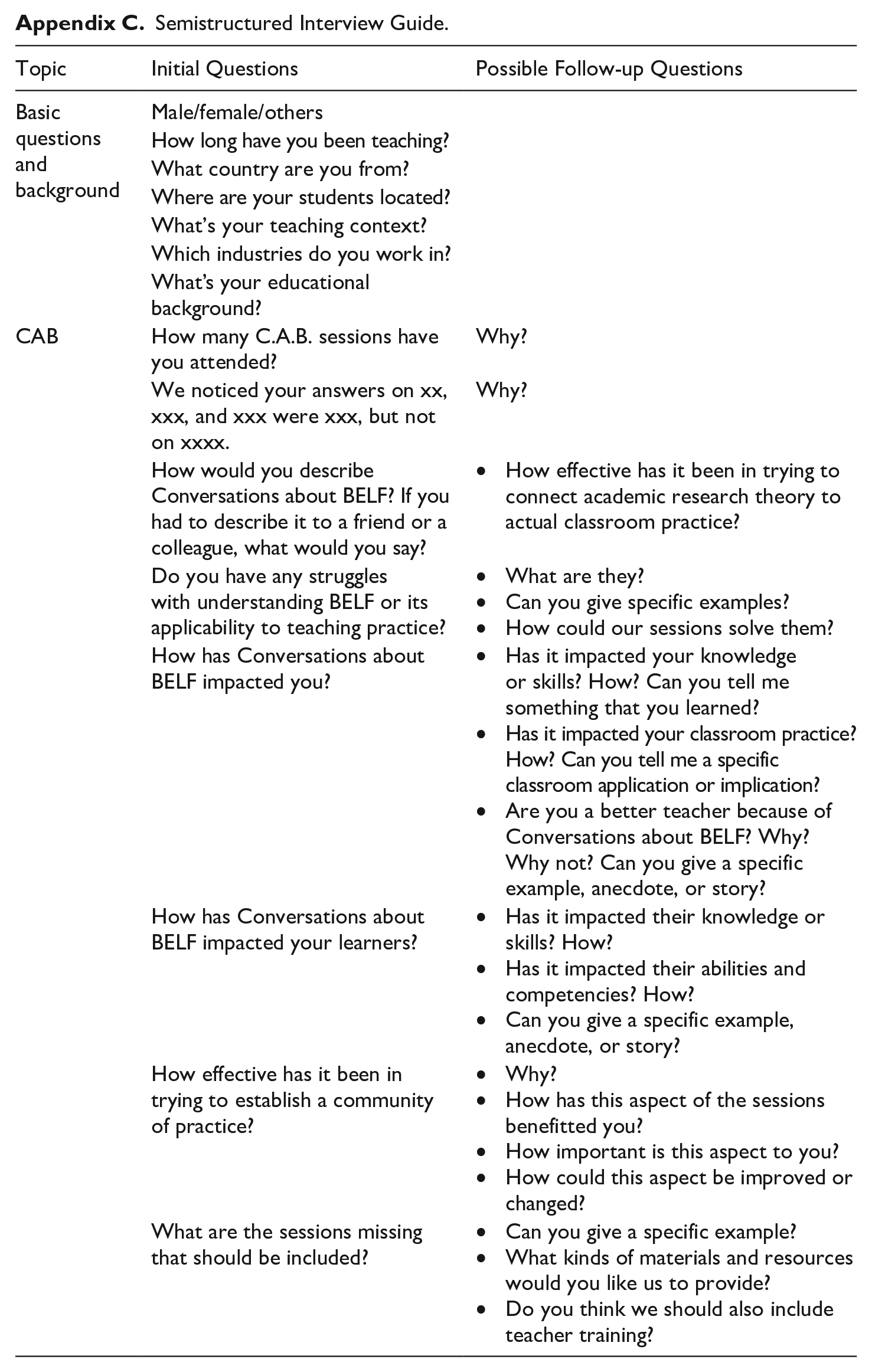
| Topic | Initial Questions | Possible Follow-up Questions |
|---|---|---|
| Basic questions and background | Male/female/others | |
| How long have you been teaching? | ||
| What country are you from? | ||
| Where are your students located? | ||
| What’s your teaching context? | ||
| Which industries do you work in? | ||
| What’s your educational background? | ||
| CAB | How many C.A.B. sessions have you attended? | Why? |
| We noticed your answers on xx, xxx, and xxx were xxx, but not on xxxx. | Why? | |
| How would you describe Conversations about BELF? If you had to describe it to a friend or a colleague, what would you say? | • How effective has it been in trying to connect academic research theory to actual classroom practice? | |
| Do you have any struggles with understanding BELF or its applicability to teaching practice? | • What are they? |
|
| How has Conversations about BELF impacted you? | • Has it impacted your knowledge or skills? How? Can you tell me something that you learned? |
|
| How has Conversations about BELF impacted your learners? | • Has it impacted their knowledge or skills? How? |
|
| How effective has it been in trying to establish a community of practice? | • Why? |
|
| What are the sessions missing that should be included? | • Can you give a specific example? |
Declaration of Conflicting Interests
The author(s) declared no potential conflicts of interest with respect to the research, authorship, and/or publication of this article.
Funding
The author(s) received no financial support for the research, authorship, and/or publication of this article.
