







Abstract
This article’s author situates late 19th-century essays by Andrew Carnegie within the rhetorical history of business and professional communication (BPC). A close analysis of the essays reveals that Carnegie relied on rhetoric to shape his public image as a benevolent business leader during a period characterized by significant socioeconomic divisions in the United States. Three primary themes—wealth, labor, and democracy—emerge, which the author argues animated Carnegie’s reasoning and arguments throughout the essays. The author concludes by recommending greater attention to the rhetorical history of BPC in future research and teaching.
Before finding success as an industrial capitalist, Andrew Carnegie’s life began modestly in Dunfermline, Scotland, in 1835 (Carnegie, 1920; Nasaw, 2006; Wall, 1989). It was there that he witnessed his father’s livelihood as a handloom weaver erode as mechanization upended the textile trade. The displacement of traditional artisans left families like his struggling to survive. By 1848, the Carnegie family immigrated to Allegheny City, Pennsylvania, near Pittsburgh, in search of work and a more promising future. Soon after their arrival, 13-year-old Andrew found work in a cotton mill before accepting a job as a telegraph messenger. His ambition and intelligence then carried him into the railroad industry, where he rose quickly through the ranks.
Carnegie’s early career as superintendent for the Pennsylvania Railroad provided him the opportunity to take highly profitable bond-selling assignments, and the commissions he earned supplied the capital for his first major investments. His involvement in the burgeoning iron and steel industries, along with his leadership in enterprises such as the Keystone Bridge Company, helped lay the foundations for the creation of the Carnegie Steel Company in 1892. After decades of prosperity, he retired in 1901, selling his share of his namesake business to J. P. Morgan for roughly $300 million. As one of the wealthiest people in the United States, he devoted the rest of his life to philanthropy. He funded thousands of public libraries, in addition to universities, cultural institutions, and peace initiatives, before his death in 1919 (Van Slyck, 1995).
Carnegie now resonates in American public memory as a defining figure of the so-called Gilded Age, a period spanning the end of the Civil War and the Reconstruction era, until roughly the middle of the first decade of the 20th century (Edwards, 2016; White, 2017). During this time, rapid industrial expansion and technological innovation led to the accumulation of vast fortunes by a select few entrepreneurs in the United States. Yet this era of remarkable economic growth belied a dark side marked by volatile markets and stark inequalities. “‘The Gilded Age,’” Richard White (2017) observes, “exposed the rot beneath the gilded surface. . . . Corruption suffused the government and the economy” (p. 2). Those at the helm of industrial enterprise, magnates with surnames like Morgan, Rockefeller, and Vanderbilt, came to be known as robber barons, and Carnegie was not immune from being caricatured in this light by 19th-century critics and later commentators (Josephson, 1934). Although his steel mills operated efficiently, workers often faced long hours, dangerous labor conditions, and limited bargaining power. These pressures culminated in several conflicts, most notably the Homestead Strike of 1892, which exposed the human costs of profit-maximization and irreparably damaged his reputation (Krause, 1992). Consequently, he remains emblematic of the social dramas that defined the Gilded Age and emerging Progressive Era.
During his lifetime, Carnegie proved to be an adept communicator who leveraged the available means of persuasion to fashion himself not just as a powerful tycoon but also as a public-facing intellectual capable of offering informed commentary on pressing social, political, and economic issues. In this article, I turn to Carnegie to help paint a clearer picture of the rhetorical history of business and professional communication (BPC). Rhetorical history, as a methodological stance, posits that “rhetorical processes have constructed social reality at particular times and in particular contexts” (Turner, 1998, p. 2). Rhetorical historians rely on principles of rhetorical theory and criticism to investigate how past acts of persuasion both constituted and were, in turn, constituted by the contexts in which they occurred (J. E. Black, 2022).
Adopting rhetorical history as a research approach, I argue that Carnegie not only reflects but also helped produce a dominant sensibility that extolled the virtues of big business and free enterprise during the Gilded Age. I do so by examining a selection of Carnegie’s essays published between 1886 and 1900. I find that three primary themes—wealth, labor, and democracy—animate his reasoning and arguments toward the goal of persuading audiences of his positions. For the remainder of this article, I support my case for Carnegie’s inclusion in the rhetorical history of BPC, beginning with a review of existing literature on rhetorical historiography in BPC scholarship.
Literature Review: Rhetorical History in Business and Professional Communication
Rhetoric, a term famously defined by Aristotle (375–320 BCE/2007) as an “ability, in each [particular] case, to see the available means of persuasion” (p. 37), has long provided the intellectual foundations of BPC as an academic field. In recent years, scholars have reaffirmed the enduring relevance of a humanistic sensibility informed by rhetorical inquiry in BPC studies (Getchell and Lentz, 2019; Jones, 2017; Lawal, 2025; Rawlins, 2024; Tomlinson, 2024). However, largely missing from this new wave of rhetorical scholarship is the methodology of rhetorical history. This absence belies the fact that rhetorical historiography was once a more prominent topic of discussion among BPC scholars and remains essential for understanding how contemporary communication practices descend from and are shaped by those of the past.
A review of existing literature reveals a formerly sustained but now less frequently pursued scholarly effort to trace BPC’s historical trajectory. Indeed, scholars have located BPC within an expansive rhetorical tradition dating back thousands of years (Reinsch, 1996; Rivers, 1994; Todd, 2020). Wolff (1979) traced modern forms of written business correspondence to the medieval ars dictaminis (the art of letter writing) by showing that 20th-century formats retain the rhetorical vestiges of classical dictaminal models. Others subsequently extended and complicated Wolff’s ideas while analyzing early examples of business writing dating to the Medieval, Renaissance, and Enlightenment periods (Richardson, 2003; J. Thomas, 1999; M. W. Thomas, 2003). Beyond the dictaminal frame, Kallendorf and Kallendorf (1985) recovered the continuing influence of classical figures of speech in modern BPC, Zappen (1987) sought to revive the longstanding association between rhetoric and technical communication, and Carbone (1994) uncovered the impact of 18th-century rhetorical pedagogy on business communication principles outlined in George Burton Hotchkiss’s 1916 textbook Business English. All of these studies ground BPC as a historically continuous rhetorical practice shaped by perennial persuasive techniques.
Another thread of scholarship consists of meta-analytical reflections on how the rhetorical history of BPC should be studied. For instance, Locker et al. (1996) contended that rhetorical historiographies of BPC must be more than descriptive accounts of archival sources. Rather, scholars must understand business-related documents “in their social, political, economic, and historical context” (p. 118). To this end, they stressed that scholars should begin with historically grounded questions. “Why,” one might ask, “did the genres or styles of certain business documents change during this period?” (p. 110). Such an inquiry shifts attention toward the underlying conditions prompting rhetorical changes over time, a point later echoed by Lund (1998). Further extending this approach, Dillon (1997) advocated for the incorporation of new historicism, a strategy of reading developed by literary critics that situates texts within overlapping networks of power, into the historical study of business writing to explore how rhetoric has reproduced dominant ideologies within BPC.
Scholarly conversations regarding the rhetorical history of BPC seem to have widely dissipated with the arrival of the new millennium. That is, until Cyphert (2010) lamented the absence of speeches by business leaders as objects of study both within BPC and the wider discipline of rhetorical studies. Without a robust corpus of scholarship on how and why business leaders use public address, it is nearly “impossible to identify common patterns of technique, content, or responsiveness to an audience or situation that might form a theoretical basis for understanding the phenomenon [of business rhetoric]” (p. 348). Accordingly, Cyphert proposes a research agenda organized around unresolved tasks, such as the need to establish a canon of exemplary speeches that can provide scholars clarity regarding the role of business leaders in rhetorically shaping policies, politics, norms, values, and other key aspects of public life.
Carnegie’s essays offer a compelling site from which to revive and expand the unfinished project of BPC’s rhetorical history. My study of these works situates their author in a larger rhetorical tradition of BPC wherein writing operates as a prime vehicle for swaying audience opinions and achieving desired goals. Moreover, my methods for analysis, to be explained in fuller detail below, emphasize closely entangled relations between text and context, with a focus on how Carnegie’s words prescribed a filtered view of reality that simultaneously mirrored and reinscribed the felt conditions of the Gilded Age. By directing attention toward BPC originating in the 19th century, I shed light on an important aspect of rhetorical history that has been largely neglected by scholars but that is nonetheless crucial for understanding BPC’s past and present. Finally, I directly heed Cyphert’s call for a more concerted look at the rhetoric of business leadership and thus make feasible future comparative assessments of how the rhetorical history of BPC informs and/or diverges from its contemporary manifestations.
Materials and Methods
I examined 11 essays collected in Carnegie’s (1900/1962l) The Gospel of Wealth and Other Timely Essays, a compilation of writings originally published between 1886 and 1900. In these essays, Carnegie comments on urgent matters of public concern, including tensions between labor unions and management, the rise of corporate trusts and consolidation, and contradictions between democratic forms of governance and imperialism, among others. I selected these essays for analysis because they contain his arguments on central issues that occupied public consciousness during a pivotal moment of his career as an industrialist. By limiting my analytical scope to only these texts, I ensured consistency in genre, since all were public essays intended for broad circulation, as well as historical coherence, allowing for a focused study of Carnegie’s rhetorical choices within a clearly defined socioeconomic context. To better assess the reception of the essays, I also examined several newspaper articles and parodic cartoons featuring commentary about his business practices. These primary sources helped to illuminate how his words and actions were circulated, contested, and reframed by popular critics of his time.
Once I assembled the data, I began the analysis process. As a rhetorical scholar whose foremost objective is to interrogate how meaning emerges through words, images, and other products of human ingenuity, I relied on a close reading method that proceeds first with an intrinsic analysis of a text, followed by an extrinsic analysis of the text’s historical context(s) (Brummett, 2019). Heeding Black’s (1980) recommendation to approach every text on “its own terms” (p. 332), as well as Leff’s (1992) call to “interpret the intentional dynamics of a text” (p. 223), I began with Carnegie’s essays alone and attended to their lexical and stylistic composition. I noticed the repetition of three themes—specifically wealth, labor, and democracy—across the essays. Although I considered other ideas, this particular triad of themes most broadly captured Carnegie’s recurring topics of discussion, so I decided to trace how he rhetorically developed his reasoning and argumentation around each thematic category. I concluded by situating the essays within their historical contexts to examine how Carnegie’s rhetoric responded to and participated in the debates that dominated his era.
Findings
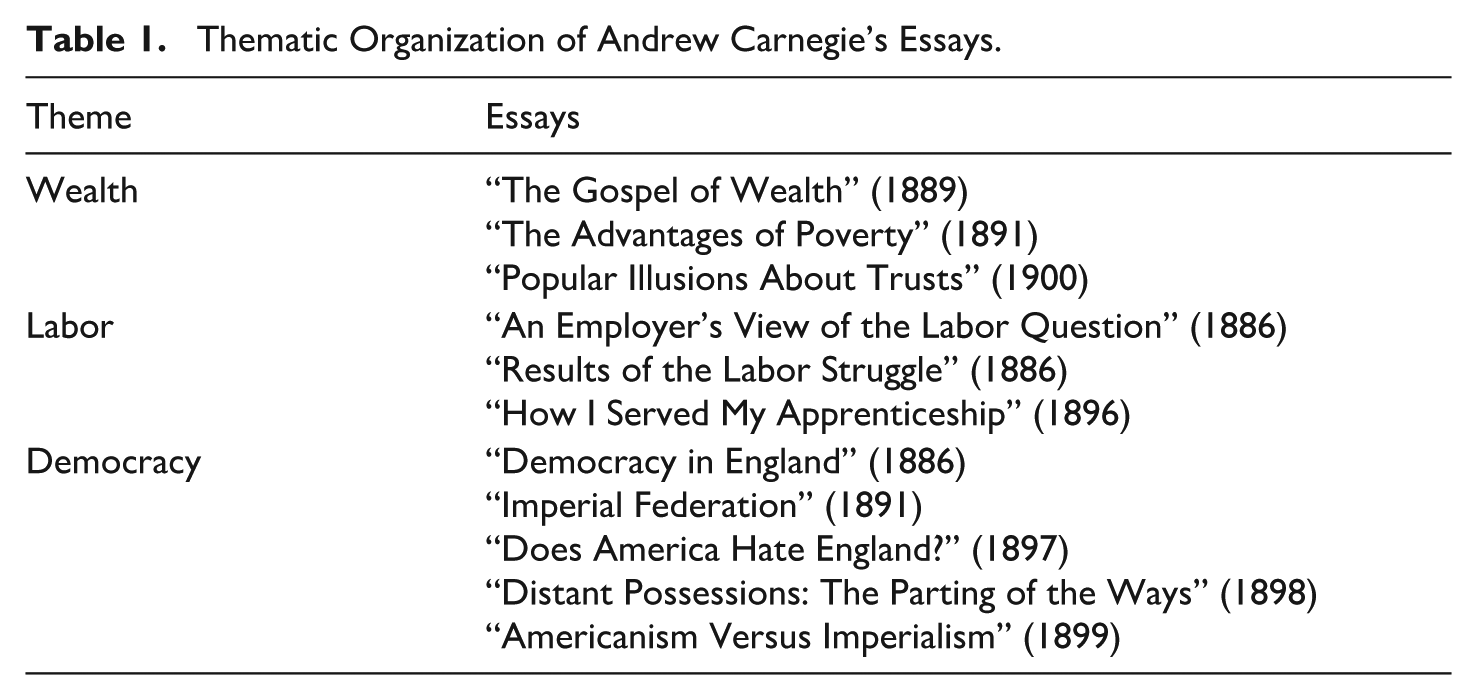
I arranged my findings thematically. I did so by sorting the 11 essays selected for analysis into three groups based on the theme that emerged most prominently in each. (See Table 1.)
Thematic Organization of Andrew Carnegie’s Essays.
Wealth
The first theme present throughout Carnegie’s writings is wealth. The theme’s significance is made apparent by the title of his most famous essay, originally titled “Wealth” and later republished as “The Gospel of Wealth” (Carnegie, 1889/1962k). “The problem of our age,” he declares, “is the proper administration of wealth” (p. 14). The statement introduces his perspective that wealth is a significant public issue, necessitating thoughtfulness about its accumulation, allocation, and place in society. He builds this idea by contrasting the conditions of an ambiguous pre-modern past with what he calls the “revolutionized” industrial era (p. 14). Acknowledging that industrialization tends to produce a stark contrast between “the palace of the millionaire and the cottage of the laborer,” he insists that this disparity is “highly beneficial” because it advances civilization as a whole (pp. 14–15). Wealth, to him, is a necessary instrument of progress that reduces suffering, even as it creates socioeconomic divisions, and he places responsibility on the wealthy to ensure that their affluence benefits the public writ large.
Few Gilded Age capitalists spoke as openly about their financial positions as Carnegie, but as one of the richest people in the United States, he embraced his status as a familiar authority on all wealth-related matters. When the ballooning power of trusts, a name for large corporate mergers that consolidated control over entire industries, drew intense scrutiny, his essay “Popular Illusions About Trusts” synthesized his argument that the efficiencies of large enterprises not only reduced costs but improved overall living standards. Carnegie (1900/1962h) writes, “The concentration of capital is a necessity for meeting the demands of our day, and as such should not be looked at askance, but be encouraged” (p. 80). “The larger the scale of operation,” he adds, “the cheaper the product” (p. 82). On this basis, he reasons that trusts are net positives that bring to “the homes of the poor, in greater degree than ever, more and more of the luxuries of the rich” (p. 91).
Carnegie’s confidence in the virtues of wealth consolidation was not always shared by all members of the country he called home. As he grew wealthier, his public image became a more regular target of ire, especially among critics who increasingly associated him with the expanding power of trusts and the weakening of democratic institutions. His shifting reputation was put on display in an October 1888 Harper’s Weekly cartoon, “A Trustworthy Beast,” which mocked his remark in an earlier interview that “The public may regard trusts or combinations with supreme confidence” (“A Trustworthy Beast,” 1888; “He Doesn’t Fear Trusts,” 1888). (See Figure 1.) The parody depicts Carnegie welcoming Uncle Sam, an allegorical figure who personifies the traditions and values of U.S. democracy. Behind Carnegie lurks a multi-headed, horned beast labeled with various trusts that appears to threaten the fabled elder. Just a little over a year later, “The Gospel of Wealth” appeared in print for the first time. The essay mounted a defense of the legitimacy of industrial consolidation at a moment when public skepticism toward concentrated wealth began growing among many Americans.
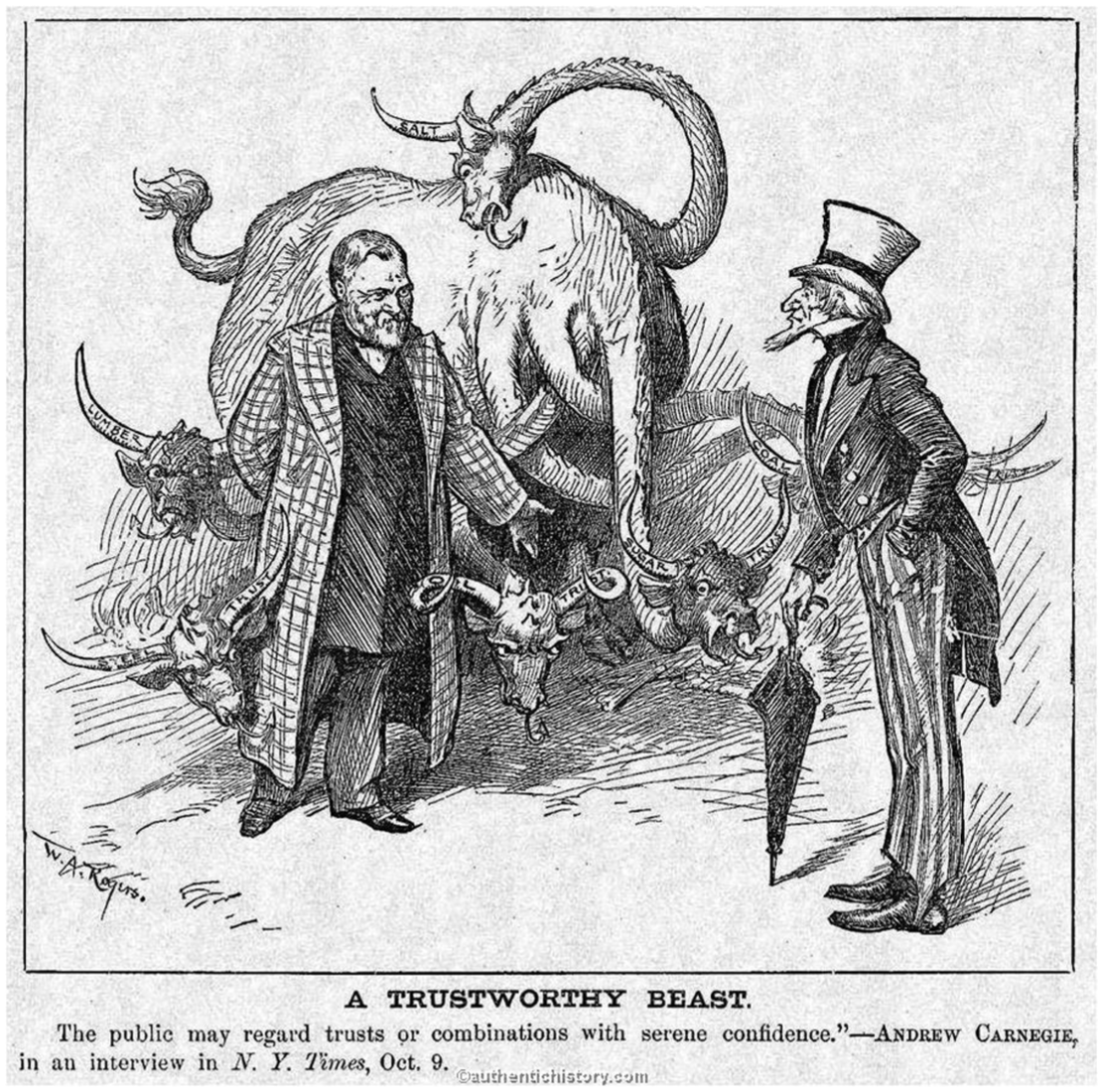
“A Trustworthy Beast” [political cartoon], Harper’s Weekly, October 20, 1888.
Carnegie’s framing of wealth as a public utility appeared closely tied to another of his recurring claims, namely, that poverty, too, served an essential civilizational function. Not long after the publication of “The Gospel of Wealth,” Carnegie’s (1891/1962j) essay “The Advantages of Poverty” debuted. In it, he articulated his view that poverty is not a social failing but a necessary prerequisite for producing what he calls the “supremely great, the genius” (p. 64). The argument is a nod to his own humble roots, though he never explicitly addresses his childhood of severe financial want. Instead, he pontificates that wealth, in the right hands, fuels enterprises that inevitably expand opportunities for those willing to work as hard as he once did. Carnegie rhetorically positions poverty and wealth as complementary forces that together propel socioeconomic advancement for all.
Holding that wealth and poverty are interdependent, in “The Gospel of Wealth,” Carnegie philosophizes that wealth attains its highest meaning only when treated as a resource to be shared, as opposed to a private possession. To this point, Carnegie (1889/1962k) describes “surplus revenues” as “trust funds,” and introduces three possible paths for investing excess wealth. The first two—leaving fortunes as inheritances to children or bequeathing wealth at death—he dismisses as unwise and even harmful. He endorses only the path of actively administrating wealth during one’s lifetime. However, he is careful to distinguish between proper and improper allocations of wealth by warning that indiscriminate charity creates entitlement and dependence. The best uses of wealth are those that empower less fortunate people to help themselves. He recommends seven public institutions where the wealthy are most likely to achieve the greatest social return on their investments: universities, libraries, hospitals, parks, meeting and concert halls, swimming pools, and churches.
While embedding the meaning of wealth in a Gilded Age belief in progress and self-reliance, Carnegie simultaneously distanced himself from the lavish lifestyles and conspicuous consumption that defined the era. He criticizes wealthy people known for “display” or “extravagance in home [and] table,” predicting that public sentiment will always judge such behavior harshly (pp. 25–26). His critique speaks to an anxiety of the period, as many Americans saw magnificent mansions and lavish parties as signs of fiscal and moral corruption. Though he certainly enjoyed inordinate luxury throughout his adult life, Carnegie presents himself as sympathetic to this stance and assures readers that the wealthy do not escape accountability. Those who do not redistribute their fortunes responsibly risk permanent condemnation. His famous line “The man who dies thus rich dies disgraced” summarizes this contention (p. 29). The quotation casts wealth as equal parts blessing and burden, softening the harsh realities of industrial capitalism with a social contract that, in theory, restrains the temptation toward self-indulgent opulence.
By the time he published “The Gospel of Wealth,” Carnegie had already begun molding the philanthropic identity that would later define him. His earliest gifts supported public libraries. He also funded universities and technical schools, contributed to musical organizations and cultural initiatives in industrial towns, and financed recreational amenities, such as reading rooms, for workers. These efforts, though smaller in scale than his later endowments, constituted “ladders upon which the aspiring can rise,” and permitted Carnegie to show in his actions that wealth could be harnessed to expand opportunity rather than entrench privilege (p. 28). Still, it was unclear when Carnegie’s own workers were supposed to find time to fully take advantage of his funded endeavors while working upward of 12 hours daily, 6 days per week.
Clearly, the topic of wealth is a centerpiece of Carnegie’s essays. The author returns to this theme repeatedly when arguing that the vast fortunes and sharp inequalities of his era ultimately serve a higher purpose. His rhetoric fabricates large-scale enterprise, concentrated wealth, and even poverty as instruments of prosperity, and renders those like himself—people of immense financial means—responsible for stewarding public goods. For Carnegie, philanthropy becomes the primary ethical check on a socioeconomic system that often prioritizes the interests of employers over those of workers, whose lives of toil he imagines as necessary sacrifices that must be made to propel the engine of progress. Although referring to socioeconomic configurations unique to the Gilded Age, Carnegie constructs a blueprint for BPC that future entrepreneurs throughout the 20th and 21st centuries would follow and adapt by construing their private wealth accumulation as the best channel for sustaining philanthropic programs that contribute to the greater good.
Labor
The second theme prominent throughout Carnegie’s writings is labor. The late 19th century was marked by pervasive labor unrest, with collective bargaining and strikes transforming relations between capital and workers (Montgomery, 1987). An 1885 New York Times article reported growing disgruntlement among employees of Carnegie’s Pittsburgh-area businesses (“Labor’s Gloomy Outlook,” 1885). Workers for the Carnegie-owned Edgar Thomson Steel Works and Homestead Mills faced wage reductions ranging from 10% to 25%. Skilled laborers, including blacksmiths, machinists, boilermakers, and furnace crews were particularly impacted. These workers felt the cuts contradicted Carnegie’s then recent espousal of certain “Socialistic views” regarding wealth reallocation (p. 5). Further, the wage decreases added fuel to the fire of unresolved disputes from previous years mounted by the Knights of Labor, a prominent national labor organization that sought to unite workers across trades and advocated for better wages and working conditions (Fink, 1983).
Carnegie managed to resolve mid-1880s labor disputes by negotiating and making minor adjustments, and he soon began publicly articulating a more expansive vision of labor’s place within the industrial order. In “An Employer’s View of the Labor Question,” Carnegie (1886/1962b) situates contemporary conflicts within a long historical arc in which labor has achieved “a triumphal march” toward freedom (p. 92). He acknowledges the persistence of “collisions between these forces, capital and labor,” but compares labor strikes to war in their irrational destructiveness (p. 93). Carnegie evaluates several proposed solutions. He dismisses worker-ownership as impractical in large organizations because “business ability” is “excessively rare” and uneven managerial talent would doom worker-owned ventures (p. 96). To avoid being painted as anti-union for minimizing the effectiveness of strikes, he defends trade unions as “beneficial both to labor and to capital” because they educate workers and promote negotiation (p. 98). He proposes the sliding-scale wage system as the most promising path for aligning the interests of labor and capital, suggesting that if wages rose and fell with prices, employers and workers would be “in the same boat” by sharing prosperity and adversity together (p. 102). As evidenced by the earlier labor tensions of 1885, the sliding-scale system was egalitarian in principle but unequal in practice because it asymmetrically exposed workers to bearing the brunt of market downturns while insulating employers’ profits.
Carnegie reaffirmed and expanded these ideas in subsequent reflections. In “Results of the Labor Struggle,” Carnegie (1886/1962i) places the recent labor disturbances within the broader context of the spring of 1886, a period marked by social movements for the 8-hour workday and punctuated by a demonstration in Chicago’s Haymarket Square that ended in a violent bombing (Avrich, 1984). Despite this volatile backdrop, Carnegie claims that the actual scope of the labor revolt was remarkably small, noting that “not more than 250,000” workers had temporarily stopped performing their duties among more than 20 million wage earners nationwide (p. 108). He contends that perceptions of a national uprising resulted from the speed and reach of modern communication channels. The “omniscient press, with the electric telegraph at its command” caused distant observers to “fancy the trouble to be general” (pp. 108–109).
After correcting what he understood as widespread misinformation about the labor unrest, Carnegie highlights what he sees as the deeper lessons conveyed by the strikes. He praises the “high sense of honor and loyalty” of workers to their managers (p. 110). He observes that such devotion, when met with respectful treatment from employers, can foster cooperative relations and avoid conflict. He also stresses that violent resistance undermines labor’s cause. He lectures that workers lost the “indispensable ally” of public sentiment when they resorted to coercion or made demands the community deemed unreasonable (pp. 111). He applies similar reasoning to the Third Avenue Railway strike by asserting that the men were “deservedly failed” once they exceeded what public opinion could support. He reiterates his belief in gradual reform while insisting that improvements in working hours must proceed incrementally and that shorter shifts in industries requiring continuous operation depend on practical constraints. Ultimately, he recommends that representative labor organizations must become “more conservative than the mass of the men they represent,” in order to temper emotions and keep the peace (p. 120).
Labor disputes remained a central focus of Carnegie’s for the remainder of the 1880s. After Henry Clay Frick became a major shareholder in 1887, Carnegie compelled him to settle a strike in the coke region on terms favorable to labor to maintain uninterrupted steel production (Demarest, 1992). This conciliatory posture soon shifted. In 1888, Carnegie broke the union at the Edgar Thomson Steel Works and replaced three 8-hour shifts with two 12-hour shifts, signaling a sharper turn toward managerial control. By 1889, Frick had become chairman of Carnegie, Phipps & Company, a predecessor to Carnegie Steel, and negotiated the purchase of the Duquesne Steel Works, a deal that proved highly profitable. That same year at Homestead, however, the Amalgamated Association, a large union representing iron and steel workers, successfully secured a 3-year contract accepting a sliding wage scale in exchange for union recognition and more input concerning working conditions, reinforcing Carnegie’s public image as a supporter of organized labor. A New York Times article with the celebratory headline “Mr. Carnegie’s Latest Victory” captures this moment as a midpoint between earlier compromises and the crisis to come (“Mr. Carnegie’s latest victory,” 1889).
The Homestead Strike of 1892, a violent labor conflict at the Carnegie Steel Works in Homestead, Pennsylvania, marked a decisive rupture in Andrew Carnegie’s largely self-promoted reputation as a friend to labor. When the aforementioned 3-year contract at Homestead neared expiration, management, now firmly under Frick’s control, announced wage reductions and moved to eliminate union authority altogether. After negotiations failed, the company locked out the Amalgamated Association workers and surrounded the mill with fencing and armed guards employed by the Pinkerton agency. The conflict escalated on July 6, 1892, when Pinkerton agents attempted to enter the plant by river, triggering a pitched battle that left several workers and guards dead. State militia forces soon occupied Homestead, and the company reopened the mill with nonunion labor, which effectively ended union power in the steel industry for decades. As Paul Krause (1992) notes, the violence of 1892 transformed Carnegie into a symbol of labor’s defeat. Press coverage recast workers’ bodies and Carnegie’s authority through spectacles of disorder and force (Slavishak, 2008). A cartoon printed in the pro-union Saturday Globe illustrated this shift, depicting Carnegie as a figure whose philanthropy could no longer mask exploitative, coercive labor practices (Demarest, 1992, p. 189). (See Figure 2.)
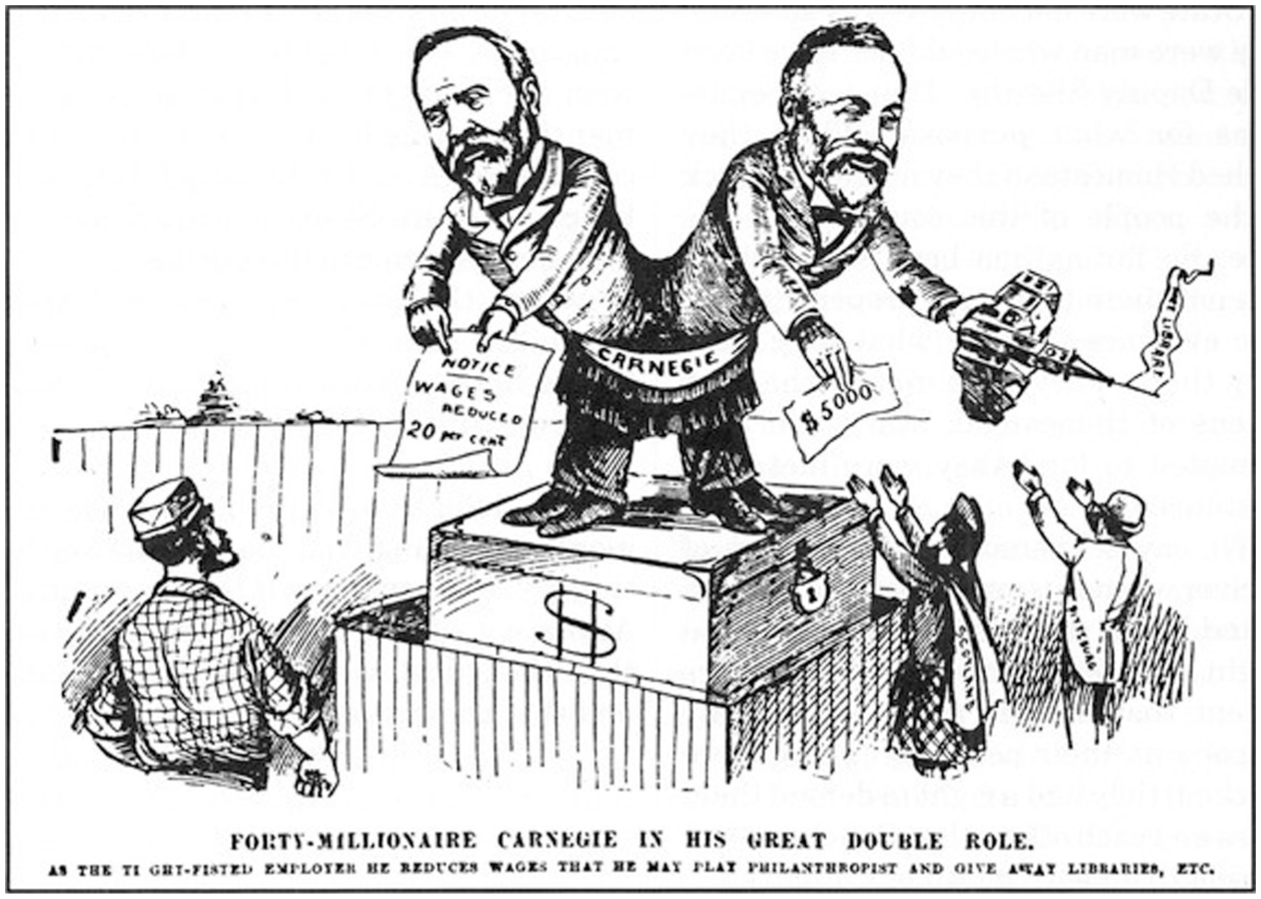
“Forty-Millionaire Carnegie in his Great Double Role” [political cartoon]. The Saturday Globe, July 9, 1892.
In the wake of the Homestead Strike, Carnegie moved quickly to rhetorically rehabilitate his public image by foregrounding a narrative emphasizing his intimate knowledge of labor and hardship. An article published in Yenowine’s Illustrated News in August 1892, just weeks after the brutality, reframed Carnegie as a former poor immigrant whose rise was a natural outcome of his discipline and tolerance for manual work (“Carnegie’s Early Poverty,” 1892). He positioned himself as someone who understood labor from the inside rather than as a distant industrial autocrat. Carnegie (1896/1962g) further substantiated this storyline when he published the autobiographical essay “How I Served My Apprenticeship.” Offering an account of his early life as an impoverished child laborer, he recalled his first job in a cotton factory, where he made 1 dollar 20 cents per week. This small sum, “the direct reward of honest, manual labor,” gave him the feeling of “genuine satisfaction” that he remembers as being more pleasurable than any of the “many millions of dollars” that had since passed through his hands (pp. 4–5). Such an origin story was central to Carnegie’s construction of himself as a quintessential “self-made man,” or an archetypal embodiment of the American Dream whose economic success is authenticated by strategic narratives of self-discipline and moral certitude (Gill, 2013, p. 337).
Carnegie’s essays on the theme of labor indicate a careful rhetorical balancing act that elevates harmonious relations between managers and workers while downplaying and often obscuring conflict. In construing the history of labor as a steady march toward progress and depicting strikes as uncivil disruptions, he directs audiences toward the shared interests that would seem to unify employers and workers. His high praise of unions as instructional and potentially stabilizing institutions serves to manufacture his image as the rare capitalist ally to labor’s cause, even though this language often diverts scrutiny from the structural inequalities embedded in his own industrial practices. Wage cuts, long hours, and the suppression of union power certainly made workers more vulnerable to hardship. Additionally, his appeals to public opinion position labor unrest as a failure of worker restraint rather than a response to oppressive material conditions. By referencing his own lived experiences as a worker in childhood, Carnegie’s rhetoric transforms conflicts over labor into a question of behavior and perception, granting him permission to discuss his workforce from a position of authority while conveniently sidestepping the deeper roots of conflicts that shaped industrial culture amid the Gilded Age.
Democracy
The third theme central throughout Carnegie’s writings is democracy. His reflections on democracy closely align with his political identity as a liberal Republican after the Civil War. In the Gilded Age, liberal Republicans held diverse views, but many championed individual liberties, property rights, and a market-oriented economy. Many also “attacked slavery, aristocracy, monarchy, standing armies, the Catholic Church, and hereditary authority” (White, 2017, p. 172). Carnegie similarly believed that a democratic society flourished when individuals were free to rise based on their talent and effort, unencumbered by aristocratic privilege or corrupt political machines.
Hence, Carnegie assumed that industrial capitalism—and the socioeconomic inequalities it produced—were not only compatible with democracy but could coexist with it so long as opportunity remained open to all. Democracy, he maintained, was sustained not by leveling economic differences but by preserving access to the possibility of advancement within a competitive free labor market. Despite his own experiences as a child laborer, Carnegie failed to grapple with the systemic barriers that made most opportunities for mobility unattainable for large swaths of the population, particularly the working classes, women, immigrants, Native Americans, and African Americans—especially those living in the post-Reconstruction South.
From his liberal Republican perspective, Carnegie articulated three main senses of democracy across his essays. The first is as a mode of self-governing authorized by anti-aristocratic institutional reform. He likely acquired his taste for democracy and his accompanying disdain toward inherited rank from his upbringing in a family sympathetic to Chartism, a working-class political reform movement that proliferated across the United Kingdom for much of Carnegie’s early life. “The motto of the Carnegie family,” Richard Bushman (1965) states, “was ‘death to privilege’” (p. 34). In the essay “Democracy in England,” Carnegie (1886/1962c) celebrates the then percolating expansion of suffrage and redistribution of parliamentary representation as profound shifts in Britain’s political matrix. He positively appraises the incremental relocation of power from elites to the broader populace. With his claim that “England has risen from her slumber” (p. 170), he uses metaphor to portray the country’s turn toward institutionalized democracy as a national awakening. Pondering England’s future, he questions whether democracy will function as a brake on the nation’s imperialist tendencies, asking “Is the British democracy to be pacific or belligerent? Is Britain to continue to embroil herself in wars in all parts of the world?” (p. 172). For Carnegie, these questions are not merely rhetorical but emblematic of his staunch belief that democratic governance should favor non-interventionist foreign policy stances.
Carnegie’s strong opposition to imperialism suffuses the second sense of democracy throughout his essays. In “Americanism versus Imperialism,” Carnegie (1899/1962a) argues that a republic committed to popular government cannot legitimately invade and/or rule foreign territories without the consent of all involved parties. Looming was the recently concluded Spanish-American War and the 1898 Treaty of Paris, which transferred control of the Philippines from Spain to the United States (Trask, 1996). Carnegie adamantly opposed the forced annexation of the Philippines on the grounds that it contradicted the democratic principles of self-governance and popular consent. He even offered $20 million to purchase the nation and grant its citizens freedom, but his proposal was rejected by the U.S. government (Edwards, 2016).
Throughout 1898 and into 1899, Carnegie further cultivated his fervent anti-imperialist ethos. He published letters to newspaper editors, as well as tracts, pamphlets, and other articles, on the topic (Nasaw, 2006). He hired a press agency to syndicate his message and facilitated the publication of speeches by others who shared his views on the threat imperialism posed to American democracy. In “Distant Possessions: The Parting of the Ways,” Carnegie (1898/1962d) writes that the governance of “alien” populations undermines democracy at home by fostering militarism and permanent inequality (p. 123). In a contemporaneous New York Times article, Carnegie supplements his democratic critique with an economic one by suggesting that “colonial acquisition” weakens American business interests by diverting resources that could be used to promote commercial prosperity toward military occupation and imperial administration (“Andrew Carnegie’s views,” 1898, p. 12). For the remainder of his life, Carnegie maintained that democracy could not be a purely domestic ideal that was selectively violated when the nation exercised power overseas.
A third sense of democracy permeating Carnegie’s essays is that of a civilizational achievement rooted in a shared cultural history. In “Does America Hate England?” (1897/1962e) and “Imperial Federation” (1891/1962g, 1962f), he presents Anglo-American culture as the foundation of a stable democratic polity, emphasizing democracy as the product of gradual historical development exclusive to English-speaking societies. The ethnocentrism of this perspective lies in its repeated invocation of shared language, legal norms, and moral sensibilities as innate conditions of popular rule. In short, Carnegie celebrates the will of the people while limiting who qualifies as “the people.” This point of view imbued Carnegie’s philanthropic vision, particularly his support for libraries and other institutions grounded in European traditions of higher learning. These places he regarded as incubators for what scholar Matthew Arnold (1869/1889) famously called “sweetness and light” (p. xxiii), a phrase encapsulating the intellectual clarity achieved through immersion in the “best which has been thought and said in the world” (p. viii). By casting democracy in these terms, Carnegie upholds a Gilded Age belief that a government by the people is viable only if based in racial and ethnonational hierarchies that privilege Anglophone heritage.
During the late 19th century, many ordinary Americans worried that their democracy was becoming undone due to threats posed by economic concentration, labor conflicts, political corruption, and imperial expansion. Concerns about what seemed to be an unfolding crisis of democratic legitimacy were only compounded by rulings like the 1886 Supreme Court decision in Santa Clara County v. Southern Pacific Railroad Co., which validated the judiciary’s treatment of corporations as persons under the Fourteenth Amendment (Paliewicz, 2019). These popular anxieties were widely circulated in Puck, a satirical magazine known for its illustrated political parodies. In 1900, the periodical featured a cartoon depicting Andrew Carnegie as an oversized figure between two pumps labeled “legitimate business” and “protective tariff” (Keppler, 1900). (See Figure 3.) One pump is pressed by a worker in overalls, and the other is controlled by a politician in a top hat. Each feeds tens of millions of dollars into the giant Carnegie’s pockets. The cartoon reflects growing public awareness that corporate wealth was derived not solely from “free” market activity but also from government subsidies. Likewise, the illustration captures fears that corporations were becoming much too big and all too powerful, resembling a monstrous distortion of the rights-bearing democratic citizen.
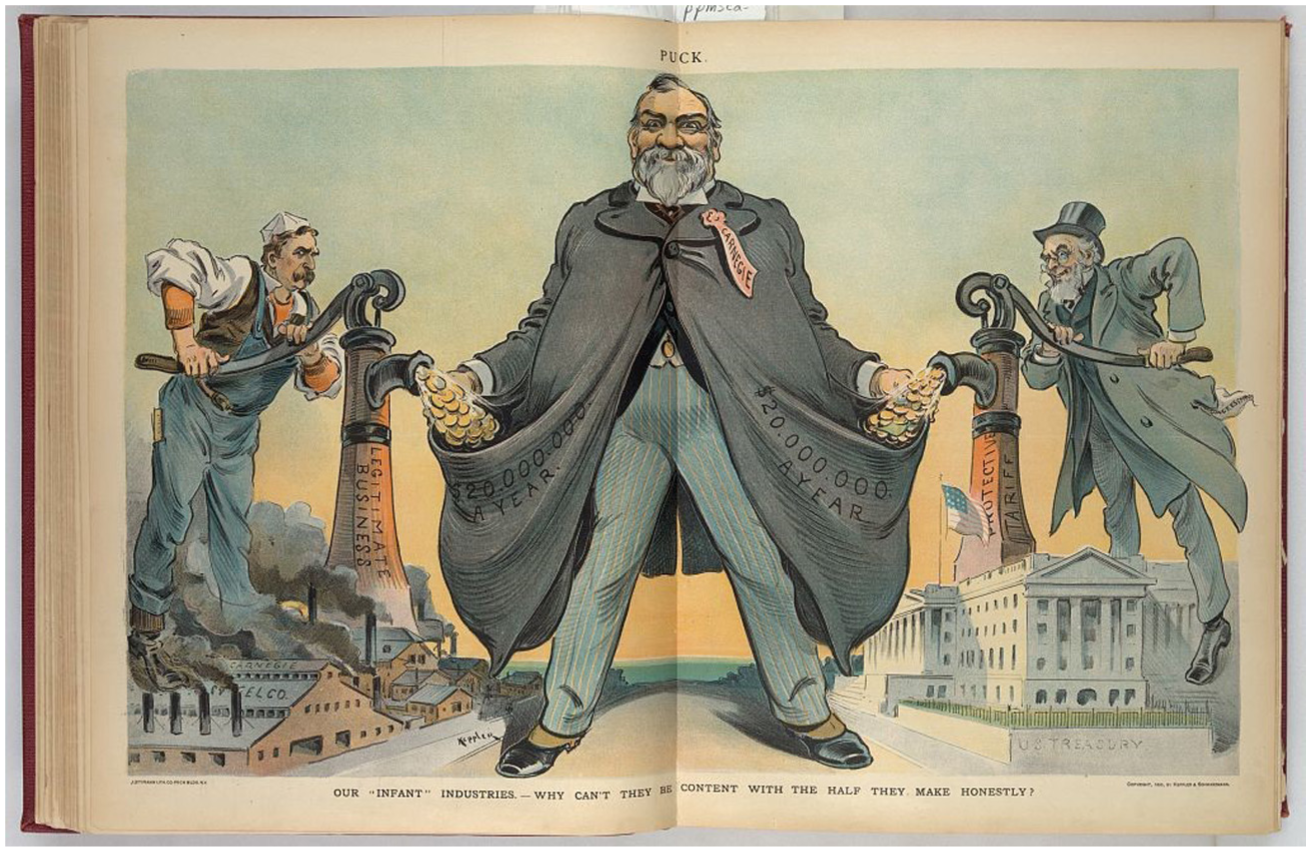
“Our Infant Industries—Why Can’t They Be Content With the Half They Make Honestly?” [political cartoon]. Puck, April 4, 1900.
Against a backdrop of widespread fears over the tentacular reach of large corporations and their potential to dismantle democratic guardrails and the will of the people, Carnegie’s liberal Republican views informed his perception of democracy and free market capitalism as mutually reinforcing systems that must both be vociferously defended. For him, democracy is a mode of self-governance that actively defends against the tyranny of aristocracy and the brutality of imperialism. Further, he envisions democracy as a civilizational feat that is best cultivated and maintained by cultural institutions that he imagines as originating from the English-speaking world. While his articulation of democracy is multifaceted, it is also incapable of interrogating the underlying political economic conditions that seemed to many spectators to imperil the very possibility of true self-governance in the Gilded Age period.
Democracy operates in Carnegie’s essays as a rather flexible signifier that can accommodate a status quo of class inequality, so long as individual economic advancement remains possible in theory. In this way, Carnegie substantiates Weaver’s (1953) claim that the term “democracy” is rhetorically powerful precisely because it often resists definitional clarity and secures assent by virtue of its felt resonance with dominant morals and values (pp. 228–229). Such usage serves a strategic rhetorical function, permitting Carnegie to align himself with strands of patriotism and American exceptionalism while leaving existing socioeconomic stratifications unquestioned to the benefit of those most financially secure. All considered, it appears that Carnegie anticipates a pattern within the rhetorical history BPC, whereby corporate leaders in the United States invoke the language of democracy to legitimize market authority and frame private enterprise as essential to the preservation of a distinctly American way of life.
Discussion
Why should scholars study the rhetorical history of BPC? Earlier I reviewed extant scholarship on the relationship between rhetorical history and BPC, showing that rhetorical history was once more widely utilized as a methodological resource than it is today. I suggested that its decline has left a gap in the field’s understanding of how the past informs BPC’s present and future. Turning to Carnegie’s essays, one of my foremost objectives has been to demonstrate the continued viability of rhetorical history as a research approach and encourage greater attention to how the study of the past can better equip scholars, students, and practitioners to interpret and intervene in the complex communicative challenges presented by the contemporary BPC landscape. Further engagement with the rhetorical history promises to expand the field’s understanding of the centrality of rhetoric in mediating the disjuncture between the private sector and public life, thus complementing the growing resurgence of rhetorical thinking within BPC scholarship.
Beyond research, my efforts to reintegrate rhetorical history within BPC carry important pedagogical implications. By engaging rhetoric’s history, students are better able to appreciate that no strategic communication exists in a vacuum. And the same is true for BPC. For this reason, students should be exposed to historical materials that situate BPC within a lineage of persuasive techniques shaped by recurring social and cultural dynamics. Carnegie’s essays are just one set of primary sources instructors may consider including on their syllabi’s reading lists. Familiarity with Gilded Age rhetoric, such as Carnegie’s, equips students to evaluate popular claims that today’s conditions signal the arrival of a new Gilded Age, one in which technology industry titans exert outsized influence on politics, economics, and society (Bajarin, 2025).
Like any mode of analysis, rhetorical history is not without its limitations, some of which constrain my scholarship and therefore warrant discussion. First, rhetorical history is a means of interpretation and contextualization that emphasizes the subjective relationship between meaning and language. In other words, rhetorical history is a humanistic style of research that cannot and does not purport to provide generalizable or predictive findings, which may be a cause for frustration among those who prefer post-positivist research methods. Relatedly, rhetorical history generally relies on techniques of close textual analysis and historical contextualization, which may produce an uneven balance between the two and leave some readers (depending on their methodological preferences) unsatisfied with the degree of textual focus or contextual depth. Finally, no single study can account for the full range of rhetorical practices or overlapping contexts that shaped a given historical period. In this article, for example, I studied a narrow slice of Carnegie’s speeches and writings and an even smaller segment of Gilded Age rhetoric considered more broadly. Rhetorical history is, to put it simply, an always incomplete project. However, this limitation of rhetorical history is also what makes it generative, as it continually opens new paths for inquiry.
Conclusion
I have examined Andrew Carnegie’s essays to elucidate how the business leader relied on rhetoric to guide understandings of the relationship between private enterprise and public life. I argued that the essays functioned as persuasive interventions that were both produced by and helped to sculpt the dominant sensibilities of the Gilded Age. My analysis demonstrated how Carnegie mobilized themes of wealth, labor, and democracy to persuade audiences to accept his image as a credible, socially aware authority amid rapid industrial change. Of course, Carnegie is just one small part of a much larger story that remains to be told by BPC scholars. We must continue the task of writing BPC’s rhetorical history, so that we can more fully comprehend the world we have inherited and the futures we are currently in the process of materializing.
Footnotes

Funding
The author received no financial support for the research, authorship, and/or publication of this article.
Declaration of Conflicting Interests
The author declared no potential conflicts of interest with respect to the research, authorship, and/or publication of this article.