






Abstract
The Résumé Redesign exercise equips business communication students with essential job search competencies through an experimental approach to résumé design. Grounded in contemporary research on AI literacy and résumé design, this assignment incorporates an AI-powered résumé scanner alongside faculty feedback to strengthen students’ understanding of formatting, mechanics, and audience adaption. Survey results from 136 student respondents indicate the AI feedback to be clear and helpful. This exercise offers flexibility for in-person and online learning environments to enhance a résumé assignment and introduce students to AI-mediated recruitment practices, while maintaining the critical role of human review in the résumé evaluation.
Purpose of the Exercise
The Résumé Redesign exercise introduces students to best practices of modern résumé building. This multifaceted, experiential approach integrates foundational job search skills, including identifying suitable jobs, interpreting job descriptions, and developing a core résumé, optimizing résumé development for AI and ATS (Applicant Tracking Systems). This assignment, developed with feedback from junior- and senior-level business students, delivers both human (faculty) and technological components to enhance learning.
Literature Review
Today, employers are seeking to hire employees with AI literacy skills. AI and big data analytics are two of fastest-growing skills employers believe will be important for workers to possess in the next 5 years (Di Battista et al., 2025). Increasingly, businesses are employing AI and ATS technology to review and rank candidates, as well as interview and critically analyze and support hiring decisions (Lookadoo & Moore, 2024). A poll of Chief Human Resource Officers in Fortune 500 companies reported a 93% AI adoption rate (Den Houter, 2024). In a 2025 survey of companies using AI in their talent acquisition process, 80% reported significant reductions in their hiring timelines for new employees (Reese, 2025). While businesses using AI report increased efficiencies in their hiring processes, human judgment still remains critical to ensure fairness and reduce bias that may occur even with the use of AI tools (Alikhani, 2025).
A fundamental component of pedagogical practice within the business communication curriculum is the instruction of best practices for professional résumé development (Marino, 2023; Helens-Hart & Dolechek, 2022). The methodologies of résumé instruction in the business communication classroom have evolved significantly, as technology has reshaped job searches. This evolution moved from creating a résumé primarily focused on grammar and structure to one suited for both paper and electronic delivery (Ponce, 2024). Today, the advent of AI and Applicant Tracking Systems (ATS) technology necessitates shifts in how student preparation is once again integrated into the business communication curriculum (Getchell et al., 2022; Lookadoo & Moore, 2024; Ponce, 2024).
Teaching students AI and ATS technology in the classroom can be problematic as rapid technological changes make it difficult for authors to include information on emerging technologies in traditional business communication textbooks (Lookadoo & Moore, 2024). This requires faculty members to rely on supplemental educational resources and job search guides to support student learning and classroom instruction (Lookadoo & Moore, 2024). Furthermore, students are reporting using traditional methods less frequently (e.g., university career center) to prepare for the job search. Instead, they are increasingly turning to faculty mentors and online sources, such as LinkedIn, Glassdoor, and YouTube videos (Ma and Fang, 2024; NACE, 2023).
As students increasingly leverage external sources, including AI tools for job search best practices, it is imperative that business communication faculty provide guidance on the ethical and appropriate use of these resources (Cardon et al., 2023; Lentz, 2024; Zufelt, 2025). This guidance ensures students maintain academic integrity and professional standards while navigating emerging technologies in career development. Cardon et al. (2023) advocates for building AI literacy in communicators through four capabilities: application, authenticity, accountability, and agency. Application underscores selecting the most suitable AI tool for the task and ensuring a thorough understanding of its capabilities and limitations. Prioritizing genuine communication by incorporating the human element is authenticity. Maintaining responsibility for verifying accuracy and fairness of AI-generated content is accountability. Agency is exercising independent decision making while avoiding overreliance on AI (Cardon et al., 2023).
Learning Objectives
After completing this activity, students will be able to:
LO1: Identify sources for locating employment opportunities
LO2: Analyze and evaluate job descriptions for employability fit
LO3: Write a targeted résumé that skillfully sells abilities
LO4: Compile a strong, organized, and complete résumé for print or electronic environments, including ATS fit
Instructions for Running the Exercise
Before running the exercise, faculty must select an AI-powered résumé scanning tool. There are many options, but career centers in higher education are commonly associated with using Big Interview/Big Resume, Jobscan, and VMock. Next, faculty should develop the assignment and scanning tool features before deploying the assignment to students.
Develop the Assignment and Customize the Screening Tool
Developing the résumé assignment may vary depending on the undergraduate or graduate course level. For undergraduate students without full-time work experience, a reverse chronological layout is most common. This résumé layout focuses on education and experience and lists components of these sections in reverse order (Lentz et al., 2024). At minimum, a résumé should include contact information, education, and experience (Randazzo, 2020). Yet, additional sections on the résumé could help a student show their relevance, value, or personality specific to meeting the needs of the audience (Randazzo, 2020).
Errors in formatting or technical mechanics on the résumé can be detrimental in moving a candidate forward in the job search process (Martin-Lacroux & Lacroux, 2017). A résumé assignment should include attention to formatting and technical mechanics, such as avoiding personal pronouns, using the correct degree title, spelling the school and location correctly, and using parallel lists.
An example of a résumé assignment and grading rubric that includes formatting, education section, experience section, additional section, and technical mechanics can be found in Appendix A. This assignment is utilized in an undergraduate business communication course.
Deploy the Assignment
To begin the process of deploying the assignment, the instructor should introduce résumé writing, including how ATS is utilized by employers. Appendix B includes resources to guide the development of classroom instruction on résumé writing. Allow at least one 75-min class for résumé writing instruction and discussion. This could be adapted to an online class using instructor-developed video and online discussion board features within a Learning Management System (LMS). Next, guide students in finding a job call that would fit their career future (LO1). Students could utilize job boards available through the institution or online job boards such as Indeed to locate a job call. The job call should capture key details about the position, including position title, organization name, position description, and minimum requirements. Invite students to design or redesign their résumé tailored to their chosen job. Aligning with LO2, dedicate 15 min of a class to guide students in finding a job call and saving the job call information into a PDF or Word document. Give students 30 min to update their résumé targeting the chosen job call or assign creating a targeted résumé as an out-of-class activity (LO3). With a résumé drafted and a saved job call, students are ready to upload their résumé to an AI-powered résumé scanner. Appendix C provides a résumé example submitted to Big Interview’s Big Résumé platform. In this example, faculty customized the AI system based on the assignment requirements, in addition to Big Résumé’s programmed review of readability, credibility, ATS fit, and format. Big Résumé provides a gold, silver, or bronze rating to each résumé section in addition to guided feedback. Allow 30 min of a class to submit and review feedback from the AI résumé scanner. The feedback from the résumé scanner allows for a unique opportunity for a think-pair-share activity during an in-person class (provide 30 min of class time) or a peer-review follow-up activity in an online class setting. Encourage students to debrief AI feedback together using the guided questions in Appendix D. Using feedback from AI and feedback from peers, students should then act on the feedback to revise and target their résumé (LO3 and LO4).
This assignment provides a student with the opportunity to have their résumé reviewed before the final résumé is submitted for a course grade (see grading rubric in Appendix A). Faculty serve as a human reviewer on the final résumé submission, further emulating a job search process where ATS is utilized to screen the résumé prior to a human review (LO3 and LO4).
Experience Teaching the Exercise
This exercise has been utilized in an upper-level undergraduate business communication course required for all business majors at a university in the Midwestern United States. Throughout 2025, an IRB-approved survey (Appendix E) collected 136 student responses to evaluate the usefulness and feedback provided by both the AI tool and faculty. Student participants were mostly junior (63%), sophomore (15%), and senior (13%) level. Exactly half of the respondents were female and half were male. Over 88% of student participants already had a résumé prior to the course, but self-evaluated their résumé to be intermediate (49%), beginner (39%), or excellent (4%).
Two open-ended survey questions evaluated if the AI and faculty feedback were understandable and if students could act on the feedback to improve their résumé. One open-ended survey question asked students to compare the AI and faculty feedback. Using magnitude coding procedures within the Dedoose software, student respondents indicated mostly positive comments for how easy the AI feedback was to understand. A student participant described their experience using Big Résumé as, “I appreciated that the AI tool was easy to understand. I implemented the tool’s feedback in my résumé, which immediately polished it. Using the AI advice, I went from a bronze to a gold in less than an hour.” Table 1 summarizes coding results, showcasing more positive codes than negative or neutral codes.
Coding Results.
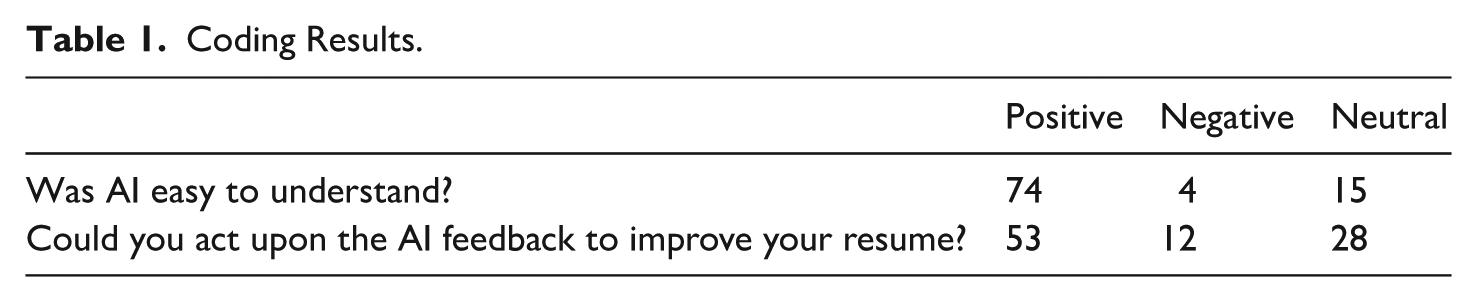
It is important to note the shift in the number of positive codes when student participants were asked about the ability to act upon the AI feedback to improve their résumé. There was more uncertainty in applying feedback from AI to improve the résumé. As such, it is imperative for faculty to include a debrief activity after the student submits to AI to help decipher the feedback and to help students act upon the suggestions AI provides.
Student respondents were also asked if they preferred to use AI or a human in a future résumé review. Human-only reviewers were most preferred (51%) over respondents who preferred using AI-only (7%). However, 42% of student respondents discussed the preference for both a human and AI review in the future. A student participant described the preference for both AI and human résumé reviews in the future as, “Both experiences are necessary and helpful. AI is great at providing a different perspective and advice for formatting or minor changes. The [human] advice is great because it is more specific and catered to what is appropriate for me.” Having a human reviewer and providing human-generated feedback as part of this assignment is necessary in the résumé development process for this assignment. It is not recommended to assign only the Big Résumé AI components of the exercise.
From the faculty perspective, human feedback is essential in the review process. Big Résumé AI made some suggestions that were unclear to students who did not have the skillset to critically evaluate the AI recommendations. For example, Big Résumé AI feedback recommended a summary section for a student with little work experience. The faculty reviewer recommended this space would be best utilized to highlight education followed by other achievements and extracurricular involvement. Another example was specific to formatting. Big Résumé AI suggested a font and spacing adjustment. These adjustments resulted in the résumé being a half-page in length. The faculty reviewer recommended additional relevant information be included and spacing be adjusted to reach the one-page goal.
Additionally, faculty recognize the importance of continued research on this topic. Future research should be focused on measuring learning outcomes. A pretest and posttest survey would allow faculty to better understand knowledge gained from this exercise through a quantitative methods lens.
Online Variations
Faculty teaching asynchronous or synchronous online course sections need to make only minimal modifications for this assignment. Lectures outlining best practices for identifying sources leading to potential employers, analyzing and evaluating job descriptions, writing targeted résumés that sell abilities, and creating a strong résumé that accentuate skills for print, electronic, and ATS fit can be recorded and deployed in an asynchronous environment or provided to students in a synchronous setting. Small group or large class discussion board questions can be utilized to unpack feedback from the AI review, discuss ease or difficulty of AI use, and share peer feedback résumé suggestions (Appendix D).
Student feedback on résumés can be delivered through a variety of methods, depending on faculty preference. Verbal feedback can be given to students through a synchronous meeting or recorded through Zoom or video software in an LMS system, and sent to students. Written feedback can also be provided through an email to students or through the feedback system within an LMS system.
Conclusion
Not only does this exercise prepare students for a job search where ATS is implemented, but according to the survey results, students see the value in having their résumé reviewed using a résumé AI scanner as well as a human reviewer. With 88% of the surveyed population already having a résumé before the business communication course, faculty recognize the importance of this assignment because it provides additional feedback to the student. Students may rate their résumé at an intermediate or expert level, so having faculty-only feedback for improvement can be difficult for the student, especially if the student has used their resume in a previous job search. Using the AI résumé review provides a buffer before the faculty-provided feedback, while also improving the résumé document. This exercise optimizes the ATS AI review while still maintaining the need for a human reviewer. Business communication faculty who teach job search communication would benefit from adopting Résumé Redesign to enhance a résumé assignment, introduce students to ATS, and provide an experiential opportunity within their classroom.
Footnotes
Appendix A
Appendix B
Many business communication textbooks include content related to job search communication, such as résumé writing and design. The following books contain relevant content for instructors:
Open Educational Resources (OER) are also available and may serve as a resource or supplemental resource to other course materials. résumé writing content can be found in the following business communication OER:
Appendix C
The following screenshots provide an example of a résumé submitted to Big Interview’s Big Résumé platform. Faculty use this example to guide the submission process to Big Résumé and to begin the debrief process for understanding the AI feedback.
Appendix D
The following questions could be used to debrief feedback from the résumé scanner tool. Use or adapt these questions in a think-pair-share activity, peer-review activity, or full class discussion. For online courses, these questions could be utilized in small group or class discussion board posts.
Appendix E
After informed consent, the survey included the following questions:

Funding
The authors received no financial support for the research, authorship, and/or publication of this article.
Declaration of Conflicting Interests
The authors declared no potential conflicts of interest with respect to the research, authorship, and/or publication of this article.