







Abstract
This article outlines a generic process in the reproduction of inequality we name cisgendering reality. Based on 114 responses from transgender Mormons and systematic reviews of religious, transgender, and inequalities scholarship, we demonstrate how contemporary American religions cisgender reality by (1) erasing, (2) marking, and (3) punishing transgender experience in ways that reproduce conceptions of reality predicated on cisnormativity. In conclusion, we argue that examining processes of cisgendering reality may provide insight into (1) transgender religious experience, (2) transgender secular experience, and (3) cisnormativity embedded within many contemporary religions.
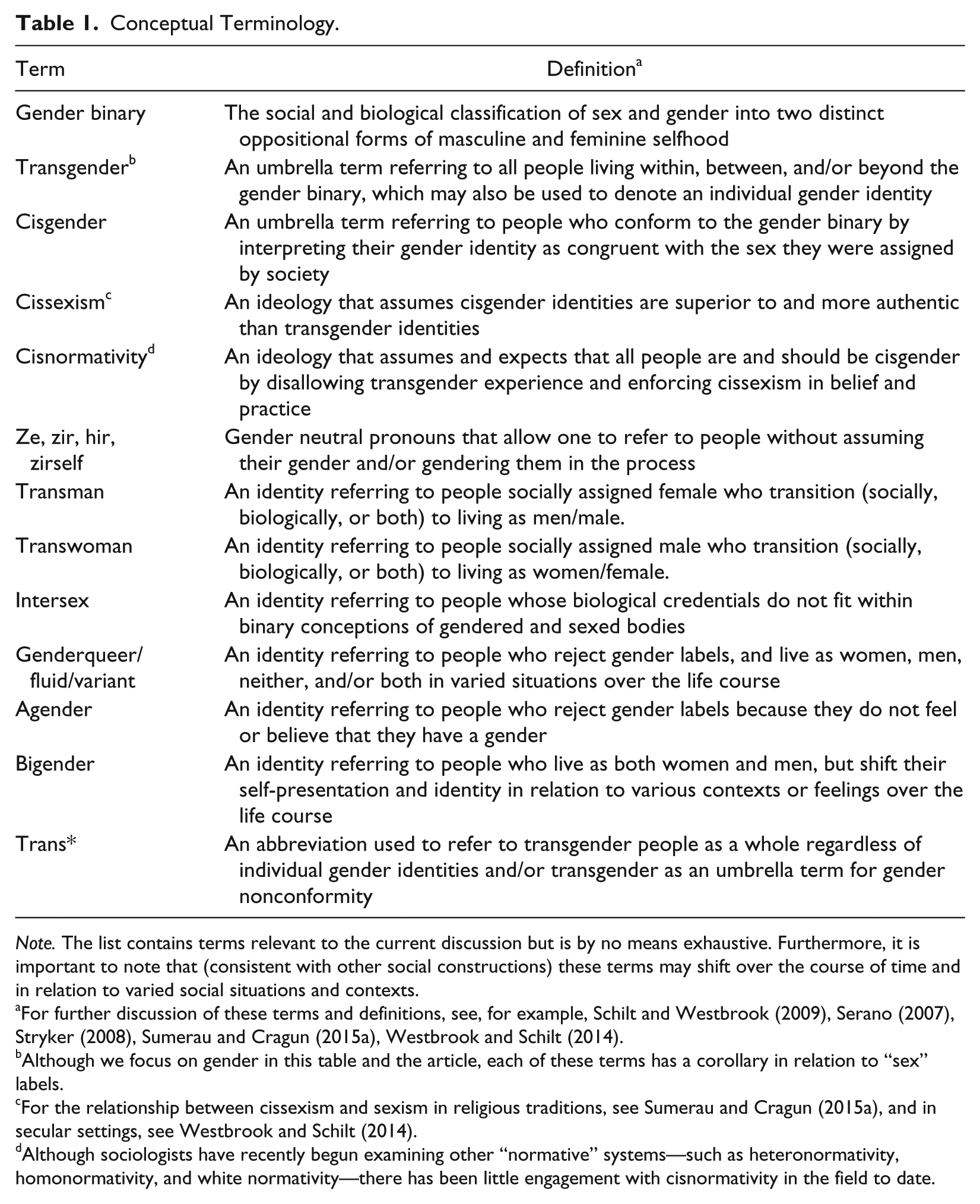
Transgender scholarship (see Table 1 for relevant terms and definitions) has expanded dramatically in the past few decades. Researchers have explored the ways transgender experience calls into question existing knowledge concerning, for example, scientific and legal classifications (Westbrook and Schilt 2014), workplace policies (Schilt 2010), family dynamics within homes and in relation to the law (Pfeffer 2010), public bathroom segregation (C. Connell 2010), internal and external dynamics of social movements (Stone 2009), medical institutions (Karkazis 2008), and political mobilization (Schrock, Holden, and Reid 2004). Furthermore, researchers have documented how transgender experience reveals the socially constructed nature of sex, gender, and sexualities in a wide variety of situations (Sumerau, Schrock, and Reese 2013). Although these studies have invigorated sociological understandings of transgender experience, our discipline has thus far left transgender religious people unexplored (but see Sumerau and Cragun 2015a).
Conceptual Terminology.
Note. The list contains terms relevant to the current discussion but is by no means exhaustive. Furthermore, it is important to note that (consistent with other social constructions) these terms may shift over the course of time and in relation to varied social situations and contexts.
For further discussion of these terms and definitions, see, for example, Schilt and Westbrook (2009), Serano (2007), Stryker (2008), Sumerau and Cragun (2015a), Westbrook and Schilt (2014).
Although we focus on gender in this table and the article, each of these terms has a corollary in relation to “sex” labels.
For the relationship between cissexism and sexism in religious traditions, see Sumerau and Cragun (2015a), and in secular settings, see Westbrook and Schilt (2014).
Although sociologists have recently begun examining other “normative” systems—such as heteronormativity, homonormativity, and white normativity—there has been little engagement with cisnormativity in the field to date.
In this article, we demonstrate some ways incorporating transgender existence and experience into scholarship calls existing assumptions and knowledge within the sociology of religion into question. Whereas much research has been devoted to gender and religion (see, for example, Avishai, Jafar, and Rinaldo 2015; Bush 2010; Burke 2012), such scholarship has thus far left transgender religious people out of the equation without even suggesting this topic in theoretical discussions or reviews. More specifically, research into religion has typically mirrored religious teachings of only two genders and, in so doing, left scholars with little information about religious issues transgender people face or cisnormativity in contemporary religions.
To this end, we examine the relationship between contemporary religion and cisnormativity 1 through the case of transgender members and former members of the Church of Jesus Christ of Latter-day Saints (LDS or Mormon Church). Although Mormons differ from other religions in theological and institutional structure, their beliefs and practices concerning gender are consistent with the vast majority of contemporary American religions (see, for example, Avishai et al. 2015; Burke 2012; Bush 2010). Specifically, they mirror these traditions by asserting and enforcing a reality wherein (1) only male and female beings exist; (2) a creator (usually referred to in masculine terms) created males and females to occupy distinct and often unequal positions, roles, and responsibilities in the divine’s eternal plan; and (3) believers are encouraged to sanction and reject any empirical realities that do not match these storylines (see also Sumerau and Cragun 2015b). Considering these assertions provide the foundation for the vast majority of contemporary American religions, we use the case of transgender Mormons to outline a generic process likely to be found whenever religions seek to create and maintain a cisnormative reality.
As such, we draw on complementary interactionist (Blumer 1969) and feminist (Sumerau and Cragun 2015b) perspectives on gender and religion to outline how religions define transgender existence as problematic or “other” (see Schwalbe et al. 2000) through the ways they respond to transgender people. More generally, this article moves gendered religious scholarship beyond an almost exclusive focus on cisgender people. In so doing, we argue the processes whereby religions define transgender experience as other, which we call “cisgendering reality,” provides a useful “sensitizing concept” (Blumer 1969) for understanding and revealing the social construction of cisnormativity in secular and religious settings.
Religion or Cisnormativity?
Religion is one of the primary organizing forces in contemporary American society (Barton 2012). Specifically, religion represents the ultimate symbolic boundary between what counts and does not count as American in the minds of many citizens (Edgell, Gerteis, and Hartmann 2006). Furthermore, researchers have found that nonreligious people often experience similar forms and amounts of discrimination in comparison with racial, classed, gendered, and sexual minorities (Hammer et al. 2013; Hammer et al. 2012). In fact, recent years reveal that even people perceived to be nonreligious, such as many sexual minorities and transgender people, face significant hardships due to the privileged position of religion (Robinson and Spivey 2007). Sociologists have observed that understanding systemic inequalities requires investigating the social construction and elevation of religion in relation to other ideologies (Sumerau 2014).
Understanding the social construction and elevation of religion, however, requires making sense of gender (Avishai et al. 2015; Bush 2010). This is because contemporary American religions—especially those founded within Judeo-Christian-Islamic traditions—tend to be organized around fundamental beliefs and assumptions about gender. Most contemporary religions teach some variant of an origin story wherein God created woman and man only, imbued each with mutually exclusive traits and responsibilities, and built the foundation of civilization on sexual, emotional, and spiritual relationships between women and men. Considering that these oppositional and distinctive—or as religions often teach, complimentary—creations provide the foundation for the entire cosmos, it is impossible to understand religion without evaluating religious constructions of gender (see also Butler 1999; Foucault 1978; Serano 2007).
To this end, we begin with an observation that most contemporary religious cosmologies and theologies are devoid of and ignore transgender existence. Rather than describing our world, they breathe life into an imagined world entirely composed of cisgender people. However, transgender experiences have existed throughout human history, and researchers have revealed that scientific, legal, medical, and other sex/gender categorization systems rely on and shift in relation to the subjective expectations and assumptions of social authorities (see, for example, Butler 1999; Karkazis 2008; Stryker 2008). With this in mind, it is clear that many contemporary religious teachings require people’s acceptance of cisnormativity. 2
As people act toward things based on the meanings those things have for them (Blumer 1969), and what people believe to be real will be real in its effects (Thomas and Thomas 1928), any understanding of contemporary religion necessarily requires grappling with meanings at the basis of these ideological frameworks (see also Berger and Luckmann 1966; Goffman 1974; Mead 1938). If people are taught to define God or other supernatural forces as creators of a cisgender world, then they will likely develop cisnormative assumptions and prejudices. So long as religious leaders seek to maintain the illusion of a cisnormative reality, they will necessarily impose cisgender forms of presentation, interpretation, and self-development on their members. As a result, we suggest that a primary component of much contemporary religion involves “cisgendering reality,” which we define as the process whereby religious leaders and members socially construct and maintain cisnormative interpretations of the world through their ongoing teachings, rituals, and other faith-related activities.
It is noteworthy that although existing studies never mention cisnormativity, a critical reading of their findings implies that cisgendering reality is common in many contemporary American religions. Exploring the teachings of the Mormon Church over the past century, for example, Sumerau and Cragun (2015b) demonstrated that members were taught how to do gender (West and Zimmerman 1987) in ways that reinforced beliefs about essential differences between women and men, and demonized any appearance of gender variance. Similarly, Bush’s (2010) systematic review of the field found that Christian traditions were typically founded on notions of male and female difference, which justified differential treatment of women and men in a wide variety of contexts. Furthermore, in an examination of the Southern Baptist Convention, Kaylor (2010) found that leaders conceptualized femininities and masculinities as essential elements of human spirituality created in an oppositional manner. Without mentioning cisnormativity, these findings imply that cisgendering realities may be a common ingredient in Western theology.
Researchers have also implied similar patterns among religious men. Examining the identity work of gay Christian men, for example, Sumerau (2012) found that respondents not only believed in notions of but also sought to become “Godly men” by enacting religious ideals of essential masculinity. Similarly, Heath (2003) found that men in the Promise Keepers mobilized the symbolic resources provided by their religions to assert their authentic Christian manhood. Considering that masculinities themselves are socially constructed notions of (cisgender) self-presentation that vary historically and culturally (Schrock and Schwalbe 2009), these studies imply some ways religious people have internalized cisgendered realities promoted by their religions by learning to believe there really are “authentic” gender distinctions.
Findings imply similar beliefs among religious women. Exploring the experiences of Evangelicals, for example, Gallagher and Smith (1999) noted some ways these people redefined male headship by emphasizing the inherent separation or difference of women and men in the eyes of God. Moreover, Beaman (2001) not only observed some ways Mormon women subverted official depictions of womanhood but also found that such women believed themselves to be essentially female despite their gender transgressions. Considering that social—religious or otherwise—constructions of femininities are no more real or essential than manhood (Martin 2004), these studies again imply many religious people have been taught to cisgender their own realities.
Although religious systems of belief, like all other ideological frameworks, are continuously changing, findings from social movement analyses also imply stability in the case of cisnormativity. In an examination of the Ex-gay Movement, for example, Robinson and Spivey (2007) found that leaders regularly promoted assumptions about essential and oppositional masculinities and femininities to oppose feminist and sexual minority movements. Similarly, Rose (2005) observed that assumptions about the ways God made women and men distinct underlie movements promoting abstinence only sexual education. In addition, studies reveal similar assumptions in other movements including but not limited to right to life campaigns (Rohlinger 2006) and opposition to same-sex-marriage campaigns (Barton 2012). Although many things may be changing in contemporary religions (Gallagher and Smith 1999), it appears processes of cisgendering reality are steadfast.
Despite widespread implicit suggestions of cisgendering reality in previous findings, researchers have left transgender religious experience mostly unexplored (Rodriguez and Follins 2012). In fact, transgender experience has typically only entered such literature in two ways. First, researchers exploring the experiences of religious sexual minorities have often noted transgender people in passing or discussed the handful of such respondents in their samples (see, for example, Sumerau, Padavic, and Schrock 2015; Wilcox 2009). In addition, researchers have sought to understand the ways religiosity might influence transgender aging and health (see, for example, Golub et al. 2010; Kidd and Witten 2008; Porter, Ronneberg, and Witten 2013). Although these studies reveal the existence of transgender religious people, they offer little understanding of transgender religious experience or the construction of religious cisnormativity. In fact, Kidd and Witten (2008) attempt to explore transgender religious experience only to find that common measurements of religiosity do not apply to transgender people. This finding (e.g., the inadequacy of existing measures for capturing noncisgender religiosity) further suggests cisnormativity as a basis for much contemporary religion.
Following interactionist (Goffman 1959) and feminist (Kleinman 2007) principles of analytic generalizability, we build on the aforementioned literature to outline a “generic process,” or a common way people accomplish a shared social goal likely to be found in multiple settings (Schwalbe et al. 2000). As Schwalbe and associates (2000) note, generic processes seek to generalize actions rather than making statements about populations, and in so doing, “sensitize” (Blumer 1969) or guide attention to the common ways people go about creating and making sense of themselves and others (Goffman 1963). In this article, we thus outline practices likely to occur in various forms whenever people (intentionally or otherwise) construct a cisnormative worldview devoid of transgender experience, a process we call cisgendering reality.
Method and Analysis
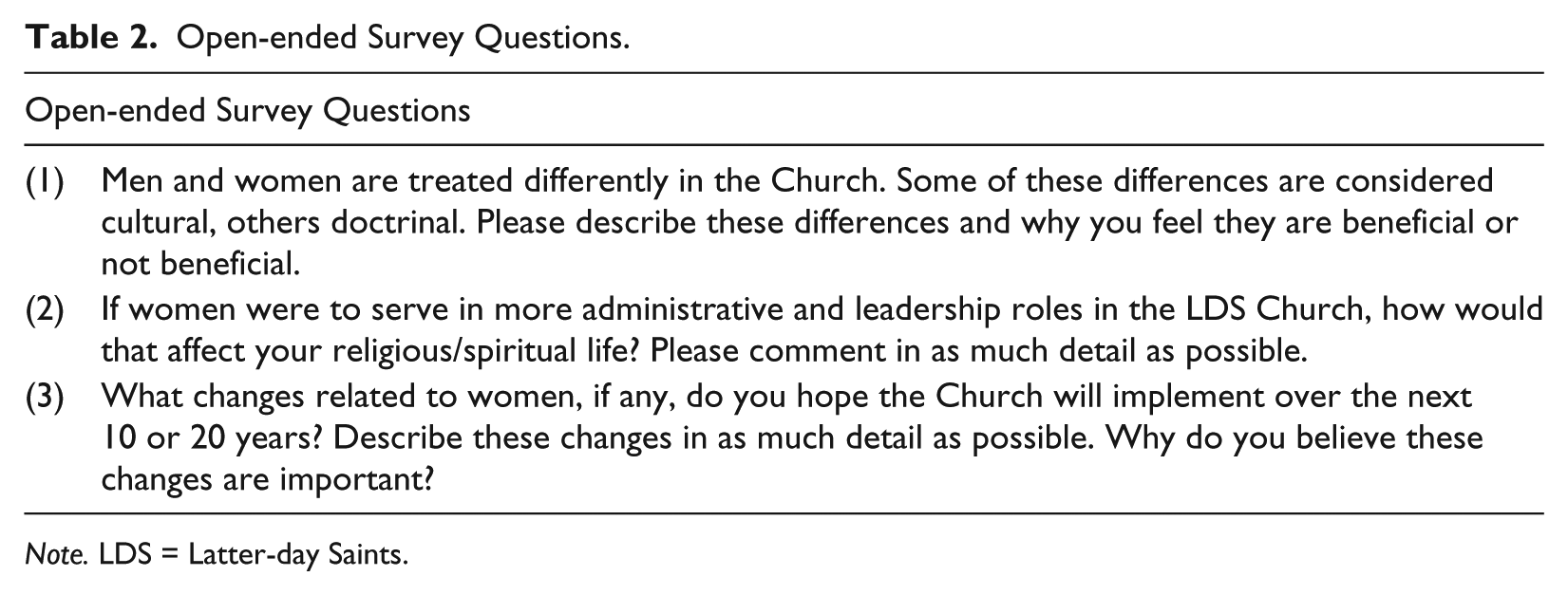
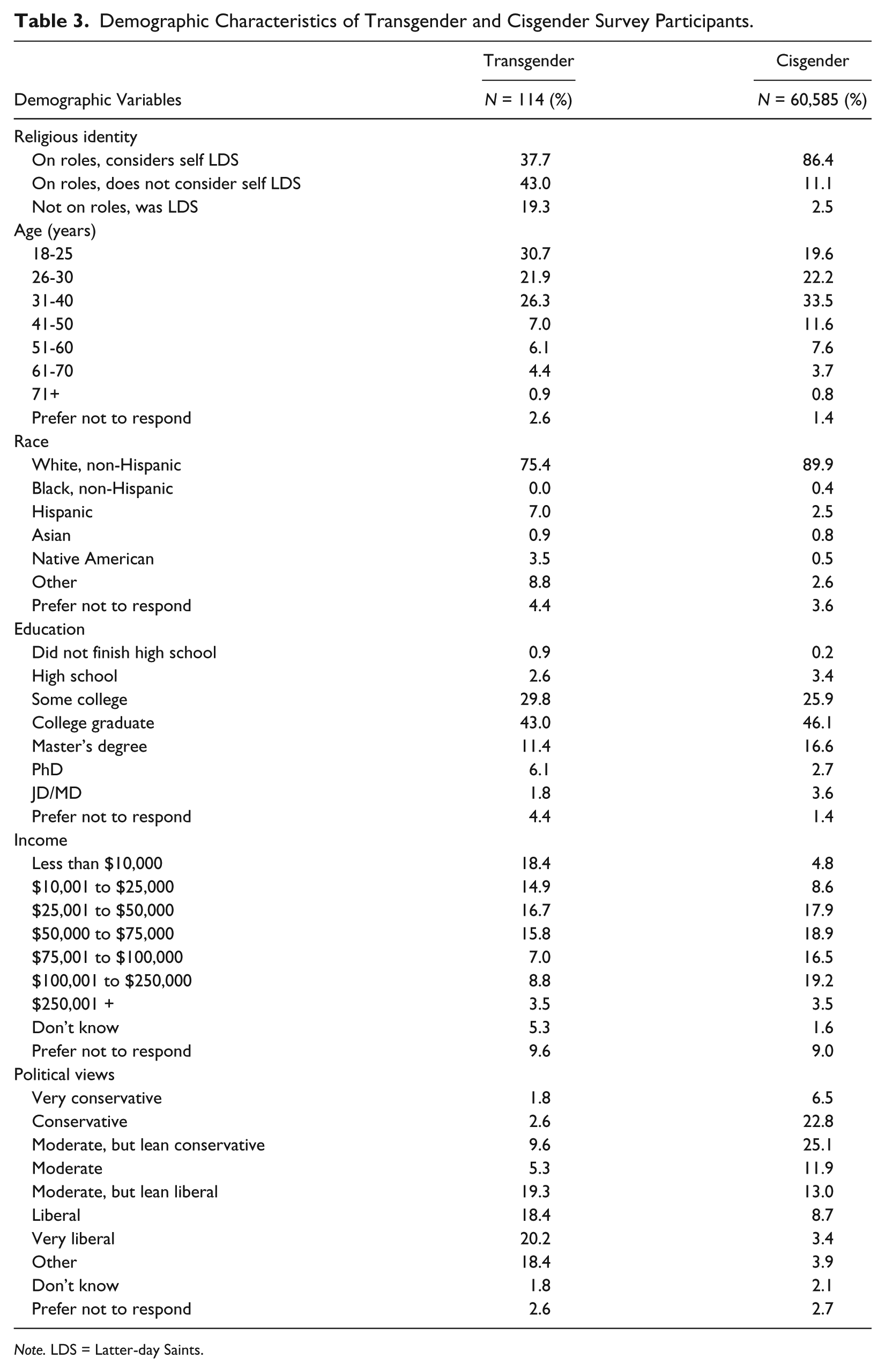
Data for this study derive from a survey of Mormons in the contemporary United States. Data collection took place in the fall of 2014 (for a background on Mormonism, see Sumerau and Cragun 2015b). Participants had to be over 18 and had to have been a member of the LDS Church at some point. The survey used a snowball sample and included three open-ended questions about gender that provide most of the data used here (see Table 2 for these questions; see Table 3 for demographics in the whole survey). Links to the survey were posted on Mormon-related Web sites. At the conclusion of the survey, the software generated a unique URL participants could share with others to enhance the snowball design. This approach resulted in an overall sample of 61,066.
Open-ended Survey Questions.
Note. LDS = Latter-day Saints.
Demographic Characteristics of Transgender and Cisgender Survey Participants.
Note. LDS = Latter-day Saints.
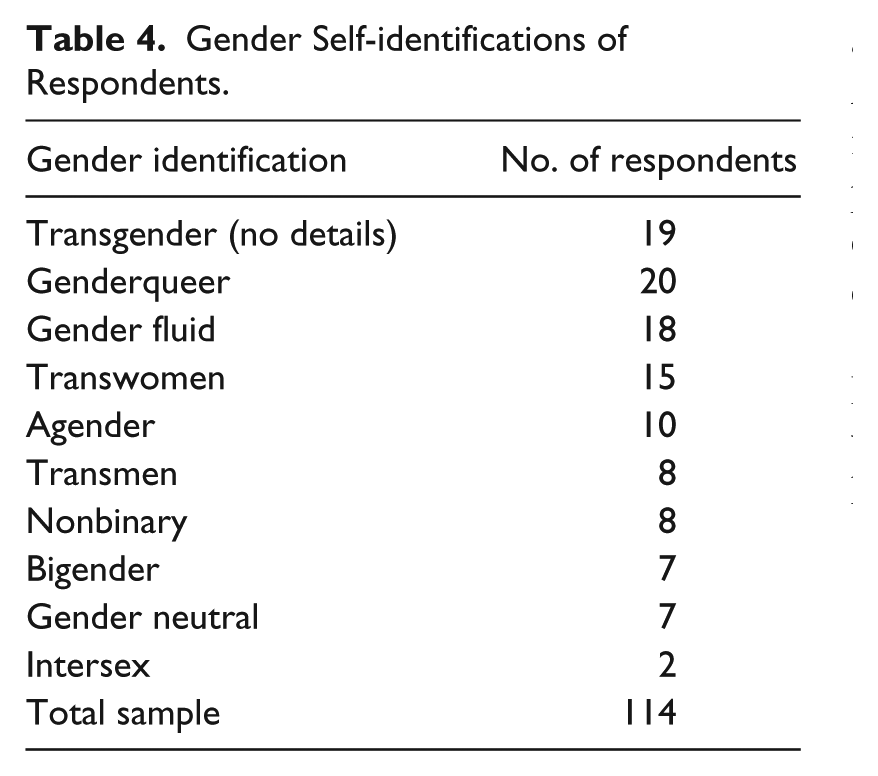
Seeking to capture diversity in Mormon opinions, the survey included an “other” option for self-reported gender. Although some respondents and media outlets expressed displeasure with this, it led to a sizable number of responses from former and current transgender Mormons. As a result, the second author separated this sample from the larger data set, and recruited the first and third authors—who primarily study sexual and gender minorities—for analyses. The first author then went through the data separating out respondents who did not explicitly identify as transgender. To this end, ze limited the sample to people who identified simply as transgender, and those identified in ways—such as genderqueer, gender fluid, agender, intersex, and bigender—often included in this umbrella term (see Table 4 for gender identities of the transgender sample). This process yielded a final sample of 114 former and current transgender Mormons.
Gender Self-identifications of Respondents.
In terms of religion, 38 percent of transgender respondents said that they were on LDS rolls and identified as LDS, 43 percent thought they remained on rolls but no longer identified as LDS, and 19 percent said they were no longer members. Further, 85 percent of transgender respondents were born and raised in Mormon households, whereas 13 percent converted to Mormonism. In terms of race, class, education, politics, and age, our sample is overwhelmingly white (75 percent), well educated (92 percent had at least some college), not particularly affluent (66 percent had incomes below $75,000), fairly liberal (58 percent self-identified as liberal or “leaning” liberal), and relatively young (78 percent were 40 years old or younger).
For the purposes of this study (see Table 1), we recognize transgender as both an individual identity and an umbrella term for people who live as a gender different than the one assigned to them at birth and/or beyond and between gender binaries (Serano 2007). As a result, we use the term transgender as a collective label to refer to our sample while introducing respondents with the gender identities they reported. Similarly, we recognize “Mormon” as both an identification of active LDS practice and an identification of former LDS practice and/or relation. As a result, we use the term Mormon as a collective label for our sample, even though some participants no longer identify as Mormon (all participants did identify as Mormon at some point).
As noted above, we also use the case of transgender Mormons as representative of experiences transgender people may navigate in religions that assert and enforce cisnormative views of reality (Sumerau and Cragun 2015a). As the vast majority of contemporary American religions teach the same foundational gender lessons (Bush 2010), we use this case to outline practices transgender people may encounter within and beyond these varied religions. We thus focus on the generic processes religions may use to create and maintain cisgender realities. Rather than arguing any specific tradition or believer will consciously or intentionally possess a specific quality or characteristic, we outline common things religious people and traditions may do to cisgender reality for themselves or others (see also Schwalbe et al. 2000).
To this end, our analysis emerged in an inductive fashion. Recognizing we had an opportunity to learn what religion was like for transgender people, the first author explored transgender respondents’ statements seeking patterns in the sample. 3 Ze looked for the ways people learned they were transgender from religious leaders and how religious leaders and members responded to gender variant self-presentations. In so doing, the first author noted common experiences among respondents, and compared and contrasted these patterns with the third author. In so doing, the first and third authors came to see these patterns as representative of the ways transgender Mormons experienced cisnormativity within the religion.
Following elements of “grounded theory” (Charmaz 2006), the first and third authors shared these patterns with the second author, and the three began to compare these categories with existing literature in gender, religion, and transgender scholarship. Our collaborative analysis revealed many ways transgender Mormons experienced cisnormativity in their interactions with Church officials and fellow Mormons. We thus went back through the data to refine our categories, and grant them labels that captured these themes. In the following sections, we outline how transgender Mormons experienced efforts to cisgender reality through (1) erasing transgender experience, (2) marking transgender bodies, and (3) punishing gender nonconformity. Although we treat these processes as analytically distinct, transgender Mormons regularly experienced a combination of these processes during their lives.
Erasing Transgender Existence
Sociologists have long recognized the importance of investigating the ways people construct varied realities (see, for example, Berger and Luckmann 1966; Collins 2005; Goffman 1974). Key to these processes are efforts to erase certain aspects of empirical reality that do not easily fit desired storylines (Foucault 1978). Examining American history textbooks, for example, historians have noted that such “records” often downplay or erase negative aspects of history for the sake of an overall storyline focused on continual progress (Loewen 2008). Likewise, researchers have noted how other media erase minority experience to bolster dominant ideologies (McCabe et al. 2011). We argue an integral part of religion involves cisgendering realities by erasing transgender reality in favor of an exclusive focus on a cisnormative world.
The erasure of transgender reality is implicit in existing studies of religion. In Mormonism, for example, Sumerau and Cragun (2015b) outlined how leaders regularly emphasize male and female distinctions without any mention of other potentially moral options, and defined gender variance of any kind as an assault on the sanctity of God’s plans. Explorations of other Christian (Ammerman 1987), Jewish (Avishai 2008), and Muslim (Rinaldo 2013) practices also imply that believers ignore or denigrate gender variance to create and enforce a male/female only view of God’s world. Although none of these studies explored the implications of these teachings for transgender people theoretically or empirically, our respondents experienced these implications every day.
As the following excerpt notes, transgender Mormons were well aware that many people within and beyond the Church did not even know they existed:
Many cultures and languages don’t even have the proper terminology to identify or label individuals who are not entirely “male” or entirely “female” (i.e. intersex individuals). Some individuals may not have been educated to know that such individuals exist! I feel the greatest differences in our society originate from beliefs about gender being a duality of the sexes, versus gender being on a spectrum. Some cultures and individuals believe that if nature has created an individual that is not entirely male or female, that something must be wrong with them, and that they must be surgically and socially altered.
Respondents, like the gender fluid respondent quoted next, often tied this erasure explicitly to the structure of the Mormon religion:
There are no activities that cater to women who do not fit into the typical Mormon housewife category and those who do not show the utmost excitement while doing activities like knitting, cooking, sewing, etc. are looked down upon.
In fact, many transgender Mormons echoed long-standing Judeo-Christian-Islamic notions of an infallible creator to suggest that fellow religious people had lost touch with the will of God. They, like the transman quoted below, suggested the cisnormative nature of religion was a human misunderstanding that ignored God’s actual creation:
I hope for the day for the realization that God does not make mistakes, yet as he made man and women he did make me, a person that is not perfect and has and will continue to make mistakes. I did not chose to be transgendered but as in everything in God’s plan I have been given choices and I chose to not commit that unforgivable sin and not kill myself.
Whether speaking to religion in general, their church, or God, transgender Mormons sought to understand how part of God’s creation could be left out of religious doctrine when religions were supposed to be vehicles of God’s entire plan.
Many respondents also suggested the heart of the issue resided in the promotion of the gender binary within the Church and larger Christian tradition. As a genderqueer respondent noted, churches often suggested freedom while enforcing gender conformity:
Gender issues are connected with all other facets of one’s identity, and specifically as a child who grew up in the church I was not given the ability to self-advocate as a powerful individual and sacred instrument of God. I was told many times that I had free agency and was able to be who I wanted by several church leaders, but their overall actions said otherwise.
While some respondents focused on the leadership, others, like the following agender respondent, noted the organization of religious activities established distinctions between males and females without room for other options:
Young Women’s activities revolved around homemaking and crafty activities, which I didn’t always enjoy, especially when I knew that the Young Men were going rock climbing, biking, hiking, fossil-hunting, and more practical hands-on things. These were always backed up with “This is how men and women work,” and I didn’t want to risk being pinned as someone in need of spiritual help, so I said nothing.
Rather than simply different, however, respondents also argued these “distinct” roles were detrimental to the development of full personhood (see also Sumerau and Cragun 2015a). As the following statement from a genderqueer respondent suggests,
This is not a beneficial way to raise children in the church. The boys will feel like they have to constantly be the strong ones, the ones who go out into battle instead of staying home and taking care of the children. The girls grow up feeling like they are required to find a man, get married, and start popping out the babies.
Religious leaders and members thus accomplished the erasure of transgender options by segregating all aspects of religious experience, and creating binary boxes everyone would feel pressured to fit in to as they aged.
Respondents also revealed some ways the Church explicitly taught and enforced cisgender realities. As a genderqueer respondent noted, following Mormon rules would ultimately leave no space—symbolically or physically—for noncisgender people:
The church’s insistence that Vagina = submissive mother and penis as authoritative leader and that this is taught starting at age 11 is ludicrous. If God made woman to be more gentle, as they say, why do they need to enforce it? Shouldn’t it happen naturally?
They also, as evidenced in the next two quotes, stated they would feel more safe and welcome in religions if these structures did not erase their experience and enforce cisnormativity:
I would feel more safe at church and would be willing to participate again and once again become a more active member. Right now church is not a safe place for me. I feel unsafe there.
A transman also noted, “I would feel more safe to speak to someone about my journey in this life. I think it would also create a safer place for many others.” As a gender fluid respondent said, the cisgender emphasis in Church teachings and activities ultimately led to stress for those who were erased: “I’m biologically male so I was forced to go to scouts, and though I enjoyed camps and stuff there’s a lot of fun things that the girls did that I would have loved to do, and I didn’t really fit in with most guys there either which made it worse.” Transgender Mormons thus experienced religion as a cisnormative training program, and while this might escape the notice of cisgender Mormons, it created significant conflicts for those framed as “other” (see also Schwalbe et al. 2000).
While the aforementioned patterns rendered transgender experience symbolically invisible, transgender people were also asked or forced to disappear once their “otherness” became known to fellow Mormons. The following excerpt from a transwoman offers an illustrative case of this type of erasure:
When I transitioned, I was told NOT to come to my ward or any other ward in my stake because my attendance would be disruptive. I stopped going to church because I did not want to disrupt any other member’s worship. That doesn’t sound like a Christ-like attitude to me, but I respected the authority of my local leaders. When they excommunicated me, it wasn’t because I had lost a Christ-like love, it was because I had altered my body surgically. Further another bishop advised my daughter NOT to have anything to do with me ever again. Her actions were to prevent me from coming to her house and forbid me to have any interactions with her five children, my grandchildren. How is that Christ-like?
When the LDS Church excommunicates members for undergoing a sex change operation, the latent purpose of the institution itself becomes cisgendering reality. In the process, the Church reifies cisnormativity by denying the existence of transgender people, whose very existence “disrupts” the imaginary world created by the church.
Although the aforementioned case offers an especially illustrative example of a common pattern noted by many respondents, transgender Mormons were erased physically in other ways. Specifically, they stated that their other activities were limited by the cisnormative emphasis in the Church and suggested things they could do if they were welcomed instead. As a transwoman noted, changes in gender teachings would expand her possible involvement where the Church is currently facing conflict:
It would add a great deal of beneficence to the Church. As a leader in the TLGBQI Community, I could be a great missionary to that community. I am being robbed of that opportunity.
Similarly, a genderqueer respondent noted some ways ze could encourage others to be more inclusive of all God’s creation if given the freedom to be zirself in Church:
Being gender neutral is frowned on, to say the least, so I felt even a tier lower than women, whom I could see were very misrepresented in the church hierarchy. Heaven forbid I try and go to church without wearing a dress, and I was called numerous names, even told to leave until I could dress appropriately for doing so. This is not behavior I would expect coming from people who claim to love thine neighbors, and it is harmful, especially to a teen already struggling to find their identity. To be made to feel less or that God somehow loves you less because you feel more comfortable dressing as the opposite sex is a very dangerous line to be feeding young kids.
Transgender Mormons were well aware not only of the ways Church teachings and practices erased their existence but also of the ways the Church itself would erase transgender people from active membership for the sake of protecting cisnormativity. In so doing, the Church placed cisnormativity above God’s children. That one’s sex or gender—or the changing of one’s sex or gender—can lead to excommunication from a religion suggests that cisnormativity is given greater priority than the belief that all are the children of a benevolent God. One might also argue that the emphasis on cisgendering reality serves to legitimate religious theology dependent upon cisnormativity. Inversely, recognizing the existence of transgender individuals could undermine theology, which has never been immutable, but is often perceived to be such by the laity (for implications of these patterns for cisgender LDS women, see Sumerau and Cragun 2015a).
Importantly, the process of transgender erasure even emerged in relation to the design of the survey. While the second author sought to open up the possibility of gaining insight into the lives of potential transgender Mormons, neither he nor the other scholars constructing the survey had much experience with transgender people. As a result, the “other” option in the gender section of the survey was the only example of a purely noncisgender question, which both respondents and the first and third authors noted after the fact. As one agender respondent put it, even the survey carried cisnormative assumptions: “I actually felt very excluded from this quiz as I identify as neither a man nor a woman. Would I get the same treatment if that were well known at my local church? Would I be able to serve a mission? Hold a leadership position? Probably not.” A genderqueer respondent offered a similar critique:
I feel I really must note that this survey, while helpful, doesn’t really address transgender individuals (neither those who are male or female, but assigned a different gender at birth, nor those who feel they don’t fit anywhere in the current—and false—gender binary). It might be good to ask a *few* questions that aren’t so strictly about the gender binary.
Considering that even the option of “other” for gender is rarely present in contemporary sociological surveys, these responses direct our attention to the ways that erasing transgender experience occurs—with or without intention—by researchers exploring religion through existing methodological and theoretical frameworks.
Marking Transgender Experience
Although erasure is a noted step in establishing unequal social relations between dominants and subordinates (Collins 2005), it is equally common—and some sociologists have argued necessary—for subordinates to be marked as distinct or other (Schwalbe et al. 2000). This is because no matter the strength of a given ideology to influence a given population, empirical realities will always manifest in ways that challenge such frameworks. Although cisgendering reality may erase awareness of transgender people from consciousness, it cannot render actual transgender people nonexistent in the empirical world (see Westbrook and Schilt 2014). As a result, cisnormativity requires mechanisms that mark transgender people and experience as different, deficient, marginal, and/or unnatural, so those who subscribe to such ideologies may maintain their belief in the face of conflicting evidence (see, for example, Serano 2007; Stryker 2008).
In fact, the ways subordinates may be marked as different or lesser has long been at the heart of much sociological analysis. Exploring the establishment and enforcement of racial categories, for example, researchers note the ways skin tone was infused with social meaning to justify ideologies built on the belief that some races deserved better treatment than others (see, for example, Bonilla-Silva 2010; Collins 2005). Similarly, researchers have noted many ways sexual minorities have been constructed as oppositional to justify heterosexual privilege and the marginalization of nonprocreative sexualities (see, for example, Sumerau 2012). In all such cases, subordinates are marked as deficient to grant legitimacy to dominant ideologies and provide social beings with reasons for the unequal treatment of their fellow citizens.
In important ways, gender scholarship has already begun the process of explicating many mechanisms of “othering” (Schwalbe et al. 2000) transgender people experience in secular settings. Researchers have, for example, noted the enforcement of binary femininities and masculinities in schools, workplaces, medical institutions, families, and many other contexts (see, for example, R. W. Connell 1987; Padavic and Reskin 2002). Furthermore, researchers have built on these insights to reveal many ways transgender people are marginalized by cisnormativity in similar settings (see, for example, Schilt 2010; Sumerau et al. 2013; Westbrook and Schilt 2014). This section shows how transgender religious people may also be marked as “other” within the context of contemporary religions.
As the following statement by a genderqueer Mormon suggests, transgender Mormons often experience careful monitoring throughout their interactions and implicit suggestions that they are cisgender:
When I was 14 and going through puberty so my body was changing, his wife would routinely ask me how she could grow breasts as large as mine and have a body like mine so her husband would look at her the way he looked at me. Grown women constantly asked me for marital advise, made comments on my appearance and body, and routinely corrected my behavior as if they owned my body and future because they though [sic] they were doing me a service, helping me become a better, more normative desirable woman for my future husband.
The above quote illustrates that, despite considering zirself genderqueer, because of the cisnormative lens through which they viewed the world, members of this respondent’s congregation viewed zir as a cisgender female and extended that perception to both jealousy (based on zir figure) and attempts to teach zir how to align with their imagined cisgendered reality. In so doing, they marked zir as a cisgender female rather than recognizing transgender existence (Butler 1999). Although the above example offers an experience transgender Mormons noted multiple times, our respondents, as noted in the following excerpt from a bigender person, also revealed specific ways they were marked as different: “Trans* members are very often marginalized by sex based on differential treatment such as dress code traditions, sex based separation of classes etc.” A nonbinary respondent added, “The rigid gender-based atmosphere of the church is extremely uncomfortable for transgender and nonbinary individuals such as myself, and changing church policies to treat men and women equally would help appease some of that dysphoria.” Respondents thus experienced others’ constant efforts to mark them as different and deficient.
They also noted the effects of such practices. Specifically, they argued cisnormativity led them to feel out of place and mismatched within the religion. As a gender fluid respondent put it,
Women are often treated as mothers and nurturers while men are often treated as the protectors and providers. We have often been told that we have our individual talents and abilities that we should use and develop. As someone who has been raised female, I have come to realize that I am not a mother or nurturer, nor do I have any desire to be such.
A nonbinary respondent added, “I am a protector, and I grew up in a world that told me I was wrong and I have to be a nurturer instead. It gave me a lot of psychological problems, and I’m certain I am not alone.” Furthermore, a genderqueer respondent noted, “Ugh, being raised as a Mormon female messed me up and all I wanted was to be a boy scout and build fires.” Like members of other minority groups within (Sumerau 2012) and beyond (Mason-Schrock 1996) religious traditions, they experienced psychological conflicts as a result of their continuous marginalization within Mormonism.
In fact, transgender Mormons often echoed experiences of religious sexual minorities by expressing feelings of guilt, shame, and fear created by such treatment (Wolkomir 2006). As a transwoman noted,
I am currently experiencing some gender dysphoria and usually it’s not a big deal, but when I go to church wearing gendered clothes that I did not desire to wear, and sit in some gender segregated lesson it makes me very anxious and not want to be there.
Beyond discomfort, a gender fluid respondent noted the general sense of emotional turmoil evidenced throughout our sample:
I am male by birth, identify as female, and have been driven to attempt suicide at the unrelenting shaming that happens when a boy doesn’t “fit the mold.” The cultural differences have caused a silent war in my life that I am still too scared to admit to anyone, out of fear of the backlash. I just want to attend church in peace without feeling like I am “sinning” by being different.
Echoing many religious sexual minorities (Wolkomir 2006) as well as transgender people in secular support groups (Schrock et al. 2004), transgender Mormons, like the genderqueer respondent quoted next, experienced significant emotional distress due to continuous marginalization: “People who do not identify with the strict gender binary wind up feeling guilty, ashamed, angry. Many feel forced out of the Church.”
Transgender Mormons also discussed the ways they were marginalized within their own families. As a bigender respondent noted, their families often became extensions of the Church’s cisgendering efforts:
I don’t fully identify with women or men, I’m a combination of the two. Growing up in a home and church that pushes for women to fit the mold described above caused me quite a bit of mental anguish. It felt so wrong for me to dress like the other girls and to go do crafts. I was always more interested in learning how things work and working with my hands. My mom frequently says things like, “that’s a job for the boys” when referring to working on a car or building anything. One time I needed to borrow my parents’ sheers to cut pieces of plastic from my bumper and my mom said, “Let Dad do that, it’s a man’s job.” I jokingly said, “You’re right, they make the sheers to fit men’s hands not women’s.”
However, transgender Mormons noted occasions where they could act more “fluid” with family members until they went to Church:
Well growing up in the church I never liked how I could go shooting with my dad but in young women’s we weren’t allowed to do “rough” things but the young men were. We as females were meant to focus on being moms and wives and know how to clean/cook/sew.
Even in cases where families allowed their children to express more expansive conceptions of gender, the presence and teachings of the Church ultimately forced transgender Mormons to either conform to cisnormativity or face emotional, social, and spiritual isolation and scorn. Alongside the erasure of transgender experience, LDS leaders and members ostracized any demonstration of transgender potential.
Punishing Transgender Experience
Although the erasure of groups from dominant expectations and the marking of people as different effectively create categories between dominant and subordinate groups, these categories must also be policed for them to stand the test of time (Schwalbe et al. 2000). As all ideological categories are socially constructed fictions (Goffman 1963), their boundaries must be defended against the encroachment of empirical reality or they will ultimately fall. Especially as transgender existence becomes better known in mainstream society, traditions based on cisnormativity may face regular “crises” (R. W. Connell 1987) or moments when holes in symbolic boundaries become apparent. As a result, cisgendering realities, like other forms of identity and ideological work, require maintaining boundaries by punishing any appearance of inconvenient empirical realities (see, for example, Goffman 1963; Pfeffer 2014; Schwalbe et al. 2000).
Sociologists of religion have often conceptualized religion itself as a symbolic boundary (see, for example, Edgell et al. 2006; Sharp 2009; Smith et al. 1998). In so doing, they have noted that religions rely on codes that position some as favorable and others as unfavorable in the eyes of deities and traditions, and that religions shift in relation to external and internal changes tied to larger societal patterns (Chaves 1997). Their analyses have revealed ways that ideological assumptions about race, class, gender, and sexualities may be used to divide the faithful from the mainstream while uniting members of a given faith (Emerson and Smith 2000). In all such cases, ideologies provide the symbolic material necessary for defining what is and is not acceptable to God.
However, feminist and interactionist scholars have generally focused on the ways symbolic boundaries reproduce societal patterns of oppression and privilege (see, for example, Ezzell 2009; Schwalbe et al. 2000; Wilkins 2008). Such scholars have argued that whatever benefits boundaries provide members, the ultimate result of such “boundary maintenance” is the ongoing elevation of some groups at the expense of others. Despite their oppositional stances, one place feminist and interactionist sociology and sociology of religion treatments of symbolic boundaries agree is that such boundaries arise through the ongoing punishment or dismissal of anyone or anything that seeks to act in ways contrary to established norms (Schwalbe and Mason-Schrock 1996). In this section, we explore how transgender Mormons were punished for gender variance.
Before discussing other methods of boundary maintenance, however, we must recall the formidable method of punishment already noted: banishment. Although the LDS Handbook leaves open the specific method of punishment those seeking sex reassignment may face, this doctrine leaves no question that punishment is the norm, and many of our respondents, as evidenced above, were well aware of the likelihood that transgender people would be banished from the Church once revealed. Although it may be difficult for nonreligious people to understand intuitively, transgender Mormons lived their lives constantly faced with the possibility that a central focus of their lives (i.e., their religion) could turn against them at any moment. As researchers note in the case of religious sexual minorities (Wilcox 2009), this means that they spend their daily lives knowing one of the most traumatic events possible for a believer could await them at any given moment.
LDS leaders and members also often addressed gender nonconformity by assaulting spiritual worth. As a genderqueer respondent recalled, this tactic often involved suggesting the devil caused gender variance:
No one cared to point out how intelligent or athletic I was; no one cared to encourage my assertiveness or to decide for myself who I wanted to be or how I wanted to be. They ignored me and told me I was afflicted with the devil’s thinking when I said I wasn’t like the other girls, that I was different because I wanted to be like a boy and grow up to have my own wife and kids.
Similarly, a gender fluid respondent recalled being ridiculed by other Mormons due to their childhood gender transgressions:
I expressed the desire to be a part of the boys’ scouts and do what the boys scouts did, but was told that was inappropriate as if I had brought up a disgusting or disturbing idea. I told my bishop that I wanted to hold the priesthood and he laughed at me, telling me I was silly and that’s why I had my father and brother. I did not want to need anyone else; I wanted to feel as close to and as much a part of Heavenly Father, Jesus, and the Holy Ghost as any boy or man. I felt like I wasn’t able to do that since I was different from the other kids.
Rather than encouraging young people who wanted to be closer to God, LDS leaders and members met transgender youth with scorn and derision.
Although many transgender Mormons talked about their own experiences, others noted situations wherein friends or family members experienced much worse punishment. As a genderqueer respondent noted, gendered and sexually “different” Mormons were often met with therapy, coercion, or other harsh treatments:
Most people are not supported by their families at all. For example, my uncle came back from “therapy” in Utah after his bishop reported him for having homosexual thoughts when I was a child. There, he had been instructed to purchase gay and heterosexual pornography, hooked up to electrodes, and shocked when the images of homosexual pornography came up on the screen. If we had understood that any man can love a man and be a good person, a good Mormon, it could have saved him from this torture and the scars.
Transgender Mormons—as well as their sexual minority counterparts (see Sumerau and Cragun 2014)—often experienced severe penalties for perceived transgression, and learned about such penalties even if they avoided them personally.
They also noted ways the Church could work toward accepting rather than marginalizing them. As a nonbinary respondent noted, LDS leaders and members could embrace their fellow Mormons:
Acknowledge and create a supportive environ-ment for individuals who are not cisgendered (cisgendered means an individual identifying with the sex they were assigned at birth), to the point to where they could feel comfortable coming out if they chose to.
Furthermore, transgender Mormons suggested Church leaders and members had more important things to worry about than punishing nonconformists. As a genderqueer respondent stated, “Women who wear pants to church are accused of having a belligerent spirit . . . they’re pants, people!” A gender fluid respondent agreed while discussing existing gender roles in the Church (see also Sumerau and Cragun 2015a): “It unnecessarily genders that doctrine AND has been weaponized, time and time again, against women who don’t strictly conform to gender roles that ARE NOT DOCTRINAL.” Transgender Mormons thus noted many ways cisnormativity is “weaponized” to punish gender variants in ways that reinforce the existing power structure of the Church and subordination of gender minorities throughout society.
Conclusion
In this article, we have used the experiences of transgender Mormons to reveal the social construction of cisnormativity, which we refer to as processes of cisgendering reality. Although the contents of this process may vary across settings and situations, our critical reading of existing studies of gender and religion suggests cisgendering reality may be a common element of much contemporary religion left unexplored in existing scholarship. Our analysis provides a conceptual framework for exploring the ways religious people and structures (intentionally or otherwise) may cisgender their natural and supernatural worlds by erasing, marking, and punishing transgender experience and existence in ways that bolster belief in cisnormativity.
Our findings have implications for understanding how religions may cisgender reality in a wide variety of contexts. First, transgender experiences clearly problematize the origin stories promoted in most contemporary American religions, and demonstrate both the harm such stories do to transgender people and the lack of support for such stories in the empirical world. Second, the cisnormative version of reality promoted by many contemporary religions provides the ideological basis for the marginalization of women (Bush 2010), sexual minorities (Robinson and Spivey 2007), and transgender people (Sumerau and Cragun 2015a). Specifically, the assertion that our world is defined by only two oppositional types of beings dependent on “essential characteristics” or “sanctified distinctions” (Sumerau and Cragun 2015b) provides symbolic “weaponry” for enforcing heteronormativity and patriarchy within and beyond any given religion (see also Bush 2010; Mathers, Sumerau, and Ueno 2015; Schrock, Sumerau, and Ueno 2014). Although our analysis of the social construction of religious cisnormativity may be relatively unique at this point in sociological history, as a “sensitizing concept” (Blumer 1969), cisgendering realities provide a generic process researchers can use to make sense of the origin and practice of cisnormativity and religion in a wide variety of settings and traditions.
Our findings also have implications for the development of sociological studies of transgender religious experience. While sociologists have begun to outline the experiences and interpretations of transgender people in a wide variety of secular settings (see, for example, Schilt 2010; Schrock et al. 2004; Sumerau et al. 2013) and the ways cisgender people respond to transgender existence (Pfeffer 2014), religion has thus far been left out of the conversation. Considering the powerful role religion has played in ongoing sexual and gender conflicts throughout the past 50 years (see, for example, Robinson and Spivey 2007; Sumerau et al. 2015; Wilcox 2009) and historical proposals for women’s (Bush 2010), sexual minority (Wilcox 2009), and racial minority (Collins 2005) rights, it is no surprise religious leaders have already spoken out against the emerging recognition of transgender people in American society. We argue it is time for sociologists to join this conversation by exploring the ways transgender people experience contemporary American religions, and the ways contemporary American religions construct and enforce cisnormativity.
These findings also support existing transgender scholarship (see, for example, Butler 1999; Serano 2007; Stryker 2008), and extend this scholarship by offering a unifying process that may lie at the heart of contemporary transgender experience. When researchers note, for example, the ways legal and medical authorities shift definitions to determine the “official” gender of people (Westbrook and Schilt 2014), cisgender people emphasize traditional elements of their relationships with transgender people (Pfeffer 2014), cisgender and transgender people explain work interactions via biological and/or essentialized language (Schilt 2010), cisgender people justify the segregation of public restrooms (C. Connell 2010), and transgender people emphasize the importance of “passing” as “real” women or men (Sumerau et al. 2013), they are ultimately seeking to navigate cisnormativity. We would thus suggest researchers exploring transgender and cisgender experience could find much use in explicating the multitude of ways people cisgender realities in many contemporary settings and structures.
These insights also have implications for the sociology of religion. Whereas a quick glance at history—even limited to American history—will reveal the long-term existence of transgender people, sociologists of religion have thus far left this population unexamined. Whether utilizing religious surveys that limit responses to male and female respondents only or qualitatively examining the experiences of women and men without mentioning other gender identities, the subfield at present could be more accurately referred to as the sociology of cisgender religion. While this troublesome gap in the literature may have arisen from the tendency toward proreligious bias (Williams 2008) in the subfield (e.g., sociologists of religion may have believed the cisgender realities created by contemporary religions) or simply from the tendency for dominant ideologies to remain invisible until questioned by subordinate groups (Collins 2005), either case leaves a lot of questions for the subfield. We would thus suggest the sociology of religion—and sociology more broadly—could benefit greatly from recognizing processes of cisgendering realities in hopes of a systematic study of all—rather than only cisgender—aspects of religion and society.
Footnotes
Declaration of Conflicting Interests
The author(s) declared no potential conflicts of interest with respect to the research, authorship, and/or publication of this article.
Funding
The author(s) received no financial support for the research, authorship, and/or publication of this article.