







Abstract
I propose a theoretical framework to understand how the religious practice of prayer influences helping. Drawing on work from symbolic interaction and cognitive psychology, I argue that individuals’ concepts of divine others become more cognitively accessible during the act of prayer. Because most people attribute the characteristics of omniscience and the desire for humans to help others to divine others, people are more likely to help known and unknown others the more cognitively accessible divine other concepts are to them. This leads to the prediction that frequency of prayer will be positively and linearly associated with frequency of helping. Using data from the General Social Survey (GSS), I find support for my argument. Frequency of prayer is positively and linearly associated with the frequency in which individuals engaged in several helpful behaviors toward known and unknown others in the past year, even after accounting for other religious and sociodemographic factors.
Why do—or don’t—people offer help to others? Social scientists are interested in answering this question for explanatory and practical reasons. Explanatorily, knowing why people are willing to help others can help explain a variety of actions social scientists are interested in explaining, like whether one will volunteer to ladle helpings of soup into bowls for the homeless, donate her blood to strangers, lend a listening ear to a co-worker distressed over the state of her marriage, or willingly risk her body and life to help secure civil rights for racial minorities in a state where overt racism runs rampant. Moreover, because helping has beneficial consequences for both those who receive help (e.g., immediate assistance) and who give help (e.g., lower likelihood of performing deviant behavior, psychological well-being; Dovido et al. 2006), knowing why people help can aid in the development of policies, strategies, and campaigns that will encourage people to help those in need.
Social scientists have identified several factors that influence the giving of help, such as being in a good mood (Baron 1997; George 1991), being distracted (Darley and Batson 1973; Mathews and Canon 1975), feeling guilty (Regan, Williams, and Sparling 1972), feeling fatigued (Xu, Bègue, and Bushman 2012), feeling socially excluded (Twenge et al. 2007), being reminded of one’s mortality (Jonas, Schimel, Greenberg, and Pyszczynski 2002), or having a “helping” identity (Callero 1985; Callero, Howard, and Piliavan 1987; Lee, Piliavin, and Call 1999). Another factor several social scientists have considered with regard to helping is religion. A cursory review of the world’s religions gives credence to the idea that people of faith would help more than those without faith: Christianity teaches believers to “do unto others as you would have done unto you”; one of the five pillars of Islam is Zakāt, or the regular giving to charity; Judaism teaches that “you should love your neighbor as yourself”; and Buddhists extol the virtues of compassion and loving kindness toward others (see Dovido et al. 2006:11–13 for additional examples).
Evidence for a link between religion and helping, however, is far from straightforward (see Preston, Ritter, and Hernandez 2010 for a recent review). Much of the early work on religion and helping concluded that religious people only think of themselves as more helpful than the average person but are no more prone to help when opportunities arise than the nonreligious (Batson, Schoenrade, and Ventis 1993). However, a limitation of most existing research on religion and helping is that it does not investigate if and how particular aspects of individuals’ religiosity influence whether individuals help. Most existing studies use several different measures of religious beliefs and practices to construct an overall scale to measure respondents’ religiosity, and then they see whether the values of these scales correlate with helping. Religiosity, however, is a multifaceted phenomenon consisting of belonging (e.g., religious affiliation), believing (e.g., religious beliefs), and behaving (e.g., religious practices). Combining all these aspects of individuals’ religiosity into one scale takes away the ability to investigate whether particular types of religious beliefs and particular types of religious practices are associated with helping; it may be the case that some aspects of individuals’ religiosity are associated with helping while others are not. It is important to consider how particular aspects of individuals’ religiosity influence helping because different and distinct social and cognitive mechanisms may be at play; for instance, attending religious services may influence helping in a different way than belief in the authority of the Bible does.
An aspect of religiosity that has received relatively little attention with regard to helping is the religious practice of prayer. Prayer is a common practice in most of the world’s religions, and, according to William James (1902), the quintessential religious act. Prayer is by far the most common religious practice performed by Americans; according to Pew Forum on Religion and Public Life (2015), 71 percent of Americans report praying at least once a week, with 55 percent saying they pray at least once a day. Existing empirical research suggests that there may be a positive association between how frequently individuals pray and how frequently they help. People who pray frequently, for example, tend to be nicer than those who pray infrequently or not at all (Ellison 1992; Morgan 1983). Moreover, the frequency in which people pray is positively associated with belonging to and volunteering for civic and charitable organizations (e.g., Caputo 2009; Lam 2002; Loveland et al. 2005; Paxton, Reith, and Glanville 2014).
In this article, I propose a theoretical framework to understand how the religious practice of prayer influences helping and evaluate this theory using data from the General Social Survey (GSS). Drawing on insights from symbolic interaction and cognitive psychology, I argue that individuals’ concepts of divine others become cognitively accessible during their interactions with these others through prayer. These concepts, in turn, encourage people to help when opportunities arise, since many people’s concepts of divine others include the attributes of omniscience and the desire for humans to help others. I further argue that by making divine other concepts cognitive accessible, prayer will motivate individuals to help both known and unknown others. Overall, I find support for the theory. My analysis highlights the importance of considering particular aspects of individuals’ religiosity when investigating how religion influences helping.
Background
Defining Helping
Prosocial behavior is any behavior “defined by society as generally beneficial to other people and to the ongoing political system” (Piliavin et al. 1981:4). Helping is a subcategory of prosocial behavior, and it refers to any behavior that has “the consequence of providing some benefit for or improving the well-being of another person” or group of people (Dovido et al. 2006:22). Helping comes in many forms, from volunteering at a domestic violence shelter to taking someone who is seriously injured to the hospital to holding a door open for a person who is on crutches. Different motivations exist for helping, such as self-presentation concerns, anticipation of material and nonmaterial rewards, or feelings of empathy and compassion for the person in need.
Pearce and Amato (1980) typologize helping using three dimensions: (1) planned, formal/spontaneous, informal; (2) direct/indirect; and (3) serious/not serious. Planned, formal helping occurs when individuals make arrangements to help at some future time (e.g., signing up to volunteer at a soup kitchen or planning to drop by the Red Cross offices to donate blood on the way to work). Spontaneous, informal helping is helping that is done in the spur-of-the-moment and is often the result of unprompted requests for aid from others during the course of everyday life (e.g., giving directions to a person who is lost or loaning money to a friend so she can cover her electricity bill). Direct helping is helping that aids the actual person or group of people in need (e.g., giving money or food to a homeless person) while indirect helping is helping that aids people and organizations who provide assistance for people in need (e.g., giving a donation to the United Way). Helping in serious situations involves a person or a group of people needing immediate aid lest they suffer serious consequences (e.g., helping a person having a heart attack or helping evacuate a building that is ablaze), while helping in nonserious situations involves helping a person or group of people in situations not involving dire potential consequences (e.g., allowing a stranger to cut in line or giving a friend a monetary loan). My focus in this article is on spontaneous/informal, direct, and nonserious helping, and henceforth “helping” will refer to helpful behavior with these three characteristics.
Prayer, Divine Other Concepts, Cognitive Accessibility, and Helping
Several scholars conceptualize prayer as a form of social interaction (e.g., Cerulo and Barra 2008; Sharp 2010, 2012; Stark and Finke 2000). Whatever the motivations or form, when individuals pray, they are interacting with a divine other (e.g., God, Allah, Vishnu) they believe and feel is real. As Stark and Finke (2000:109) put it, “Prayers may be silent or spoken out loud, impromptu or regular, formulaic (ritualistic) or spontaneous, mandatory or voluntary, and they may express need, praise, hope, joy, or even despair . . . But, in all cases, prayers are meant to be heard” (emphasis in original). Findings from neuropsychology support the idea that people experience prayer as a social interaction. Schjoedt et al. (2009:205) find that regions of the brain that activate during prayer are the same ones that activate during interactions with other human beings, leading them to conclude that “praying to God is an intersubjective experience comparable to ‘normal’ interpersonal interaction.”
As with all social interactions, during interactions with divine others during prayer, individuals place themselves in the “role of the other” (Mead 1934) and adjust their actions accordingly. To put themselves in the role of these divine others, individuals activate the concepts they have of these others. These concepts consist of the attributes—such as personality characteristics, wants, motives, and interactional styles—that individuals believe these divine others possess.
Because people activate their concepts of divine others when praying, prayer increases the overall cognitive accessibility of individuals’ concepts of divine others. Cognitive accessibility refers to the extent to which concepts are easily thought of and retrieved (Fiske and Morling 1996). Social psychologists have consistently shown that concepts that are more cognitively accessible—either through recent use or priming (Bargh 2006; Rudman and Borgida 1995)—have more of an influence on individuals’ thoughts and behaviors than schemas less cognitively accessible. For instance, if a college student taking a social inequality course encounters a homeless person, she is likely to interpret the person’s predicament as a consequence of the social structure because concepts related to social structural inequality are highly accessible to her because of her exposure to the course material. However, if a person who has just completed an Ayn Rand novel encounters the same homeless man, she is likely to interpret the person’s predicament as the result of individual choice and initiative because concepts such as individualism and meritocracy are highly accessible to her through her reading. Because individuals activate their concepts of divine others during prayer, these concepts are more cognitively accessible and will, thus, have more of an impact on the thoughts and behaviors of those who pray frequently than to those who pray infrequently or not at all.
Most people who believe in divine others believe these others have the ability to witness everything humans do (i.e., are omniscient; Kunkel et al. 1999). Moreover, most people who believe in divine others believe these divine others are loving and want humans to help others (Froese and Bader 2010). Thus, for many people, the activation of divine other concepts during prayer makes cognitively accessible people’s belief in a loving divine other who wants them to help others and can surveil their behavior. If prayer makes more accessible divine other concepts with these attributes, research suggests that those who pray frequently should help more often than those who pray infrequently or not at all. People who believe they are being watched are more likely to help than those who do not believe they are being watched (Bateson, Nettle, and Roberts 2006; Bering, McLeod, and Shackelford 2005; Haley and Fessler 2005). Moreover, people believing that their significant others want them to be helpful increases the chances they will actually help when opportunities arise (Cialdini and Kenrick 1976; Froming, Allen, and Jensen 1985).
There is experimental evidence that the accessiblilty of divine other concepts leads individuals to help more than they would otherwise. In two separate experiments, Shariff and Norenzayan (2007) implicitly primed respondents’ divine other concepts by having them correct nonsense sentences that contained terms associated with supernatural agents (e.g., spirit, God, divine). The experimenters then had respondents participate in a one-shot dictator game in which they were given 10 one-dollar coins and told that they got to choose how many to keep and how many another participant (a confederate) would receive. To contend with self-presentation issues, the experimenters assured respondents that only the other participant would know the result and that their identities would not be revealed to the other participant. In the first experiment, using a sample of college students, those who did not have divine other concepts primed left the other participant on average $1.84, while those who had their divine other concepts primed left on average $4.22. The second experiment, using a noncollege-student-based sample, replicated the results of the first experiment; those who did not have divine other concepts primed left on average $2.56, while those who did have their divine other concepts primed left on average $4.56 (see also Preston and Ritter 2013; Preston, Ritter, and Hernandez 2010).
There is also experimental evidence that the accessibility of divine other concepts influences people’s behavior because they feel their behavior is being watched. Two things that are very influenced by whether people believe they are being watched is public self-awareness—or the concern people have for how they appear to others—and socially desirable self-presentation. Using the same divine other concept priming procedures as Shariff and Norenzayan (2007), Gervais and Norenzayan (2012) found that those who had divine other concepts primed scored significantly higher on measures of public self-awareness and socially desirable self-presentation than those who did not have divine other concepts primed.
Prayer and Helping Known and Unknown Others
Social scientists who study helping often distinguish between helping known others and unknown others (i.e., strangers) because the decision to help may depend on whether the person in need is known or unknown. There are readily apparent benefits for helping known others: establishing good reputations, strengthening social ties, and having others in one’s social network that will reciprocate help given at some future time. However, these benefits usually do not occur when helping strangers. Despite this apparent lack of benefits, experimental and survey research, along with a bevy of anecdotal evidence from history and contemporary news stories, shows that people often do help strangers, even at the potential cost of their own lives.
Empirical research regarding the role religion plays in motivating helpful behavior toward unknown others is contradictory. Some studies show that religion dampens the motivation to help unknown others. Saroglou et al. (2005) found that religious individuals were more likely to help known others than unknown others in hypothetical helping situations. Moreover, several researchers have shown that religious people are less likely to help those who violate their values (e.g., an evangelical Christian helping a homosexual or a religious humanist helping a Christian fundamentalist; Batson et al. 2001; Batson et al. 1999; Goldfried and Miner 2002; Mak and Tsang 2008). Other research, however, suggests that religion boosts the motivation to help unknown others. Preston and Ritter (2013) and Shariff and Norenzayan (2007) found that priming individuals’ divine other concepts positively influences their helpful behavior toward strangers. Analyzing survey data of people from 126 nations, Bennet and Einholf (2017) found that people who had attended a religious service in the past seven days were more likely than those who had not attended to report helping a stranger in the past week.
If prayer increases helpful behavior by activating divine other concepts, then those who pray frequently should be more likely to help unknown others than those who pray infrequently or not at all. An attribute of many people’s concepts of divine others is love and compassion for everyone. According to one nationally representative survey, around 88 percent of Americans believe God loves all living beings (Baylor University 2010). Many religious traditions teach that God loves everyone and that people should be help not just to others they know but to strangers as well. Yahweh tells the Israelites, “When a foreigner resides among you in your land, do not mistreat them. The foreigner residing among you must be treated as your native-born. Love them as yourself, for you were foreigners in Egypt . . .” (Leviticus 19:33-4 [New International Version (NIV)]). Jesus’ parable of the Good Samaritan involves a stranger helping another stranger, and in the Sermon on the Mount Jesus commands, “Give to everyone who asks you, and if anyone takes what belongs to you, do not demand it back . . . ” (Luke 6:30 [NIV]). Thus, the belief that divine others want humans to help strangers and can observe whether humans do so can serve as motivation for helping strangers that makes up for any lack of apparent benefits (Preston, Ritter, and Hernandez 2010). If prayer makes this belief more cognitively salient, then those who pray more frequently should be more likely to help strangers than those who pray infrequently or not at all.
All told, there is reason to believe that there will be a positive and linear association between the frequency with which individuals pray and the frequency with which they help: the more frequently individuals pray, the more frequently they should help. There is also reason to believe that this association will not be confined to just helping known others. Rather, the association will apply to helping both unknown others as well.
Method
Data
I use GSS data to evaluate whether frequency of prayer is associated with the frequency with which individuals help (Smith et al. 2017). The GSS is a probability sample of noninstitutionalized American adults 18 years of age and older. In the 2002, 2004, 2012, and 2014 waves of the survey, the GSS randomly selected half of the respondents and administered items in two separate modules (Altruism and Social Networks) that measured the frequency with which they engaged in specific helpful behaviors in the past year. The response rates for these years were 70, 70, 71, and 69 percent, respectively. The total sample size is 4,858. I used Stata’s multiple imputation program to handle missing values. 1
Dependent Variables
I use 12 measures of the frequency with which respondents engaged in specific helpful behaviors as the dependent variables in the analysis. These items were asked in two different modules: (1) Altruism and (2) Social Networks and Support Systems. First, the GSS asked respondents selected for the Altruism module how often they performed the following behaviors in the past 12 months: (1) carried a stranger’s belongings, (2) gave food or money to a homeless person, (3) allowed a stranger to go ahead in line, (4) gave directions to a stranger, (5) gave up a seat to a stranger in a public place, (6) let an unfamiliar person borrow an item of some value, (7) returned money to a cashier after getting too much change, and (8) looked after a person’s plants, mail, or pets while they were away.
Second, the GSS asked respondents selected for the Social Networks and Support Systems module how often they had done the following behaviors for people they knew personally, such as relatives, friends, neighbors, or other acquaintances: (9) helped someone outside of one’s household with housework or shopping, (10) lent quite a bit of money to another person, (11) spent time talking to someone who was down or depressed, and (12) helped someone find a job.
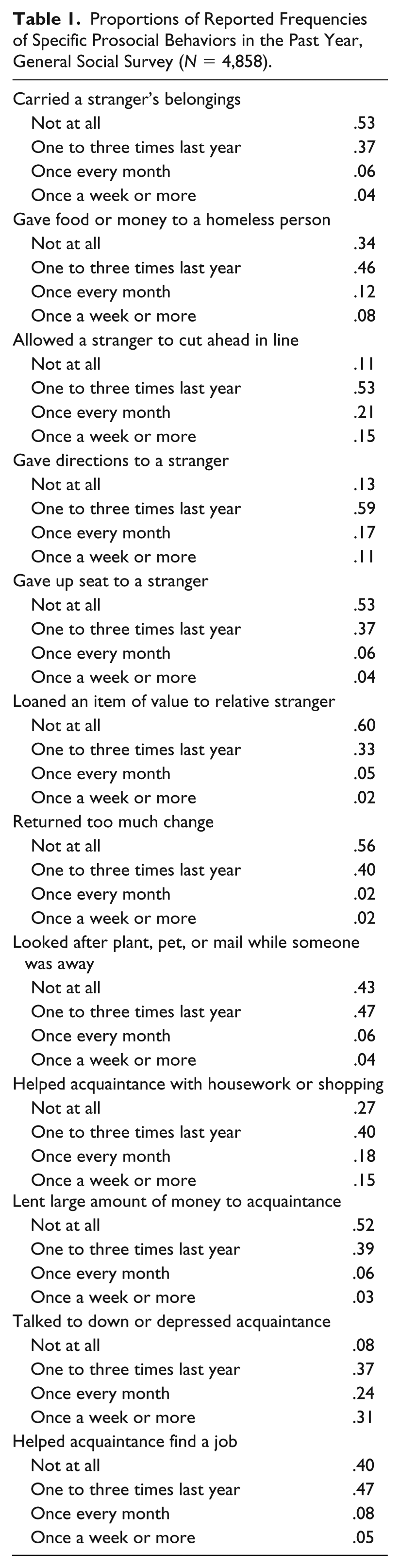
I coded the frequency with which respondents reported performing these behaviors as follows: (1) never, (2) one to three times in the past year, (3) once a month, and (4) once a week or more. Table 1 lists the proportions for each of these outcome variables.
Proportions of Reported Frequencies of Specific Prosocial Behaviors in the Past Year, General Social Survey (N = 4,858).
Independent Variables
Frequency of prayer
The main independent variable in this analysis is frequency of prayer. The GSS asked respondents, “About how often do you pray?” I coded responses into five categories: (1) more than once a day (reference category), (2) once a day, (3) once to several times a week, (4) less than once a week, and (5) never.
Religiosity variables
Given the possibility that the association between frequency of prayer and frequency of helping is simply a reflection of respondents’ overall religiosity, I include several measures of religiosity. First, I control for religious affiliation. This is a seven-category variable indicating respondents’ stated religious preference. I use Steensland et al.’s (2000) religious affiliation categories: (1) evangelical Protestant, (2) mainline Protestant, (3) historically black Protestant, (4) Catholic, (5) Jewish, (6) other religion, and (7) none (reference category). The associations reported do not change much using other coding procedures (e.g., putting Mormons in their own category instead of “other religion” or not separating black Protestants from evangelical and mainline Protestants).
I also include frequency of religious attendance, which refers to how often one attends religious services (e.g., church, temple). I truncated the original nine categories into four (never [reference category], several times a year or less, once a month to nearly every week, weekly or more) for ease of analysis and interpretation. In terms of religious attendance, the constructed categories identify respondents who never attend, attend very little, attend a moderate amount, and attend quite often.
I also include respondents’ views of the Bible, which refers to the perceived authority and legitimacy of the Bible. The GSS asked respondents to indicate which of the following most closely described their feelings about the Bible: (1) the Bible is the actual word of God and is to be taken literally, word for word; (2) the Bible is the inspired word of God but not everything in it should be taken literally, word for word; and (3) the Bible is an ancient book of fables, legends, histories, and moral precepts recorded by men (reference category). A little under 2 percent of respondents (n = 66) responded “other” to this question; I put these respondents in the “book of fables” category. The associations reported do not significantly change if I drop these respondents from the analysis.
Sociodemographic variables
I also include several sociodemographic variables that may confound or suppress the relationship between frequency of praying and frequency of helping. I include gender, since previous research indicates that there are gender differences in helping (Eagly 2009; Leslie, Snyder, and Glomb 2013; Mesch et al. 2006; Wiepking and Bekkers 2012) and because women tend to pray more frequently than men (Pew Forum on Religion and Public Life 2015). I treat gender as a dichotomous variable (1 = female).
I include race and ethnicity variables, since previous research suggests racial and ethnic differences in helping (Leslie, Snyder, and Glomb 2013; Mesch et al. 2006; Wegner and Crano 1975) and because racial minorities tend to pray more frequently than whites (Pew Forum on Religion and Public Life 2015). I include race, which includes three categories: (1) white (reference category), (2) black, and (3) other. I also include Hispanic/Latino/a identification, which I treat as a dichotomous variable (1 = identifies as Hispanic/Latino/a).
I include the age (in years) of respondents in the analysis. Previous research finds that age is positively associated with helping (Bekkers and Wiepking 2011; Freund and Blanchard-Fields 2014) and frequency of prayer (Pew Forum on Religion and Public Life 2015). I treat this as a continuous variable in the analysis.
I include two measures of socioeconomic status, because previous research has found social class differences in helping (Bekkers and Wiepking 2011; Piff et al. 2010; Wiepking and Bekkers 2012) and because social class is associated with frequency of prayer (Baker 2008; Pew Forum on Religion and Public Life 2015). First, I include the number of years of education respondents reported they had completed. I treat this as a continuous variable in the analysis. Second, I include yearly family income (in $). I coded this variable into five categories: (1) $0 to $24,999 (reference category); (2) $25,000 to $49,999; (3) $50,000 to $74,9999; (4) $75,000 to $109,999; and (5) $110,000 or more.
I also include two family characteristic variables in the analysis, since previous research indicates that marital status and family composition are associated with the performance of helpful behavior (Mesch et al. 2006; Wiepking and Bekkers 2012) and religiosity (Pew Forum on Religion and Public Life 2015). Marital status is a four category variable: married (reference category), widowed, divorced/separated, and never married. Number of children is a continuous measure that indicates how many children the respondent has.
I also include a political party identification variable, since previous research suggests that people who are politically liberal are more helpful than those who are politically conservative (Van Lange et al. 2012; Zettler and Hilbig 2010), and because political conservatives tend to be more religiously active than political liberals (Pew Forum on Religion and Public Life 2015). I treat this as a three-category variable: (1) Democrat (reference category), (2) Independent/Other Party, and (3) Republican. 2
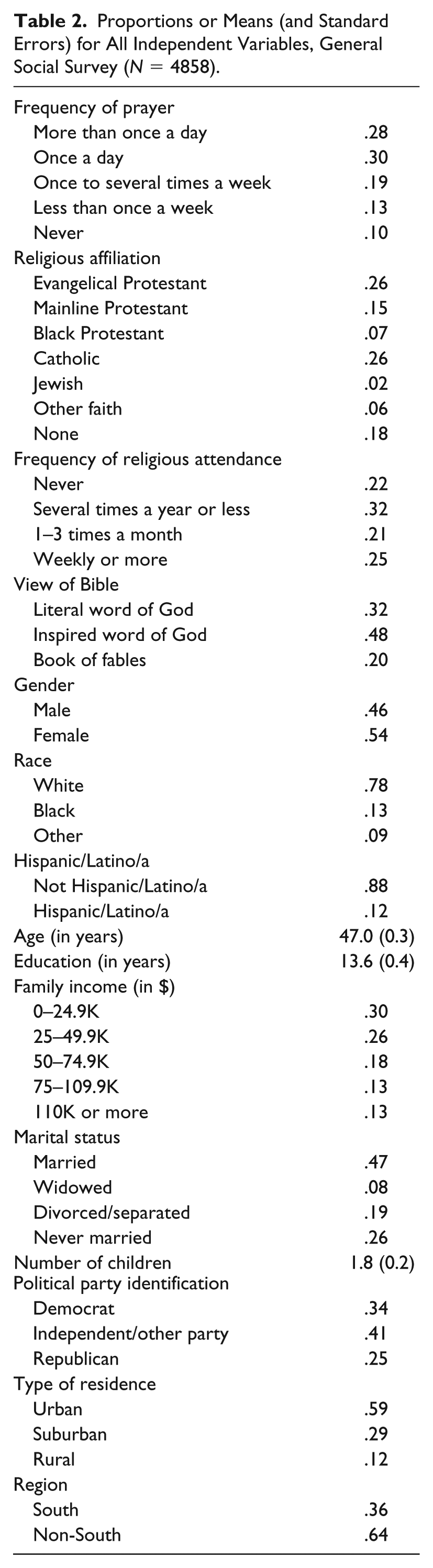
I also include residence and region variables in the analysis, since these factors are associated with religiosity (Chalfant and Heller 1991; Pew Forum on Religion and Public Life 2015) and helping (Bridges et al. 1997; Rushton 1978). First, I include type of residence (urban, suburban, and rural [reference category]) in the analysis. I also include a dichotomous region variable indicating whether respondents live in the South (1 = resides in the South). Table 2 lists all the proportions, or means and standard deviations, of independent variables used in the analysis. 3
Proportions or Means (and Standard Errors) for All Independent Variables, General Social Survey (N = 4858).
Analytic Strategy
I use ordinal logistic regression to estimate models evaluating whether frequency of prayer is associated with the frequency with which individuals report performing the 12 helpful behaviors. I use ordinal logistic regression because the response sets of the dependent variables are categorical, ordered from lowest to highest, and the distances between the categories is unequal (Long and Freese 2006). 4
Results
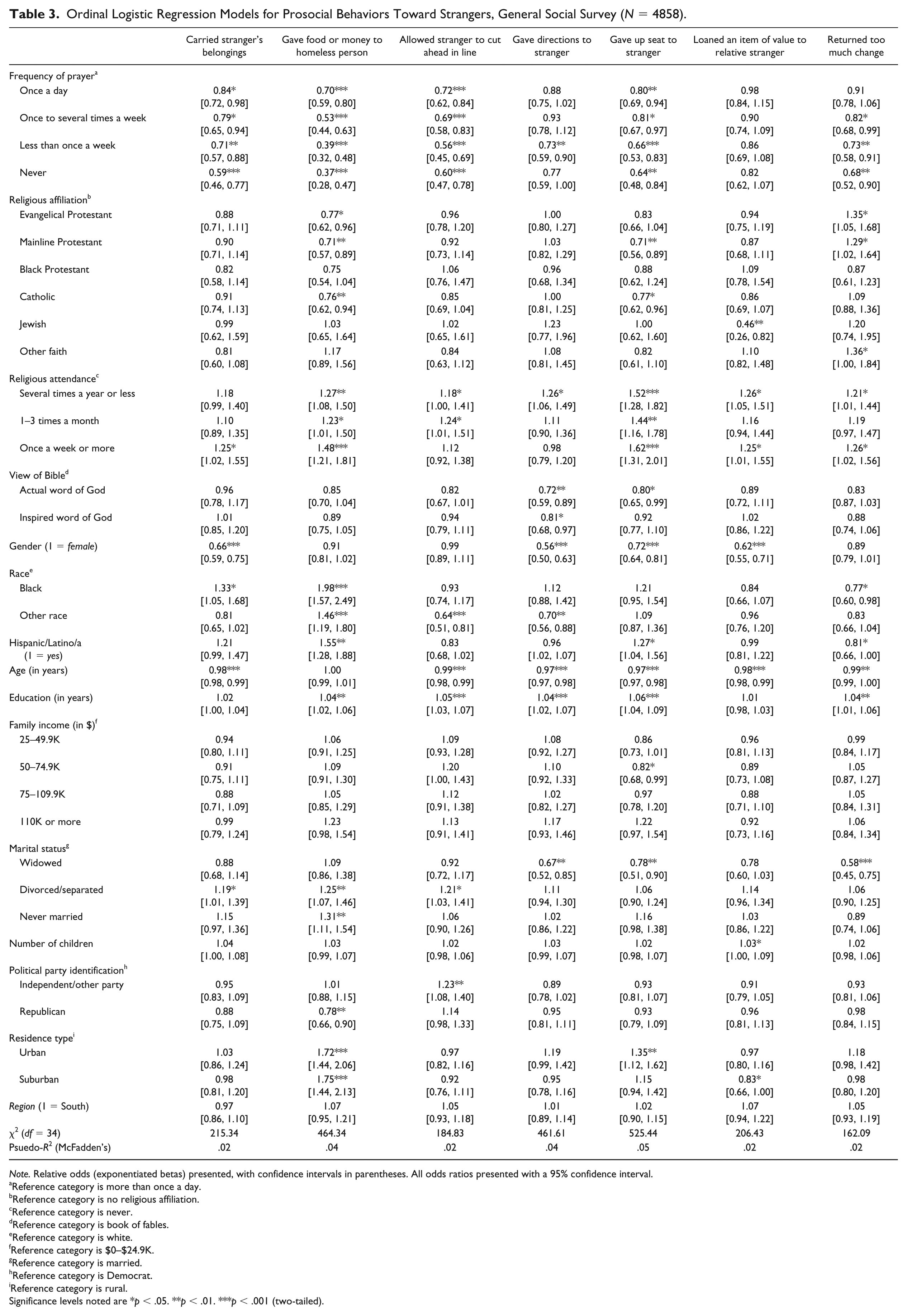
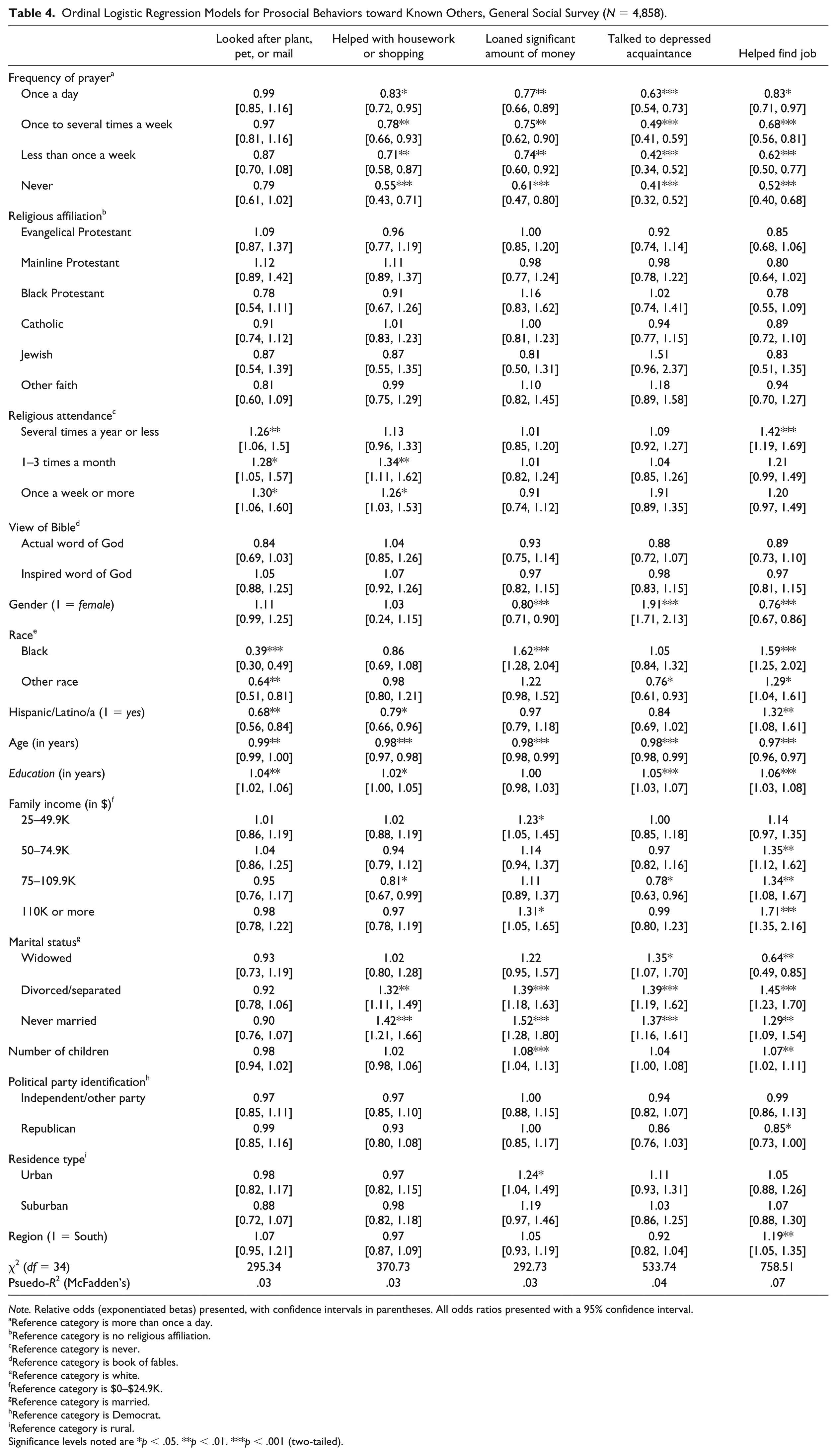
I present the results of ordinal logistic regression models predicting the performance of 12 helpful behaviors in Tables 3 and 4. Table 3 presents the results of ordinal logistic regression models predicting helpful behaviors toward unknown others, and Table 4 presents results predicting helpful behaviors toward known others. All models presented include all independent variables used in the analysis. 5 I present odds ratios (exponential betas) in both tables and text. Since I coded the dependent variables in ascending order (never, one to three times in the past year, once a month, once a week or more), odds ratios above 1 indicate higher odds of engaging frequently in helpful behaviors, while odds ratios below 1 indicate lower odds of engaging frequently in helpful behaviors.
Ordinal Logistic Regression Models for Prosocial Behaviors Toward Strangers, General Social Survey (N = 4858).
Note. Relative odds (exponentiated betas) presented, with confidence intervals in parentheses. All odds ratios presented with a 95% confidence interval.
Reference category is more than once a day.
Reference category is no religious affiliation.
Reference category is never.
Reference category is book of fables.
Reference category is white.
Reference category is $0–$24.9K.
Reference category is married.
Reference category is Democrat.
Reference category is rural.
Significance levels noted are *p < .05. **p < .01. ***p < .001 (two-tailed).
Ordinal Logistic Regression Models for Prosocial Behaviors toward Known Others, General Social Survey (N = 4,858).
Note. Relative odds (exponentiated betas) presented, with confidence intervals in parentheses. All odds ratios presented with a 95% confidence interval.
Reference category is more than once a day.
Reference category is no religious affiliation.
Reference category is never.
Reference category is book of fables.
Reference category is white.
Reference category is $0–$24.9K.
Reference category is married.
Reference category is Democrat.
Reference category is rural.
Significance levels noted are *p < .05. **p < .01. ***p < .001 (two-tailed).
As Tables 3 and 4 reveal, the frequency of prayer is significantly, positively, and linearly associated with the frequency with which individuals performed nine of the 12 helpful behaviors included in the analysis (carried stranger’s belongings, gave food or money to homeless person, allowed stranger to cut in line, gave up a seat to a stranger, returned too much change, helped with housework or shopping, loaned significant amount of money to known other, talked to depressed known other, helped known other find a job). The pattern is clear: the more frequently respondents pray, the more frequently they report performing these helpful behaviors. For example, consider the helpful behavior of giving food or money to a homeless person (Table 3). The odds of those who pray once a day being in a higher category of the dependent variable is .69 times less than then the odds of those who pray more than once a day of being in a higher category of the dependent variable, which means that those who pray just once a day are less likely to have performed in this helpful behavior in the past year than those who pray more than once a day. The odds of being in a higher category of the dependent variable are .53, .40, and .38 times less than the odds of those who pray more than once a day of being in a higher category of the dependent variable for those who pray once to several times a week, less than once a week, or never, respectively.
I found significant but inconsistent relationships between frequency of prayer and frequency of giving directions to stranger. Only those who pray less than once a week were significantly less likely to give directions to a stranger than those who pray more than once a day. Although this relationship is inconsistent at the level of significance, the overall pattern still suggests that the more respondents pray, the more likely they are to engage in this helpful behavior.
I found two helpful behaviors in which frequency of prayer was not significantly associated in any way: (1) loaning an item of value to a relative stranger and (2) looking after someone’s pet, plant, or mail while they are away. These findings reveal that while frequency of prayer is positively associated with the frequency of performing everyday prosocial behaviors, it is not positively associated with them all.
In terms of helping known and unknown others, comparison of Tables 3 and 4 indicates frequency of prayer is associated with helping both known and unknown others. Frequency of prayer was significantly, positively, and linearly associated with five of seven helpful behaviors toward strangers (carried stranger’s belongings, gave food or money to homeless person, allowed stranger to cut in line, gave up a seat to a stranger, returned too much change) and four of five behaviors toward known others (helped known other with housework or shopping, loaned significant amount of money to known other, talked to depressed known other, helped known other find a job). Although this could merely reflect the fact that the GSS measured different helpful behaviors toward known others and toward unknown others, these results do support the notion that frequency of prayer is positively associated with the frequency with which individuals engaged in spontaneous/informal, direct, and nonserious helpful behavior toward strangers and toward known others. 6
Discussion
Social scientists continue to identify the factors that influence whether a person offers help when the opportunity arises. I have identified another plausible contributing factor: frequency of prayer. Overall, I found a significant, positive, and linear association between frequency of prayer and frequency of helping, even after controlling for other religiosity variables and sociodemographic variables associated with helping.
The conclusion that prayer is associated with helping comes with three important qualifications. First, this claim is limited to helping that is spontaneous/informal, direct, and nonserious. I do not make any claims that frequency of prayer will be associated with the frequency with which individuals perform planned/formal, indirect, and/or serious helping. Future work should evaluate if there are associations between frequency of prayer and frequency of planned/formal helping (e.g., volunteering to be a big brother or sister), indirect helping (e.g., donating to charity), and helping in serious situations (e.g., the willingness to seek help for someone who is having a medical emergency).
The second qualification is that prayer is not universally associated with helping. There were three helpful behaviors with which frequency of prayer was inconsistently or not associated: (1) giving directions to a stranger (2) loaning an item to a relative stranger, and (3) looking after someone’s pet, plant, or mail while they are away. It may be the case that these behaviors are inconsistently or unassociated with frequency of prayer because they do not carry the moral weight, so to speak, of the other helpful behaviors analyzed, and thus individuals who pray frequently do not feel divine others will judge them harshly for not performing these helpful behaviors. That is, people may believe that God will not judge them negatively if they do not check a neighbor’s mail while she is away but will judge them negatively if they do not give up their seat on a crowded bus for a mother with her three children in tow. Future work should explore what other types of helping are, or are not, associated with prayer and why.
A third qualification is that I only demonstrated that the frequency with which individuals pray is associated with the frequency with which they help. I did not demonstrate whether the motivations or types of prayer individuals perform were associated with the frequency with which people help. There are many motivations for prayer, such as asking for assistance for self and others, asking for forgiveness, and expressing praise (Ladd and Spilka 2002; Poloma and Gallup 1991; Sharp 2012; Stark and Finke 2000). Also, people pray in both private and public contexts. Future research should investigate whether particular motivations or types of prayer are associated with helping.
Another key finding presented here is that frequency of prayer is associated with helping both known and unknown others. While I made the theoretical argument for why those who pray frequently would be more likely to help unknown others than those who pray infrequently or not at all, this finding could be the result of the measures used in this study. Respondents were asked about different helpful behaviors toward strangers and toward known others. In most previous research on religion and helping, researchers have contrasted whether individuals will help known and unknown others in the same ways. Relatedly, the measured helpful behaviors toward known others used in this article tend to be costlier than the helpful behaviors toward strangers. It might be the case that frequency of prayer is only associated with helping strangers when it is not costly; the finding that frequency of prayer is not associated with loaning an item of relative value to a stranger gives some credence to this notion. Future survey items that measure the same helpful behaviors toward known and unknown others, at different cost levels, could help evaluate whether the association between prayer and helping depends on the targets and costs of helping.
Implications
This study has three major implications. First, the analysis has implications for the study of religion and helping. As I noted above, religiosity is a multifaceted phenomenon consisting of belonging, believing, and behaving. Rather than combine two or more of these aspects into a single scale of religiosity—which much previous research on religion and helping has done—my analysis suggests that it may be important to investigate whether and how particular aspects of individuals’ religiosity are associated with helping. As the models presented show, while frequency of prayer is significantly and positively associated with frequency of helping, other aspects of individuals’ religiosity—such as being religiously affiliated, attending religious services, and views of the Bible—are not. If I were to include frequency of prayer into an overall scale of religiosity, I might have missed the impact this particular aspect of religiosity has on helping. I hope this article will encourage future researchers to consider how particular aspects of individuals’ religiosity influence helping.
Identifying a potential mechanism for the relationship between congregational membership and the receipt of social support is another major implication of this research. Several scholars have found that people who belong to a congregation receive more social support than those who do not belong to a congregation (Ellison and George 1994; Krause et al. 2002). Because of this, people who belong to congregations have better health outcomes, have higher life satisfaction, and are more optimistic than their “unchurched” counterparts (Assari 2013; Krause 2002, 2008; Schafer 2013). The receipt of social support from other members of one’s congregation may be due to the fact that members of congregations frequently pray, which in turn leads them to help more than they perhaps otherwise would. If prayer motivates people to help, then it is no wonder that people receive much social support from a group of people who are very likely to pray on a relatively frequent basis.
Another major implication of this research is that it highlights how prayer can influence social behavior. Much of the social psychological literature on prayer either investigates the predictors of prayer (e.g., Baker 2008) or looks at how prayer is associated with psychological outcomes such as mental illness and subjective well-being (e.g., Poloma and Pendleton 1989; Whittington and Scher 2010). However, prayer can also motivate behavior, whether it is motivating intimate partner abuse victims to leave their abusive partners (Sharp 2010), leading people to volunteer for civic organizations (Loveland et al. 2005), or motivating people to offer assistance to others in everyday life. Given that prayer is by far the most common religious practice performed by Americans (Pew Forum on Religion and Public Life 2015), investigating how prayer influences social behavior will be an important way to identify the influence that religion has in what seems like an increasingly secularized society (Voas and Chaves 2016).
Future Research Directions
The theory and findings in this article suggest several future research endeavors. For one, future researchers can evaluate whether and how individuals’ particular conceptualizations of divine others influences the relationship between prayer and helping. Several scholars have noted that how people conceptualize God influences a great deal of attitudes and behaviors (e.g., Froese and Bader 2010; Mencken and Fitz 2013; Silton et al. 2013). It may be the case that people’s particular conceptualizations of divine others moderates the relationship between prayer and helping, meaning that the relationship between frequency of prayer and helping will depend on whether people conceptualize divine others in a particular way. It also may be the case that people’s particular conceptualizations of divine others mediates, or accounts for, the association between prayer and helping. Unfortunately, I could not evaluate this here because the GSS did not include measures of respondents’ conceptualizations of God in the years analyzed.
Future researchers can also evaluate if and how individuals’ attachments to God influence the relationship between prayer and helping. Recently, several researchers have shown that the relationship between prayer and individuals’ mental health is moderated by the type of attachment (e.g., secure, anxious, avoidant) individuals have with God (Bradshaw and Kent 2017; Ellison et al. 2014). This may be the case for the relationship between prayer and helping; for example, there may only be a positive and significant association between prayer and helping among those who have a secure attachment to God. Unfortunately, I could not evaluate this here because the GSS did not include measures of respondents’ attachments to God in the years analyzed.
Future researchers should also conduct experiments to evaluate whether prayer actually causes people to be more helpful. Although several experiments regarding religion and helping exist, none have used prayer as a manipulated independent variable. Experimenters could manipulate whether participants pray, present them with an opportunity to help, and then evaluate whether there are appreciable differences between those who pray and those who do not. Experimenters could also evaluate the theoretical mechanism proposed here by comparing the helpful behavior of individuals asked to pray with individuals in conditions where their divine other concepts are primed and that simulate the experience of being watched. Experimenters could also collect data from participants to see whether any differences in helping between those asked to pray and those not asked are moderated by people’s beliefs in and about divine others, as well as their attachments to divine others.
Conclusion
Scholars have demonstrated that significant others in individuals’ lives have a substantial impact on their helpful behavior (Amato 1990; Grusec 1991). While previous researchers have implicitly worked within the assumption that these significant others are concrete and human, the results of this article show that “imagined others”—such as deities and other supernatural agents—are also types of significant others who can influence helping. Given that imagined others are readily available others because they are always inside individuals’ heads, so to speak, they may have a bigger impact on helping and other types of social behavior that have heretofore gone unnoticed. In short, it is time for social scientists to start taking the influence of imagined others seriously.
Footnotes
Acknowledgements
I would like to thank Deborah Carr, Fred Markowitz, Adam Slez, and Elizabeth Schewe for their comments on previous versions of this manuscript.
Declaration of Conflicting Interests
The author(s) declared no potential conflicts of interest with respect to the research, authorship, and/or publication of this article.
Funding
The author(s) received no financial support for the research, authorship, and/or publication of this article.