







Abstract
Regardless of why it happens, racial discrimination is damaging and unacceptable. Efforts to reduce discrimination, however, are most successful when we understand the mechanisms that give rise to it. Building on the observation that employers are members of the public, we examine two attitudinal mechanisms that may foster discriminatory employment practices in the context of criminal background checks: stereotypes and threat-based animus. First, we estimate public perceptions of arrest prevalence using two nationwide surveys. Next, we experimentally test the effects of two racially threatening primes—Census projections about a coming majority-minority America, and information about the prison population’s racial composition—on attitudes toward hiring job applicants with criminal records. Consistent with statistical discrimination theory, respondents identify black males as having the highest arrest prevalence. Respondents are less accurate, however, when it comes to gender differences: they underestimate arrest prevalence for black, Hispanic, and white males, and tend to overestimate it for females. On the other hand, our experiments provide little evidence of an effect of threat-based animus: racially threatening primes that are influential in other contexts do not significantly impact attitudes about hiring applicants with criminal records.
Racial discrimination plays a powerful role in the hiring process (Neumark 2018; Pager, Bonikowski, and Western 2009) and the level of bias against African American applicants is not declining (Quillian et al. 2017). Criminal justice system contact, which disproportionately affects African American men, poses additional barriers to employment. Employers are less likely to call back applicants with criminal records, 1 even when the offenses are minor (Agan and Starr 2017; Pager 2003; Uggen et al. 2014). Race and criminal record status are closely connected, and when considering both in combination, “the problem grows more intense” (Pager 2003: 961).
Two dominant models of racial discrimination in the employment literature are taste-based (animus) and statistical (information asymmetry). Under the former, employers express their distaste for minority applicants by restricting hiring opportunities or offering lower wages to the disliked group (Becker 1957). Put differently, the employers “care about race itself, not race as a proxy for something else” (Doleac 2021: 2). According to statistical discrimination theory, however, employers care not about race itself, but instead use it as a proxy for something they do care about: evidence of a past crime. Lacking criminal record information, employers rely on other available information, including the applicant’s race, which results in differential treatment (Bushway 2004; Holzer et al. 2004). Since black men are more likely than other demographic groups to have criminal records (Brame et al. 2014; Shannon et al. 2017), widespread knowledge of this disparity could disproportionally harm black applicants. An important point is that employers do not need to have racial animus to statistically discriminate or to harm racial minorities through biased decision-making, as the outcomes of a decision are distinct from the cognitive processes that motivate it.
While useful, the two perspectives certainly oversimplify the factors that produce racial discrimination. Both assume employers (and other decision-makers) are rational actors making conscious choices, although discrimination can also be “unintentional and outside of the discriminator’s awareness” (Bertrand, Chugh, and Mullainathan 2005: 94) and implicit (e.g., Greenwald et al. 1998). Many new prejudice frameworks, for example, focus on “more subtle forms” of racism that involve a blend of racial and political attitudes (Quillian 2006). These forms of prejudice appear to increase in the context of racial threat and, in turn, increase the salience of racial considerations in decision-making (Soss, Langbein, and Metelko 2003; Taylor 1998).
When considering criminal record stigma and employment decisions, both racial animus and threat-oriented ideologies—exaggerated views and beliefs about the level of threat posed by outgroups (Blalock 1967)—should theoretically increase discrimination. Racial animus should increase as the outgroup population increases (Blalock 1967; Pettigrew 1957) or the in-group’s resources are perceived to be at risk (Blumer 1958). Racial animus may be both a mediator and a moderator of threat, increasing because of contextual threats (Quillian 1995; Taylor 1998) and then increasing the salience of those threats (Rabinowitz et al. 2009; Soss et al. 2003). In other words, if people hold racial animus, racially threatening information—such as descriptions of the United States’ changing racial composition—should theoretically increase threat perceptions, animus, and the desire to discriminate (Abascal 2015; Craig and Richeson 2014a, 2014b).
Regardless of the form racial discrimination takes—whether based on animus or statistical inferences—it is illegal and has tangible negative consequences for job seekers. Yet, distinguishing between types of discrimination is useful from a policy perspective (Bohren et al. 2019) as well as for anticipating the effects of changing threat levels (Craig and Richeson, 2014a, 2014b; Hetey and Eberhardt 2014). Understanding the mechanisms that contribute to job discrimination may also help to uncover potential adverse effects of well-intentioned policies, which have animated recent debates surrounding Ban-the-Box (BTB), a strategy designed to improve employment opportunities by delaying criminal history inquiries (Agan and Starr 2018; Doleac and Hansen 2020).
There is growing empirical evidence that BTB increases discrimination against black applicants (e.g., Agan and Starr 2018; Doleac and Hansen 2020), but it remains unclear why it does. Statistical discrimination is one possible reason, but it is only a plausible discrimination mechanism if people are aware of racial differences in criminal records—differences that often reflect previous discriminatory processes, creating a self-perpetuating cycle—and then use their knowledge of those differences to make biased decisions. Stated differently, the key assumption in the statistical discrimination literature is that people know—and then base their decisions on—racial differences in criminal justice contact. Research conducted within the past few years provides empirical baselines to make comparisons between actual and perceived disparities in the system (Brame et al. 2012, 2014). Yet, to our knowledge, there are no nationally representative estimates on public perceptions of the prevalence of criminal records across different racial and gender groups. 2 Obtaining such estimates is important because taste-based discrimination does not require accurate knowledge of racial disparities; in fact, it suggests that perceived racial differences are likely to be exaggerated—a phenomenon Kahneman (2011, p. 168) calls “hostile stereotyping,” and others characterize as “stereotype amplification” (Haner et al., 2020; Quillian and Pager, 2010).
Employers are members of the public, and we can learn much about the former from studying the latter (Denver, Pickett and Bushway 2018). Accordingly, the current study examines (1) whether public estimates of the prevalence of arrest records by race and gender align with empirical estimates, and (2) whether racial animus and threat exert effects on decision-making in the employment context. Specifically, we adapt two racial primes (or information treatments) (Gilens 2002; Mutz 2011) from prior research and test whether they affect attitudes toward hiring applicants with criminal records. The key findings are (1) respondents correctly recognize that the prevalence of arrest is highest for black men, but (2) do not become significantly less supportive of hiring criminal record holders in response to racially threatening information. In terms of theoretical consistency, these results align more with a statistical-discrimination than a taste-based account of employment discrimination, and indicate that reducing discriminatory hiring practices may require addressing the broader social factors that give rise to racial disparities in criminal justice contact—disparities that our data show the public discerns.
Race and Crime: Reality Versus Perception
Self-reported crime levels do vary by race (Sampson et al. 2005), but the differences are smaller than in official (police) data, and scholars disagree about how to interpret them (Sohoni et al. 2020). The root causes of crime are comparable across race, and the best evidence indicates that racial differences in offending reflect differential exposure to criminogenic neighborhood environments rather than individual-level factors (Krivo, Lyons, and Valdez 2021; Sampson et al. 2005; Sampson and Wilson 2020). Additionally, black individuals report comparable or lower levels of involvement in certain activities, such as illicit drug use, but experience differential law enforcement responses (U.S. Department of Health and Human Services 2019). Most notably, the relationship between criminal offending and arrest has weakened in recent decades, especially among black Americans, a phenomenon Weaver and colleagues (2019: 119) call “the great decoupling.” There is also strong evidence of racial bias in policing (Ba et al. 2021; Vomfell and Stewart 2021).
Past public opinion studies examining general racial stereotypes found that many members of the public believe black individuals are prone to crime (Peffley and Hurwitz 2007; Sniderman and Piazza 1993; Soler 2001). This research also showed that racial differences in offending are sometimes exaggerated in the public mind. For example, members of the public overestimate the percentage of people committing serious violent and drug crimes who are black (Chiricos et al. 2004; Pickett et al. 2012). Quillian and Pager (2010: 83) characterized such misperceptions as “stereotype amplification,” a process wherein real race-crime associations “become exaggerated or distorted through various channels, including the influence of cultural stereotypes, skewed media coverage, perceptions of group threat, and other nonsystematic sources of information.” Haner and colleagues (2020) showed that stereotype amplification influences perceptions of criminal threat. More broadly, strong evidence exists that both perceived criminal threat and racial animus have powerful influences on a variety of social decisions, attitudes, and judgments (e.g., Brown and Socia 2017; King and Wheelock 2007; Peffley and Hurtwitz 2007). Thus, they are plausible explanations for outcomes in the employment context as well.
Several prior studies examined the racial typification of serious crime by asking respondents to estimate the racial breakdown for offenses such as robbery (Chiricos et al. 2004; Pickett et al. 2012). However, these studies did not ask about arrest records, nor did they analyze the gendered racial breakdown. Both are important omissions given that (1) arrest records mostly reflect minor offenses, and (2) criminal stereotypes appear to be gendered, with the strongest pertaining to the criminality of black men (Chiricos and Eschholz 2002). Over the past several decades, news media depictions of crime have solidified a stereotype of young black males as “criminals” (Dixon and Linz 2000; Gilliam and Iyengar 2000; Barlow 1998). Alternatively, black females are more often portrayed in the news as victims of crime (Meyers 2013).
Ban-the-Box and Racial Discrimination in the Employment Context
Ban-the-Box (BTB), one of the most prominent prisoner reentry policy movements in the past two decades, has drawn both excitement and concern from advocates and researchers as a formal stigma remediation strategy (Doleac 2016; Henry and Jacobs 2007; Stoll 2009). BTB has been adopted by the federal government, over 30 U.S. states, and over 150 cities and counties (Avery 2019). The policy is intended to build in legal protections for people with criminal records and avert blanket ban discrimination in the hiring process.
While there is consensus about the well-meaning goals of BTB, there is mixed evidence on whether statistical discrimination occurs after the policy takes effect. Research examining employment outcomes before and after changes in policies and laws suggests there may be statistical discrimination (Doleac and Hansen 2020; Holzer et al. 2004). Finding lower employment rates among black men with lower levels of education, Doleac and Hansen (2020: 10) concluded that such “well-intentioned policies … can do more harm than good for minority job-seekers.” However, some studies examining individuals with criminal histories came to a different conclusion. In studies detecting small or null effects on employment outcomes, researchers suggested that applicants with criminal records may simply become more selective about the jobs they apply to after BTB takes effect (Jackson and Zhao 2017; Rose 2021). Still, findings from other studies indicated that employment discrimination may be taste-based. One of the most prominent BTB studies, an audit study in two states where researchers submitted fictitious job applications before and after BTB policies took effect, found racial disparities in callbacks, with black applicants receiving fewer callbacks than white applicants (Agan and Starr 2018). Agan and Starr (2018: 37) attributed this finding to racial animus or stereotype amplification, noting that “small real-world differences [in conviction disparities] are greatly exaggerated” by employers.
Stereotypes, Animus, and Decision-Making
When considering decision making in the employment context, the line between employers and non-employers is both thin and porous (Denver, Pickett and Bushway 2018). People make hiring decisions all the time, including which contractor, babysitter, landscaper, or day laborer to hire. Additionally, discrimination similar to that in the hiring context also occurs in non-employment contexts, such as college admissions (Stewart and Uggen 2020) and Airbnb rentals (Edelman, Luca, and Svirsky, 2017). Further, over 30 million Americans search online for criminal record information every year, presumably to use in hiring, admittance, dating, and other interpersonal decisions (Lageson et al. 2019). There is much we can learn, then, about employer decision-making by analyzing public opinion.
Evidence that perceived threat and racial animus exacerbate punitiveness enhances the plausibility of the taste-based account of employment discrimination (Brown and Socia 2017; King and Wheelock 2007; Peffley and Hurwitz, 2007). What is unclear, however, is whether racial beliefs have similar effects on preferences for social and economic exclusion after formal legal system punishment. That is, the effects of racial stereotypes and animus on criminal justice attitudes may occur mostly in the front end, influencing attitudes about how to patrol and punish people, rather than in the back end, where the focus is on reintegration after sentences are completed (Lehmann, Pickett, and Denver, 2020). Wozniak (2020), for example, found that racialized cues did not influence investment preferences for justice-related community programs. The question of whether racial threat and animus affect people’s attitudes toward the hiring of criminal record holders, as the taste-based account suggests, remains an open one. The two studies reported below were designed to provide evidence on this front.
Experiment 1
Data
To examine public estimates of the prevalence of arrest records by race, which we do not have clear expectations for a priori, we analyze data from an experiment embedded in two self-administered surveys administered to separate national samples in 2016. 3 The GfK Group (formerly Knowledge Networks) administered the first survey to a probability sample (N = 1023) of US adults who were initially selected randomly from the general population using address-based sampling. 4 The analytic sample size after excluding cases with missing data is 980. We weight the data to match geodemographic population benchmarks from the Current Population Survey.
Descriptive Statistics.
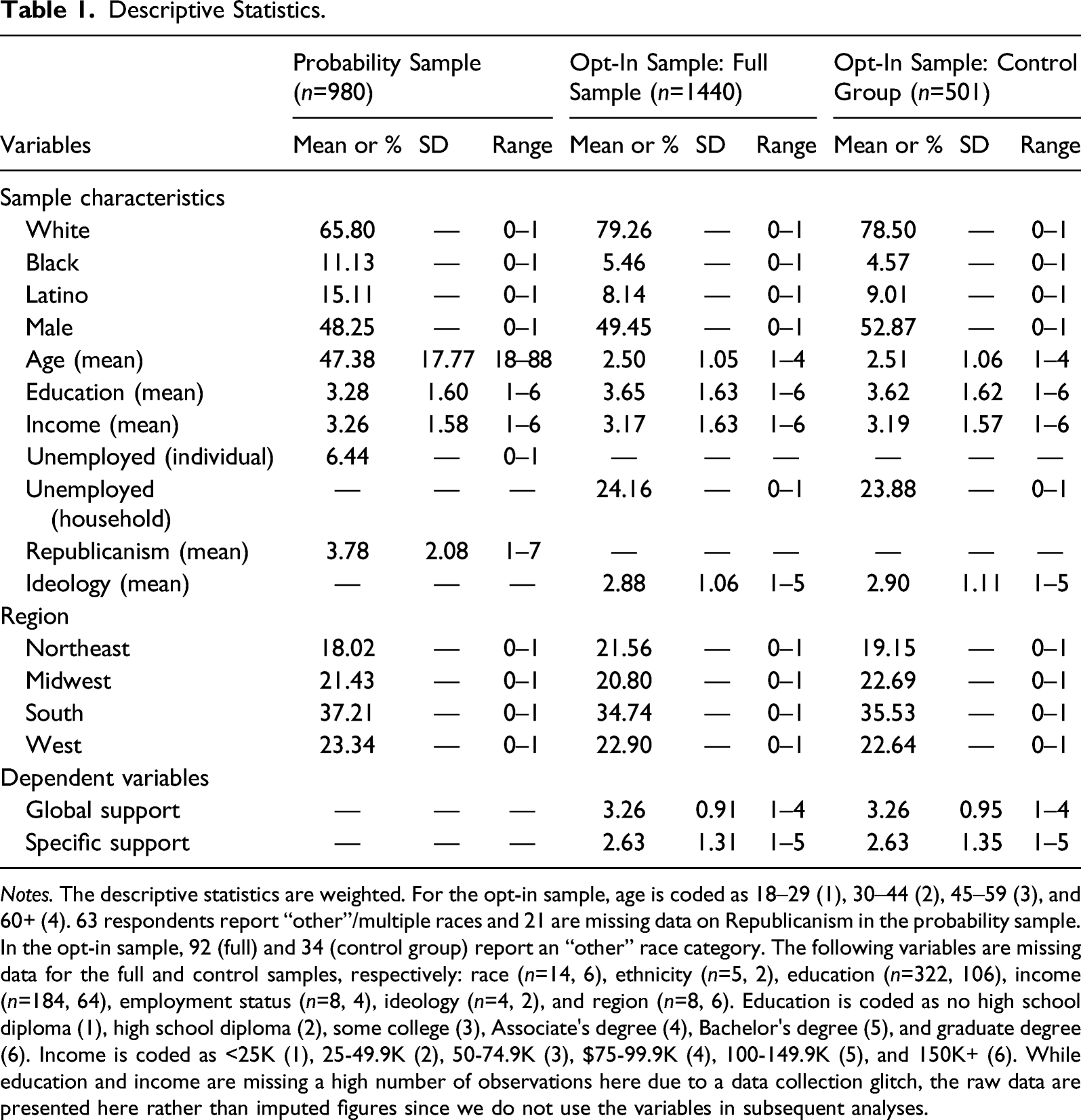
Notes. The descriptive statistics are weighted. For the opt-in sample, age is coded as 18–29 (1), 30–44 (2), 45–59 (3), and 60+ (4). 63 respondents report “other”/multiple races and 21 are missing data on Republicanism in the probability sample. In the opt-in sample, 92 (full) and 34 (control group) report an “other” race category. The following variables are missing data for the full and control samples, respectively: race (n=14, 6), ethnicity (n=5, 2), education (n=322, 106), income (n=184, 64), employment status (n=8, 4), ideology (n=4, 2), and region (n=8, 6). Education is coded as no high school diploma (1), high school diploma (2), some college (3), Associate's degree (4), Bachelor's degree (5), and graduate degree (6). Income is coded as <25K (1), 25-49.9K (2), 50-74.9K (3), $75-99.9K (4), 100-149.9K (5), and 150K+ (6). While education and income are missing a high number of observations here due to a data collection glitch, the raw data are presented here rather than imputed figures since we do not use the variables in subsequent analyses.
Experimental Procedure
In both surveys, using a split-ballot design, we asked respondents to estimate the prevalence of arrest records for one population subgroup. We asked about arrest records
6
rather than conviction records for several reasons. While the Equal Employment Opportunity Commission (EEOC 2012) advises employers against the use of arrest records, the federal guidance also references exceptions, which highlights the complexity of the issue. The fact of an arrest does not establish that criminal conduct has occurred, and an exclusion based on an arrest, in itself, is not job related and consistent with business necessity. However, an employer may make an employment decision based on the conduct underlying an arrest if the conduct makes the individual unfit for the position in question. (EEOC 2012: Summary)
More importantly, in many contexts employers use open arrest records (i.e., pending cases), even though such data can be outdated and inaccurate, and arrest records routinely become public regardless of whether arrestees are convicted (Lageson 2020). In addition, we were concerned that the term “conviction” may be confusing for respondents and raise questions about plea deals, sealed records, and other parts of the process. Arrests, on the other hand, occur early in the process and are the most visible to the public, with over 30 million Americans searching online for these records every year (Lageson et al. 2019). Thus, for simplicity, and as a first step in this research area, we focus on arrest prevalence.
In the probability sample, the arrest prevalence question was randomized to refer to one of four randomly assigned subgroups (WHITE MALES, BLACK MALES, WHITE FEMALES, and BLACK FEMALES). In the opt-in sample, the same question was used but there were eight randomly assigned groups: MALES, WHITE MALES, BLACK MALES, HISPANIC MALES, FEMALES, WHITE FEMALES, BLACK FEMALES, and HISPANIC FEMALES. Adding the additional groups enabled us to compare the responses between the two samples for four key groups while also obtaining additional information about other groups of interest. We randomized the specific subgroup mentioned in the question stem to ensure that the respondents who evaluated each subgroup were similar and thus that the estimates for each subgroup were comparable. Doing this was also important to avoid asking respondents about multiple subgroups, which might result in anchoring effects and/or relative judgments (or “joint evaluations”) (Kahneman 2011). It also helps to minimize social desirability bias, which might arise if respondents were directly asked to compare demographic groups (Gilens 2002).
The specific experimental question was “What PERCENT of [randomly assigned subgroup] in the U.S. do you think have an arrest record by the age of 25?” Respondents estimated the prevalence of arrest records by entering a number between 0 and 100. We use a linear regression model with survey weights (described above) to test whether the estimates for the different subgroups differ significantly. Each demographic subgroup is included as a dummy variable in the models, with black males as the reference category.
Findings
First, we descriptively compare the public’s estimates of arrest prevalence in the U.S. with available empirical estimates. We should note that racial biases in the arrest process—as in other parts of the criminal justice system—are embedded in this self-reported national data. We do not know whether the public has accurate perceptions of racial biases in criminal justice processing or whether public estimates of arrest record prevalence take such biases into account. It is likely that some people believe racial differences in the prevalence of arrest records are due to variations in offending, while others attribute differences to systemic discrimination. Our data cannot disentangle the two, but from the perspective of statistical discrimination, it does not matter; what matters is the prevalence of records, not the underlying reason for them.
Public Perceptions and Empirical Estimates of Arrest Prevalence.
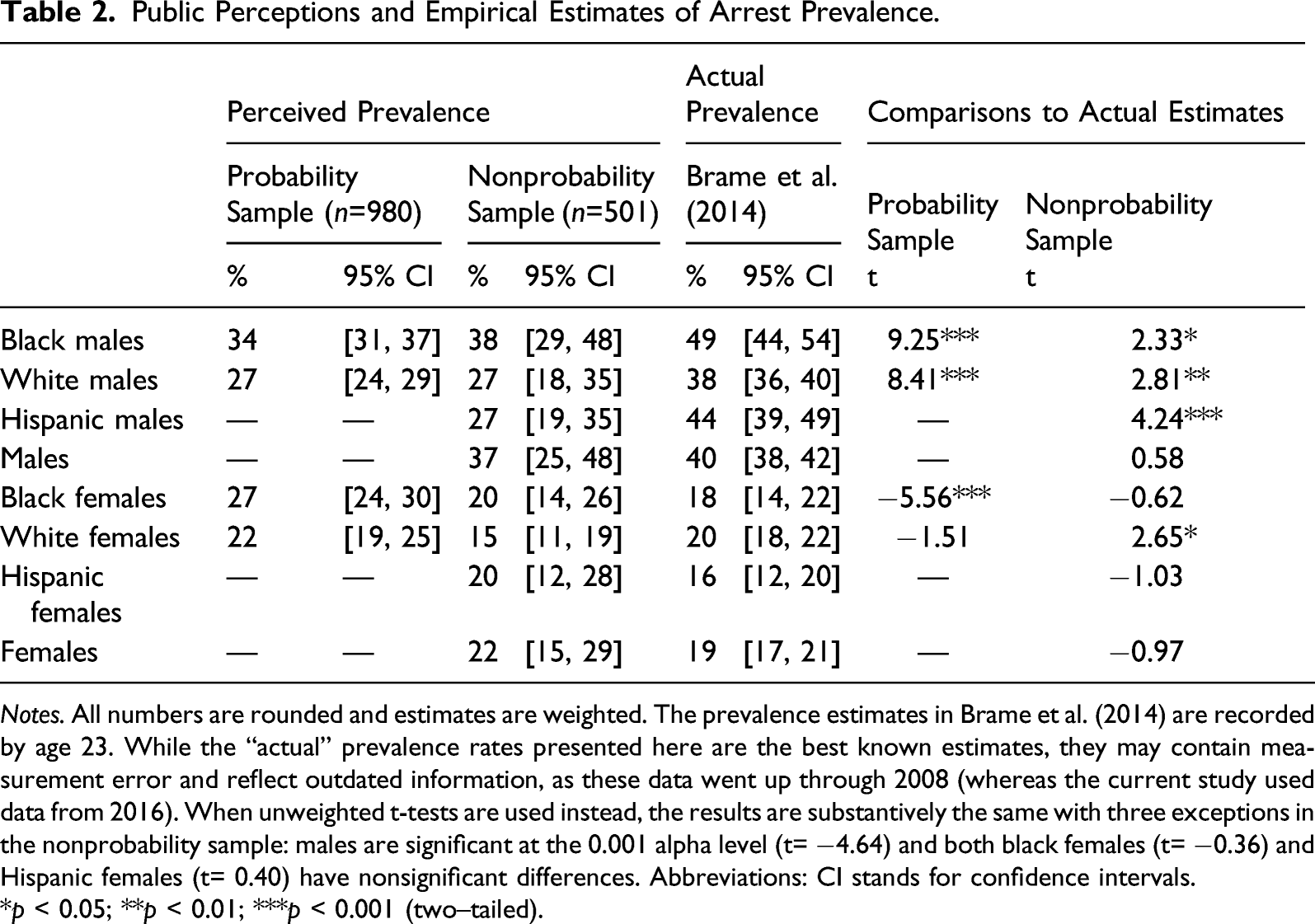
Notes. All numbers are rounded and estimates are weighted. The prevalence estimates in Brame et al. (2014) are recorded by age 23. While the “actual” prevalence rates presented here are the best known estimates, they may contain measurement error and reflect outdated information, as these data went up through 2008 (whereas the current study used data from 2016). When unweighted t-tests are used instead, the results are substantively the same with three exceptions in the nonprobability sample: males are significant at the 0.001 alpha level (t= −4.64) and both black females (t= −0.36) and Hispanic females (t= 0.40) have nonsignificant differences. Abbreviations: CI stands for confidence intervals.
*p < 0.05; **p < 0.01; ***p < 0.001 (two–tailed).
There are four sets of columns in Table 2: results from the probability sample, results from the opt-in sample, actual prevalence estimates and comparisons between the public’s estimates and self-reported estimates. First, we focus on perceptions for black males, our key demographic group of interest. Both sets of results indicate that the public is aware that black males are the group that is most likely to have an arrest record by age 25 (34% and 38%, respectively), but did not exaggerate the extent to which black males hold arrest records. Instead, relative to the Brame estimate, respondents underestimated the percentage of black males with arrest records in both the probability (t = 9.25, p < .001) and nonprobability (t = 2.33, p < .05) samples. Brame et al. (2014) estimate that by approximately the same age (23), close to 50% of black males self-report an arrest, while the respondents in both samples estimate that it is under 40%. Prevalence estimates were also lower for white males relative to the Brame estimate (probability sample t = 8.41, p < .001; nonprobability sample t= 2.81, p < .01). The same was true for perceptions of Hispanic males in the nonprobability sample (t = 4.24, p < .001). One of the only discrepancies between weighted and unweighted t-tests was for the general “males” category, where the difference was not meaningful in the weighted test but was significant in the unweighted data.
By contrast, respondents in both samples tended to accurately estimate or overestimate the percentage of females with arrest records by age 25. The comparison for the overall “females” group in the nonprobability sample was comparable, with only a three-percentage point difference. Estimates for female subgroups were also comparable. The broad takeaway is that Americans underestimate males’ arrest record prevalence, but generally closely estimate or slightly overestimate females’ arrest record prevalence.
Linear Regression Models for Prevalence Estimate Comparisons.
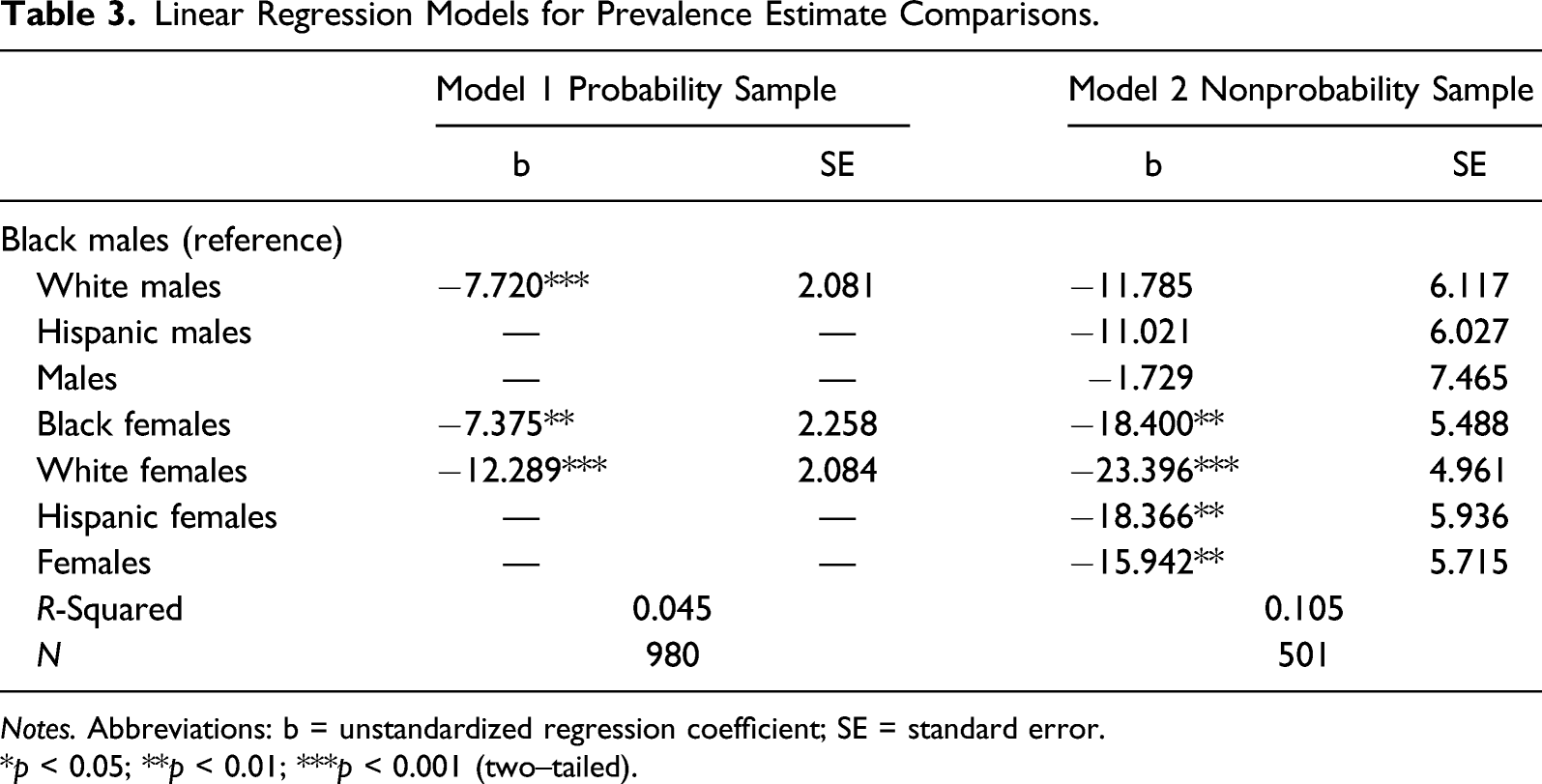
Notes. Abbreviations: b = unstandardized regression coefficient; SE = standard error.
*p < 0.05; **p < 0.01; ***p < 0.001 (two–tailed).
Experiment 2
Data
The second experiment examined whether racial threat influences whites’ perceptions of criminal record inquiries and decisions in the employment context. It was embedded in the opt-in sample described earlier. We included two separate racial threat primes, which we took from prior research that used them to trigger prejudicial responses in other contexts. We hypothesized that relative to not being exposed to a racial prime, receiving either of the two primes would increase global support for criminal background checks and specific support for denying employment to an individual with a criminal record. Supplementary Appendix A contains descriptive statistics for the three experimental groups (control group, Census prime, and prisoner prime).
Experimental Procedure
Racial threat test using U.S. Census projections
The first racial prime originates from the sociological and psychological literature on group-status threat (Abascal 2015; Craig and Richeson 2014a, 2014b). For example, Abascal (2015) found that receiving information about minority population growth led white respondents to identify more strongly with their race than their status as an American, reinforcing “a white/non-white divide” (p. 806). Our prime used the U.S. Census Bureau’s population change projections as summarized in a 2015 news article titled: For U.S. Children, Minorities Will Be The Majority By 2020, Census Says 8 (see Supplementary Appendix B for the full text). The article provides several highlights from a U.S. Census report, including projections for 2060. We did not include the news source (NPR) in the brief selection provided in the survey, but we did include the original formatting, including social media icons, to increase its credibility. We used the following manipulation check question immediately after the prime: “Racial and ethnic minorities will account for what percent of the total U.S. population in 2060?” The correct answer was 56% and most respondents (93%) chose it.
Racial threat test using prisoner race information
The second treatment informed respondents about the demographic makeup of the U.S. prison population in 2014 (the most recent year for which data were available). Following Hetey and Eberhardt (2014), who presented participants with information about inmates’ racial breakdown (percent white vs. black), we included part of a Bureau of Justice Statistics (2014) report brief titled: Prisoners in 2014 (Supplementary Appendix C). The selected material referenced an overall minor decline in the prison population, mentioned the number of admitted and released persons, and described the proportion of black, white, and Hispanic males incarcerated in state or federal prisons in 2014. We followed the prisoner race information prime with the following manipulation question: “What percent of the U.S. male prison population was WHITE in 2014, and how many inmates were released in that year?” The correct answers were 32% and 636,300 and 95% of respondents chose them.
Dependent variables and analytic strategy
For both racial prime experiments, we have two dependent variables of interest: global support for criminal background checks, and specific support for denying a job to an applicant with a criminal record. Our global support question asked, “In your view, when should employers first be allowed to ask about a job applicant’s criminal record, or do you think they should never be allowed to ask?” There are four response options: never (=1), after the initial hiring decision (=2), at the interview stage (=3), and at the initial application stage (=4). This measure was modeled after the BTB movement, which aims to delay criminal record inquiries until later stages in the hiring process. 9
The specific support measure and vignette dimensions were previously included in a separate study that examined the impact of criminal record and job characteristics on public support for hiring (Denver, Pickett and Bushway 2017). That study focused on the effects of vignette dimensions in the full sample. The experimental factorial vignette 10 described an employer who was evaluating a job applicant with one prior conviction who had served time in prison. The question asked, “How much would you support or oppose allowing this employer to deny this applicant a job solely on the basis of his criminal record?” The response was a five category Likert scale (1=strongly oppose; 5=strongly support). In the current study, we are not interested in investigating the effects of the dimensions (criminal record type, job characteristics) randomized within the factorial vignette. Nor are we interested in the full sample; we are only interested in the white subsample. Specifically, our interest is in whether our broader experimental racial primes have an impact on whites’ support for job denial above and beyond the effects of the vignette dimensions. That is precisely how racial animus would influence hiring—above and beyond the specific applicant’s criminal record type and the job type. The priming manipulations of interest and the vignette dimensions are orthogonal—randomization was carried out separately for each. Although the within-vignette manipulations are not our focus, we do control for them in the models and present the coefficients in the tables for context. We otherwise do not include control variables. 11
If group-status threat influences employment policy preferences for individuals with criminal records, then we expect that white respondents in the racial prime treatment groups would be more likely to advocate for the use of criminal records by employers and to support inquiries at earlier stages in the process. To determine the impact of the different primes on each of the dependent variables, we ran ordered logit models with a three-category independent variable (1=control group, 2=Census projection prime, and 3=prisoner race prime) and focused only on white respondents (n=1132). The specific support models also control for the original experimental vignette conditions (crime type, age of record, and job type). 12
Findings
Ordered Logit Models: Racial Prime Experiments.
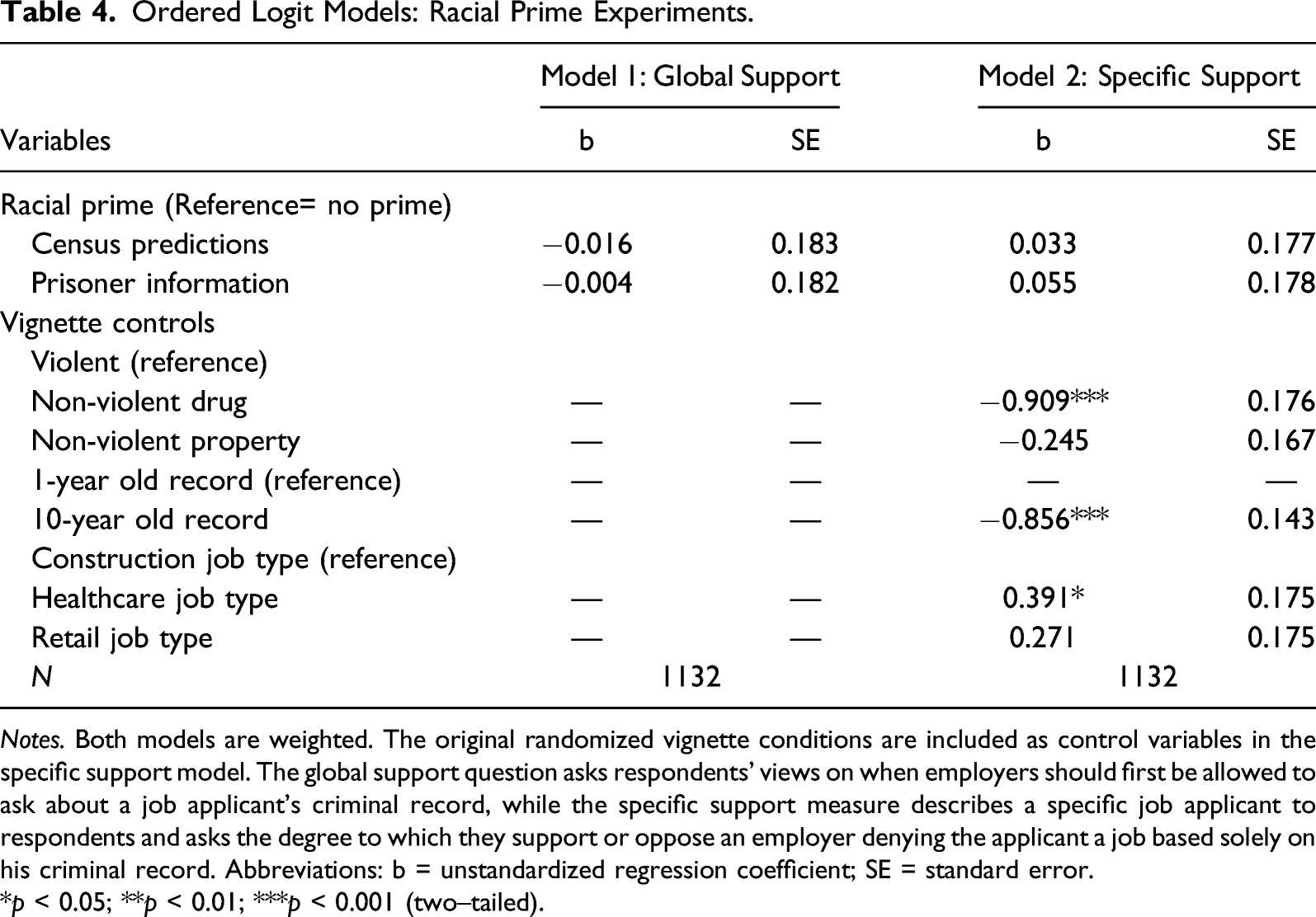
Notes. Both models are weighted. The original randomized vignette conditions are included as control variables in the specific support model. The global support question asks respondents’ views on when employers should first be allowed to ask about a job applicant’s criminal record, while the specific support measure describes a specific job applicant to respondents and asks the degree to which they support or oppose an employer denying the applicant a job based solely on his criminal record. Abbreviations: b = unstandardized regression coefficient; SE = standard error.
*p < 0.05; **p < 0.01; ***p < 0.001 (two–tailed).
Ordered Logit Models: Racial Prime Experiments for Respondents With High Racial Prejudice.
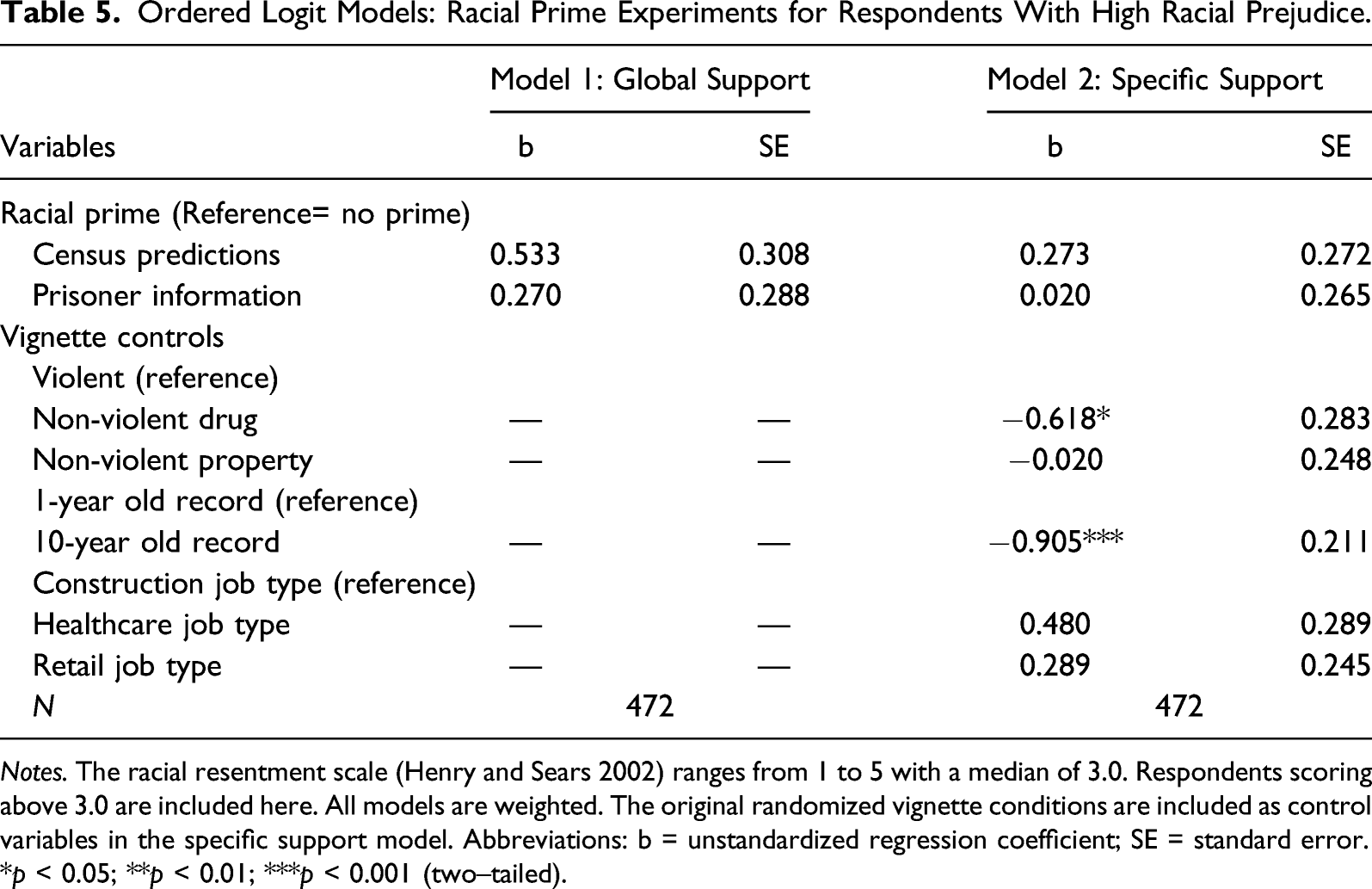
Notes. The racial resentment scale (Henry and Sears 2002) ranges from 1 to 5 with a median of 3.0. Respondents scoring above 3.0 are included here. All models are weighted. The original randomized vignette conditions are included as control variables in the specific support model. Abbreviations: b = unstandardized regression coefficient; SE = standard error.
*p < 0.05; **p < 0.01; ***p < 0.001 (two–tailed).
Finally, we examined whether respondents who self-reported making an employment decision in the past (n=308) differed from the full sample. We found no evidence that the racial primes had significant effects on either outcome in the employer sample (available upon request). In sum, regardless of the type of support, the content of the racial prime, or respondents’ racial attitudes or employer experience, we found no evidence that racially threatening information increased support for criminal record inquiries or for denying a job to an applicant with a criminal record.
Discussion
Racial discrimination is a seemingly intractable social problem (Bertrand and Mullainathan 2004; List 2004; Pager et al. 2009). Further, individuals with criminal records—who are disproportionately people of color—face heightened discrimination in the hiring process (Agan and Starr 2017; Pager 2003; Uggen et al. 2014) as well as in other contexts, such as college admissions (Stewart and Uggen 2020). A central debate in the discrimination literature concerns the degree to which people use statistical inferences to make group generalizations when facing uncertainty (Arrow 1973; Phelps 1972) or instead exaggerate differences in group characteristics through stereotype amplification (Haner et al. 2020; Quillian and Pager 2010). While both are illegal in the employment context and both are equally harmful, the distinction can be useful for shaping policy reform and for forecasting how discrimination may change with shifts in either the contextual or information environment. In the current study, to advance understanding about the attitudinal mechanisms that may give rise to employment discrimination, we examined whether the American public has realistic perceptions of arrest record prevalence for different racial and gender groups. We also tested whether the types of racially threatening information that have generated prejudicial reactions in other contexts also affect attitudes toward hiring applicants with criminal records.
In contrast to theoretical arguments about stereotype amplification, our data show that the public underestimates the arrest prevalence for black males, perceiving it to be lower than the best available estimates from self-reported arrest data. In fact, the public appears to underestimate the prevalence of arrest for males generally (for black, white, Hispanic, and all males). While the precise level of perceived arrest prevalence sometimes differs meaningfully from the self-reported estimate—and there is measurement error in our (and in all) survey estimates—the key finding is that the public rank orders demographic groups in a way that aligns accurately with empirical estimates. That finding is consistent with statistical discrimination theory. That the public also does not exaggerate the arrest prevalence of black males (as stereotype amplification theory posits) further supports the plausibility of statistical discrimination. As Kahneman (2011, p. 169) explains, reducing statistical discrimination in the hiring process is critical because “we do not want to draw possibly erroneous conclusions about the individual from the statistics of the group.” It is also important to emphasize that whether reflecting statistical averages or not, statistical discrimination is not “better” or “more fair” than taste-based discrimination. Discrimination is discrimination, period—it is always harmful to job applicants, no matter the reason. The “why” question is important only because answering it can inform efforts to reduce discrimination.
In fact, even discussing statistical discrimination as an explanation for biased decisions without making the harms of discrimination clear could have negative consequences. In a recent survey experiment, exposing a group of individuals with managerial experience to statistical discrimination theory—without further explanation or criticism about its dangers—led to stronger beliefs in and justifications for the stereotype and more discriminatory behavior in a hiring simulation (Tilcsik 2020). As an anonymous reviewer pointed out, a focus on statistical discrimination theory might also divert attention away from important structural explanations for such disparities, and it is important to contextualize interracial disparities whenever possible (Hetey and Eberhardt 2018). If policymakers heed researchers’ calls to reconsider the use of Ban-the-Box policies (Doleac 2016), discussions about the root causes of variations in criminal justice system involvement should be a priority.
Another interesting finding is that the public typically either overestimates or closely estimates female arrest prevalence across demographic groups. There has long been a point of concern with gender expectations and crime, with differential and harsher responses to girls and women relative to boys and men (Chesney-Lind and Pasko 2012; Visher 1983). However, we are not able to determine why the accuracy of public perceptions of arrest prevalence diverges for males versus females, nor can we decipher what effects it might have. Future research could explore whether the public is aware of increased arrest trends for girls and women (Steffensmeier et al. 2005) or otherwise perceives a closing gender gap. It could also be useful to further examine the implications of the intersection between race and gender for public prevalence estimates.
Our second set of findings—that racial threat primes have little effect in the hiring context, even among racially prejudiced respondents—differs from prior experimental research using similar primes for other outcomes (Abascal, 2015; Craig and Richeson, 2014a, 2014b; Hetey and Eberhardt, 2013). There are a few potential explanations for this unexpected finding. First, it is possible that the effects of racial threat primes have changed over time, perhaps because a larger proportion of the public has become familiar with Census projections. We also selected two particular primes based on prior research. Testing other animus primes and in other contexts (e.g., housing) would be beneficial, as the results presented here may not generalize to other contexts or primes. We also did not test whether the effects of the primes depended on the race of the job applicant. Future research should consider such potential interactions.
Second, it is possible that the primes simply do not have the same effect on reactions to social inclusion opportunities post-punishment as they do on punishment preferences. This would align with experimental survey research findings that focus on outcomes other than formal punitive policy responses to crime. For example, Wozniak (2020) found no evidence that implicitly racialized cues affect justice investment preferences. Similarly, an analysis of 17 nationally representative survey experiments on racial discrimination found that (1) white respondents did not discriminate for or against white targets, and (2) there was a small to moderate effect in favor of black targets among black respondents (Zigerell 2018). Pager and Freese (2004, as cited in Mutz 2011) suggest that some Americans may view black applicants as more deserving of certain programs or opportunities, such as governmental assistance, due to historical disadvantages. Further exploring how and why attitudes might differ when considering social inclusion opportunities can have important implications for reintegration policy.
Limitations and Implications for Further Research
There are several important considerations and study limitations. First, our cumulative response rate for the nationally representative sample was 2.4%, which is low but consistent with other studies (e.g., the American National Election Study) using pre-recruited probability samples (Pickett et al. 2018). We should note that while nonresponse bias can compromise the generalizability of results, there is typically a very weak link between nonresponse bias and the nonresponse rate (Krosnick et al. 2015). Instead, nonresponse bias heavily depends on whether the likelihood of responding to the survey is correlated with the specific outcome variables in a study (see Groves et al. 2009), which we do not suspect is the case here. Our questions for that survey were embedded in an omnibus survey that contained a variety of topics, and people generally selected out before beginning the survey. Most importantly, nonresponse bias, even if present, does not threaten the internal validity of experimental estimates. However, replications in other contexts would be useful.
Another consideration and area for future research involves our prevalence estimate measure and racial prime treatments. While arrests are a useful baseline measure for understanding perceptions of criminal justice system prevalence, as with other aspects of the criminal justice system, they can be the product of biased decision-making processes. Arrest data are notoriously inaccurate and outdated (Lageson 2020), but employers might react differently if they were aware that official records can reflect police bias rather than offending. The broad category of arrests also includes heterogeneous offenses. Many arrests are for minor crimes and/or are dismissed. Therefore, future studies using convictions or certain record types (felonies, violent records, crimes traditionally connected to racial stereotypes, etc.) would provide additional insights. Similarly, defining “criminal record” in different ways in the racial threat prime experiments could further contribute to our knowledge about employment decisions. As an anonymous reviewer pointed out, because the prisoner race information treatment also mentioned declining prison populations (in addition to racial demographics of the prison population), it is possible that respondents may perceive improvement in the criminal justice system. Given recent declining trends in correctional populations (Maruschak and Minton 2020), it is useful to understand how such primes work in this dynamic context. However, it would also be useful to test alternative racial primes to learn whether racial animus is triggered when there is a more punitive environment or setting. Furthermore, testing similar experiments on a set of employers actively making hiring decisions would provide an interesting comparison to our general public sample.
Conclusion
In sum, the evidence from the two national experiments reported herein points to an important overarching conclusion. The first experiment suggests that inference-based discrimination is plausible in the employment context because Americans are aware of demographic differences in arrest prevalence, but the second experiment does not find any effect of racially threatening primes—primes that should increase hostility toward minorities among taste-based discriminators. Taken together, this suggests that statistical discrimination may be a primary mechanism leading employers to react differently to job applicants of different races. By extension, policies like BTB, which withhold criminal record information until later in the hiring process, may inadvertently increase racial discrimination as people attempt to fill in the missing details using observable demographic characteristics (Doleac and Hansen 2020; Holzer et al. 2004). Because members of the public know that arrest records are most common among black males, they are likely to assume that black male applicants are the most likely to have records and to use this information when making hiring (and other) decisions. If so, it might be possible to reduce employment discrimination in the short-run by informing decision-makers about the harms of statistical discrimination, and in the long-run by ameliorating the damaging social conditions that produce racial disparities in arrest to start with.
Supplemental Material
sj-pdf-1-scu-10.1177_23294965211053832 – Supplemental material for Race, Criminal Records, and Discrimination Against Job Seekers: Examining Attitudinal Mechanisms
Supplemental material, sj-pdf-1-scu-10.1177_23294965211053832 for Race, Criminal Records, and Discrimination Against Job Seekers: Examining Attitudinal Mechanisms by Megan Denver and Justin T. Pickett in Social Currents
Footnotes
Acknowledgments
We would like to thank Shawn Bushway for his feedback on an earlier version of this manuscript.
Declaration of Conflicting Interests
The author(s) declared no potential conflicts of interest with respect to the research, authorship, and/or publication of this article.
Funding
The author(s) disclosed receipt of the following financial support for the research, authorship, and/or publication of this article: This research was supported by a grant from the Center for Social and Demographic Analysis (CSDA) through the National Institute of Child Health and Human Development [grant number R24HDO44943].
Supplemental Material
Supplemental material for this article is available online.
Notes
References
Supplementary Material
Please find the following supplemental material available below.
For Open Access articles published under a Creative Commons License, all supplemental material carries the same license as the article it is associated with.
For non-Open Access articles published, all supplemental material carries a non-exclusive license, and permission requests for re-use of supplemental material or any part of supplemental material shall be sent directly to the copyright owner as specified in the copyright notice associated with the article.
