







Abstract
This paper engages in a content analysis of public testimonies available through the Conceivable Future project, a network of individuals from the United States and Canada who seek to bring awareness to the threat climate change poses to reproductive justice. How are these individuals navigating reproductive decision making amid the climate crisis? Specifically focusing on individuals who express that they are choosing not to have children, we explore how emotional experiences, family planning, and environmental concern collide within the Anthropocene. Analysis of testimonies revealed a number of themes. Most people struggled with ethical questions about what it means to be accountable to and responsible for future generations in a warming world. Their concerns were tied to visions of future climate apocalypse and, implicitly and explicitly, to recognition of their own privileges living in North America. Many encountered some form of stigma or social pressure from family, friends, and/or broader society about their choice to remain childfree, sentiments more strongly expressed by women. Ultimately, individuals forgoing having kids express motivations rooted in love and the hope that they can channel their energies into alternative forms of caregiving and/or activism.
You say that you love your children above everything else, and yet you are stealing their future in front of their very eyes. —Climate justice activist Greta Thunberg My unborn child Never to breathe the icy fresh winter air Never to feel the warmth of the sun on your skin Never to stare wide eyed at the wonders of this world . . . I’m sorry my child To not give you these things But to give you life Would be to give you great pain and loss To bring you into a broken world That is being torn apart Just so I could get to love you Then leave you to suffer the fate of this planet It wouldn’t be right This is my way to protect you But please know That I love you deeply, my child. —#BirthStriker Herbie Bloch
Increasingly, the risks that global warming poses have become entangled with intimate decisions, including whether or not to have children. In 2019, Business Insider found that nearly 38% of 1,102 Americans surveyed (18–29 years old) felt that climate change should be a factor in reproductive decisions (Relman and Hickey 2019). Another 2018 poll of 1,858 Americans by The New York Times indicated that 33% had or expected to have fewer children than they considered ideal in part because they were worried about climate change (Miller 2018). In 2020, a survey from Morning Consult of 2,201 childless Americans found that 26% identified climate change as a major or minor reason why they had chosen not to have kids, with rates of nearly 40% for Hispanic and Other racial groups (Jenkins 2020). Grassroots networks have also drawn attention to the risks that global warming poses to reproductive justice. For example, Conceivable Future (established 2014) encourages individuals to share their personal struggles with the decision to have children (or not) amid the climate crisis. Other movements like #BirthStrike (2019–2020) consisted of individuals who pledged to remain childfree until there is substantial action to address the climate crisis.
This paper engages in a content analysis of public testimonies available through Conceivable Future, specifically focusing on North Americans who are choosing not to have children. How do these individuals make meaning of reproduction amid the climate crisis? We begin by reviewing literature on what factors shape reproductive decision making in general as well as voluntary childlessness specifically. While many studies ignore environmental concern as a potential factor, there is a small but growing literature on how climate change is influencing fertility intentions. After an overview of our methodology and data, we explore a number of themes to better understand the motivations and emotional experiences of North Americans who are choosing to remain childfree 1 due to climate change. In conclusion, we discuss the implications of this study and reflect on whether choosing not to have children for environmental reasons can be considered a form of everyday activism.
Reproductive Decision Making and Climate Risk
The term “Anthropocene” refers to a new epoch in which the biosphere of the planet “has been fundamentally transformed by human activity” (Moore 2016:3). While ecological impacts of climate change vary geographically, they include more intense rains and flooding, more intense droughts, longer fire seasons, more extreme weather like hurricanes and tornadoes, ice loss and sea level rise due to global warming, as well as loss of habitats and biodiversity. Potential impacts on human civilizations include damage to economies and infrastructure, mass migration and growing climate refugees, risks of new diseases, food and water scarcity, and increased likelihood of armed conflicts. Research shows that those who are already poor and marginalized will experience these impacts sooner and more intensely, both at an international level but also intra-nationally (Pearse 2017). For these reasons, climate change disproportionately impacts women as well as female-headed households (Bartlett 2008a, 2008b; Demetriades and Esplen 2008).
Other impacts of climate change are psychological. As the planet warms, people are more likely to experience ecological grief and anxiety in response to experienced or anticipated ecological losses (Coffey et al. 2021; Cunsolo and Ellis 2018; Doherty and Clayton 2011; Obradovich et al. 2018). Younger generations report higher rates of eco-grief and eco-anxiety, and while results are mixed, there is growing evidence that women also report higher levels of concern about climate change (Boluda-Verdú et al. 2022; Clayton et al. 2023; Poortinga et al. 2019). Racial identity also shapes psychological impacts, with other national polls in the United States indicating that Black, Hispanic, and Asian Americans are more likely to perceive climate change as a critical threat (Leiserowitz and Akerlof 2010; Smeltz et al. 2023).
Researchers and activists have highlighted the importance of the next decade to enact widespread policy and cultural changes to keep global warming to minimal levels and avoid catastrophic ecological and societal impacts. Given that our present-day decisions as individuals and social groups have non-trivial effects long into the future, geographer Castree (2014:444) claims that we will all be forced to reconcile the implications of the Anthropocene with how we currently live our lives. However, climate change is a complex and ongoing crisis, making it unclear how this new era will impact families. Given that people hoping to have children face compounding risks in warming times, sociologist Jamieson (2016:3) argues that: “More focused attention is now needed on how family and intimate practices intersect with how people take up, sustain, rework, or challenge environmentally consequential dispositions, actions, discourses and systems.”
While controversial, decisions about childbearing have environmental significance, especially in developed countries where wealthier individuals and families have higher carbon footprints (Murtaugh and Schlax 2009; Nielsen et al. 2021). Activists as well as scientists often cite that the most effective way to reduce personal emissions is having one fewer child (Wynes and Nicholas 2017), and the question of whether procreation is immoral on environmental grounds is a growing topic in philosophy (Cafaro 2021; Hedberg 2020; Vance 2024). With that said, feminist scholar Sasser (2018) has shown that populationism, or the attribution of social and ecological problems to population numbers, is rooted in histories of eugenics and racism that have often supported coercive forms of population control. As such, we must be wary of contemporary populationist projects that “are antithetical to the goals of reproductive justice, which reject population interventions and support the ability to have wanted children, free of coercion, as a human right” (Sasser 2023:2).
So, what shapes reproductive decisions? While health psychologists Boivin et al. (2018:91) caution that there is variation in the preconditions that different people consider necessary, research on fertility in general identifies a variety of factors that increase the likelihood of conception, assuming availability of family planning methods (which make intentional choices regarding childbearing possible). In their review, medical researchers Hashemzadeh et al. (2021) found that feeling ready to parent was influenced by one’s physical and psychological health as well as relationship status, with those in stable, long-term relationships especially cohabitation or marriage more likely to conceive. Financial security is also important (Boivin et al. 2018), although paradoxically, literature has indicated that those with higher incomes have fewer children or are less likely to conceive, especially women with high education (Balbo, Billari, and Mills 2013; Livingston 2015).
At the micro-level, a variety of motivational forces relating to personal values and beliefs also shape reproductive decisions. An individual’s desire for children and their ideal family size matter, as do those of their partner (Balbo et al. 2013:6). Men and women who adhere to more traditional gender norms are more likely to have children than those who adhere to more egalitarian beliefs (Hashemzadeh et al. 2021). Religiosity has also been shown to increase the likelihood of childbearing (Hashemzadeh et al. 2021). Meso-level factors impacting decisions about reproduction include social networks, which can serve as a source of “fertility-relevant supportive resources” (e.g., childcare assistance) for those with long-term, stable, and trusting relationships with relatives and/or close friends (Balbo et al. 2015:16). Fertility intentions have been shown to be influenced by peer groups, who serve as a basis for social comparison and are usually sources of social pressure to have children (Balbo et al. 2013; Boivin et al. 2018; Hashemzadeh et al. 2021). Other macro-level factors include the cost of having a child (Boivin et al. 2018:98) as well as national family policies and the availability of childcare (Balbo et al. 2013; Hashemzadeh et al. 2021).
Since data on childlessness in the United States became available in the 1970s, rates of childlessness have ranged between 10% and 20% of women aged 40 to 44, with current rates around 15% (Livingston 2015). There is consistent variation by race/ethnicity with whites more likely to be childless, followed by Black, Asian, and Hispanic Americans respectively (Livingston 2015).
Many studies on voluntary childlessness, or the active choice and commitment to not have children, reinforce the influence of key factors mentioned above. According to a study by sociologists Waren and Pals (2013) using national US data, demographic, socialization, and attitudinal factors consistently applied to childless men and women; however, education was only significant for women. Psychologist Shapiro (2014:6) argues that “‘freedom’ (or ‘autonomy’) on the whole motivates the voluntarily childless; freedom from the pressures and responsibilities that parenting involves and the freedom to pursue self-development and self-fulfillment.” For example, in sociologist Houseknecht’s (1987) review of 47 studies of childfree individuals, rationalizations included freedom from childcare, more prestigious work opportunities (especially for women), greater self-fulfillment, doubts about parenting abilities, and sometimes a general dislike of children. While there is a gap in research on childlessness among people of color, studies on Black individuals who are childfree have found similarities in motivational factors with potential exceptions being the importance of physical health and marital status (Boyd 1989; Lundquist, Budig, and Curtis 2009).
Given widespread pronatalist beliefs in many societies, there exists an “enduring social pressure and stigmatization of those who are voluntarily childless” (Shapiro 2014:9). Those who are voluntarily childless are perceived by others as being more selfish, less nurturing, individualistic, materialistic, and less mature (Blackstone and Stewart 2012; Shapiro 2014). Childfree individuals report that their decision can be met with disbelief, that they are seen as deviant, and that they experience pity and criticism from others (Blackstone and Stewart 2012; Gillespie 2000), with studies indicating women experience more stigma than men (Park 2002). Childless individuals rationalize their reproductive decision using “an acceptable vocabulary of motives previously established by the historical epoch and the social structure in which one lives,” with men more likely to identify monetary advantages and women more likely to identify altruistic motives, including concerns about overpopulation (Houseknecht 1987:376). Some childfree individuals challenged stereotypes by shifting criticisms back to parents, highlighting the prevalence of abusive parenting or framing the decision to have children as selfish (Park 2002). Others managed stigma by forming a supportive reference group with empathetic others (Houseknecht 1987), efforts now facilitated by online social networking sites (Blackstone and Stewart 2012).
Research has shown that childfree individuals are unlikely to express regret about their decision later in life (Harrington 2019). While there is less research on consequences of voluntary childlessness on the lives of others (Shapiro 2014), recent studies have explored the value of childless adults to their community and extended families (Albertini and Kohl 2009; Barnwell 2022; Milardo 2009; Pollet, Kuppens, and Dunbar 2006).
Public arguments and research on the intersection of fertility decisions and environmental crisis go back to at least the late 1960s when concerns about overpopulation spiked following biologist Ehrlich and Ehrlich’s (1968) book The Population Bomb. While some early research investigated grassroots organizations like Zero Population Growth (Barnett 1971, 1974), most studies on reproductive decision making including on voluntary childlessness have ignored environmental concerns as a potential factor (Schneider-Mayerson and Leong 2020). This is partly due to an emphasis on quantitative studies (Lynch et al. 2018) and shortcomings in data sets, which rarely include questions on these topics.
While limited, there is a growing literature exploring how concerns about climate change influence reproductive decisions, at least for some. In their survey of 1,000 Canadians (16–25 years old), health and education researchers Galway and Field (2023:3) found that 39% of respondents reported hesitation about having children due to climate change. Another survey of 2,521 Americans aged 22 to 35 found that people of color were more likely than white people to consider climate change when deciding whether to have children and have fewer children than preferred (Sasser 2024). A non-representative survey of 607 Americans (27–45 years old) who were factoring climate change into their reproductive plans found that 96.5% of respondents were concerned about “the future well-being of their existing, expected, or hypothetical children” (Schneider-Mayerson and Leong 2020:5). Those who remained childfree (35% of the sample) felt their decision contributed to their ability to pursue environmental activism, leading American Studies scholar Schneider-Mayerson (2022:1) to argue that reproductive decisions have become a way to “act as environmental political actors.” Similarly, psychologist Nakkerud (2021) interviewed 20 childfree Norwegians and concluded that their choice was a form of ecological activism (see also Nakkerud 2024). In their study of BirthStrike, gender studies scholar Mo (2021) noted that involvement in the movement was a means of mitigating eco-grief and eco-anxiety. In a content analysis of comments on news articles about BirthStrike in addition to interviews with 24 college students in the United States and New Zealand who were affiliated with sustainability clubs, common motivations for reducing fertility included concerns about overpopulation and overconsumption (Helm, Kemper, and White 2021).
Building on prior work, our study features a unique sample of 50 individuals aged 20 to 65 years, many of whom do not identify as activists, who have shared public testimonies through the Conceivable Future organization about their decision to remain childfree. Testimonies reflect what those choosing childlessness due to climate change consider most important in shaping their reproductive decisions, and include affective experiences beyond eco-grief and eco-anxiety. Rather than focusing on the causal influence of climate change on fertility intentions, we aim for a rich description of how individuals from North America make sense of and navigate the emotional un/certainty regarding their reproductive decisions. We also discuss how these processes are shaped by gender. We thus hope to address psychologists Lynch et al.’s (2018:35) call for more qualitative research “exploring the subjective experiences and meaning-making in narratives and autobiographies of voluntary childless people [to] contribute to depth of understanding of an issue that involves complex interweaving of social dynamics.”
Methods and Data
This project engages in an inductive analysis of testimonies available online through Conceivable Future. The network and organization were founded in 2014 by Dr. Meghan Kallman, a sociologist, and Josephine Ferorelli, a writer, both based out of the east coast of the United States. Their goal was to bring awareness to the threat climate change poses to reproductive justice. The organization argues that given contemporary economic and environmental threats no one makes reproductive “choices” freely even when individuals have access to family planning (Conceivable Future 2020). The main activities of Conceivable Future include organizing house parties where people are able to talk about how climate change is impacting their intimate decisions. Participants include those who are unsure and are still grappling with these questions, individuals who have or will have children, as well as those who will never conceive. The organization gathers and shares testimonies as an offering meant to be “an act of conscience for our nation’s future” (Conceivable Future 2020). Most testimonies are recorded at house parties, though it is also possible to submit a testimony independently in video, audio, or written format.
How house parties are organized can affect participation, how many people come, and how many give testimonies. Conceivable Future provides a one-page how-to guide to hosting a house party and the co-founders try to support and/or attend house parties whenever possible. However, the exact format varies depending on who is hosting. Most house parties last three to four hours and include food. While it is possible for attendees to be strangers, more often the events are hosted within an existing network like an activist network, student network, or sometimes simply friends and/or family. The recommended agenda encourages beginning by establishing ground rules, stating the event’s objectives, and reading the Conceivable Future mission statement. After explaining the testimony process and screening one to two testimonies, all attendees take a few minutes to free-write and then break into small groups to talk before ending with a larger group discussion. Guidelines encourage creating a private space somewhere where individuals can record a testimony whenever they are ready.
Testimonies shared on Conceivable Future are typically between two and ten minutes long. Originally, the co-founders asked specific questions during the testimony collection process, however over time they realized it was more powerful to ask just one question, “How is climate change shaping your reproductive life?” Typically, only a small number of attendees at house parties choose to provide testimony, and who gives testimonies is shaped by power. In a conversation between our research team and one of the co-founders of Conceivable Future about the house party and testimony process, they observed that, in general, people with more privilege are more likely to testify. While they shared that the demographics of in-person house parties are not that different from the testimonies on the website, men may be slightly overrepresented and Black and other people of color slightly underrepresented in testimonies. Younger people are also more likely to testify. Organizers of the network focus on making a space to discuss personal reproductive decisions in ways that highlight the structures shaping those “choices” rather than blaming individuals caught in the system. Testimonies submitted to Conceivable Future undergo a vetting process to screen out those that seek to prescribe an individual’s reproductive choice to a broader public (e.g., telling other people not to have children) or framing the activities of the organization as promoting any specific choice.
For this project, we have focused specifically on those who expressed that they are choosing not to have children due to climate change in their testimony. This limited scope was chosen to keep the project feasible, with goals to expand the sample in future studies. Out of the 87 testimonies shared by Conceivable Future, this left 50 for analysis, including 35 video testimonies (70%), 3 audio (6%), and 12 written (24%). The majority of testimonies were from individuals between 20 and 39 years old (82%, N = 41). Most were women (64%, N = 32), although nearly a quarter were men (24%, N = 12) with 12% (N = 6) unknown gender. Although race was not explicitly disclosed, we inferred race from skin tone for video testimonials, identifying 97% white or lighter-skinned except for one woman of color (3%). Written and audio testimonies were unclear race/ethnicity (93%), except for one individual who self-disclosed as white (7%). While not always shared, the geographic location of participants at the time they submitted their testimony is shown in Figure 1.
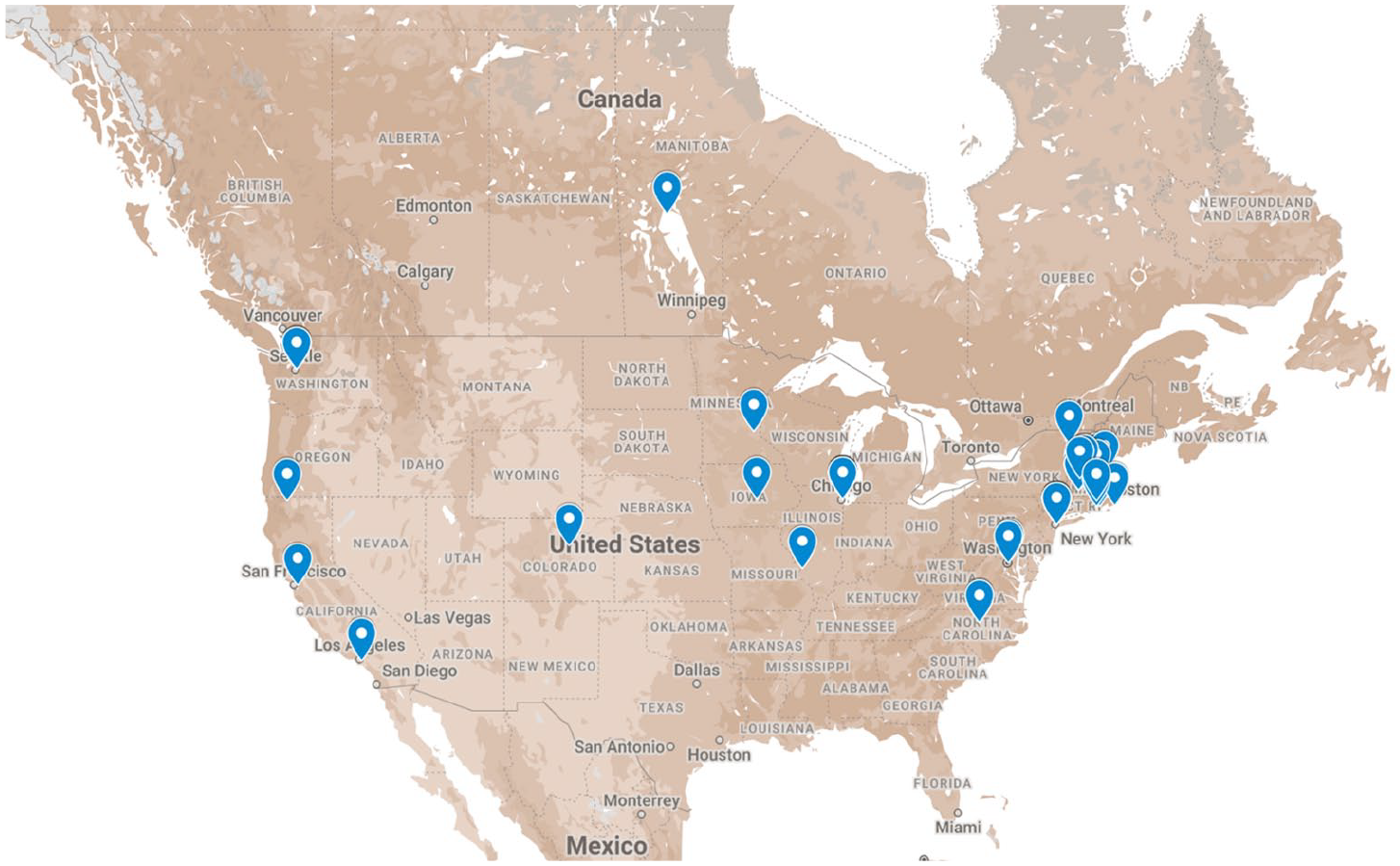
Locations of Conceivable Future testimony participants included in sample upon submission of the testimony, when disclosed (N = 43).
We retained real names for individuals who chose to disclose them publicly on Conceivable Future’s website. While transcribing video and audio testimonies, we tried to capture emotional and embodied behaviors (e.g., noting body language like rocking back and forth, rubbing hands or legs, laughter, and/or tears). During preliminary emergent coding, each researcher viewed the testimonies independently, generating a list of themes arising from the data that were then discussed as a group and combined into an initial set of codes. The first round of formal coding was done using the program Dedoose, with each researcher reviewing a specific range of testimonies independently alongside periodic group check-ins to refine the codes and ensure normalization in application. A final round of coding was done as a group, with all researchers reviewing applied codes for all testimonies together to ensure accuracy. Code frequencies and code presence were analyzed across the total sample as well as by gender to help reveal subtleties within the qualitative data.
Reproductive Decision Making in Climate Crisis
Analysis revealed a number of patterns in the testimonies. The 25 codes tracked included concerns about ethical questions; visions of a warming world; fantasies of a future parent-child relationship; conflict between global needs and personal desires; acknowledgment of their own privileges; encounters with stigma due to their decision to remain childfree; social pressures to have children; witnessing impacts of climate change; a range of experiences relating to alternative caregiving; as well as whether individuals expressed certainty or uncertainty regarding their decision. Reproductive decisions were deeply entangled with a range of emotional experiences. The most frequent themes were ethical responsibility to future generations, certainty and uncertainty of their decision, visions of future climate crisis, expressions of eco-anxiety, and alternative caregiving (see Table 1).
Frequency Counts for the Total Sample As Well As Broken Out by Gender (Including Averages Per Testimony).
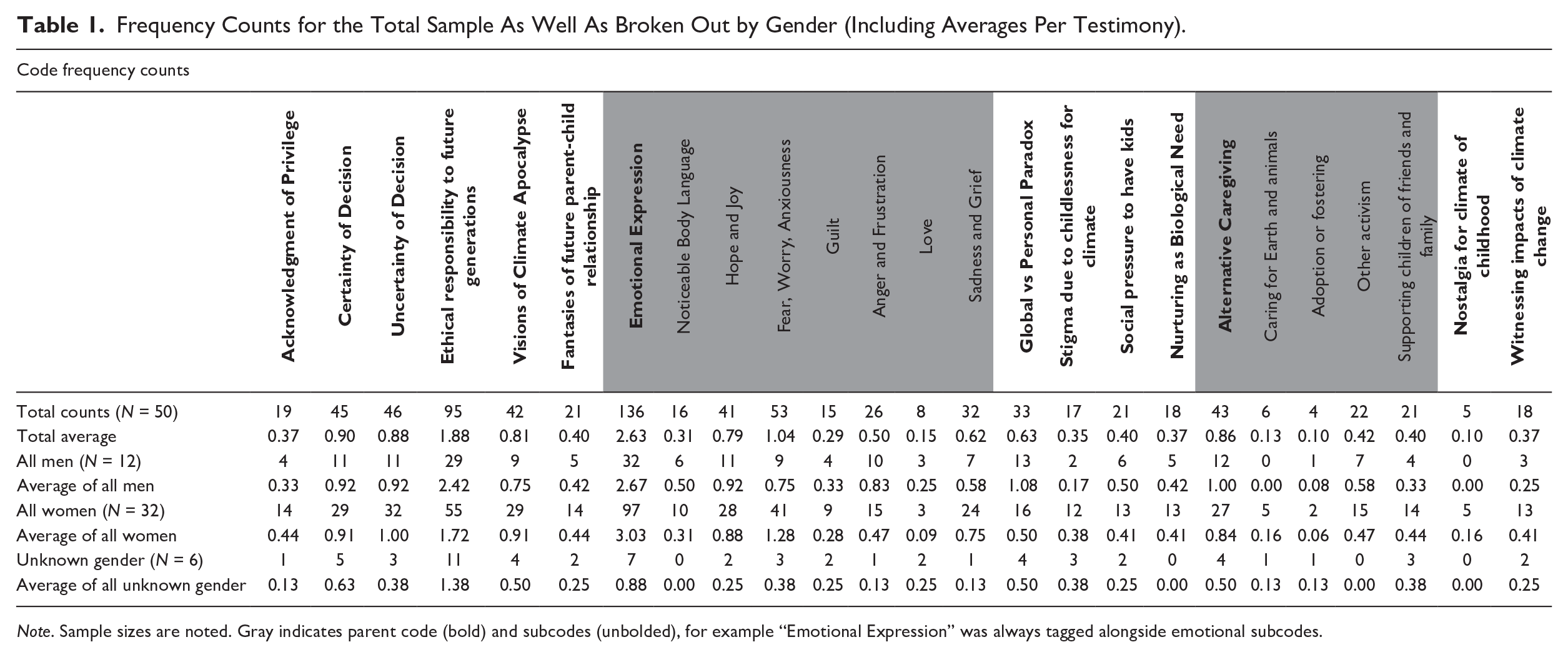
Note. Sample sizes are noted. Gray indicates parent code (bold) and subcodes (unbolded), for example “Emotional Expression” was always tagged alongside emotional subcodes.
Ethical Responsibility to Future Generations
Most individuals expressed struggling with ethical questions surrounding reproduction in a warming world and what it means to be accountable to and responsible for future generations. This was the case for both men and women, who brought up the topic at similar rates, although code frequencies indicated men emphasized ethical concerns more in their testimonies.
Hannah from New Hampshire explained how “I’ve thought about this in the context of two questions. The first is: Is it fair to my child to bring them into this world? And then, is it fair to this world to give them my child?” On the one hand, individuals drew attention to high carbon footprints in North America and were concerned about what Hannah described as “what my child might do to the world and what kind of resources that they’ll use and the way that they will be contributing to those problems.” Another testimony from Jessica explained that, “one American child is roughly equivalent to the consumption of 25 children in a developing country. So once I learned that fact it was kind of game over for me.” These concerns demonstrate that individuals were aware of their privilege and how it implicated them in disproportionately contributing to climate change (e.g., their location in North America), yet also enabled them to make the reproductive decision to forgo having kids (e.g., women were more likely to explicitly mention access to family planning and bodily autonomy). Their potential contributions to climate change, especially if they were to reproduce, thus shaped fertility decisions by impacting their perspectives on ethical responsibility and obligation to future generations.
On the other hand, individuals were also deeply concerned about the life their future children would have. For example, Alison from Vermont asked: What does bringing more people into the world mean for the future of the planet? And also, what are those people’s lives going to look like when we have populations running up against resource constraints, and extreme weather, and crop failures, and famines?
Fear about what their potential children would experience was often connected to individuals’ imaginings of future climate apocalypse. While grim, such visions are hardly unrealistic unless drastic measures are taken in the next decade to address global warming. Many individuals were aware of research on climate change and were concerned about the impacts on human societies, including global responses to growing climate refugees and the potential for more wars. For example, Josephine from New York admitted that “I think the stuff that I’m most afraid of for my child’s life is not necessarily the environmental disasters themselves, but the way those environmental factors are gonna work on human civilizations . . . Our society is not going to resemble what we know and understand in the relatively near future, if not our lifetime then our children’s lifetime. And that—and that scares me.” These worries make some individuals feel the ethical decision is to forgo reproducing. Jamie from Rhode Island seemed somber and close to tears as he described his feelings of fear when he imagined what his future child might experience across their lifetime: “I expect that that person would be alive to see some of the worst of what might be ahead. And, that thought scares me. And it’s hard to feel confidently that putting a human being in that position would be the right thing to do.”
Sometimes, individuals shared conflicted fantasies about what their future parent-child relationship might be like if they did reproduce, and how their future child might feel about their decision. Rebecca from Chicago described how “I sort of fantasize about this situation. . . where I have a fifteen-year-old and they come to me and say, ‘Hey what were you doing in this point in time when this was a real issue?’” An anonymous written testimony expressed: I want to have a baby. I can imagine that baby growing into a toddler, a child, a teenager, and finally an adult. I think about the names I might choose for my son or daughter, the books and stories I would share with him or her, and the things we would do together . . . But I also think about the world my child would inhabit. . . The pictures in my mind’s eye of caring for my child and the ones of an apocalyptic future are not easy to reconcile . . . What happens when your emotional choice and your rational choice are opposites? Will I be haunted by some mixture of guilt and regret no matter what? My would-be child will never know to thank me for sparing him or her existence. My hypothetical child will most likely forgive me. Who do I answer to?
Another individual from Minneapolis wrote how, “The fallout of climate change isn’t somewhere out there it’s somewhere RIGHT HERE. It’s right here in my body with my clock ticking and me quietly shutting the door. And it’s right here in my top dresser drawer where for years I’ve kept a few bits of baby clothes hidden in the back, hoping one day to use them.”
People often expressed feelings of conflict between global needs and their personal desires, a theme more strongly expressed by women. Alison from Vermont described how “it ends up being this sort of painful, personal, dialogue in my head around like the global versus the personal. And like the common good versus what I want out of my life.” Many expressed sentiments that to have children today knowing full well the potential risks that future generations would face would be unfair, unjust, or even selfish. Another individual, Amelia, explained that “I think it’s selfish at this point of me to want to continue bringing children into this world but at the same time it’s a constant conflict because that should be everyone’s right, and I feel that in a way it’s sort of being taken from me.”
Eco-Anxiety, Eco-Grief, and Anger
Feelings of eco-anxiety, eco-grief, and anger were prominent in many testimonies. These emotional codes were present for men and women at similar rates, though during their testimonies women expressed feelings of eco-anxiety more often and men expressed feelings of anger more often.
Feelings of eco-anxiety and eco-grief were most prominent when envisioning the world future generations will experience. Jem Dillion described his feelings this way: There are kinda two big, sort of ugly problems with having kids. Given the climate crisis, one is just that when you have a kid you are contributing to another engine for producing carbon into a world that has way too many of those already. So it contributes to the problem, and then there’s also just the problems that you don’t want to think about your kid having to, you know, bear witness to . . . just natural devastation to social problems, unrest and scarcity. And it’s a shame. Because at a personal level it is something that I would like, I think it’s sort of, it’s one of our deepest instincts.
Megan Hoskins from New Hampshire openly cried while explaining: I question what kind of life my little redheaded babies would have. I question what kind of future they would have and I’m afraid. I’m afraid that they’ll never get to know and enjoy the beauty and connectedness of nature. I'm afraid that they will have to live in a world that is increasingly full of war fueled by climate change. I’m afraid that they will eventually have to live in a world where there is no fresh water and that is increasingly full of dangerous and toxic chemicals.
Like many others, Jem and Megan feared that their future hypothetical children would experience worsening social problems due to the lack of action taken by former and current generations.
Individuals also conveyed feelings of grief and anxiety when describing fantasies about future parent-child relationships they would never experience. Jade from Manitoba, Canada, described her emotions in the following way: Some of my friends have told me that this one song that we often sing at different climate justice marches, rallies, they’ve pictured singing as a lullaby to their kids. I thought about this same thing too . . . [singing] People gonna rise like the water, gonna calm this crisis down. Hear the voice of my great granddaughter, singing climate justice now. [end song] . . . To me there’s something so sad in thinking about how a number of us won’t even be having children to sing that song to, and not because we don’t want to. But just because it feels that our choices are severely limited . . . For me a lot of it is also not so much even wondering about the state of the world that my kids would grow up in but this kind of deep sense of anxiety and dread that I often feel when I think about how little is being done in terms of climate justice, or at least how little feels like is happening, and just realizing how much that feeling would probably be amplified for my children, and how often will they feel that sense of dread and anxiety and how deeply.
Due to these concerns, many chose to live environmentally conscious lifestyles and make difficult choices, including remaining childfree, to spare the planet and their unborn children.
These feelings were sometimes connected to their own experiences witnessing the impacts of climate change. For example, Christy begins her testimony with a story of a tornado ravaging her hometown that seemed much larger than anything previously experienced in her lifetime, and that “having a child in that environment seems just bananas.” Hannah, from New York described it this way: It’s like a biological feeling that it’s a very bad idea to have children because of what’s going on with the climate. It’s not rational per se. It’s- it’s a feeling like my body just observes when I go to the forest where my family lives. Or travel in different places that I’ve been going to my entire life. It’s like my body feels that things are changing and there’s a problem. And it’s almost instinctual that it just wouldn’t be fair or a good idea to bring someone else into this change, this uncertainty.
Many expressed a sense of powerlessness when describing their desires to become a parent, but feelings that they may never do so. Benjamin from Massachusetts reflected on how his experience at the house party highlighted “how much grief there is around making this decision” and how many people are gaining more emotional clarity about its impact on their families. Benjamin described how: I know between me and my partner we’ve had some pretty sad conversations about, like, “Yeah, this is the right thing to do,” and “Man, what are we missing?” And how sad and how tough that is. It’s a kind of a curious intersection between the objective science-based ability we have as human beings to make these assessments and also just the really personal, biological and emotional element of deciding not to move forward as parents because of how uncertain the world is.
His testimony captures the intensity of emotions that are part of conversations individuals have with romantic partners and/or extended family about family planning. The personal conflict between their desires to parent and the decision to not have children creates a sense of loss and grief in the lives of many.
Feelings of powerlessness over the current cultural, social, and institutional forces that have caused such degradation to the planet also drive people to anger. Nathaniel from Seattle described how attending the house party helped him realize that “I’m angry that this discussion is even happening.” Camila from Washington D.C. professes, When I’m really engaged in the [climate justice] work . . . I- I’m so happy that I have this opportunity to work on something that’s truly so much bigger than myself . . . At the same time I feel so small, so powerless, and so angry that this deeply felt desire as a human, as a woman, as a person who loves family, and very much loves kids . . . needs to wrestle with like, oh, maybe that’s the wrong thing to do. That devastates me on such a deep level that it’s like scary to look at even.
This can make people feel as though they have lost agency in their own reproductive choices.
Experiences with Social Pressures and Stigma
Many individuals described experiencing social pressures to have children. This was true for both men and women, who brought up social pressures at similar rates. For example, David from Rhode Island expressed how he and his wife had experienced “pressure over the years, people question you, it’s not normal” among the Catholic and conservative region they lived in.
Individuals also experienced stigma from family, friends, and/or broader society due to their decision to remain childfree. Marya from Chicago explained how there was “something really lonely about this decision. I feel like it’s difficult having conversations with friends who have children or want to have children because I’m afraid of offending or scaring them.” She described how “when sort of pushed to explain why I don’t want to have children, my professional and economic reasons why are met with reasoning. Whereas, where I pose environmental reasons why, people react with a combination of disbelief and ridicule.” When others don’t understand their sense of urgency regarding the climate crisis, individuals expressed feeling like their decision is considered invalid. This situation can be frustrating as individuals feel that their actions are informed by science and are a result of caring consideration, yet at times they are treated like they are being overly dramatic or irrational.
Experiences with stigma were more often expressed by women. This may reflect greater concern about an inability to make a “correct” choice given gender roles and pressures to adhere to a heteronormative family system. Meghan Kallman explains it this way: We [Women] have this very interesting social mandate, right, on the one hand it’s to be keepers of the next generation and to be nurturers and to be caretakers, and on the other hand we’re being asked to do so in a world that is unstable and wherein our leadership is not keeping the best interest of those future generations at heart . . . I mean people asking you in the grocery store when you’re gonna have children. I mean your great aunt knitting things for your baby-to-be even if your baby to be isn’t even, you know, real yet. It’s a very hard thing to be sort of socially told and expected to have children . . . while on the other hand those who are supposed to protect the world for the next generation have been so patently unwilling to do so. So, it’s a difficult paradox. It’s a hard thing to struggle with. One feels like one can’t make a right choice.
Sometimes, people expressed that they had found ways to cope with these feelings of invalidation and scrutiny from others. Marya explains how “what helps me is reminding myself that my choice not having children is not actually about me, and I also remind myself that my choice is legitimate, and that it’s really important for us to talk about the impact of our reproduction and subsequent human life on the environment.”
Love, Joy, and Hope in Alternative Caregiving
Hope and joy were found in half of all testimonies, with similar prevalence of positive emotional expressions for both men and women. Alternative caregiving was also present in a majority of testimonies, with comparable rates for men and women, although men were slightly more likely to emphasize other forms of activism and women often expressed a broader range of caregiving activities that also included supporting children of friends and family or caring for the Earth and animals. Interestingly, feelings of love and alternative caregiving were more likely to co-occur with certainty in decisions to not have children.
Many testimonies expressed feelings of hope, joy, and love alongside feelings of anxiety and grief, reflecting individuals’ complex emotional experiences. Josephine expressed how she finds comfort and hope in her community and said, “You gotta help people come together and take care of each other, while they’re confronting really dark stuff. You can’t dodge the dark stuff, you have to see it, you have to describe it, and you have to stand up against it.” Eleanor from Chicago expressed how “on the other side of capitalist collapse . . .. there’s still joy in making and there’s still joy in objects and in jokes and in learning stuff.” Such declarations of joy amid collapse were one way that individuals coped with the changing future.
Some individuals also found a sense of happiness and hope by engaging in activism, channeling the energy they would have given a future child into creating a better, more socially just future. For example, Jay from Massachusetts explains: What is the purpose of my life? Is my life about creating more humans, perpetuating my family? Creating something deep and meaningful but nonetheless . . . distractions from what I feel called to in my purpose right now which is to build an empowered, loving, just movement that's capable of changing the trajectory that we’re on in terms of climate.
McKenzie from New Hampshire spoke about the “small window that we’re working within [to address climate change], and I felt . . . it’s kind of like our calling to be a part of it. And the same way I see what happens beyond this window is kind of an abstract thing that I don’t deal with, ‘cause I’m in the here and now, I think of having kids or having that decision to have kids also is beyond that window.”
Engaging in activism could also be a way to connect to like-minded individuals, allowing them to share their decision to not have children with others who understand. Benjamin, an activist from Maryland, recalls: I remember the men sung in a circle, in Council Bluffs, Iowa. We had walked 18 miles that day. My mother flew in to Omaha to visit me for my birthday. I had been walking for five months. I remember it was the first time I felt like I wasn’t going to be perceived as crazy to say “I want to get a vasectomy because the atmosphere is warming.” I remember the normalcy and acceptance of that and sharing of similar experiences.
Conceivable Future house parties were also described as a positive bonding experience, regardless of whether they were activists, with many people discussing how meaningful it was to create spaces of community to share their concerns.
Some individuals spoke about using the energy they would have given a future child to engage in other caregiving, including adoption, fostering, supporting the children of friends or other family, and/or caring for the Earth or animals. Claire from Massachusetts planned to continue conservation work through falconry, and Christy from Chicago described her desire to help other people with their kids: When I have these strange moments, maybe it’s just like mental preparation for collapse–like it just comes into my brain and I think about what I would do, and who I would want to be with me, and who I would be concerned about. I think first about the people I love that have kids and if I could be helpful to them.
Another individual, Laura, felt that “In some ways I get my nurturing, my maternal instincts out by working for the Earth or for also caring for other people in the community.”
There were several ways in which people talked about hope in their testimonies. One participant, Katie from North Carolina, explains what her faith in the future feels like: I think about the fact that the Earth has gone through all of these mass extinctions over and over and over. And there have been times when the Earth has been reduced to nothing but cyanobacteria floating in the ocean, and yet I look out my window right now and we have hummingbirds. So, the worst we could possibly do can result again in hummingbirds evolving. It’s just we might not be a part of the next incarnation of hummingbirds and orchids and things like that. So, in the end, whatever choices we make, I like to make my choices to increase the happiness and well-being and diversity of people and creatures around me. And I do believe in the sacredness of all life. But I also have this faith that it is going to be okay. It might not be okay in the way I want it to be okay. But there will be hummingbirds.
Katie finds hope even amid mass extinction and planetary collapse by reminding herself that life finds a way, and biodiversity will evolve again even if it is something that human beings may not be there to witness.
Ultimately, those forgoing having kids express motivations rooted in love, challenging us to reimagine what caring means in a warming world. Tim from Rhode Island asks, “How could the older generations actually care about us if they didn’t fight hard enough for us to defend a livable future? Did they really love us more than they loved the convenience that they chose over our future?” Marya put it this way: I feel like we have a moral obligation to do whatever is in our power to mitigate it [climate change] in its effects. And not just for the planet and its organisms and its ecosystems but for other people . . . My decision to not reproduce comes mostly from a place of love. I’m really concerned for my friends and families and people I’ve never met who have kids.
An anonymous written testimony powerfully states that: “Because we love our unborn children, we are not having them.” A different written account also described how, “I can’t think of anything more powerful than to forgo your own desires to take care of the future of our planet and our species.”
Un/Certainty in Decision Making
Un/Certainty in decision making was analyzed in two ways. First, we tracked whether those providing testimony disclosed whether they previously wanted children (see Table 2). When coding the testimonies, we also used two codes (“uncertainty” and “certainty”) applied to sentiments about reproductive decision making (past or present). During analysis, we looked at each individual to determine if they had expressed un/certainty (were codes present) and to what degree (see Table 3).
Whether Individuals Indicated If They Had a Prior Interest in Having Kids When Younger During Their Testimony, and If So, How Certain.
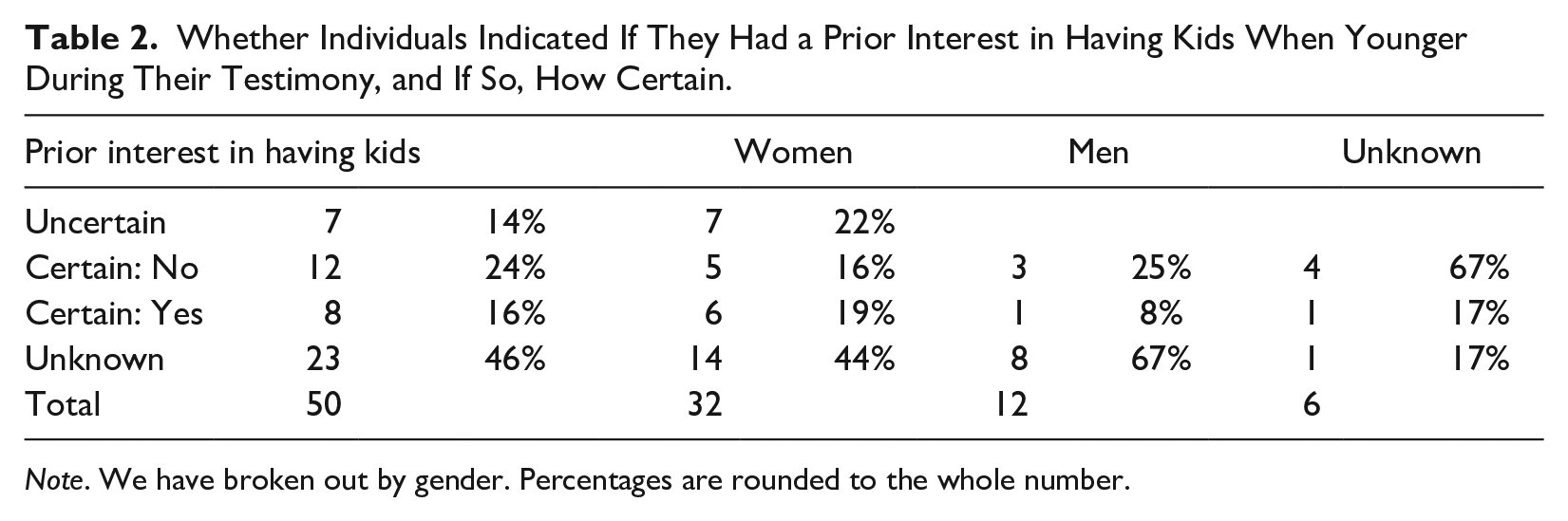
Note. We have broken out by gender. Percentages are rounded to the whole number.
Certainty of Decision at Time of Testimony, as Indicated by Whether the Codes “Certainty” and/or “Uncertainty” Were Present in an Individual’s Testimony.

Note. Completely uncertain meant only the uncertainty code was present. Mixed equally indicates both codes were present in equal frequencies. Mixed more certain indicates that while both codes were present, certainty was expressed in greater frequency. Completely certain meant only the certainty code was present. Neither expressed means neither code was present. Percentages are rounded to the whole number.
Slightly more individuals leaned toward certainty in their decision to not have children (46%), including 10% who had mixed feelings but leaned toward certainty and 36% who were completely certain. For example, Marya described how: “Facing facts of climate change, how close we are to two degrees, how uninhabitable the places where we grew up are going to be by the time we die, I think the decision to not reproduce has become an increasingly easy one.” Notably, all of those who gave testimonies later in life (over the age of 40) were certain.
On the other hand, 44% expressed only uncertainty in reflecting on their decision, with 50% of people under 40 remaining uncertain and women experiencing uncertainty more strongly than men. Despite expressing they are currently planning to not have children due to climate change, many individuals felt an ongoing inner conflict about their decision. For example, at the end of her testimony, Meghan admits that she is still “conflicted, I don’t know if I’m going to have children. I would like to.” Another individual, Jade, concluded her testimony close to tears by acknowledging that “I don’t know anymore if it’s a good thing for me to bring children into the world with the way it’s headed, or if it’s really kind of a selfish thing. So obviously that’s all personal questions, and I don’t have answers for anyone else and I still don’t have answers for myself.” This sense of uncertainty was exacerbated by how governments around the globe, especially the United States, will address climate risks in this next crucial decade. Julia from New York admitted that “I’ve been conflicted about having children . . . For my conceivable future, what would it mean for climate change if a large group of people decided not to reproduce? Would that equal change, or would it just spare the kids?”
Discussion
In their testimonies, individuals emphasized how they felt ethically responsible for future generations and endeavored to make reproductive decisions that they perceived as morally right amid the climate crisis, even though doing so often felt in conflict with their own personal desires. Fertility intentions were shaped by visions of future climate apocalypse as well as their own privilege and how this related to feelings of personal responsibility in contributing to global warming (however small compared to corporate and government actors). Many experienced social pressure and stigma from family, friends, and/or broader society, and spoke of the significance of finding supportive social groups who acknowledged that they were not alone in navigating these questions.
Coming to the decision to remain childfree was an intensely emotional process, characterized by conflicting feelings. While those providing testimony grappled with grief, anxiety, and anger, individuals also expressed feelings of love, hope, and joy as key motivations. This prevalence of positive emotions (amid pain) contributes to literature on reproductive decision making in the Anthropocene, which has largely focused on eco-anxiety and eco-grief. A majority of our sample hoped to channel the energy they would have given a future child into alternative forms of caregiving and/or activism. In these ways, those providing testimony are reformulating what it means to make ethical, loving choices in their private lives and their communities.
Our results challenge dominant narratives in the literature that identify key motivations as freedom from responsibility, as well as popular stereotypes of childfree individuals as being selfish, materialistic, or less nurturing. On the contrary, these individuals were motivated by profound empathy for others and a sense of responsibility and obligation to the collective well-being of all of humanity and the Earth. This emphasis on altruistic motives was the case for both men and women in our sample. For example, both genders used “feminized” discourses to explain their choice to not have children, such as discussing their desire to “save” their unborn children from the harms of future climate apocalypse or explicitly mentioning nurturing as a biological need. Such similarities between genders in their reasoning as well as their emotional experiences contradict prior studies. At the same time, we did observe some gender differences that align with prior research, including women’s greater discussion of stigma and greater emphasis on eco-anxiety, compared to men who expressed anger more frequently. In this way, gender roles still shaped how individuals’ complex emotional states were expressed, as well as what forms of alternative caregiving individuals emphasized (with men more likely to engage in conventional activism, and women a range of activities in public and private spheres).
While this paper is more about the psychological factors that shape reproductive decision making, it is clear that structural factors remain influential. Similar to prior research on voluntary childlessness, our sample is disproportionately white and middle- to upper-class given education levels disclosed by participants. In other words, those providing testimony are also those who are most likely to be childless according to literature. Disentangling which forces, the structural or the psychological, have causal power is a different task than the rich description we hope to present here. Regardless, this study illustrates that climate change is influencing some individuals’ fertility intentions and is becoming part of an acceptable vocabulary of motives to rationalize and explain decisions to not have children.
There are a number of limitations in this study. As previously noted, racial categorization was coded according to researcher perception, leaving room for error. Small subsample sizes made it impossible to determine statistical significance between ages or genders. There is also a degree of self-selection bias regarding who is more likely to give testimony that makes generalizations challenging. Unfortunately, there were also no testimonies from Southern states.
Regarding un/certainty, these testimonies represent a snapshot in time. Given our methodology, it is impossible to know if the participants remained childfree. Especially for younger populations, reproductive decisions are best understood as ongoing assessments about the state of the world, personal needs and desires, relationships with loved ones, and power structures that shape what “choices” are accessible to individuals. Since remaining childfree entails the use of some form of birth control for those who are sexually active, these decisions are made in healthcare contexts shaped by class privilege and are also gendered in ways that put more pressure and responsibility for the decision on women (Littlejohn 2021). Although we did not follow-up with any individuals who provided testimony, journalist Rainey (2019) spoke with Caitlin and Nathaniel Blair-Stahn, a couple who participated in a house party in Seattle, WA, in 2018. Interestingly, we included Nathaniel’s testimony in our sample (as someone clearly choosing not to have children) but Caitlin’s testimony was too unclear to make a determination, and was excluded. At the time of their testimonies, both cited their reservations about having kids due to the climate crisis; however, they later decided to have children.
Additional studies should investigate the impact of climate change on parents who may be having fewer children than desired and/or may be altering their parenting in other ways. There is also need for continued research into “the effect of this choice on the lives of other children, family, and communities” (Shapiro 2014:8). Echoing sociologists Blackstone and Stewart (2012:723), more research is needed on how reproductive decisions to remain childless are made across time as well as the emotional pathways that are part of that process. In addition, the reproductive experiences of non-white populations and those outside of North America in response to climate change remains underrepresented in the literature (Fu, Schneider-Mayerson, and Montefrio 2022).
The question remains whether individuals’ decisions to not have children are a form of everyday activism, “talk and action in everyday life that is not consciously coordinated with the actions of others but is (1) to some degree caused (inspired, encouraged) by a social movement and (2) consciously intended to change others’ ideas or behavior in directions advocated by the movement” (Mansbridge 2013:1). These activities often include lifestyle and consumption behaviors (Rodan and Mummery 2016). Because of stereotypes of the “ideal activist” and associations of activism with street protest (Boler et al. 2014; Craddock 2019; O’Shaughnessy and Huddart Kennedy 2010), intimate decisions like whether or not to have children are rarely considered when thinking about activism. However, the distinction between everyday activities and activism can be blurred. For example, research on the everyday activism of feminist mothers has shown that their activities influenced how their daughters came to adopt a feminist consciousness and subsequently sought social change (Stephenson-Abetz 2012).
In our study, some individuals who provided testimonies expressed that they had participated in direct actions including for climate justice. However, participants never spoke directly about their reproductive choice being a form of activism, or as part of a coordinated campaign. This is distinct from networks like the BirthStrike movement who engaged in a form of intentional, “existential” activism by pledging to remain childfree until action is taken to address climate change (McMullen and Dow 2022). The lack of testimonies that frame reproductive choices as activism in our data set is not random, given that the co-founders of Conceivable Future feel that reproductive decisions are not an activist choice, even if they have political consequences. Their approach has allowed the organization to avoid the contention and harassment directed at other campaigns like BirthStrike, which disbanded in 2020 amid concerns about associations with eugenicist and racist messaging by those outside the movement and sometimes within, despite the efforts of organizers to prevent it (Wray 2020).
Organizers with Conceivable Future do not promote specific action items at house parties other than to encourage attendees to share their story. This can mean sharing it publicly through their website, but they also encourage sharing with people who the individual knows as a way to express what the decision means to them and with the hope of opening up conversations about the topic with those who are supposed to love and care for them. Ultimately, doing so can be a therapeutic process, providing a confessional space where people can work through their emotions together, in solidarity.
Footnotes
Acknowledgements
We would like to thank Josephine Ferorelli and Conceivable Future for their support and feedback during this project.
Data Availability
The data underlying this article will be shared on reasonable request to the corresponding author.
Declaration of Conflicting Interests
The author(s) declared no potential conflicts of interest with respect to the research, authorship, and/or publication of this article.
Funding
The author(s) received no financial support for the research, authorship, and/or publication of this article.
