







Abstract
Do Americans conceive of race categorically, continuously, or both? This question matters because redressing racial inequality hinges on understanding the racial schemas embedded in minds and social institutions. Drawing on a survey of over 1,000 respondents, I find significant contradiction, ambivalence, and flexibility in conceptions of membership as a yes/no binary (one is or is not part of a racial group) and as a continuum (people are members to greater or lesser degrees). Findings include (1) In the abstract, most respondents reject the idea that race can be continuous or partial. But given concrete scenarios, most people regard racial membership as a continuum; (2) Race shapes race concepts. Black respondents are especially skeptical of a continuous conception of race when given an abstract prompt, but Blacks and all other groups of color are more inclined than Whites to think of racial membership as a continuum in concrete scenarios. Further, Black, Hispanic, and multiracial respondents differ in which dimensions of race they see as continuous; (3) Younger respondents use a continuous lens more; (4) Very conservative and very liberal Americans use a categorical lens more. I consider roots and implications.
Introduction
“All models are wrong—but some models are useful.”—George Box
1
Is “race” best conceived of as a category or a continuum—or both? The American public, American law, and most social science typically cast racial group membership as categorical. For instance, even a US-born, light-skinned, native English-speaking American of Hispanic ancestry might face discrimination due to their categorical ethnoracial status. This person would be entitled to civil rights protections, might be eligible for affirmative action, and is likely grouped in with many foreign-born, darker-skinned, nonnative English-speaker Hispanic and Latino individuals in studies that measure discrimination. 2 In this conception of race, variation in skin tone or cultural cues is unimportant; one either is or is not a member of a racial group.
Yet Americans sometimes understand race as continuous rather than categorical (Monk 2022). Individuals whose appearance, acculturation, name, native language, or socioeconomic status are atypical of their group, or whose ancestry is mixed, may be seen as partial, context-specific, or peripheral group members. Colloquial claims that individuals are “so White,” “not very Asian,” “Blacker (or less Black) than” someone else all imply gradations of racial belonging (Buggs 2017; Harris and Khanna 2010; Iyer 2020). Research on colorism likewise finds that within-race economic inequality and health disparities by skin color match or exceed between-races inequality, suggesting that racialization plays out on a spectrum within categories rather than only categorically (Hochschild and Weaver 2007; Monk 2021).
This study therefore builds on recent research on racial conceptualization and attribution by inquiring into views on degrees of race—that is, under what conditions Americans see racial group membership as categorical and absolute, versus when and how they see membership as partial, continuous, or a question of degrees. I draw on a nationally representative survey of 1,102 respondents and find significant contradiction, ambivalence, and flexibility in conceptions of race as categorical or continuous. I identify four main patterns.
First, in the abstract, most respondents reject the idea that race can be continuous or partial, but given concrete scenarios, most regard racial membership as a continuum. Second, respondents’ race shapes their race concepts. Black respondents reject gradational conceptions of race more than any other racial group when given an abstract prompt, but Black, Hispanic, and Latino, and multiracial respondents are all more supportive of the continuum idea than Whites when responding to concrete scenarios, though they focus on different dimensions. Black respondents deploy continuous race concepts most often when scenarios address external judgments, while Hispanic and Latino Americans are especially likely to see culture and self-identification as continuums. Third, younger respondents more readily use a continuous lens. Last, very conservative and very liberal Americans unite in seeing race as categorical more than all other groups. Together, these findings demonstrate that gradational race concepts are both widespread and patterned, with significant variation across contexts, dimensions of race, and social groups.
Racial Conceptualization after the Binary Era
For most of the 20th century, the U.S. racial system was dominated by a White/Black binary, with earlier debates about the boundary’s location fading in prominence and questions about other groups pushed to the margins due to their limited size (Davis 2001; Monk 2022). But the last four decades have seen a rise in American racial diversity and recognition of complexity, with growth concentrated among mixed-race, Hispanic and Latino, Asian, and Middle Eastern and North African (MENA) populations. Not only do these identities challenge placement schemes that rely solely on the White/Black binary; these individuals’ ancestries, appearance cues, cultural upbringing, socioeconomic backgrounds, and self-identifications do not always align in predictable ways.
In part due to this increased diversity and in part due to rising emphasis on self-determination of identity in Western societies broadly (Brubaker 2016), warrants for claiming racial identities, ascribing them to others, and making claims about what groups or categories meaningfully exist have proliferated (Ghoshal 2025b; Morning 2018; Rich 2014; Roth 2016). These definitional processes are consequential because their outcomes unlock experiences of privilege or oppression, determine eligibility for antidiscrimination remedies, and shape how individuals understand themselves and others as members or outsiders of social worlds. In the last two decades, a sociological literature on what Americans think race is (racial conceptualization) and how they ascribe race to others (racial appraisals) has begun to take shape. This literature has productively examined topics including what racial groups people believe exist and how they are imagined to differ; discrepancies between abstract and context-specific conceptions of “race”; context cues that affect racial perceptions; how Americans resolve conflicting racial cues; and (mis)match between self-identification, others’ perceptions, and formal classification, among others (Abascal 2020; Croll and Gerteis 2019; Ghoshal 2019; Gil-White 2001; Gómez 2022; Lee and Ramakrishnan 2020; Maghbouleh, Schachter, and Flores 2022; Mora 2014; Tawa 2018; Vargas and Kingsbury 2016).
Two patterns are especially relevant for the present study. First, race is consistently shown to be multidimensional, with classification drawing on multiple, sometimes competing dimensions such as phenotype, ancestry, culture, and self-identification (Morning 2018; Roth 2016; Schacter et al. 2021; Schmotter 2026). Second, racial classification is context-dependent, such that which dimensions matter, and how they are interpreted vary across interactional settings (Abascal et al. 2025b; Morning 2009; Saperstein and Penner 2012). These findings highlight flexibility in how racial group membership is defined and applied.
Racial Membership as Categorical—and Continuous
While this research has enhanced our understanding of racial conceptualization and appraisals, it has nearly always taken placement into a group as the core noteworthy form of classification. This seemingly unremarkable assumption—that classification of people as members of a group (or occasionally, more than one group) and not as members of others is the sine qua non of racial appraisal and conceptualization—is in fact quite significant, as I argue more fully below. What is noteworthy for now is that these studies have typically relied on a nominal logic—there are a series of groups, and the question is whether a person is or is not a group member.
This yes/no way of thinking about racial group membership is entrenched in American law, organizational practices, and social science. Laws around civil rights and affirmative action largely regard individuals as either members or nonmembers of a racial group; legally, one cannot be “sort of” Asian American or “White, but less White” than someone else. The infamous “one drop rule” arose as a solution to questions of nuance in defining Blackness, and multiracial individuals may be legally considered members of multiple groups, but lawsuits alleging within-category discrimination by skin tone and degree of ancestry have struggled on the grounds that all members of a racial category ostensibly hold all relevant traits of that group equally, making within-race racial discrimination legally impossible (Rich 2014). Similarly, social science research on racial inequality typically assigns individuals to racial categories but rarely inquires whether these members’ within-group typicality varies enough to call into question the practice of “binning” them together as holding that categorical status equally (Monk 2022). Though intersectional approaches have sometimes sought to address this problem, they have usually done so by adding additional variables such as gender, class, or nativity (Crenshaw 1989; Gaddis and Ghoshal 2020; Kim and Sakamoto 2010), effectively multiplying categories rather than adopting a continuous model for how racialization “itself” unfolds. These legal and social science practices likely persist in part because they reflect racial “common sense”: especially in formal contexts, Americans often think and act as if they and others simply either are, or are not, members of racial groups.
Yet beneath the surface lurks another conceptualization of racial group membership as continuous, not crisp. Multiracial people are sometimes described as “half” or “partial” or “not full” members of a racial group (DaCosta 2007). A continuous race concept also frequently seems to underlie discourses on cultural dimensions of race: claims that someone is “not very Asian,” “so White,” “Whiter than” (someone else), “a White White girl,” a “Twinkie,” an “Oreo,” or an “ABCD” (American-born confused Desi) are used to suggest a within-race stratification of belonging. In the 2023 thriller-comedy film The Blackening, the antagonist tells the all-Black lead cast that he will let all but one of them live if they sacrifice their “Blackest” member, leaving the meaning undefined yet clearly invoking a continuous concept that triggers a heated debate. Various characters deny that they can be the “Blackest” by pointing to their geographical origins, ancestry, romantic relationships, habits, and voting histories (though when one mentions having voted for Donald Trump, the others drop the debate and sacrifice him). Popular writer Robin DiAngelo, author of White Fragility and Nice Racism, likewise suggests that White Americans can strive to be “less white” when discussing race by reducing their arrogance and defensiveness, for example, there are behavioral elements of race that she sees as continuums (DiAngelo 2023).
Social science research also finds significant impacts of appearance typicality and/or stereotypicality on discrimination, health, wealth, and well-being. This research implies various mechanisms, including others’ de facto use of continuous racial concepts. For instance, juries are harsher toward defendants who they take to be “very Black” based on appearance cues (Eberhardt et al. 2006), while people whose racial identity and physical appearance seem discordant may face discrimination or exclusion by other group members (Campbell and Troyer 2007; Gaither 2015; Hochschild and Weaver 2007; Kurzman et al. 2014; Monk 2022). Moreover, some studies document intraracial boundary-making and authenticity judgments based on culture, behavior, or background (DaCosta 2007; Khanna 2012; Warikoo 2011). But very few studies have explicitly considered how common it is for people to think about or experience racial group membership as a continuum, nor what factors might lead people to deploy continuous rather than categorical approaches. Most notably, psychologist Lee’s (2009) survey prompted respondents to divide up 10 “identity points” among racial category options to describe their identities. A quarter of his respondents allocated at least one point to multiple groups (far more than the 3% who had volunteered a multiracial identity in an earlier, more standard race question), suggestive of a partial or continuous conception of race among some respondents (see also Patten 2015). In sociology, Aliya Saperstein and Andrew Penner (e.g., 2012) have argued that racial fluidity in response to events like job loss is suggestive of varying underlying propensities to classify oneself and be classified as part of different groups, which may be consistent with a continuous race concept, while Monk (2022) has argued that the theoretical grounds for investigating the continuum concept more deeply are strong. But despite suggestive evidence that a continuous schema for racial group membership may be nearly as embedded in Americans’ racial “common sense” as a categorical one, few others have taken up this call.
Research Questions
Given the complexities of these different lenses and bearing in mind Morning’s (2009:1185) argument that “racial concepts are extremely situational,” I first ask descriptively whether Americans conceptualize people’s racial group membership as categorical or as a matter of degrees. I also examine whether this propensity shifts between an abstract prompt and concrete examples; assess consistency across respondents; and consider which dimensions of race are most often seen as continuous.
I then examine factors that influence people’s tendency to treat race as categorical, continuous, or both, beginning with respondents’ race. Black Americans’ racialization was influenced for a century by the one-drop rule that prescribed ostensibly equal membership in the Black category to those with any traceable African ancestry (Davis 2001; Monk 2022). An inclusive standard of Black identity persists in U.S. civil rights law, Black civil society institutions, and informal practice; the rule’s legacies may therefore distinctively inform Black conceptualizations of race (Khanna 2010; Roth 2005). Black, Hispanic, and multiracial Americans broadly may further be more likely than Whites to have experienced within-racial category variation in treatment based on skin tone, nativity status, ancestry share, or language proficiency; to have engaged in discussions about racial belonging with mixed-race or racially ambiguous family and friends; and to have encountered cultural discourses that imply partial group membership is possible.
I also consider age cohort. Younger cohorts came of age during a period of increasing racial diversity and multiracial visibility, in a formally “colorblind” era with speech norms that discourage racetalk that could offend others (Bonilla-Silva 2006; DeSante and Watts 2020). Further, for Americans born in the 1990s and later, Barack Obama’s 2007–2008 rise to fame and the accompanying national discussion of multiraciality occurred before or during the adolescent and early-adult “critical period” in which political and social schemas often crystallize (Corning and Schuman 2020; Mannheim [1928] 1952). For this group, the idea that a person can be of a race and yet not “fully” of that race has been commonsensical for their entire adult lives, possibly shaping their racial concepts in distinctive ways.
Finally, political ideology may shape how people conceptualize race. Research on “old-fashioned racism” (Schuman et al. 1997; Tesler 2013) suggests that some political conservatives view race as a fixed biological category rather than as a construct that might vary by degrees based on social appraisals, culture, or other dimensions. However, some self-identified anti-racists see any conception of race that highlights intragroup variation as likely to dilute group strength and therefore dangerous (DaCosta 2007; Harris and Khanna 2010; Hochschild and Weaver 2007). I therefore examine how political ideology affects views of racial group membership as a continuum or set of categories.
Data and Methods
To test these possibilities, I contracted with Lucid, a major national sample provider, to conduct a survey of Americans’ views on race-related topics in 2019. The survey was conducted online, a format that may reduce some forms of social desirability bias surrounding sensitive racial questions. The sample was constructed to be representative of English-speaking American adults by race, gender, age, and region. Lucid draws on multiple panels and routes pre-profiled panelists to studies through APIs, and uses respondents’ stored demographics such as age, sex, race/ethnicity, and region to fill eligibility and quota targets. Because recruitment occurs across many upstream sources (rather than a single sampling frame) and surveys were accepted only for those who answered all questions, a standard American Association for Public Opinion Research response rate is not defined (Cint 2023). The final sample included 1,102 respondents. The survey included mostly closed-ended questions addressing respondents’ views on race and racism, a few open-ended questions, and demographic items. The survey was approved by my university’s Institutional Review Board (Elon University IRB #19-135). The Appendix presents additional information on the survey and sample.
Dependent Variables
The first dependent variable tracks responses to a question which framed the question of whether degrees of race exist abstractly, for example, without mentioning specific cues or situations: “Which statement best captures your opinion? (a) Every member of a race is equally part of that race. There are NOT degrees of belonging to a race; or (b) Someone can be part of a race more than someone else of that race. There ARE degrees of belonging to a race; or (c) I’m not sure.” This question aimed to engage respondents’ abstract and formal conceptions of racial membership.
The second dependent variable is a binary based on a more concrete question that gave respondents cues to think with; this variable seeks to simulate thinking about racial group membership in specific situations that involve comparison. This question read, “Imagine two people in the US who are FROM THE SAME RACE. Which, if any, of these factors might lead you to consider Person 1 to be more part of that race than Person 2—e.g. ‘whiter than’, ‘blacker than’, etc.? Check all that apply.” A list of seven cues plus an eighth choice, “NONE OF THESE—Everyone in a racial group is equally part of that group,” followed. The choices appeared in randomized order except that the “none of these” option was always last. The options were: “If Person 1 has a greater share of their ancestry from people of that race”; “If Person 1 self-identifies with that race more strongly”; “If Person 1 had a more typical cultural upbringing or socioeconomic background of that race”; “If Person 1 is more physically identifiable as part of that race”; “If people of that race consider Person 1 to be more of that race”; “If Person 1 is more genetically typical of people of that race”; and “If people in general consider Person 1 to be more of that race.” Respondents could check as many options as they wished. The dichotomous dependent variable compares those who chose only “none of these” to those who chose at least one factor as potentially continuous. In follow-up analyses, I consider each of the seven factors independently.
Independent and Control Variables
The first independent variable is the respondent’s own race, drawn from a question that asked respondents to “please mark which racial group or groups below you belong to. You can check multiple options if needed.” The options listed were White, Hispanic or Latina/o, Black or African American, Asian, American Indian/Native American (Cherokee, etc.), and Other: _________. Hispanic or Latina/o was included here alongside the other race categories (rather than in a separate ethnicity question) to reflect the reality that most Hispanic and Latino people have long regarded the Hispanic/Latino category as de facto parallel to a racial designation, even prior to the U.S. federal government’s 2024 update to its official racial categories (Gómez 2022; Telles 2018; Wang 2024). Recoding yielded seven initial mutually exclusive groups: White alone (n = 716, 65.0%), Black alone (113, 10.3%), Asian alone (34, 3.1%), Native American alone (11, 1.0%), Hispanic or Latino (115, 10.4%), Other alone (13, 1.2%), or multiracial non-Hispanic (100, 9.1%). Though Whites are slightly over-represented relative to Americans in general, the sample was strongly representative of the target population due to the restriction to adults as of 2019 and to English-speakers (see Appendix). All 1,102 respondents are included in the descriptive analyses. In regression analyses I remove the three groups with small sample sizes, retaining only the White alone, Black alone, Hispanic or Latino, and multiracial categories (n = 1,044). While the multiracial category encompasses significant variation, I include it to test whether shared experiences of liminality may influence understandings of racial group membership in consistent ways (DaCosta 2007:125–46; Gaither 2015:114–16).
I also include respondents’ age and political ideology in regressions. I tested a standard numeric age term along with age grouped into 10-year categories and quartiles as initial parsimonious ways to examine possible cohort patterning. I also examined the youngest quartile against the three older groups combined to consider the possibility of an “Obama effect” concentrated among respondents who were still in their teens or younger when Obama rocketed to fame; follow-up analyses described in a footnote test the parameters of this effect. Ideology is derived from the question “Which of the following best describes your political views?” with options of “very conservative,” “slightly conservative,” “moderate or centrist,” “slightly liberal,” “very liberal,” “I don’t know,” and “none.” I collapsed the two options for denying political views (“I don’t know” and “none”) together given their similar logics and because few respondents chose “I don’t know” (see Table A1). I examine the resulting variable in several different ways, including using separate dummies for each of the six categories, treating it as a scale (with the moderates, don’t knows, and nones combined as a middle group); and contrasting the extremes against all other categories.
Finally, I include gender and education as controls. Since only two respondents indicated a gender other than man or woman, I collapsed gender into women versus all others. Education is a five-point scale.
Modeling Strategy
I conducted all analyses in Stata 14.2. Because the first outcome has three nominal categories, I present multinomial logit models in the main text. I also tested ordinal models, which yield substantively similar results and are reported in Supplemental Table S1. The second outcome and each of its components are binary, so I used standard logistic regression models.
Findings
Descriptive Findings
I find significant ambivalence and flexibility in respondents’ conceptualization of race as a category, a continuum, or both. Given an abstract prompt, respondents are about twice as likely to deny conceiving of race as a matter of degrees than to indicate they do so (Figure 1). But given concrete examples, a slight majority of respondents deploy a continuous conception of race in which one person can be “more part of” a race than someone else (Figure 2). Only slightly more than two-fifths of respondents hold consistently to either a purely categorical or purely continuous race concept across the outcomes; nearly three-fifths display ambivalence, flexibility, or contradiction in their racial conceptualization (Figure 3).
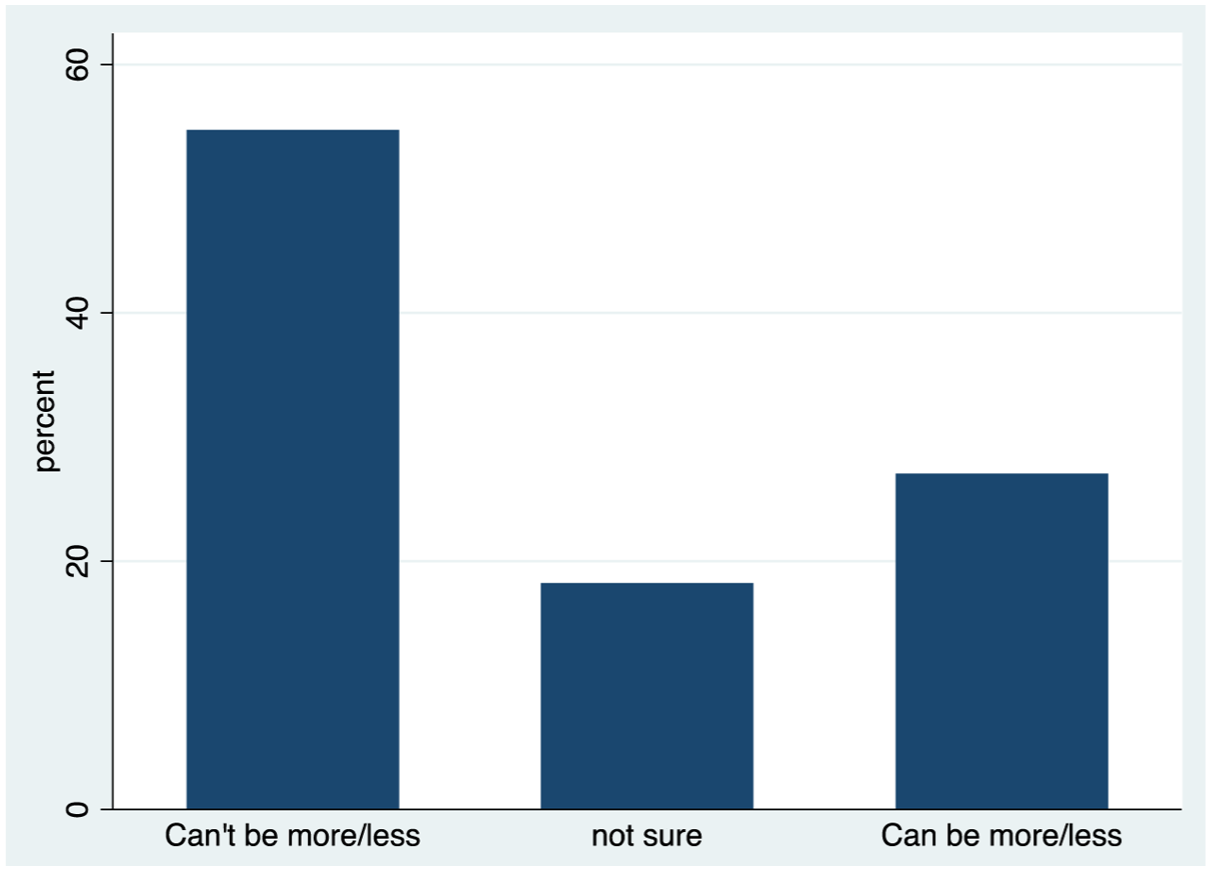
Degrees of race concept, abstract prompt: majority rejects.
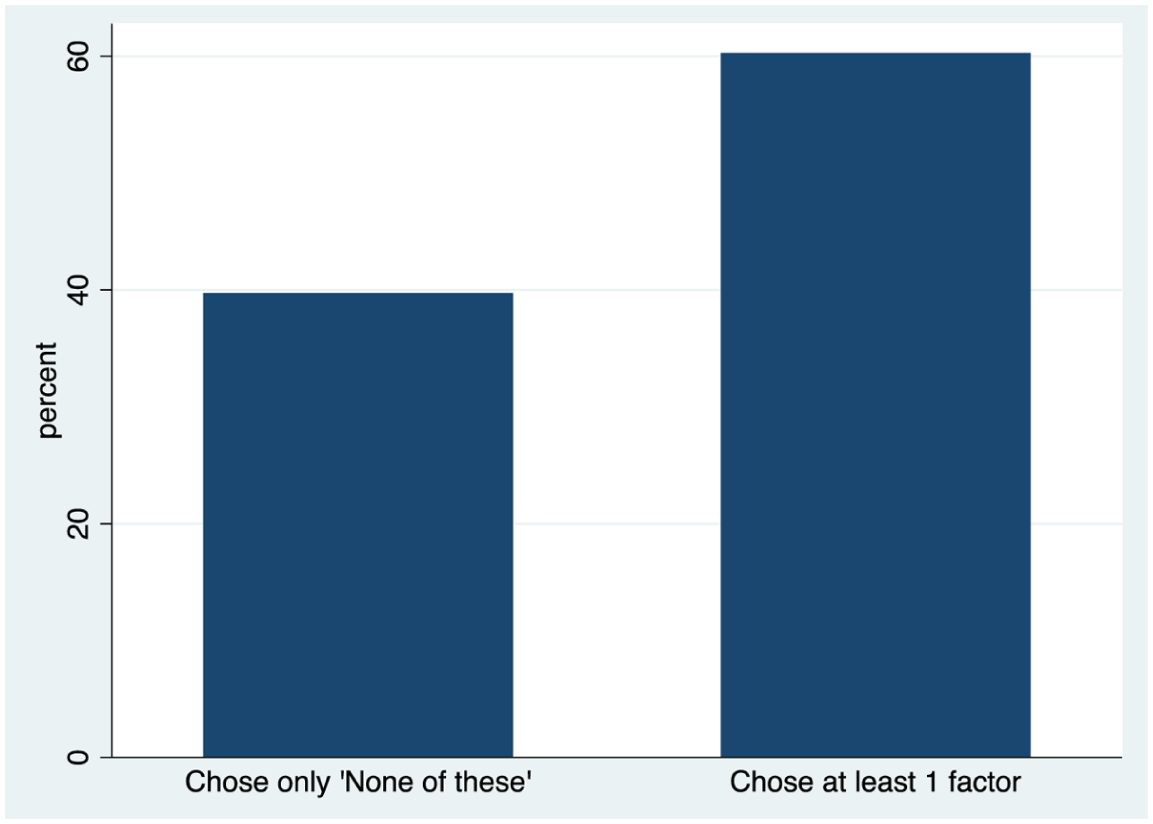
Degrees of race concept, concrete scenarios: majority accepts.
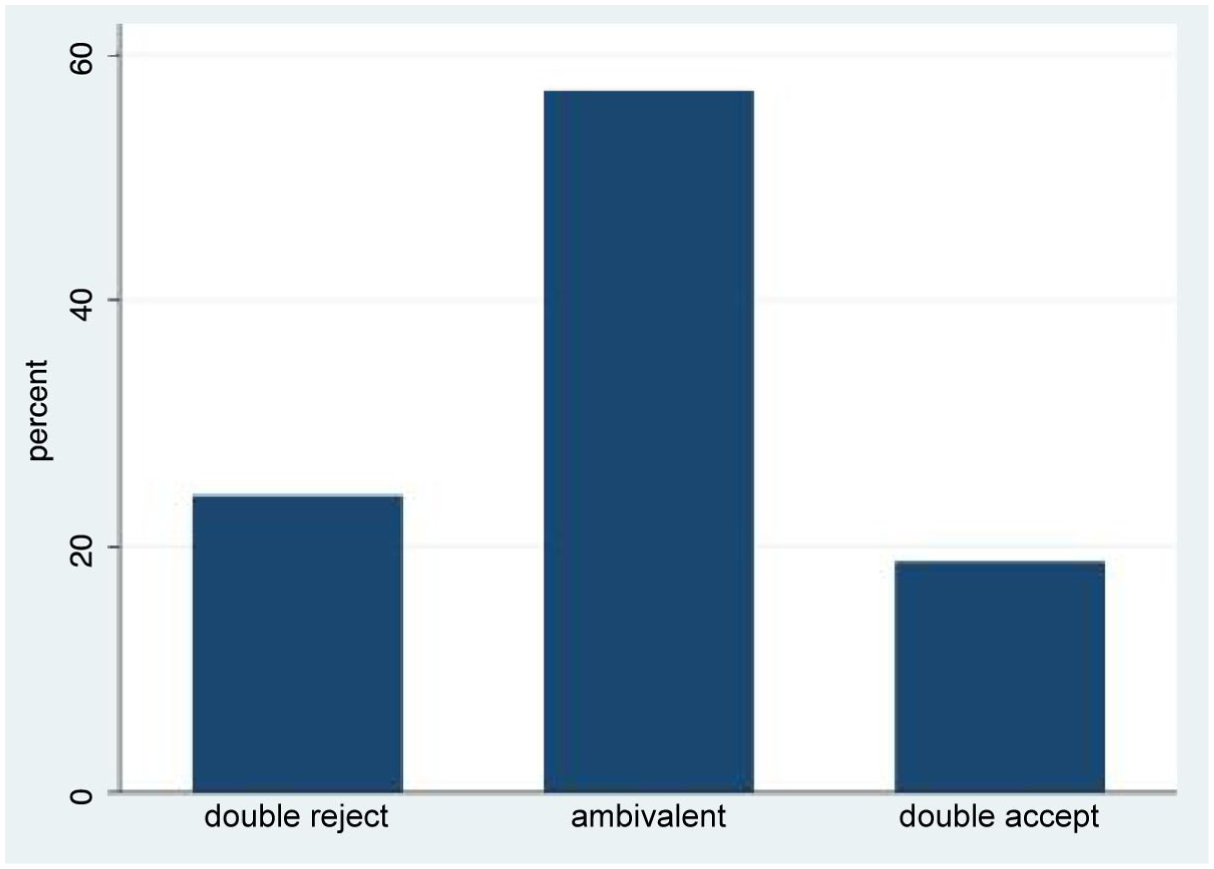
Aggregated dependent variable: most people both accept and reject the degrees of race concept.
Patterns also emerge in which specific factors different groups see as continuous or categorical. As Figure 4 shows, the dimensions of race that trigger continuous lenses are varied. The mean respondent chose 1.7 different factors (other than “none of these”) that could yield variation in degree of membership; that mean rises to 2.8 when those who selected none are excluded. Notably, the factor openly raised most often in formal discussions of partiality—that is, degree of ancestry—falls only in the middle. Variations in strength of self-identification, cultural and socioeconomic upbringing, and within-group appraisals are somewhat more likely to trigger continuous understandings of race, while differences in genetic typicality, broad external appraisals, and appearance are less likely to do so, though most differences are modest. Overall, the pattern differs substantially from the hierarchy of cues that Americans use to appraise race generally (Abascal et al. 2025a; Ghoshal 2025a; Schacter et al. 2021), revealing that respondents took the continuum part of the prompt seriously rather than simply flagging the factors they see as core elements of “race.”
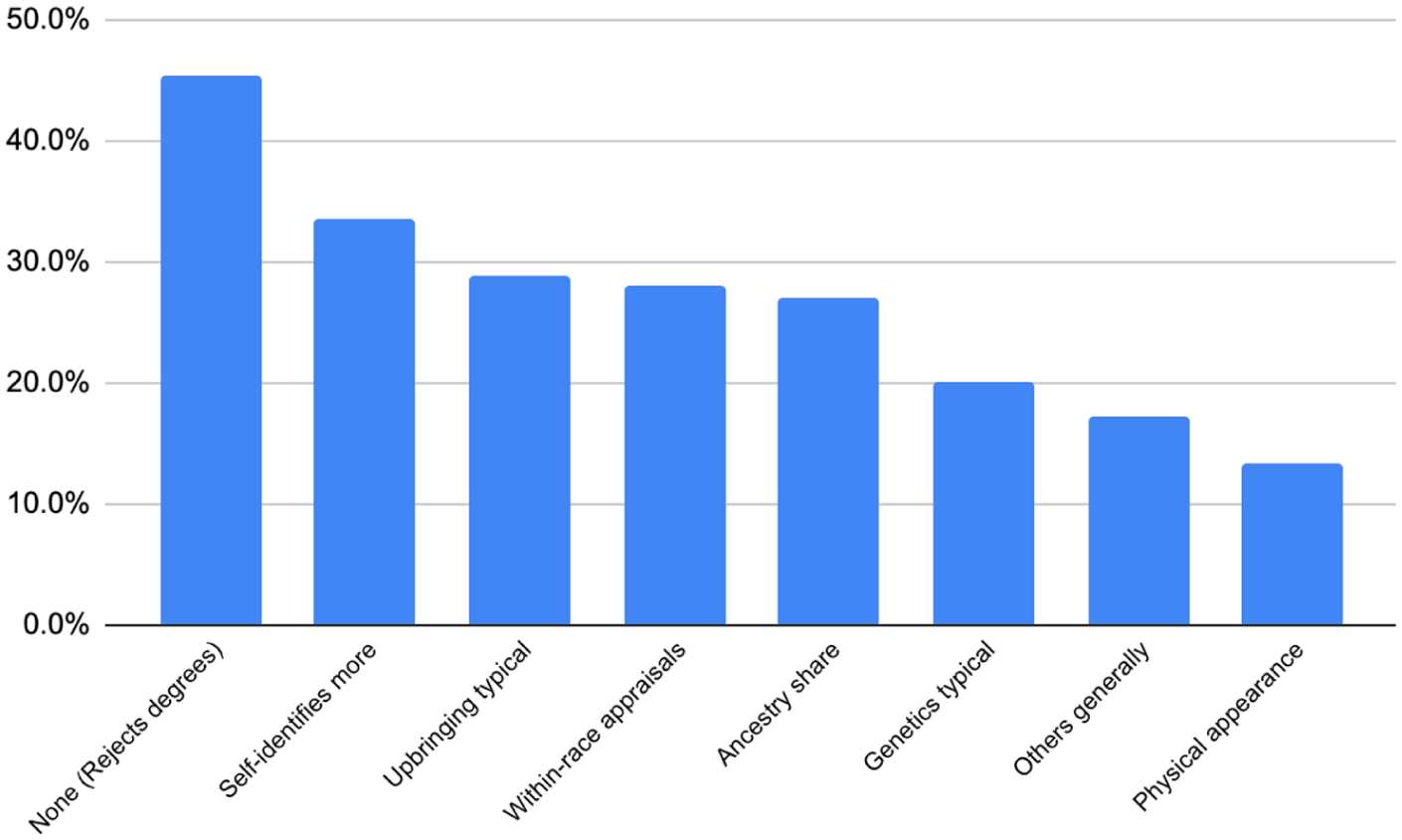
Factors respondents consider as continua for group membership (n = 1,102).
Abstract Rejection of Degrees of Race
I then conducted explanatory analyses. I first tested what factors are associated with abstractly agreeing that someone can be more “part of a race” than someone else (and rejecting the idea that “all members of a race are equally part of that race”). Table 1 presents the findings from multinomial logistic regressions. In Table 1 bivariate analyses, Black respondents are especially likely to reject the abstract idea of racial group membership as a continuum, while women are less rejecting than men. The gender difference is driven mostly by the “unsure” option, a finding consistent with research on how gender relates to expressions of certainty (Mondak and Anderson 2004). Though “slightly liberal” respondents see race as a continuum more than “very liberal” ones, and those who deny holding political views are especially likely to be unsure, the most intriguing differences are at the extremes: “very liberal” and “very conservative” respondents stand out in their greater rejection of the degrees concept, relative to being uncertain. These patterns persist across the multivariate models. Further testing revealed that Black respondents’ abstract views on race as categorical or continuous differ not only from Whites but also from Hispanics (always at p < .05, not shown) on the agree/reject contrast, but not the not sure/reject contrast, across the models. The Black/multiracial and Hispanic/multiracial contrasts are not significant, nor is education. Age is similarly insignificant regardless of whether it is considered as a linear term, in decades, or in quartiles; I show only the linear version here to conserve space. 3
Agreement with Degrees of Race Concept in Abstract Framing, Multinomial Logits (Odds Ratios; n = 1,044).
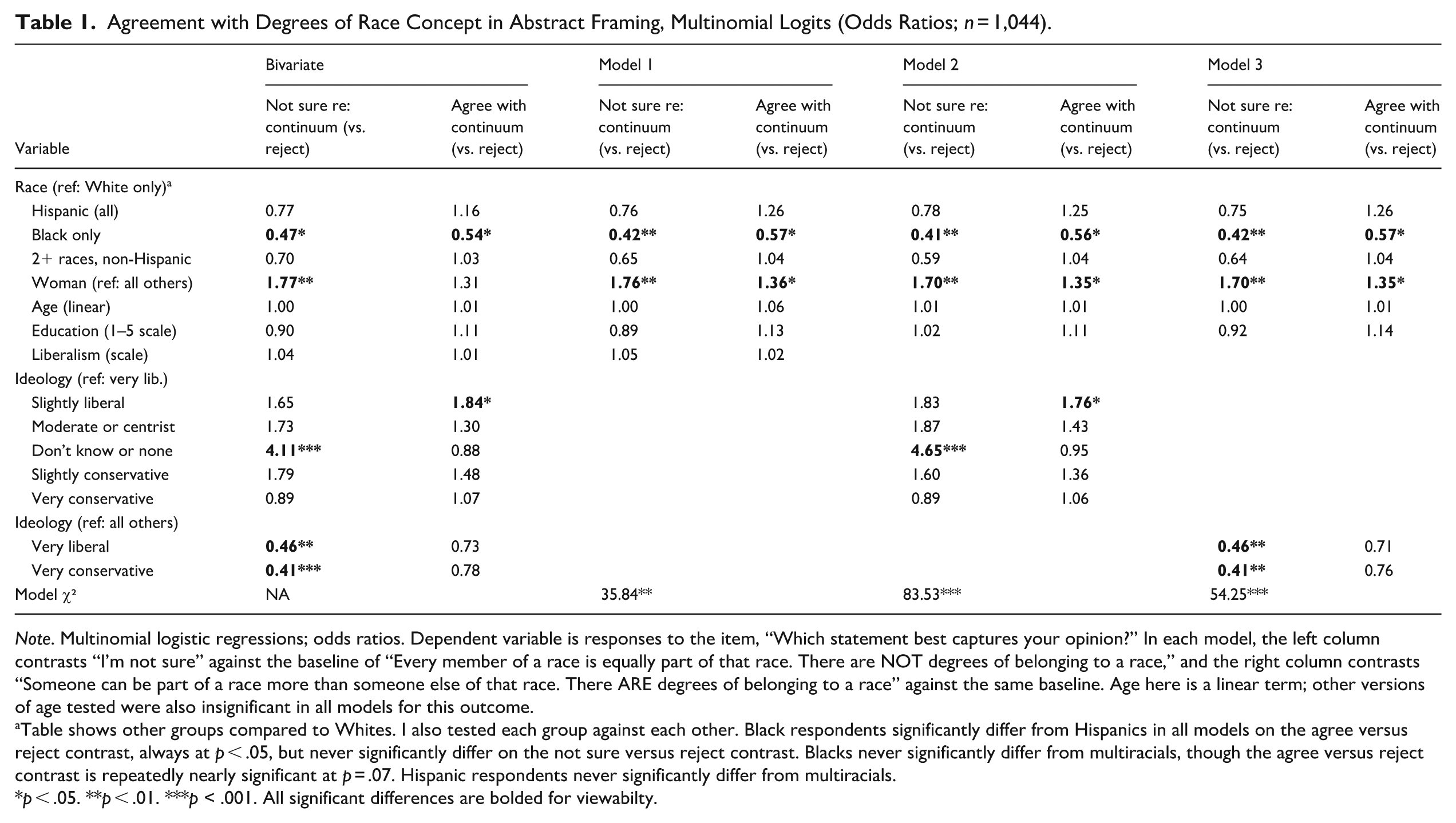
Note. Multinomial logistic regressions; odds ratios. Dependent variable is responses to the item, “Which statement best captures your opinion?” In each model, the left column contrasts “I’m not sure” against the baseline of “Every member of a race is equally part of that race. There are NOT degrees of belonging to a race,” and the right column contrasts “Someone can be part of a race more than someone else of that race. There ARE degrees of belonging to a race” against the same baseline. Age here is a linear term; other versions of age tested were also insignificant in all models for this outcome.
Table shows other groups compared to Whites. I also tested each group against each other. Black respondents significantly differ from Hispanics in all models on the agree versus reject contrast, always at p < .05, but never significantly differ on the not sure versus reject contrast. Blacks never significantly differ from multiracials, though the agree versus reject contrast is repeatedly nearly significant at p = .07. Hispanic respondents never significantly differ from multiracials.
p < .05. **p < .01. ***p < .001. All significant differences are bolded for viewabilty.
Concrete Use of a Continuous Concept of Race
Abstract acceptance or rejection of a concept may be only loosely related to the propensity to use that idea under more concrete circumstances. I therefore test what factors might lead respondents to agree that various qualities can make a person “more part of [a] race” than someone else of the same race. Table 2 presents bivariate associations and then logistic regressions in which choosing at least one factor as grounds for greater membership is contrasted against fully rejecting the idea of degrees. In these analyses, Black, Hispanic, and Latino, and multiracial respondents are all significantly more likely than White respondents to select at least one factor that can make an individual more or less part of a race. These racial patterns endure in the presence of various controls, as shown in columns 2 through 6. By contrast, groups of color never significantly differ from each other on this outcome (not shown), though Hispanics are consistently the most likely to employ a continuous race concept.
Used Degrees of Race Concept at Least Once, Given Examples (Odds Ratios; n = 1,044).
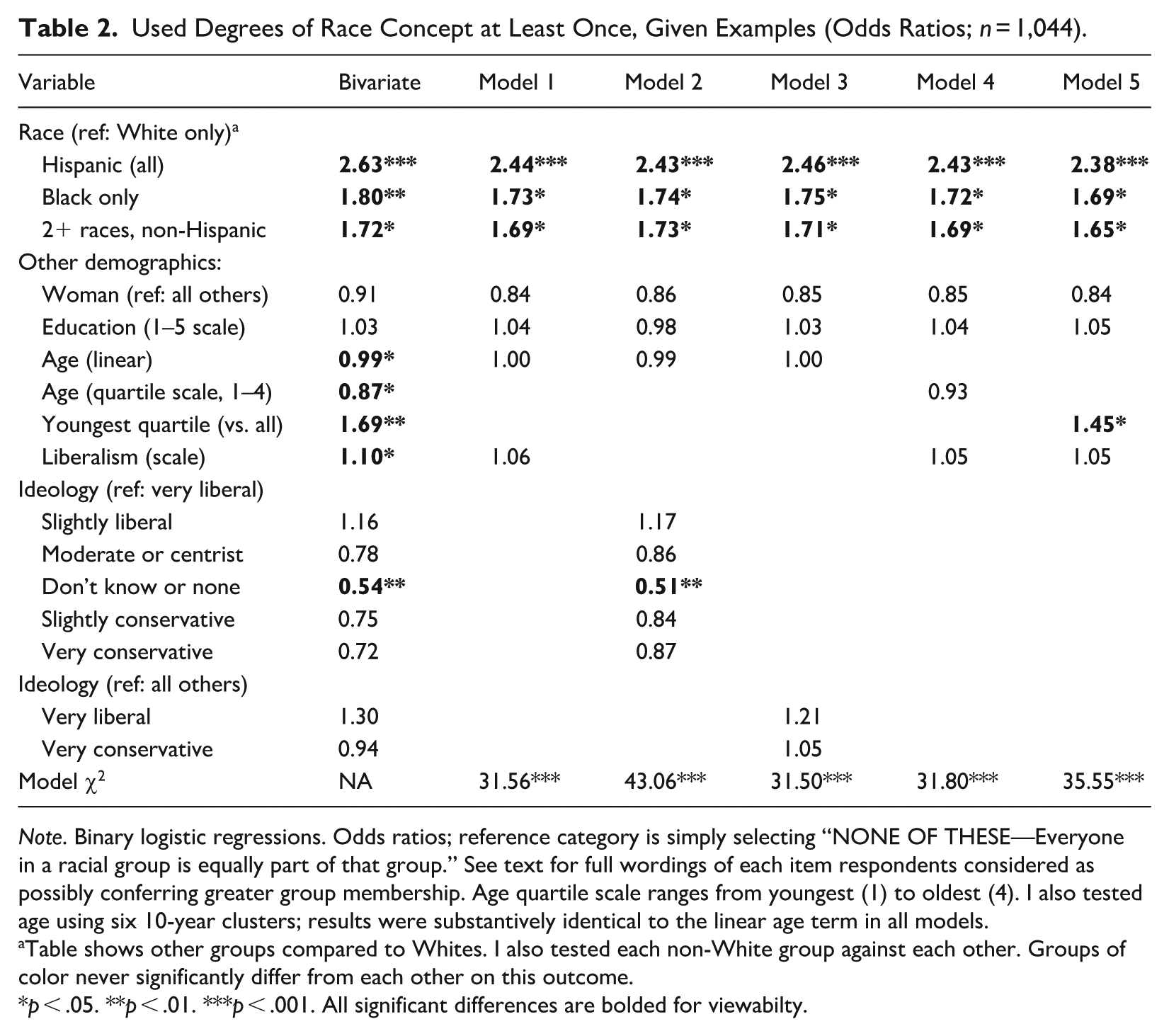
Note. Binary logistic regressions. Odds ratios; reference category is simply selecting “NONE OF THESE—Everyone in a racial group is equally part of that group.” See text for full wordings of each item respondents considered as possibly conferring greater group membership. Age quartile scale ranges from youngest (1) to oldest (4). I also tested age using six 10-year clusters; results were substantively identical to the linear age term in all models.
Table shows other groups compared to Whites. I also tested each non-White group against each other. Groups of color never significantly differ from each other on this outcome.
p < .05. **p < .01. ***p < .001. All significant differences are bolded for viewabilty.
There is also a striking pattern by age. Linear, 10-year cluster, and quartile-based versions of the age term all are significant in bivariate analyses, but this pattern persists in multivariate models only for the version of age that contrasts the bottom age quartile against all older respondents (Model 5). This suggests that the relationship is driven primarily by the youngest cohort rather than reflecting a broader linear age gradient. Indeed, the percentage of respondents ever using a continuous race concept was nearly identical across the three older groups (56%, 59%, and 57%) while significantly higher for the youngest (70%, differences significant at p = .01 or p < .01 for all three contrasts). Year-by-year examination further confirmed this pattern. For instance, within every single 1 of the 13 (100%) represented ages from 18 to 30, over three-fifths of respondents selected at least one factor that could make someone more part of a race than another same-race person, but the same was true for only 16 of the 52 (31%) represented ages over 30. 4
In terms of other variables, those who deny specific political views (the “don’t know” and “none” respondents) deploy the continuum idea less than others, while other ideology terms are insignificant across different specifications. Gender and education are never significant.
Factors Seen as Continuous and Categorical
I next consider each component separately. Table 3 presents logistic regressions of each of the seven items. Apart from the far right “none” column, items are sorted with factors influenced by the respondent and those close to them (self-identification, upbringing, and views of same-race others) on the left side and factors outside of individual or in-group control (societal views generally, physical identifiability, and genetic typicality) on the right side, with ancestry in between since the ancestry item did not specific genetic or cultural ancestry (see Huang 2023). Respondent race shapes the outcomes here in five of the seven models, while effects of other variables are scattered.
Predictors of Seeing Specific Factors as Continuous: Logistic Regressions (n = 1,044).
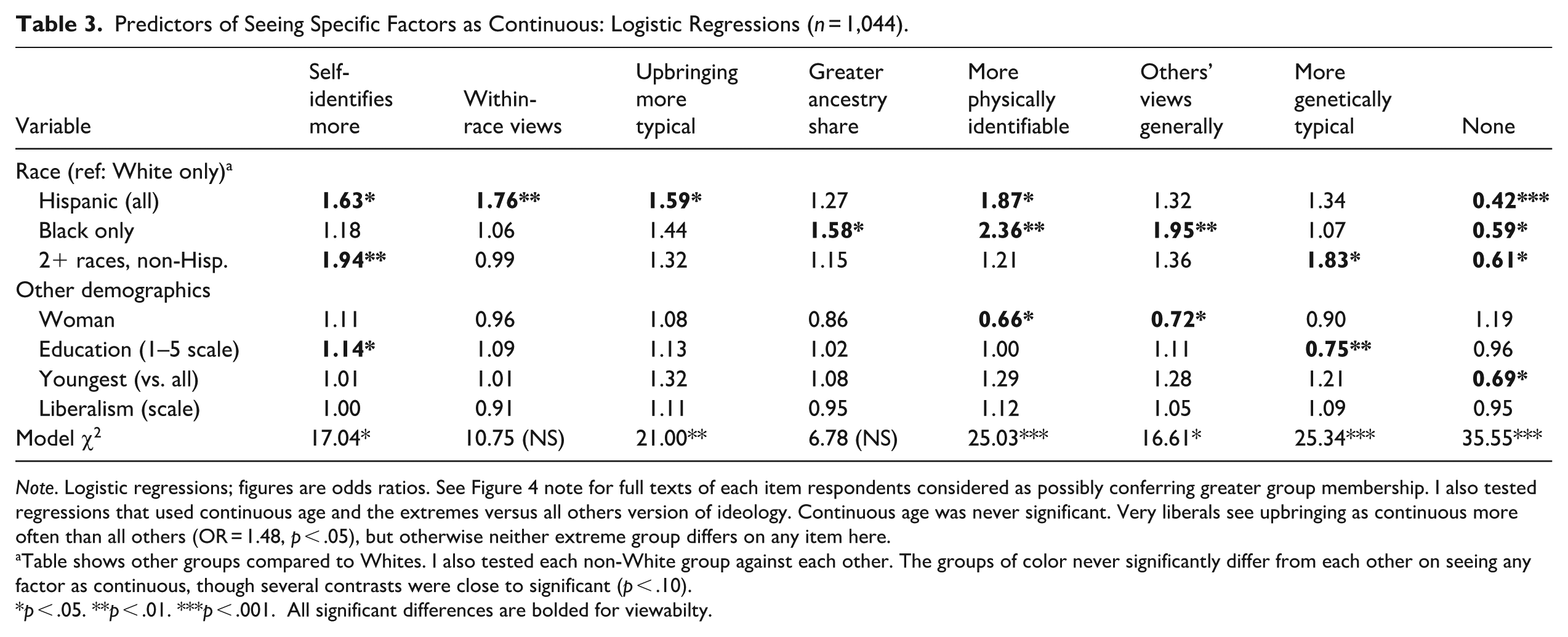
Note. Logistic regressions; figures are odds ratios. See Figure 4 note for full texts of each item respondents considered as possibly conferring greater group membership. I also tested regressions that used continuous age and the extremes versus all others version of ideology. Continuous age was never significant. Very liberals see upbringing as continuous more often than all others (OR = 1.48, p < .05), but otherwise neither extreme group differs on any item here.
Table shows other groups compared to Whites. I also tested each non-White group against each other. The groups of color never significantly differ from each other on seeing any factor as continuous, though several contrasts were close to significant (p < .10).
p < .05. **p < .01. ***p < .001. All significant differences are bolded for viewabilty.
The most intriguing pattern is that the dimensions Hispanic and Latino Americans especially see as continuous mostly concern individual and in-group dimensions of race, while the items seen by Black respondents as more continuous relate more to external appraisals. Also, the genetics item stands out as the only dimension that neither Black nor Hispanic and Latino respondents are especially likely to see as yielding degrees of membership, though multiracial individuals do see it (alongside self-identification) as potentially continuous.
I also conducted an exploratory factor analysis using tetrachoric correlations and principal-component factoring (see Supplemental Table S2). Varimax rotation revealed two factors with eigenvalues >1, together accounting for 51 percent of total variance. The first factor (26%) showed its strongest loadings on self-identification (loading = 0.78) and views of same-race others (0.78), and the second factor (25%) on views of other people generally (0.73) and physical identifiability (0.77). The genetics item stood out with a high uniqueness value (0.67) and fit poorly with either factor. These results are broadly consistent with the individual-item regression patterns, though a lack of significance in two of the seven models and the less definitive placement of several other items in the factor analysis caution against over-interpretation of these parts of the results.
Finally, I examined whether abstract views of race as a matter of degrees (the first dependent variable) affected scenarios response patterns (the second dependent variable and its components). They did 75 percent of those who chose “there ARE degrees of belonging to a race” supported the continuum concept in at least one concrete scenario, a significantly greater share than both the 56 and 53 percent of the “there are NOT degrees” and “not sure” groups who did so (p < .001 for both these contrasts but not significant for the “no” vs. ”not sure” contrast; overall χ2 = 37.3, p < .001). This pattern of differences held for most of the individual components as well. For example, 51 percent of initial “yes” respondents indicated that greater self-identification could yield being more “part of that race,” whereas only 27 and 28 percent of the “no” and “not sure” groups did so. The only item on which abstract views were unrelated to scenario responses was “if Person 1 is more physically identifiable as part of that race,” which only 15, 11, and 13 percent of each group saw as yielding a different degree of membership. (See Table S3 in the Supplemental Material for details, while Table S4 presents results from models that examine DV1 and DV2 simultaneously to consider ambivalence.)
Discussion
This article identifies four main patterns in how Americans conceive of race: (1) Most people abstractly believe that they see race as purely categorical, but use a continuous lens when faced with concrete examples; (2) Black Americans are especially skeptical that racial group membership can be a matter of degrees in the abstract, but they and other groups of color use this idea more than Whites in practice, and respondents’ race shapes which dimensions they see as continuous; (3) Younger respondents more readily use a continuous lens; (4) Those at the liberal and conservative extremes both see race as categorical more than other groups, at least in some formulations. Why?
First, the discrepancy across prompts in whether Americans see a continuous model of racial group membership as reasonable is consistent with Morning’s (2018) contention that “race” in 21st Century America is a “kaleidoscope” of overlapping but distinct concepts, as people use multiple schema to reckon with complex realities. As Morning argues, “we cannot assume that individuals hold a single definition of race. Instead, they may carry around a ‘tool kit’ (Swidler and Arditi 1994) of race concepts from which to draw depending on their reading of how the situation should be deciphered” (p. 1186). One person might therefore consider ancestry and culture as the only core elements of race, but adopt a categorical criterion for one and a continuous conception of the other, while someone else might consider many dimensions all as continua. These conceptions and criteria may further shift across settings.
The core descriptive findings also bear out Morning’s (2009:1185) claim that abstract questions can trigger different race concepts than applied ones. Specifically, the abstract/concrete divergence found in this study may reflect differences between formal and informal race discourses, amplified by current norms wherein a core aim of most everyday racetalk is to avoid controversy or offense (e.g., to not “seem racist”; DeSante and Smith 2020). The abstract formulation likely triggers intellectually driven responses, reflecting that formal discourses on race typically conceive of race as categorical and that claims of partiality (e.g., that someone is “acting White,” “not really Black” ) would be seen as vulgar in these contexts. These abstract orientations appear to structure, but not fully constrain, how respondents evaluate more concrete scenarios. Responses to the concrete scenarios, meanwhile, may call to mind specific situations of racial contestation, ambivalence, and boundary disputes that more often arise in informal contexts (Roth 2018). All told, these findings are consistent with a view of racial conceptualization as partially cue-dependent as well as with Ellis Monk’s (2022) claim that continuous racial concepts are more prevalent than sociologists usually acknowledge.
It is also striking that variation in ancestry does not stand out as especially powerful in triggering continuum conceptions, even though it is the dimension most openly discussed this way in formal contexts. Instead, factors decided by an individual or those close to them—self-identification, upbringing, and within-race appraisals—are seen more often as matters of degree than those decided at a macro or transhuman level: appraisals by society at large, physical appearance, and genetics. It seems plausible that respondents classify aspects of race they see as “objective” as categorical, whereas those where they recognize micro-level social processes or individual choices at play are more readily coded as continuous; future work might test this possibility.
Second, Black respondents’ strong support for a categorical, rather than continuous, conceptualization of race when given an abstract prompt likely reflects historic patterns of racialization in the United States, especially the historic force of the one-drop rule. The strength of within-group collective identification may suppress attention to potential axes of variation (Harris and Khanna 2010; Hochschild and Weaver 2007; Monk 2021). But Black, Hispanic, and multiracial respondents all embrace ideas of partiality more than Whites when given concrete scenarios. That factors related to internal identity and in-group judgments most often trigger a continuous understanding of race for Hispanic and Latino respondents, while those related to external judgments do so for Black respondents, likely relates to these groups’ diverse racialization trajectories (Fox and Guglielmo 2012). Black identity was historically externally and brutally imposed, and variation in external judgments has long shaped Black people’s experiences and life chances. By contrast, the development of Hispanic identity has often allowed for greater intra-cultural adjudication, yielding more space for cultural and identity dimensions to emerge as continuums (Davis 2001; Ghoshal 2025a; Gómez 2022; Mora 2014). The patterns, along with Hispanics’ overall high propensity to engage with race as a continuum, may also derive from long-standing multidimensionality in the “Hispanic or Latino” concept and ambiguity about whether the term designates a race, ethnicity, or some combination (Lopez, Krogstad, and Passel 2023; Roth 2012; Schmotter 2026). Multiracial respondents’ especially high selection of genetic/ancestral dimensions as continuous; meanwhile, may reflect the lineage-based logic through which multiracial identification is often understood.
Third, that Americans born in the late 1980s onward are far more likely to deploy the idea of race as partial or continuous in concrete situations is consistent with several possible explanations. Some part could derive from young people growing up around greater diversity or being less familiar with entrenched conceptualization norms due to youth and inexperience. That the difference maps closely onto the age division between respondents who came of age in the pre-Obama era versus later is also consistent with a possible cohort-inflected “Obama effect.” Obama’s rapid rise to fame yielded an intense conversation that rapidly normalized multiraciality, racial complexity, and the idea that someone could be “partly Black” in one sense and “just Black” in another, in national political culture. The impact of this rethinking would have been muted on people who had already passed through the “critical period” (late teens and early twenties) when political-cultural concepts typically harden (Corning and Schuman 2020). By contrast, those in this period and younger could absorb this more nuanced conception of race without dissonance, soon taking it for granted in a way that those who came of age under a more neatly categorical racial system could not.
If correct, this interpretation also suggests that at least some aspects of “racial formation” processes (Omi and Winant 2014) might be patterned by cohort, for example, new understandings of race may catch on more quickly among young people than in elders. 5 That young Americans’ more continuous understanding of race emerges only when given examples is consistent with the arguments laid out at the start of this section, as younger cohorts have been more strongly socialized into norms that render overt racial judgments face-threatening, a tendency toward more indirect racial discourse, and a reluctance to challenge others’ racial self-identifications (Bonilla-Silva 2006; DeSante and Smith 2020; Schuman et al. 1997).
Last, political ideology affects views on nearly any question involving race (Klein 2020). What is striking here is that the groups who unite in rejecting a continuous conception of racial group membership (when given an abstract framing) are very liberals and very conservatives. Given how starkly racial views typically divide these poles, it is likely they arrive at a shared destination via different routes. Prior research finds that very conservative Americans approach racial conceptualization using more essentialist lenses than others (Schuman et al. 1997; Suhay and Jayaratne 2013), though my follow-up analyses found only insignificant differences in very conservative respondents’ reliance on biological race logics. Meanwhile, perhaps very liberal ones hew tightly to categorical binaries because, whether consciously or not, they see them as useful in maintaining cohesion within groups of color (Hochschild and Weaver 2007). Indeed, very liberal Americans’ higher support for categorical race concepts might be a form of “strategic essentialism” (Eide 2016; Spivak 1988): these respondents minimize or obscure within-category variation in order to tell a simpler, and therefore more easily retained, story of undifferentiated group oppression. This strange ideological pairing is reminiscent of Matthew Hughey’s argument that White racists and antiracists sometimes embrace similar understandings of race (Hughey 2012:184; see also pp. 3–6); of unusual alliances in 1990s debates about whether the U.S. Census should adopt a separate “multiracial” category (DaCosta 2007); and of the one-drop rule’s co-option by Black individuals who used it as a mechanism for group cohesion and expansion (Davis 2001; see also Ho, Kteily, and Chen 2017).
This study has several limitations that future work might address. First, different target identities might cue different levels of belief in continuity. For instance, if Hispanicity is seen as more cultural and voluntary than Blackness or Whiteness (Ghoshal 2025a; Schachter, Flores, and Maghbouleh 2021; Schmotter 2026), do different rules for assessing partiality apply? Surveys or survey-experiments that focus only on one specific target identity would deepen our understanding of nuances here (see also Abascal et al. 2025a).
Second, some interpretations of the patterns here are not conclusive and merit further inquiry. For instance, researchers might conduct interviews with very liberal and very conservative Americans to better understand the causes of their unusual convergence.
Third, this study addressed adult English-speaking Americans, but non-English speakers, new immigrants, and younger cohorts may conceptualize race in different ways. Future research on these groups, and on Asian and Middle Eastern Americans (removed from regressions here due to their small numbers), will reveal additional nuances.
Ultimately, these findings are significant because the assumption that people think of and with race using solely a categorical lens impairs an accurate understanding of racial schemas, discrimination, and inequality. We should instead recognize that both categorical and continuous conceptions are part of most Americans’ cultural and racial toolkits (Morning 2009; Swidler 1986). In this case, understanding what social contexts are associated more with categorical or continuous logics, and with what consequences, is important because fine-tuning actions to remedy inequality is only possible when the full range of concepts that inequality might hinge on is well understood (Haney-Lopez 1996; Hochschild and Weaver 2007; Monk 2022). Developing this more nuanced understanding is especially important given the recent rise of multiple logics of racial attribution, growth in multiracial and racially ambiguous populations, and this study’s finding of shifting conceptions particularly among the youngest Americans; new dimensions and combinations may continue to come into focus (Morning 2018; Roth 2016). Scholarship that assumes that people bring a single set of lenses to bear on “race” no longer does justice to the interlocking yet varied ways that race continues to shape American life.
Supplemental Material
sj-docx-1-scu-10.1177_23294965261456193 – Supplemental material for Americans’ Race Concepts as Categorical and Continuous
Supplemental material, sj-docx-1-scu-10.1177_23294965261456193 for Americans’ Race Concepts as Categorical and Continuous by Raj A. Ghoshal in Social Currents
Footnotes
Appendix
Data are drawn from a survey I designed in Qualtrics and ran through an online survey provider, Lucid, in 2019. The survey addressed respondents’ views on race. It included mostly closed-ended questions along with a few open-ended questions. Lucid provides a sample designed to be representative of English-speaking American adults in terms of race, gender, age, and region. While the Hispanic/Latino sample percentage is below that group’s total population share, it is similar to that group’s 11 to 12 percent share of the English-speaking adult population at the time (Ghoshal 2025a). A detailed explanation of the survey, sample quality and quality checks, exclusion decisions, and representativeness appears in Ghoshal (2025a). Table A1 shows descriptive information on the final sample. Of the variables addressed in this article, the abstract prompt came first, followed by the items asking about degrees of belonging within the same group, and then demographic items. Other parts of the survey included items on how the respondent appraises membership in racial groups, why the respondent identifies as a member of the race(s) they do, and questions about racial attitudes. The median respondent took slightly over 15 minutes.
Acknowledgements
This work was influenced by ideas developed by Wendy Roth, Ann Morning, and Ellis Monk. I also thank the editors and reviewers, as well as Peter Hart-Brinson, Sanem Soyarslan, Kerem Morgül, Tyson Brown, Nica Davidov, and Elon University Faculty Research & Development, for helpful feedback and support.

Funding
The author received no financial support for the research, authorship, and/or publication of this article.
Declaration of Conflicting Interests
The author declared no potential conflicts of interest with respect to the research, authorship, and/or publication of this article.
Supplemental Material
Supplemental material for this article is available online.
Notes
References
Supplementary Material
Please find the following supplemental material available below.
For Open Access articles published under a Creative Commons License, all supplemental material carries the same license as the article it is associated with.
For non-Open Access articles published, all supplemental material carries a non-exclusive license, and permission requests for re-use of supplemental material or any part of supplemental material shall be sent directly to the copyright owner as specified in the copyright notice associated with the article.
