






Abstract
Research on racial attitudes has long examined how white Americans explain ethnoracial inequality, but it often treats race and gender as separate, independent dimensions of analysis. In this article, I investigate how whiteness itself operates as a gendered interpretive framework that shapes how white women and men understand racial inequality. Using data from the 2018 Chicago Area Survey, which included a dual split-ballot experiment varying the race and gender of target groups, I analyze how white respondents explain unemployment rate disparities among Black and Latinx women and men. Across the sample, white Chicagoans were more likely to endorse structuralist than individualist explanations for racial inequality, yet their interpretations depended on both respondent and target gender. White women expressed less support for structural explanations when asked about Latina women’s unemployment than about Latino men’s, while white men’s responses did not vary by target gender. These findings show that the gender of both the perceiver and the perceived shapes how members of the dominant racial group interpret inequality. I argue that such patterns reveal how whiteness functions as a gendered social framework through which inequality is rationalized and moral boundaries are drawn. Rather than treating racial attitudes as gender-neutral, I show that explanations for inequality are shaped by both respondent gender and the gender of the racialized group being evaluated. By conceptualizing whiteness as a gendered interpretive framework, I demonstrate how dominant-group members differentially recognize structural disadvantage across racialized men and women.
Introduction
Over the past 50 years, sociologists have developed a rich body of research examining how Americans explain ethnoracial inequality (Bobo and Kluegel 1993; Hochschild 1996; Hunt 2007; Schuman and Krysan 1999). This scholarship shows that while overt expressions of prejudice have declined, racial inequality endures not only in outcomes but also in how people make sense of those outcomes. Many Americans continue to attribute racial disparities in education, employment, and income to individual failings rather than to structural barriers—reflecting the persistence of individualism in the American racial belief system (Bobo and Kluegel 1993). These explanations matter because they shape how citizens interpret inequality, justify privilege, and evaluate the fairness of social institutions. Despite extensive attention to racial attitudes and stratification beliefs, relatively little research explores how gender structures these explanations. Scholars have identified gender differences in racial attitudes—women often expressing somewhat more progressive views than men (Douds, O’Connell, and Bretter 2019; Shelton 2017)—but have rarely examined how gender interacts with race to shape dominant-group members’ understandings of inequality. Even fewer studies consider whether white men and women perceive racialized inequality differently depending on the gender of the people they are asked to evaluate. I address this gap by analyzing how white Chicagoans explain racialized unemployment and how these explanations reflect the gendered operation of whiteness itself. Most studies of racial attitudes treat whiteness as an unmarked or gender-neutral baseline, obscuring how white men and women interpret inequality from distinct social positions. I argue that attending to the gendered dimensions of whiteness reveals how racial privilege operates through moral reasoning–shaping when structural disadvantage is recognized and when it is dismissed as a matter of individual responsibility. To investigate these questions, I draw on data from the 2018 Chicago Area Survey, which included a between-subjects experiment asking white respondents to evaluate unemployment among one of four groups: Black men, Black women, Latino men, or Latina women. This design allows me to examine how explanations for ethnoracial inequality vary by both respondent and target gender within the same local context. Chicago, with its near-equal proportions of Black, Latinx, and white residents and its long history of racial segregation (Henricks et al. 2017), provides an ideal setting for this analysis.
I focus specifically on unemployment because it is a domain that strongly activates moral judgments about responsibility, effort, and deservingness (Gilens 1999; Hochschild 1996; Katz 2013). Unemployment is often interpreted simultaneously as a personal failing and as the product of structural barriers such as discrimination, credentialing, and labor market segmentation (Hunt 2007, 2016; Kluegel and Smith 1986; Mijs 2018; Reynolds and Xian 2014). This makes unemployment a particularly revealing site for examining how structural and individualist explanations for inequality are mobilized. I situate this study within broader sociological debates about racial attitudes, intersectionality, and whiteness. Rather than treating race or gender as additive categories, I conceptualize whiteness as a gendered social position that shapes how people make sense of inequality. This framework clarifies how dominant-group members’ explanations for racialized outcomes are structured by both their own gender and the gender of those they evaluate. In doing so, I extend research on racial attitudes by moving beyond gender-neutral analyses of both respondents and targets. I show that white men and women interpret the causes of racialized unemployment through different moral and experiential lenses, and that these interpretations depend on the gendered dynamics of whiteness. By tracing how race and gender intersect in white Americans’ reasoning about inequality, I highlight the social processes through which privilege is naturalized and responsibility is displaced.
Gender and Beliefs About Ethnoracial Inequality
How Women and Men Explain Ethnoracial Inequality
Research suggests that people tend to simultaneously embrace both structuralist and individualist explanations (Hunt 2007, 2016; Kluegel and Smith 1986). Which explanation is most salient may depend on the form of ethnoracial inequality being considered (Mijs 2018). In general, however, scholars find that most Americans favor individualist over structuralist explanations, especially white Americans (Bonilla-Silva 2006; Hughes and Tuch 2000; Kluegel and Bobo 1993; Krysan 2000; Reynolds and Xian 2014). Social structural theorists such as Blumer (1958) attribute the cohesion of white Americans’ beliefs on ethnoracial inequality to a “sense of group position”; white Americans tend to hold similar perceptions of ethnoracial inequality because they are members of the same ethnoracial group with little intragroup variation (e.g., by gender). As Hughes and Tuch (2003:385) discuss, other theoretical approaches such as realistic group conflict theory (Bobo 1983; Campbell 1965) and Bonacich’s (1980) work merging class and race, “. . . are generally consistent with Blumer’s (1958) idea that racial prejudice and antagonism are reflections not of individual personality traits, but of competition and conflict between groups for material rewards, power, and status in a racialized society.” Scholars studying the gendered dynamics of stratification beliefs have challenged the legitimacy of gender-neutrality implicit in these social structuralist approaches. Early studies such as Beutel and Marini (1995), Cross and Madsen (1997), and Johnson and Marini (1998) contend that we must consider how gender socialization shapes attitudes. Because women are typically socialized from childhood by family members, friends, and media to be more empathetic than men; these scholars expect women to hold more progressive racial attitudes. Others argue that women are more likely than men to endorse structuralist attitudes not necessarily due to gender socialization but because even white women generally experience more structural inequality (e.g., discrimination) than men (Bolzendahl and Myers 2004; Cech and Blair-Loy 2010; Mijs 2018). Greater exposure to structural inequality may lead to stronger perceptions of structural factors as major drivers of social (dis)advantages.
Empirical evidence has shown mixed support for whether gender significantly shapes white people’s stratification beliefs. Early studies such as Bobo and Kluegel (1993), Hughes (1997), Johnson and Marini (1998), Schuman et al. (1997), and Steeh and Schuman (1992) find that white women often have slightly more progressive racial attitudes than white men concerning social distance, affirmative action, and other race-based policies. Hughes and Tuch (2003) find some evidence suggesting that white women hold more progressive attitudes. Some studies, such as Croll (2013), Grayman and Godfrey (2013), and Reynolds and Xian (2014), find the opposite: women express greater support toward individualist (or meritocratic) rather than structuralist beliefs. These discrepancies may be because the authors focus on different issues within the larger domain of stratification beliefs and that beliefs vary across contexts (Reynolds and Xian 2014:131). Hunt (2007), Shelton (2017), and Douds et al. (2019) all find that white men are significantly more likely than white women to endorse individualist explanations for Black–white inequality while white women are significantly more likely to endorse structural explanations for ethnoracial inequality. Unfortunately, gender generally takes a “backseat” to other analyses in these studies, as researchers treat it as a control variable. As such, the extent to which gender influences peoples’—in this case, white Americans’—explanations for ethnoracial inequality remains unclear.
Whiteness, Group Position, and Target Gender
While this body of research identifies persistent racial and gendered patterns in how Americans explain inequality, it often treats whiteness as a neutral baseline rather than a social position embedded in power and gendered meaning. Sociologists have long shown that whiteness operates not only as a racial category but also as a social position that structures perception, morality, and identity (Bonilla-Silva 2006; Frankenberg 1993; Lewis 2004). Yet much scholarship on whiteness treats it as an unmarked or internally homogeneous category, often overlooking how white women and white men differently experience and reproduce racial dominance (Daniels 1997; Frankenberg 1993; Hughey 2010; Lewis 2004). Scholars such as Twine (1997), Daniels (1997), and Hughey (2010) demonstrate that whiteness is itself a gendered formation—variably enacted, performed, and justified across gendered lines. These studies reveal that the power and privilege associated with whiteness take distinct forms depending on whether the actor occupies a masculine or feminine social position. Building on this insight, I conceptualize whiteness as a gendered interpretive framework through which dominant-group members make sense of ethnoracial inequality.
White men’s and women’s lived experiences of privilege differ in ways that can influence whether they view ethnoracial disparities as the result of individual behavior, structural barriers, or some combination of both. For instance, white men may perceive less threat or moral responsibility when reflecting on inequality that affects racialized men, while white women may interpret racial inequality through a lens shaped by their own experiences of gender disadvantage. Integrating whiteness studies with intersectionality highlights how racial and gender hierarchies intersect to shape explanatory frameworks for inequality. This perspective allows me to consider both respondent gender and target gender—asking not only who is making judgments about inequality but also about whom these judgments are made. This perspective reframes whiteness as an active interpretive framework (Eriksson Krutrök and Åkerlund 2023; Hughey 2012), one that structures the moral boundaries of empathy, responsibility, and perceived deservingness across racialized and gendered lines.
Conceptualizing whiteness as a gendered interpretive framework highlights how moral responsibility is unevenly assigned. Structural explanations serve as lenses through which dominant-group members may recognize, or deny, obligation and injustice. Whether inequality is attributed to discrimination or to individual behavior reflects judgments about who constitutes a legitimate subject of structural disadvantage.
Intersectionality, Prototypicality, and Acknowledging Gendered Targets
Most studies of explanations for ethnoracial inequality analyze attitudes toward racialized groups as internally undifferentiated, without distinguishing between men and women within those groups (Hughes and Tuch 2003; Hunt 2007; Kluegel and Bobo 1993). Because most studies ask respondents to explain their attitudes toward ethnoracial groups overall, they imply these attitudes are gender-neutral. By treating gender as if it does not matter, we have little understanding as to whether people perceive the causes of ethnoracial inequality differently when thinking about women versus men within a particular minoritized ethnoracial group (Hughes and Tuch 2003; Hunt 2007; Johnson and Marini 1998; Kluegel and Bobo 1993; Telles and Bailey 2013). Feminist scholars have long argued that gender and race, rather than being separate, nonoverlapping constructs, are inherently intersectional and interdependent (Collins 2000, 2004; Connell 1987; Connell and Messerschmidt 2005; Crenshaw 1991; Ridgeway and Kricheli-Katz 2013). Several scholars have applied the intersectionality framework to study stereotypes and discrimination (Babbitt et al. 2018; Chavez and Wingfield 2018; Purdie-Vaughns and Eibach 2008; Ridgeway and Kricheli-Katz 2013; Wong and McCullough 2021). Central to these studies is Rosch’s (1973) concept of prototypicality—the degree to which something or someone is perceived as the ideal member of a category. For example, when thinking of birds, a cardinal is generally considered as more prototypical compared with a penguin. Because of racism, white Americans represent the prototypical ethnoracial group. Additionally, because of androcentrism, men represent the prototypical gender within ethnoracial groups (see Wong and McCullough 2021 for the exception of Asian men). This suggests that stereotypes about ethnoracial groups (e.g., Black Americans) actually reflect stereotypes about the men within those groups (e.g., Black men; Macrae and Quadflieg 2010). What does this mean for women as the nonprototypical gender in most research on racial attitudes? Purdie-Vaughns and Eibach’s (2008) model of intersectional invisibility suggests there are stark differences in the experiences of white and non-white women. Because of their race, white women represent prototypical women and therefore tend to be front and center in stereotypes about women in general. Non-white women, with the exception of Asian women (Wong and McCullough 2021), are nonprototypical in terms of both race and gender. As a result, non-white women are not easily classified by racial or gendered stereotypes, nor do they fit most mental images of their ethnoracial groups (e.g., Black people; Latinx people) or women (i.e., white women). This effectively leaves non-white women socially invisible (Billups et al. 2022; Purdie-Vaughns and Eibach 2008; Ridgeway and Kricheli-Katz 2013). Work that is more recent has built on Purdie-Vaughns and Eibach’s (2008) intersectional invisibility model. Chavez and Wingfield (2018) referred to this approach as intersectional prototypicality. They emphasize the role context plays in determining racial and gendered prototypicality. Because racial and gendered stereotypes (both positive and negative) vary across contexts, one may be prototypical in one domain and not in another (Wong and McCullough 2021). Being prototypical in a given context may have positive or negative consequences depending on whether the stereotypes coincide with the gender profile of that context. For example, Black men (and Blacks Americans in general) are stereotyped as hyper-masculine compared to white Americans and so may experience certain advantages in some masculine-linked settings, such as athletics (Ghavami and Peplau 2012), while facing various disadvantages in feminine-linked domains like nursing (Wingfield 2009). To determine whether people hold similar or different attitudes toward women and men within each ethnoracial subgroup, we need empirical research to account for racial and gendered prototypicality. Additionally, if racial and gendered prototypicality is context-specific, researchers must avoid asking respondents to simultaneously explain the causes of ethnoracial inequality in multiple social domains, such as employment, housing, and income. In the next section, I move even further beyond existing studies on stratification beliefs by theorizing that there may be a relationship between respondents’ gender and the gender of those about whom questions are asked in the specific context of ethnoracial inequality in unemployment rates.
These insights are directly relevant to explanations for unemployment inequality. Scholarly and public discourse around racial economic marginality has often centered the experiences of men of color, even as women of color face comparable and intersecting disadvantages. Wilson’s (1987) foundational account of joblessness among Black men in deindustrialized cities linked structural economic shifts—manufacturing decline, spatial mismatch, and labor market exclusion—explicitly to the experiences of Black male workers. Similarly, influential audit studies documenting racial discrimination in hiring have predominantly used male testers, shaping scholarly understanding of structural barriers in employment around male experiences (Pager 2003). At the policy level, the Obama administration’s My Brother’s Keeper initiative, designed to address structural barriers in education and employment for communities of color, focused exclusively on boys and men—an exclusion that Crenshaw (2014) argued reflected the widespread belief that men of color are the primary and most legitimate subjects of racial structural disadvantage. If men are more likely to be perceived as prototypical representatives of racialized groups, and if the cultural, scholarly, and policy narratives linking race to structural disadvantage in employment have often centered men of color, then structural disadvantage in the domain of unemployment may be more readily acknowledged when inequality affects men rather than women from the same groups. This perspective suggests that target gender may shape whether racial inequality is recognized as structurally produced or dismissed as individual failure—an expectation that the experimental design of this study allows me to examine empirically.
Gendered Explanations for Non-White Men’s and Women’s Unemployment Rates in Chicago
If white women and men do perceive the causes of ethnoracial inequality differently (Douds et al. 2019; Hunt 2007; Shelton 2017), does this variation extend to attitudes toward women and men within minoritized ethnoracial groups, particularly in domains of economic inequality such as unemployment rates? Penner and Saperstein (2013) find that women who reveal a history of welfare usage are more likely to be perceived as Black than are men who respond that they have been on welfare. Neubeck and Cazenave (2001:34) highlight this association between unemployment, race, and gender when explaining “. . . [the controlling image] of the stereotypical “welfare mother” is built on the assumption that women of color are bad mothers . . . [and] are the root cause of many contemporary social problems.” Others, such as Boris (2007), Chavez (2004), and Lacayo (2017), suggest Latina women also increasingly find themselves victims of a stereotypical image akin to the welfare queen. Thus, when discussing economic subjects such as unemployment, people may unconsciously be thinking of women of color; that is, Black and Latina women may represent the prototypical figure in the context of unemployment. Due to the negative association of unemployed women of color and the welfare queen stereotype, white Americans may be less likely to believe Black and Latina women’s unemployment rates are due to structural factors and more inclined to offer individualist explanations for ethnoracial inequality in unemployment.
A different mechanism may operate in another direction. Mijs (2018) argues that we must take people’s social environments into consideration when trying to analyze stratification beliefs. Because Black and Latino men make up a disproportionate share of the incarcerated population, white Americans may be more exposed to media focus on the hyper-incarceration of Black and Latino men and the difficulties finding jobs after prison. If this is the case, white Americans may be more likely to perceive Black and Latino men’s heightened unemployment rates as the result of structural issues rather than, or in addition to, individualist factors. These contrasting perspectives suggest that gender may shape how structural disadvantage is recognized across racialized groups in different ways.
Hypotheses
These theoretical perspectives generate competing expectations about which racialized groups are most readily recognized as legitimate subjects of structural disadvantage in the context of unemployment. One possibility, derived from gender positionality arguments, is that white women may be more likely than white men to recognize structural causes of inequality because women themselves experience gender-based disadvantage. A second expectation follows from intersectional prototypicality: because men of color more readily function as prototypical representatives of racialized groups in the domain of employment, structural disadvantage may be more readily acknowledged when unemployment disparities affect men rather than women from those groups. A third possibility reflects racialized gender stereotypes associated with the “welfare queen” trope, which frames women of color as personally responsible for economic hardship. If such stereotypes influence how unemployment inequality is interpreted, respondents may be less likely to attribute women of color’s unemployment to structural causes and more likely to endorse individualist explanations.
To evaluate these competing expectations, I test three hypotheses:
This study contributes empirical evidence about gender differences between white Americans’ explanations for ethnoracial inequality. I expand upon previous studies by examining whether and how white men’s and women’s explanations vary toward Black and Latinx women and men separately rather than toward gender neutral ethnoracial groups. I move beyond treating gender simply as a characteristic of survey respondents by acknowledging that how we perceive other people’s gender may also matter. This work is critical if we wish to better understand the complex ways in which people understand ethnoracial inequality and the intersectional relationship between gender and race.
Methods
Sample
Data come from the 2018 Chicago Area Survey, an online survey administered by the National Opinion Research Center (NORC) using its probability-based AmeriSpeak® Panel. The survey was designed to examine how residents of the Chicago metropolitan area explain ethnoracial inequality and was fielded between August and October 2018. Respondents were adults (18 years and older) residing in the metropolitan Chicago area.
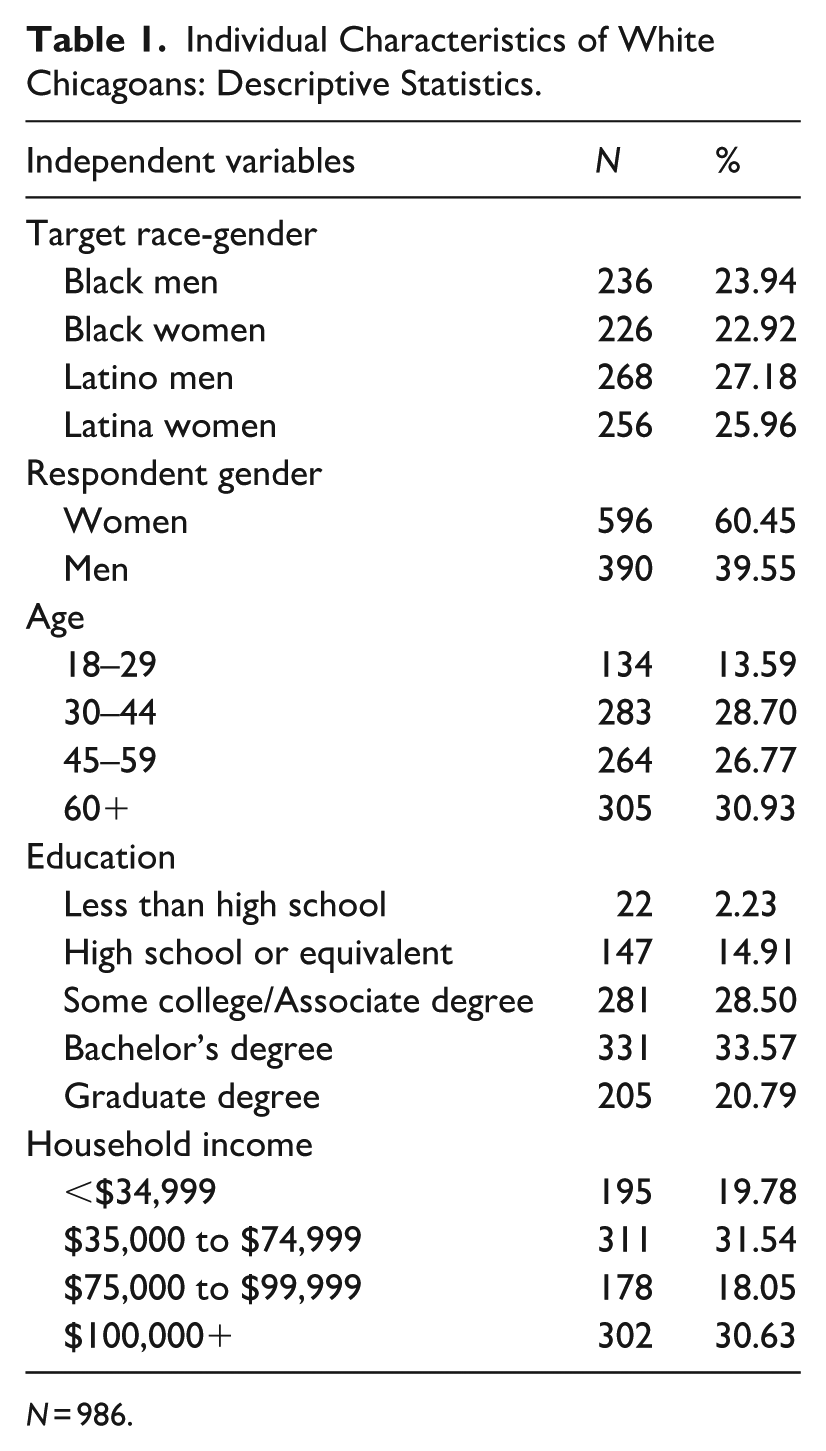
The full sample included 1,747 respondents: 1,012 white, 390 Latinx, and 345 Black participants. Because this study focuses on dominant-group explanations of ethnoracial inequality, analyses are restricted to white respondents. After excluding 26 cases with missing data on key variables, the final analytic sample consists of 986 white respondents. Descriptive characteristics of the analytic sample are reported in Table 1.
Individual Characteristics of White Chicagoans: Descriptive Statistics.
N = 986.
Experimental Design: Dual Split-Ballot Experiment
The survey included a dual split-ballot experiment in which respondents were randomly assigned to evaluate unemployment inequality for one of four race–gender target groups: Black men, Black women, Latino men, or Latina women. Each respondent was exposed to only one experimental condition.
Respondents first received a prompt describing unemployment disparities between their assigned racial group and whites in Chicago. For example, respondents assigned to Black target conditions read that Blacks experience unemployment rates substantially higher than whites, while respondents assigned to Latinx target conditions read an analogous statement comparing Latinos/as and whites. The prompt defined unemployment as the percentage of individuals actively seeking work in the previous 4 weeks and referenced contemporaneous unemployment statistics to anchor the comparison. The full survey prompt and exact wording of the unemployment inequality items are reproduced in Figure A1.
Following this prompt, respondents were asked to evaluate the extent to which various factors accounted for the difference in unemployment rates between their assigned race–gender target group and a same-gender white reference group (e.g., Black women compared to white women; Latino men compared to white men). Random assignment produced an approximately even distribution across experimental conditions: 24% Black men, 23% Black women, 27% Latino men, and 26% Latina women (see Table 1).
The experimental design used a same-gender white reference group for each target condition: respondents evaluated unemployment inequality between their assigned race–gender target and white women or white men, respectively. This approach was chosen because it holds gender constant within each comparison, isolating racial disparities in unemployment while avoiding confounds introduced by cross-gender wage and employment gaps. As a result, findings should be interpreted as reflecting respondents’ perceptions of each group’s unemployment inequality relative to same-gender white reference groups, rather than as direct cross-target comparisons of absolute disadvantage. Readers should note that this design does not support conclusions about whether respondents perceive Black men and Black women, for instance, as facing equivalent levels of structural disadvantage in any absolute sense—only how they explain each group’s inequality relative to a matched white reference group.
Measures
Explanations for Ethnoracial Inequality in Unemployment
Respondents evaluated six items assessing explanations for unemployment inequality. For each item, respondents were asked how much of the unemployment rate difference was due to a given factor, with response options ranging from “None” (1) to “A Great Deal” (4).
Two items captured individualist explanations:
being too picky about which jobs to take;
preferring to rely on government assistance.
Four items captured structuralist explanations:
employer discrimination;
white women and men having better job connections;
not having enough education 1 ;
lack of role models.
Responses were averaged to create two scale measures: an individualist explanations scale (α = .62) and a structuralist explanations scale (α = .69). Item-level descriptive statistics are reported in Table A1.
Predictor Variables
Target Race–Gender
Target race–gender is an experimentally assigned categorical variable with four levels: Black men (reference category), Black women, Latino men, and Latina women.
Respondent Gender
Respondent gender is a binary variable coded 0 for women and 1 for men. Respondent gender is included to assess whether explanations for inequality vary by the gender of the evaluator and in interaction with the gender of the racialized target group.
Control Variables
Models include controls for respondent age, education, and household income. Age is coded into four categories (18–29, 30–44, 45–59, 60+). Education is coded into five categories ranging from less than high school to graduate degree. Household income is coded into four categories (<$35,000; $35,000–$74,999; $75,000–$99,999; $100,000+).
Analytic Strategy
Analyses proceed in three stages. First, I examine overall levels of endorsement of individualist and structuralist explanations using descriptive statistics, summarized visually in Figure 1.
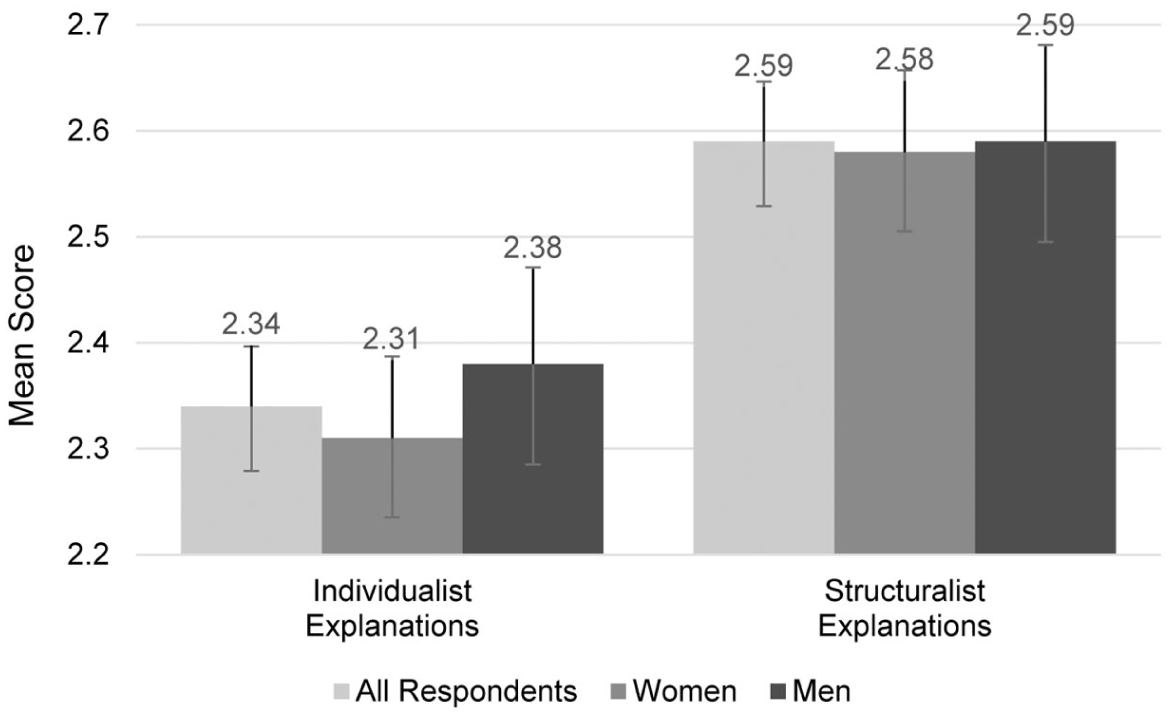
Mean endorsement of individualist and structuralist explanations for ethnoracial inequality in unemployment.
Second, I estimate pooled linear regression models predicting endorsement of each explanatory scale as a function of the experimentally assigned race–gender target, with Black men serving as the reference category. These models include respondent gender and sociodemographic controls and test interaction terms between respondent gender and target race–gender. Given the same-gender reference structure of the dependent variable, cross-target comparisons in the models below reflect differences in how respondents explain each group’s inequality relative to comparable whites, not differences in perceived absolute levels of disadvantage across race–gender targets.
Third, to assess whether patterns differ within gendered social positions, I estimate gender-stratified regression models for white women and white men. Although interaction terms test whether coefficients differ statistically across groups, feminist methodological scholars argue that stratified analyses can reveal how explanatory frameworks operate within distinct social positions rather than merely whether slopes differ across them (Sprague 2016). Estimating separate models therefore allows for a more substantively grounded interpretation of gendered stratification beliefs.
Results
The analyses below evaluate the hypotheses derived from gender positionality, intersectional prototypicality, and racialized gender stereotypes. I present the results in three stages. First, I describe overall levels of endorsement of individualist and structuralist explanations for ethnoracial inequality in unemployment. Second, I examine whether these explanations vary by the race–gender of the target group using pooled regression models that leverage the experimental design. Third, I assess whether these patterns differ for white women and white men by estimating gender-specific models.
Overall Endorsement of Explanations for Unemployment Inequality
Figure 1 presents respondents’ mean endorsement of individualist and structuralist explanations for ethnoracial inequality in unemployment. On average, white Chicagoans expressed greater endorsement of structuralist explanations than individualist explanations. This pattern held for the full sample as well as when responses were examined separately for white women and white men. Although both explanatory frameworks were endorsed to some degree, structural explanations consistently received higher mean ratings, indicating that respondents more strongly attributed unemployment disparities to systemic factors than to individual behavior. Item-level descriptive statistics and mean endorsement by target race–gender are reported in Tables A1 and A2 for reference.
Target Race–Gender and Explanations for Inequality: Pooled Models
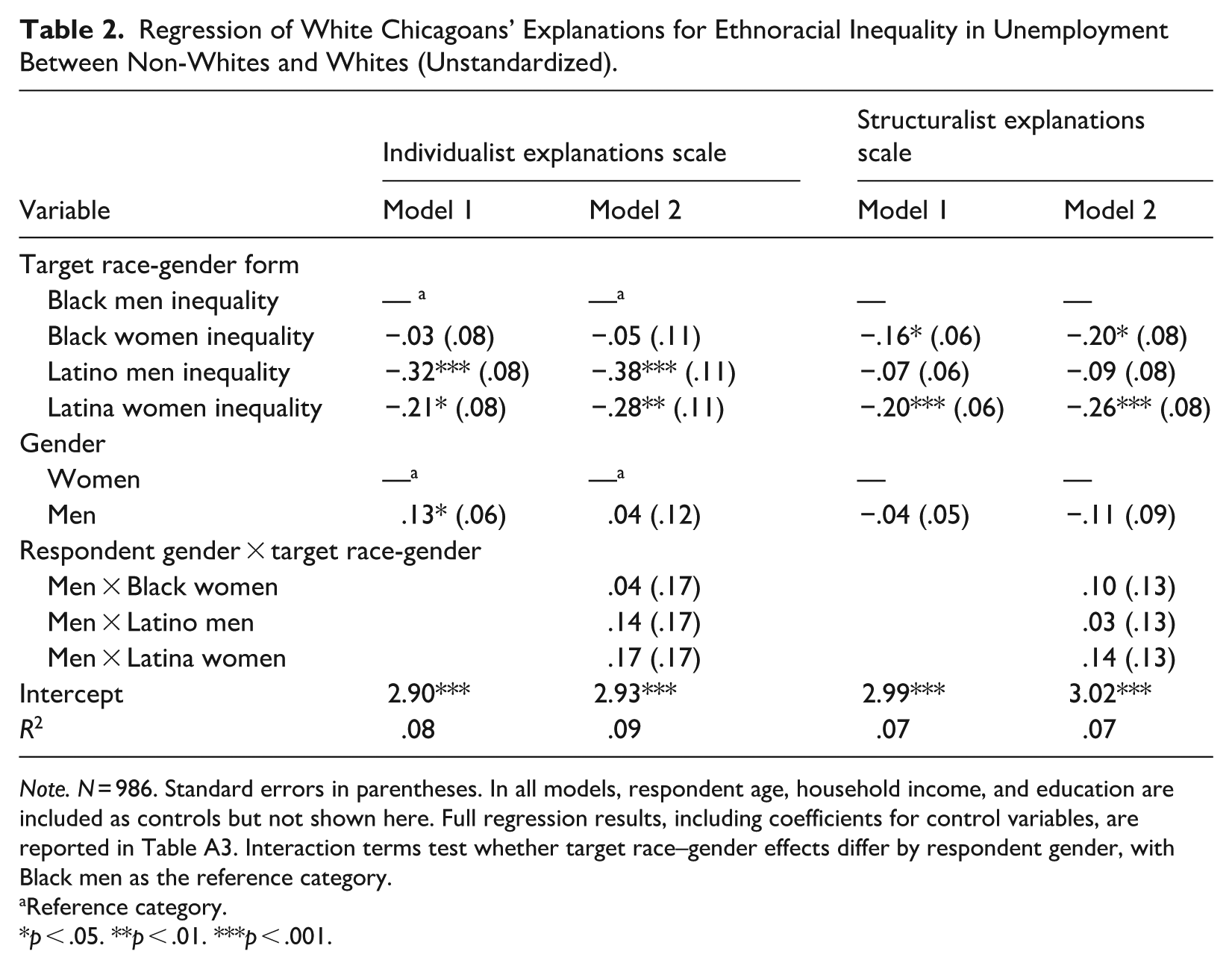
Table 2 reports pooled regression models predicting endorsement of individualist and structuralist explanations as a function of the experimentally assigned race–gender target. Black men serve as the reference category in all models. Model 1 estimates the association between target race–gender and explanations for inequality while controlling for respondent gender, age, household income, and education. Model 2 adds interaction terms between respondent gender and target race–gender.
Regression of White Chicagoans’ Explanations for Ethnoracial Inequality in Unemployment Between Non-Whites and Whites (Unstandardized).
Note. N = 986. Standard errors in parentheses. In all models, respondent age, household income, and education are included as controls but not shown here. Full regression results, including coefficients for control variables, are reported in Table A3. Interaction terms test whether target race–gender effects differ by respondent gender, with Black men as the reference category.
Reference category.
p < .05. **p < .01. ***p < .001.
Consistent with Figure 1, endorsement of individualist explanations varied modestly across target groups. Respondents expressed lower levels of individualist attribution when evaluating Latino men and Latina women than when evaluating Black men, net of controls. In contrast, endorsement of structuralist explanations exhibited clearer differentiation by target gender. Respondents expressed significantly weaker support for structural explanations when evaluating Black women and Latina women compared to Black men. These differences persisted after adjusting for sociodemographic characteristics, indicating that they are not driven by compositional differences across experimental conditions.
To assess whether target race–gender effects differed by respondent gender, Model 2 includes interaction terms between respondent gender and the target race–gender indicators. None of these interaction terms reached statistical significance for either explanatory scale. This suggests that, in the pooled models, the effects of target race–gender on explanations for unemployment inequality do not differ significantly between white women and white men.
Gender-Stratified Analyses
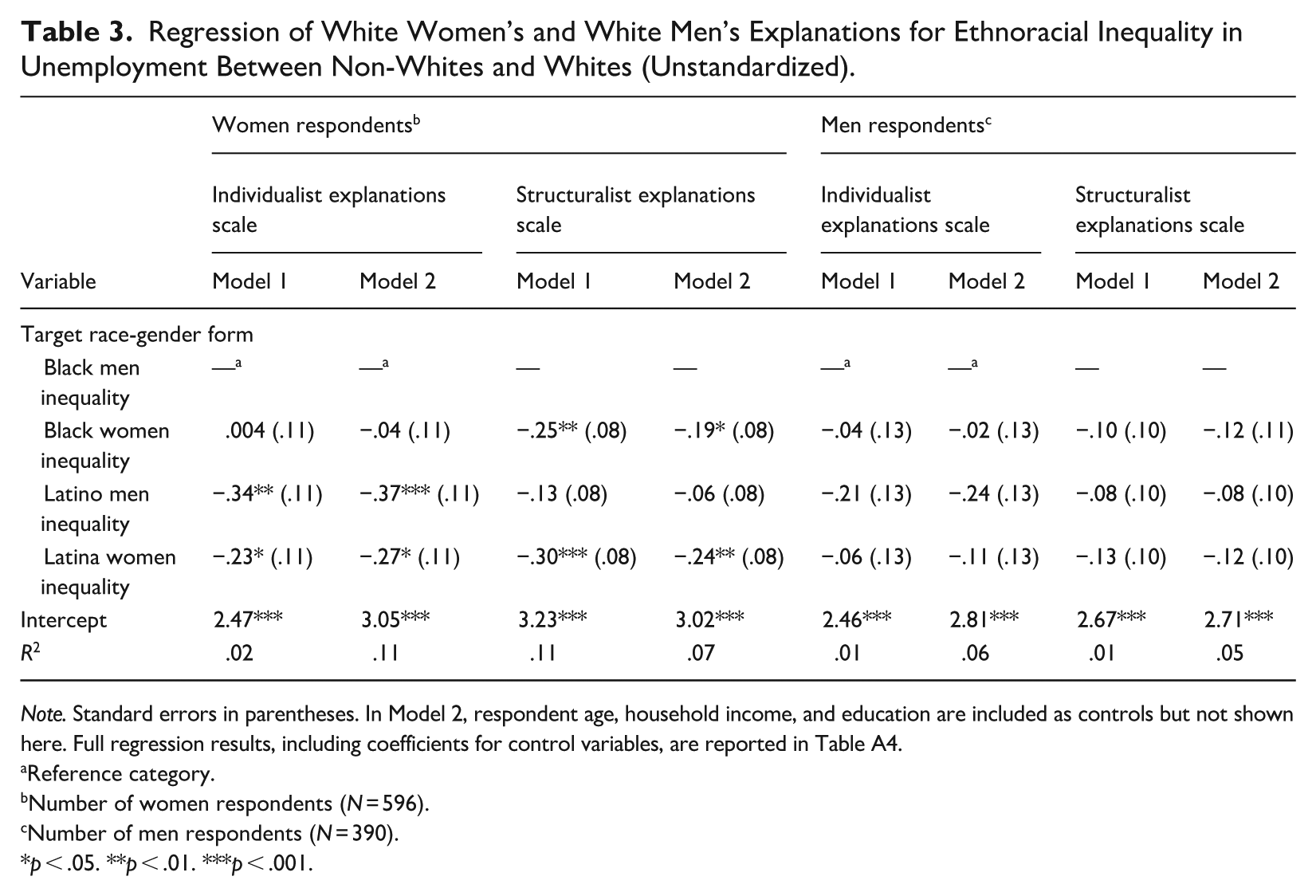
Although the interaction terms did not reveal statistically significant differences by respondent gender, prior research suggests that stratification beliefs may be patterned differently within gendered social positions (Sprague 2016). I therefore estimated separate regression models for white women and white men, reported in Table 3.
Regression of White Women’s and White Men’s Explanations for Ethnoracial Inequality in Unemployment Between Non-Whites and Whites (Unstandardized).
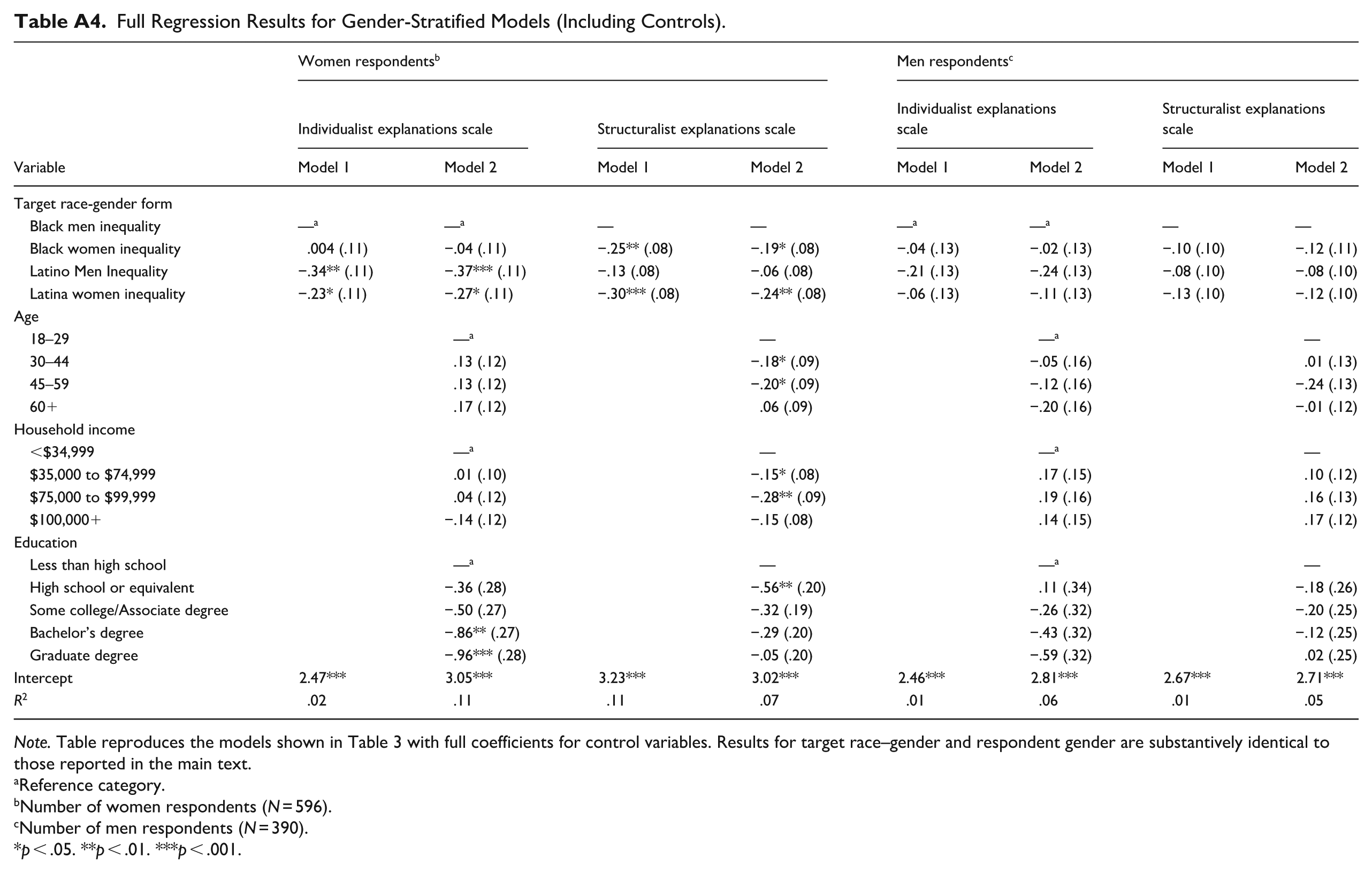
Note. Standard errors in parentheses. In Model 2, respondent age, household income, and education are included as controls but not shown here. Full regression results, including coefficients for control variables, are reported in Table A4.
Reference category.
Number of women respondents (N = 596).
Number of men respondents (N = 390).
p < .05. **p < .01. ***p < .001.
Among white women, endorsement of individualist explanations did not differ substantially by target gender once controls were included. In contrast, white women expressed significantly weaker support for structural explanations when evaluating Black women and Latina women relative to Black men. These differences remained statistically significant net of age, education, and household income, indicating that white women’s structural attributions vary depending on the gender of the racialized target group.
Among white men, no statistically significant differences emerged across target race–gender groups for either individualist or structural explanations. White men’s endorsement of both explanatory frameworks remained relatively stable regardless of whether the target was a man or a woman, Black or Latinx. This pattern suggests that white men apply a more uniform interpretive framework when explaining ethnoracial inequality in unemployment.
These results reveal that explanations for ethnoracial inequality in unemployment are neither uniform nor gender-neutral. White Chicagoans generally endorsed structural over individualist explanations, yet this structural recognition was selectively applied–weaker for women of color targets than for men of color targets, and particularly so among white women. White women’s structural attributions varied markedly depending on the gender of the racialized target, while white men’s remained largely stable across conditions. These patterns offer little support for the expectation that white women would be uniformly more structural than white men, while lending clearer support to the expectation that men of color would be more readily recognized as subjects of structural disadvantage than women of color. The finding that individualist attributions did not differ significantly across target gender further suggests that the interpretive asymmetry between men and women of color operates primarily through the withholding of structural recognition rather than the active assignment of individual blame. Together, these findings demonstrate that who is being evaluated matters as much as who is doing the evaluating, and that understanding explanations for racial inequality requires attention to the gendered dynamics of both.
Discussion
In this study, I examined how white Chicagoans explain ethnoracial inequality in unemployment and whether those explanations depend on both the gender of the respondent and the gender of the racialized group being evaluated. Using an experimental design that varied the race and gender of unemployment targets, I find that explanations for inequality are shaped by gendered distinctions among racialized groups rather than applied uniformly across them.
Across the sample, respondents expressed greater support for structural than individualist explanations of unemployment inequality. This pattern aligns with prior research documenting the coexistence of structural awareness and individual responsibility narratives in contemporary racial attitudes (Bobo and Kluegel 1993; Hunt 2007; Kluegel and Smith 1986). However, disaggregating responses by target race–gender reveals important heterogeneity in how structural explanations are applied. Structural attributions were significantly weaker when respondents evaluated unemployment among women of color, particularly Latina women, than when they evaluated unemployment among men of color, which is consistent with intersectional scholarship documenting that race and gender combine to shape how inequality is perceived and interpreted (Collins 2000; Crenshaw 1991).
Gender-stratified analyses clarify how these differences are patterned. Among white women, structural explanations varied markedly by target gender. White women expressed significantly higher levels of structural attribution when evaluating men of color, especially Black men, than women of color. When evaluating Black women’s unemployment, white women’s structural attributions converged with those of white men. This pattern is consistent with intersectional prototypicality: because androcentrism positions men as the prototypical gender within racialized groups, men of color are more readily legible as legitimate subjects of structural disadvantage (Chavez and Wingfield 2018; Purdie-Vaughns and Eibach 2008). Women of color, occupying a doubly nonprototypical position in terms of both race and gender, are less easily situated within dominant cultural scripts linking race and structural marginality, attenuating their recognition as structurally constrained. The convergence of white women’s and white men’s responses when evaluating Black women is particularly telling. It suggests that intersectional invisibility operates even among those who might otherwise be expected to extend greater structural recognition across racialized groups (Purdie-Vaughns and Eibach 2008; Ridgeway and Kricheli-Katz 2013). Rather than reflecting a generalized gender empathy, white women’s structural recognition appears conditioned on the prototypicality of the target group within dominant frameworks of racialized disadvantage.
By contrast, white men’s explanations exhibited little variation across target race–gender categories. Regardless of whether the target group was Black or Latinx, male or female, white men’s levels of support for structural and individualist explanations remained largely stable. This invariance may reflect two related dynamics. First, research on gender socialization suggests that women develop greater empathy and other-orientation than men through early socialization processes (Beutel and Marini 1995; Cross and Madsen 1997), which may produce greater sensitivity to distinctions among racialized target groups. White men’s uniformity, from this perspective, reflects the absence of that socialized attunement rather than active indifference. Second, white men occupy the most structurally dominant position in both the racial and gender hierarchy, which may produce a relatively undifferentiated interpretive stance toward the experiences of marginalized others (Blumer 1958; Bonilla-Silva 2006). From the most privileged position within whiteness as a gendered interpretive framework, distinctions among racialized groups—and particularly gendered distinctions within those groups—may simply not register as meaningful or morally significant, rendering the experiences of marginalized others relatively undifferentiated (Hughey 2010; Ridgeway and Kricheli-Katz 2013). Together, these dynamics suggest that white men’s invariance is not simply a null finding but reflects the operation of racial and gender privilege in shaping whose inequality is recognized as meaningfully differentiated.
These findings provide little support for Hypothesis 1, the gender positionality hypothesis. White women were not uniformly more likely than white men to endorse structural explanations across target conditions. This null finding is itself informative. It suggests that shared experience of gender disadvantage does not straightforwardly translate into generalized structural recognition across racialized groups, at least not in the domain of unemployment. Rather than expressing a consistently more progressive interpretive stance, white women’s structural attributions appear to be conditioned on the gender of the racialized target, extended more readily to men of color than to women of color. This pattern is difficult to explain through gender positionality alone and points instead to the role of intersectional prototypicality in shaping when and for whom structural disadvantage is recognized. These findings suggest that experiencing gender disadvantage does not automatically translate into generalized structural awareness across racial lines; shared marginality is not a reliable basis for cross-group empathy.
The findings do offer support for Hypothesis 2, the intersectional prototypicality hypothesis, and are consistent with broader scholarship on the gendered construction of racialized disadvantage (Chavez and Wingfield 2018; Ridgeway and Kricheli-Katz 2013). Because androcentrism positions men as the prototypical gender within racialized groups, and because scholarly and public discourse around economic marginality has often centered the experiences of men of color—through foundational accounts of deindustrialization and joblessness (Wilson 1987), influential audit studies of racial discrimination in hiring (Pager 2003), and policy initiatives premised on men of color as the primary subjects of racial structural disadvantage (Crenshaw 2014)—structural disadvantage in the domain of unemployment may be more cognitively available and morally legible when the target is male. Women of color, by contrast, occupy a doubly nonprototypical position: neither the racial prototype (white women) nor the within-group gender prototype (men of color; Purdie-Vaughns and Eibach 2008). This intersectional invisibility attenuates recognition of their structural disadvantage, not because respondents actively deny it, but because women of color are less readily situated within the dominant cultural scripts through which unemployment inequality is understood as structurally produced (Chavez and Wingfield 2018). The results of this study suggest that such prototypicality processes shape how structural explanations are selectively extended, and selectively withheld, across race–gender targets. That prototypicality processes shape structural recognition in this way offers direct empirical support for the argument that whiteness operates as a gendered interpretive framework—one that structures whose inequality is recognized as structurally produced and whose is not.
A further pattern worth examining is the race divide in individualist explanations. Respondents expressed lower individualist attribution for Latino men and Latina women than for Black men and Black women, a difference that is not fully anticipated by the racialized gender stereotypes hypothesis and that warrants interpretive attention. This pattern likely reflects differentiated stereotyping across racialized groups rather than a uniform application of individualist logic to all people of color. The welfare queen trope, which frames women of color as personally responsible for economic hardship through dependency and moral failing, has been documented most prominently in relation to Black women (Gilens 1999; Neubeck and Cazenave 2001). Although scholars have identified analogous stereotypes applied to Latina women (Boris 2007; Chavez 2004; Lacayo 2017), the anti-Black specificity of this trope, one rooted in decades of racialized welfare discourse, likely activates individualist attributions more strongly for Black targets than for Latinx targets. Latinx targets may be partially buffered by a countervailing cultural narrative: research documents that Latinxs have been stereotyped as hardworking laborers (Fox 2004), even as this coexists with contradictory stereotypes of laziness (Harris et al. 2020). The hardworking frame may suppress individualist attributions by positioning Latinx unemployment as inconsistent with perceived group character, without necessarily producing recognition of structural disadvantage. Importantly, lower individualist attribution for Latinx targets should not be interpreted as greater structural recognition; rather, it reflects the differential availability of the cultural scripts through which individualist blame is activated. Together, these mechanisms suggest that the race divide in individualist explanations reflects the uneven reach of anti-Black welfare stereotypes and the partial moderating effect of hardworking labor narratives associated with Latinx groups.
The absence of support for Hypothesis 3—that respondents would express stronger individualist attributions for women of color than for men of color—is also worth addressing directly. The hypothesis rested on the expectation that racialized gender stereotypes, particularly the welfare queen trope, would activate individualist reasoning more strongly when targets were women of color (Boris 2007; Gilens 1999; Neubeck and Cazenave 2001). That this pattern did not emerge may itself be theoretically informative. Rather than operating by elevating individual blame assigned to women of color, the welfare queen stereotype may work primarily by suppressing structural recognition, thereby shifting the ledger of recognition rather than actively elevating individual blame. From this perspective, the findings for Hypotheses 2 and 3 are two sides of the same interpretive coin: intersectional invisibility (Purdie-Vaughns and Eibach 2008) manifests not as active stigmatization but as the withdrawal of structural legitimacy.
Importantly, the observed patterns do not imply that white women are uniformly more or less progressive than white men. Instead, they highlight how explanatory frameworks are context-dependent and relational. Gender shapes not only who is evaluating inequality but also how particular racialized groups are interpreted as deserving of structural recognition. These distinctions underscore the value of distinguishing between respondent gender and target gender when examining explanations for ethnoracial inequality, particularly in contexts such as unemployment where judgments about responsibility and structural constraint are especially salient.
Conclusion
In this study, I investigated how white Americans explain ethnoracial inequality in unemployment and whether those explanations vary depending on the gender of both the respondent and the racialized group being evaluated. Using an experimental design that independently varied the race and gender of unemployment targets, I demonstrate that explanations for inequality are not gender-neutral. Instead, they are shaped by intersectional perceptions of who is recognized as structurally constrained and who is not.
Across the sample, white respondents expressed greater support for structural than individualist explanations of unemployment inequality. Yet this overall pattern masks important variation. Among the white women in my sample, structural explanations were applied unevenly across race–gender targets, with significantly weaker structural attribution for women of color—particularly Latina women—than for men of color. These differences persist after accounting for respondents’ sociodemographic characteristics, underscoring that they reflect interpretive distinctions rather than compositional effects.
Crucially, the findings reveal that gender operates differently across respondent groups. White women’s explanations exhibit sensitivity to the gender of the racialized target, marked by elevated recognition of structural disadvantage when evaluating men of color, especially Black men. When the target is a Black woman, white women’s explanations converge with those of white men. White men’s explanations, by contrast, remain largely invariant across race–gender targets, reflecting a more uniform interpretive stance toward ethnoracial inequality in unemployment.
These patterns complicate conventional assumptions that women are uniformly more supportive of structural explanations for inequality. Rather than reflecting a generalized gender difference in progressiveness, the results suggest that white women’s structural recognition is selectively extended to those racialized groups that align with dominant prototypes of economic disadvantage. Men of color appear more readily legible as structurally constrained, while women of color occupy a less prototypical position that attenuates recognition of structural barriers. In this way, gender shapes not only the evaluation of inequality but also whose inequal position is most readily understood as unjust.
By distinguishing between respondent gender and target gender, this study advances research on racial attitudes in three key ways. First, it challenges the common practice of treating attitudes toward racial groups as implicitly gender-neutral. Analyses that aggregate responses toward “Black Americans” or “Latino Americans” obscure meaningful variation in how inequality is interpreted across men and women within those groups. Second, the findings contribute to scholarship on whiteness by demonstrating that dominant-group explanations for inequality are internally differentiated rather than monolithic. Whiteness does not operate as a singular interpretive position; it is structured by gendered patterns of recognition that shapes when structural disadvantage is acknowledged and when it is minimized. Third, the study highlights the value of experimental designs that incorporate gendered targets, showing how relatively small shifts in question framing can reveal otherwise hidden dimensions of stratification beliefs.
Several limitations of this study should be noted. First, because the survey compared each target group’s unemployment to a same-gender white reference group (Black and Latino men to white men, Black and Latina women to white women), direct cross-target comparisons of absolute disadvantage are not straightforwardly supported. This design was appropriate given the study’s focus on racial inequality within gender categories and was constrained by panel capacity and sample size, but future research with larger samples could address this by including a shared or cross-gender reference group alongside same-gender comparisons. Second, while the experimental design identifies patterned differences in explanations for inequality, it cannot directly observe the interpretive processes through which these judgments are formed; qualitative interviews could shed light on how white Americans narrate responsibility, effort, and constraint when discussing unemployment among different racialized groups. Third, the data are drawn from a single metropolitan area and focus on unemployment as a specific domain of inequality. Although unemployment is a particularly salient context for judgments about responsibility and deservingness, future research should examine whether similar race–gender patterns emerge in other domains such as housing, income, education, or criminal justice.
Beyond these limitations, this work points to several broader directions for future inquiry. Survey research could examine how gendered explanations for inequality are linked to policy preferences, political behavior, and support for redistributive interventions—asking whether the patterns of selective structural recognition documented here translate into differential support for race- and gender-targeted policies. More broadly, extending this approach to other populations and geographic contexts would help clarify whether the gendered dynamics of whiteness observed among white Chicagoans reflect a broader feature of dominant-group reasoning about ethnoracial inequality or are shaped by the specific racial composition and history of the Chicago metropolitan area.
These findings underscore the importance of treating explanations for inequality as socially situated judgments rather than abstract beliefs. How people make sense of ethnoracial inequality depends not only on what they believe about race or gender in isolation, but also on how these categories intersect in shaping perceptions of who counts as a legitimate victim of structural disadvantage. By incorporating gendered targets into the study of racial attitudes, this research reveals how inequality is rationalized through intersecting frameworks of race and gender—and how those frameworks sustain differential recognition of injustice.
Footnotes
Appendix
Full Regression Results for Gender-Stratified Models (Including Controls).
| Variable | Women respondents b | Men respondents c | ||||||
|---|---|---|---|---|---|---|---|---|
| Individualist explanations scale | Structuralist explanations scale | Individualist explanations scale | Structuralist explanations scale | |||||
| Model 1 | Model 2 | Model 1 | Model 2 | Model 1 | Model 2 | Model 1 | Model 2 | |
| Target race-gender form | ||||||||
| Black men inequality | — a | — a | — | — | — a | — a | — | — |
| Black women inequality | .004 (.11) | −.04 (.11) | −.25** (.08) | −.19* (.08) | −.04 (.13) | −.02 (.13) | −.10 (.10) | −.12 (.11) |
| Latino Men Inequality | −.34** (.11) | −.37*** (.11) | −.13 (.08) | −.06 (.08) | −.21 (.13) | −.24 (.13) | −.08 (.10) | −.08 (.10) |
| Latina women inequality | −.23* (.11) | −.27* (.11) | −.30*** (.08) | −.24** (.08) | −.06 (.13) | −.11 (.13) | −.13 (.10) | −.12 (.10) |
| Age | ||||||||
| 18–29 | — a | — | — a | — | ||||
| 30–44 | .13 (.12) | −.18* (.09) | −.05 (.16) | .01 (.13) | ||||
| 45–59 | .13 (.12) | −.20* (.09) | −.12 (.16) | −.24 (.13) | ||||
| 60+ | .17 (.12) | .06 (.09) | −.20 (.16) | −.01 (.12) | ||||
| Household income | ||||||||
| <$34,999 | — a | — | — a | — | ||||
| $35,000 to $74,999 | .01 (.10) | −.15* (.08) | .17 (.15) | .10 (.12) | ||||
| $75,000 to $99,999 | .04 (.12) | −.28** (.09) | .19 (.16) | .16 (.13) | ||||
| $100,000+ | −.14 (.12) | −.15 (.08) | .14 (.15) | .17 (.12) | ||||
| Education | ||||||||
| Less than high school | — a | — | — a | — | ||||
| High school or equivalent | −.36 (.28) | −.56** (.20) | .11 (.34) | −.18 (.26) | ||||
| Some college/Associate degree | −.50 (.27) | −.32 (.19) | −.26 (.32) | −.20 (.25) | ||||
| Bachelor’s degree | −.86** (.27) | −.29 (.20) | −.43 (.32) | −.12 (.25) | ||||
| Graduate degree | −.96*** (.28) | −.05 (.20) | −.59 (.32) | .02 (.25) | ||||
| Intercept | 2.47*** | 3.05*** | 3.23*** | 3.02*** | 2.46*** | 2.81*** | 2.67*** | 2.71*** |
| R 2 | .02 | .11 | .11 | .07 | .01 | .06 | .01 | .05 |
Note. Table reproduces the models shown in Table 3 with full coefficients for control variables. Results for target race–gender and respondent gender are substantively identical to those reported in the main text.
Reference category.
Number of women respondents (N = 596).
Number of men respondents (N = 390).
p < .05. **p < .01. ***p < .001.
Acknowledgements
The author is grateful to Barbara J. Risman for her guidance and support with this research project.
Author Note
An earlier version of this article was presented at the 2020 annual meeting of the American Association for Public Opinion Research (AAPOR). Any opinions, findings, and conclusions or recommendations expressed in this material are those of the author and do not necessarily reflect the views of the University of Illinois at Chicago.

Funding
The author received no financial support for the research, authorship, and/or publication of this article.
Declaration of Conflicting Interests
The author declared no potential conflicts of interest with respect to the research, authorship, and/or publication of this article.