







Abstract
Executive Summary
Over the past decade, there has been a sharp increase in the number of women and girls arriving at the U.S. Southwest border from Guatemala, El Salvador, and Honduras. In order to design and implement effective strategies to address female immigrants’ needs, it is imperative to fully understand the drivers of girls’ and women’s migration. Prior research has found that the migration calculus of Northern Central American women is often driven by fear of crime and crime victimization. We delve more deeply into the effect of personal safety concerns on women’s decision to migrate by focusing on the role that gender-based violence (GBV) plays in the migration calculus among women from Northern Central America, where GBV is particularly pervasive. GBV is distinct from other types of victimization as it frequently occurs in both public and private spheres, and is often dismissed as a private affair by state agents who either refuse to investigate it or, worse, are actively complicit in its perpetuation. Relying upon statistical analysis of survey data from the Latin American Public Opinion Project (LAPOP Lab), we find that women who report that violence against women is a serious problem in their neighborhoods are significantly more likely to plan to migrate, independent of their experiences and perceptions of other types of crime. When women perceive that violence against women in their neighborhoods is very serious, they become just as likely as men to plan to migrate. In contrast, perceptions of GBV do not shape men’s migration calculus, even though men and women share similar views on the severity of the problem of violence against women in their neighborhoods. Our findings indicate that there is a distinct set of factors driving women to migrate from Northern Central America. Thus, policies designed to address the “root causes” of forced migration must take into account these gendered differences in the migration decision.
From our research, we derive policy implications for domestic and foreign governments to protect women from GBV and turn migration into a choice rather than the only perceived way out of violence. First, given the persistently high rates of GBV, a larger budget allocation to address GBV should be part of governments’ citizen security plans. Second, such funds should be directed to strengthen the capacity of specialized institutions (i.e., women’s shelters, specialized police stations, and tribunals), as well as to evidence-based media and education campaigns focused on generating attitudinal change. Funds should be dedicated to raise public awareness about the problem of GBV, and socialize citizens to recognize it as a crime, not a private family matter. Third, since women and sexually diverse populations are more at risk of sexual violence at the hands of armed state actors in the context of militarized responses to organized crime, a shift in security policy rooted in human rights rather than excessive use of force is imperative. Finally, as the second Trump administration focuses on indiscriminate deportation, risking individuals’ safety in general and women’s exposure to GBV in particular, we urge international organizations and human rights advocates to engage in coordinated efforts to demand U.S. adherence to core tenets of international law such as non-refoulement and uphold the fundamental rights to migration and asylum. We conclude with a call to foreign governments to collaborate with civil society actors to protect women from GBV in the region.
Introduction
As recently as 2011, a mere 13 percent of individuals apprehended at the Southwest U.S. border were women, while in 2019 that number had nearly tripled to 35 percent. 1 In 2000, over 98 percent of the 1.64 million individuals apprehended at the border were born in Mexico. Nineteen years later, that number had dropped to 20 percent (Customs and Border Protection 2010–2020). What was once a predominantly economic migration corridor between Mexico and the U.S. has now become strikingly mixed, with women increasingly among those making the journey north. To understand the changing profile of migrants, in prior work we have examined the impact of crime victimization (Hiskey et al. 2018) and broader perceptions of insecurity on Central Americans’ migration intentions (Córdova et al. 2025). Particularly for women, we have found that crime victimization increases the likelihood of migration, especially when it is not just women themselves who are victimized, but other people living in their households (Malone et al. 2025). In this paper, we seek to understand more clearly how gender-based violence (GBV) shapes women’s intentions to migrate in Northern Central America. GBV is distinct from other types of criminal victimization as it frequently occurs in both public and private spheres, and is often dismissed by state agents who ignore (or are even complicit in) the pervasive violence that threatens women throughout their daily lives. Given the rise of domestic violence that occurred during the COVID-19 lockdowns, it is now even more critical to examine how GBV shapes migration trends (Bourgault, Peterman, and O’Donnell 2021).
Gender-based violence (GBV), in all of its forms, is ubiquitous throughout the Americas but particularly so among the Northern Central American countries of Guatemala, Honduras, and El Salvador (Carey and Torres 2010; Wilson 2014; Menjívar and Walsh 2016, 2017; Navarro-Mantas et al. 2018; Obinna 2019, 2021). Across virtually any metric, these three countries stand out for their high levels of GBV, the depth of impunity that exists for gender-based crimes, and the degree to which agents of the state are involved in the perpetuation of these daily forms of violence (Menjívar and Walsh 2017; Gerschutz-Bell 2022). Recent data from ECLAC on femicide rates across Latin America and the Caribbean identify Honduras as the country with the highest level of this extreme form of GBV, followed by El Salvador (ECLAC 2023). Guatemala also reports one of the highest levels of femicide, and impunity for violence against women, in the world (Ogrodnik and Borzutzky 2011; Walsh and Menjívar 2018). A USAID report on Honduras found that “individual GBV is largely normalized and disregarded, notwithstanding a collective recognition of the pervasiveness of GBV in all its forms” (USAID 2015, 1). A principal conclusion from the report is that “institutional responses to GBV are woefully inadequate” (Ibid. 2). In El Salvador, a report by the International Crisis Group notes that “born into a deeply patriarchal society, Salvadoran women and girls face risks in every sphere of life. The country has one of the worst rates for killings of women and girls in the world . . . Everyday life for Salvadoran girls and women is fraught with the risk of violence” (International Crisis Group 2023).
Though such gendered violence has long been a feature of Northern Central America, only in the past decade or so have scholars begun to examine its influence on the migration decision for hundreds of thousands of women from the region (e.g., Córdova et al. 2025; Malone et al. 2025; Wilson 2014; Menjívar and Walsh 2016, 2017; Obinna 2021). We argue that recent migration trends demonstrate that a highly gendered migration dynamic is emerging, which is rooted in the distinct forms of everyday violence against women on the part of both state and non-state actors. In the following pages, we explore these dynamics through analysis of survey data on violence against women and migration intentions collected by Vanderbilt University’s LAPOP Lab in 2023. 2 Our analysis of survey data adds empirical precision to the abundance of qualitative work that is rich in detail yet unable to provide reliable national-level estimates for the scope and depth of the impact of GBV on the migration calculus of women and men.
We find that there is a highly gendered dimension to the migration decision that is largely shaped by the everyday context of violence against women. We find that women who report that violence against women is a serious problem in their neighborhoods are significantly more likely to plan to migrate, independent of their experiences with crime victimization associated with non-gendered crimes, and of the influence of their social networks abroad. Our findings indicate that there are a highly distinct set of factors at work in driving women and men from their homes in the Northern Central American countries of Guatemala, El Salvador, and Honduras. GBV is an important driver of migration intentions among women, underscoring the urgent need to address forced migration through the lens of gender.
Women Migrants
Prior to the 2010s, the longstanding view of migrant women had been that “associational” factors (i.e., decisions of their male partner or larger family reunification dynamics) drove their decision to migrate (Hondagneu-Sotelo 1994; Cerruti and Massey 2001). Even in those cases where women were clearly motivated by economic considerations and became the principal wage earners for households via migration, such as the case of women from the Philippines (Parreñas 2008), with few exceptions the conventional view of women migrants throughout much of the twentieth century allowed for very little agency on the part of women in the migration calculus. 3 While this conventional wisdom may have been consistent with observed migration patterns in Central America prior to the turn of the century, over the past twenty years migration dynamics have fundamentally changed in ways that demand a reconsideration of these traditional views, particularly as female murders and gendered hierarchies in El Salvador, Guatemala, and Honduras have forced women to flee their home countries in search of protection elsewhere (Varela Huerta 2017; Obinna 2021).
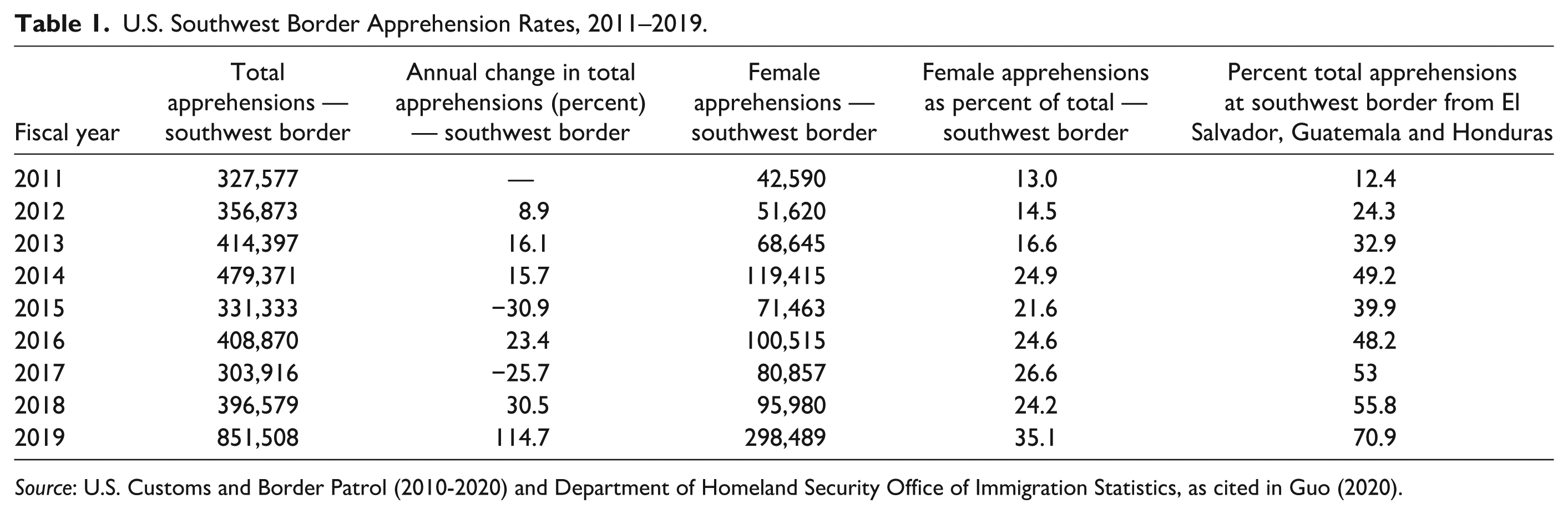
As Table 1 displays, the face of the migrant arriving at the U.S. border in recent years has fundamentally changed from that of the typical migrant arriving at the turn of the century. From 2011 through 2019, the percentage of migrants apprehended at the Southwest border who were women has steadily increased, as well as the number of apprehended migrants who were unaccompanied children or in family units. 4
U.S. Southwest Border Apprehension Rates, 2011–2019.
Source: U.S. Customs and Border Patrol (2010-2020) and Department of Homeland Security Office of Immigration Statistics, as cited in Guo (2020).
Apprehension data underscore that the country of origin has shifted dramatically as well. In 2012, apprehended persons in family units were primarily from Mexico (80 percent), yet by 2019, 91 percent of apprehended persons in family units were from El Salvador, Guatemala, and Honduras (Singer and Kandel 2019). When documenting the total number of apprehensions at the Southwest border, in 2011, 12.4 percent were from Northern Central American countries; by 2019, this percentage had increased almost six times, to 70.9 percent. 5 This picture of the new migrant has only come into sharper relief in the post-Covid-19 period.
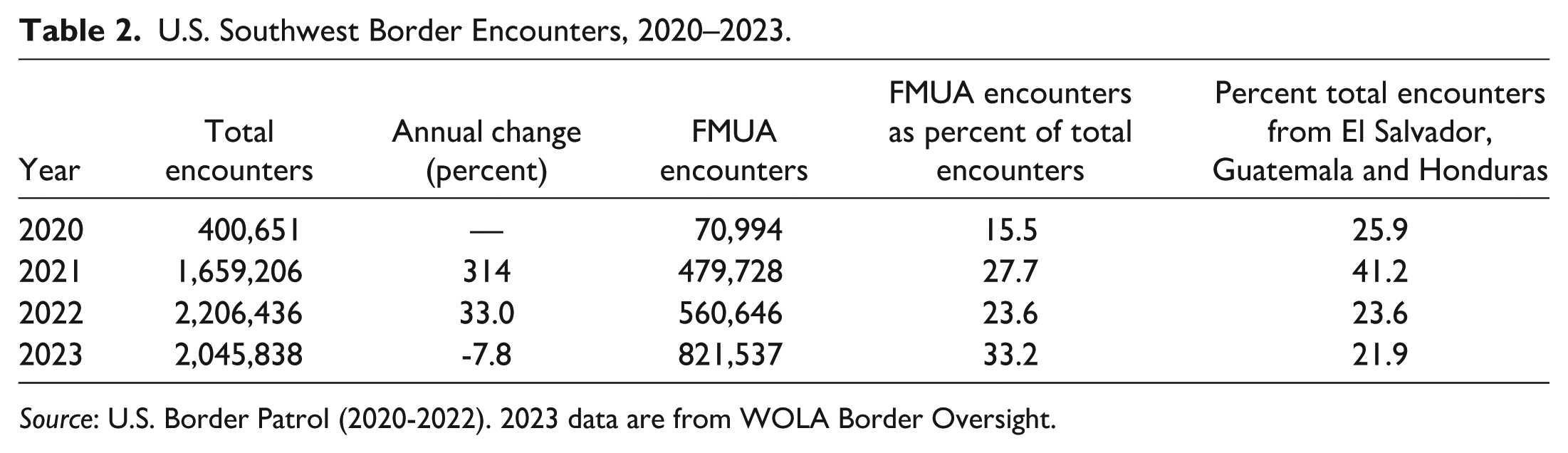
In March of the 2020 fiscal year, the U.S. Border Patrol (USBP) began to report data differently, referring to “encounters” rather than “apprehensions.” Encounters statistics include Title 8 Apprehensions; Office of Field Operations (OFO) Title 8 Inadmissibles; and Title 42 Expulsions. As these data include different categories than the previously used apprehension data, comparisons before and after 2020 must be treated with caution. According to the 2020 data on encounters, 75,074 women were recorded under this new designation, representing 18.7 percent of total encounters at the Southwest border.
Starting in fiscal year 2021, data on encounters are no longer broken down by gender. The USBP data reports only the following demographics available for encounters: Accompanied Minors (AM); Individuals in a Family Unit (FMUA); Single Adults (SA); and Unaccompanied Children (UC). Table 2 reports the FMUA encounters, as this category often includes women. Table 2 also underscores the prevalence of migrants from El Salvador, Guatemala, and Honduras. From 2020 to 2023, the percentage of encounters involving migrants from these three countries never falls below 20 percent. Indeed, in 2021 this percentage spiked to over 40 percent.
U.S. Southwest Border Encounters, 2020–2023.
Source: U.S. Border Patrol (2020-2022). 2023 data are from WOLA Border Oversight.
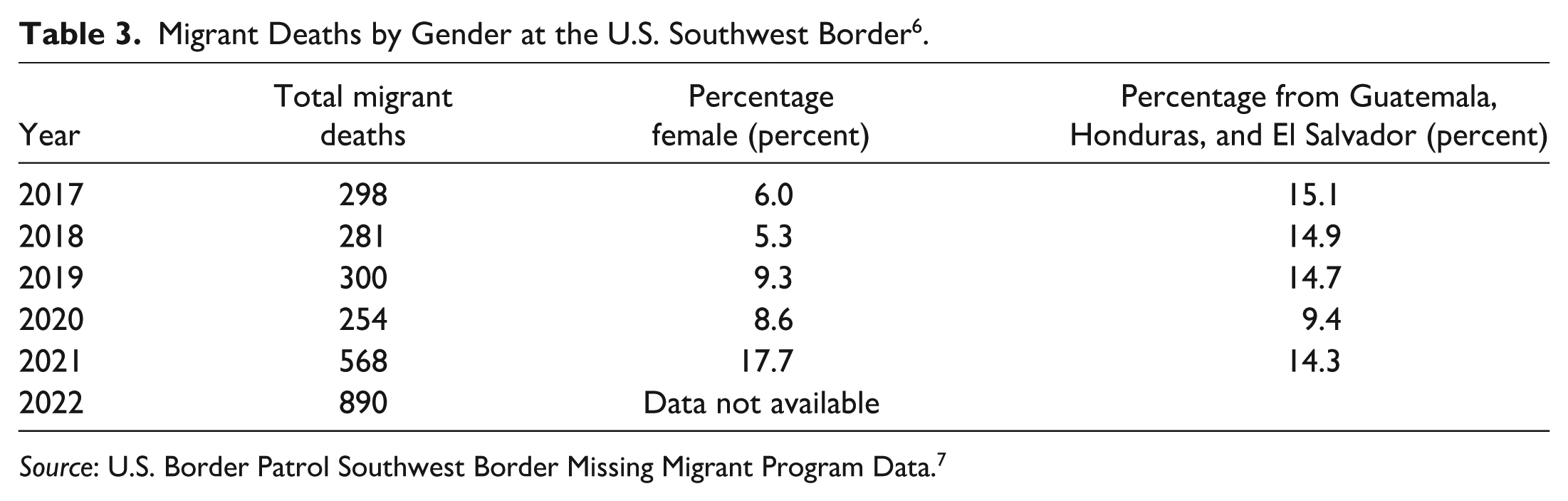
The USBP did report data on migrant deaths by gender. On this tragic indicator, the percentage of women increased sharply between 2017 and 2021. As Table 3 indicates, in 2017 women represented only 6.0 percent of migrant deaths. By 2021, that number had almost tripled to 17.7 percent. With the exception of 2020, the percentage of migrant deaths from Northern Central America was relatively steady, at roughly 15 percent.
Migrant Deaths by Gender at the U.S. Southwest Border 6 .
Source: U.S. Border Patrol Southwest Border Missing Migrant Program Data. 7
A similar pattern emerges from data on unaccompanied children, with the percentage of girls processed by the U.S. Office of Refugee Resettlement growing (2023) from 23 percent in 2012 to 39 percent in 2022 (see Figure 1 below). From 2022 to 2023, the percentage of unaccompanied girls increased further from 36 percent to 39 percent. Taken together, all these data underscore the fact that over the past decade, a growing number of women and girls are fleeing their countries to seek refuge in the United States. Though we lack gender breakdowns of more recent data on encounters, by all accounts, these fundamentally different patterns of gendered migration have continued over the past several years. Indeed, many observers point to the sharp increase in GBV, particularly domestic violence, during the Covid-19 period as yet another factor at play in the increasing number of women emigrants from the Northern Central American region (Gerschutz-Bell 2022).
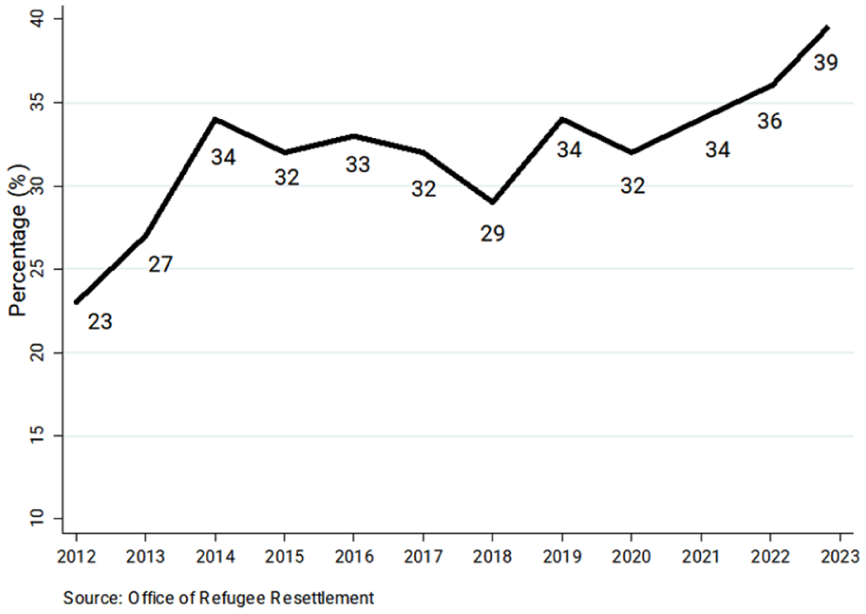
Girls as Percentage of Total Unaccompanied Children Cases Processed by the U.S. Office of Refugee Resettlement (2023).
Violence Against Women in Northern Central America
As we note above, myriad reports underscore the grim reality that GBV pervades women’s lives in Northern Central America. Women often describe the threat of violence and sexual assault as omnipresent, as safety concerns emerge in their homes, at places of work, in their communities, and even at the hands of state actors (Córdova 2025a). The prevalence of organized criminal groups exacerbates these threats to women’s safety, as gang members often intimidate women and young girls through rape and assault and use such violent tactics to terrorize local communities, particularly when they seek to control territories (Gurney 2014). 8 Once established in a territory, gang members use threats of rape and assault to coerce young women to serve as their “girlfriends,” and consequently serve the gang by selling drugs or weapons and/or providing sex on demand (Rubio 2011). In these contexts, state agents, typically from law enforcement or military organizations, will also view women and girls as collateral damage in their war on gangs and treat them as such rather than as citizens deserving of protection. In our prior research, we found that perceptions and reports of gang activity in women’s neighborhoods can shape their intentions to migrate, particularly when these perceptions overlap with the view that the police are involved in crime (Córdova et al. 2025).
Tolerance Toward GBV
Survey data indicate that there is societal indifference and even tolerance toward GBV, which can create conditions for GBV to go unpunished (Azpuru 2015; Pak 2016). In a 2021 national survey, 56 percent of respondents from El Salvador indicated that they regarded domestic violence as a private matter (Barba 2022). In LAPOP Lab’s 2023 AmericasBarometer survey, Salvadoran respondents reported some of the highest levels of tolerance for GBV in the Latin American and Caribbean region, with 31 percent of Salvadoran men condoning or even supporting violence against a wife who neglected her chores, compared with 19 percent of Salvadoran women (see Figure 2). Similarly, around 33 percent of Salvadoran men support or justify gender-based violence if a woman is unfaithful, compared to 26 percent of Salvadoran women (see Figure 3). Guatemalan responses were only slightly lower, with roughly 20 percent–26 percent of both men and women condoning or supporting violence in these scenarios. 9 As tolerance toward GBV exacerbates women’s risk of suffering this type of violence, scholars have noted that the likelihood of international migration also increases. As Azpuru (2015, 1) explains, “domestic violence in Guatemala is a serious problem with consequences that reach far beyond the affected family . . . [such violence] has been mentioned as one of the factors that have driven women with young children to flee the country and emigrate to the United States or other countries.” Unfortunately, as Central American women seek a “sanctuary” abroad to protect themselves from GBV back home, a high percentage of them confront further GBV along the migration route. According to a recent study, Central American immigrant women face a higher risk of violence than their Mexican counterparts, finding that at least 25 percent of Central American women are sexually assaulted as they try to reach the U.S. (Fernández-Ortega et al. 2024).
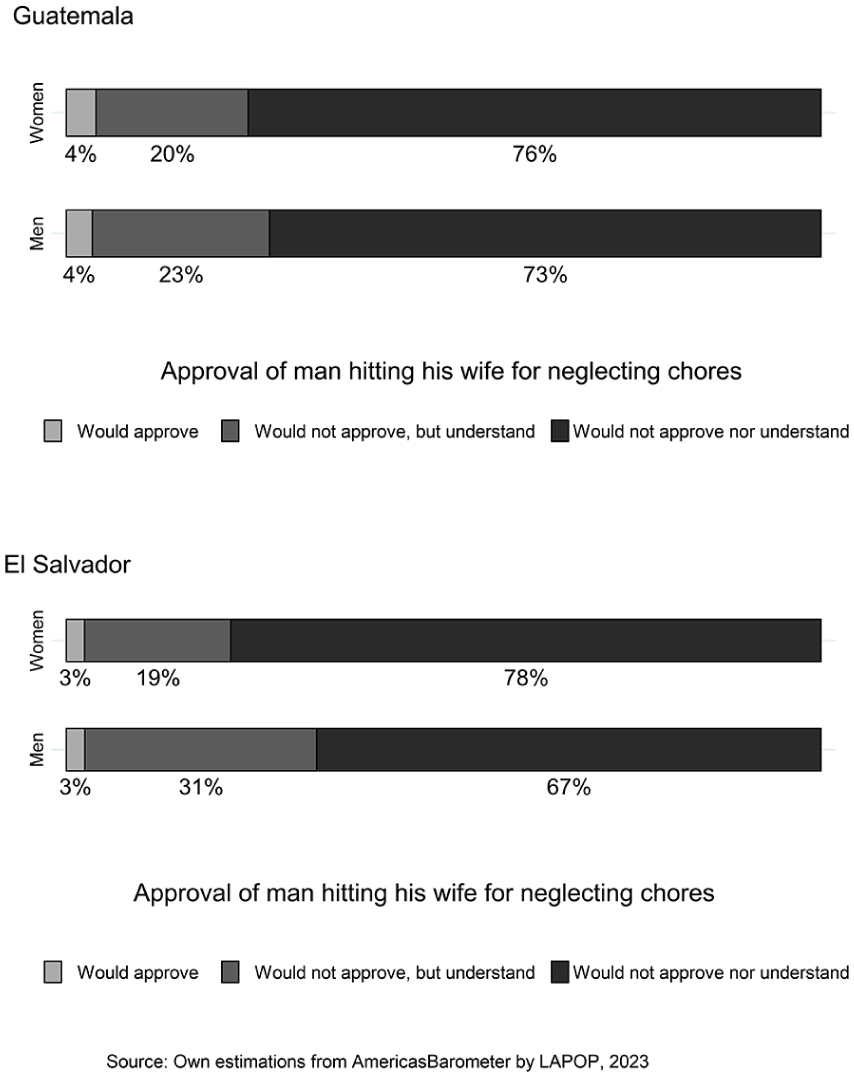
Tolerance toward GBV: Hitting Wife for Neglecting Chores.
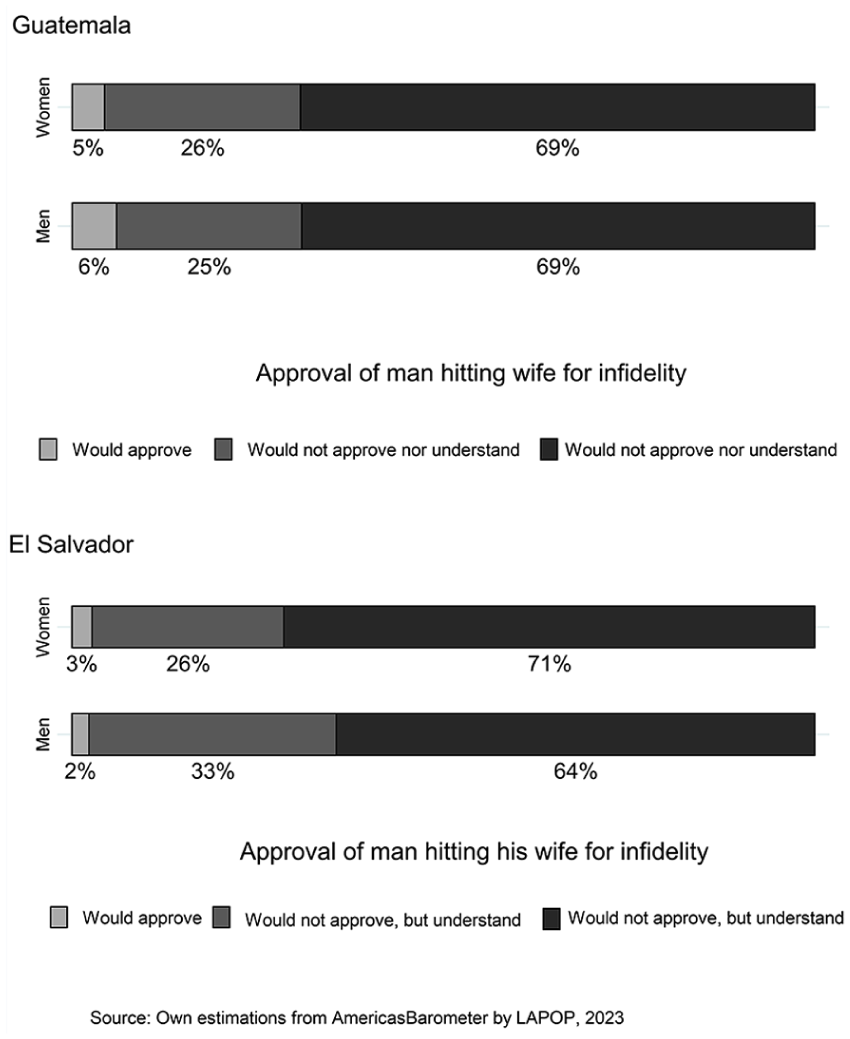
Tolerance toward GBV: Hitting Wife for Infidelity.
Context Matters: The Threat of Gender Based Violence (GBV) in Neighborhoods
The AmericasBarometer survey contains an item that allows us to examine citizen reports of violence against women in their neighborhoods across the three countries of focus: Guatemala, El Salvador, and Honduras. We begin with a look at responses to this item and the contextual factors associated with a higher reported incidence of violence against women at the neighborhood level. To measure individual assessments of the pervasiveness of violence against women in the neighborhood, LAPOP Lab posed the following survey question: Violence against women here in your community . . . is this a problem that is (5) Very serious; (4) Somewhat serious; (3) A little serious; (2) Not serious; (1) Not a problem. (reverse coded to higher numbers denoting a higher incidence of violence against women)
Figure 4 reports the responses to this item across our three countries by gender. We find that Guatemalans are far more likely to consider violence against women a “very” or “somewhat” serious problem compared to their counterparts in El Salvador and Honduras. It is noteworthy, though, that a clear majority of individuals in each country views this issue as a “problem,” albeit with varying levels of seriousness.
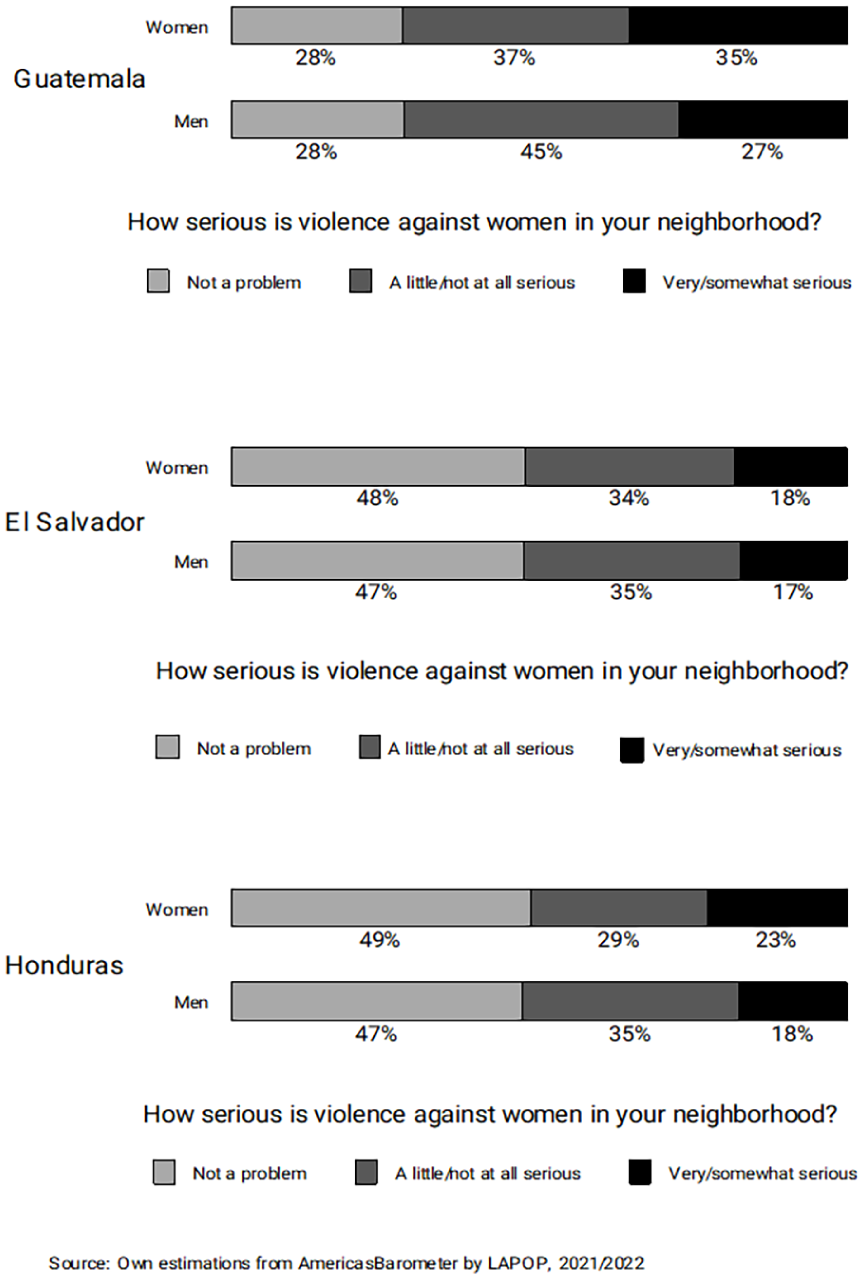
Perceived Seriousness of Violence Against Women in Neighborhood.
Contrary to our initial assumption that women would be much more likely than men to perceive GBV against women as somewhat or very serious, we find that this perception does not vary dramatically across men and women (see Figure 4), particularly in El Salvador and Honduras. More generally, we find that a similar percentage of men and women respondents across the three countries view the issue as a problem in their neighborhood. 10
Using 2022 data for the three countries, we now turn to assess the degree to which these perceptions of violence against women correlate with measures of other types of neighborhood violence, particularly those associated with gang activity and police/military crackdowns in neighborhoods marked by gang-control. In general, a higher incidence of shootings and graffiti in a neighborhood tends to be associated with the presence of gangs in the community, as well as the intervention of state-armed actors in those neighborhoods (Sanchez et al. 2022). These state-initiated military interventions are a hallmark of the “iron fist” public security policies that have characterized state responses to gangs and organized criminal groups in the Northern Central American countries (Cutrona, Dammert, and Rosen 2025). LAPOP included the following two questions in its 2022 survey that allow us to examine reported signs of other forms of violence:
“Shootings are a problem in the neighborhood”
“Graffiti is a problem in the neighborhood”
For both of these survey items, respondents were asked to indicate if these problems were (1) Not a problem; (2) Not serious; (3) A little serious; (4) Somewhat serious; or “(5) Very serious.”
To analyze whether higher levels of perceived violence against women are associated with these forms of violence, we use the pooled dataset across the three countries. As Figures 5 and 6 indicate, men and women who reported that violence against women was a serious problem in their neighborhoods also tended to report a higher incidence of shootings and graffiti (which is typically a mark of gang control) in their place of residence. We find positive, statistically significant and strong correlations between perceived violence against women and shootings as a problem in the neighborhood among both men and women, as well as perceived graffiti. 11
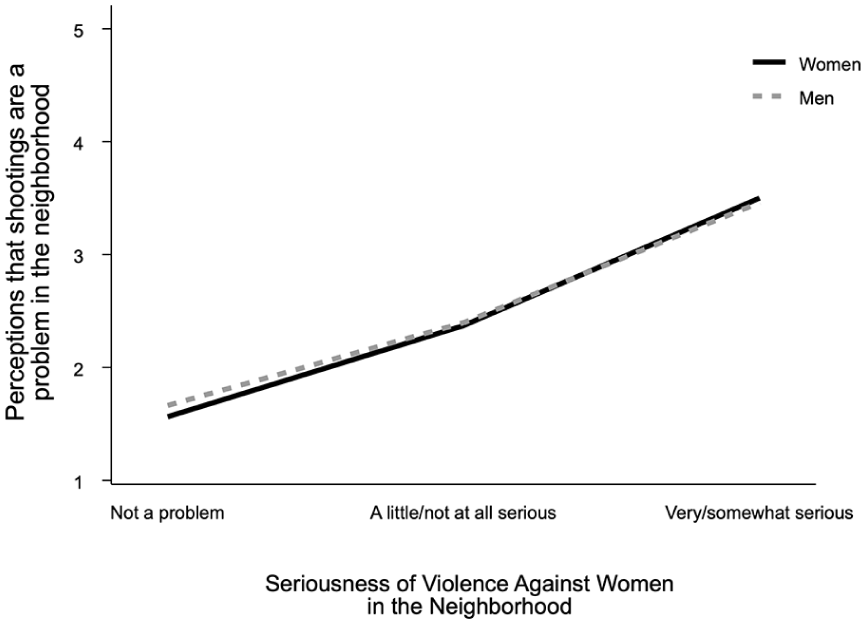
Neighborhood Shootings by Reported Violence Against Women.
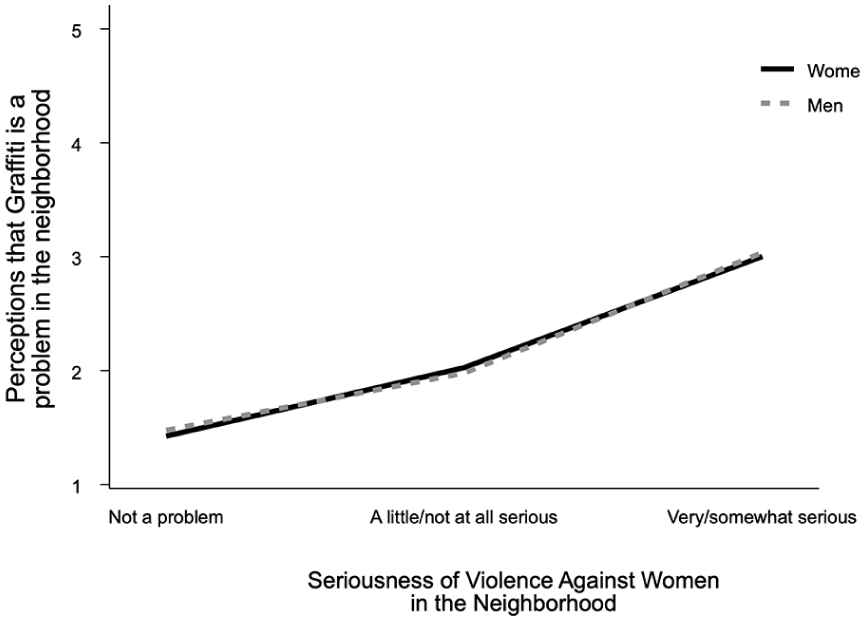
Neighborhood Graffiti by Reported Violence Against Women.
What we can glean from these similarities is that a context of violence against women appears to be recognizable to both men and women, and when the problem is serious in a neighborhood, it also intersects with a context characterized by high levels of shootings and/or graffiti: two indicators of a pervasive gang presence and a potential militarized response to it. In sum, men and women respondents alike living in these communities share very similar views on the litany of security issues they must confront on a daily basis. Since men and women respondents who view violence against women as a serious problem in their neighborhood also agree on other neighborhood evaluations, we can have more confidence that the GBV assessments from respondents correspond to actual conditions on the ground in a particular community.
Reported Violence Against Women and Effects on Migration Intentions
In this section, we first examine the relationship between the reported incidence of GBV against women in one’s neighborhood and intentions to migrate. To measure migration intentions, we rely upon the following survey question: “Do you have intentions of going to live or work in another country in the next three years? (1) Yes, or (0) No.” Though certainly not a measure of actual emigration, an increasing number of scholars find that survey questions assessing an individual’s “emigration intentions” offer a meaningful proxy for actual migration, particularly in high migration countries (e.g., Creighton 2013; Ryo 2013). Further, in standard models of emigration intentions, many of the most influential variables are highly consistent with those factors typically used to explain emigration itself, suggesting that while intentions do not always translate into action, the pool of potential emigrants likely includes most actual emigrants.
Table 4 presents the regression models of our analysis of migration intentions. Our statistical analysis relies on a series of logistic models. Model 1 reports the results of our full model, which includes data for both men and women. Models 2 and 3 replicate this analysis separately for men and women to examine whether the effects of independent variables vary between genders. Finally, Model 4 includes an interaction effect between gender (women or men) and the variable capturing reported violence against women in the neighborhood. Our main independent variable of interest is perceived violence against women. All models control for a series of variables known to be correlated with international migration, plus dummy variables for each country (i.e., country fixed effects). We present the exact wording of all variables included in our models in Supplemental Table A1 in the online appendix.
Factors Predicting Migration Intentions.
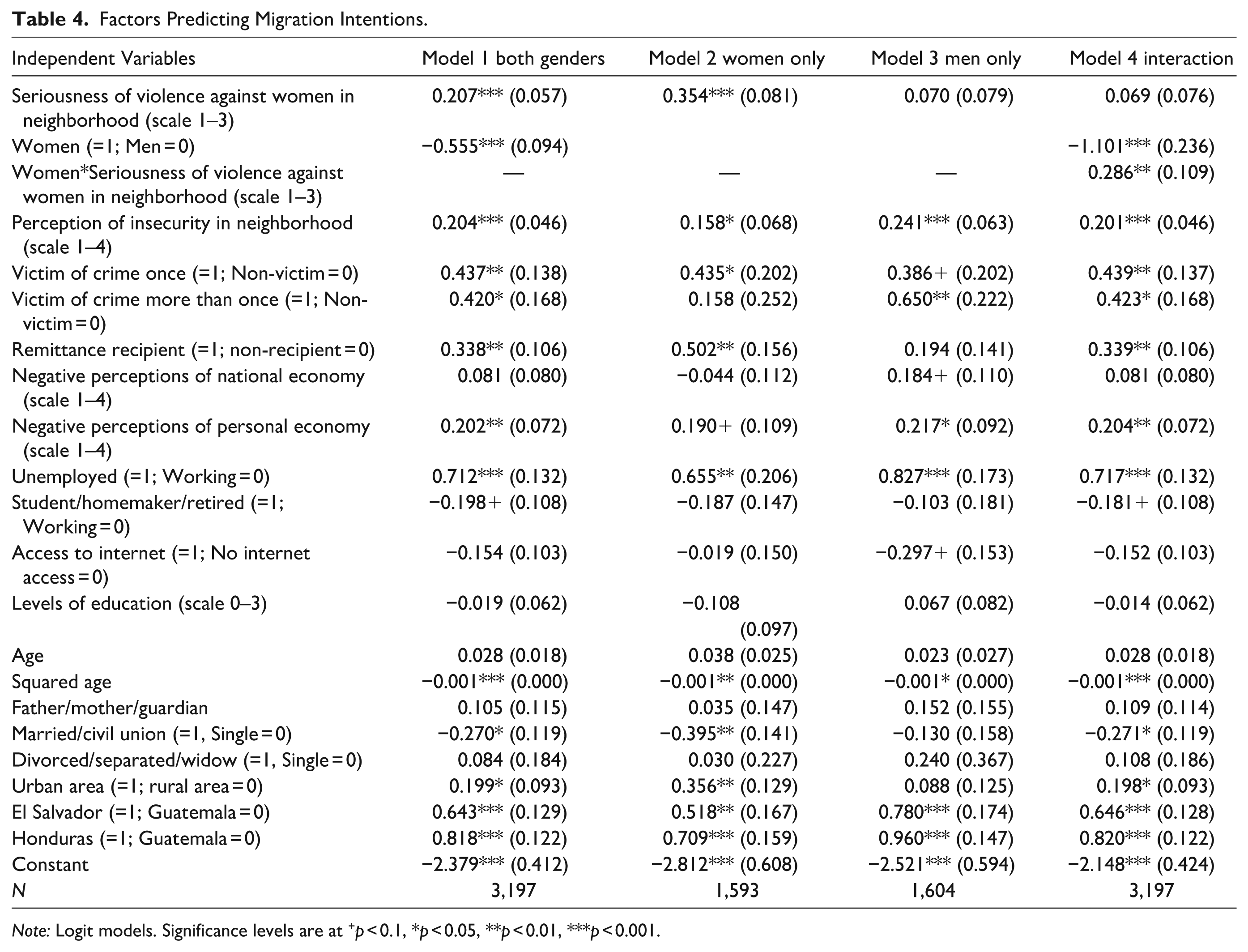
Note: Logit models. Significance levels are at +p < 0.1, *p < 0.05, **p < 0.01, ***p < 0.001.
Model 1 in Table 4 shows that, as expected, on average women are less likely to intend to migrate than men, and that an overall sense of neighborhood insecurity is associated with a higher probability of migration intentions. Victimization by non-gender crimes, such as robbery and extortion, also increases the probability of harboring migration intentions, which confirms the results of our previous research (Malone et al. 2025). Importantly, as we show in the online Supplemental Appendix, although non-gender crime victimization is correlated with GBV in the neighborhood (r = 0.12; p < .05)., the significant effect of non-gender crime victimization we observe in Table 4 Model 1 is stable and not the result of multicollinearity. 12 Model 1 shows that economic conditions also matter. Individuals having a negative perception of their personal economy and those unemployed are more likely to intend to migrate. In addition, having a strong social network abroad, as reflected by receipt of remittances, is associated with higher migration intentions. Consistent with migration patterns, we also observe that citizens in El Salvador and Honduras are more likely to express migration intentions compared to Guatemalans.
Further, turning to the main variable of focus, we observe in Model 1 that on average, perceptions of violence against women are positively associated with migration intentions. However, as shown in Models 2 and 3, which restricts the analysis to either men or women, respectively, this average effect is driven by women. The coefficient associated with the perceived violence against women variable is statistically significant in the women sample (Model 2), but not when the analysis is restricted to male respondents (Model 3). We also observe that, while general perceptions of insecurity also shape women’s migration intentions, perceptions of gender-based violence specifically are more influential. Men’s perceptions of neighborhood insecurity, as measured by fear of non-gender crime victimization, are much stronger predictors of intentions to migrate, compared to women. Interesting gender effects also manifest along control variables, including the stronger positive effect of remittance receipt on women’s likelihood of migration intentions compared to men.
Model 4, which contains the interaction term, allows us to further examine the effect of our primary independent variable on migration intentions and its gender effects. We find a positive and statistically significant interaction term between the reported violence against women variable and gender. Given the difficulty of interpreting interaction effects, we estimate predicted probabilities and examine graphically the effect of perceived violence against women in the neighborhood on migration intentions by gender.
As evident in Figure 7, we see first that men on average have a much higher probability of reporting intentions to migrate. This finding is consistent with what we know about actual migration behavior in the region, where men are far more likely to migrate than women, all else equal. Second, consistent with Model 3, we see from Figure 7 that men’s perception of the severity of violence against women in the neighborhood has a negligible impact on their migration decision. Simply put, it does not seem to matter whether a man lives in a community in which violence against women is a “serious” problem or not a problem at all with respect to his migration decision. Conversely, consistent with Model 2, for women respondents, the perceived severity of violence against women in the neighborhood appears to be a principal determinant of her decision to migrate or not. For those women living in a community in which violence against women is “not a problem,” women’s probability of wanting to migrate is around 21 percent. For those women living in a neighborhood where violence against women is deemed “somewhat” or “very” serious, however, the likelihood that they will express intentions to migrate approaches that of men at around 33 percent. When GBV against women is not perceived as a problem in the neighborhood by both men and women, there is a “gender gap” in migration intentions, with women showing a lower probability of planning to migrate. However, this gap closes as women perceive GBV to be a more serious problem in their neighborhoods, and their migration intentions are on par with those of men.
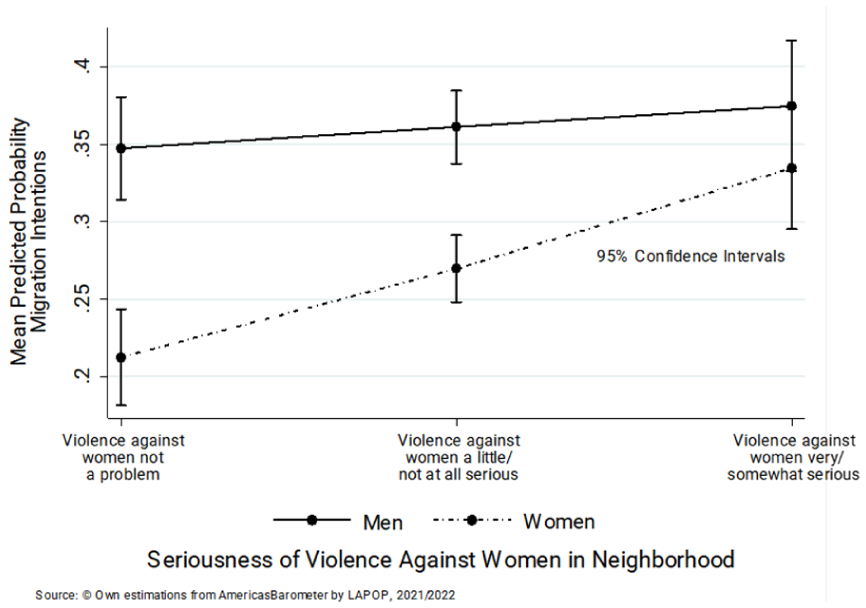
Mean Predicted Probability of Intending to Migrate by Reported Violence against Women and Gender.
These results offer further support that a fundamental difference in the drivers of migration for men and women is the degree to which GBV is prevalent in the lives of women, independent of their general perceptions of neighborhood insecurity or experiences with non-gender crimes. The gender gap in the probability of intending to migrate closes for women who face the threat of GBV in their neighborhood. In short, both men and women in such neighborhoods show a similar probability of wanting to migrate (Figure 7), despite men’s overall higher likelihood of intending to migrate. These results underscore the importance of accounting for gender to understand international migration patterns and the need to account for neighborhood or community level risk factors to uncover the drivers of migration.
Conclusion
Taken together, our survey analyses indicate that Central American women experience violence differently than men. Women confronting a community context of GBV seek to leave, while such a context has no discernible impact on men’s probability of leaving their country. Further, we find that those individuals identifying violence against women as a serious problem in their neighborhood live in contexts also characterized by higher overall levels of other forms of violence, as manifested in a higher probability of shootings and the presence of gang violence. This finding is consistent with what we know about communities marked by violence in the Northern Central American region — that they tend to be threatening on a daily basis as both gangs and state armed actors engage in violence in those territories. Even when migration involves a higher likelihood for women of experiencing additional gender-based violence during their trip North (Cook Heffron 2019), women living in contexts marked by gang violence and militarization opt for international migration as a last resort to flee violence in general and GBV in particular. While the majority of both men and women in our survey reported that violence against women was widespread, perceptions of such GBV shaped only the migration decision of women. When women perceive violence against women in their neighborhoods as very serious, they become just as likely as men to plan to migrate. In contrast, in areas where GBV against women is not viewed as a problem, the probability of migration plans among women is substantially lower than that of men. These findings, then, highlight the need to specifically target government policies, both domestic and international, to address the specific ways in which violence infects the lives of women.
Our findings also raise additional questions for future research. GBV has historically been pervasive throughout the Central American region, yet it did not appear to drive as many women to migrate in the past. According to the data on female apprehensions at the Southwest border, prior to 2014, less than 25 percent of migrants apprehended were women. This raises the question as to why women are more likely to respond to perceived threats of GBV by migrating today, compared to historical trends. Several plausible avenues of inquiry exist to explore this question, such as the greater availability of information on migration routes, the reported flourishing of in-country commercial migration services, and the possibility that over the past twenty years, state responses to gang violence focused on the militarization of marginalized neighborhoods have left women’s safety needs largely unaddressed. The latter have further increased the risk of GBV for women at the hands of state armed actors, lowering their trust in state institutions that should ostensibly serve their interests. The answers to these and many other questions demand continuing research in order to better understand the difficult and life-changing decisions being made by women and men across the region.
Policy Implications
During the Biden administration, with the support of USAID, the U.S. had forcefully called for the local implementation of policies to address the root causes of Central American migration, which included gender-based violence. Trump’s second administration not only dismantled USAID, it also dramatically shifted the government’s approach to address undocumented immigration, relying exclusively on a deterrence approach that includes deportation efforts with no apparent regard for the international principle of non-refoulement, and travel bans on citizens from many countries across the world. Taken together, the results of our previous research (Córdova et al. 2024) and this study suggest that without addressing the root causes of migration, including GBV, a deterrence approach will not only continue to result in human rights violations but also will prove ineffective to stop forced migration from Central American countries long term. In the particular case of women, they will continue to migrate and encounter further risks to their physical and psychological integrity so long as these countries do not prioritize the eradication of GBV and thus fail to implement effective and comprehensive policies to address women’s safety and increase their access to justice.
In line with the results of our research, we identify key areas that Central American governments must address to eradicate GBV and subsequent forced migration. We end with a call for a shift in the current U.S. government’s approach from a deterrence strategy — including arbitrary arrests and deportations that have led to severe human rights violations — to one that adheres to the rule of law according to domestic and international standards. Further, we conclude by emphasizing the pressing need for a more forceful involvement of other donor governments, such as Canada and European nations, in coordinated efforts to help mitigate the triggering factors of forced migration and human suffering in the region, including GBV.
An Agenda for Central American Governments’ Action on GBV
We identify five related areas of Central American governments’ action to address GBV and thus women’s forced migration. First, national and municipal governments in the region should increase their budget allocations to invest in evidence-based measures to prevent and respond to GBV. Unfortunately, the opposite is occurring. The percentage of national budgets allocated to eliminate GBV remains extremely low in all three countries, and has decreased in Guatemala and El Salvador over the past several years. Using data from a study by the UNDP and USAID (2023), Figure 8 shows the percentage of the national budget allocated to the main institutions in each country in charge of GBV attention and prevention: ISDEMU in El Salvador, INAM in Honduras, and SEPREM in Guatemala. 13 Between 2010 and 2021, their budget allocation remained less than 1 percent, showing important declines from year to year in some cases. Current budget allocations are clearly insufficient to address GBV and consequently to make international migration a choice and not a necessity for women.
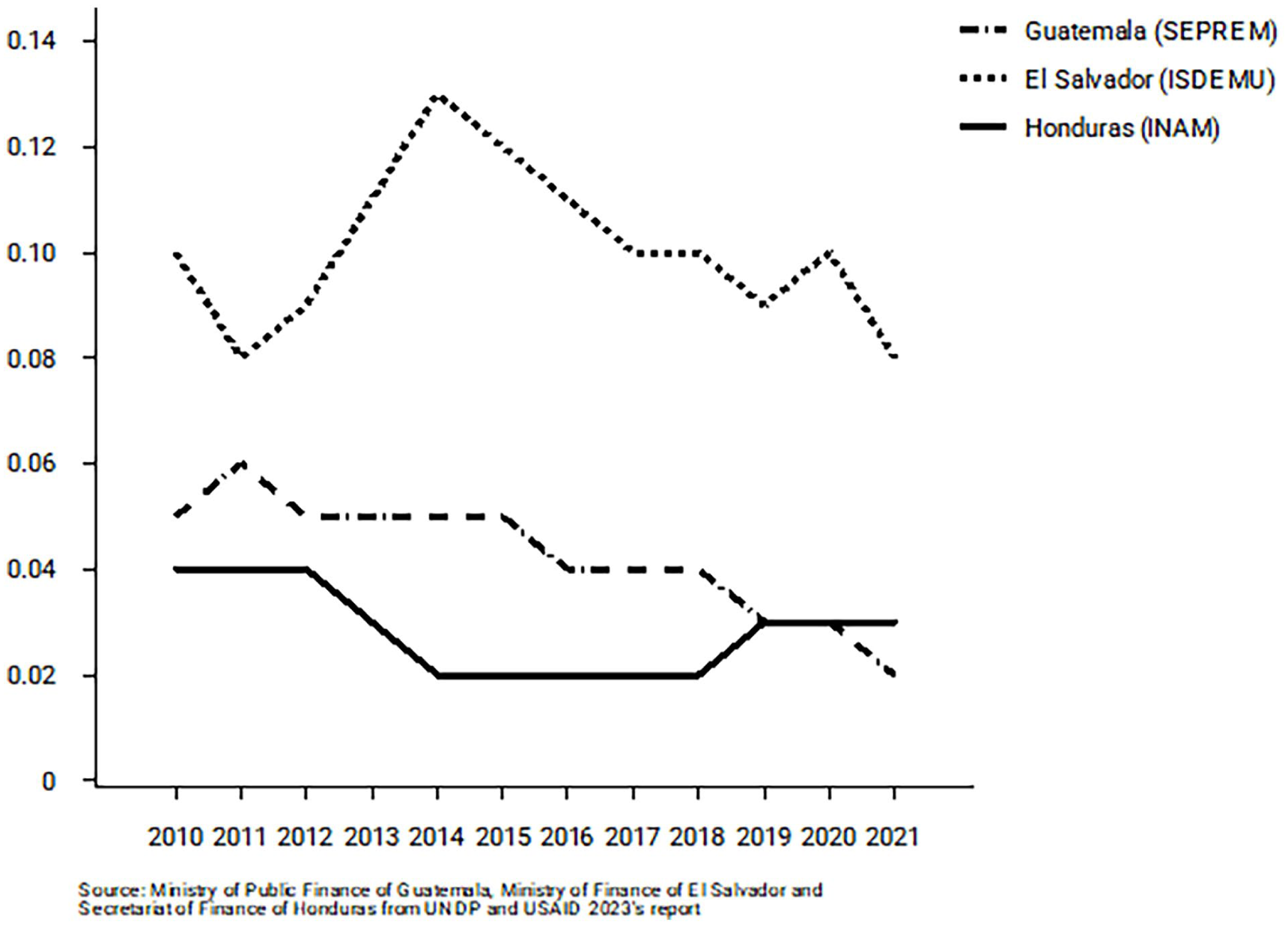
Percentage of Budget Allocated to Public Institutions Addressing GBV.
Second, in addition to improving legislation mandating specialized services to address GBV, resources need to be invested to strengthen the capacity of already existing specialized institutions focused on the attention, investigation, and prevention of GBV, such as women’s shelters and specialized police stations and tribunals. For example, research using experimental and quasi-experimental designs in Latin American countries (including El Salvador) shows that increasing the representation of women in specialized police units and offering specialized services to women survivors can increase confidence in the police among women and improve men’s attitudes toward GBV (Córdova 2025b). When implemented and funded properly, women’s police stations can systematically provide services to survivors of GBV and increase access to justice. 14 Even increasing the number of women police officers can strengthen trust in justice institutions ostensibly responsible for ensuring women’s safety, and the fostering of such trust is critical given that women’s trust in state institutions and justice institutions more specifically has been frayed by state actors who ignore or are complicit in GBV. 15
Third, given the high levels of tolerance of GBV, Central American governments should also work to change perceptions about GBV, and socialize citizens to recognize that it is a crime, not a private matter. For example, the Guatemala’s Secretariat against Sexual Violence, Exploitation and Trafficking in Persons (SVET) in Guatemala works in this vein. Created by the Law against Sexual Violence, Exploitation, and Human Trafficking in 2009, SVET aims to provide an institutional foundation for confronting GBV. One of its primary objectives is to develop, monitor, and implement public awareness campaigns and training sessions to educate people that GBV is a crime, and identify resources for those who have been victimized. 16 However, it is important to rigorously examine the impact of such campaigns and education programs before implementation to assess their effectiveness and subsequent need for adjusting their design. As Figures 2 and 3 presented above show, on average, the percentage of men who tolerate GBV in Guatemala appears lower than in El Salvador; yet the lack of rigorous impact evaluations in Guatemala do not allow us to attribute this result to the implementation of programs such as SVET. Recent evidence from El Salvador does give us confidence that specific campaign content and design, along with improvement in education access, can generate changes in social norms supportive of women’s safety and gender equality. More specifically, the study shows that campaigns evoking the law and indicating that sexual harassment is a crime improves men’s attitudes toward survivors, but particularly among those with at least secondary education (Córdova 2025c).
While public or private investments in specialized services and campaigns are important, they are insufficient to effectively address GBV if national security policies continue to prioritize the militarization of public security. Extensive research shows that militarized policies result in increased human rights violations (e.g., Flores-Macias and Zarkin 2023), including sexual violence against women committed by the police and military in marginalized neighborhoods marked by organized crime (Córdova 2025a). Therefore, our fourth policy implication underscores the need of shifting public security policy in Northern Central American countries from excessive use of force to one rooted in human rights. This is a necessary condition to protect all citizens and maximize the effectiveness of well-funded specialized services to address GBV. If citizens in general encounter state repression rather than protection, they will continue to turn to migration as the only option available to them.
Implications for the U.S. and Other Foreign Governments
At this writing in June 2025, the prospects for an informed, empirically-based U.S. migration policy that respects basic human rights are bleak. The Trump administration has eschewed due process and respect for basic human rights in favor of indiscriminate arrests and mass deportations. Should civil society mobilization succeed in challenging and reversing these trends, there are several ways in which the U.S. could address GBV with its migration policies. First, the U.S should recognize the gendered differences inherent in the migration experience and therefore the need of implementing a gendered approach to immigration. 17 The militarization of the U.S. Southwest border, and Mexico’s border with Guatemala, has created space for state repression and organized criminal groups to profit off migrants’ vulnerability (Solano and Massey 2022; Pries et al. 2024). To respond to the externalization and securitization of U.S. and Mexican migration policies, migrants have reconfigured their travel routes and spend more time in transit or residing in temporary transit zones, increasing women migrants’ vulnerability to GBV. Central American migrants now spend far more time in transit and protracted displacement in Mexico, which creates additional challenges of human security as these migrants lack secure access to housing, food, employment, and a safe environment (Faret et al. 2021; Gil-Everaert, Masferrer, and Rodriguez Chavez 2023). 18
To address the vulnerability of women migrants, an informed U.S. policy would invest in processing asylum claims according to domestic law and international treaties, rather than rejecting asylum claims outright. Even prior to the anti-immigrant campaign of the second Trump administration, the U.S. immigration court system was not capable of processing asylum claims expeditiously. Due to a lack of resources and investment, immigration courts faced a chronic backlog of pending cases that undermined their ability to do their jobs (Kerwin and Millet 2023). Increased resources for the immigration court system would be critical for providing a measured and equitable adjudication process for what are oftentimes life-or-death cases. Importantly, any measure to address immigrant women’s needs, including that of fleeing GBV, requires the expansion of eligibility categories of current U.S. asylum legislation. Without the explicit inclusion of GBV as a protected ground for asylum, it becomes extremely difficult for survivors to exercise their right to seek asylum according to international law.
In a similar vein, the U.S. could reinstate programs that allow migrants to apply for humanitarian parole in their home countries before embarking on the journey north, with critical improvements. For example, in 2023, the Biden administration launched a program to create a legal pathway for nationals of Cuba, Haiti, Nicaragua, and Venezuela to request humanitarian parole and enter the U.S. legally — the Processes for Cubans, Haitians, Nicaraguans, and Venezuelans (CHNV) program. While flawed, the CHNV did allow some citizens of these four countries to come to the U.S. if they had a U.S. sponsor and passed a background check. 19 CHNV migrants could legally live and work in the U.S. for two years, using a legal mechanism known as “humanitarian parole” (American Immigration Council 2023). According to the CBP, this policy change corresponded to a decrease in the number of apprehensions of migrants from these countries at the Southwest border. 20 An expanded and improved version of this humanitarian parole program could be tailored to address the needs of migrants fleeing GBV in their home countries.
Unfortunately, at the time of writing, the prospects for improving existing U.S. programs and legislation that provide protection to at-risk immigrants, or establishing new ones, seem more distant than ever. With the second Trump administration now in office, the militarization of the Southern border and the mass deportation of immigrants — including those with protected status — have become the central priorities of immigration policy. While civil society has mobilized to challenge the de facto closing of the U.S. border and the creation of a mass detention and deportation infrastructure, as of this writing, these drastic changes to U.S. migration policy paint a bleak picture for survivors of GBV. In response to the administration’s transgressive actions, we urge international organizations and human rights advocates to engage in coordinated efforts to demand U.S. adherence to international law and uphold the fundamental rights to migration and asylum.
Finally, other foreign governments also have an important role to play now more than ever. Given the dismantling of USAID and the draconian, and largely unlawful, approach of the current U.S. administration to address undocumented immigration, it is all the more imperative for other receiving countries, such as Canada and those in the European Union, to join forces and help fund local projects in Northern Central America that serve the needs of some of the most vulnerable migrant populations, such as women. SVET in Guatemala is an example of multi-sector and country collaboration, including the Canadian government. Through its Technical Assistance Partnership (TAP) initiative, the Canadian government has supported the design and implementation of a digital platform to collect and monitor data and indicators on crimes of sexual violence, exploitation, and human trafficking, with the goal of targeting resources to the areas and populations that are most vulnerable. Improving and expanding such strategic coordination and alliances among foreign governments and civil society is critical to address GBV and a key root cause of women’s migration.
Supplemental Material
sj-docx-1-mhs-10.1177_23315024251369503 – Supplemental material for Violence Against Women and Central American Migration
Supplemental material, sj-docx-1-mhs-10.1177_23315024251369503 for Violence Against Women and Central American Migration by Abby Córdova, Jonathan Hiskey, Mary Malone and Diana Orcés in Journal on Migration and Human Security
Footnotes
Declaration of Conflicting Interests
The author(s) declared no potential conflicts of interest with respect to the research, authorship, and/or publication of this article.
Funding
The author(s) received no financial support for the research, authorship, and/or publication of this article.
Supplemental Material
Supplemental material for this article is available online.
1
In 2011, 6.1 percent of apprehensions at the Southwest border were of citizens from Guatemala, 4.5 percent from Honduras, and 4.0 percent from El Salvador. Beginning in March of the 2020 fiscal year, USBP began to report data on encounters instead of apprehensions. Consequently, data on encounters after 2020 is not strictly comparable to data on apprehensions from prior years.
2
3
Scholars also noted that women faced higher barriers to migration than men (Donato 1993; Hondagneu-Sotelo 1994; Kanaiaupuni 2000;  ).
).
4
The categories of unaccompanied children and family units often include women. For example, in FY 2019, the last year data were reported by gender, approximately 48 percent of family units apprehended were headed by women, 44 percent by men, and 8 percent by two parents (). In 2012, at the Southwest border, single adults made up 90 percent of apprehended migrants; by 2019, persons in family units and unaccompanied children together accounted for 65 percent of those apprehended (ibid.). Also in 2019, approximately 30 percent of unaccompanied child apprehensions were girls (ibid.).
5
In contrast, from 2011 to 2019, the percentage of migrants apprehended at the Southwest border from all other countries (i.e., not from Guatemala, El Salvador, Honduras, or Mexico) never reached 10 percent. This started to change in 2021, when there was a spike in migrants from countries that historically had not been part of the migration flow. In 2021, 5.8 percent of encounters at the Southwest border were with citizens of Ecuador; 3.4 percent from Brazil; 3.0 percent from Nicaragua; 2.9 percent from Venezuela; 2.7 percent from Haiti; and 2.3 percent from Cuba ().
6
For more information on how data on migrant mortalities are collected, see: https://www.cbp.gov/newsroom/stats/border-rescues-and-mortality-data. For limitations on the reliability and validity of these data, see: .
8
9
This question was not included in the Honduran sample.
10
Data for El Salvador allows us to examine the temporal stability of GBV. Prior to 2022, this variable was only included in the 2016 LAPOP Lab survey for this country. Even though 2016 was one of the most violent years since the ending of the civil war, we find that respondents in El Salvador were equally likely to perceive violence against women in their neighborhood as “a problem” in 2022 as it was in 2016. The similar percentage acknowledging violence against women as “a problem” suggests that violence against women continues to be endemic in many neighborhoods, demonstrating that this type of violence remains unaddressed.
11
In Figure 5, the correlations between perceived violence against women and shootings are 0.465 and 0.528 among men and women, respectively. In , the correlations for men and women between perceived violence against women and graffiti are 0.453 and 0.469. All correlations are statistically significant at p < .05.
12
Supplemental Table A2 in the appendix reproduces Model 1 in , adding the variables on GBV and non-gender crime victimization separately. We observe that the coefficients of both variables remain stable and statistically significant, suggesting that each of these two variables have an independent effect on migration intentions and therefore that our results are not merely the product of multicollinearity.
13
ISDEMU is the Instituto Salvadoreño para el Desarrollo de la Mujer. INAM stands for Instituto Nacional de la Mujer, and SEPREM the Secretaría Presidencial de la Mujer.
14
Nicaragua had originally pioneered several of these innovations with promising results. Compared to other Central American countries, Nicaragua recruited a far greater percentage of women into police ranks, and was the first to open specialized women’s police stations in 1993, staffed exclusively by women to provide comprehensive support for victims of violence (Beltrán 2007; Walsh 2019). These specialized police stations and the recruitment of women into police forces generated more public trust in the police and greater willingness to report gender-based crimes (Walsh 2019). However, these women’s police stations and other initiatives against GBV became collateral damage in ongoing clashes between the incumbent government of President Ortega and women’s civil society organizations and were shut down by the Ortega administration (Vílchez 2022; ).
15
Indeed, in a study of perceptions of justice in Mexico, Barba, Lupu, and Zechmeister (2023) find that women respondents expected their justice institutions to respond to violence against women with impunity rather than accountability.
16
17
Ekanayake et al. (2023) make a similar argument when examining the policies of the United Nations High Commissioner for Refugees (UNHCR) and partner UN agencies, arguing that “taking gender seriously means recognizing how protection needs may be shaped by power relationships, and how policy and practice would be enhanced by a more nuanced understanding of how vulnerabilities and opportunities are structured by gender and the specificities of the displacement context. They highlight the importance of bringing “humanitarian policy on gender and forced displacement into conversation in order to strengthen protection” (, 243).
18
Due to the externalization of U.S. border security policies, between 2014 and 2021, asylum applications in Mexico increased sharply from 2,000 to 130,000, making Mexico the third-largest country for asylum requests (Gil-Everaert, Masferrer, Rodriguez Chavez 2023).
19
Flaws include the small scope of the program, which originally reserved 30,000 spots for nationals from CHNV countries. In the first several months of the program, the United States Citizenship and Immigration Services (USCIS) received 1.5 million applications (). In a more punitive vein, the U.S. sharply restricted the ability of citizens from CHNV countries to apply for asylum under U.S. immigration law at the Southwest border and declared migrants ineligible for the program if they attempted to begin their migration journey after the program was announced.
20
In December of 2022, the CBP encountered 91,344 VCHN migrants at the Southwest land border. In February of 2023, after expansions to legal pathways to migration through parole, this number had dropped to 14,381, a sizeable decrease.
References
Supplementary Material
Please find the following supplemental material available below.
For Open Access articles published under a Creative Commons License, all supplemental material carries the same license as the article it is associated with.
For non-Open Access articles published, all supplemental material carries a non-exclusive license, and permission requests for re-use of supplemental material or any part of supplemental material shall be sent directly to the copyright owner as specified in the copyright notice associated with the article.
