







Abstract
Executive Summary
This study evaluates the impact of Indonesia’s Zero Rupiah Passport Policy (ZRPP) on international migration as a coping mechanism for climate-induced displacement. Introduced by the Government of Indonesia to reduce financial barriers to passport acquisition, the ZRPP has reshaped migration patterns, particularly among communities affected by climate disasters.
Using Indonesia’s Potential Village data (PODES) from 2008 to 2021 and employing the Difference-in-Differences (DD) methodology, this research analyzes the causal relationship between ZRPP and migration decisions. Sub-districts affected by climate disasters are identified as the treatment group, while unaffected areas serve as the control group.
Key Findings: The ZRPP proved instrumental in facilitating migration for vulnerable populations from disaster-prone areas, reducing economic barriers and enabling mobility. Migration decisions were significantly influenced by the need for safety and better opportunities abroad, particularly after climate-related disasters. The education, skills and development program, health facilities, and vulnerable families were found to have a significant effect on international migration.
Policy Recommendations: Strengthen security, healthcare access, and job opportunities in disaster-prone regions by coordinating efforts between the Ministry of Manpower, BNPB (National Agency of Disaster Management), Ministry of Social Affairs, and local governments. The Ministry of Home Affairs and Ministry of Social Affairs can offer assistance for minority communities impacted by climate disasters and social tensions. The Ministry of Manpower can align the Zero Rupiah Passport Policy (ZRPP) with climate adaptation policies so that migrant workers are better protected. Develop long-term disaster resilience initiatives through BNPB, the Ministry of Social Affairs, and local governments, ensuring preparedness and sustainable recovery support. Carry out regular evaluations of support and migration programs, coordinated by BAPPENAS (Ministry of National Development Planning) and relevant ministries, to keep them effective and responsive to changing conditions. Build stronger regional cooperation, with the Ministry of Foreign Affairs and ASEAN working together on joint frameworks to protect migrants from climate and social risks.
Keywords
Introduction
The frequency of climate-related disasters has sharply increased over the past decade, resulting in complex socio-economic challenges, including international migration and rising crime rates (Mechler and Bouwer 2015; Castelli 2018). Disasters disrupt communities, displace populations, and strain resources, leading to heightened social tensions and security concerns (Drabo and Mbaye 2015; Gröschl and Steinwachs 2017). Furthermore, as vulnerable populations migrate in search of safety and stability, they often face economic hardship, which can further exacerbate crime rates and social instability in both their origin and destination regions.
Indonesia is highly vulnerable to natural disasters due to both climate change and the nation’s geographic location (National Agency for Disaster Countermeasure 2021). Positioned along the Pacific Ring of Fire, the country frequently experiences volcanic eruptions, earthquakes, and tsunamis. Climate change has intensified these risks by increasing the occurrence of typhoons, floods, and extreme weather events, making Indonesia one of the world’s most disaster-prone countries (National Agency of Disaster Management 2023).
International migration can serve as a coping mechanism for vulnerable populations seeking safety from natural and climate disasters (Cinque and Reiners 2022). According to the Indonesian Migrant Workers Protection Agency (2024), the number of migrant workers rises notably within six to twelve months following a disaster. International migrant work is particularly popular among low-income and vulnerable families due to the its relatively easy access and low entry requirements, typically requiring only a high school diploma and no specific skills (Ha and Mendoza 2010). This movement often involves migration from developing to developed countries, driven by pull factors in the destination countries (Boucher and Cerna 2014; Flahaux and De Haas 2016).
Figure 1 shows the increasing number of Indonesian migrant workers from 2008 to 2024, categorized by island. Java, Kalimantan, and Sulawesi Islands have maintained relatively stable and consistently high numbers of migrant workers. However, there has been a significant increase in the number of migrant workers from Papua Island since 2014. According to the Indonesian Migrant Workers Protection Agency (2024), the primary destination countries for Indonesian migrant workers are Saudi Arabia, Taiwan, Hong Kong, Malaysia, Japan, and South Korea. However, due to a series of negative incidents involving Indonesian migrant workers in Saudi Arabia, the Indonesian government decided to ban migration to that country.
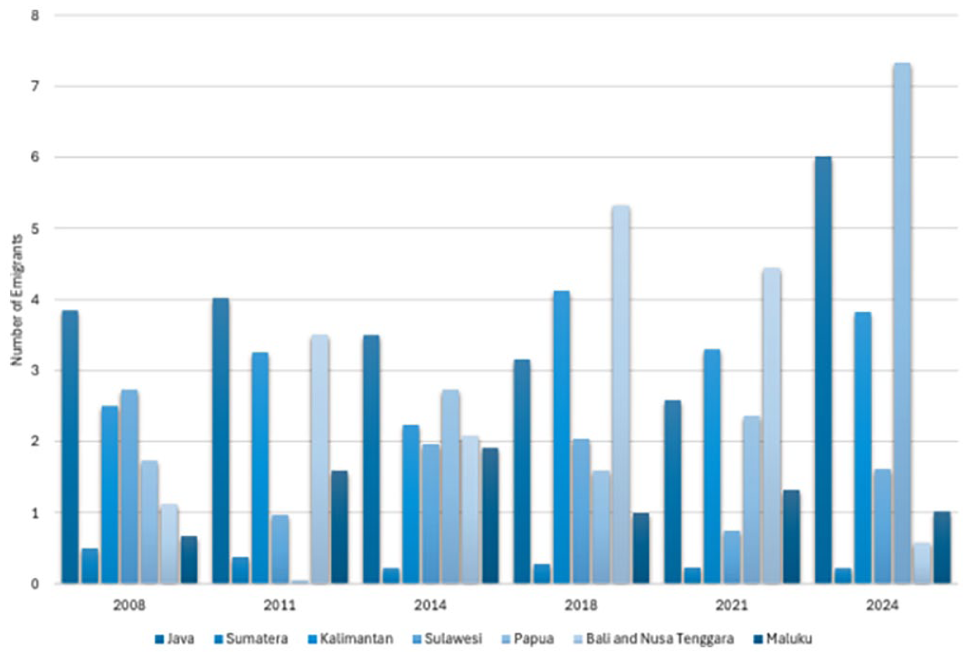
Number International Migrant Workers in Indonesia.
In response to the growing number of Indonesian Migrant Workers, the government has introduced several policies, including the “Zero Rupiah Passport Policy” (ZRPP) initiative for originally Indonesian Migrant Workers who cannot afford the IDR (Indonesian Rupiah) 350,000 (approximately 23 US dollars) fee for new or renewed passports in 2014. This policy has been effectively implemented worldwide and will be implemented not only for Indonesian Migrant Workers, but all Indonesian citizens who are eligible in 2020 (Ministry of Law and Human Rights of the Republic of Indonesia 2020). According to Cahyadi (2023), the policy has had a positive impact, with an estimated increase of 386,605 migrant workers between 2020 and 2022. This initiative could be a driving factor for international migration, potentially increasing the number of individuals seeking work abroad, especially after climate disasters. The goal of this policy is to remove the financial barriers for Indonesian citizens in obtaining a passport, such as to increase the accessibility for Indonesian migrant worker or low-income households, to facilitate labor migration, encourage legal migration and reduce undocumented travel (Ministry of Law and Human Rights of the Republic of Indonesia 2020). However, no study has yet proven the effectiveness of the Zero Rupiah Passport Policy as a coping mechanism for vulnerable individuals seeking work as international migrant workers post-disaster.
This paper is among the first to provide causal evidence on the impact of the ZRPP in the context of extreme climatic events. It examines whether the ZRPP increases migration for individuals as an escape mechanism from climate disaster. The study utilizes Indonesia’s Potential Village data from 2008 to 2021, employing a Difference-in-Difference (DD) approach to address the research question. This method allows for a robust comparison between treated and control groups, offering valuable insights into causal relationships and policy effectiveness.
This study may be the first to apply causal inference methods to evaluate the Zero Rupiah Passport policy (ZRPP) aimed at increasing the number of Indonesian Migrant Workers (PMI — Pekerja Migran Indonesia). The research provides robust results by using advanced methodology in the context of migration studies in developing countries. As a result, its findings can serve as a valuable policy input for decision-makers focusing on international migration.
Literature Review
Climate Disaster and International Migration
Climate disaster issues have been increasing on the last few decades due to the increase in climate change (Ferris 2020). One of the impacts of climate disaster is that it leads people to move to safer places (Piguet et al. 2011; Berlemann and Steinhardt 2017). The literature on migration identifies several push and pull factors that influence migration decisions, particularly in response to natural and social shocks. Push factors include environmental disasters such as famine, drought, and landslides, as well as social phenomena like blasphemy cases, war, political instability, and discrimination. Additionally, individuals with lower education and skills, as well as economically vulnerable populations, may migrate in search of better opportunities and improved living standards for future generations. On the other hand, pull factors often include the promise of higher income, safety, human rights protections, and the potential for new life opportunities, including the possibility of permanent residency.
The Neo-classical theory of migration emphasizes these push and pull factors, asserting that migration is driven by both adverse conditions in the home country and the attractiveness of the destination. Meanwhile, the Aspiration and Capabilities Framework suggests that those who migrate often have less to lose, while those who stay have assets and livelihoods to protect (De Haas 2021). The Vulnerability and Adaptive Capacity Theory highlights how migration is a response to climate and natural disasters, particularly for those with limited adaptive capacity. This theory underscores the migration challenges faced by vulnerable populations, such as minorities who may face migration restrictions, as seen with tighter border policies in countries like the United States (Lutz 2017; McLeman 2019).
In Indonesia, several studies have examined how climate disasters can drive migration. A study by Auwalin (2020) used Indonesia Family Life Survey (IFLS) data and a logit regression model to show that different ethnic groups exhibit different internal migration patterns following climate shocks. A second study, by Ananta et al. (2023), also focused on internal migration and led to similar results. It found that ethnic groups in Indonesia are well-known for migrating to escape environmental challenges in their regions of origin. According to Bryan and Morten (2019), reducing the internal migration barrier could led to a 22 percent increase in labor productivity, boosting economic growth. Another study in internal migration in Indonesia also found a similar pattern, showing the positive impact of internal migration on economic growth (Wajdi et al. 2017). However, these studies focus only on internal or domestic migration as a coping mechanism for people affected by climate disasters. In contrast, our research explores international migration as an alternative coping strategy. .
Zero Rupiah Policy Passport
Climate disaster is making vulnerable families, including poor people, migrate to other regions and countries. Early studies in Indonesia provided valuable insights into migration patterns, particularly in response to environmental factors. Fearnside (1997) examined transmigration from Java to Kalimantan between 1976 and 1989, highlighting the impact of state-sponsored programs on population distribution. Baird (2008) employed qualitative methods to explore the displacement of minorities in Kalimantan due to palm oil cultivation, revealing the conflicts and subsequent agreements between affected communities and palm oil farmers. Goldbach (2017) applied logistic regression to analyze migration, distinguishing between environmental and other migration drivers. His study yielded significant findings in Indonesia and Ghana, emphasizing the role of environmental factors in shaping migration patterns. Caruso et al. (2016) investigated the relationship between extreme weather, crime, and displacement in Indonesia, identifying the connections between agricultural income/productivity and migration patterns. These early studies laid the foundation for understanding the complex interactions between environmental, social, and economic factors driving migration.
Before the ZRPP, the Government of Indonesia had already implemented several migration policies to support migration flows (both domestic and international) such as Visa Redemption for tourists (Yudhistira et al. 2019) and increasing border safety (Sumadinata et al. 2022). In its bilateral agreements, Indonesia also established strong relationships with Japan (Ford and Kawashima 2016; Efendi et al. 2017), Taiwan (Yuniarto 2016), Thailand (Kampan and Tanielian 2017), and Australia (Kneebone 2017; Missbach and Hoffstaedter 2020) to support Indonesian Migrant Workers flows.
The Zero Rupiah Passport Policy was first established in 2014 targeting the low-income and Indonesian Migrant Workers, in 2020 fully implemented to all Indonesian. According to the Ministry of Law and Human Rights of the Republic of Indonesia (2020), this policy originally targeted low-income households and Indonesian Migrant Workers in 2014. However, by 2020, the policy was extended to all Indonesian citizens, including marginalized communities and those affected by the COVID 19 pandemic. The original goal of ZRPP was to ease international migration flows. In practice, many of Indonesia’s Immigrants Worker (PMI — Pekerja Migran Indonesia) have benefited from this policy due to the zero fee for passports (Choirul 2019; Saraswati 2024). Most of Indonesia’s Immigrant Workers come from lower middle-income families, who require financial assistance to work abroad (Yuniarto 2016). Many also originate in areas that are vulnerable to climate-related and natural disaster, which increases their exposure to risk (National Board for Disaster Management 2024). The Government of Indonesia aims to increase the remittance from the PMI (Indonesia’s Migrant Worker) by giving the benefit of the ZRPP to migrant workers who need support to renew or secure a new passport. The government plans by reducing the financial barrier — in this case, the passport fee — to increase the number of emigrant workers and increase receipt of remittances.
Materials and Methods
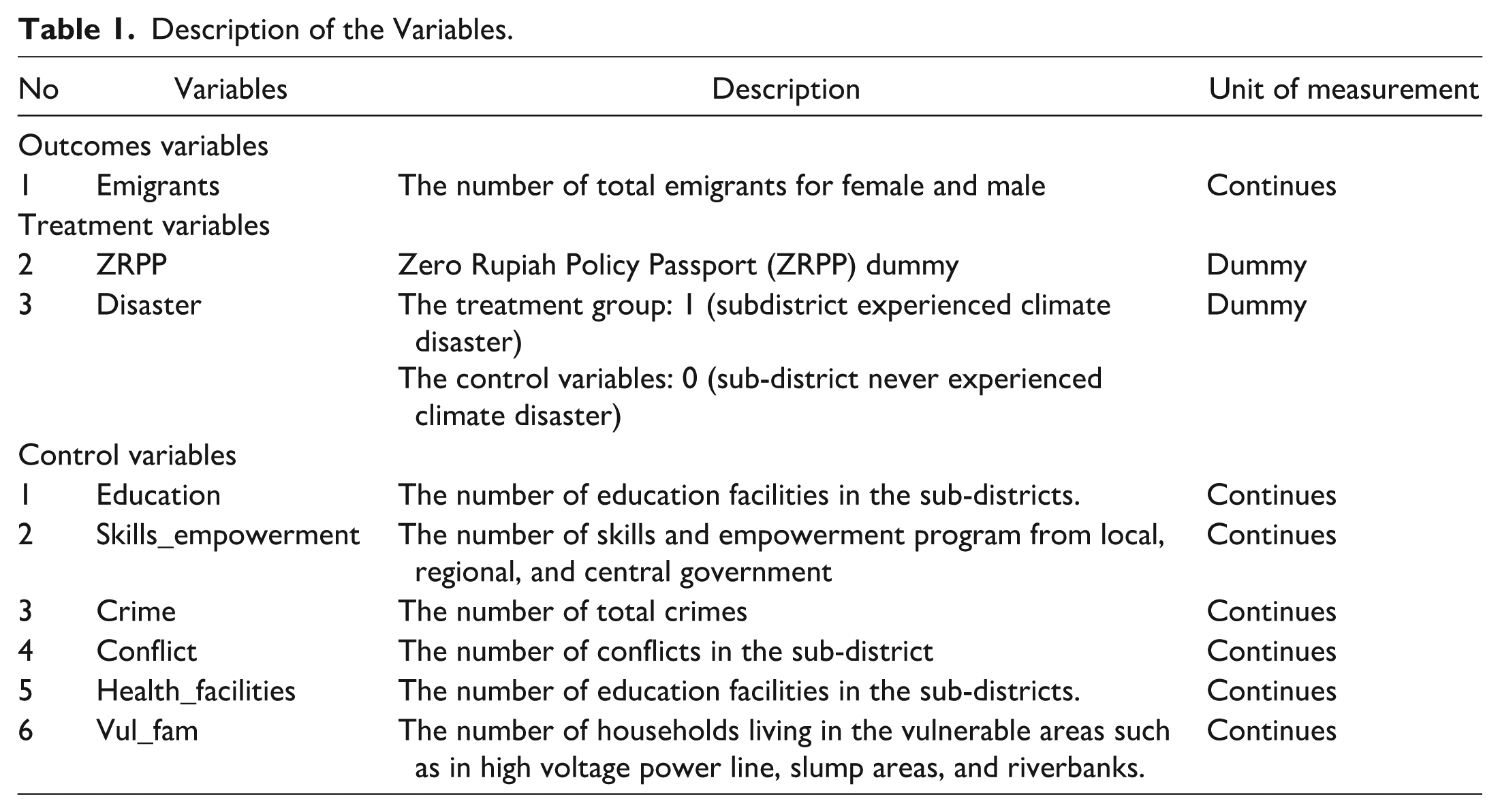
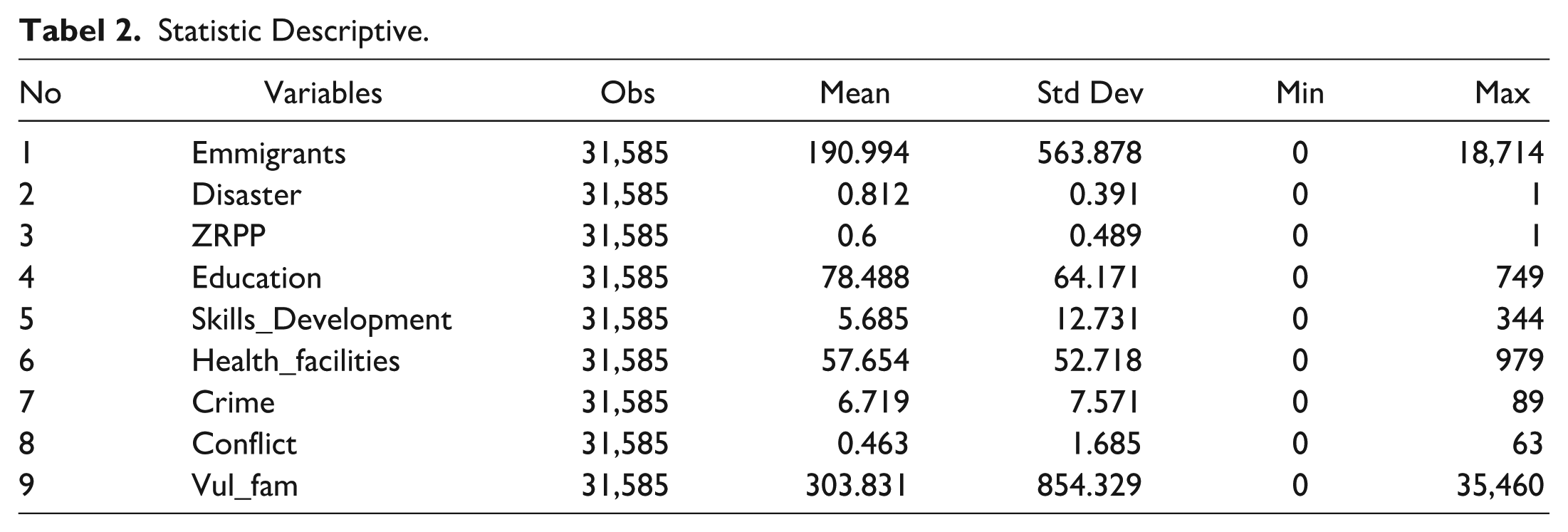
This study utilizes longitudinal micro data, Indonesia’s Potential Village data (PODES) from 2008 to 2021. It employs a Difference-in-Difference (DD) methodology to investigate the research question on a sub-district level. This approach enables a robust comparison between treated and control groups, allowing for clearer insights into causal relationships and policy impacts. The data, sourced from longitudinal surveys published by Indonesia’s Central Statistics Agency (BPS), include detailed sub-district level information essential for the analysis (Tables 1 and 2). The total of observations is 31,585, compared to 6,317 sub-district level observations from 2008, 2011, 2014, 2018, and 2021.
Description of the Variables.
Statistic Descriptive.
The present research uses the number of total international migrant workers (PMI — Pekerja Migran Indonesia) as the outcomes of the variables. The treatment in our study uses dummy varibles for Zero Rupiah Policy Passport (ZRPP). The ZRPP consists of 1 (2014–2021) which represent the year of the policy implementation and 0 represent pre-implementation policy (2008–2013). The treated group is the sub-district which experiences any type of climate disaster during the study, while the control group is the sub-district without any type of climate disaster. A climate disaster is a disaster that relates to climate issues, such as floods, landslides, drought, typhoon, and forest fire. Vulnerable families are the number of households living in vulnerable areas such as those with high voltage power lines, slump areas, and riverbanks.
The DiD approach is extensively applied in natural disaster research, as evidenced by studies such as Bondonio and Greenbaum (2018), Yang et al. (2023) and Yao et al. (2019)). This model is effective for assessing policy impacts through comparisons between treatment and control groups. In this study, we define the treatment group as the sub-district that experienced climate disaster and the control group as the sub-district that never did. The present research utilizes education, skills and development, health facilities, crime, conflict, and vulnerable families as control variables.
DiD Model Specification
The primary regression equation is specified as:

Where:
The coefficient of interest,
Empirical Result
Empirical Result: Difference-in-Differences Regression
In this section, we present and discuss the empirical results obtained from the Difference-in-Differences regression model. This model was applied to investigate the factors influencing emigration patterns among vulnerable populations in Indonesia, with a particular emphasis on sub-district experienced climate disaster. The analysis is based on a set of explanatory variables related to socio-economic conditions, disaster exposure, and access to infrastructure. It considers different time periods, including pre-treatment and early and late post-treatment periods.
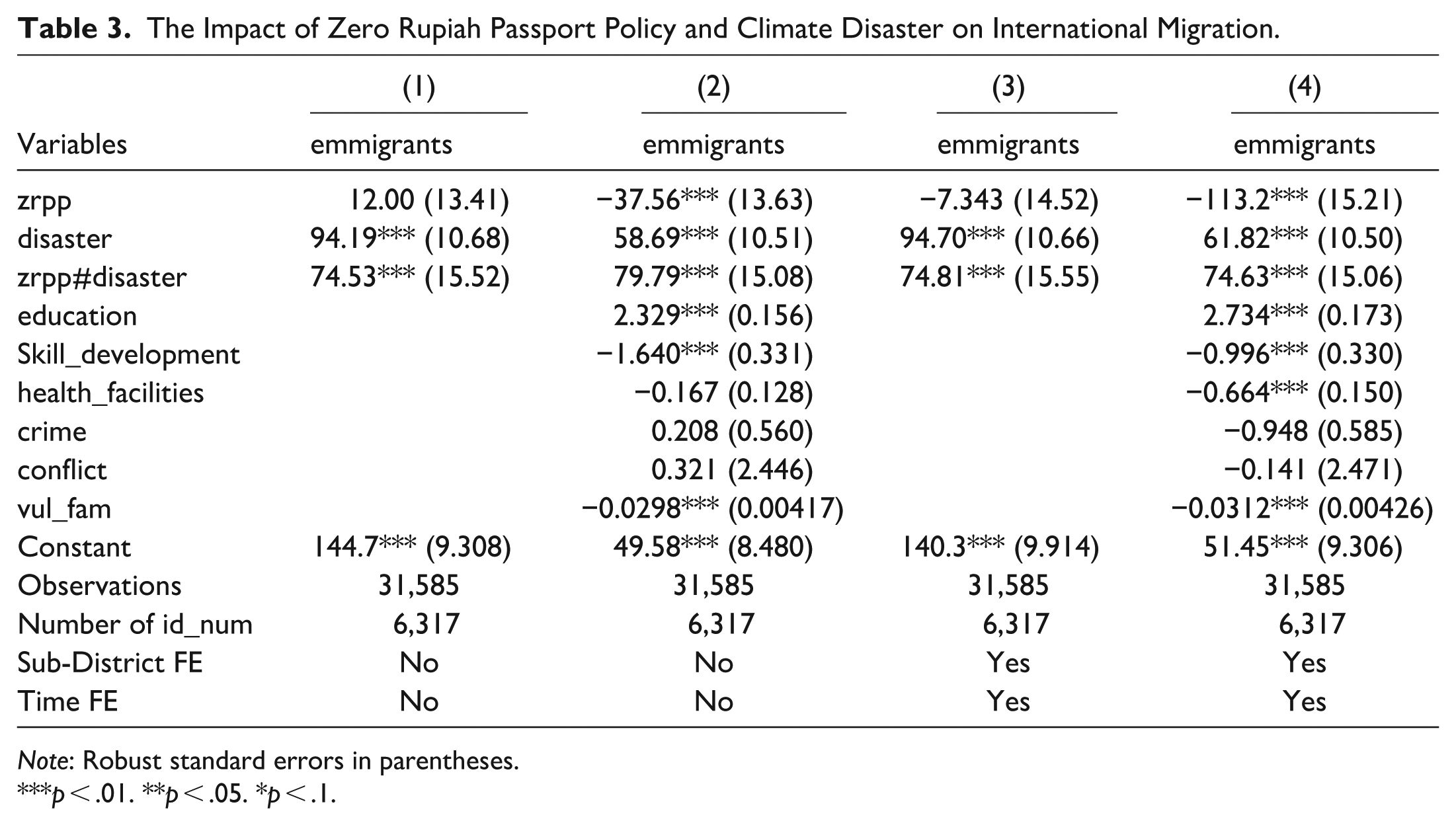
The results are presented in Table 3. Models 1 and 3 show the main regression, while Models 2 and 4 include control variables. Additionally, we explored regressions both with (Models 3 and 4) and without (Models 1 and 2) sub-district and time fixed effects to ensure robustness. These results reveal several key insights. First, the impact of the ZRPP in the treated group is statistically significant, increasing the number of International Migrant Workers between 74.53 and 79.79 person. The coefficients are all strong and stable from Model 1 to 4, which shows there is a small probability of an endogeneity problem. This result confirms that after the implementation of ZRPP, the region with climate disaster tends to have a higher number of international migrant workers.
The Impact of Zero Rupiah Passport Policy and Climate Disaster on International Migration.
Note: Robust standard errors in parentheses.
p < .01. **p < .05. *p < .1.
Education has a positive and significant effect on the number of international migrations for both models with or without the Sub-district and Time FE (Model 2 and 4). This shows that the regions with the better education facilities tend to have a higher number of emigrants. Meanwhile, there is a contrary result for health facilities and skill development program which shows significant reduction in the outcome variables. Lastly, the vulnerable families claim to have negative and significant effects on the outcome variables, which implies that the sub-district with higher numbers of vulnerable families have lower international migration.
Assumption Testing — Parallel Trend Test
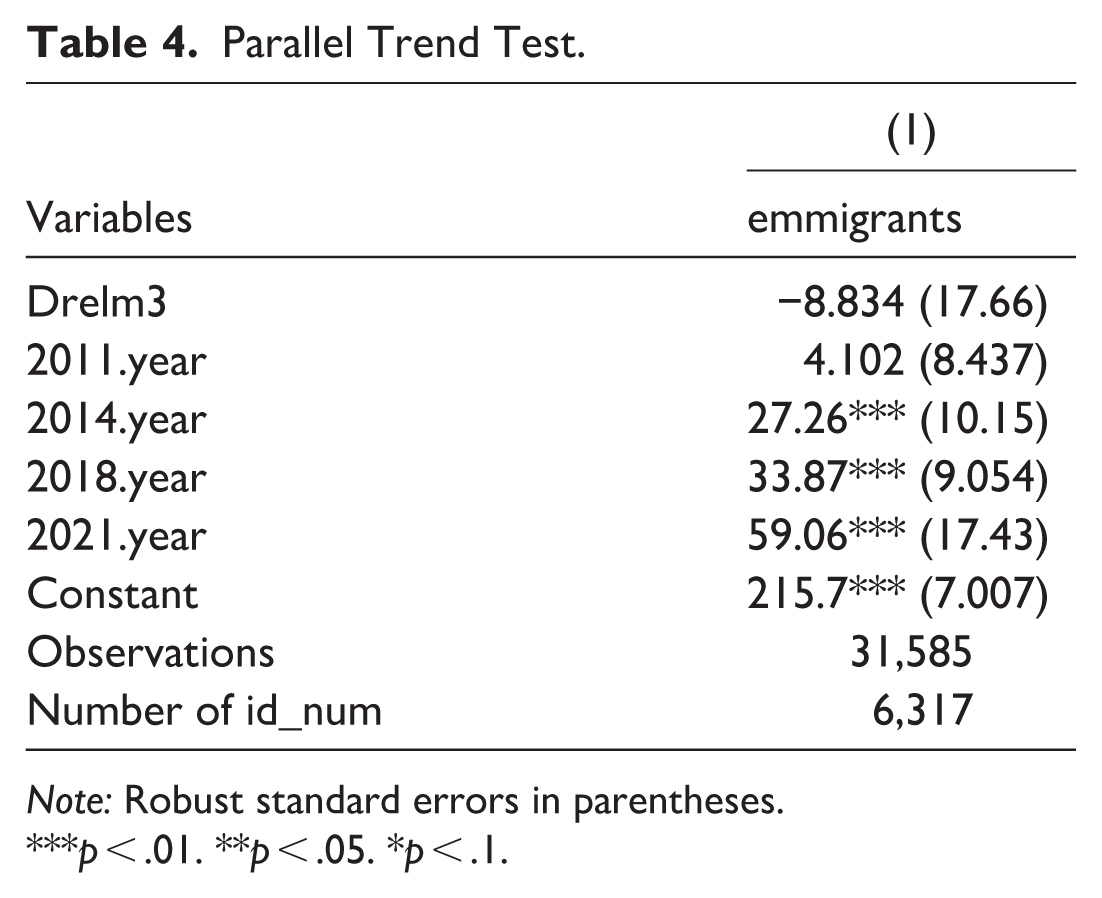
The present research employs an assumption test to examine the impact on the treated group using a parallel trend test. Table 4 presents the results of this test. The coefficient for 2011 shows a positive and significant effect, confirming that the parallel trend assumption between the treated and untreated groups before the treatment (ZRPP) is satisfied. This indicates that there was no significant difference in the number of Indonesian Migrant Workers before the treatment between sub-districts affected and unaffected by climate disasters. After the ZRPP, the results show a positive and significant effect. This parallel trend test supports the main findings discussed earlier.
Parallel Trend Test.
Note: Robust standard errors in parentheses.
p < .01. **p < .05. *p < .1.
Discussion
The findings from the DiD regression model provide evidence of the significant role that the ZRPP plays in influencing emigration patterns, particularly for individuals residing in sub-districts affected by climate disasters. In this study, the treatment group consists of sub-districts that have experienced climate-related disasters, while the control group comprises sub-districts that have not been impacted by such disasters. The regression results indicate that the ZRPP policy is associated with a notable increase in the number of emigrants from disaster-prone areas, highlighting the crucial role that international migration plays as a coping mechanism for individuals seeking to escape the adverse impacts of climate change.
The ZRPP, which eliminates the cost of obtaining a passport, acts as an enabler for individuals, particularly from vulnerable and disaster-prone regions, to pursue international migration. These findings strengthen the previous study published by Kaczan and Orgill-Meyer (2020). Kaczan and Orgill-Meyer (2020) stated that policy that can reduce the immigration cost and risk could increase the number of international migration. For individuals living in disaster areas, where livelihoods and safety are often compromised due to climate-induced events such as floods, droughts, and storms, the ZRPP reduces the financial barrier to international migration, making it a more accessible option. This reduction in passport acquisition costs is especially relevant for individuals from lower-income households, who might otherwise be unable to afford the necessary documentation to migrate abroad (Cattaneo et al. 2019). In this context, the ZRPP serves as an important mechanism that facilitates migration as a response to climate disasters, offering vulnerable populations the opportunity to seek safety and stability in other countries (Call et al. 2017).
For communities living in disaster-prone sub-districts, emigration is often seen as an adaptive response to the growing uncertainty and risks posed by climate change (Kallius et al. 2016). The regression results indicate a clear difference after the treatment between control groups and the treatment group (sub-districts affected by climate disasters), showing a higher propensity for emigration. This suggests that people in disaster-impacted areas are more likely to seek opportunities abroad as a means of escaping the immediate and long-term consequences of climate disasters, such as the destruction of homes, loss of agricultural income, and overall economic instability (Crawley and Hagen-Zanker 2019). The increased migration from disaster-prone sub-districts reflects the broader trend of climate-induced migration, where individuals and families perceive emigration as a survival strategy. With the ZRPP in place, the cost of obtaining a passport is no longer a significant barrier, allowing more individuals from these vulnerable areas to pursue emigration as a viable solution.
In terms of control variables, several socio-economic factors also emerged as significant predictors of emigration. The positive and significant coefficient for education suggests that individuals with higher education levels are more likely to emigrate by 2.329 people, possibly in search of better opportunities abroad. Higher education facilities will give domestic labor more training, and hard and soft skills to increase their bargaining in international job market (Beech 2018; Baas 2019; Kerwin 2020). These benefits could also increase the confidence of domestic laborers, which is also important during the job searching time frame (Manic 2019; Baláž et al. 2021; Ķešāne and Weyher 2021).
Conversely, the negative coefficient for skill development is −1.640 implies that regions which have higher skills and development programs have lower numbers of international migrant workers, potentially due to greater opportunities in the domestic labor market. The high number of skills and development programs can increase the local labor’s skills which in the end increase opportunities in domestic labor markets (Adamson and Tsourapas 2019; Lagakos 2020). Additionally, crime and conflict reportedly do not have an empirically significant effect on international migration.
Similarly, the positive relationship between health_facilities and emigration (0.664) suggests that access to healthcare infrastructure is an important factor in the decision to migrate. In particular, regions with better health facilities have lower international migration. This might be due to the ability of local facilities to satisfy the health needs of residents (Doocy et al. 2019; Thomas et al. 2019). Healthier people can have more opportunity in local economies and do not need to go abroad to find a decent job.
The variable vul fam (vulnerable families) shows a negative and significant coefficient of −0.0312, which suggests that more vulnerable families are less likely to emigrate, likely due to the financial and logistical barriers associated with international migration (Sanchez 2018). This reinforces the idea that while vulnerability is a key driver of migration, other factors, such as financial capacity, may prevent the most vulnerable from migrating.
Conclusion and Policy Recommendation
This study examines the effectiveness of the Zero Rupiah Policy Passport issued by the Government of Indonesia as a coping mechanism for escaping climate disaster. It utilizes the Indonesian’s Longitudinal Potential Villages Data from 2008 to 2021 and applies Difference-in-Difference approach to estimate the policy’s impact. The findings can be highlighted in two ways. First, the empirical results suggest that the ZRPP significantly influenced emigration decisions, particularly in areas affected by climate-related disasters. By reducing the financial cost of migration, the policy facilitated the movement of individuals seeking safety and better opportunities abroad. These results indicate that emigration can serve as a vital coping mechanism for vulnerable populations exposed to environmental risks, highlighting the need for policies that support migration as part of broader climate adaptation strategies.
These results have important policy implications. Addressing the root causes of migration, such as improving security, healthcare, and economic opportunities, could help mitigate the need for migration in response to disasters and conflicts. Additionally, targeted interventions for vulnerable populations, such as minorities, may reduce the pressures that drive them to emigrate and promote more sustainable solutions for managing the impacts of climate disasters and social tensions. It is highly advisable for coordinating among the National Agency for Disaster Countermeasure (BNPB), the Ministry of Villages, Development of Disadvantaged Regions, and Transmigration (Kemendesa PDTT), the Ministry of Manpower (Kemnaker — Kementerian Ketenagakerjaan), and the Ministry of Environment and Forestry (KLHK — Kementerian Lingkungan Hidup dan Kehutanan), in collaboration with local governments in disaster-prone areas. Moreover, the ZRPP should be complemented with long-term resilience programs, focusing on economic stability and disaster risk reduction to mitigate the need for migration as a coping mechanism. Additionally, it is advisable for Ministry of Justice and Human Rights (Kemenkumham — Kementerian Hukum dan Hak Asasi Manusia) to regularly assessing the implementation of the ZRPP and aligning it with the climate change mitigation policy framework and National Action Plan for Climate Change Adaptation (RAN-API). This ensures that the needs of communities affected by climate disaster and climate change are met, while also strengthening their resilience. Lastly, promoting regional collaboration to enhance cross-border migration support and protection for individuals affected by environmental risks including climate disaster, is essential steps to ensure the safety of international migrant workers.
The present research has several limitations. First, because it relies on the sub-district level data, it is not possible to verify whether the Indonesian migrant workers included in the dataset specifically utilized the ZRPP. Second, due to data limitations, this study is unable to conduct a gender-based analysis of Indonesian migrant workers or examine their destination countries. Future study should elaborate on the gender analysis and destination countries.
Footnotes
Author Contributions
Conceptualization was contributed by YR; data selection, management, and analysis were involved by YR; Draft paper preparation was performed by YR; review and editing was attributed by YR; all authors have read and approved this version of manuscript.
Declaration of Conflicting Interests
The author declared no potential conflicts of interest with respect to the research, authorship, and/or publication of this article.
Funding
The author received no financial support for the research, authorship, and/or publication of this article.
Availability of Data and Materials
Data and codes used in the analysis will be made available upon request.
