







Abstract
Previous research suggests a high prevalence of entrapment in post-9/11 terrorism sting operations, but it is unknown whether entrapment abuses are disproportionately targeted at specific racial/ethnic, religious, or socioeconomic groups. Drawing on Black’s theory of law, symbolic threat theory, and research on stereotypes, cognitive biases, and institutional incentives, the authors hypothesize that government agents and informants will use problematic tactics disproportionately against certain marginalized groups. This study empirically tests for such disparities using detailed data on post-9/11 terrorism prosecutions. Specifically, the authors code the sociodemographic characteristics of the 316 domestic terrorism defendants in cases occurring in the 13 years after 9/11 and involving informants. These data are integrated with an existing database of indicators of entrapment for each defendant. Using multivariable models, the authors test whether sociodemographic characteristics predict four key entrapment-related outcomes. Results indicate that minority racial and religious groups, undocumented immigrants, and individuals with low socioeconomic status all have elevated risk for at least one entrapment-related outcome. Strikingly, the most consistent predictor of entrapment is black Muslim identity. In contrast, white Muslims show no increased risk for entrapment vis-à-vis white non-Muslims for all but one outcome. This study thus documents apparent discrimination against African Americans (and white privilege) in yet another area of the criminal justice system. It also demonstrates that deeply ingrained forms of discrimination may become dominant even in policy fields characterized by intense discrimination against other groups.
In recent years, academics, journalists, and human rights organizations have provided mounting evidence of entrapment in post-9/11 terrorism prosecutions. Many of these cases feature aggressive informants pressuring previously law-abiding defendants into committing terrorism offenses that they otherwise would never have committed (Human Rights Watch 2014). In some cases, reluctant defendants have been offered hundreds of thousands of dollars, and repeatedly pestered and manipulated, until they finally agreed to commit a crime (Aaronson 2013). Although some of the sting operations since 9/11 have genuinely enhanced public safety, a large proportion of cases involve robust entrapment allegations (Norris and Grol-Prokopczyk 2015). These cases likely constitute a waste of government resources, because they failed to prevent any crime; the defendants were often unable to carry out attacks on their own or lacked prior inclination to do so. Nevertheless, sting operations remain a frequently used counterterrorism technique and have become increasingly common in recent years (Lichtblau 2016).
Previous research has documented the prevalence of entrapment indicators among post-9/11 terrorism cases (Norris and Grol-Prokopczyk 2015) and critically analyzed several specific cases of alleged entrapment against Muslims and left-wing activists (Kumar 2010; Laguardia 2013; Norris 2016; Said 2010; Sherman 2009; Szpunar 2017). An unrelated (and massive) body of literature has documented racial, ethnic, and socioeconomic disparities in arrests, prosecutions, convictions, sentencing, and law enforcement misconduct generally (Mitchell and Caudy 2015; Wooldredge 2012; Wu 2016). However, no empirical research has tested whether entrapment has been disproportionately used against members of disadvantaged groups in post-9/11 counterterrorism.
We hypothesize that stereotypes, cognitive biases, and institutional incentives could drive government agents and informants to disproportionately target marginalized groups for entrapment. More generally, the operation of law as a form of social control against low-status groups, as theorized by Donald Black (1976), or against groups feared as a challenge to the social order, as in symbolic threat theory (González et al. 2008), would also predict disparities in this area. We use detailed data on post-9/11 terrorism prosecutions to test whether disadvantaged sociodemographic groups experience higher risk for entrapment. This research offers insight into the ethical and policy issues surrounding the aggressive use of informants in counterterrorism operations and documents a less commonly studied area of the criminal justice system in which law enforcement misconduct may be directed disproportionately toward particular groups. Our findings demonstrate how long-standing forms of discrimination may become predominant even in policy areas expected to target other groups and shed light on how race, ethnicity, and religion interact in shaping criminal justice disparities. We recommend specific policy changes, including reduced reliance on “pre-emptive” prosecutions, and training to counter the role of discretion in generating disparities.
Entrapment, Terrorism, and Inequality
Entrapment in Counterterrorism Operations
Sting operations were used in some terrorism cases in the 1990s, but strong entrapment claims were extremely rare (Norris and Grol-Prokopczyk forthcoming). After 9/11, terrorism sting operations became widespread, and entrapment claims become much stronger and more frequent. These operations arose from the Federal Bureau of Investigation’s (FBI) desire to minimize terrorism by engaging in “preventative prosecutions” that, in theory, would thwart threats at the earliest possible point (Aaronson 2013).
In practice, what occurred was that the FBI cultivated thousands of new informants to infiltrate Muslim communities, promising money or leniency to informants in exchange for facilitating terrorism convictions (Kundnani 2014). Many of the informants had long criminal records, and some were notorious con men with extensive histories of fraud (Aaronson 2013). In some cases, informants went to extraordinary lengths to induce previously law-abiding individuals to commit terrorist offenses, by offering them hundreds of thousands or even millions of dollars, attempting to radicalize them, repeatedly pressuring them despite their reluctance, and even threatening them with violence (Norris and Grol-Prokopczyk 2015).
As a legal doctrine, the entrapment defense is meant to prevent and redress inappropriate government tactics in undercover operations (Marcus 2009). Under the most prevalent version of the entrapment defense, a case must be dismissed if the government agent or informant induced the defendant to commit the crime, and the prosecution cannot prove the defendant’s predisposition to commit that type of crime. The entrapment defense has been litigated in some terrorism cases and may have influenced partial acquittals and light sentences for a few defendants. Yet in no terrorism case since 9/11 has a defendant been fully acquitted solely on entrapment grounds (Laguardia 2013).
The failure of the entrapment defense to block terrorism convictions is likely explained by deficiencies in its content and implementation rather than by an absence of entrapment (Norris and Grol-Prokopczyk 2015). Many observers have concluded that these prosecutions often target individuals who would never have committed such offenses on their own, violating the key policy concern behind the entrapment defense (Aaronson 2013; Dratel 2011; Said 2010; Sherman 2009). Judge Colleen McMahon, who presided over the James Cromitie case, concluded that he was “incapable of committing an act of terrorism on his own,” and that “only the government could have made a terrorist out of” him, noting that his “buffoonery” was “positively Shakespearian in its scope” (Dratel 2011:76). Nonetheless, she declined to rule that he was entrapped—a decision narrowly upheld on appeal—and sentenced him to 25 years (Weiser 2013).
Sociodemographic Disparities in Counterterrorism
In the months after 9/11, the U.S. government engaged in widespread ethnic and religious profiling. It conducted mass arrests and “voluntary interviews” of thousands of U.S. residents from predominantly Muslim countries, required residents from those countries to register with the government and submit to fingerprinting, discriminated against visa applicants on religious grounds, arrested a number of individuals simply because they were perceived as Muslim, and targeted many Muslims for deportation even after they were cleared of terrorist ties (Chon and Arzt 2005; Glaser 2014). This vast exercise in profiling failed to yield any terror convictions, despite encompassing more than 90,000 individuals (Cole and Lobel 2007). The federal government also singled out Muslim communities for heavy surveillance, including through a network of thousands of informants (Kundnani 2014). The documented use of torture and inhumane confinement conditions against South Asian and Middle Eastern Muslims at Central Intelligence Agency “black sites” are further examples of the use of profiling to select targets (some completely innocent) for government misconduct (Mayer 2008). Chon and Arzt (2005) understand this “terror profiling” to include a wide array of negative treatments by public and private actors, including the sharp post-9/11 increase in anti-Muslim violence, widespread private discrimination, and government-prompted private surveillance of Muslims.
Despite the documented use of profiling in post-9/11 counterterrorism, existing research has not assessed profiling in sting operations or investigated disparities in counterterrorism on the basis of race and socioeconomic disadvantage. Indeed, despite evidence for pervasive discrimination against African Americans, undocumented immigrants, and those with low socioeconomic status (SES) in the justice system (Light, Massoglia, and King 2014; Reiman and Leighton 2015), it is rarely suggested that such disparities would arise in counterterrorism as well.
Hypotheses
We hypothesize that certain marginalized sociodemographic groups, including Muslims (particularly Middle Eastern or South Asian Muslims), undocumented immigrants, African Americans, and those with low SES, will have a higher risk for entrapment. In what follows, we describe mechanisms potentially driving entrapment-related disparities for each group and then argue that such disparities would be consistent with Black’s theory of law and with symbolic threat theory. In short, Black’s theory of law predicts that legal sanctions are disproportionately used against lower status groups, while symbolic threat theory understands discrimination as resulting from perceptions that a group challenges the social order or middle-class norms.
First, most obviously, the stereotypical association of Muslims with terrorism is likely to influence agents and informants to focus their investigative efforts on them (Kundnani 2014). This may be influenced by the “good Muslim” versus “bad Muslim” trope, in which Muslims outwardly displaying religiosity or criticizing U.S. foreign policy are assigned to the “bad” category (Gotanda 2011; Selod 2015). In addition, cognitive biases enhancing fear of outgroups could make government actors more likely to think that even harmless Muslims are dangerous and should be induced into committing an offense so that they can be convicted and incapacitated. Psychological research has documented decreased tolerance toward outgroups—and support for reducing their rights—when there is a heightened perception of threat, as well as the operation of an in-group leniency effect (Brewer 1999; Piazza 2015). One survey found that people are permissive toward using extraordinary legal measures, such as indefinite detention and denial of access to attorneys, for Muslim terrorist suspects (Piazza 2015). In contrast, respondents were significantly less likely to approve of such measures for non-Muslims, including right-wing terrorist suspects. Because entrapment is an “extraordinary legal measure,” these findings suggest greater tolerance for such tactics against Muslims.
Such effects could also result from meso-level influences, such as the FBI’s documented use of Islamophobic training materials (Ackerman 2011). Institutional incentives to achieve terrorism convictions (Mueller and Stewart 2016) could influence agents to engage in more inappropriate inducement techniques against Muslims, because such convictions are most likely to be recognized as terrorism related. Right-wing terrorists are less often labeled as terrorists by the media and government (Norris 2017).
Second, it seems reasonable to expect that Muslims from regions associated with terrorism, including the Middle East and South Asia, or Muslim undocumented immigrants, would be targeted for more aggressive investigations, because they are feared as more “foreign” or more likely to have associations with terrorists (Piazza 2015). Golash-Boza (2016:6–7) theorized stereotypes as “controlling images” influenced by media portrayals, arguing that these stereotypes (such as of black men as “thugs” or Arabs as “terrorists”) are used to justify and expand discriminatory policies. South Asians, such as Pakistanis and Afghanis, are likely stereotyped as terrorists as well, because of the war in Afghanistan and Al Qaeda’s presence in the region. Agents and informants acting on such stereotypes may consider entrapment justified, if they believe that Arab and South Asian Muslims are inherently predisposed toward violent extremism. Research has demonstrated that such beliefs facilitate the dehumanization of marginalized groups and that this dehumanization strongly contributes to support for discrimination (Kteily et al. 2015). Measuring whether different groups of Muslims are more likely to be targeted (as we do below) is consistent with the growing recognition of diversity among U.S. Muslims and the absence of a monolithic “American Muslim” identity. This may have consequences for racial and religious profiling, such as a lower incidence of profiling among white or light-skinned Muslims (Chon and Arzt 2005).
Stereotypes may also influence authorities to misinterpret innocent speech as criminal. Doherty and Stancliffe (2016) found in an experiment that nonviolent speeches by Muslims merely criticizing U.S. foreign policy were seen as nearly as worthy of arrest as speeches by non-Muslims explicitly advocating violence. If simple policy criticisms by Muslims are interpreted by informants and agents as meant to inspire violence, agents may approve aggressive inducement techniques in response to nonviolent and legally protected speech, potentially leading to entrapment. Relatedly, the finding that Americans who believed the 9/11 attacks were motivated by opposition to democracy were more likely to support curtailing Muslims’ civil liberties (Jamal 2008) suggests that Muslims critical of the West are often assumed to be inherently dangerous “enemy Others” (p. 116).
Third, although African Americans are not stereotypically associated with terrorism, it seems possible that they would disproportionately experience entrapment, because of the general cultural perception that blacks are more prone to violence (Entman and Gross 2008), the FBI’s history of inordinate suspicion of black Muslims (Crawford 2015), and highly publicized yet questionable claims about rampant Muslim radicalization in prisons (SpearIt 2013). If these stereotypes, institutional habits, or specific claims guide decision making in sting operations, they could lead to disproportionate entrapment against African Americans.
Fourth, individuals with low SES could be at higher risk for entrapment, particularly because of their greater vulnerability to financial inducements. Although socioeconomic disparities in criminal justice have been the subject of less research than racial disparities, there is clear evidence that discrimination against those with low SES is widespread (Reiman and Leighton 2015). Thus, it is possible that agents or informants are generally more likely to target low-SES individuals for entrapment, even apart from the issue of vulnerability to financial appeals.
A higher prevalence of entrapment among all these groups would be predicted by Donald Black’s (1976, 1989) theory that a greater quantity of law is deployed against groups lower in a country’s status hierarchy (Rojek, Rosenfeld, and Decker 2012). Black (1976) defined “quantity of law” as “the amount of government authority brought to bear on a person or group” (p. 8). Each tactic used to induce someone to commit a crime amounts to a certain quantity of law, and just as a “serious charge is more than a minor charge” (Black 1976:3), more aggressive or manipulative tactics (such as offering large amounts of money or engaging in repeated pressure) represent a greater imposition of government power over an individual. Even though African Americans and those with low SES are not widely stereotyped as prone to terrorism, their lower status could predict a greater quantity of law being deployed against them even in this area of law. When invested with broad discretion to select potential targets for inducement attempts, police may disproportionally choose members of lower status groups, regardless of the type of crime. This would also be consistent with studies documenting how post-9/11 terrorism discourse was characterized by a rejection of neutral expertise and the manipulation of terrorism’s “fluid” and “unstable” meanings for political purposes (Stampnitzky 2013:201), often contributing to the repression of stigmatized groups (Kundnani 2014).
In addition, Black’s (1976:70) proposition that more law is deployed against those with more “cultural distance” from authorities would predict more entrapment against minority Muslims, compared with white non-Muslims or even white Muslims. More generally, the greater centralization and lack of transparency that characterize counterterrorism may contribute to increased law enforcement misconduct (such as entrapment) by reducing the likelihood that the misconduct will be punished (Cooney 2015).
Symbolic threat theory would also predict a higher risk for entrapment among African Americans, undocumented immigrants, Muslims, and in particular South Asian or Middle Eastern Muslims. This theory understands criminal justice disparities as resulting from perceptions that particular groups engage in more crime, are unable to abide by middle-class norms, or represent a threat to the social order more generally (Thomas, Moak, and Walker 2013). The deep cultural associations between “foreign” Muslims and terrorism and between blacks and violence, and the fear that jihadi terrorism threatens the American way of life, could lead to the disproportionate targeting of these groups for problematic informant practices. Indeed, research has found that symbolic threat and stereotypes were the strongest predictors of anti-Muslim prejudice in the Netherlands (González et al. 2008).
In short, stereotypes, cognitive biases, institutional incentives, the tendency of criminal law to be deployed against lower status groups, and the perception that certain groups represent a threat to the social order could all lead to a higher prevalence of entrapment among Muslims, African Americans, undocumented immigrants, and those with low SES. In what follows, we empirically test our predictions that certain disadvantaged social groups may experience a higher risk for entrapment in terrorism investigations. Although our data cannot determine which of these theories or mechanisms best explain our results, our analysis can serve as a useful starting point for further inquiry, by documenting potential injustices in this area of the criminal justice system, suggesting less biased and more effective counterterrorism strategies, and highlighting the complex interactions between discrimination based on race, ethnicity, and religion.
Data and Methods
Data
Norris and Grol-Prokopczyk (2015) developed 20 indicators of entrapment on the basis of criteria used by courts in determining whether entrapment occurred and on problematic features of cases widely considered examples of entrapment. These indicators include the degree to which the government was involved in facilitating the crime (such as pressuring the defendant or providing needed equipment), the defendant’s reluctance to commit the crime, the use of specific inappropriate tactics such as offering the defendant large sums of money, and the targeting of individuals lacking previous sympathy for terrorism. Brief descriptions of the indicators are provided in Appendix A; more detailed descriptions are available in Norris and Grol-Prokopczyk (2015). A particular entrapment score cannot definitively prove the presence or absence of entrapment; a comprehensive analysis of the facts of each case and the application of entrapment doctrine in the relevant jurisdiction would be required for that task. Nonetheless, these indicators may be interpreted as each suggesting an increased likelihood that entrapment occurred, or that the defendant would never have committed a terrorism offense without government involvement (Norris and Grol-Prokopczyk 2015).
Norris and Grol-Prokopczyk (2015) coded all terrorism prosecutions at the state or federal level that (1) involved crimes allegedly committed in the 13 years after the 9/11 terror attacks (i.e., between September 12, 2001, and September 11, 2014) and (2) involved government informants or undercover agents before the alleged crime was committed. These prosecutions involved 316 defendants. Cases were coded for the 20 indicators using all publicly available information about the case, particularly court documents and news articles obtained through Internet and database searches.
In the present project we make use of this data set after modifying it in several ways. First, the final three of the 20 indicators were omitted here, because they measure defendant characteristics that increase vulnerability to entrapment, rather than identifying government or informant actions suggesting that entrapment occurred (which is the focus of this analysis). Cases in this study could thus receive indicator scores between 0 and 17. Second, a small number of cases were recoded to reflect new information (primarily for defendants arrested in 2013 or 2014) that became available after the publication of Norris and Grol-Prokopczyk (2015). Third, to enable comparison of entrapment indicators across sociodemographic groups, we added new variables to the database: defendant race, ethnicity, religion, citizenship status, educational attainment, employment, sex, and age. Values for these variables were ascertained using all available information, including court documents and media coverage.
Seven of the 316 cases in the database were excluded from our analyses below because of small cell sizes. (For example, only one Middle Eastern defendant was non-Muslim, making the “Middle Eastern non-Muslim” category too small to be analyzed.) The analytic data for the present project thus consists of 309 defendants.
Table 1 shows the sociodemographic characteristics and alleged terrorism type of the 309 defendants, as well as the mean number of entrapment indicators by category. Overall, the mean number of entrapment indicators was 4.0 (SD = 3.6), with a median of 3 and a maximum of 13. 68 of the cases (22.0 percent) showed no indicators of entrapment.
Characteristics of Defendants in Post-9/11 Terrorism Cases Involving Informants or Undercover Agents (n = 309).
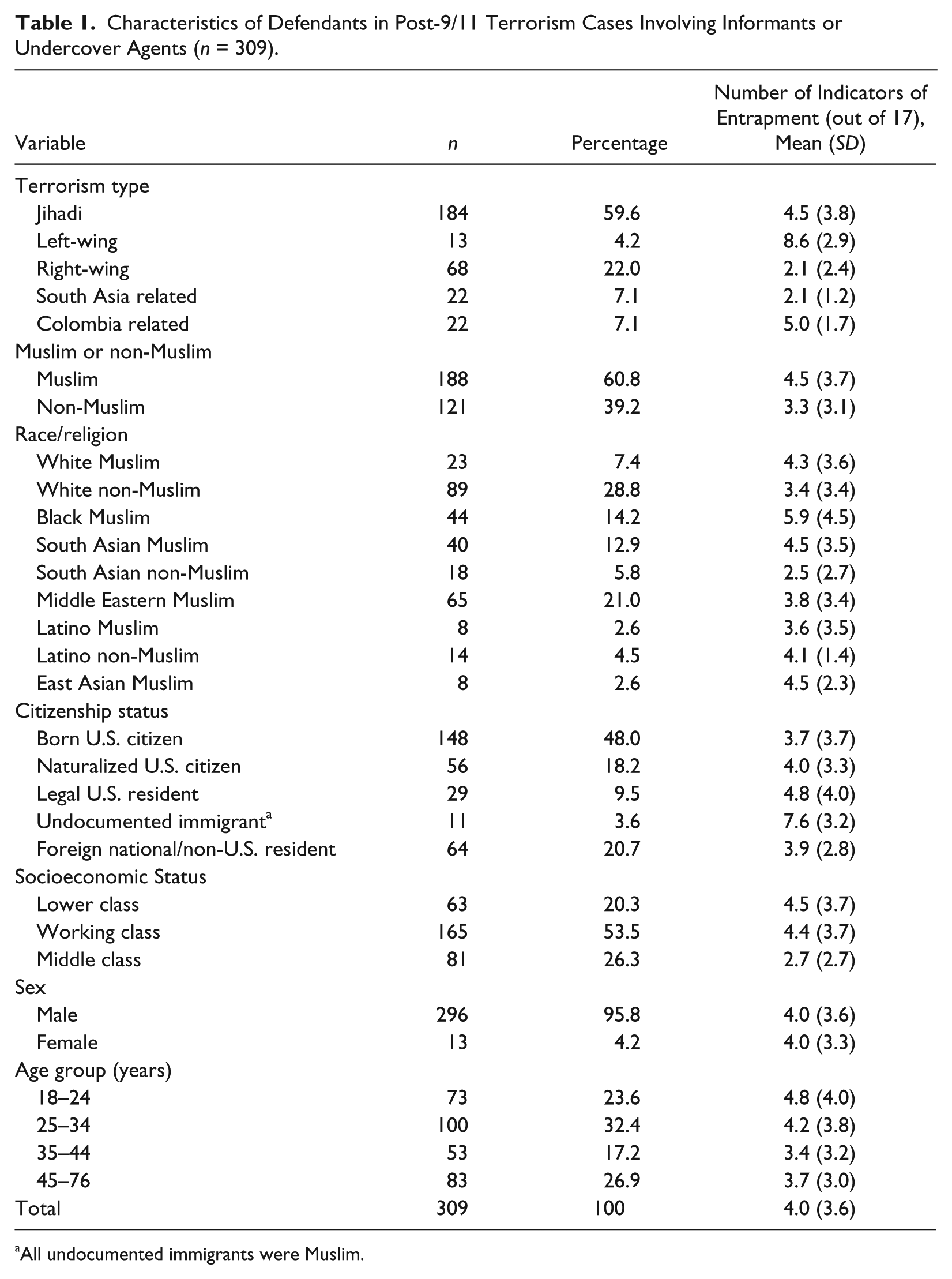
All undocumented immigrants were Muslim.
Terrorism type, classified in five categories (jihadi, domestic left-wing, domestic right-wing, South Asia related, and Colombia related), is replicated from Norris and Grol-Prokopczyk (2015). Jihadi terrorism denotes any terrorism-related offenses influenced by Islamist ideology. The left-wing category includes offenses motivated by environmentalism, anarchism, or other left-wing ideologies, while right-wing terrorism encompasses white-supremacist, antigovernment and antiabortion motivations. South Asia–related terrorism relates to separatist movements, primarily the Tamil Tigers. Colombia-related terrorists include Fuerzas Armadas Revolucionarias de Colombia (FARC) and the paramilitary group Autodefensas Unidas de Colombia, both of which are designated as foreign terrorist organizations by the U.S. government.
Regarding race/ethnicity, all defendants of sub-Saharan African ancestry were coded as black. These included U.S.-born blacks (29 [65.9 percent]), naturalized citizens or legal residents (5 [11.4 percent]), undocumented immigrants (3 [6.8 percent]), and foreign nationals (7 [15.9 percent]). Analyses distinguishing U.S.-born blacks from foreign-born blacks, not shown, revealed no statistically significant difference between the two on any key outcome measures. “Black” included Hispanic blacks, because of the very small number of such defendants (n = 2, representing 4.5 percent of blacks). “White,” in contrast, excluded Hispanics, South Asians, and Middle Easterners, as these are classified in separate categories.
Regarding religion, respondents coded as Muslim included adherents of mainstream Islam as well as practitioners of Islam-related faiths such as the Moorish Science Temple (n = 7, accounting for 3.7 percent of Muslims and 15.9 percent of black Muslims in this population). These are combined because authorities are unlikely to distinguish between mainstream and heterodox Muslims when deciding whether to investigate or induce suspects. Overall, 188 defendants (60.8 percent) were Muslim. All undocumented immigrants in this data set were Muslim.
Race/ethnicity and religion were highly collinear in these data. After the exclusion of seven cases because of small cell sizes, noted above, all blacks, East Asians, and Middle Easterners in the data set were Muslim. All Hindus were South Asian. (Whites were the only racial/ethnic group with somewhat high religious diversity.) Because of the high or even perfect collinearity between race/ethnicity and religion for multiple groups, multivariable models including race/ethnicity and religion as separate variables were not appropriate. Instead, we created a composite race/religion variable, comprising categories such as “white Muslim,” “white non-Muslim,” “black Muslim,” and so on, as shown in Table 1.
SES was coded into three categories. “Lower class” was defined as being unemployed and/or lacking a high school diploma. “Working class” comprised individuals who graduated high school and were employed but who lacked professional jobs or bachelor’s degrees. “Middle class” was defined as having a professional occupation and/or a bachelor’s degree. Two defendants had college degrees and were unemployed; these were classified as “middle class” on the basis of additional information (e.g., that one was subsisting on a substantial inheritance). In analyses below, working class is treated as the reference category because it is the largest category (with 53.5 percent of defendants) and because this best highlights differences across the socioeconomic spectrum.
In initial codings, three respondents (1.0 percent of analytic data) were missing on citizenship category, and 75 respondents (24.3 percent) were missing on SES. To preserve sample size, multiple imputation with chained equations was used to impute values for these two variables (generating 20 imputations). The descriptive statistics in Table 1 reflect the distribution of these variables after imputation, and all analyses below make use of the imputed data. (Findings were broadly similar when conducted using listwise deletion instead.)
We note that the majority of defendants were below middle-class, both overall and in all but two specific racial and religious groups (South Asian non-Muslims and Latino non-Muslims; detailed data are available upon request). Sting operations involving informants thus predominantly target lower social classes in most racial and religious categories, including all Muslim categories.
Table 1 also shows that women made up a very small minority of defendants (4.2 percent) and that most defendants were fairly young, although more than a quarter were age 45 or older. Sex was not included as a covariate in multivariable analyses, because of small cell sizes. Analyses including age categories (available upon request) differed only trivially from those without age (with exceptions noted below); we thus present the more parsimonious models.
Methods
Multivariable analyses were performed to examine whether defendants’ sociodemographic characteristics (race and religion, undocumented immigrant status, and SES) predicted each of four entrapment-related outcomes: (1) the overall number of entrapment indicators, (2) whether a case was among those with the very highest number of indicators (eight or more), (3) whether the informant offered financial or other material incentives to the defendant to encourage participation in the offense, and (4) whether a defendant was targeted despite a lack of terrorist ideology. Cases with eight or more indicators constitute the top 17.8 percent of cases and are highlighted because they are particularly likely to be genuine cases of entrapment, involving defendants with no realistic chance of committing terrorism offenses on their own. The financial-incentive and lack-of-ideology variables are two individual indicators among the 17. They were selected for individual analysis because they are potential markers of a particularly questionable sting operation, because real terrorists do not recruit by offering large sums of money or fixating on persuading individuals who do not already share their beliefs (Sageman 2004).
Outcome 1, as an overdispersed count outcome, was modeled via negative binomial regression, while Outcomes 2 through 4 used logistic regression. Although the data analyzed here include nearly the entire population of post-9/11 domestic terrorism prosecutions involving an informant (through September 11, 2014), the data can be seen as a sample of a longer span of time beyond this 13-year period. Therefore, p values are reported in the findings below. At the same time, because we analyze nearly complete data from the focal time period (excluding only seven of 316 cases), we do not restrict our discussion to findings with p values less than .05 but also highlight marginally significant findings (with p values < .10). All tests were two tailed. Analyses were conducted using Stata MP/14.2. Stata code is available upon request.
Results
Table 2 presents results from the negative binomial regression testing whether sociodemographic characteristics predict defendants’ total number of entrapment indicators (Outcome 1). Black Muslim identity and undocumented immigrant status are both associated with higher entrapment scores: net of other variables, black Muslims have entrapment scores 1.69 times higher than white non-Muslims (p < .01), and Muslim undocumented immigrants have scores 1.69 times higher than all other citizenship categories (i.e., citizens, documented immigrants, and foreign nationals; p < .10). Middle-class status is associated with significantly lower entrapment scores than working-class status (incidence rate ratio [IRR] = 0.62, p < .01). Supplementary analyses with different omitted reference categories (available upon request) indicate that black Muslims have higher entrapment scores than all other racial and religious groups (p < .10 in comparison with white Muslims, South Asian non-Muslims, and Middle Eastern Muslims; other racial and religious groups did not differ significantly from one another). Analyses using a binary Muslim/non-Muslim variable instead of race and religion confirm that overall, Muslims have significantly higher counts of entrapment indicators than non-Muslims (IRR = 1.28, p < .05).
Negative Binomial Regression of Number of Entrapment Indicators on Sociodemographic Variables (n = 309).
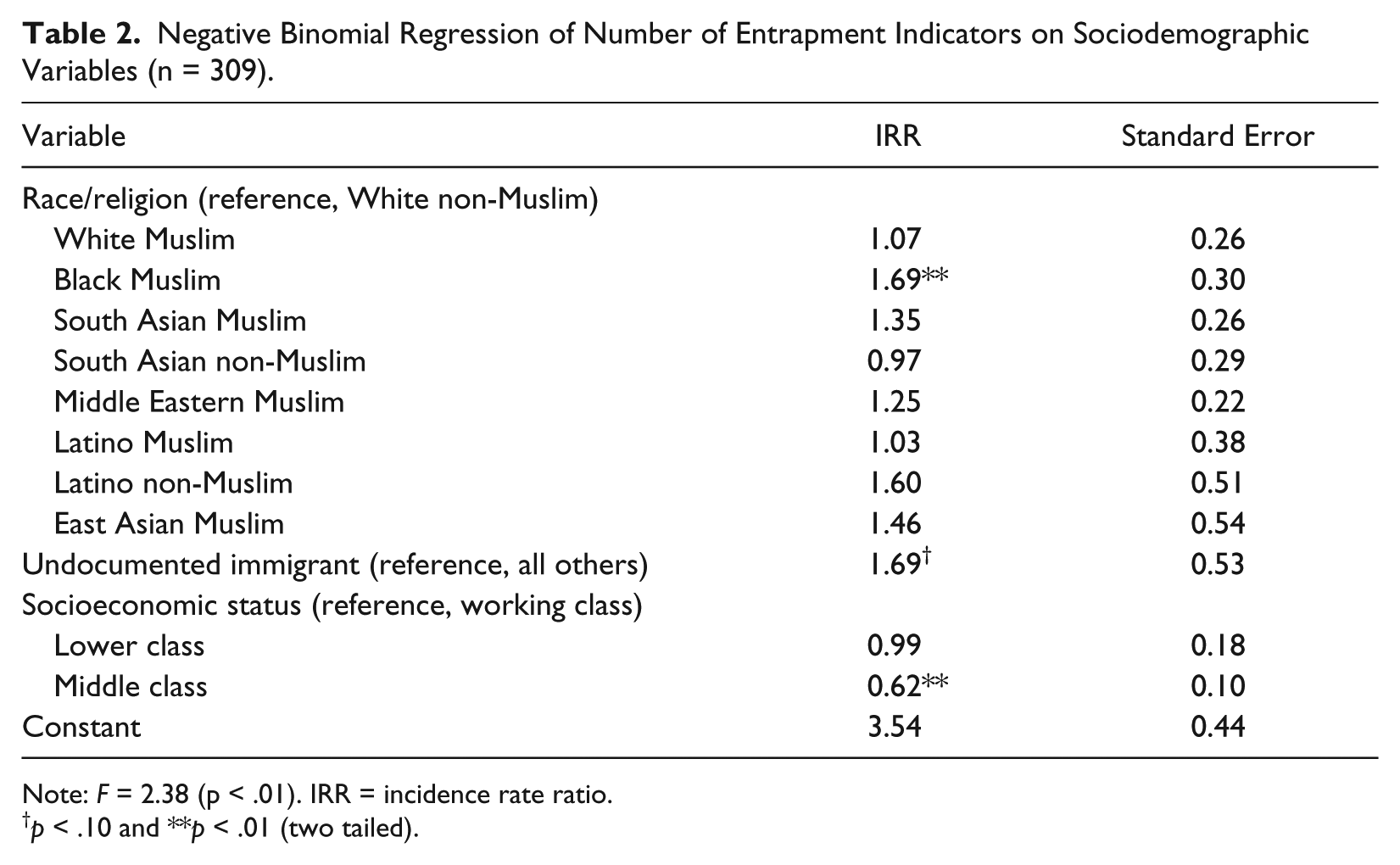
Note: F = 2.38 (p < .01). IRR = incidence rate ratio.
p < .10 and **p < .01 (two tailed).
Table 3 presents results of the three logistic regressions (Outcomes 2–4). The first, shown in Column A, tests whether sociodemographic factors predict whether a case is among the highest scoring cases (i.e., those with eight or more of the 17 indicators). Findings resemble those from the previous model: black Muslim identity and undocumented immigrant status predict increased odds of inclusion in the high-scoring category, while middle-class SES predicts decreased odds. Specifically, black Muslims have 3.48 times the odds of white non-Muslims of having eight or more indicators (p < .01), undocumented immigrants have 3.63 times higher odds than all others (p < .10), and middle-class defendants have 0.27 the odds of working-class defendants (p < .05). Supplementary analyses (not shown) indicate that black Muslims also have significantly higher odds of being in the high-scoring category than do Middle Eastern Muslims (odds ratio [OR] = 3.48, p < .05) and marginally higher odds than white Muslims (OR = 2.84, p = .10). No other significant differences across race and religion were found. An alternative model directly comparing all Muslims with all non-Muslims confirms that the former have elevated odds compared with the latter (OR = 1.87, p < .10).
Logistic Regressions of High-Scoring Cases, Informant/Agent Provision of Financial Incentive, and Targeting of Defendant Despite Lack of Terrorist Sympathies on Sociodemographic Variables.
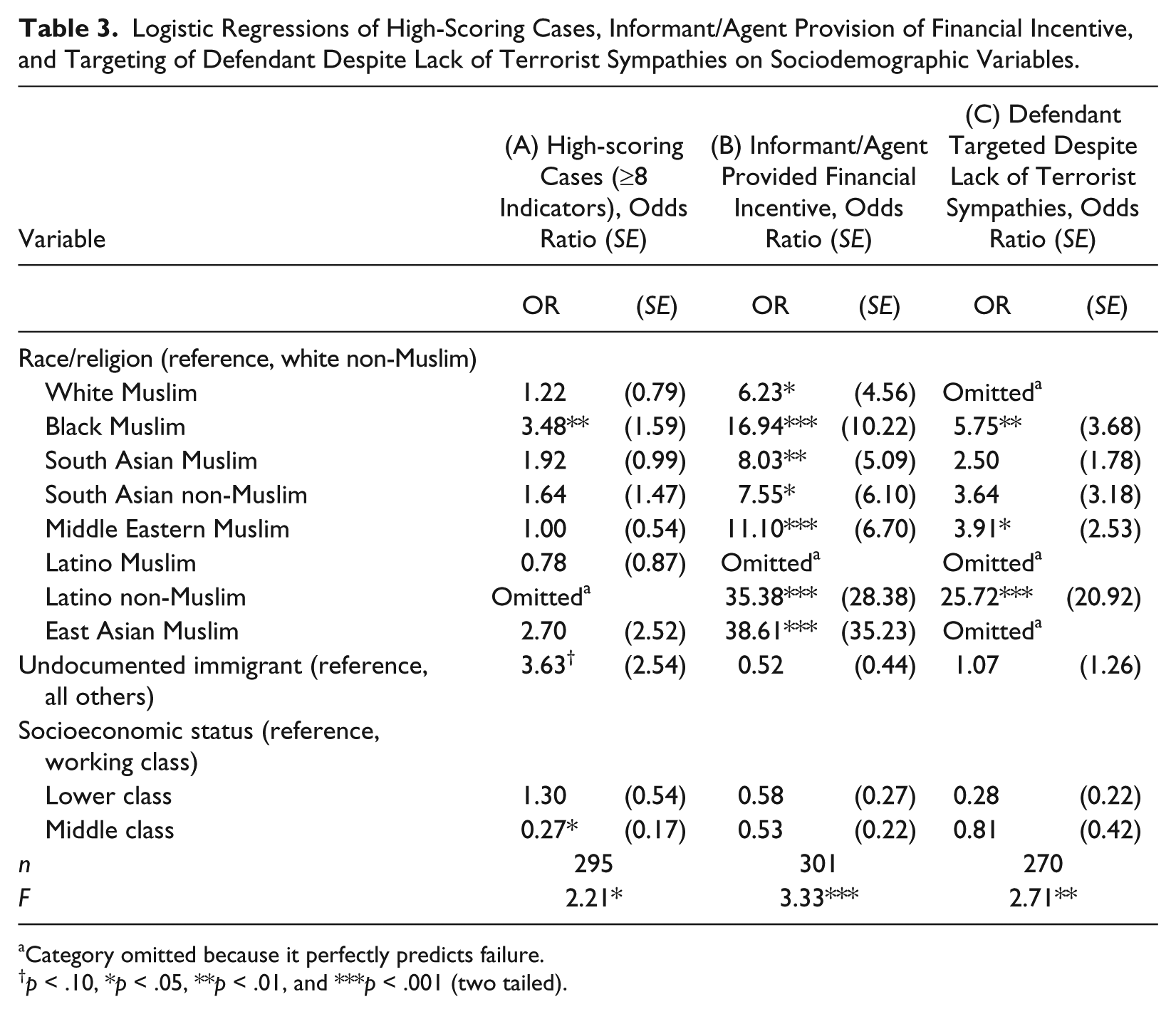
Category omitted because it perfectly predicts failure.
p < .10, *p < .05, **p < .01, and ***p < .001 (two tailed).
The next regression, in Table 3, Column B, tests whether sociodemographic characteristics predict whether the informant offered the defendant financial incentives to commit a terrorist offense (Outcome 3). In contrast to previous models, neither undocumented immigrant status nor socioeconomic disadvantage significantly raised risk. However, compared with the reference category of white non-Muslims, all racial and religious groups showed significantly higher odds of being offered a financial incentive (except Latino Muslims, who were never offered financial incentives by informants and thus were excluded from the model). Particularly high ORs were observed for black Muslims (OR = 16.94), Middle Eastern Muslims (OR = 11.10), Latino non-Muslims (OR = 35.38), and East Asian Muslims (OR = 38.61) (p < .001 in all cases). These extremely high ORs reflect that only 4.5 percent of white non-Muslims were offered financial incentives, compared with much higher percentages among other races and religions (e.g., 43.2 percent of black Muslims, 30.8 percent of Middle Eastern Muslims, 57.14 percent of Latino non-Muslims, and 62.5 percent of East Asian Muslims). Supplementary analyses reveal a number of additional significant differences across groups, including that black Muslims had higher odds of receiving financial incentive than white Muslims (OR = 2.72, p < .10). Analyses also confirm that as a whole, Muslims had higher odds of being offered financial incentives than non-Muslims (OR = 3.02, p < .001).
The final model (Table 3, Column C) tests for associations between the sociodemographic variables and whether the defendant was targeted for inducement into a terrorist crime despite having no preexisting sympathy for terrorism (Outcome 4). In this model, black Muslim identity was once again associated with significantly higher odds of such targeting compared with white non-Muslims (OR = 5.75, p < .01), as was Middle Eastern Muslim identity (OR = 3.91, p < .05) and Latino non-Muslim identity (OR = 25.72, p < .001). No white Muslims, Latino Muslims, or East Asian Muslims were targeted despite lack of terrorist sympathies; these groups thus dropped out of the model. No significant associations by citizenship status or SES were found. Supplementary analyses found no significant differences between black Muslims and Middle Eastern Muslims or between Muslims and non-Muslims.
We note that the particularly high ORs for East Asian Muslims in the third model and non-Muslim Latinos in the third and fourth models may be driven by the specific types of sting operations used against these groups. For example, a large proportion of non-Muslim Latino cases involved payments for the cross-border smuggling of purported FARC members. In contrast, other racial and religious groups had larger sample sizes and experienced a greater diversity of sting operations.
Supplementary analyses (available upon request) indicate that age categories were not significant predictors of most outcomes and had minimal effect on other findings. The lone exception was Outcome 3: defendants age 35 or older were significantly more likely to be offered financial incentive than younger defendants, and net of age, middle-class individuals were significantly less likely than others to be offered financial incentive (OR = 0.23, p < .05). The SES pattern observed for Outcomes 1 and 2 is thus replicated for Outcome 3 when age is controlled for. Models with interactions between race and religion and SES category were also examined, but none of these interaction terms were significant (potentially because of lack of statistical power).
Overall, the most consistent predictor of entrapment-related outcomes—associated with higher counts of entrapment indicators, the presence of eight or more indicators, and both of the two specific and particularly problematic indicators—was black Muslim identity. Black Muslims not only had significantly more markers of entrapment than white non-Muslims, in every model, but also frequently had more than other Muslims—including Middle Eastern Muslims (p ≤ .10 for Outcomes 1 and 2) and white Muslims (p ≤ .10 for all outcomes except the last, in which p value was not estimated because of complete absence of white Muslims with that indicator). White Muslim identity, in contrast, predicted entrapment outcomes in only one of the four regressions. These results suggest that white privilege has a protective effect in the counterterrorism context and as a whole are consistent with understandings of racialization as a multilayered process encompassing religion, ethnicity, national origin and phenotype (Zopf forthcoming).
Undocumented immigrant status also predicted entrapment-related outcomes, specifically a larger number of entrapment indicators and higher odds of having eight or more indicators. It should be noted, however, that only 11 defendants in this data set were undocumented immigrants. A small number of cases thus drive these particular findings. We also found that middle-class SES, defined as having a college degree and/or a professional occupation, predicted a smaller number of overall indicators, lower odds of having a high-scoring case, and (after controlling for age) lower odds of being provided a financial incentive. The lack of significant differences between the “lower-class” and “working-class” SES categories may reflect that both groups are somewhat socioeconomically disadvantaged.
Discussion
This study is the first to test whether entrapment-related abuses in post-9/11 terrorism sting operations have been disproportionately targeted toward specific sociodemographic groups. Our results show that, as predicted, Muslims experienced higher risk for entrapment than non-Muslims, but among Muslim defendants, specific populations were particularly affected. Across all four entrapment-related outcomes, black Muslims consistently showed elevated risk, making black Muslim identity the single most consistent predictor of entrapment outcomes. Other marginalized groups (in particular Middle Eastern Muslims, Latino non-Muslims, undocumented Muslims, and those below the middle class) also experienced increased risk for one or more of the four key outcomes. These findings broadly confirm our predictions of sociodemographic disparities in entrapment. At the same time, some unexpected findings highlight the complex role of sociodemographic characteristics in this area of the criminal justice system.
Specifically, it is noteworthy that black Muslim identity was far more strongly and consistently associated with entrapment than white Muslim identity (which predicted increased risk, relative to white non-Muslims, for only one of the four entrapment outcomes). This suggests that Muslim religion alone, when not accompanied by specific minority race or ethnicity, is less likely to raise the risk for entrapment. These findings are consistent with Selod’s (2015) argument that race theorization should incorporate religious identities as well as phenotype to capture the increasingly complex dynamics of contemporary American race formation. As the feminist literature on intersectionality has long noted, simultaneous membership in more than one marginalized group can result in compounded inequality (Choo and Ferree 2010). What is observed here appears to be a variation on this phenomenon: membership in a favored social group (whites) seems to have largely prevented white Muslims from being disproportionately targeted, despite their membership in a suspect religious minority. This suggests that white privilege may mitigate or block the effects of Islamophobia.
Although our data do not enable us to pinpoint the causal mechanisms underlying these disparities, a confluence of cognitive biases, stereotypes, and institutional incentives may be responsible. As in Piazza (2015), our findings could be explained by heightened fear of outgroups that are perceived as threats (Muslims and blacks) and the in-group leniency effect (for white Muslims and non-Muslims). At a macro-cultural level, the widespread stereotype of Muslims as inherently dangerous, or as terrorists in waiting (Kundnani 2014), likely encouraged the FBI to develop its practice of aggressively inducing previously law-abiding Muslims to commit terrorism offenses and, more generally, to encourage agents to focus on terrorism-related convictions of Muslims. The largely uncritical media coverage of these convictions (Sageman 2016), in turn, further reinforced stereotypes about Muslims. The cultural construction of Muslims as terrorists may thus be both a cause and an effect of questionable sting operations, illustrating the mutually constitutive nature of race and criminal justice (Selod 2015; Szpunar 2017; Van Cleve and Mayes 2015).
Our findings demonstrate the complex causality of racial disparities in the criminal justice system in another way as well. Exaggerated fears of foreign-born Muslims appear to have motivated policies that eventually supplied a new mechanism generating unjustified disparities against blacks, even though the war on terror might have been expected to divert attention away from African Americans toward other groups. As noted above, the FBI’s history of inordinate suspicion of black Muslims, and more recent media alarm about the radicalization of black Muslim converts in prison, led us to hypothesize that blacks might be targeted to some degree by counterterrorism efforts. Yet we did not expect that black Muslim identity would be the most consistent predictor of entrapment indicators.
This result illustrates that when forms of discrimination are deeply entrenched, they may become dominant even in policy areas widely expected to target different populations. This can be seen as providing further support for Black’s (1976, 1989) theory that the quantity of law is directly related to the relative social status of different groups. Because African Americans occupy a low position in the country’s social hierarchy, perhaps the machinery of law is more likely to be deployed against them even when there is no discernible policy reason for doing so. This is similar to U.S. drug enforcement: despite similar rates of drug use across racial and ethnic groups, blacks are several times more likely to be arrested for drug-related crimes (Beckett et al. 2005).
Our findings are also consistent with the symbolic threat hypothesis that criminal justice disparities are driven by fears that certain groups represent a threat to the social order (Thomas et al. 2013). The perception that Muslims are predisposed to terrorism and pose a threat to Western civilization, and that blacks are prone to serious violent crime, may have driven these groups’ disproportionate targeting.
More broadly, these findings suggest that the racialization of Muslims (the process through which innate traits are ascribed to Muslims; Garner and Selod 2015), as accomplished via the operation of the legal system in action (Gotanda 2011), works in concert with other forms of racialization, such as the stereotypical association of blacks with violence. Terrorism sting operations can be seen as a racialized system of social control (Coates 2003; Rios 2011) that disproportionately selects particular racialized groups for inducement and preventive punishment, in ways consistent both with post-9/11 trends to racialize “foreign” Muslims as permanent outsiders (Gotanda 2011) and with the longer term racialization of African Americans through mass incarceration.
These robust racial and ethnic disparities provide general support for theorizations of the “racial state” (Omi and Winant 2015), which analyze all aspects of the state—from ideology to institutional practices—as “thoroughly racialized in every respect” (Bracey 2015:556). If racism is so inherent in the “personality of the modern state” that “state emergencies invariably service white supremacy” (Goldberg 2002:246–47), then perhaps new manifestations of state power, including domestic counterterrorism, tend to ultimately reproduce or extend existing racial inequalities. Regardless, the widespread use of sting operations against black Muslims and other nonwhite Muslims unlikely to engage in terrorism on their own illustrates the intersection of the racialized dynamics of the war on terror and the criminalization of nonwhites through selectively aggressive policing (Jung and Kwon 2013; Rios 2011).
The Demographics of Targeting versus Offending
Entrapment is inherently irrational from a policy perspective, because resources expended to convict those who would otherwise not commit crimes are wasted. Thus, regardless of whether entrapment victims share demographic characteristics with real terrorists, the practice is indefensible. Yet it is useful to note that several of the social inequality markers measured in this study have no real association with terrorism. In particular, there is no reason to believe that black Muslims, undocumented immigrants, or those with low SES are more likely than others to engage in terrorism.
Prior research shows that middle-class background appears to be a stronger predictor of terrorist involvement than poverty or working-class origin (Sageman 2004). Regarding citizenship status, although the 9/11 hijackers were foreign nationals, the vast majority of those perpetrating domestic jihadi attacks since 9/11 have been citizens. According to the New America Foundation’s (2017) list of deadly jihadi terrorist attacks since 9/11, only one of the 13 perpetrators was an undocumented immigrant. Of the remaining 12, ten were U.S. citizens, and two were legal permanent residents. Three of these 13 perpetrators were African American, but they account for only six of the 95 deaths from jihadi attacks since 9/11.
In contrast, right-wing terrorists (who, before the 2016 Orlando massacre, had killed more people since 9/11 than had jihadi terrorists) are overwhelmingly non-Muslim, white U.S. citizens (Michael 2003). Thus, the disproportionate targeting of blacks, undocumented immigrants, and the socioeconomically disadvantaged for the most questionable operations may not only be an expression of the systemic bias against these groups in the criminal justice system, but may be undermining rather than strengthening counterterrorism efforts.
Policy Recommendations
Aside from the injustice of many of these prosecutions, and their exacerbation of existing inequalities, such operations also divert resources from tactics more likely to combat genuine security threats. Thus, reducing bias in informant targeting decisions may be one important step in reforming counterterrorism practices to better protect public safety. Law enforcement agencies should systematically review their practices and implement reforms to ensure that systemic bias does not infect counterterrorism operations.
As previous scholarship has argued, the most realistic way to curtail entrapment may be to strictly limit sting operations to cases with reasonable suspicion that the defendants are already planning terrorist offenses (Norris and Grol-Prokopczyk 2015; Said 2010). Although restrictions on sting operations would not eliminate the problematic role of police discretion in enabling abuses and disparities, it would guide discretion in a more structured manner and prevent some of the starkest abuses, reducing the aggregate numbers of disadvantaged individuals affected.
Reportedly, authorities at one point followed the movements of Orlando attacker Omar Mateen but later closed the case, apparently focusing instead on inducing less dangerous suspects in the region—such as Hispanic Muslim converts Harlem Suarez (who lived with his parents and was described as “slow”) and James Medina (who was homeless and mentally ill)—to commit terrorist attacks (Aaronson 2016). A return to the “traditional police work” of watching suspects until enough evidence of wrongdoing has been gathered may be more effective in preventing terrorism than the “preemptive” approach of inducing law-abiding Muslims unlikely to act on their own (Cole and Lobel 2007:258; Norris 2015). As Stampnitzky (2013) noted, the war on terror’s other controversial features, such as rendition and torture, share this “logic of pre-emption, in which the slightest possibility of attack could warrant any degree of preventative action,” including “otherwise unthinkable actions” (p. 168). Using a conventional “criminal justice” logic in domestic counterterrorism—for example, by requiring reasonable suspicion before commencing sting operations, as noted above—could reduce discrimination and other injustices while improving effectiveness.
Reducing pressures for agents to achieve terrorism-related convictions could also reduce entrapment and, with it, the disparities documented in this study. Specific strategies for eliminating disparities within sting operations could include more accurate radicalization models, which recognize that the vast majority of terror sympathizers never act; equal emphasis on preventing terrorism by non-Muslims; and law enforcement training to reduce the impact of cognitive biases and stereotypes.
Limitations
Limitations of this study include, first, the possibility that entrapment indicators in the current database over- or underestimate the true likelihood that entrapment took place. For example, a sizable portion of cases in the database had zero indicators, but it is unclear to what extent this is due to lack of problematic informant practices versus lack of publicly available information about such practices. However, a previous review did not identify any low-scoring cases that upon close analysis seemed to involve entrapment, or high-scoring cases that appeared unproblematic (Norris and Grol-Prokopczyk 2015).
Second, these quantitative data cannot adjudicate between competing causal explanations for disparities in terrorism sting operations. Entrapment ultimately results from a highly complex and opaque process, enabled by a series of decisions by informants, police, prosecutors, judges, and juries. Perhaps for this reason, there is little empirical work on entrapment, aside from a few psychological experiments, and limited statistics on the success of the doctrine in court (Edkins and Wrightsman 2006; Valdes 2005).
In-depth qualitative analyses of particular cases, especially if informed by candid interviews with the informants, defendants, and agents involved, could shed light on the specific reasons particular people were targeted. Such analyses could illuminate the operation of bias in its social context. As Van Cleve and Mayes (2015:424) argued, quantitative analysts of race will often benefit from a “mixed-methods moment” in which “deep inquiry into individual-level cases” reveals the underlying causal dynamics. Thus, a close examination of sting operations involving black Muslims could illuminate the factors driving problematic tactics in these cases. For example, an in-depth analysis of the Cromitie case could gather evidence on whether the suspect’s race, class, or other characteristics motivated the use of extraordinary inducements. Case studies of several cases featuring high entrapment scores with black Muslim defendants could potentially be particularly illuminating. Such inquiries could clarify which factor(s) identified earlier—cognitive biases, stereotypes, and/or institutional incentives—most strongly shape targeting decisions.
Third, because some sting operations may have been abandoned because of the suspect’s refusal to participate in terrorism or for some other reason, our data may not encompass all individuals experiencing terrorism-related inducement attempts. Given counterterrorism’s lack of transparency, it is not realistically possible to access data about abandoned inducement attempts. Thus, our data may be understood as a subset of all cases involving government inducement attempts in terrorism investigations, because the true number of cases may be somewhat higher.
Fourth, it is possible that entrapment claims, even if they fail at trial or are never raised, may influence lower-than-expected sentences for some defendants, partially mitigating the alleged police misconduct. Future research should examine interactions between entrapment claims and sentencing outcomes.
Finally, our analyses may well understate the extent of racial and religious profiling, because they do not account for the mismatch between the database’s demographic composition and the demographics of U.S. domestic terrorism. Specifically, alleged jihadi terrorists constitute 60 percent of the database, and alleged right-wing terrorists account for only 22 percent. Yet a New America Foundation (2017) study found that, at least before the Orlando attack, there were both more perpetrators and more fatalities from right-wing than from jihadi terrorism since 9/11. Another study with different inclusion criteria counted several times more fatalities in the United States from far-right extremist violence than from jihadi violence in the decade following 9/11 (Kurzman and Schanzer 2015; Perliger 2012). Even including the Orlando attack, there have been nearly twice as many fatal right-wing terrorist attacks as jihadi attacks (20 vs. 11, respectively; New America Foundation 2017). The government has apparently chosen to overwhelmingly focus its undercover operations on Muslims rather than right-wing suspects, instead of allocating resources in proportion to the relative threat posed by each group.
Conclusion
This study demonstrates that entrapment-related abuses in post-9/11 terrorism sting operations appear disproportionately directed toward certain disadvantaged sociodemographic groups. Our most unexpected findings—that black Muslim identity is the most consistent predictor of entrapment, while white Muslim identity is generally not a significant predictor—document apparent discrimination against African Americans, and the protective effect of white privilege, in yet another area of the criminal justice system. Although current data cannot clarify the causes of these disparities, we propose that a confluence of several factors are likely responsible, including stereotypes, cognitive biases, institutional incentives, and the tendency to deploy state power against low-status and culturally distant groups, as well as against groups feared as threats to the social order.
More generally, our findings illustrate the importance of understanding the complex relationships among different forms of inequality as they influence law enforcement discretion and misconduct. In particular, the finding that counterterrorism strategies initially targeted against Middle Eastern or South Asian Muslims ultimately resulted in disproportionate entrapment abuses against black Muslims highlights the enduring significance of institutional racism even in counterterrorism policy. Whether this finding reflects the general pattern of discrimination against blacks in criminal justice, or represents a revival of the FBI’s specific targeting of black Muslims for inordinate surveillance, it demonstrates that historically strong forms of discrimination can become dominant even in new policy fields featuring intense discrimination against other groups.
Footnotes
Appendix A: Brief Descriptions of 17 Entrapment Indicators
For complete coding criteria, see Norris and Grol-Prokopczyk (2015).