






Abstract
How are the boundaries of Blackness negotiated in the mediated public sphere when new Black populations transform long-established Black neighborhoods? This article answers this question through an analysis of news media representations of Le Petit Sénégal (Little Senegal), a hub of West African life within the historically Black neighborhood of Central Harlem. Comparing portrayals of Le Petit Sénégal in several hundred news articles published between 1930 and 2025 in both mainstream newspapers and Black-owned media, I analyze how different media institutions describe the neighborhood and its residents and, in doing so, draw symbolic boundaries within the Black population. I find that mainstream outlets often frame the area as culturally vibrant yet foreign, emphasizing aesthetic difference and tension within a gentrifying Harlem. In contrast, Black-owned media foreground themes of diaspora and Black unity, positioning Le Petit Sénégal within a longer history of struggle and belonging in Black New York. By comparing these narratives, I show how media institutions with different audiences and missions construct competing meanings of a Black immigrant area, shaping how Black immigrants and Black Americans relate to one another and redefining Blackness in the city.
Introduction
On a short stretch of 116th Street in Central Harlem, storefront signs announce a cluster of West African residents and businesses, collectively known as Le Petit Sénégal. Over the past several decades, the corridor has become a hub of Senegalese (and, more broadly, West African) life in New York City and a visible marker of Harlem’s changing population.
Harlem has long occupied an outsized place in the American imagination as a metonym for Black urban life. Throughout the early twentieth century, Harlem was celebrated as the “Black Mecca,” a site of creative innovation and political power that served as evidence of Black self-determination (Rhodes-Pitts 2011). However, as a precursor to gentrification, the neighborhood has also been stigmatized as a zone of poverty and pathology (Zukin 2011), with its social problems standing for the failures of Black urban life more generally (Balshaw 1999; Matlin 2012). Yet, as evidenced by Le Petit Sénégal, Blackness in Harlem 1 is not homogeneous. Black immigration, primarily from Africa, has transformed the neighborhood in recent decades (Sawadogo 2022). The coexistence of these overlapping Black populations within Harlem raises a question: How does the internal diversification of Blackness reshape the boundaries and meanings of a Black neighborhood?
This question extends beyond the boundaries of Harlem. Across American cities, the growth of Black immigrant communities has altered the demographics of Black America (Hamilton 2019). While sharing a racial category and often living alongside one another (Tesfai 2019), Black Americans and Black immigrants are ethnically distinct (Pierre 2004; Waters 1999) and may be perceived differently in the same neighborhoods (Dahir 2025). Some research shows that Black immigrants seek to distance themselves from the stigma attached to Black neighborhoods and the negative media portrayals that sustain that stigma (Foner 2016; Kasinitz 1992; Waters 1999), while at other times, shared racialization fosters political and cultural solidarity (Medford 2021; Pierre 2004). This article examines how the internal boundaries of Blackness become visible through a case study of the Senegalese community in Harlem, as represented in news coverage and commentary on Le Petit Sénégal. Drawing on a qualitative comparative analysis of several hundred New York-based news and magazine articles published between 1930 and 2025, I analyze how these articles depict Le Petit Sénégal and the Senegalese community in Harlem across two different media types: mainstream outlets (e.g., The New York Times) and Black-owned media (e.g., New York Amsterdam News).
A focus on media representation foregrounds how public discourse constructs meanings of Black space, as opposed to meanings produced through interpersonal interaction or formal institutions (Martin 2000; Rucks-Ahidiana 2025). In historically Black neighborhoods, media portrayals carry particular weight, often associating Blackness with crime and disorder and helping to fix negative neighborhood reputations in the public imagination (Dixon and Linz 2000; Entman and Rojecki 2001). As Blackness changes with migration, however, the media’s role in constructing (or deconstructing) intra-Black boundaries in a shared neighborhood remains unclear.
Through a comparative analysis of mainstream and Black-owned press, I examine how Le Petit Sénégal is positioned in relation to the Harlem in which it is embedded. Against the backdrop of gentrification, mainstream outlets frame Le Petit Sénégal as a bounded ethnic enclave, nested within, and symbolically apart from, Harlem. This differentiation positions Black immigrants as outsiders who help rebrand the neighborhood and make it consumable for gentrifiers (Hackworth and Rekers 2005). Black-owned outlets more often situate the same area within a global Black diaspora (Hudson 1997), emphasizing Harlem as a Black crossroads. One portrayal partitions Black space, whereas the other extends it.
Reading these two archives side by side shows how representations of the same space can either legitimize or challenge boundaries within Blackness. Through the stories told about this neighborhood and its residents, the media define who belongs in a changing Harlem and on what terms. Focusing on the Senegalese community in Harlem, I do not imply that these findings generalize to all Black immigrant groups, a highly heterogeneous population differentiated by national origin, language, culture, and religion (Medford 2019). Instead, as a Black immigrant community within a symbolically significant Black neighborhood, Le Petit Sénégal offers a case study of how ethnic distinctions within Blackness may be publicly narrated.
Background
The Media and Neighborhood Stereotypes
Neighborhoods develop through ongoing interactions and relationships between residents and the broader institutional forces that surround them (Hwang 2016; Lefebvre 1991; Suttles 1972). Media coverage is one such force. By highlighting certain narratives while omitting others, media representations reflect and reproduce broader societal discourses, influencing public perceptions and neighborhood reputations (Martin 2000; Park 1952; Suttles 1972).
However, media outlets do not exercise the power to influence public perceptions of neighborhoods and their trajectories in a neutral way. Race structures media representations (Johnstone, Hawkins, and Michener 1994; Martin 2000), with Black neighborhoods disproportionately associated with narratives of crime and decay that work to legitimize surveillance and disinvestment (Baranauskas 2020; Rucks-Ahidiana 2025). Images associating Blackness with criminality persist even in the absence of objective differences in crime rates (Dixon and Linz 2000) because of journalistic practices and institutional norms that prioritize sensationalism and racial stereotypes (Entman and Rojecki 2001).
While the racialized framing of Black neighborhoods often emphasizes criminality and decay, the media subject immigrant neighborhoods to a different, though similarly consequential, representational frame of cultural foreignness and ethnic insularity (Cisneros 2008). By depicting immigrant enclaves as sites of tension with the broader urban context, the media reproduce public anxieties about belonging and foreignness, thereby embedding exclusion into definitions of immigrant neighborhoods (Korver-Glenn and Mayorga 2024; Rucks-Ahidiana 2025). When a neighborhood is both Black and immigrant, as in the case of Le Petit Sénégal within Harlem, these two representational frames likely interact to produce a complex field of stereotypes and narratives.
The Media and Neighborhood Inequality
The media do not merely reflect existing neighborhood inequalities, but actively participate in their (re)production (Parisi and Holcomb 1994). The narratives they circulate are material as well as discursive; through representation, the media mark certain areas of a city as needing revitalization or investment (Haworth and Manzi 1999; Mele 2000; Wilson 1993; Wilson and Mueller 2004). These designations may then encourage potential gentrifiers, enabling them to feel comfortable, even noble, in “reinvesting” in targeted neighborhoods (Taylor 2002).
These neighborhood representations and consequent patterns of development emerge within a racially unequal city. Through the stories they tell about neighborhoods and their residents, journalists interpret and translate racial ideas into the public imagination, thereby encoding value into differences between neighborhoods (Taylor 2002). Thus, the media enact a racial project, which involves “simultaneously an interpretation . . . of racial identities and meanings, and an effort to reorganize and redistribute resources (economic, political, cultural) along particular racial lines” (Omi and Winant 2015:125). Within neighborhoods, gentrification may be the outcome of the media’s racial project. As media narratives codify a neighborhood’s potential for improvement through racialized stereotypes (Golio 2024; Helmuth 2019; Schaffer and Smith 1986), gentrification occurs, with material consequences along racial lines (Alvaré 2017).
Harlem’s enduring centrality to Black America makes this dynamic particularly visible (Gates 1997; Goldstein 2017; Maurrasse 2014). After decades of racialized disinvestment, the early 2000s were an important turning point in Harlem, labeled a “second renaissance” by the media (Goldstein 2017; Siegal 1999a, 1999b). Mainstream media sources in New York portrayed Harlem as newly revitalized and welcoming, an enticing neighborhood that promised “culture” alongside affordable housing for a White, wealthy class of newcomers (Zukin 2011). To do so, media portrayals embedded racialized stereotypes of the previously undesirable Harlem in the public imagination, rendering it ripe for gentrification (Chronopoulos 2019; Maurrasse 2014; Zukin 2011).
Gentrification’s racial dynamics, in Harlem and beyond, are typically theorized through contrasts between Black and non-Black, but this obscures the vast diversity and multiplicity within the category of Black people (Pattillo 2010). Through portrayals of neighborhoods and their residents, the media can also interpret internal differences among Black people, translating demographic variation into hierarchies within Blackness. In doing so, the press can enact an intraracial project by organizing difference among Black people, naturalizing those distinctions, and distributing resources accordingly.
The Media and the Making of Intra-Black Difference
Within existing research, the locus of intra-Black differentiation centers on Black immigrants themselves rather than external forces such as the media. This identity work focuses largely on how Black immigrants distinguish and distance themselves from Black Americans (Kasinitz 1992; Vickerman 2016; Waters 1999, but see Guluma 2023; Medford 2019; Pierre 2004). These identities are intertwined with neighborhoods. Black immigrants may seek to distance their communities from Black American neighborhoods due to the stigma attached to these neighborhoods (Adida and Robinson 2023; Waters et al. 2014). This distancing, however, may be for naught, as Black immigrants are often highly integrated with Black Americans and unable to translate socioeconomic advancement into non-Black neighborhoods (Crowder 1999; Freeman 2002). Yet although Black immigrants and Black Americans may reside in the same neighborhoods, Black immigrant settlement corresponds with neighborhood changes that differ markedly from those associated with Black Americans, suggesting that outsiders perceive them differently (Dahir 2025; Tesfai, Ruther, and Madden 2020).
The ways Black immigrants differentiate themselves from Black Americans, and the ways they are perceived differently, emerge from structural forces, such as the media, that shape how Black Americans and Black immigrants are positioned in urban space. Through narratives that portray Black Americans as inherently criminal or disorderly, media coverage can construct a negative foil against which Black immigrants may be differentiated or against which they may differentiate themselves (Vickerman 2016; Waters 1999). Furthermore, media emphasis on Black immigrants’ ethnicity, especially in the context of racialized subjugation, reinforces narratives that position Black Americans as culturally inferior (Pierre 2004). Thus, despite their shared racial identification, the media can cast Black immigrants and Black Americans as different kinds of urban subjects by presenting immigrants as culturally distinct and exceptional.
The Black Press and Diaspora
Mainstream outlets are not the only ones telling stories about Black neighborhoods and residents. Black-owned media, with their own institutional histories and political commitments, offer an alternative account of Black urban life (Martin 2000). In response to the devaluation of Black people, communities, and stories in mainstream outlets, the Black press developed as a counterpublic arena that articulated a collective vision of Black life and resisted dominant racial hierarchies (Fagan 2016; Fraser 1990; Gallon 2021).
A central means through which this reinterpretation occurs is the invocation of the global Black diaspora (Ogunyemi 2024; Thompson 2005). Guided by a belief that Blackness is a cultural-political formation transcending national and ethnic boundaries (Gilroy 1993), the Black press emerged to focus on the interconnectedness of Black people worldwide (Hudson 1997; Thompson 2005) and often emphasized Africa as a site of origin, return, and political hope (Martin 1984). Throughout the twentieth century, this diasporic lens emphasized pan-Africanist movements and anti-colonial struggles across Africa (Horne 2017; National Coordinating Committee 1974). In presenting these global struggles alongside local issues, the Black press espoused a vision of Blackness that transcended national boundaries and foregrounded the shared fate of Black people. These appeals to solidarity, however, were complicated by a long-running debate over whether Black Americans share a cultural world with Africans at all (Frazier 1948). This debate inaugurated a question that remains unresolved as African immigration now brings these communities into direct, daily contact in American neighborhoods. The Black diaspora is defined by ongoing circulation and negotiation of people and ideas, and shaped by specific histories that bring Black people into contact under unequal conditions (Patterson and Kelley 2000). This ongoing negotiation produces a field of tension and possibility, wherein shared racial identification coexists with real differences.
In the American context, the Black press has served as an institutional arena to negotiate diasporic identity and articulate aspirations for Black solidarity (Thompson 2005). The Black press, as an institution representing and reflecting the diversity of the American Black population, has always had to negotiate internal boundaries, most notably of class and gender, in realizing the vision of Black solidarity (Gallon 2021; Thompson 2005). As immigration reshapes Black neighborhoods, the Black press increasingly must mediate differences of ethnic origin and nativity. The Black press’s core mission of opposition to the representations of Blackness in mainstream discourse suggests a tendency toward diasporic inclusion of immigrant communities in Harlem. The empirical question remains, however, as to whether its counter-hegemonic commitments prevail over the internal tensions that accompany representing a diverse population.
Case: Harlem and Le Petit Sénégal
Le Petit Sénégal (Little Senegal) is an ideal site for examining how both mainstream and counter-hegemonic media construct and represent Black immigrant neighborhoods. Located in Central Harlem, Le Petit Sénégal is centered on 116th Street and bounded by Malcolm X and Frederick Douglass Boulevards (Kankam 2007). Since the 1980s, African immigrants have established a visible and vibrant presence in Harlem, contributing to the area’s commercial landscape, religious institutions, and cultural networks (Sawadogo 2022). Businesses such as restaurants, shops, and travel agencies catering to West African clientele, alongside communal spaces like mosques, anchor Le Petit Sénégal as a hub for the Senegalese community (Shukla 2024).
Meanwhile, Le Petit Sénégal exists within Harlem, a neighborhood long associated with Black American cultural and social movements (Vergara 2014; Zukin 2011). Moreover, as an immigrant neighborhood, Le Petit Sénégal is subject to the broader discourses around immigration and gentrification. Given Le Petit Sénégal’s positioning both within Harlem and as a distinct immigrant space, it is a setting where media narratives may highlight tensions or solidarities between Black immigrant and Black American communities.
Furthermore, the dual media environment of New York City, where both major national outlets and historically Black newspapers operate, allows for a comparative view into how different institutions, with distinct audiences and political projects, may produce intraracial differentiation.
Data
To examine how the media have portrayed Harlem’s Senegalese community, I constructed a dataset of newspaper and magazine articles that mention both “Senegal” and “Harlem” in the same piece across all New York-based publications indexed in the ProQuest Historical Database. This broad initial search returned 1,784 articles dating from 1930 to 2025. The starting point for my search, 1930, reflects the first substantive mentions of the Senegalese in any media source, in line with a small but burgeoning community at the time (Zeleza 2005). After reading all articles, I found that 330 articles substantively addressed the Senegalese presence in Harlem, rather than merely referencing one or both terms incidentally (e.g., in foreign policy coverage or brief mentions). These articles form the analytic sample for this article.
Table 1 presents article counts by decade and publication. The table demonstrates two clear patterns. First, there was a sharp increase in coverage across outlets in the 1990s that coincided with the rise in West African migration to New York City (Hamilton 2020). Most articles in the corpus belong to the later decades, as is reflected in the analysis and findings. However, I include the earlier articles because they establish a historical baseline that contextualizes themes as the community grows in later decades. Second, there are meaningful differences in timing and quantity of publications about Le Petit Sénégal across outlets.
Article Counts by Decade and Publication.
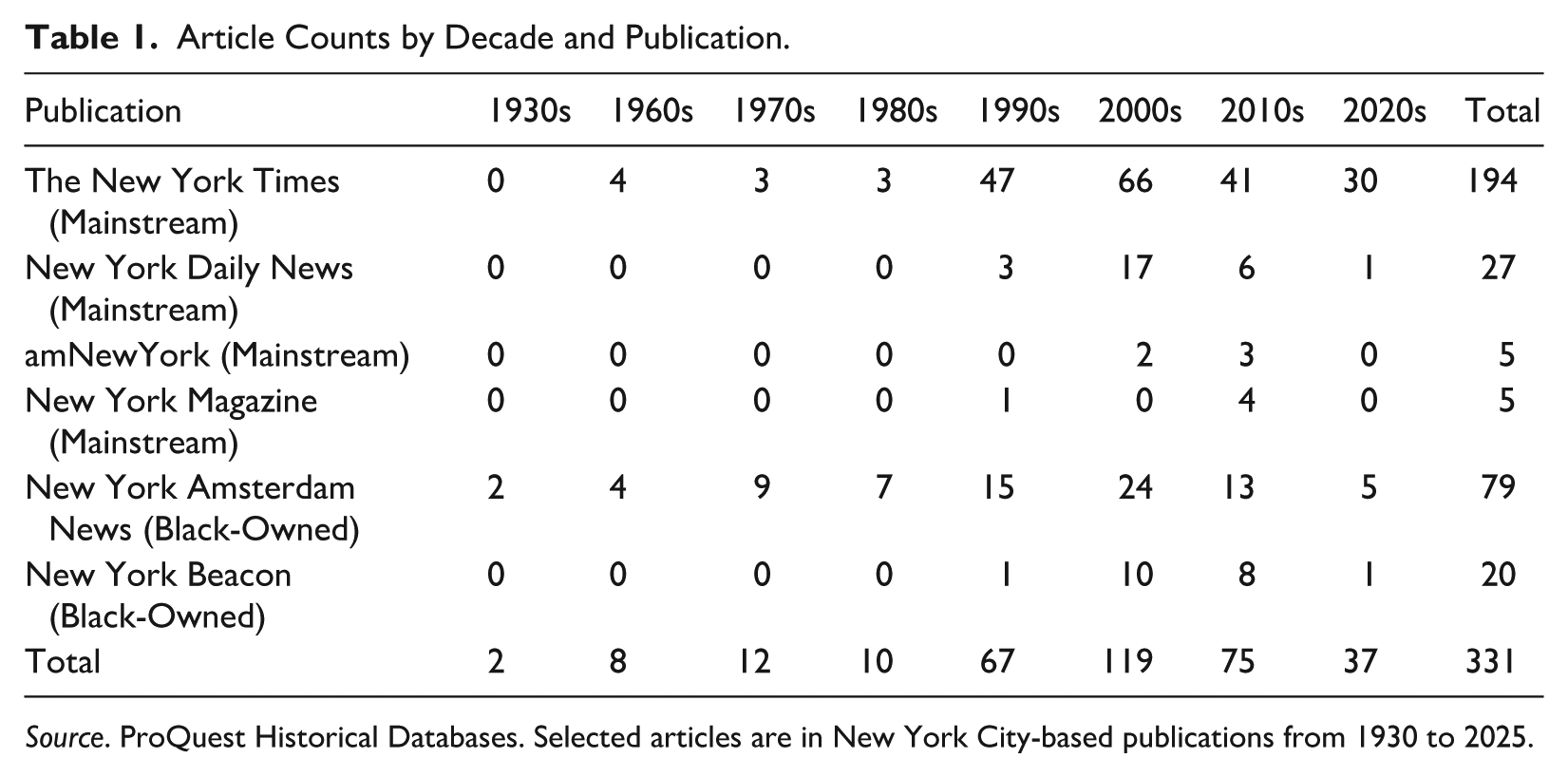
Source. ProQuest Historical Databases. Selected articles are in New York City-based publications from 1930 to 2025.
Mainstream publications produce the bulk of coverage. The New York Times (NYT) alone accounts for nearly 60 percent of all articles (n = 194), reflecting both its greater archival volume relative to all other publications and its singularity as a local newspaper with a global circulation. This dominance indexes the institutional centrality of the mainstream press, and particularly the NYT, in defining the city’s symbolic geography. The discrepancy in volume also reflects structural and institutional differences between the outlets. Black-owned outlets, including the New York Amsterdam News and New York Beacon, operate with smaller circulations and a community orientation, publishing coverage of events and issues of particular relevance to Black New Yorkers. Differences in institutional capacity and intended readership therefore shape both the scale and focus of reporting. I interpret these contrasts as indicators of the distinct functions that each media type performs in narrating Harlem’s social landscape.
Yet, as the table shows, Black-owned media were far ahead of the mainstream media in documenting the Senegalese presence in Harlem. The largest Black-owned publication, the New York Amsterdam News (NYAN; n = 79), began mentioning the Senegalese community and Le Petit Sénégal in the 1930s, many decades before comparable attention appeared in the NYT. The coverage in NYAN peaked in the 1990s and 2000s, maintaining consistent attention into the new century even as mainstream mentions of the community waned. Black-owned outlets, although far outpaced in volume, appear more attuned to everyday shifts in Harlem’s Black demography, whereas mainstream coverage surged only when Le Petit Sénégal was large enough to warrant wider attention.
The dataset also includes a range of article types. The majority are feature articles (n = 181), followed by event coverage (n = 75), reviews (n = 43), and a smaller number of opinion pieces (n = 7), news reports (n = 11), obituaries (n = 5), and other formats, including interviews, classifieds, and series columns. The genres reflect different frames and show how portrayals of Le Petit Sénégal emerge through both explicit commentary and other types of writing, such as everyday reporting or reviews.
Analytic Strategy
I conducted qualitative analysis of the articles that substantively engage with the Senegalese presence in Harlem, as described in the previous section. Because I am interested in how media sources describe and understand this community, I adopt an inductive interpretive strategy and approach this dataset as a corpus of narratives.
My analytic approach occurred on two levels. First, I identified recurring themes through which the relationship between Harlem and Le Petit Sénégal are narrated. Second, I examined how the same theme or domain is differently encoded across outlet types. To identify the themes of focus, I followed an abductive approach (Timmermans and Tavory 2012), where I iteratively moved between empirical observation of the textual data and analysis. I began by organizing all documents into types and years. Then, I constructed a random subset of 50 articles sampled by article type, media source, and decade. For each of these articles, I wrote a brief descriptive memo that, as relevant, identified how the Senegalese community was narrated and how Harlem at large was described. These initial readings and memos sensitized me to recurring patterns relating to migration, race, and the neighborhood. As themes began to coalesce in this initial subset, I wrote more in-depth analytic memos to define these emergent themes.
From these provisional patterns, I developed a thematically structured codebook, which I then applied to the full sample. As I read the full sample, I revised and expanded codes as new themes emerged, while continuing to write analytic memos to capture insights and trace patterns across texts as I reviewed more articles. As I revised the codebook, I returned to earlier articles and coded them again to ensure that I was engaging fully with the entire corpus. Throughout, I read each article for what was said explicitly, what was omitted, and how meanings may be embedded in description.
The codes I used can be organized into a few primary domains. I described how Blackness is framed and negotiated, and how Harlem overall is described, whether as a cultural capital, a declining space, a revitalized area, or a contested terrain shaped by gentrification. I also coded portrayals of the Senegalese community and of the Senegalese neighborhood (e.g. as “exotic” or “downtrodden”). Finally, I included codes that capture references to the African continent, as well as the tone of the article overall.
After an initial coding, I shifted to a comparative analysis, examining how the same themes were differently represented and interpreted across outlets. In comparing these two archives, which have different purposes and audiences, my goal was to examine how the same neighborhood may be made to have different meanings. Thus, within each coded excerpt, I paid specific attention to divergences in the representations of the same areas and events, taking these divergences as empirical evidence of different interpretative approaches.
Altogether, my approach examined the construction of the themes themselves and the implications of this construction. This is especially important for a study of media representations, where meaning extends beyond what is said to how it is framed, for whom, and with what absences or assumptions. Therefore, I approached these articles as active sites of differentiation and meaning-making inflected with different narratives about this community.
Results
Across almost a century of coverage, mainstream and Black-owned media have produced competing definitions of Le Petit Sénégal and the boundaries of Blackness within Harlem. While both sets of coverage engage with the Senegalese presence in Harlem, one marks out African immigrants as alien and exceptional while the other incorporates them into a collective Black geography.
In the following, I show how the differences observed turn on whether the Black immigrants of Le Petit Sénégal are narrated as a fragmentation or an extension of Black Harlem. I present the different portrayals across three interrelated domains: (1) the spatial and cultural construction of an enclave; (2) the moral narratives attached to its residents; and (3) the framing of intra-Black relationships. I illustrate each domain with direct quotations and close readings of representative articles from the mainstream and Black-owned media to present their competing visions of Blackness and belonging in Harlem.
An Ethnic Enclave in a Gentrifying Harlem
Mainstream media, particularly the New York Times, consistently frame Le Petit Sénégal as a bounded ethnic enclave geographically situated within Harlem but symbolically differentiated from it. This representational strategy relies heavily on sensory and aesthetic markers of foreignness. Take, for example, this 2007 New York Times feature article describing 116th Street: “Sepia-skinned women, their dresses sewn from richly colored fabric from West Africa, home still fresh in their minds . . . young men sell sweet-smelling incense . . . women with plaited hair plead in urgent West African accents” (Kankam 2007). Another from the same year notes: “As in Senegal . . . Islam is the predominant religion and French the default language, heard wafting out of hair salons and among groups of men in bright robes gathered outside the mosque on Frederick Douglass” (Lee and Lee 2007).
The cumulative effect is to present the neighborhood as a contained cultural exhibit separate from Harlem. These portrayals, with their emphasis on skin tone and culture, implicitly situate the reader as an outsider and render the African community as hypervisible and culturally distant from the reader and from the surrounding Black Harlem. This framing is reinforced through spatial metaphors that underscore separateness and containment, such as this passage from the Times:
Nine blocks away [from Le Petit Sénégal] looms the historic Apollo Theater, where busloads of tourists regularly unload for a nostalgic glimpse of Harlem’s storied days. Yet . . . a decidedly foreign feel prevails on this particular stretch of Harlem—Le Petit Senegal, as it is often called . . . (Kankam 2007)
By representing Le Petit Sénégal as a self-contained zone, the article produces a geography where the African immigrants are proximate yet separate. The juxtaposition of Harlem’s iconic Apollo Theater, a symbol of African American cultural memory, with the “decidedly foreign feel” of Le Petit Sénégal reveals the representational boundaries imposed by mainstream media.
Similarly, mainstream portrayals of Harlem itself often emphasize transformation, in line with existing research demonstrating the media’s role in justifying gentrification (Goldstein 2017; Zukin 2011). The New York Times frequently juxtaposes the vibrancy of past Black Harlem with its present-day churn of gentrification, referring, for example, to the immigrant community’s role in “reviving” Harlem’s “ravaged heart” (Waldman 2001). In such accounts, Le Petit Sénégal’s ethnic specificity is part of this revival, rather than a continuation of Harlem’s Black legacy:
In their robes and headdresses, especially on holy days, West African Muslims may be the most recognizable [newcomers]. The word has gone out: this neighborhood has cheap rents and many countrymen. “Like you have the Chinese in Chinatown . . . We would like to make this Africatown” [says one new resident] [. . .] the predominant language in south-central Harlem these days is the language of renewal. (Rozhon 2000)
Thus, immigration signals “renewal,” aligning Le Petit Sénégal with a story of improvement through gentrification. In the mainstream media, the enclave defines where Senegalese Harlem fits within the geography of Black New York, and cultural representation addresses how the practices and aesthetics of Senegalese life are made legible to those outside Harlem. In mainstream publications like the New York Times and Daily News, the culture of the Senegalese community is often marked through a lens of otherness. Descriptions of Senegalese music, clothing, or food are rich in detail, but framed for the consumption of outsiders. For example, a Daily News article characterizes Little Senegal as “an exotic, French-inflected spot where music like that of Senegalese singer Youssou N’Dour is a constant sidewalk soundtrack” (Salamone 2007), thus differentiating and distancing Senegalese Harlem from Black Harlem through coded language that aestheticizes difference and invites outsiders into the otherwise inhospitable Harlem.
Food is one particularly salient point of description. Through depictions of restaurants and “mysterious” cuisine (Burros 2008) with “intriguing secrets” (Lee and Lee 2007), Le Petit Sénégal becomes a palatable entryway into Harlem. Reviews describe the foreignness of the food in sensory and anthropological detail:
The plate can barely contain it: red snapper, stuffed with a paste of garlic, onions, peppers and parsley, on a broad stage of rice ruddy from tomato paste and primed with guedj, fermented dried fish, and yete, fermented dried sea snail, funky missives from the sea (Mishan 2016),
transforming an everyday dining establishment into a site of spectacle, while leaving the question of neighborhood belonging unanswered. This emphasis on culture and exoticization in the mainstream media reflects a broader pattern of the media’s role in creating and sustaining ethnic enclaves, often to promote gentrification (Collins 2020; Hoffman 2003; Rucks-Ahidiana 2025). The Senegalese community in Harlem, despite racial similarity to the prevailing group in the neighborhood, appears to be no exception.
In contrast to mainstream portrayals that otherize the Senegalese community as foreign and exotic, Black-owned media position the 116th Street enclave within a longer tradition of Black urban life. A 1990 New York Amsterdam News article captures this integrative vision: “Sidewalk vendors from Senegal, Ghana, and our other faraway homes in Africa, the Caribbean, Georgia, or the Carolinas, have made [Harlem] an exciting, colorful bazaar with a vast number of tempting commercial artworks” (Tapley 1990). In this telling, Senegalese vendors are positioned as participants in a collective Black geography, one that extends across Africa, the Caribbean, and the American South. The rhetorical move to describe these places as “our other faraway homes” indicates kinship. Harlem is not imagined as fragmented by ethnic enclaves but as a convergence point for a global Black identity. The language of “our” and the inclusion of Africa alongside American regions implies shared belonging, emphasizing that Le Petit Sénégal is part of Harlem’s diasporic connections, and a place where “Africa, the Caribbean, and Europe meet” (Springer 2009). Similarly, the Islam of the Senegalese community is not introduced as novel or external, but is situated within local history, as “part of the faith-based life blood that flows through Harlem” (Abdul-Salaa 2003).
Coverage in Black-owned media links West African institutions and events to the broader Black nature of Harlem. Reporting on the Africa Day Parade, for example, the Amsterdam News describes the procession as “enrich[ing] Harlem and the whole of NYC,” quoting a community leader on the parade’s purpose as: “bridge-building between new arrivals from Africa, who are beginning the process of connecting with brothers and sisters in this country [and] the Diaspora” (Misani 2008). Through event coverage, the Amsterdam News showcases West African dance and drumming as an integral part of Harlem’s culture. Indeed, West African culture is a bridge between Africa and America, and “helps us know more about ourselves” (Gilbert 1988).
The contrasting portrayals of the “enclave” constructed by mainstream and Black-owned media reflect divergent conceptualizations of belonging. Whereas the former frames Senegalese Harlem as an ethnically marked exception to the “ravaged” Harlem around it, the latter integrates it into a broader Black diaspora. Mainstream portrayals often produce an outsider gaze for an implicitly White audience, rendering the Senegalese presence as something bordered and distinct from the Black American Harlem around it. Thus, mainstream outlets enact a spatial intraracial project by encoding symbolic and material boundaries within the Black population of Harlem. Black-owned narratives, by contrast, advance a vision of the Senegalese community grounded in historical continuity and diaspora. These differences shape how Harlem is imagined and for whom.
Immigrant Vulnerability and Exceptionalism
The divergent narratives of the two media types also assign meaning and value to the residents of Le Petit Sénégal and Harlem at large. Mainstream media portrayals of Senegalese immigrants in Harlem often revolve around themes of vulnerability and exceptionalism. These outlets portray the Senegalese community as either precarious figures at risk of violence and economic marginalization or as virtuous individuals who overcome adversity. Moreover, Black immigrants’ virtue becomes visible only through contrast to presumed Black American deficiency, reinforcing distinctions between “deserving” and “undeserving” Blackness. Such distinctions obscure the broader conditions that shape Senegalese life in Harlem, including labor market segmentation and immigration policies that channel many into precarious work, deportability, racialized policing practices, and the ongoing restructuring of Harlem through gentrification. Rather than situating Senegalese experiences within these conditions, mainstream coverage frames their vulnerability and their success in cultural or individual terms. These portrayals extend the intraracial project from material to human terms by distributing value and legitimacy unevenly across Black subjects.
Coverage of violence exemplifies the portrayal of depoliticized vulnerability. In one New York Times article, titled “Invisible, and in Anguish,” the funeral of a killed Senegalese cab driver (by a young Black American woman) is described in evocative detail, as mourners spill out from the mosque, forming “a window into the tight bonds and common anguish of a little-known immigrant group whose struggle to make a better life in New York City led many of them into a dangerous profession” (Bruni 1997). Senegalese hardship thus becomes a site for reader empathy, framed through the image of this “dangerous profession,” but with neither discussion of the economic inequalities that lead this community into this profession nor the inequalities that lead to the perpetration of the crime. Instead, the article positions the Senegalese community as fearful and vulnerable to crime from their Black American neighbors, embedding a stereotype of danger within Harlem.
A similar narrative structure emerges in coverage of informal labor. In describing African hair braiders on 116th Street, the Times notes that “most spoke little English and had no formal training, and some were illegal immigrants, but they could braid hair into intricate designs that were the envy of American salon workers” (Day 2001). While the article admires their technical skill, braiding is framed as a surprising form of survival for women otherwise marked by illegitimacy, rather than situated within a long tradition of Black women’s labor or connecting it to structural exclusion from formal employment for “illegal immigrants.”
Although he was neither Senegalese nor living in Harlem, the 1999 killing of Amadou Diallo by police officers sparked a flurry of coverage of the West African community and neighborhood of Le Petit Sénégal. The mainstream press made this vulnerability legible through an ethnic lens (see Pierre 2004). A New York Times article, titled “Killing Heightens the Unease Felt by Africans in New York”, opens in a café on 116th Street (in Le Petit Sénégal) and pivots immediately to fear: “We are afraid, we are afraid,” one West African businessman says as he describes being told to go back to Africa by police officers, and the article notes, “For Africans, particularly West Africans, Mr. Diallo’s death has only reinforced the vulnerability they feel as black immigrants in New York City.” Furthermore, the article seemingly blames Diallo’s death on the “wildness” of African American culture that may have infiltrated African households: “Africans are strict disciplinarians [. . .] American children, in contrast, ‘are very wild’, and African parents must constantly battle their influence.” The piece ends on a question: “Where . . . do we go now?” (Waldman 1999), making the statement that this African community is not safe within New York City, from police violence and from the “influence” of Black American neighbors.
Even the success of the Senegalese community is defined through vulnerability to the “dangers” of the dominant Black American culture around them. Consider a profile in the New York Times of a young Senegalese man doing volunteer work to ensure his success as a college applicant:
Allassane’s classmates, many of whom were working in dead-end jobs to pay for the latest jeans and sneakers, teased him for working without pay. They accused him of acting white, and speculated that he was gay. “I wore simple shirts, small sneakers,” he said. “I can say that it paid off. All the money they used to pay for clothes to show off, now they are struggling to go to college.” Instead of playing basketball on the street, he strives for something higher. (Hartocollis 2003)
This portrayal describes Allassane’s success as the result of personal sacrifice and distance from his peers who are depicted through anti-Black stereotypes as unserious and unmotivated. Allassane’s exceptionality arises from his ability to triumph over the perceived deficiencies of his native-born Black friends.
Meanwhile, Black-owned newspapers such as the New York Amsterdam News and the New York Beacon do not frame the Senegalese community through the lens of vulnerability at all. Narratives of distinct vulnerability to violence or economic desperation are strikingly absent. In particular, there is a near absence of mentions of Amadou Diallo. While his death was covered extensively in these media sources elsewhere, he is absent from this corpus because these mentions were never about the West African community. His Blackness, not his African-ness, shaped the story and his death was part of a larger struggle between the state and Black lives, rather than something unique to the West African community in New York.
More generally, Senegalese presence is not newsworthy as crisis or spectacle in the Black press. Take, for example, the case of Amadou Ly, a Senegalese Harlem high schooler on a robotics team, who, after a surprise win over much more well-funded schools, revealed he was undocumented and could not board the flight to a national competition. This sparked wide coverage in both the mainstream press and the Black-owned press. The mainstream media primarily framed this as a story of individual achievement despite his tragic circumstances. In the Black media, however, it was framed as a story of community achievement and repair. The New York Amsterdam News tracked the student’s support from the Harlem community: “What followed was an outpouring of support . . . donations and legal advice,” culminating in his commitment to reciprocity: “this is my way of giving back.” The story ends with a call to the community to contribute to the Amadou Ly Education Fund (Anonymous 2007). While vulnerability is present, belonging and community are the main organizing lenses.
Part of this divergence stems from the different journalistic missions of these outlets. Black-owned media, such as the Amsterdam News and New York Beacon, are not structured around news reports of crime or violence, like the New York Times. Instead, they are oriented toward cultural memory and thus often refer more to community events. In this regard, Senegalese immigrants are not portrayed as vulnerable to any external forces, but rather as neighbors in the making, and maintaining, of a Black Harlem.
In the coverage of events experienced by the Senegalese community, divergent visions of the community and their context emerge. By emphasizing vulnerability, especially to the Black American Harlem, and exceptionalism, as an immigrant characteristic, the mainstream media remove agency from the Senegalese community. They are portrayed as passive recipients of admiration and concern, not political actors who must navigate racialized and nativity-based exclusion. Furthermore, this positioning relies on differentiation from Black Americans, who are portrayed as perpetuators of harm to the African community, a framing that steeps the larger neighborhood in stigma. In sharp contrast, Black-owned outlets reinforce Black collective struggle against inequalities that affect all Black people, recentering the community as agentic within a longer struggle for Black equality.
Tensions and Belonging between Black People
Both mainstream and Black-owned media acknowledge that tensions exist between African immigrants and African Americans in Harlem. These tensions are spatial and made visible on shared blocks and streets (Brown 2009). However, the way these tensions are framed and what solutions (if any) are imagined varies between the outlets. Mainstream portrayals often present strain between the communities as a result of immutable cultural difference, implicitly pathologizing African Americans while idealizing African immigrants. In contrast, Black-owned media view these frictions as the legacy of historical fragmentation, colonialism, and racism. Thus, the Black press envisions solidarity, while also acknowledging that this ideal is aspirational and unevenly realized in daily life.
A 2000 New York Times feature, for instance, notes the Senegalese are making Harlem “a community once more,” leaving open the question of what it was without them. In this, it also highlights discomfort from longtime Black residents. One resident is quoted saying, “They all group together and you don’t know what they’re talking about. That makes a division. I’m not saying it’s wrong, but it segregates them.” Another describes being “perplexed by some of the newcomers’ habits,” reinforcing a sense of cultural dissonance (Rozhon 2000).
The story juxtaposes this anxiety with praise for the immigrants’ “industriousness” and “piety” (in contrast to whom?), while it positions them as outsiders who have transformed Harlem into something new, unfamiliar, and unburdened by the negative connotations of Harlem. While the article includes gestures toward social context (mentioning the rise in West African migration, affordable rents, and gentrification pressures), it fails to contextualize or note the relationship between African immigrants and African Americans as part of a shared legacy of Blackness.
As one imam puts it, in a quote that becomes the article’s final word on the matter: “It’s probably just clashing cultures.” The Times thereby frames Black intragroup tension as an inevitable feature of neighborhood diversification, without regard to the shared race and history of the Senegalese and Black American communities. Instead, tension is naturalized, as in this 1995 piece from the New York Times, which describes Harlem as “a shabby welcome mat” for African newcomers:
Several Africans said they had been disappointed to encounter hostility from blacks in the neighborhood, reporting with bitterness that they were sometimes accused of selling the Americans’ ancestors into slavery. The Africans, in turn, lashed out at what they said was an unwillingness on the part of the Americans to work. “They make us ashamed, because they won’t work . . . When we saw American blacks on TV, we thought they were brothers . . . it’s not true.” (Nossiter 1995)
Here, the two communities are portrayed as each judging one another for uninterrogated beliefs. Rather than questioning the structural forces that produce these strained perceptions, such as the legacies of anti-Black American prejudice and the colonial mindset that serves to divide Black people, the article presents these frictions as the result of irreconcilable cultural differences. In doing so, it presents the neighborhood as a patchwork of disparate communities rather than a unified Black geography (Frazier 1948).
Tensions between Black people also appear in mainstream portrayals of the braiding economy. A New York Times feature documents disputes between African American hair braiders and newer West African shop owners. Established Black stylists describe the immigrants’ businesses as unregulated “sweatshops” and challenge their claims of “authentic” African technique. One stylist laments: “There was not any order. People had combs stuck in their mouths and in their hair. That simply is not safe” (Williams 1994). Such framing locates the issue between the Black community and describes the immigrants as disruptive to the standards and status of a racialized profession. There is no mention of shared histories of labor exclusion that lead to difficult working conditions.
By contrast, Black-owned media narrate intra-Black friction through a lens of shared struggle and potential solidarity. In these narrations, rather than depicting African immigrants and Black Americans as inherently incompatible, they treat friction as the product of disrupted diasporic ties. In line with a Pan-Africanist view (Patterson and Kelley 2000), the solution, in this framing, is not assimilation or separation, but reconnection. In one of the earliest mentions of the Senegalese in Harlem in the Amsterdam News in 1939, the article describes a visit from a Prince in Senegal to Harlem, where he states:
I should like to leave at least one thought with the American Negroes—that of solidarity, the importance of sticking together, [. . .] I am sorry to find [. . .] that American Negroes are under the impression that their African brothers do not like them and feel themselves superior. It is merely the propaganda of the white man who sees the importance of keeping the black man divided. (Chase 1939)
African voices in Harlem frequently emphasized the continuity of global Blackness that this neighborhood embodied. When a new mosque opened in Harlem, one of the leaders noted: “We want to be friends with the African-Americans. We are having our open house during Black History Month out of respect for African-Americans . . . this house is for all . . .” (Salaam 2002).
This spirit of unity appears repeatedly throughout the Black-owned media. For example, in the Amsterdam News, one columnist emphasized a common ethos at a “Day of Action” event in Harlem: “to form a united front of African people across the world . . . [one speaker noted] ‘We are one people. Our struggles are woven together’” (Farad 2011), underscoring a diasporic ethos that links Harlem’s Black communities to a common ancestral homeland. This emphasis on Africa as a symbolic point of return, and source of cultural pride, appears across coverage in Black-owned media. For example, when Senegalese president Macky Sall visited Harlem in 2012, the Amsterdam News portrayed the event not just as a moment of diplomatic recognition, but as a reunion and “return” (Anonymous 2012). Black American elected officials and community leaders and residents of all Black ethnicities turned out in celebration, treating his presence as a meaningful affirmation of diasporic belonging that included African Americans.
But this diasporic embrace of Africa also carries tensions of its own. While Pan-Africanism in the Black press powerfully counters dominant narratives of irreconcilable difference, it can also abstract “Africa” into a symbol of origins or moral clarity, rather than addressing the concrete, lived relationships between African Americans and African immigrants in the present in Harlem. Thus, even in its counter-hegemonic work, Black-owned media can sometimes mirror the gaps they seek to redress. African immigrants are celebrated most visibly when they are linked to events with continental or spiritual significance, such as visits from African heads of state or Pan-African cultural festivals. Less attention is paid to the everyday experiences of social distance in Harlem. In elevating Africa as an ancestral homeland and moral center, the Black-owned outlets create an alternative to the pathologizing narratives of mainstream outlets. Yet in doing so, they also sidestep the more difficult task of articulating what solidarity across difference actually looks like.
Still, a review of the film Little Senegal in the Amsterdam News offers a revealing counterpoint. The article, titled “A clash of cultures, played out on Harlem’s 116th street,” does not shy away from depicting the “indifference and incomprehension” between African immigrants and African Americans in Harlem, noting the ways that cultural divides, language barriers, and mutual misrecognitions manifest in daily life. But rather than framing these rifts as permanent or pathological, the review positions the film’s narrative as a hopeful allegory. The movie follows a fictional Senegalese man retracing the transatlantic routes of slavery in reverse from Goree Island to Harlem in a bid to reconnect with descendants of the enslaved. His journey is cast as a narrative of return and recognition, suggesting that while present-day disconnection exists, it is neither fixed nor inevitable (Herpich 2004).
Discussion and Conclusion
As Black immigration transforms Black American neighborhoods across the United States, what role do the media play in the relationships between the new neighbors? This side-by-side reading of mainstream and Black-owned offers an answer: mainstream media partition Black space through contrast while Black-owned media extend it through kinship and bridge-building. As news institutions classify an area, they also have the power to classify, and rank, the people within it. Through their institutional capacity to name and describe, media operate as an instrument of intraracial formation at the local scale, intervening in the relationship between demographic change and the boundaries of Blackness. The routine descriptive choices that various media sources make are constitutive of the meanings of Black space and the relationships between the people within it.
The stakes of this intraracial formation are material. Both sets of portrayals of Le Petit Sénégal emerge against the backdrop of a gentrifying Harlem. In describing Le Petit Sénégal, mainstream outlets focus on sensory markers and touristic language, thus rendering the immigrant community an appealing entryway into Harlem for gentrifiers (Zukin 1987). Black-owned media, however, present gentrification as an existential crisis for all Black residents of Harlem. This relatively new Black population is not portrayed as an intrusion, but as a partner in the collective resistance against the presumed White gentrifier.
Harlem and Le Petit Sénégal provide an analytically rich site for examining the role of media representation on the boundaries of Blackness. The setting also offers methodological advantages. Because Harlem and its areas have been extensively documented, the media archive is uniquely deep and continuous. Few other settings provide such an extended record of major mainstream outlets alongside long-running Black-owned newspapers. But the very prominence of Harlem also poses analytic challenges. Its unique role in the American imagination of Black urban life may amplify the observed divergences. The mainstream press’s investment in rendering Harlem legible to outsiders and the Black press’s investment in defending its meaning for insiders may both be heightened because of the neighborhood’s symbolic weight. Where Black immigrant neighborhoods are in less symbolically laden settings, or where the Black press is weaker, the gap between Black and mainstream outlets may be narrower or take different forms. Furthermore, this study relies on one immigrant community: the Senegalese in New York City. In the case of Caribbean immigrants and other African communities (that differ in religion, language, socioeconomic status, and mode of entry), results may differ.
A focus on the media, moreover, privileges the discursive life of a neighborhood over other media forms and lived experiences. Television, radio, or social media portrayals may engage in boundary-making in ways that diverge from traditional print media. Future research should consider these additional arenas. Newspaper archives also cannot fully account for how residents themselves experience or respond to these meanings produced about their neighborhood. Interview-based research can examine these dynamics.
These limitations notwithstanding, I show how boundaries between Black people are reified or contested through the discursive power of different media sources. Where mainstream outlets frame Blackness as fragmented by immigrant difference, Black-owned media frame it as diasporic and expansive. Each framing is a competing intraracial project, carrying consequences for how communities relate and how neighborhoods change. Yet mainstream and Black-owned outlets are not on equal footing, differing in reach, resources, and whose narratives are treated as authoritative. As Black-owned media construct a capacious vision of Harlem’s Blackness, that vision circulates primarily within the community it describes. The mainstream intraracial project that partitions and implicitly hierarchizes is the one most likely to shape how Harlem and its residents are perceived by the city and the nation. Disrupting the perceived hierarchies within Blackness, then, requires attention not only to how Black neighborhoods and Black people are represented, but also to the institutions that make those narratives heard.
Footnotes
Acknowledgements
I thank Jasmine Hill, Kimya Loder, and the participants of the session “The Structures and Institutions That Shape Place-Making” at the 2025 American Sociological Association Annual Meeting for helpful comments that have improved this paper.

Funding
The author received no financial support for the research, authorship, and/or publication of this article.
Declaration of Conflicting Interests
The author declared no potential conflicts of interest with respect to the research, authorship, and/or publication of this article.